by Legislative Media | Apr 10, 2007 | Politics
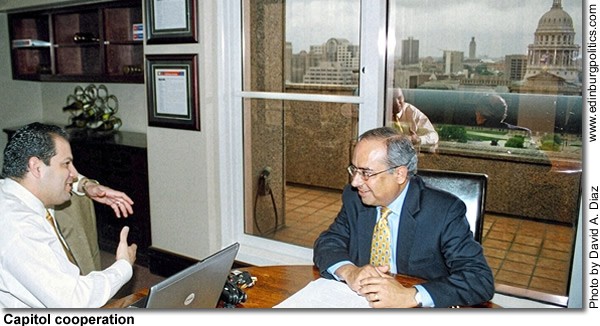
Hidalgo County Judge J.D. Salinas, left, and Maverick County Judge José Aranda have been working in Austin on state transportation issues of mutual concern to the Texas Border Coalition, which is an allliance of elected leaders and economic development officials from the 14 Texas counties that border Mexico. One of those issues, the possible development of a light passenger rail system for the border region, has been approved by a major House committee and could be set for debate by the full House of Representatives as early as Thursday. See related story later in this posting.
••••••

On Saturday, April 28 at 11 a.m., the Edinburg Chamber of Commerce, City of Edinburg, Hecho en Tejas and the Dustin Michael Sekula Memorial Library in Edinburg will host the first Edinburg Books and Brunch Series at the new library, located at 1906 South Closner. Sponsoring the event is Corrina’s Tea Room. The Books and Brunch Series is the first of future literary events to come and will include readings, book signings, coffee, sandwiches and deserts. The first series features writers Dagoberto Gilb, Erasmo Guerra and special guest Dr. Rene Saldaña and is free to the public.Dagoberto Gilb, an award-winning fiction writer (Woodcuts of Women) is the editor of Hecho en Tejas. As part of the Rio Grande Valley book tour, he will be doing several readings throughout the Valley. Hecho en Tejas is an anthology of Texas-Mexican authors dating back to the days of the Spanish explorers. The book’s comprehensive sweep includes ballads and corridos, poetry, essays, short stories, letters, photographs, novel excerpts and political declarations such as Juan Nepamuceno Cortina’s 1859 proclamation declaring the establishment of the Republic of the Rio Grande. The anthology is published by The Southwestern Writers Collection (SWWC) at Texas State University-San Marcos. For more information please call Evana Vleck at 383-4974.
••••••
More Valley lawmakers get on board in support of border light rail plan proposed by Rep. Martínez
By DAVID A. DÍAZ
State Rep. Verónica Gonzáles, D-McAllen, and Rep. Ryan Guillen, D-Rio Grande City, have added their support for a far-reaching plan by Rep. Armando “Mando” Martínez, D-Weslaco – contained in his House Bill 2510 – that could eventually lead to the creation of light rail systems along the Texas-Mexico border.
In general, a light rail system uses special trains designed for urban travel, with capacities of up to 250 passengers per train, along with a bus system, to transport people and luggage while avoiding traffic congestion and other bottlenecks associated with larger population centers.
“HB 2510 will allow the citizens of Hidalgo County, along with the counties that border Mexico, to address one of the issues that results from growth – transportation,” Martínez said.”As our areas grow, so will the need for alternative forms of transportation. My bill, HB 2510, addresses this issue. With a population of over 1.4 million in the Rio Grande Valley, a light rail system will prove to be an invaluable form of transportation.”
Although Martínez envisions a light rail system to link the major cities in the Lower Rio Grande Valley, he said he wrote the legislation to allow any of the 14 Texas counties that border Mexico to be able to set up their own versions of light rail.
Gonzáles and Guillen recently added their names as joint authors to Martínez’ House Bill 2510 that would create a light rail district to study, and if necessary, adopt the rules to create and establish a light rail system in the border region.
“I applaud and thank Representatives Verónica Gonzáles and Ryan Guiilen for joint authoring HB 2510. Together, we will make light rail a reality in the Rio Grande Valley,” he said. “Additionally, I want to thank Hidalgo County Judge J.D. Salinas and the entire Hidalgo County Commissioners’ Court for providing a resolution in support for HB 2510. This resolution was very important to the members of the Transportation Committee.”
In addition, according to Scott Jenkines, Martínez’ legislative chief-of-staff at the State Capitol, Sen. Juan “Chuy” Hinojosa, D-McAllen, has agreed to carry the measure in the Senate.
The Martínez/Gonzáles /Guillen measure is on a fast track, receiving unanimous approval from the House Transportation Committee on Tuesday, April 3. It could be set for action by the full House as early as Thursday, April 13.
If eventually approved by the Texas Legislature and supported by Gov. Rick Perry, HB 2510 would provide the legal authority for any border county to set up the creation, administration, powers, duties, operations, and financing of a commuter rail district, including granting the authority to issue bonds and granting the power of eminent domain.
The new governmental entity would not need voter approval to be created; however, any financing plan that would involve the use of local property taxes would require the approval of the majority of voters in a county-wide election.
According to a bill analysis of the measure provided by the House Transportation Committee, which held the public hearing on the bill, a light rail passenger district could provide a new option for border leaders grappling with increasing motor vehicle traffic congestion and the many related problems.
“The Border Region, especially the Rio Grande Valley, is one of the fastest growing areas in Texas as well as the entire United States,” the bill analysis noted. “As populations grow, so do transportation needs. To address the growing transportation needs and associated problems, alternative forms of transportation need to be studied. If deemed feasible and acceptable, such alternative forms of transportation should be considered for implementation.”
Martínez had earlier predicted legislative support by the transportation panel.
“I am very pleased that the Transportation Committee unanimously voted out HB 2510 and sent it to the Committee on Local and Consent Calendars,” Martínez said.”I appreciate Chairperson Mike Krusee’s, and the remaining eight members’, support of my light rail bill.”
••••••
CHIP expansion sought by Texas BorderCoalition receives final approval by Houseof Representatives
By DAVID A. DÍAZ
An additional 100,000 children in Texas by 2009 could be added to the crucial Children’s Health Insurance Program, known as CHIP, following overwhelming approval by the House of Representatives on Tuesday, April 3, of House Bill 109, which is supported by the Texas Border Coalition.
TBC is an alliance of elected officials and economic development leaders from the 14 Texas counties which border Mexico. They represent an estimated 2.1 million residents.
HB 109 cleared third and final reading Tuesday evening on a 126 – 16 vote, and will be picked up in the Senate by Sen. Leticia Van de Putte, D-San Antonio. Rep. Sylvester Turner, D-Houston, who also is the House Speaker Pro Tempore – second in command – was the principal author of the legislation.
The legislation features key priorities for the Texas Border Coalition, including making it easier for working families to purchase the affordable and comprehensive health insurance protections offered by CHIP, which is administered by the state.
“Common sense policies – like reducing paperwork, deducting child care costs when determining eligibility and not counting families’ savings against them – will ensure that more of our children receive health care,” said Rep. Verónica Gonzáles, D-McAllen, one of the many co-authors of HB 109.
El Paso County Attorney José R. Rodríguez, chair of the TBC Healthcare Committee, said the organization was in strong support of the HB 109 because it would move “more kids into insurance, saves local tax dollars, helps education and improves our state’s economy.
“People without health insurance are very likely to obtain their medical care from an emergency room,” Rodriguez added. “In fact, uninsured children are five times more likely than insured children to use the emergency room as their primary source for medical care.”
Rep. Aaron Peña, D-Edinburg, was one of the five primary joint-authors of the legislation and was a key negotiator in ensuring that more children became eligible to receive healthcare under the program.
“The legislation will allow children to receive continuance coverage for a year at a time rather than having to re-qualify every six months. It eliminates a 90-day waiting period for coverage to begin and makes it easier for families to enroll their children for services,” Peña said.
Turner hailed the House passage as a sign of bipartisanship by both political parties.
“Today was a victory for the working poor. The House has shown its support for ensuring the well-being of our children and it’s now up to the Senate to do the same,” said Turner. “All the time and effort that went into drafting this legislation and working on a bi-partisan compromise with Chairman John Davis, Chairman Patrick Rose, and my fellow joint authors, has always been about the children.”
HB 109 addresses key policy changes to the current Children’s Health Insurance Program (CHIP) which will insure approximately 102,224 qualified children per month in Texas by the end of fiscal year 2009.
Turner allowed the bill to stay true to its original intent by keeping the provisions that extend the period of eligibility to twelve months and eliminate a 90-day waiting period for children not previously covered by some type of insurance. As passed, HB 109 protects taxpayers by maintaining and revising the asset and verification tests to increase the limit of allowable liquid assets and vehicle amounts.
Rodríguez provided details on how the border region would be impacted.
According to the Comptroller, in 2005, Texas’ border Metropolitan Statistical Areas (El Paso, McAllen-Edinburg-Mission, Brownsville-Harlingen-San Benito and Laredo) had about 11 percent of all uninsured Texans, or more than 600,000, he said.
“Three of these MSAs – Laredo, El Paso and Brownsville-Harlingen-San Benito – had the highest rates of uninsured among all Texas counties, at 36, 33.2 and 32.4 percent respectively,” Rodríguez said. “The Corpus Christi and McAllen-Edinburg-Mission MSAs were not far behind, with uninsured rates of 28.3 and 27.8 percent respectively.”
From September, 2003, to February, 2007, enrollment in CHIP declined statewide from 507,259 to 325,479. For the same period, along the 14-county border, enrollment declined from 80,958 to 48,084; that is, 32,874 children of working families along the border lost their CHIP benefits, he noted.
Insurance coverage is critical to the education of Texas children, Rodríguez contended.
“Children without health insurance are 25% more likely to miss school because of illnesses, and school districts in Texas lose millions per day because of absenteeism,” he said.
“Employee productivity also increases with insurance coverage because working parents need to take less time from work for their sick children. CHIP is also good for Texas business; a 2003 report by the Perryman Group noted that the program contributes $1.4 billion in Gross State Product and supports 22,562 jobs,” Rodríguez added.
The Texas Border Coalition maintains a web site at http://www.texasbordercoalition.org.
••••••
Sen. Hinojosa counters McAllen Monitor’s editorial; he says CHIP is a government program that works
By SEN. JUAN “CHUY” HINOJOSA
The newspaper editorial by the McAllen Monitor entitled “Privatization works, even if firms don’t,” suggested that the spectacular failure of a politically connected corporation to meet its obligations under a taxpayer-funded state contract to enroll eligible families in social service programs such as CHIP should not be taken as a failure of privatization itself.
Perhaps you also agree with the Houston-area lawmaker who huffed that his family never had insurance when he was growing up so why should anyone else need it.
I don’t agree. The Children’s Health Insurance Program (CHIP) was passed by a bipartisan Legislature and signed into law by a Republican governor because it is that rarest of government programs — one that works. To qualify, families must have jobs but earn too little to afford private health coverage for their children.
For every $1 Texas spends to fund the program, the federal government kicks in $2.60. And local taxpayers no longer have to foot the bill for uninsured children whose families take them to hospital emergency rooms for routine medical care.
In other words, CHIP is government at its best — a little extra help for those who are working hard and paying their taxes. The bottom line of any business is making a profit — period. The bottom line of government should be serving its constituents in a fair and transparent way that is both humane and worthy of the people who it serves.
Competition is good, especially if it makes vital public programs like CHIP more effective and efficient. Privatization for the sake of shifting tax dollars to political cronies makes no financial or moral sense, and it weakens accountability. This notion that government can be run like a business sounds good until you find out that the business some politicians have in mind is Enron or Halliburton. It should also be noted that Accenture is incorporated in Bermuda where it does not have to pay U.S. taxes.
••••••
Planned shopping center in Edinburg lands JCPenney as a major anchor
By DAVID A. DÍAZ
Edinburg and its planned shopping center have landed JCPenney, one of the country’s largest department store retailers, which has selected the three-time All-America City to be part of a 150 store nationwide expansion that began last fall.
The announcement by First Hartford Realty of Manchester, Connecticut, which is developing The Shoppes at Rio Grande Valley, will reportedly result in the construction of a 104,000-square-foot JCPenney retail structure, the first of as many as two dozen stores that will eventually be part of the projected $80 million complex.
The Shoppes at Rio Grande Valley, which is scheduled to be built in stages over the next three years, is located on about 130 acres of currently vacant fields in south-central Edinburg.
The shopping center is bordered by U.S. Expressway 281 and Business 281 to its east and west, respectively, with Trenton Road serving as its southern border.
Ramiro Garza, executive director of the Edinburg Economic Development Corporation, said details on the groundbreaking schedule for the new JCPenney store will be announced later this spring by company and shopping center officials.
However, the news that JC Penney has chosen the Edinburg shopping center is expected to help land other high-quality stores, he said,
“Eventually, the shopping center could result in 800,000-square-feet of retail space, create up to 1,300 jobs, and have a $90 million annual economic impact on the city,” Garza added.
But for now, the addition of a local JC Penney introduces the company’s newest style of store, known as the off-mall concept, to deep South Texas.
According to a JCPenney announcement last October, Mryon E. (Mike) Ullman, III, JCPenney chairman and chief executive officer, explained the retail giant’s expansion plans, including the use of the off-mall stores, by the Plano, Texas-based national corporation.
The announcement continued:
“There is growing demand for JCPenney stores in markets across the country. We are addressing this by launching the most aggressive store opening program in more than 25 years, which will allow us to offer our customers even more access to style and quality at smart prices,” said Ullman.
Fueled by the success of its new off-mall format, continued improvement in operating results and strong free cash flow, JCPenney previously announced that it expects to open at least 50 stores per year from 2007 through 2009. Eighty percent to 90 percent of the new JCPenney stores, including 17 of the 20 opening Oct. 6, will adopt the off-mall format, although the company continues to pursue opportunities to acquire mall stores in attractive locations. The company currently has 25 stores open in the off-mall design.
The off-mall format, covering approximately 100,000 square feet on a single level, features wider aisles, new lighting designs and concentrated customer service centers. The new store layout helps shoppers easily locate major brands such as The Original Arizona Jean Company, Chris Madden for JCPenney Home Collection, nicole by Nicole Miller, SouthPole, Worthington, Stafford, Bisou-Bisou, Oshkosh, Nike and more.
“Our off-mall stores have exceeded our expectations, generating higher sales per square foot than our mall-based stores and more frequent visits by customers,” continued Ullman. “We have a unique advantage in that our off-mall department stores provide a neighborhood presence that offers convenience and accessibility for mid-week shopping, while complementing our mall stores which continue to be a weekend and holiday shopping destination.”
J. C. Penney Corporation, Inc., the wholly owned operating subsidiary of J. C. Penney Company, Inc., is one of America’s largest department store, catalog, and e-commerce retailers, employing approximately 151,000 associates. As of July 29, 2006, J. C. Penney Corporation, Inc. operated 1,021 JCPenney department stores throughout the United States and Puerto Rico. JCPenney is the nation’s largest catalog merchant of general merchandise, and jcp.com is one of the largest apparel and home furnishings sites on the Internet.
••••••
El Paso state senator invokes Jesus Christ in chastising GOP cuts in health programs
By DAVID A. DÍAZ
On the eve of Good Friday, one of the most solemn days in Christianity, Sen. Elliot Shapleigh, D-El Paso, condemned Republican efforts to cut state taxes at the expense of the poor, invoking the teachings of Jesus Christ to demonize the GOP as the heartless party of the rich.
His essay, featured on his political website, http://www.Shapleigh.org, was released at noon on Thursday, April 5, soon after the Legislature had adjourned for spring break and Easter.
No reaction had been developed by Republican leaders as of this article’s deadline for publication.
In his essay on his political website, which was e-mailed April 5 to key media outlets and community leaders statewide, Shapleigh was unforgiving in his judgment of the Republican-controlled Texas Legislature, especially in how the GOP leadership decides to use a multi-billion dollar state budget surplus.
His comments come as a long-standing lawsuit, Frew v. Hawkins, seeking more money to provide health care to poor children comes to a conclusion on April 13
“With a $14.3 billion surplus, what would Jesus do about Frew?” Shapleigh asked. “Throughout the Bible, from Ecclesiastes to Matthew, Jesus teaches us to defend those who are defenseless. Instead, in an 8-6 vote, 7 Republicans and 1 Democrat voted to rob Peter to pay poorer Paul, all to keep tax cuts tucked away for the wealthy.”
Shapleigh declined to identify the Democrat by name.
His website posting laying out his contentions follows verbatim:
By SEN. ELLIOT SHAPLEIGH D-El Paso
What would Jesus do about Frew?
Frew v. Hawkins, of course, is the lawsuit by low-income Texans wanting to fully fund basic medical services for poor children in Texas. Frew was filed in 1993 after years of funding allegedly so low as to violate basic Constitutional guarantees.
During a session when a lawmaker wants to introduce the Bible into classrooms and “In God We Trust” is permanently displayed in the Senate Chamber, we need to ask what would Jesus do about Frew.
So, what would Jesus do?
For decades, conservatives in Austin have cut and cut again basic health care services. As a result, Texas covers fewer Texas children with health care than any state in America. After 13 years of litigation, Susan Zinn, the activist attorney who filed the suit has won. The Frew case has a final hearing on April 12.
Last Friday (March 30), in the Senate Finance Committee, a rider was introduced by Sen. Robert Duncan (R-Lubbock) to take whatever funds the Frew case costs the state from existing funds spent on Medicaid and CHIP. In other words, he wants to rob poor Paul to pay poorer Peter. Why? The reason, of course, is tax cuts.
“[I]f the [Frew] decision requires additional spending when the Legislature is not in session, we’re going to stay within the four corners of the appropriations bill, and we’re not going to the rainy day fund to pay for it,” said Sen. Steve Ogden, R-Bryan, the Senate Finance Committee chairman, on passage of the rider.
Of course, the “rainy day fund” is $8.5 billion in tax cuts tucked safely away in the House version of the budget for 2010-2011, right when Republicans run in their primaries.
These tax cuts are not for you and me; they are for people who make over $85,000. In fact, 95% of all the tax cuts will go to people who make $85,000 or more.
So, the moral choice in the Frew rider is to rob poor Peter to pay poorer Paul, so more of your tax money can go to millionaires.
With a $14.3 billion surplus, what would Jesus do about Frew? Throughout the Bible, from Ecclesiastes to Matthew, Jesus teaches us to defend those who are defenseless.
As Jesus said in Proverbs 22:16, “He who oppresses the poor to increase his wealth and he who gives gifts to the rich—-both come to poverty.”
In Proverbs, Jesus continued, “Speak up for those who cannot speak for themselves, for the rights of all who are destitute. Speak up and judge fairly; defend the rights of the poor and needy.”
Over the course of American history, caring for the poor has been a core value.
After the Civil War, Abraham Lincoln made caring for widows and orphans in poverty a priority. Franklin D. Roosevelt, the author of Social Security, said following the Great Depression, “These unhappy times call for the building of plans that build from the bottom up and not from the top down, that put their faith once more in the forgotten man at the bottom of the economic pyramid.”
Later, John F. Kennedy cautioned, “If a free society cannot help the many who are poor, it cannot save the few who are rich.”
Today, when we look into our heart of hearts, Texans know that our first responsibility is to take care of the most vulnerable among us—to defend the rights of the poor and needy.
We are a government of people, by people, for people. We should take care of kids.
Instead, in an 8-6 vote, 7 Republicans and 1 Democrat voted to rob Peter to pay poorer Paul, all to keep tax cuts tucked away for the wealthy.
Do you believe that is what Jesus would do with Frew?
Keep the Faith!
••••••
House Democrats pass restoration of health insurance for 100,000 children
By KEVIN VICKERS
House Democrats successfully passed a bill today that will restore 102,000 children to the rolls of the Children’s Health Insurance Program (CHIP). The CHIP program was slashed by the Republican leadership in the 2003 legislative session. Shortly thereafter, 250,000 children lost their health insurance coverage.
“The reason this bill passed today is because Democrats across the state pointed out the heartless and immoral nature of the 2003 cuts and we have kept that issue alive ever since,” said Rep. Garnet Coleman, D-Houston. “After the Republican leadership took two steps backward and slashed children’s health insurance in 2003, Democrats fought hard to make sure that we took one step forward today.”
The House Democrats were disappointed that amendments to the bill to make it more comprehensive – in particular one that would have fully restored the 250,000 children to the program – were rejected.
“Fully restoring the cuts made to CHIP and expanding coverage that thousands of more Texas children could receive health coverage is the best public policy we could have advanced with this legislation,” Coleman said. “But at the end of the day, I’m a progressive, and I believe in progress, so I was proud to vote for the bill and restore CHIP coverage for 102,000 Texas children.”
Other amendments offered would have repealed the assets test and other restrictive policies that prevent children from receiving health coverage for CHIP.
“Repealing the assets test would have ensured we don’t punish families for something as simple as saving money for college,” House Democratic Leader Jim Dunnam, D-Waco said. “Our work to fully restore CHIP isn’t finished, but we’ve taken an important first step with today’s passage of HB 109.”
Another amendment would have ensured that the dental benefits package provided through CHIP would cover anesthesia.
“Our children shouldn’t have to suffer through a painful procedure because the state is too cheap to pay for the anesthesia,” Rep. Pete Gallego, D-Alpine said. “My hope is that, when the bill goes to the Senate, Governor Dewhurst will add the anesthesia coverage and maintain the other important restorations within the legislation.”
House Democrats pledged to keep the pressure on as the bill arrives in the Senate. Just as the Democrats have been successful in calling attention to the CHIP issue, the House Democratic leaders said they were hopeful that the bill will improve in the Senate and be signed as soon as possible by the governor.
“Democrats want to do a lot more to help our children, and we have a long way to go to deliver a government whose priorities are in line with the people of this great state,” said Dunnam. “But today is a good day and I am proud of the work my colleagues and I have done to protect the children of Texas.”
••••••
Rep. Peña: Alarming trend in copper theft addressed by Texas House of Representatives
By ORLANDO SALINAS
The Texas House of Representatives on Wednesday, April 4, unanimously approved House Bill 1766 by Rep. Aaron Peña, Jr., D-Edinburg, that would increase the penalty for theft of aluminum, bronze, and copper wiring.
HB 1766 would increase the penalties for the theft of insulated or noninsulated wire or cable that was at least 50 percent aluminum, bronze, or copper and worth up to $1,500. Penalties would increase from misdemeanors to a state jail felony.
As the price of those metals has increased so has there been a global crisis in the theft of items comprised of those materials, the Valley legislator said.
“Aluminum, bronze, and copper wiring are commonly used by municipalities, electric utilities, railroads and telecommunications companies to provide vital services,” said Peña. “Perpetrators are hauling off hundreds of dollars worth of wiring, causing thousands of dollars worth of repairs, lost productivity and commerce but of most concern are the issues of public safety.”
The Department of Homeland Security has reported that the theft of copper has degraded the electric power grid’s reliability, causing outages affecting thousands of customers. The theft of downed power lines and grounding cables following major storms has also hindered recovery efforts in some states.
At least seven individuals were electrocuted last year while attempting to steal copper wire from electric power generation or substation facilities.
“Current Texas law provides penalties for theft that generally vary by the value of the item stolen,” said Peña. “The theft of a train signal wire has a significant business cost but it can lead to deadly accidents and derailments. In these cases the punishment didn’t fit the crime. This law aims to change that and send a message that stealing wire isn’t worth it.”
Home owners, builders and small businesses have also shared their frustrations with the theft of wires from construction and building sites.
••••••
Senate passes child passenger safety bill being carried by Sen. Zaffirini
By NICK ALMANZA
The Texas Senate on Wednesday, April 4, passed Senate Bill 60 by Sen. Judith Zaffirini, D-Laredo, which would strengthen current child passenger safety protections.
The bill requires that children 7 years and younger, unless they are four-feet nine-inches tall, be secured in a child passenger safety seat while riding in a motor vehicle.
“This is a bill that will save lives, preclude tragedies and injuries and qualify Texas for $3.2 million in federal funds while saving the state $17 million in health care expenditures.” Zaffirini said. “Each year more than 1,600 children die in vehicular accidents, which is the leading cause of unintentional, injury-related death among children 14 years and younger. SB 60 will strengthen Texas child passenger safety laws and ensure a greater level of public safety.”
In 2005 the Texas Legislature directed the Texas Department of Public Safety Committee on Child Passenger Safety to examine the need for a booster seat law in Texas. The committee advised Texas to pass a law based on national recommendations. SB 60 reflects the committee’s recommended language.
The DPS Child Passenger Safety Committee determined that SB 60 would reduce Texas health care expenditures by more than $17 million and that that an average $30 booster seat generates $2,000 in cost benefit savings. What’s more, by raising child passenger safety standards, Texas also will be eligible for $3.2 million in federal transportation grants each year from 2008 to 2009.
Current law requires only children who are younger than five and shorter than 36 inches be secured properly in child-passenger safety seats during the operation of a vehicle. Children between the ages of five and eight and who are between 36 and 57 inches represent an age group that is at great risk of death or severe injury due to the gap in current law. SB 60 will eliminate this gap and strengthen current child passenger safety protections.
Originally SB 60, as recommended unanimously by the Senate Committee on Transportation and Homeland Security, included a four-month temporary grace period to inform Texas drivers about this new measure and a fine for non-compliance between $100 and $200.
Zaffirini on April 4 amended the bill to extend the warning period from four months to one year and reduce the penalty to $25, instead of up to $200.
“I amended SB 60 because we want to educate parents about the importance of booster seats and child passenger safety, not punish them,” she said. “A one year grace period will allow the state to inform more families and increase the impact this bill will have on public safety.”
The bill must be passed by the House of Representative before it can be sent to Gov. Rick Perry for final approval. The continued progress of this and all bills authored by Zaffirini can be monitored via the Internet at http://www.zaffirini.senate.state.tx.us or by contacting the Texas Legislative Reference Library’s toll free in-state hotline, 1-877-824-7038.
••••••
Gov. Perry urges Legislature to keep transportation projects on track
Gov. Rick Perry on Tuesday, April 3 encouraged the Legislature to support the state’s current transportation system and to ensure vital transportation projects continue as planned. The governor was joined by U.S. Secretary of Transportation Mary Peters and Dr. H. K. Park, executive vice president and general manager for Samsung Hard Disk Drive, at the Samsung Austin Semiconductor expansion site currently under construction.
“Our message today is that building needed infrastructure is essential to creating jobs and attracting economic development investments in Texas,” Perry said. “And you can’t accomplish that with a two-year moratorium on needed road projects.”
During the remainder of the session as the Legislature debates critical issues affecting Texas, Perry encouraged the Legislature to consider the successes from past sessions, highlighting key aspects of the existing transportation system. Texas is currently:
• Pouring more concrete and building more roads than any state in the nation; • Attracting multi-billion dollar investments from private partners to build needed roads now; and • Using billions of dollars advanced up front by private concessionaires to build numerous other projects in local communities.
The governor also noted that the land needed for highways will always be owned by Texas, and drivers will always have a non-tolled alternative to toll projects.
“But let no one be confused: there are no such things as freeways,” Perry said. “There are taxways and tollways, and for 50 years we have tried taxways that have been underfunded by Austin and Washington and that have left local communities choking on pollution and brimming with congestion.
••••••
Teacher pay raises, CHIP funding increases included in House state budget, says Rep. Martínez
By SCOTT JENKINES
Rep. Armando “Mando” Martínez, D-Weslaco, helped pass a statewide teacher pay raise on Thursday, April 5, as part of the votes cast during more than 18 hours of debate, and 200 amendments to Texas’ $150 billion state budget bill (House Bill 1).
Martínez voted for an amendment to increase public school employee pay.
“Ensuring that Texas’ children have access to top-notch public schools is my top priority. Our state must do everything possible to attract the best and brightest educators,” said Martínez. “I voted to provide an across-the-board pay raise for every public school teacher, counselor, librarian and school nurse because a great education begins with them.”
He noted that the House version of the state budget also included crucial funding to improve the Children’s Health Insurance Program and other measures important to young Texans.
“I support a state budget that fully funds the children’s health insurance program, improves access to higher education, strengthens our public schools and provides the necessary funds to ensure Texas children are secure now and in the future,” said Martínez. “I voted for amendments that would strengthen House Bill 1.”
The numerous amendments adopted April 5 helped alleviate some of the concerns about the initial shortcomings of the bill. Martínez voted in favor of the amended bill and will work with Sen. Juan :Chuy” Hinojosa, D-McAllen, and Sen, Eddie Lucio, D-Brownsville, as it moves through the Senate.
The House state budget bill and the version that will be approved by the Senate, which will not be identical, will then go to a legislative conference committee, where appointed members of the House and Senate will iron out the differences.
“We made a lot of ground on Thursday. We started with a bill that needed some changes, and we finished with a bill that contained some great provisions, like the across-the-board teacher salary increase,” Martínez noted.
••••••
Family violence, stalking victims could more easily qualify for unemployment insurance benefits
By NICK ALMANZA
The Senate Business and Commerce Committee on Wednesday, April 3, unanimously recommended passage of Senate Bill 142 by Sen. Judith Zaffirini, D-Laredo, which would make less burdensome the list of required evidence of eligibility for Unemployment Insurance (UI) benefits provided to victims of stalking or family violence.
“Because it is difficult for a victim of domestic violence or stalking to obtain multiple forms of evidence and because some judges in certain counties rarely issue protective orders, the multiple eligibility requirements for UI make it difficult for many victims to access benefits,” Zaffirini said. “This bill would allow victims to present only one form of evidence regarding the violence they are suffering in order to obtain easily the benefits needed to support themselves and their families while evading potentially dangerous domestic situations.”
In 2003 the Texas Legislature passed a measure that allows persons who must leave their job to protect themselves from family violence or stalking to be eligible for unemployment compensation. Victims must substantiate the existence of family violence by providing three pieces of evidence, including an active or recently issued protective order documenting family violence or stalking of the employee; a police record documenting family violence against, or the stalking of, the employee; and a physician’s statement or other medical documentation of family violence against an employee.
SB 142 would make persons eligible for UI benefits if they left the workplace for protection against family violence or stalking and are able to provide only one of the three forms of evidence mandated by the 2003 legislation.
••••••
Dr. Linda Villarreal of Edinburg recognized for her contributions by the House of Representatives
Dr. Linda Villarreal, an internist who has been an active player in promoting improved access to medical care for the poor in Hidalgo County, has been honored for her accomplishments by the Texas House of Representatives.
Highlights of her career are included in House Resolution No. 1297, authored by Rep. Verónica Gonzáles, D-McAllen. HR 1297 was unanimously approved by the House of Representatives on Tuesday, April 3.
The resolution follows verbatim:
WHEREAS, Dr. Linda Villarreal is being honored by the Zonta Club of West Hidalgo County for her outstanding contributions to her community; and
WHEREAS, Dr. Villarreal is known for her competency, compassion, and dedication to practicing preventative medicine, and her endeavors in promoting the health and vitality of her friends and neighbors have earned her their lasting respect and admiration; and
WHEREAS, Outside of managing her own practice, “Dr. Vee,” as she is affectionately called, is a regular volunteer at a local free clinic and is a member of the American Medical Association and the Texas Medical Association-Council on Legislation; this former chief of staff for Edinburg Regional Medical Center is also a mentor to several medical students, a physician advisor for the Texas Medical Foundation’s research pilot program on diabetes, and a member of the Border Health Caucus; in addition, she has worked tirelessly for the Health Services District and given generously of her time and expertise to the American Heart Association, American Diabetes Association, Arthritis Foundation, VAMOS, and Easter Seals; and
WHEREAS, The strength of our communities depends on the dedication of individuals like Dr. Villarreal, whose considerable talents have benefited countless people who live and work in South Texas; now, therefore, be it
RESOLVED, That the House of Representatives of the 80th Texas Legislature hereby commend Dr. Linda Villarreal on her years of professional and civic service to her community and extend to her best wishes for the future; and, be it further
RESOLVED, That an official copy of this resolution be prepared for Dr. Villarreal as an expression of high regard by the Texas House of Representatives.
••••••
Carol Lynn Looney of Edinburg recognized for her contributions by the House of Representatives
Carol Lynn Looney of Edinburg, who has been part of the economic, educational and cultural advancements of the city, has been honored for many contributions by the Texas House of Representatives.
Mrs. Looney, whose husband, attorney Cullen R. Looney is a former Edinburg state representative, received the public recognition on Tuesday, April 3, when the House of Representatives unanimously passed House Resolution 1296 by Rep. Verónica Gonzáles, D-McAllen.
The resolution follows verbatim:
WHEREAS, Carol Lynn Looney is being honored by the Zonta Club of West Hidalgo County for her outstanding contributions to her community; and
WHEREAS, A graduate of Beaumont High School and The University of Texas at Austin, Mrs. Looney has long benefited her community through her tireless volunteer service, and her endeavors in behalf of her friends and neighbors have earned her their lasting respect and admiration; and
WHEREAS, Through the years, Mrs. Looney has lent her time and expertise as a president of the Freddy Gonzalez Elementary School PTO, board member and chair of the Museum of South Texas History, and as a member of The University of Texas-Pan American International Women’s Board; in addition, she is a member of the Edinburg Junior Service League and St. John’s Episcopal Church, where she is involved in the Altar Guild, and she has ably served as a board member of the International Museum of Art & Science, Gladys Porter Zoo, United Way, and the Tip-O-Tex Girl Scout Council; and
WHEREAS, The strength of our communities depends on the dedication of individuals like Mrs. Looney, whose considerable talents have helped make Hidalgo County a better place in which to live, work, and raise a family; now, therefore, be it
RESOLVED, That the House of Representatives of the 80th Texas Legislature hereby commend Carol Lynn Looney on her years of service to her community and extend to her best wishes for the future; and, be it further
RESOLVED, That an official copy of this resolution be prepared for Mrs. Looney as an expression of high regard by the Texas House of Representatives.
••••••
McAllen Mayor Cortéz, a member of the Texas Border Coalition, honored by Texas House
By DAVID A. DÍAZ
McAllen Mayor Richard Cortéz, only the second Hispanic mayor in that city’s history, has been honored for his many accomplishments by the House of Representatives with a legislative resolution authored by Rep. Verónica Gonzáles, D-McAllen, Rep. Ismael “Kino” Flores, D-Palmview, and Rep. Armando “Mando” Martínez, D-Weslaco.
The measure, unanimously adopted by the House of Representatives, was filed on Friday, March 23, and approved by the full House a week later, on Friday, March 30. In addition to being mayor, Cortéz is on the governing board of the Texas Border Coalition, an alliance of elected leaders and economic development officials from the 14 Texas counties that border Mexico.
Cortéz, through the Texas Border Coalition, has been instrumental on various state and federal legislative initiatives of the organization, including opposing the controversial proposed construction of a wall that would separate the U.S. from Mexico as a way to address the issue of illegal immigration.
Rather, Cortéz and the other leaders of the Texas Border Coalition are championing their own immigration reform recommendations, both at the state and federal levels, with proposals that would strengthen border security while not adversely affecting legitimate travel and trade.
The resolution follows verbatim:
Whereas, Mayor Richard F. Cortéz has truly distinguished himself through his outstanding service to the McAllen community, and he is being honored for his accomplishments at the ninth annual “A Night at the Oscars”sponsored by the Rio Grande Valley Chapter of the Muscular Dystrophy Association; and
Whereas, Elected to office in 2005, Mayor Cortéz has brought to his role a wealth of insight gained over the course of his life as a successful businessman, public servant, and community volunteer;
Whereas, Mayor Cortéz is a certified public accountant with a career that has spanned more than three decades; he is a senior partner with the public accounting and management firm of Burton, McCumber & Cortéz, L.L.P., where he is in charge of the litigation support department; and
Whereas, His civic involvement is equally impressive, encompassing service with the McAllen Economic Development Corporation, McAllen Chamber of Commerce, McAllen Community Development Council, Rio Grande Valley Partnership, McAllen International Museum, and Boys & Girls Club of McAllen and The University of Texas–Pan American Business Council; he has also held leadership positions with the Border Trade Alliance, McAllen Housing Finance Corporation, McAllen Public Utilities Board, and International Bank of Commerce-McAllen; and
Whereas, Mayor Cortéz has worked tirelessly in behalf of his fellow Texans; supported by his wife, Elva, four children, and nine grandchildren, he is a dynamic leader who will undoubtedly continue to be an outstanding advocate for his community and for the state; now, therefore, be it
Whereas, That the House of Representatives of the 80th Texas Legislature hereby honor Mayor Richard F. Cortéz for his dedicated service in behalf of the residents of McAllen and extend to him best wishes for the future; and, be it further
Resolved, That an official copy of this resolution be prepared for Mayor Cortéz as an expression of high regard by the Texas House of Representatives.
••••••
District Clerk Hinojosa, County Clerk Guajardo to host major conference in McAllen on April 12, 13
Hidalgo County District Clerk Laura Hinojosa and County Clerk Arturo Guajardo will be hosting about 100 of their colleagues in McAllen on Thursday, April 12 and Friday, April 13 as part of a major conference of the County and District Clerks Association of Texas, Region VIII.
Region VIII represents 32 South Texas counties.
The session, which will include appearances by Hinojosa’s father, U.S. Congressman Rubén Hinojosa, D-Mercedes, along with Hidalgo County Judge J.D. Salinas, and members of the Hidalgo County Commissioners Court, will be held at the Holiday Inn, 200 W. Expressway, McAllen.
The Thursday session will be held from 8 a.m. to 5 p.m., while the Friday meeting will be held from 8 a.m. to noon.
“The purpose of the County & District Clerk Association of Texas is to promote professional standards, to provide the means for education of its members regarding the statutory and constitutional duties of the offices of the county clerk and the district clerk, and to participate in the legislative, judicial and executive processes of government beneficial in the performance of the member’s duties,” said Ricardo Contreras, who issued the announcement on behalf of Laura Hinojosa and Guajardo.
••••••
NAHJ disappointed with decline in percentage of journalists of color in U.S. newsrooms
By DANIELA MONTALVO
The National Association of Hispanic Journalists is once again disappointed by the lack of progress made toward achieving diversity in the nation’s newsrooms.
As pointed out in the 2007 newsroom census released March 27 by the American Society of Newspaper Editors (ASNE), minority representation in newsrooms slipped by 0.25 percent, to 13.62 percent. The percentage of Latino journalists dropped from 4.51 percent to 4.41 percent.
“Our industry is in the midst of rapid change, but one thing remains the same,” said NAHJ President Rafael Olmeda. “Latinos continue to be severely underrepresented in the newsroom workforce. We are asked to adapt to changes in the industry, learn new skills and think differently about the way newspapers deliver the news to readers. Is it too much to ask the industry to adapt to changes in the U.S. population, changes that make newsroom diversity more necessary than ever?”
This year, for the first time, ASNE’s census included journalists working full-time online, an addition that makes it appear in the survey that newsrooms added nearly 2,000 jobs. Including online journalists helped the numbers for minorities, who make up 16 percent of that sector, according to the survey. Without including online journalists, the picture for minority hiring and retention is even more bleak.
Minorities also make up 10.9 percent of newsroom supervisors, another decline from last year.
Through the Parity Project, NAHJ has proven that news organizations that commit to increasing Latino representation can succeed. The project has not only improved numbers; it has improved coverage of the Latino community and relationships between news organizations and their readers. To date, 150 Latinos have been hired at 25 Parity Project partners.
When ASNE committed in 1978 to achieving parity in the nation’s newsrooms by 2000, the intention may have been noble, but ASNE President David Zeeck referred to it Tuesday as a “hot check” because the association did not have the ability to deliver. Today, the industry strives to reach that goal by 2025, but it is clear to NAHJ that it will be impossible for news organizations to achieve parity at the current rate. The population of the United States is increasingly non-white, while the population of newsrooms just took a step in the other direction.
NAHJ believes it is time for diversity to cease being a slogan or a “value.” It’s time for diversity to be an unqualified commitment at all levels, from coverage to hiring to upper management.
NAHJ encourages media organizations to work with our association and other partners in Unity: Journalists of Color to play an active role in increasing representation in our newsrooms. The Parity Project, in addition to being a strong program, should be a model to the entire industry of how commitment backed by action can change a newsroom.
••••••
Senate approves bill by Sen. Lucio declaring April as “Fruit and Vegetable Month”
By DORIS SÁNCHEZ
The Texas Senate on Wednesday, April 4, gave approval to a bill by Sen. Eddie Lucio, Jr. that designates April as Fruit and Vegetable Month for Texas.
“Senate Bill 555 was necessary because unfortunately, only 23 percent of Texans report consuming the recommended levels of fruits and vegetables,” said Lucio. “This number is unacceptable and needs to be raised by several levels. Declaring April Fruit and Vegetable Month will help encourage Texans to consume more fruits and vegetables.”
Various studies have proven there are countless health-related benefits of fruits and vegetables. Fruits and vegetables contain antioxidants, vitamins, minerals, and fiber that may prevent many chronic diseases such as diabetes, hypertension, and cardiovascular disease. The Dietary Guidelines for Americans recommends adults consume 3.5 to 6.5 cups (7 to 13 servings) of fruits and vegetables daily and children eat 2 to 5 cups per day (4 to 10 servings) depending on their ages. Ninety percent of Americans do not eat the recommended amounts.
“I represent an area of Texas rich with fertile soil and a mild climate, ideal for growing some of the tastiest and most nutritious fruits and vegetables in the country,” noted Lucio. “Nothing can compare to the Ruby Red Grapefruit grown here.
“But no matter where the fruits and vegetables are raised, our children and families should be eating a lot more of them.”
The senator is confident that his bill will “open the door of awareness to the people of Texas and will be part of the strategy to reach out and educate the public of the important contribution of fruits and vegetables in a nutritious diet and healthy lifestyle.”
••••••
Rep. Martínez announces grant writing seminar to seek funding for health and health-related programs
By SCOTT JENKINES
Rep. Armando “Mando” Martínez, D-Weslaco, on Thursday, April 5, announced that a grant writing seminar to help communities seek and obtain funding for health and health-related programs in rural and underserved areas will be held in Weslaco on April 19 and 20.
The seminar will be hosted by the Center for Community Health Development’s (CCHD).
“The center strives to recognize and analyze the practices affecting the health of our community and procedures designed to increase the overall health status,” said Martínez. “Another goal of CCHD is to provide knowledge regarding disease prevention and prevention research to health providers, scholars, and the general population”
The first day of the seminar will concentrate on civic agencies; while the following day will train the health and human service agencies. The seminars will focus on discussing types and sources of funding and reading an RFP. It will also provide valuable tips to successfully write proposals.
“The Center for Community Health Development provides assistance to agencies with understanding and applying data to research and conduct projects,” said Martínez. “It is also a very reliable organization as it will continue its support throughout the entire grant writing process and help in locating potential financial donators.”
For more information, please contact Delia Morales at (956) 688-6325 or view http://www.cchd.us/services.htm
••••••
Financial aid director placed on leave, investigation begun at The University of Texas at Austin
By ANTHONY P. DE BRUYN
Lawrence W. Burt, associate vice president and director of student financial aid at The University of Texas at Austin, on Friday, April 5, was placed on paid administrative leave pending the completion of an investigation into allegations of conflict of interest.
This action results from allegations made on Thursday, April 4, in a letter sent to William Powers Jr., president of The University of Texas at Austin, by the office of Andrew M. Cuomo, attorney general of the state of New York. The attorney general alleged that Burt received stock from Student Loan Xpress Inc., a company that is included on the university’s preferred lender list.
“It is important that the university confirm and ensure the integrity of its financial aid program,” Powers said, “and maintain unimpeachable practices on behalf of students and their families.”
Powers asked James R. Huffines, chairman of the University of Texas System Board of Regents, and Mark G. Yudof, chancellor of the University of Texas System, to authorize the Office of the General Counsel of the University of Texas System to conduct an investigation in collaboration with the university. The investigation will be led by Vice Chancellor and General Counsel Barry D. Burgdorf of the University of Texas System
••••••
Mario Cuomo, New York attorney general, provides details on alleged student loan deceptive practices
On March 15, New York Attorney General Andrew M. Cuomo revealed deceptive practices that he has uncovered in his nationwide investigation into the college loan industry.
According to Cuomo’s announcement, the New York attorney general said in a letter sent to every college and university in New York state, and certain other schools across the country, that he warned them to end or fully disclose potential conflicts of interest in their relationships with private lenders. He also cautioned students and their families to protect themselves against these practices.
Industry practices revealed include: Establishment of so-called “preferred lender” lists without disclosing the basis for selection or the specific benefits associated with these preferred lenders; revenue sharing and other financial arrangements between schools and lenders; denials or impediments to a student or parent’s choice of lender based on the borrower’s selection of a particular lender or guaranty agency; impediments to competition in the lending industry that stifle better loan terms for students and parents.
Cuomo said, “There is an unholy alliance between banks and institutions of higher education that may often not be in the students’ best interest. The financial arrangements between lenders and these schools are filled with the potential for conflicts of interest. In some cases they may break the law.”
Cuomo continued, “I do not want another college-bound class to be taken advantage of by schools or by lenders. Students and their families need to know about the practices in the industry so they can better protect themselves when being steered toward a lender by a college or university. With this knowledge, students have the power to select the lender that is truly best for their situation.”
The New York attorney general has been leading an ongoing investigation into the $85 billion-per-year student loan industry. In February, he requested information from more than 60 public and private colleges and universities nationwide regarding the standards they use to determine which lending companies are included on their “preferred lender” lists. Financial aid administrators often produce such lists to direct their students toward the lenders that are most preferred by the schools but may not be the best deals for students and parents.
On March 15, Cuomo notified over 400 colleges and universities throughout the country, including all in New York state, to end relationships with lenders that have the potential to mislead students and compromise their ability to obtain the best rate for their student loans.
In his letter, Cuomo revealed the following problematic practices in the student loan industry:
1 Lenders pay financial kickbacks to schools based on a percentage of the loans that are directed to the lenders. The kickbacks are designed to be larger if a school directs more student loans to the lender. And the kickbacks are even greater if the schools make the lender their “exclusive” preferred lender.
2 Lenders pay for all-expense-paid trips for financial aid officers (and their spouses) to high-end resorts like Pebble Beach, as well as other exotic locations in the Caribbean and elsewhere. Lenders also provide schools with other benefits like computer systems and put representatives from schools on their advisory boards in order to further curry favor with the schools.
3 Lenders set up funds and credit lines for schools to use in exchange for schools putting the lenders on their preferred lender lists.
4 Lenders offer large payments to schools to drop out of the direct federal loan program so that the lenders get more business.
5 Lenders set up call centers for schools. When students call the schools’ financial aid centers, they actually get representatives of the lenders.
6 Lenders on preferred lender lists agree to sell loans to a single lender so there is actually no real choice for the student.
7 Lenders sell loans to other lenders, often wiping out the back-end benefits originally promised to the students without the students ever knowing.
Rebecca Weber, Executive Director of the New York Public Interest Research Group (NYPIRG), said, “NYPIRG, as a consumer group and a student group, is particularly concerned about deceptive lending practices that appear to target students and their families. The Attorney General is alerting the colleges to the dangers of doing business with predatory lenders and we think that’s a crucial move as this investigation continues.”
Cuomo also urged students and parents to use these findings to consider whether a college or university is currently engaged in questionable practices. The Attorney General’s office has prepared a pamphlet to help those seeking student loans make more informed decisions. The pamphlet is being distributed to every high school in New York State. It is also posted on the Attorney General’s website at http://www.oag.state.ny.us.
The investigation is being handled by Executive Deputy Attorney General for Economic Justice Eric Corngold and Assistant Attorneys General Joy Feigenbaum, Melvin Goldberg, and Kevin R. Harkins.
••••••
UTPA to be featured in PBS documentary series
The University of Texas-Pan American will be featured in one of 13 episodes of the State of Tomorrow documentary television series, which begins airing this month on PBS stations across the state.
The series examines some of the most exciting work being done by researchers and academics in public higher education to address major challenges facing Texans today. The University of Texas Foundation and Alpheus Media, Inc. in partnership with KLRU-TV, Austin PBS, co-produced the series, and it is paid for with private funding from sponsors including AT&T Inc., Exxon Mobil Corp., and IBC Bank, among others.
UTPA will be highlighted in the eighth episode of the series titled “Faces of the New Texas.” The episode focuses on the increasing population of the state, particularly the growing Hispanic population, and education and access. Dr. Blandina “Bambi” Cárdenas, UTPA president, will discuss how higher education can better serve and reflect its community.
“We are proud The University of Texas-Pan American was chosen to participate in this series and this particular episode, which will highlight our growing Hispanic student population and our dynamic efforts as a University and member of the UT System to make access to higher education possible and affordable for all,” Cárdenas said.
Also featured in the episode will be The University of Texas at Brownsville and The University of Texas at El Paso.
The wide-ranging series explores major challenges in areas including public health, homeland security, energy policy, economic development and education, and highlights new research in biosafety, nanotechnology, and proton therapy.
Faculty from Texas A&M, Texas State, Texas Tech, University of Houston, University of North Texas and University of Texas systems are featured in the series, representing a collaboration among Texas’ public higher education groups that is thought to be unprecedented.
“Public higher education offers solutions to many of the major challenges facing Texas, and it is important for Texans to know that whether or not they ever set foot on our campuses, we work to ensure that they are the beneficiaries of education’s service to society,” said UT System Chancellor Mark G. Yudof.
The State of Tomorrow series, which began airing on Sunday, April 8, will be broadcast beginning at 7:30 p.m. each Sunday at 7:30 p.m. on the local PBS station, KMBH-TV 60 (Time Warner Cable Cable Channel 10).
by Legislative Media | Apr 3, 2007 | Politics

Wanda Garza of McAllen, during a Thursday, March 29 meeting in Austin of the Texas Border Coalition, shared a copy of an editorial cartoon depicting difficulties that face Texas workers if they do not have enough training to keep and hold good jobs. Garza, who chairs the TBC Workforce Development Committee, praised the House of Representatives for the Tuesday, March 27 passage of House Bill 48, which would protect millions of dollars a year for the state’s Skills Development Fund, which pays for crucial workforce training along the Texas border region. The bill, whose principal authors are Rep. Norma Chávez, D-El Paso, Rep. Ryan Guillen, D-Rio Grande City, Rep. Aaron Peña, D-Edinburg, and Rep. Joaquin Castro, D-San Antonio, now goes to the Senate for action. Featured in this photograph with Garza is El Paso County Attorney José R. Rodríguez, while in the background, from left, are Celestino Hernández of Eagle Pass and Ignacio Madera, Jr. of Austin. See story later in this posting.
••••••

Gov. Rick Perry on Wednesday, March 28, announced that he had abolished the Texas Youth Commission’s governing board and replaced it with a juvenile prison czar during a press conference in Austin. Perry was flanked by various legislators, including Rep. Aaron Peña, D-Edinburg, and Sen. Juan “Chuy” Hinojosa, D-McAllen, who were appointed to the select committee investigating the agency. See story later in this posting.
••••••

The Texas Disability Policy Consortium and the AARP in conjunction with a coalition of aging and disability groups and Sen. Judith Zaffirini, D-Lardo, on Wednesday, March 29 rallied at the State Capitol to encourage legislators to eliminate waiting lists and fund access to community care for 90,000 persons with disabilities. Currently more than 90,000 Texans are on waiting lists for home and community based services and care. “With only 61 days before the 2007 legislative session adjourns sine die, it is absolutely imperative that we unite to pass good legislation, stop bad bills and focus especially on increased funding to reduce the waiting lists for health and human services programs,” said Zaffirini. “We should do everything in our power to adopt a 10-year plan to eliminate waiting lists and invest the much needed resources so long term care services can be provided at home.” As vice chair of Senate Finance, Zaffirini worked to secure funding for a 10 percent wait list reduction and will continue to work toward increased funding for an additional 10 percent.
••••••
House passes Texas Border Coalition’s bid to protect Skills Development Fund
By DAVID A. DÍAZ
A measure seeking to prevent a decrease in September of $6.4 million a year in the state’s Skills Development Fund, which is a customized workforce training program that has been beneficial in the Texas border region, was approved Tuesday, March 27, by the House of Representatives.
It now goes to the Senate. As of March 27, no Senate sponsor had been selected by the House authors of the legislation.
The legislation, House Bill 48 by Rep. Norma Chávez, D-El Paso, would protect a funding formula that dedicates money to the Skills Development Fund and the Texas Enterprise Fund. Rep. Ryan Guillen, D-Rio Grande City, Rep. Aaron Peña, D-Edinburg, and Rep. Joaquin Castro, D-San Antonio are joint authors of the measure.
It is one of the top legislative priorities of the Texas Border Coalition. TBC is an alliance of elected officials and economic development leaders from the 14 Texas counties which border Mexico. They represent an estimated 2.1 million residents. The goal of the Skills Development Fund, according to the Texas Border Coalition, is to increase the skills levels and wages of the Texas workforce.
“Let business dollars work for business,” said Chávez. “This bill keeps more money for worker training and creates more jobs. The positive impact of enhancing the Skills Development Fund is universal because employers, workers, and the economy all benefit.”
The Skills Development Fund is an important part of the TBC’s efforts to bring higher paying jobs to the border areas by providing a trained workforce.
“Over 12,000 workers have been trained or retrained and millions of dollars have been spent in our areas to provide that training,” said Guillen. “Economic growth and job creation are a major part of the solution to other border problems such as limited health care and educational opportunities,” Guillen said.
Wanda Garza of McAllen, chair of the TBC Workforce Development Committee, praised the lawmakers for their work in the House.
“We would like to commend Rep. Chávez, as well as border and Texas legislators, for their commitment to skills training. Protecting the Skills Development Fund will directly impact economic growth in every community across the state. We must have a skilled workforce in order to stay competitive in the global economy.”
Without passage of HB 48, the Skills Development Fund’s share of dedicated money, which is generated from an assessment on employers, would drop from 33 percent to 25 percent on September 1. According to the House committee’s bill analysis, dropping from 33 percent to 25 percent would represent a loss of $6.4 million a year to the Skills Development Fund.
HB 48 would keep the 33 percent share intact and prevent the $6.4 million annual loss to the Skills Development Fund.
The skills development program is a customized workforce training program, with funds distributed as a partnership grant between a business and a community college in the area, according to a bill analysis of the proposal.
The Texas Border Coalition maintains a web site at http://www.texasbordercoalition.org.
According to the House Research Organization, which provides analyses of all major legislation set for debate by the full House, supporters of the measure such as TBC say:
HB 48 would result in more money for the skills development fund by retaining the percentage allocated to the fund in the most recent fiscal year, rather than diminishing that percentage beginning on September 1, 2007.
Skills and workforce training is under-funded in Texas. The Texas Workforce Commission has said it receives three requests for training for every dollar it spends, demonstrating a need for skills development in Texas without a means to provide it.
The skills development program is a customized workforce training program, with funds distributed as a partnership grant between a business and a community college in the area. The job training can be either for new workers or for incumbent workers to acquire new skills. The program trains workers only when an employer has demonstrated a need and requested that employees be trained in a specific area. The funds for training are put to immediate and specific use.
One of the best ways to combat unemployment is to have a more stable, larger, and better trained workforce, and the skills development fund can help with this. As the cost of training increases, it would be beneficial to have a dedicated funding source for an effective training program.
The skills development fund would a better place to allocate more of the money from the employment and training investment assessment (ETIA) because the Texas Enterprise Fund uses money from current employers to attract future competitors. The TEF has been used primarily to attract out-of-state employers with money from in-state employers paying a state tax.
Through this program, in-state employers use their own money to provide tax breaks to get their competition to Texas at their disadvantage. These are tax breaks for which in-state employers often are not eligible.
Further, the TEF has benefited primarily urban areas of the state, while the skills development program benefits communities in all regions of Texas. The TEF rarely is used by itself but is often used in conjunction with other subsidies so that the benefit the TEF brings is low for each dollar spent.
••••••
House budget includes combined $5 million in state funding for UT-RAHCs in Edinburg and Harlingen
By ORLANDO SALINAS
and
DAVID A. DÍAZ
As the Texas House of Representatives began debate on the state’s $151.1 billion budget during the final days of March, critical funding for the University of Texas – Regional Academic Health Centers in Edinburg and Harlingen were included prominently in the House of Representatives’ version of the state budget.
In February, Rep. Aaron Peña, D-Edinburg, filed legislation securing that amount for both campuses, which are part of the University of Texas Health Science Center at San Antonio.
Initially, Peña said he wanted $5 million for the Edinburg RAHC campus, but the legislation that was finally approved in the House budget leaves it up to the UT Health Science Center at San Antonio on how much each campus receives from that appropriation, according to James Lampley, Peña’s chief-of-staff in Austin.
However, Lampley remained confident that the Edinburg RAHC would get enough state funding for its needs during the Legislature’s upcoming two-year budget cycle, which begins September 1.
Peña negotiated with House leaders to include the $5 million in combined funding RAHC funding in Article 3 of the budget bill.
“Getting these $5 million in Article 3 of the state budget is critically important in assuring that the RAHC gets the funds it needs to staff this facility with world-class scientists,” said Peña. “There were hundreds of amendments and contentious debate on the budget bill. I worked hard to ensure that this funding makes it to our community.”
The Senate still has to pass its version of the state budget, which could include more, less, or different funding formulas for the Edinburg RAHC and all other state government agencies and functions.
The University of Texas-Pan American serves as a partner in providing faculty, administrative and research support for the Edinburg facility.
Research areas may include the study of diabetes, emerging infectious diseases, aging, environmental health, mental health and other conditions that may affect residents in deep South Texas.
The $20 million Edinburg RAHC campus houses 12 laboratories, state-of-the-art class room spaces and administrative offices.
••••••
Rep. Peña: Reducing drug demand necessary part of an effective border security plan
By ORLANDO SALINAS
As the Texas House of Representatives debated immigration and border security on Wednesday, March 28, many of the witnesses testified about the growth of drugs, violence and the rise of drug cartels on the border.
Rep. Aaron Peña, D-Edinburg, responded to those concerns by amending the House’s version of the state’s budget to include $4 million for a substance abuse treatment center to be located in Edinburg.
House Bill 1, the House’s budget plan, was approved after hours of debate on Thursday, March 28.
“An integral part of the strategy in making our state safer is to give people the tools to break the dependency of drugs,” said Peña. “Cutting demand will cut the supply of drugs and violence along our border. South Texas needs a facility where families can help their loved ones break the devastating cycle of substance abuse.”
The treatment facility, included in Article 11 of the bill, is a part of a broader state-wide strategy to stem the flow of drugs and violence through our borders and address substance abuse and rehabilitation issues in our criminal justice system.
HB 1 includes over a $100 million for border security. The border security component of the legislation provides funding for local and state law enforcement to hire more personnel. The bill also includes monies for training, operations, DPS helicopters and pilots and grants for local police departments and sheriffs offices.
“Providing increased funding for border security, coupled with substance abuse treatment programs for the general public and inmates in the state criminal justice system is a new approach for the state of Texas,” said Peña. “Many of my colleagues in the legislature have embraced the idea that drug and alcohol treatment can keep many people out of our criminal justice system.”
The budget includes more funding for substance abuse treatment and diversion programs for low level, non-violent offenders at the Texas Department of Criminal Justice. The bill also adds treatment and capacity dollars at the local level to give judges and the parole board an alternative to sentencing offenders and considering probation and parole options.
The Texas Juvenile Probation Commission will receive an increase of funding for mental health and substance abuse treatment services and post-adjudication facilities. This is expected to keep hundred of kids from entering into the Texas Youth Commission.
“I have long advocated the strategy of treatment and diversion rather than spending hundreds of millions of dollars in building more prisons,” said Peña. “The more we can keep adults and kids out of our prisons the better we are all off. It is important that we are looking at a variety of strategies to combat the terrible effects that illegal drugs have in our community.”
••••••
ECISD trustee candidates draw for positions on ballot
By GILBERT TAGLE
School board candidates seeking election to the ECISD Board of Trustees in the May 12th elections drew for ballot spots Tuesday, March 20.
The election is to fill positions for Place 4 and Place 5 on the board currently held by Melba González and Gregory “Greg” García, respectively.
Both incumbents did not, however, draw first position on the May 12 ballot. The top position on the ballot for Place 4 will read: Robert Pena (who is challenging González), followed by Melba Gonzalez.
The top position on the ballot for Place 5 will read: Dr. Martín Castillo, followed by Cris Treviño in the number two spot, and Gregory “Greg” Garcia in the number three spot.
The Edinburg school district also released key contact information about the candidates, which is contained in public documents filed with ECISD, for distribution to the community.
Place 4
Robert Peña, 1112 Loyola, Edinburg, Tx 78540
(w) 318-1000/(c) 207-3644
Employment: Robert is a businessman involved in construction
Campaign Treasurer is Alex Zúñiga, of Edinburg
(h) 381-5800
Melba González (Pl. 4 Incumbent and current board president)
P.O. Box 1042, Edinburg, Texas 78540
(h) 318-0148/(c) 457-9793
Employment: PSJA ISD elementary school teacher
Campaign Treasurer is María Natalia González
(c) 533-1798
Place 5
Dr. Martín Castillo, Jr., 3020 W. Rogers Road, Edinburg, Tx 78540
(h) 381-0551
(c) 393-1130
Employment: Chiropractor in Pharr
Campaign Treasurer is Felipe de la Garza — (h) 383-6454
Cris Treviño, 975 Ebony, Edinburg, Texas 78539 — (h) 383-1415
Employment: Did not list
Campaign Treasurer is Cris Treviño
Gregory “Greg” García (Pl. 5 Incumbent)
604 E. Van Week, Edinburg, Texas 78539 — (w) 968-2504
Employment: Boys & Girls Club in Weslaco
Campaign Treasurer is Xavier Morín
••••••
Gilberto Garza voted sole finalist for ECISD superintendent’s job
By GILBERT TAGLE
The Edinburg Consolidated ISD Board of Trustees voted Tuesday, March 27, to make Gilberto Garza Jr. the sole finalist for the job of superintendent of schools.
Garza has been leading the Edinburg school district since August when he was named acting superintendent by the school board. He was named interim superintendent in December.
Garza is a veteran educator in the Edinburg school district who served as a teacher, an elementary school principal, and director of Elementary Education prior to being tapped to fill the superintendent’s job which became vacant early last August.
Dr. Jacques Treviño, attorney for the school board, said that under the government code the district must post notice of the school board’s decision to make Garza the sole finalist for the job for 21 days. At the end of that time period the school board has the option of voting to officially make Garza the superintendent of schools or continuing it search for a new superintendent.
Board president Melba González said the same down-to-earth nature and fairness in leadership that Garza has demonstrated as a principal and as an administrator has made him a successful interim superintendent of schools.
“Mr. Garza has brought unity to the school district in dealing with important academic, financial and operational issues. The response from the community to Mr. Garza’s role as interim superintendent has been very positive,” said González. “He is doing an excellent job and we are confident that our district will rise to new heights under his leadership.”
••••••
House passes House Bill 1, the state’s proposed $150 billion, two-year budget, says Speaker Craddick
By ALEXIS DELEE
Early Friday morning, March 30, the Texas House of Representatives passed House Bill 1 (HB1), the Appropriations Bill for the 2009-2010 biennium. HB 1 presents a fiscally conservative and responsible budget that funds the state’s responsibilities while saving revenue for future appropriations, according to Speaker of the House Tom Craddick, R-Midland.
The budget totals just over $150 billion, an increase of 5.4 percent from the previous biennium. Compared to the state’s population growth and the rate of inflation since that time, this increase represents a fiscally conservative use of taxpayers’ money. This amount also leaves $4.2 billion unappropriated, which will be carried forward to the following biennium.
In addition, the state’s Rainy Day fund is expected to accumulate $4.3 billion by the end of the 2009 fiscal year. The combined $8.5 billion ensures that homeowners will continue to enjoy property tax reductions enacted during the 79th Legislature.
“I’m thrilled that we were able to accomplish so many goals at once with this budget,” Craddick said. “We have met the state’s funding obligations, put away revenue for future appropriations and protected tax cuts for Texas homeowners.”
Several key programs saw increased general revenue funding with HB 1. When compared to FY06-07 funding, education received a $3.6 billion increase, covering the Teachers’ Retirement System, financial aid and additional funding for public schools and higher education.
More than $2.5 billion was added to health and human services for increased Medicaid and Children’s Health Insurance Program costs, improved provider rates for physicians and other healthcare professionals, increased trauma funding for hospitals, and a new mental health crisis stabilization program. Additionally, corrections received nearly $600 million to meet projected inmate population growth and increase border security.
Before debating HB 1 on the House floor, members voted to require that any new spending item added to the budget must be accompanied by removing another item of equal value. In this way, representatives worked to ensure that they maintained fiscal responsibility in crafting the budget for the 2009-10 biennium.
••••••
House Democrats pass historic teacher pay raise, kill school vouchers, say party leaders
BY KEVIN VICKERS
Texas House Democrats on Thursday, March 29, passed an historic increase in teacher pay and killed efforts to fund private school vouchers today, flying in the face of opposition from Republican Speaker of the House Tom Craddick.
Led by Reps. Rick Noriega, D-Houston, and Joe Heflin, D-Crosbyton, Democrats in the House led a bipartisan coalition to convert a controversial and divisive teacher incentive pay program—which is opposed by teachers across the state—into an across-the-board pay raise for every teacher in Texas and drove a nail into the coffin of private school vouchers.
During Thursday’s debate on the $165 billion Texas budget, Noriega authored a measure to increase teacher pay by approximately $900 annually for every Texas teacher, librarian, counselor, and nurse.
“Hardworking Texas teachers deserve to be paid what they are worth. Texas teachers are paid thousands of dollars below the national average. The teacher pay raise we passed today will help to get Texas teacher pay closer to the national average,” commented House Democratic Leader Jim Dunnam, D-Waco.
Following the vote increasing teacher pay, Heflin led a bipartisan coalition to kill efforts to rob public schools to pay for private school vouchers.
“Texans have spoken and we’ve been on their side—we hear them loud and clear,” said Dunnam. “Texans support our public schools and they simply do not believe it is right to rob our public schools to pay for more failed social experiments. Today, a bipartisan majority of the House rejected the radicalism of Rick Perry (and) Tom Craddick.”
“By passing an across-the-board pay raise for Texas teachers and killing vouchers, House Democrats are delivering on the promises we have made the people of Texas. We will continue to work hard for hard-working families,” Dunnam concluded.
••••••
Rep. Peña secures $750,000 for Museum Park in state budget approved by Appropriations Committee
By ORLANDO SALINAS
The Museum of South Texas History in Edinburg stands to receive $750,000 for construction of a park and renovations to the historic Hidalgo County Jail House if efforts by Rep. Aaron Peña are successful.
The state budget, approved on Thursday, March 29, included a rider in Article 11 authored by the Edinburg Democrat securing that amount for the museum.
“This year’s budget includes more funding for our state and local parks,” said Peña. “Our state has shown that it is committed to enhancing our quality of life by investing in our communities. This appropriation will only serve to improve the beauty of our community.”
The funds will be applied to the completion of the Will Looney Legacy Park in downtown Edinburg. The project includes the conversion of recently acquired property to a sanctuary that features educational stations, a palapa, an archeology pit, and a windmill. The park will also feature a sculpture commissioned by the Looney family in honor of their son, Will, and his grandmother, Mrs. Margaret Looney.
The funding may also be used for the preservation of the Museum’s cornerstone structure, the 1910 Hidalgo County Jail House building, a Texas Historic Landmark. A companion structure to the former Spanish revival county courthouse, the jail was designed by Atlee B. Ayres and includes a hanging tower, which was used once in 1913. The jail is deteriorating due to rising damp and age. A master plan for its preservation has been developed.
“Growing up in Hidalgo County we have all heard stories about the old county jail,” said Peña. “I am going to continue to fight to save this South Texas treasure.”
The budget is now headed to the Senate for consideration. After passage in that chamber the bill heads to conference for final approval.
Peña is serving his third term in the Texas House of Representatives. He is Chairman of the House Committee on Criminal Jurisprudence and is a member of the House Committee on Ways and Means.
••••••
Rep. Gonzáles’ bill to protect home buyers from toxic drug exposure risks unanimously approved by House
By RICARDO LÓPEZ-GUERRA
Rep. Verónica Gonzáles, D-McAllen, on Tuesday, March 27, passed her first bill of the 80th Legislature with unanimous support of the House.
Her House Bill 271 requires disclosure by home sellers whether they are aware of any previous use of a residence for the manufacture of methamphetamines.
Residents living in former meth labs can suffer long-term effects such as cancer; damage to the central nervous system, liver, kidneys; birth defects and miscarriages.
“A home is a huge investment – for many of us our largest investment – and buyers should know exactly what they are getting” she said.” HB 271 protects the public from the lingering effects of meth labs.”
Gonzáles’ bill defends the interests of buyers and sellers.
“The disclosure protects those in the chain of sale – that is the seller, the realtor and most importantly, it protects the buyer of the home. Children are especially vulnerable to develop adverse health effects from exposure to residue from methamphetamines,” Gonzáles said.
Like mold, if meth labs have not been properly cleaned, young children and others with compromised immune systems can suffer respiratory problems for the rest of their lives. “Meth is the new mold,” said Gonzáles. “Disclosure in this bill promotes consumer health and the integrity of the real estate industry.”
In 2005 alone, Texas seized 269 meth labs which raised the urgency to address the need to extend the protection of buyers’ health as well as the liability of banks and realtors selling homes that were previously used to manufacture methamphetamines. “I commend the state and local authority’s efforts to prevent and reduce the existence of meth labs, but it is also necessary to address how to deal with the long term effects produced by meth labs after they have ceased to exist,” said Gonzáles.
Gonzáles is currently serving her second term representing parts of McAllen and Hidalgo County in the Texas House. In addition to serving on the influential Judiciary and Public Health Committees, she has also been elected by her colleagues to serve as Secretary of the House Democratic Caucus and has been appointed to the National Conference State Legislature standing committee on Health.
••••••
Senate approves $250 million funding authority by Sen. Lucio for water/wastewater Services
By DORIS SÁNCHEZ
The Senate on Tuesday, March 27 approved Senate Joint Resolution 20 by Sen. Eddie Lucio, Jr., D-Brownsville, the Chairman of the International Relations and Trade Committee.
Lucio’s measure would would allow the Texas Water Development Board to issue the an additional $250 million in general obligation bonds for economically distressed areas to obtain water and wastewater services statewide if approved by Texas voters.
“As Chairman of IRT, for the last two years, I’ve been working with Lt. Gov. David Dewhurst to address the water and wastewater needs of distressed areas of our State. Today, with the passage of SJR 20, we are a step closer to bringing essential water and wastewater services to the most economically distressed areas in Texas,” said Lucio.
“On behalf of the communities impacted by the IRT Committee, I want to thank Lt. Gov, Dewhurst for appointing me to the powerful Senate Finance Committee,” said Lucio. “This appointment has enabled me to work with Finance Committee Chairman Steve Ogden, R-Bryan, and Natural Resources Committee Chairman Kip Averitt, R-Waco, to address a number of issues outlined in our IRT Interim Report, including acquiring the necessary funding to finish out the original Economically Distressed Areas Program – EDAP I – and setting aside the necessary debt service revenue in the base state budget to support the newly expanded statewide EDAP II program, which would be funded by SJR 20.”
SJR 20 is the accompanying joint resolution of the bill Lucio amended last session with the help of Sen. Mario Gallegos, D-Houston, and Rep. Kevin Bailey, D-Houston, which took the Economically Distressed Areas Program statewide. SJR 20 provides for a constitutional amendment that if approved would give the TWDB up to $250 million in Bonding Authority to address the estimated $5.4 billion in water & wastewater needs for distressed areas of the state.
Lucio added, “My committee, along with the Texas Water Development Board, identified communities statewide during the interim that are in dire need of water and wastewater services, and SJR 20 will afford them an opportunity to apply for critical EDAP funding.”
When approved by the House, SJR 20 will be one of the constitutional amendments up for voter approval in November. “My good friend, Rep. Norma Chávez from El Paso, will be the main sponsor of SJR 20 in the Texas House of Representatives. Her leadership and understanding of the water/wastewater needs of Texas will ensure that SJR 20 will be found on the Governor’s desk in the weeks to come,” added Lucio.
••••••
Rep. Peña encourages immediate action from TYC conservator
By ORLANDO SALINAS
The embattled Texas Youth Commission has been placed into a conservatorship, thus allowing a single executive to take control of the agency.
Gov. Rick Perry made the announcement on Wednesday, March 28, flanked by various legislators, including Rep. Aaron Peña, D-Edinburg, and Sen. Juan “Chuy” Hinojosa, D-McAllen, who were appointed to the select committee investigating the agency. The press conference revealed the strategy of permanently abolishing the Texas Youth Commission’s board and replacing it with a juvenile prison czar.
“Less talk and more action, this is what many of us are demanding,” said Peña. “Today’s announcement will allow the agency’s conservator to start cleaning house. The first to go should be the firing of the 111 TYC employees with felony convictions. I strongly encourage the conservator to take immediate action.”
Jay Kimbrough will serve as conservator until the end of the legislative session in May. After that, the goverrnor will appoint, with the Senate’s approval, another conservator who will serve as the agency’s new chief. Texas law gives conservators the power to hire and fire employees.
“I have seen and heard enough,” said Kimbrough. “We want a fresh start and we are going to have a fresh start.”
Speaker of the House Tom Craddick expressed his support for Kimbrough’s selection by Perry.
“I applaud the Governor’s decision to appoint a conservator to the Texas Youth Commission. This is a serious issue that the Legislature has done an excellent job of quickly addressing. The appointment of Jay Kimbrough will further ensure a rapid and thorough investigation of this issue so we can guarantee the safety and well-being of these children and good management of this agency.”
Peña has been participating in bi-weekly committee meetings investigating all aspects of the management and operation of the Texas Youth Commission. The committee was created after allegations of sexual misconduct came to light in a West Texas juvenile center.
“The sense that we get in testimony from officials and employees at the TYC is that things aren’t moving fast enough,” said Peña. “Even after the increased scrutiny of the commission I am getting word that working conditions at our facility in Edinburg and others centers are getting progressively worse.”
For the past 18 months Peña’s office has maintained a dialogue with guards, staff and teachers from the Evins Center who have shared their concerns of conditions at the unit.
“Today’s announcement will result in having all superintendents of the various juvenile centers reapply for employment,” said Peña. “They should be aware that their re-hiring will be dependent on how well they were able to do their job in the past. This is a positive step in moving this agency forward.”
••••••
Concerns at Evins Regional Juvenile Center in Edinburg raised in letter to TYC by Rep. Peña
Rep. Aaron Peña, D-Edinburg, in a March 27 letter to Ed Owens, Acting Executive Director for the Texas Youth Commission, which oversees the Evins Regional Juvenile Center in Edinburg, raised some of his concerns regarding reported abuses at the South Texas state facility.
His letter follows verbatim:
March 27, 2007
Ed Owens
Acting Executive Director, Texas Youth Commission
P.O. Box 4260
Austin, Texas 78765
Dear Mr. Owens,
At the request of a group of teachers from the Evins Regional Juvenile Center my office was called to a meeting on March 24, 2007 to discuss issues of working conditions at the Edinburg unit. I am writing you this letter to share with you their concerns. A summary of their sentiments follow:
•Claim that Local Administration has created a hostile working environment for those who have expressed concerns about conditions at the Evins Center
• Some teachers and staff feel intimidated and believe they have been subject to retaliation for speaking out against administration of policy
• Local Administration has contributed to hostile working environment by selectively applying policy to curry favor
• Claim that there is selective application of state and federal education policy
• Lesson plans were not required until recently
• No technology allowed in classrooms, no music or vocational programs are available to youth
• Large number of uncertified teachers employed at Center
• Expressed little confidence in grievance policy
• Claim that Local Administration has insensitive attitude towards students and staff
• Principal uses abusive language and gestures in meetings with teachers and staff
• Local Administration has on occasion expressed derogatory attitudes towards youth at facility
• Claim unsafe and unsanitary working conditions at Evins Center
• For six weeks the Center has faced severe water pressure problems limiting the use of toilets and lavatories
• Doors at Center malfunction often being open and closed when they aren’t supposed to
On various occasions over the last year and a half my office has met with guards and staff members from the Evins Center to discuss workplace issues. It concerns me that these educators believe that working conditions have worsened at the Evins Center even after the recent scrutiny of all TYC centers across the state. That same sentiment was expressed to me at the last meeting I had with guards and staff on March 11, 2007.
It remains our duty to provide safe conditions for the rehabilitation of our youth and for the employment of our staff at our TYC centers. I will continue to monitor conditions at the Evins Center. If I can be of any assistance or to discuss this matter further please do not hesitate to contact me or my staff.
Sincerely,
Aaron Peña, Jr.
Chairman, House Committee on Criminal Jurisprudence
••••••
Congressman Hinojosa: new report documents what works for first-generation college students
By SUSAN TREBACH
Raising aspirations, navigating the admissions process and robustly supporting the transition to college life are all essential parts of the college access formula for first-generation students, according to a new study by the Pell Institute for the Study of Opportunity in Higher Education.
Congressman Rubén Hinojosa, D-Mercedes, chairman of the House Subcommittee on Higher Education, Lifelong Learning and Competitiveness, said the researchers focused on Texas students because “our state is making a sincere effort to increase disadvantaged student participation in college.”
Hinojosa cited the College for Texans Campaign and the Higher Education Assistance Pilot Program as evidence of Texas’ commitment.
Hinojosa said that seeking Texas students’ perspectives proved effective: “The Pell Institute’s report enhances our understanding of the complexities of life for first-generation students.”
“Congress now has the opportunity to turn these insights into some effective strategies as we move forward in reauthorizing the federal Higher Education Act,” he continued. “We appreciate this timely, valuable addition to our information base.”
“Straight from the Source: What Works for First-Generation College Students” offers a comprehensive look at the college access struggles of Texas students who are the first in their families to pursue post-secondary education. Based on intensive focus group interviews with students in Dallas, Edinburg, El Paso, Houston, Kingsville, and San Antonio, the report is a best-practices road map for policymakers and college access professionals across the country.
“As these students make clear, it is not enough to raise first-generation students’ hopes and dreams,” said Colleen O’Brien, Director of the Pell Institute and a co-author of the report. “To make the successful leap to college, disadvantaged students need intensive help with the admissions and financial aid processes and a real comfort level with both campus life and college academic support resources. And once they are in college, the challenges to stay enrolled are just as significant.”
In Texas about 365,000 students (35%) currently attending college are first-generation. They are under-represented at four-year colleges and over-represented at two-year institutions. They tend to be female, from minority backgrounds and from families with mean incomes of $45,000 a year. Nationally, 6.5 million current college students are first-generation.
The report, funded with a grant by the Texas Guaranteed Student Loan Corporation (TG), reveals the academic, financial, familial and work issues first-generation students confront on a daily basis as they strive to succeed in college. Some of the key recommendations include:
• First-generation students need to understand why college matters and trust the people delivering the information;
• The message that a college education can move the entire family forward is particularly salient;
• Involving parents and family members early in the process prepares everyone for the challenging transition;
• Pressures on students to earn money for both family and college conflict with students’ need to spend more time on academic work;
• Prior exposure to college life and, once they are enrolled, access to college-based support services are extremely important to first-generation students.
For an online view of the entire report, go to http://www.pellinstitute.org
••••••
Gov. Perry appoints Thomas Wingate judge of the 430th Judicial District Court
Gov. Rick Perry on Monday, March 26 appointed Thomas P. Wingate of Mission as judge of the 430th Judicial District Court serving Hidalgo County. Wingate will serve until the next general election.
Wingate is legal counsel to Wingate Law Offices and CEO of Security Land Title, a Texas title insurance company. He served six years in the U.S. Army as a Captain in the Judge Advocate Generals Corps.
Wingate retired from the Army Reserves as a Lieutenant Colonel after 21 years of service. He is a board certified specialist in commercial and residential real estate law by the State Bar of Texas Board of Legal Specialization. He is also a member of the Supreme Court of Texas and the U.S. Court of Military Appeals.
Wingate received a bachelor’s degree from St. Mary’s University and a law degree from the University of Texas at Austin.
This appointment is subject to Senate confirmation.
••••••
Senate approves pro-consumer, pro-worker bills by Sen. Lucio
By DORIS SÁNCHEZ
The Senate on Thursday, March 29 approved a bill by Sen. Eddie Lucio, Jr., D-Brownsville, designed to assist consumers to comparison shop for home and auto insurance, and another to assist injured employees with legal representation.
Senate Bill 611, the one-stop-shop for insurance comparison, would offer consumers the ability to log onto a website and view a listing of insurers offering homeowners and automobile insurance in this state. The website would simplify one of the most complex financial services to interpret and decide upon.
“Since coverage levels vary so greatly between the different policies, policyholders cannot shop based on price alone,” said Lucio. “My bill directs the Texas Department of Insurance and the Office of Public Insurance Counsel to develop this website with side-by-side comparisons of different policies, rates charged, the percentage by which rates have fallen or risen in the past three years, and other pertinent information.”
Executive Director of Texas Watch, a statewide consumer advocacy and research organization, Alex Winslow, noted, “This legislation will go a long way toward making our insurance market more transparent for consumers by giving them tools they need to make the best choices for their families.”
Senate Bill 287 would provide district courts the authority to appoint an attorney to represent injured employees who have won approval throughout the administrative process of the legitimacy of their employment-related injuries. Generally insurers opt to go to court because the cost is less for legal fees than for payment benefits. Injured employees are usually at a disadvantage in the court room because they cannot afford legal representation and insurers can. When employees represent themselves, the insurer usually prevails.
“No one should have to forfeit a court case with merit because of the lack of money to hire an attorney,” explained Lucio. “Our judicial system should be based on equity, and through this bill, we can ensure fairness to both sides in workers compensation cases.”
••••••
Senate passes SB 64 by Sen. Zaffirini to eliminate PAC campaign contribution disclosure loophole
By NICK ALMANZA
The Texas Senate on Thursday, March 29 unanimously passed Senate Bill 64 by Sen. Judith Zaffirini, D-Laredo, which requires general-purpose political committees (PACs) to disclose contributions of more than $5,000 during the last nine days of a campaign. This disclosure is required of candidates and their campaign committees for contributions of $1,000.
The bill closes a legal loophole that allows large contributions to general-purpose PACs to go unreported for months after a general or primary election.
“We must ensure the integrity of the electoral process, which is why I filed SB 64,” Zaffirini said. “All PACs should be held to the same standards as candidates and campaign committees. This bill provides this essential level of parity.”
Under current law the Texas Ethics Commission (TEC) is not authorized to issue penalties automatically for PACs that fail to file timely special reports near an election. SB 64 also will authorize the TEC to notify and issue automatic penalties for campaign committees that fail to submit those reports timely.
The bill must be passed by the House of Representative before it can be sent to Gov. Rick Perry for final approval. The continued progress of this and all bills authored by Zaffirini can be monitored via the internet at http://www.zaffirini.senate.state.tx.us or by contacting the Texas Legislative Reference Library’s toll free in-state hotline, 1-877-824-7038.
••••••
TXU Corp. could be fined $210 million by state Public Utilities Commission, says Sen. Lucio
By DORIS SÁNCHEZ
The Texas Public Utilities Commission staff has recommended a $210 million fine against TXU Corporation, which includes $70 million that would be reimbursed to consumers, said Sen. Eddie Lucio, Jr., D-Brownsville.
The remaining $140 million would be assessed for administrative penalties. It is important that TXU customers be compensated for their overpayments and that refunds go directly to them.
“I am pleased that the Public Utility Commission (PUC) staff has acted expediently to formalize the alleged violations of market power abuse by TXU Corp,” said Lucio. “I feel confident that we are headed in the right direction towards fairness and equity for the consumer.”
The PUC is in the initial step of making a final determination on the independent report. The PUC staff recommendations must still go through the hearing process and be approved by the three PUC Commissioners before final penalties can be assessed.
On March 12, an independent report concluded that TXU, one of the largest generators of electricity in Texas, manipulated the wholesale electric market, causing at least $70 million in higher electricity prices across the state in 2005. That same week, the Senate approved a package of electric utility bills to improve competition in the retail electric market, discourage market and price manipulation, and bring rate relief to Texas households.
Lucio amended one of the electric utility bills to strengthen language that would require refunds to be passed to consumers or to an organization that offers emergency payment assistance. The amendment also included language that would require PUC to make a final determination within 30 days after the Independent Market Monitor issued a report on market power abuses or violations, and that the report be referred to the Attorney General’s office for further investigation and prosecution.
This legislation that passed the Senate in mid-March will likely come before the House this week.
••••••
A Down Payment on Texas’ Future
By SEN. EDDIE LUCIO, JR.
and
SEN. RODNEY ELLIS
Texas faces a looming crisis: while our diverse, high-tech economy relies on a highly skilled, highly educated workforce, we rank near the bottom in the nation at producing college graduates. We lag particularly behind in graduating Hispanics and African Americans
As Texas becomes a more heavily minority-majority state, the future literally depends on increasing college access and success for Hispanic and African American Texans.
Unfortunately, all our efforts to close the gaps in college participation continue to fall far short of what is necessary and, unless the state significantly increases investment in direct grant aid, more and more students and families will be priced out of a college education, further jeopardizing our social and economic future.
So what is Texas doing about this challenge? Sadly, not nearly enough.
In 1999, Texas leaders promised high school students that if they worked hard and followed the rules, we would help them pay to go to college. Senator Rodney Ellis(Houston) and I co-authored legislation to create the TEXAS Grants program, which provides tuition and fees to students who have taken the Advanced or Recommended curriculum in high school. By every account, this program has been a runaway success.
Since we created the program, 161,000 students have received a TEXAS Grant to help them achieve the dream of college. The program has been the key to increasing minority college participation to meet the goals of the Closing the Gaps initiative.
No area has benefited more from this program than the Lower Rio Grande Valley. In just the last four years, 26,423 students have received $67.6 million to help them pay for college. Unfortunately, that success will be destroyed unless the Legislature takes dramatic steps today.
Frozen funding and skyrocketing tuition costs, thanks to tuition deregulation, have forced over 70,000 students to lose their TEXAS Grants in just the last two years and, if nothing is done today, the number of students left behind will soon explode. If funding is not dramatically increased, 150,000 students – 75 percent of those eligible – will be left behind every year, making TEXAS Grants an empty, broken promise.
Texas already compares poorly to other states – our competitors for new jobs – in producing college graduates. The numbers speak for themselves:
·Texas ranks 41st in the nation in the rate of college enrollment;
·Texas ranks 34th in the percentage with a bachelor’s degree or higher;
·Only 26 percent of Texans aged 25-65 have earned a bachelor’s degree or higher;
·Only 13 percent of Hispanic Texans have earned an Associate’s Degree or higher;
·Texas spends, on average, $180 million less on direct grant aid than the other five largest states, California, New York, Florida, Illinois and Pennsylvania;
Unless we significantly increase direct grant aid to students, our state will fall further behind our competitors in producing the graduates needed to fuel the 21st century economy.
To address this looming crisis, we have filed legislation to put our money where our mouth is and fulfill the state’s promise to Texas students and their parents. Our plan, SB 1176, would dedicate $897 million to the TEXAS Grant program, and ensure that every eligible Texas student has a chance to go to college.
This is simply a matter of priorities. We have a $14 billion budget surplus, so the money is there to keep our promise. If Texas is serious about Closing the Gaps and ensuring the doors to college are open to every student who wants an education, we will make this down-payment on our children’s future.
(Senator Eddie Lucio represents South Texas in the Texas Senate. Senator Rodney Ellis represents Houston in the Texas Senate.)
by Legislative Media | Mar 26, 2007 | Politics

Members of the Edinburg Parks and Recreation Folklórico Dance Team strike a pose on Tuesday, March 22, following public recognition of their talent and skills by the Edinburg City Council. The group, under the direction of instructor Rebeka González, won top honors, both as a group and by individuals, during the Fourth Annual Bailes de mi Tierra Ballet Folklórico competition held March 2 – 4 in Bastrop. The group landed seven first-place trophies, three second place trophies, and four third place trophies against 29 other groups. Kneeling, from left: Homar González, Procópio Vargas, Jr. and Adolfo Salinas, Jr. Standing, from left: Sonia Méndez, Mónica Vargas, Luz María Vargas, Rebekah Flores, Brian Gutiérrez, Renay López, Inez Sánchez, Yesenia Méndez, and Jessica Bochas
••••••

Rep. Armando “Mando” Martínez, D-Weslaco, and Sen. Eddie Lucio, Jr., D-Brownsville, recently welcomed members of the 2006-2007 Leadership Mid Valley Class, which visited Austin to gain further insight into legislation that impacts South Texas. One of those measures, House Bill 2510 by Martínez, could result in light rail passenger trains for the border region (see story later in this posting). The group, featured here on the south steps of the Capitol with Martínez and Lucio, include: Mónica Berry, Honei Deiu Blanco, Roel Campuzano, Anabell Cardona, Julie Crockett, Irma García, Jimmy Don Lawrence, Julie Majors, James Martínez, Hector Mejía, Norma Montalvo, George Piña, Lucia Regalado, Fernando Sáenz, Benito Sánchez, Jason Schoen, and Belda Villalon-Hill.
••••••
House panel sets March 27 hearing on Rep. Martínez’ plan for passenger light rail system along the border
By DAVID A. DÍAZ
A legislative locomotive could be taking off on Tuesday, March 27, when a measure that would allow the creation, maintenance, and financing of a light rail system – which would transport thousands of residents within, or between, the state’s 14 Texas counties which border Mexico – receives a public hearing in Austin before the powerful House Transportation Committee.
House Bill 2510, filed by Rep. Armando “Mando” Martínez, D-Weslaco, would give each of those border counties the power to create commuter rail districts – a governmental body – that could eventually usher a new concept in mass transportation for the region’s estimated 2.1 million residents.
The bill, if approved by the Legislature, would hasten the arrival of a commuter line in the Lower Rio Grande Valley that would run from Brownsville to Roma, Martínez envisioned.
“When you take into account congestion, growth, the environment, and the rising cost of fuel, light rail makes perfect sense,” said Martínez. “In South Texas, a light rail system would be great for our schools. Students would be able to get to South Texas College, UT-Pan American, UT-Brownsville, and TSTC.”
In general, a light rail system uses special trains designed for urban travel, with capacities of up to 250 passengers per train, along with a bus system, to transport people and luggage while avoiding traffic congestion and other bottlenecks associated with larger population centers.
In many cities along the border, a light rail system would provide many advantages, the lawmaker contends.
Martínez says a light rail system along the border would be a major step forward in tackling traffic congestion and public safety concerns, and it offers a better option to toll roads.
“This is an alternative to toll roads, which people don’t want, and which people don’t like,” Martínez believes. “It is also an alternative to spending large amounts of money for roads, which cost three times more to build per mile than a rail system. Plus, in many cases, our highways and roads simply can’t be widened because they have run out of space to grow.”
Martínez said it costs about $1 million to build one mile of rail tracks, and about $3 million to build one mile of road.
The details of how the light rail system would be designed are not provided in his legislation.
That responsibility would be left to a five-member governing board, which would be appointed by the local county judge and county commissioners.
However, some basic administrative aspects are included in his legislation, such as a provision that would give the light rail districts the authority to issue bonds and address various forms of financing, and develop a coordinated park-and-ride bus service in conjunction with the train system.
Although the commuter rail districts could tap into a wide range of funding sources, from federal grants to passenger fares, a county’s voters would have the final say, through a mandatory election, before any local taxes could be used to help pay for a light rail system.
HB 2510 “would cost nothing to the state,” the Mid-Valley lawmaker added. “By using existing rail, there would be low costs for the Valley. It will also aid in public safety by lowering congestion on roads and cutting down on DWIs and other alcohol-related traffic incidents.”
The system in the Valley would also use existing railroad tracks in order to save even more on construction costs.
His plan, which he said he had been developing during the past year, has already picked up the political support of Hidalgo County Judge J.D. Salinas and the four county commissioners.
On Tuesday, March 20, the judge and commissioners approved a resolution endorsing his legislation.
The county leadership went on the record and stated they support HB 2510, as well as a light rail system for the Rio Grande Valley, because it would “increase alternative transportation options that will promote accessibility and economic vitality to our major destinations.”
Martínez has already cleared a major obstacle that faces most pieces of legislation – the legislative committee chairman, Rep. Mike Krusee, R-Round Rock, on Thursday, March 22, agreed to schedule the public hearing.
“He is very excited about the legislation,” Martínez said.
Sen. Juan “Chuy” Hinojosa, D-McAllen, and Sen. Eddie Lucio, Jr., D-Brownsville, are both very interested in carrying the legislation in the Senate, Martínez added.
••••••
Texas Border Coalition to receive legislative update during March 29 session in Austin
By DAVID A. DÍAZ
With state lawmakers now finished with drafting major legislation for action by the Legislature, the Texas Border Coalition will meet in Austin on Thursday, March 29, to begin a major push for its own agenda, which includes immigration, transportation, workforce, education and health care initiatives.
“Now that the dust has settled, we can focus on h2ly promoting our legislative priorities and opposing those measures that go against the best interests of an estimated 2.1 million Texans who live along the state’s 14 counties that border Mexico,” said TBC chairman Chad Foster, who also serves as mayor of Eagle Pass.
The meeting, which will be held at TBC’s Austin headquarters at 919 Congress Avenue, Suite 1500 (corner of 9th and Congress), will feature elected and community leaders from El Paso to Brownsville who are members of the statewide lobbying group. It will begin at 11 a.m.
The Texas Border Coalition is a collective voice of border leaders and communities on issues that affect the quality of life along the Texas-Mexico border. TBC develops and promotes major legislative initiatives to help the Texas border region grow and prosper economically.
“The purpose of the meeting will be to discuss a number of critical legislative issues that affect our border,” said Mike Allen, TBC’s vice-chairman from McAllen. TBC’s agenda calls for several key legislative measures to be reviewed, and actions to take place.
Strategic policy on transportation funding for the border, as well as the results of a recent meeting with TxDOT Assistant Executive Director Amadeo Sáenz, Jr., P.E., will be discussed.
“There have been discussions for a user fee for commercial trucks traveling north bound and we believe this is a way of leveraging significant funding for transportation projects along the border,” said Maverick County Judge José A. Aranda of Eagle Pass, who serves as chair of the TBC Transportation Committee.
In addition to transportation, immigration bills currently flowing through the legislative process will be discussed, as well as, a strategy to ensure the Legislature maintains a common sense approach on immigration issues, said Monica Stewart of McAllen, chair of TBC’s Immigration Committee.
Plans to support workforce training funds also will be presented by Wanda Garza of McAllen, chair of the TBC Workforce Development Committee.
Also, legislation regarding the Children’s Health Insurance Program (CHIP) will be reviewed. El Paso County Attorney José R. Rodríguez, chair of the TBC Healthcare Committee, noted that House Bill 109 by Rep. Sylvester Turner, D-Houston, was rescheduled for debate on the House floor on Monday, March 26.
Passage of the HB 109 would help achieve one of the key healthcare goals of the Texas Border Coalition: the restoration of the 2003 cuts to the Children’s Health Insurance Program.
The Texas Border Coalition has been an effective force in Austin and Washington, D.C., since it was first established in 1998. In addition to shaping major state policies and legislation in Texas, TBC also has established an influential presence in Congress, pushing for national measures ranging from increased funding for homeland security to protecting the flow of commerce and tourism into Texas from Mexico.
TBC maintains a web site at http://www.texasbordercoalition.org.
Officials who serve on the Texas Border Coalition include:
•Chairman /Mayor Chad Foster of Eagle Pass;
•Vice-Chairman/ Mike Allen, McAllen Economic Development Corporation;
•Treasurer / Pat Townsend, Jr., Mission Economic Development Corporation;
•Mayor Eddie Treviño, Jr., Brownsville;
•Judge Carlos Cascos, Cameron County;
•Mayor Efraín Valdéz, City of Del Rio;
•Mayor Joe Ochoa, City of Edinburg;
•Mayor John F. Cook, City of El Paso;
•Mayor Richard Rodríguez, City of Harlingen;
•Mayor John David Franz, City of Hidalgo;
•Judge J.D. Salinas, Hidalgo County;
•Mayor Raúl G. Salinas, Mayor of Laredo;
•Mayor Richard Cortéz, City of McAllen;
•Judge José Aranda, Maverick County;
•Mayor Norberto Salinas, City of Mission;
•Mayor Leopoldo Palacios, Jr., City of Pharr;
•Mayor Fernando Peña, City of Roma; and
•Mayor Joe V. Sánchez, City of Weslaco.
••••••
Nation’s largest U.S. Marines camp to honor Dolia González during book signing ceremony
By DAVID A. DÍAZ
Dolia González – mother of the late Marine Corps Sgt. Alfredo “Freddy” González of Edinburg, a Medal of Honor recipient – will be the guest of honor at a book signing at 1:30 p.m., Friday, March 30, at the main exchange on Marine Corps Base Camp LeJeune, North Carolina.
Ms. González, 77, was invited to visit the base for the book signing, and to see for the first time “González Boulevard” on the base that is named for her heroic son, killed at age 21 during the 1968 Tet Offensive. He was posthumously awarded the Medal of Honor for saving many fellow Marines under his command, over a three-day period, despite being seriously wounded several times in the days leading up to his final actions.
The book is a biography titled “When The River Dreams”, and was published last October. The book signing will be held March 30-31 at the Camp LeJeune Base Exchange. The City of Jacksonville, near Camp LeJeune, is going to present a Mayor’s Proclamation honoring Dolia and her son.
Commander Alistair Borchert, the commanding officer of the USS González – a $900 million warship based at Norfolk, VA – is planning to attend, and will be met by Col. Adele Hodges, commander of the base that houses 50,000 Marines – the largest in the world.
Col. Hodges, an African-American woman, is the first female base commander in Marine Corps history.
Information on the book and Sgt. González, and his mother, can be accessed at several web locations, including: http://www.authorhouse.com (look under book store); http://www.thehistorynet.com (type in Sgt. Freddy González); and at http://www.wikipedia.org, among many other sites.
For more information contact: John W. Flores, 505-296-0428, or email [email protected]; Or call Dolia González at 505-381-1157. Marine Corps Base Camp LeJeune contacts are: Kimberly Oliver at 910-451-2481 (ext. 6309), [email protected]; or Megan Sanderson at 910-451-2481 (ext. 6394), [email protected].
Meanwhile, in Austin, legislation has been filed seeking to bestow upon González one of the most coveted honors in the state – the Texas Legislative Medal of Honor.
Rep. Aaron Peña, D-Edinburg, has filed the legislation, which is awaiting a public hearing by the House Committee on Defense Affairs and State Federal Relations.
Rep. Juan Escobar, D-Kingsville/Willacy County, is vice-chairman of that panel.
The legislation, House Concurrent Resolution 121, would require the approval of the Senate and Gov. Rick Perry.
The Texas Legislative Medal of Honor (TLMH) was established by the 58th Texas Legislature, and has been awarded three times throughout its history to those who voluntarily perform a distinguished deed of personal bravery, or self-sacrifice involving risk of life.
••••••
Senate approves bill by Sen. Hinojosa to require automated defibrillators at every campus for emergencies
By MELISSA DEL BOSQUE
Sen. Juan “Chuy” Hinojosa, D-McAllen, on Monday, March 19, passed legislation out of the Texas Senate that will help make public schools safer by guaranteeing that all school districts have defibrillator devices on every campus, as well as on hand at University Interscholastic League (UIL) sporting events to revive students who suffer sudden cardiac arrest.
“There is no greater fear for a parent than the fear of losing a child. Statistically, we know that it’s only a matter of time before another student suffers sudden cardiac arrest. Now, when tragedy does strike, our children will have a much better shot at beating the odds and going home to their families,” said Hinojosa.
SB 7 calls for public school districts to have an automated external defibrillator available on each campus and at UIL athletic events. A similar measure failed to pass in the last regular legislative session. Since then, several high profile incidents in which student athletes have collapsed during training exercises and competitions have brought increased attention to the issue.
SB 7 would also require that certain school personnel, such as medical staff and athletic coaches and sponsors, be certified in CPR and defibrillator techniques. Not only will school employees be trained to save lives, but high school students, as well, will be taught CPR and defibrillator usage in their high school health courses.
“Life-saving techniques are invaluable tools that teachers and students can learn in our schools and carry with them for the rest of their lives. The more people are educated in how to save a life, the safer we all are,” said Hinojosa.
Sen. Jane Nelson, R-Lewisville, who chairs the Senate Health and Human Services Committee, said it’s about time Texas passed this law.
“We have become more and more aware of the necessity to have these devices in every high school,” she said. “We have so many lives unnecessarily lost because we didn’t have a readily available AED. That’s inexcusable.”
The bill was amended on the floor to include private schools in the requirements. The bill will permit the Texas Education Agency to accept private donations to offset the cost of these devices.
According to the American Red Cross:
Every minute of every day, sudden cardiac arrest (which often leads to heart attack) claims another victim. A heart attack occurs when the arteries that supply blood to the heart become blocked, the flow of blood which carries oxygen to the heart is slowed or stopped, and the muscle fibers contract chaotically rather than in synch with each other as they normally do.
How defibrillators work:
Manual defibrillators work by giving the heart a controlled electric shock, forcing all the heart muscles to contract at once, and, hopefully jolting it back into a regular rhythm.
Historically, only trained medical professionals were able to interpret the heart rhythms on manual defibrillator devices. However, today’s new Automated External Defibrillators (AEDs) use embedded computer chips to analyze the rhythms instantly and accurately, making it possible for non-medical professionals to administer the same vital service without risking an accidental shock.
••••••
Ciro Leonel Treviño, 53, accomplished musician, son of local school board member, succumbs to cancer
Ciro Leonel Treviño, 53, entered into eternal rest quite peacefully in the company of friends and family, Tuesday, March 20, 2007 at Doctor’s Hospital at Renaissance in Edinburg after a four-year- long courageous battle with cancer.
Ciro was born October 18, 1953 to Ciro and Antonia (Toni) Anzaldua Treviño. He was preceded in death by his mother, Antonia (Toni) Treviño.
He is survived by his loving and devoted wife of 30 years, Leticia Montalvo Treviño; his two sons, Robert Daniel, Aaron Andrew; his daughter, Amanda Yvette; and his father, Ciro Treviño, all of Edinburg.
His father, a former longtime Hidalgo County tax-assessor/collector and Edinburg city commissioner, currently serves on the Edinburg school board.
He was born and raised in Edinburg and attended Sacred Heart Catholic School, Edinburg High School, and Pan American University. In pursuit of his love of music, Ciro earned a Bachelor’s degree in music and a Master’s degree in secondary supervision.
His lifelong dream was accomplished in his 30 year profession as a band director. In his first year out of college he was hired as an assistant band director in the Mercedes School District. The following year he was hired by his alma mater, Edinburg High School as an associate band director and later became head band director. In 2002 Ciro was promoted to Director of Fine Arts where he served his remaining four years with the district before retiring in June 2006.
Because of his love and commitment, Ciro touched the hearts and souls of all his students and inspired many to pursue the music profession. His compassionate, witty, and charming disposition helped him overcome any differences with some of his students. He maintained a positive attitude that would eventually win him the respect and admiration of all his students. He often expressed how lucky he was to have a job that gave him such pleasure.
While in college Ciro was a member of Phi Kappa Theta Fraternity and Phi Mu Alpha Sinfonia. As a professional music teacher, Ciro was a member of the Texas Mu Educator’s Association and the Texas Band Masters Association.
Ciro was a very loving and generous husband, father, son and friend. His friendly demeanor and humorous candor made him a real pleasure to be around. He will be dearly missed by his family, friends, and all whose lives he touched.
Visitation was held from 5 to 9 p.m. with a 7 p.m. rosary on Thursday, March 22, 2007, at Memorial Funeral Home, 208 E. Canton in Edinburg. Funeral service was held at 10 a.m. Friday, March 23, 2007, at St. Joseph Catholic Church in Edinburg. Interment was held at 10 a.m. Saturday, March 24, 2007, at Valley Memorial Gardens in McAllen.
Pallbearers were Xavier L. Ríos, Fransisco Omar Montalvo, RR Rodríguez, David Rodríguez, Rick Pérez, Mike Pérez, Orlando Zamora, and J.J. González. Honorary pallbearers were Gerardo Montalvo, Rudy Ramírez, Wilfredo Pérez, Curtis Maynard and Robert Vela.
In lieu of flowers, the family would like donations made to the American Cancer Society (local chapter), 5413 S. McColl, Edinburg, Texas 78539. Phone number (956) 682-8320, http://www.cancer.org.
Funeral Service were under the direction of Memorial Funeral Home in Edinburg.
••••••
Edinburg’s retail economy starts off 2007 with 10.1 percent improvement over January 2006 showing
By DAVID A. DÍAZ
Edinburg’s retail economy in January 2007, as measured by the amount of local and state sales taxes generated by a wide range of local businesses, was up 10.1 percent over the same month in 2006, the Edinburg Economic Development Corporation has announced.
The EEDC is the jobs-creation arm of the Edinburg City Council.
It’s five-member governing board, which is appointed by the Edinburg City Council, includes Mayor Joe Ochoa, former Mayor Richard García, who serves as board president, Fred Palacios, Mike Govind, and George Bennack.
The figure translates into more than $1 million generated in local sales taxes in January, and sent back to the Edinburg city government on March 9 by the state comptroller of public accounts.
State sales tax revenue for February, and the March 9 payments made to local governments on represents sales that occurred in January.
The local sales taxes are generated by the city’s 1 1/2 local sales tax and the 1/2 economic development sales tax that is administered by the EEDC.
Retail businesses are required to collect both the local and state sales taxes and send them to the Texas Comptroller of Public Accounts, which soon after returns the local sales tax back to communities in the form of a rebate.
The local sales tax is used to help pay for dozens of major city services, ranging from new streets to city personnel.
In January, Edinburg’s economy generated $1,015,366.40 in local sales taxes, compared with $922,972.84 in local sales taxes in January 2006.
Edinburg registered the second-best showing in Hidalgo County in December, with McAllen outpacing all major cities in the Valley.
McAllen’s economy generated more than $4.1 million in local sales taxes in January, compared with more than $3.6 million during the same month last year.
According to the comptroller’s office, Hidalgo County also showed continued prosperity. In January, 2007, all cities in Hidalgo County generated more than $8.8 million in local sales taxes, up 12.06 percent over January 2006, which reached more than $7.8 million.
Neighboring Cameron County also registered economic growth, according to the state figures.
In January, all cities in Cameron County generated almost $4.5 million in local sales taxes, compared with $4.2 million during the same month in 2006, a increase of almost 5.8 percent.
Other major cities in Hidalgo and Cameron counties reported the following sales tax figures:
•Brownsville’s retail economy generated more than $2.3 million in local sales taxes in January 2007 compared with more than $2.1 million in January 2006, an increase of 5.76 percent;
•Harlingen’s retail economy generated more than $1.4 million in local sales taxes in January 2007, compared with more than $1.3 million in January 2006, an increase of almost six percent;
•Mission’s retail economy generated almost $862,000 in local sales taxes in January 2007, compared with almost $797,000 in January 2006, an increase of more than eight percent;
•Pharr’s retail economy generated more than $843,000 in local sales tax activities in January 2007, compared with more than $866,000 during the same month in 2006, a drop of more than 2.6 percent; and
•Weslaco’s retail economy generated almost $681,000 in local sales tax activities in January 2007, compared with almost $643,000 in January 2006, an increase of more than 5.8 percent.
Statewide, Texas Comptroller Susan Combs announced state sales tax revenue in February totaled $1.65 billion, up 7.0 percent compared to February 2006.
“Post-holiday sales indicate the Texas economy and our sales tax collections continue to grow, though not at the rapid pace we experienced a year ago,” Combs said. “We will continue to closely monitor our state’s economic indicators such as oil and gas, the Texas housing market and consumer spending.”
Combs delivered $396.8 million in March sales tax payments to Texas cities, counties, transit systems and special purpose taxing districts, a 5.6 percent increase compared to March 2006. So far this calendar year, local sales tax allocations are up 5.5 percent compared to the first three months of 2006.
Combs sent March sales tax payments of $268.6 million to Texas cities, up 5.1 percent compared to March 2006. Calendar year-to-date, city sales tax allocations are running 6.5 percent higher than last year. Texas counties received sales tax payments of $24.2 million, up 5.9 percent compared to one year ago. Calendar year-to-date, county sales tax allocations are 7.6 percent higher than last year.
The 115 special purpose taxing districts around the state received $11.8 million in sales tax revenue, up 9.3 percent compared to last March. Ten local transit systems received $92 million, up 6.4 percent.
For details of March sales tax payments to individual cities, counties, transit systems and special purpose districts, locate the Monthly Sales and Use Tax Allocation Comparison Summary Reports on the Comptroller’s Web site at http://www.window.state.tx.us/taxinfo/allocsum/compsum.html. The Comptroller’s next sales tax allocation will be made on Friday, April 13.
••••••
Rep. Peña overcomes opposition from the press, passes bill to keep key information about certain crime victims a secret
By DAVID A. DÍAZ
A bill that would automatically keep secret most personal information about people who are helped financially by a state crime victims compensation fund was unanimously approved on Tuesday, March 20, by the Texas House of Representatives.
The measure, House Bill 1042 by Rep. Aaron Peña, D-Edinburg, keeps confidential key information about victims and claimants held by the Office of Attorney General’s Crime Victims’ Compensation Program.
Under current law, after three years, the victim must request that his/her personal information remain confidential. Also, claimants – usually family members or survivors of victims that are seeking financial help on behalf of the victims – have no confidentiality protections.
The measure was opposed by the Texas Daily Newspapers Association, which contended, according to the House Research Organization, that keeping secret the information of all people involved with the crime victims’ compensation fund for long periods could inhibit the press from monitoring the fund, from verifying victims’ information, and from approaching victims to determine if they want to tell their stories to the news media.
The House Research Organization is a nonpartisan organization, funded by the House of Representatives, which provides detailed background on all major legislation, and strives to provide as many sides to the issue as possible.
“The Crime Victims’ Compensation Program is designed to help Texans and their families deal with the real costs associated with being a victim of a violent crime,” said Peña. “The legislation we passed today will ensure that the victim’s or claimant’s identifiable information is kept confidential.”
The legislation would keep private the social security number, address or any other information that would reveal the identity of the crime victim or claimant. The Crime Victims’ Compensation Program allows reimbursement of lost wages, medical expenses, burial expenses and other costs incurred as a result of a violent crime.
Under current law, that information is kept secret for three years, but a person must request in writing that their personal
“Victims of crime and their families do not need to fear that their address, social security or phone numbers will be available to those same people who perpetrated the crimes against them,” said Peña.
The bill was filed in part as response to the highly publicized case of Gloria Amaya of Austin, an employee with the Texas Comptroller of Public Accounts, who was repeatedly stabbed and critically injured by her estranged husband in June 2002. The assault took place in a parking garage as she was leaving work. Following the stabbing he fled the scene and took his own life and the life of his and Gloria’s 12 year old son.
Soon after the tragedy, then-Comptroller Carole Keeton Strayhorn refused to release a photograph of Amaya to an Austin television station, KEYE, which had requested copies of her state security badge photo.
“I have always been a staunch supporter of conducting government in the sunshine. The right of the people to observe and question their government as it conducts their business should be absolute – so long as it does not violate the privacy rights of an individual citizen, which I believe is the crux of why we are here today,” Strayhorn said in September 2002.
“The next day, an Austin television station, KEYE, requested copies of Gloria’s state security badge photo. I saw no reason to release the photographs. I believe to release the photographs would have been a gross invasion of privacy,” she continued.
Strayhorn also chastized the news media, saying that “broadcasting or publishing Gloria’s photograph would only serve to victimize her all over again. The National Center for Victims of Crime warns that the media, in an overzealous attempt to report every aspect of a story, can often make crime victims feel further violated and disoriented. I refuse to allow that to happen on my watch.”
The companion (identical) bill, Senate Bill 636 by Sen. Glen Hegar, R-Katy, has been referred to the Senate Criminal Justice Committee.
Sen. Juan “Chuy” Hinojosa, D-McAllen, is one of the seven members of the Senate Criminal Justice Committee.
Orlando Salinas contributed to this story.
••••••
Congressman Hinojosa endorses bipartisan immigration reform legislation
Congressman Rubén Hinojosa, D-Mercedes, on Thursday, March 22, issued the following statement regarding the announcement today of bipartisan comprehensive immigration reform legislation, Security Through Regularized Immigration and a Vibrant Economy (STRIVE) Act of 2007.
“I applaud Congressmen Luis Gutiérrez, D-Chicago, and Jeff Flake, R-Mesa, Arizona, for their efforts to address comprehensive immigration reform. It is clear that our immigration system is broken, and it is critical that we have legislation in this country that offers up a sensible solution. This bill recognizes the fact that we cannot fix our immigration process without addressing all sides of the equation—enforcement, border security, processing backlogs, our workforce needs, and our large population of undocumented immigrants. Most importantly, this bill presents Congress with a reasonable launching point from which I believe we will be able to craft broad reform.
“As chair of the Subcommittee on Higher Education and the Congressional Hispanic Caucus Education Taskforce, I am particularly pleased to see the inclusion of the Development, Relief, and Education for Alien Minors (DREAM) Act in Congress’s renewed quest for immigration reform. Without this legislation, too many of our nation’s talented immigrant students will be forced to forego their pursuit of a higher education. It is essential that we provide a way for our undocumented students who grew up in this country to attend college, have access to financial aid and grants, and earn legal permanent residency.
“America has long been known as the land of opportunity—a country that affords men and women the chance to seek a better life and pursue the American Dream. But we must bring our immigration policy into the 21st Century. This bill will help us begin that process. I look forward to working with my colleagues to make sure that this crucial issue is not pushed to the backburner once again.”
••••••
Led by Rep. Flores, Valley legislators help secure license for horse race track to be built in Hidalgo
By ED SERNA
The Texas Racing Commission (TRC) on Tuesday, March 20, issued a Class 2 horse racetrack license to Valle de los Tesoros, Ltd. (VDLT), opening the door for construction on a project that will bring new jobs and revenue to the Rio Grande Valley. The proposed Valley track, which reportedly will involve up to a $23 million investment, received unanimous support from the six TRC commissioners in attendance.
VDLT is a company headed by the LaMantia family of McAllen, which is active in political, community and charitable affairs. They own L&F Distributors, which features Budweiser.
“I’ve been spearheading this project, along with the entire Valley delegation and the local horse industry, for eight years and I am pleased that we cleared the last hurdle that will allow us to bring a first-class horse racetrack facility to the Valley,” said Rep. Ismael “Kino” Flores, D-Palmview. “Horse racing in the Valley will be a financial asset for the area that will generate substantial job growth and new revenue.”
VDLT predicts that the first year impact to the local economy will be worth approximately $91 million and will generate approximately 1,200 jobs. Once operational, the racetrack will have an annual budget of approximately $4.2 million, of which $1.4 million will be spent on salaries and wages.
VDLT also projects that the track will have a positive impact on local agribusiness, which will translate into jobs for feed suppliers, farmers, veterinarians, and other track-related positions.
“More than sixty percent of all horses that race in Texas come from the Rio Grande Valley,” said Rep. Flores. “When you consider the Valley’s horse breeding tradition and the role that it plays in the local economy, it’s easy to see why this project is important to me.”
The track will be located on a 200-acre site near Dodge Arena in the city of Hidalgo at 10th Street and Dicker Road, just south of the McAllen city limits.
According to the Texas Horse Racing Commission, VDLT said the facility’s grand stand will provide live views of horse racing between February 23 through April 1 of each year, with the grandstand capable of seating 1,035 people. An indoor air conditioned, 25,000-square-foot area will feature simulcasts of horse racing from other venues, with a seating capacity of 350 persons.
On an annual basis, VDLT estimates 43,222 persons will attend the live views of horse racing between February 23 and April 1, while 190,655 patrons will show up for the indoor simulcasts.
Horse-racing tracks are classified as class 1 racetracks, class 2 racetracks, and class 3 racetracks.
A class 1 racetrack is a racetrack on which racing is conducted for a minimum of 45 days in a calendar year, the number of days and the actual dates to be determined by the commission under Article 8 of this Act.
A class 2 racetrack is a racetrack on which racing is conducted for a number of days not to exceed 44 days in a calendar year except as otherwise provided by this section. The commission may permit an association that holds a class 2 racetrack license and that is located in a national historic district to conduct horse races for more than 44 days in a calendar year.
A class 3 racetrack is a racetrack operated by a county or a nonprofit fair under Article 12 of this Act. An association that holds a class 3 racetrack license and that conducted horse races in 1986 may conduct races for a number of days not to exceed 16 days in a calendar year on the dates selected by the association.
Flores represents District 36, which includes parts or all of the cities of Hidalgo, Granjeno, McAllen, Mission, Palmview, Penitas, and Pharr.
••••••
Rep. Gonzáles appointed to health committee of the National Conference of State Legislatures
By RICARDO LÓPEZ-GUERRA
Rep. Verónica Gonzáles, D-McAllen, on Monday, March 14, was appointed by Speaker of the House Tom Craddick, R-Midland, to serve a two-year term on the Health Committee of the National Conference of State Legislatures (NCSL). The health committee is composed of state legislators who will work together to create policy guidelines on a variety of issues ranging from cancer prevention and control, children’s health insurance, disease prevention, health care insurance and substance abuse.
“I am eager to use my experience on the House Public Health Committee to work for state-federal health policy development,” Gonzáles said. “This appointment is a vital opportunity to further advocate for South Texas’ health needs.” The committee helps to develop policy on state-federal issues and guide the lobbying efforts of NCSL.
As a member of the NCSL Health Committee, Gonzáles will be responsible for participating in legislative forums which focus on policy innovation among different legislatures and guiding the NCSL’s lobbying efforts at the federal government.
“Access to quality and affordable health care is not just a Texas issue,” stated Gonzáles. “We need to work together with other states and with our federal government to discuss innovative ways to insure every adult and child and to work on prevention rather than responding to health needs when they have reached the crisis level.”
Gonzáles represents House District 41, which is contained entirely in Hidalgo County and includes portions of McAllen, southwest Edinburg, and Mission.
••••••
Colonias legislation by Sen. Zaffirini clears Senate International Relations and Trade Committee
By NICK ALMANZA
The Senate Committee on International Relations and Trade on Monday, March 19 unanimously recommended passage of Senate Bill 99 by Sen. Judith Zaffirini, D-Laredo, which would support persons living in Texas’ most impoverished communities by increasing the number of state agencies required to submit data about projects that serve colonias.
The bill also would increase accountability of the logistical and financial reports regarding colonia improvements made by agencies and by state and local governments.
“Legislators need a comprehensive road map of how all state monies are spent on colonias projects, including the dollar amount spent on each colonia to best serve residents and improve upon their quality of life,” Zaffirini said. “As the state senator of one of the largest districts in Texas that also runs along the U.S./Mexico border, I have seen repeatedly the daily struggles of families who live in colonias. This bill will assist them by improving the organization of and access to state services ranging from basic utilities to providing health care.”
A number of specific problems affect not only colonia residents, but also the legislators and state agency staff who are charged with developing projects to assist colonias. Current laws intended to prevent the proliferation of colonias take a variety of forms and apply in a variety of circumstances. While the legislature has refined these laws during the last 15 years, several laws apply only in the border area or in “economically distressed” counties with high unemployment and low per capita income.
Application and proper execution of these laws relies on complete and accurate demographic information collected about colonias and colonia residents. What’s more, state agencies often lack comprehensive demographic data about colonias that is necessary to develop programs to address the needs of residents.
SB 99 builds on Zaffirini’s legislation that improves and increases access to state services for colonia residents. In 2005 she authored and passed SB 827, which required the establishment and maintenance of a statewide system to identify and classify colonias with the highest health risk to residents. SB 827 also directed a state agency work group to develop a report regarding the progress of state-funded projects in providing water or wastewater services, paved roads and other assistance to colonias.
This report was published on December 1, 2006, and provides a comprehensive overview of the colonias in Texas as well as a complete summary of colonias projects. SB 99 would further improve the colonias reporting process and would implement several of the state agency workgroup recommendations.
••••••
Plan by Rep. Flores, Sen. Hinojosa to improve water services to La Joya approved by the House
By ED SERNA
House Bill 479, which outlines the succession of the La Joya Water Supply Corporation, passed the House on Thursday, March 22, said Rep. Ismael “Kino” Flores, D-Palmview, who authored the legislation.
The bill transfers the necessary authority to the La Joya Special Utility District and is the latest effort to reform the much-maligned LJWSC and providing quality water service to residents served by the utility. The bill now heads to the Senate, where Sen. Juan “Chuy” Hinojosa, D-McAllen, will be the sponsor of the legislation.
“This is another step forward to helping ensure that area residents and businesses get the reliable water service that we deserve and depend on greatly,” says Flores. “I look forward to working with Sen. Hinojosa to get this important measure passed on the Senate side.”
Currently, LJWSC is under receivership. The bill authorizes the current receiver to make all necessary steps to allow the Texas Commission on Environmental Quality to transfer essential operating permits to the La Joya Special Utility District.
Additionally, the bill establishes a temporary board until a uniform election is held. It would also require the temporary board to receive training and establish an education program for the elected directors.
The bill analysis of the measure, which was presented during the committee hearing earlier this month, follows:
BACKGROUND AND PURPOSE
The La Joya Water Supply Corporation supplied water and wastewater service to residents in the western part of Hidalgo County and the eastern part of Starr County. As a non-profit water supply corporation, there was little if any oversight of the business operating procedures by state agencies. La Joya Water Supply Corporation’s lack of institutional oversight and specific guidelines regarding operations of the corporation resulted in below par administrative and managerial proceedings with respect to its day-to-day activities.
During the 79th Legislative session, HB 1358 was passed and the La Joya Special Utility District was created.
HB 479 deals with the succession of the La Joya Water Supply Corporation by the La Joya Special Utility District. Currently, the La Joya Water Supply Corporation is under receivership. The bill would authorize the current receiver to take all necessary steps to allow the Texas Commission on Environmental Quality to transfer the Certificates of Necessity and Convenience to the Special Utility District. The bill would also establish a temporary board of directors for the Special Utility District, until a uniform election is held. It would also require the temporary board to receive training and establish an education program for the elected directors.
••••••
Congressman Cuellar announces $7.4 million grant for Anzalduas Bridge border inspection facilities
By RUBÉN BAZÁN
Congressman Henry Cuellar, D-Laredo/McAllen, on Wednesday, March 21, announced that the planned Anzalduas Bridge has received $7,478,000 from the General Services Administration (GSA).
The GSA was able to secure the final portion of the $25,200,000 needed to complete funding for the Border Inspection Facilities at the Anzalduas Bridge.
“Our border cities have seen a significant increase of international crossings and business between the United States and Mexico. This money will provide for a h2 and successful international port of entry,” said Cuellar. “Assisting projects such as the Anzalduas Bridge is vital to the tourism and trade that is shared between the two nations.”
The Anzalduas Bridge – a joint project between the cities of Mission, McAllen, and Hidalgo — will be located approximately five kilometers up the Rio Grande from the Hidalgo-Reynosa Bridge, connecting Mission with Reynosa.
McAllen Bridge Director George Ramon said, “We have a viable project, a formidable team, and the financial capacity to provide both the US and Mexico with a unique opportunity. It is our intent to develop a state of the art facility that will serve to accommodate changing technologies, speed, and accessibility to markets.”
Cuellar continued, “As a member of the House Homeland Security Committee and Chairman of the Subcommittee on Emergency Communications, Preparedness, and Response, I am committed to ensuring that our international crossings receive the resources they need to adequately serve our borders. I’d like to thank McAllen Mayor Richard Cortez, Hidalgo Mayor John David Franz, Mission Mayor Beto Salinas, GSA, McAllen Bridge Director George Ramon, and other local officials for working together to move this project forward. As a Member of Congress, I will continue searching for ways in which to promote trade, tourism, and economic development.”
Cuellar is a member of the House Homeland Security, Small Business, and Agriculture Committees in the 110th Congress; accessibility to constituents, education, health care, economic development, and national security are his priorities. Congressman Cuellar is also a Majority Senior Whip.
••••••
Sen. Lucio declares March 21 “Smoke Alarm Awareness Day”, honors life of late Sen. Madla
By DORIS SÁNCHEZ
Sen. Eddie Lucio, Jr., D-Brownsville, on Wednesday, March 21, commemorated the life of his longtime friend and colleague, the former Sen. Frank Madla, Jr., by proclaiming March 21, 2007, Smoke Alarm Awareness Day at the State Capitol.
Co-authoring Senate Resolution 491 is Sen. Leticia Van de Putte, D-San Antonio. March 21 was also Firefighter Legislative Day sponsored by the State Firemen’s and Fire Marshals’ Association.
“Having smoke alarms in every home can avert fire tragedies and loss of precious lives, such as those of Mrs. Mary Cruz (Sen. Madla’s mother-in-law), Sen. Madla, and his precious granddaughter Aleena (Virginia Jiménez)” said Lucio. “The family died as a result of a fire in the San Antonio home of the Madla’s Nov. 24, 2006. Sen. Madla’s wife, Helen, survived despite injuries. She attended the event with three relatives.
State Fire Marshal Paul Maldonado commented, “Smoke alarms are essential to home fire safety because they alert us to fire in its early stages…They can save your life when you are at your most vulnerable – asleep at night in your home.”
“Smoke alarms are one of those tools made available to help save people from fires, and I highly recommend that every home have at least one, but preferably more,” said Brownsville Fire Chief Lenny Pérez, president of the Texas Fire Chiefs Association. “I encourage people to please contact their local fire stations to see if they have a smoke alarm program and if not, to encourage their fire stations to start one.”
The National Fire Protection Association reports that more than 700 lives could be saved every year by the presence of a working smoke alarm in every home. The death rate from home fires has been reduced by half since battery-powered smoke alarms became available in the 1970s. Fire deaths could decline an additional 36 percent if every home had a working smoke alarm, ideally in every room. Smoke alarms should be tested regularly and batteries should be replaced twice a year.
“If only Sen. Madla’s home had been equipped with working smoke alarms, we would still be blessed with these three beautiful individuals,” added Lucio. “Everyone’s home should be equipped with smoke alarms in every room, and we should remember to maintain them.”
••••••
Legislation introduced by Congressman Hinojosa to tackle “alarmingly low” graduation rates in U.S.
By ELIZABETH ESFAHANI
Rep. Rubén Hinojosa, D-Mercedes, on Thursday, March 22, reintroduced legislation that would combat the alarmingly low graduation rates among Hispanic students and other at-risk groups.
“One of the most distressing things occurring in American public education is the slow disappearance of students—especially African-American and Hispanic youth—from our public schools,” said Hinojosa. “At the national level, the federal government must step up—not by shifting resources but by providing states with the tools to target the school districts with the lowest graduation rates.”
H.R. 1623, The Graduation for All Act, will authorize $1 billion for fiscal year 2006 to address the graduation crisis at hand. Funds will be used to establish high school literacy programs and provide on-site faculty development through the use of literacy coaches.
Additionally, this legislation provides resources to schools to develop individualized graduation plans for students most at risk of not earning a diploma. Finally, the bill strengthens accountability by requiring state and school districts to disaggregate data on graduation rates by race, ethnicity, income, disability status, and limited English proficiency status.
The dropout statistics in America are alarming: Currently, 10 percent of public school students who begin ninth grade in September drop out before graduation. Only five in 10 Hispanic and African-American students graduate on time. Studies show that each class of high school dropouts costs the nation more than $200 billion in lost wages, tax revenues, and spending for special support programs.
“We cannot call high school reform successful if only half of our students make it to graduation,” said Hinojosa. “In our accountability system, the standard must be that every student graduates, prepared for postsecondary education and careers – otherwise, we, as a country have failed them.”
••••••
Guest Viewpoint: Calling for accountability on failed Accenture contract
By SEN. EDDIE LUCIO, JR.
A program that was supposed to save the state millions of dollars and enhance services to needy Texans did exactly the opposite.
Many reasons and excuses have been offered for the failed performance of Texas Access Alliance, a private consortium led by Accenture, a management consulting firm based in Bermuda. Accenture contracted with the Health and Human Services Commission (HHSC) for $899 million to privatize several social programs for the state, such as the Children’s Health Insurance Program (CHIP), Medicaid, Food Stamps and Temporary Assistance to Needy Families (TANF).
The contract was terminated March 13, 2007, because it failed miserably to provide services or save money. However, those responsible for touting its leading-edge capabilities cannot wash their hands of the matter. I joined 30 senators in signing a letter requesting the Office of Inspector General of HHSC to investigate this transaction.
In 2003, I vehemently opposed House Bill 2292, the legislation that created this fiasco by reorganizing what was then the Texas Department of Health and dividing some of its departments into other agencies. I voted against this bill because I did not feel that the administration of programs like CHIP and Medicaid should be subjected to uncertainty. When it comes to basic human rights like child health, people must come first.
This proposal to exchange face-to-face services with call centers so that Accenture could make a profit at the expense of our needy citizens signaled a red flag from the very beginning. Yet the bill passed.
I don’t oppose outsourcing or profit-making, but not on the backs of the poor or hard-working. I generally favor private-public partnerships, because these arrangements often offer more accountability to the taxpayers. I was opposed to the Accenture contract because it meant putting hard-working employees—sometimes employed for 20 or more years—out on the streets.
Any money saved would be offset by making productive citizens wards of the state. Displaced workers from the privatization could not have quickly or easily found work, and would have suddenly been deprived not only of a paycheck, but also of health insurance, retirement savings and the dignity to earn a living.
Another grave concern of mine was risking or endangering someone’s health or welfare. And unfortunately it did. Accenture mismanaged records and documentation, and was continuously behind schedule in updating records and organizing call centers.
The inefficiency was so severe, that names of children and persons eligible for state social services disappeared from enrollment data. CHIP’s operations, assumed by Accenture on Dec. 1, 2005, caused enrollment to plunge by 8.5 percent, or a loss of 27,567 children, through August 2006. Medicaid enrollment dropped 2.9 percent, or 53,937 children, for the same period.
Tragically, Devante Johnson died, a 14-year-old cancer patient who was dropped from Medicaid enrollment. The suffering was widespread throughout the state, but it was more pronounced in high-poverty areas like South Texas and along the Border.
The Accenture contract has cost the state $100 million more than budgeted, while fewer children and families received the needed benefits.
This troubled arrangement with Accenture, since its inception, lost CHIP applications, leaving children unable to visit their doctors, with no one accepting accountability. Ill-trained workers, instead of competent state employees, were making policy decisions they were unable to make.
Fortunately, the plan to scrap thousands of state jobs was canceled late last year.
Termination of the contract does not answer the many questions still unanswered nor does it replace the financial and emotional havoc it wreaked.
It is time that we ask and receive accountability through an audit.
We owe it to the families who have suffered. We owe it to Devante Johnson’s family. We also owe it to the state employees who lost or almost lost their jobs. And in good conscience, we owe it to the taxpayers who footed a bill with zero returns on their dollars.
I vow to keep an eagle eye on the rebuilding process to ensure that this mistake is never again repeated.
••••••
Gov. Perry honored as Texan of the Year
Gov. Rick Perry on Friday, March 23, was honored as Texan of the Year by the 41st Legislative Conference. Serving more than 22 years in Texas state government, Perry continues to champion a variety of issues important to the state, including health care, education and transportation.
“The most critical quality of a leader is someone who never loses sight of a long-term vision,” Perry said. “My vision is to build a Texas of limitless opportunity and prosperity, and I view decisions I make through that prism.”
Speaking to more than 500 government, business and education leaders, Perry emphasized the importance of leadership in public service. Highlighting several achievements during the six years of his administration, Perry spoke about his h2 personal philosophy and values on leadership.
“The most important thing we can do for the people of Texas is lead with conviction,” Perry said. “Leadership is not about making everyone happy; it is about standing h2 for something you believe in even when the wind currents start to blow hard in your face.”
Perry addressed two important issues facing the legislature: transportation and higher education reform.
“Let’s have an honest debate about transportation,” Perry said. “Either we build toll roads, slow roads or no roads. One 26-mile road extension in Dallas/Fort Worth, Highway 121, brought in $2.1 billion up front from the winning private vendor. That’s what the state gas tax delivered for roads all across Texas last year.”
Perry discussed his higher education initiative, which has been acclaimed by one federal official as the best reform plan in the nation, saying, “My plan is simple: it makes a college degree more accessible, our institutions more accountable and performance-oriented, and it invests in classroom and research excellence.”
Perry’s plan dedicates an addition $1.7 billion to financial aide and performance incentives for colleges and universities.
Talking about his philosophy for governing Perry said, “I believe what makes a state vibrant are investments in classrooms and research labs; jobs and infrastructure; healthcare and emerging industries; and limited government, restrained spending and lower taxes.”
For a complete transcript of Perry’s speech, please visit
http://www.governor.state.tx.us/divisions/press/speeches/speech_032207
••••••
Measure by Sen. Cornyn to fight genocide unanimously approved
The U.S. Senate Judiciary Committee on Thursday, March 23, unanimously approved bipartisan legislation introduced by U.S. Sen. John Cornyn, R-Texas, that takes critical steps to fight genocide.
The Genocide Accountability Act, S. 888, now moves to the full Senate for consideration. The bill, introduced with U.S. Sen. Richard Durbin, D-Illinois, would close a current loophole in federal law that prevents the U.S. Justice Department from prosecuting aliens in the United States who have committed genocide in other countries.
“We must hold those guilty of atrocities responsible and ensure they are brought to justice. By closing the current loophole in federal law, this bill takes important steps to rid the world of genocide,” said Cornyn, a member of the Judiciary Committee’s Human Rights and the Law subcommittee.
“The genocide in Darfur has become the world’s most dire human rights and humanitarian crisis. I’m encouraged that this legislation is moving forward and urge my colleagues to support it in the full Senate,” he added.
Under current law, genocide is only considered a crime if it is committed within the United States or by a U.S. national outside the United States. The Genocide Accountability Act would close the current loophole by amending the Genocide Convention Implementation Act to allow prosecution of non-U.S. citizens for genocide committed outside the United States.
The bill is co-sponsored by Sens. Tom Coburn (R-Okla.), Russ Feingold (D-Wis.) and Patrick Leahy (D-Vt.).
The Justice Department has identified individuals who participated in the Rwandan and Bosnian genocides and are living in the United States under false pretenses. Under current law, these individuals cannot be arrested or prosecuted for genocide because they are not U.S. nationals and the acts in which they were involved did not take place in the United States. In contrast, the laws on torture, material support for terrorism, terrorism financing, and hostage taking, are among the crimes that federal prosecutors can charge despite having been committed outside the United States by non-U.S. nationals.
The Genocide Accountability Act developed out of the first hearing of the Human Rights and the Law subcommittee, established this year. The February hearing addressed the genocide in Darfur and other parts of the world. The bill has been endorsed by numerous human rights organizations.
On a related note, Sen. Cornyn recently introduced the Sudan Divestment Authorization Act, S. 831, which will increase pressure on the Khartoum government to stop the genocide in Darfur. The legislation provides federal support for state and local divestment efforts and expresses the sense of Congress that states and other entities should be allowed to divest their efforts of certain holdings in opposition to the genocidal policies of the Sudanese government and authorizes—though does not require—such divestment.
by Legislative Media | Mar 19, 2007 | Politics

Linda Villarreal, M.D. of Edinburg, shares her personal story as a kidney donor with guests at a recent ribbon-cutting and open house for the South Texas Transplant Center at McAllen Medical Center. Her message about giving life to others by becoming an organ donor was echoed by recipients and donors at the center’s unveiling during World Kidney Day. See story about transplant center later in this posting.
••••••

Mayor Joe Ochoa, flanked to his left by Sen. Juan “Chuy” Hinojosa, D-McAllen (seated) and Francisco G. Ciagarroa, M.D., president of the University of Texas Health Science Center at San Antonio, on Friday, March 9, announced major funding for a groundbreaking study of diseases that impact the border region. The $1.2 million grant is derived partly from the RAHC budget in the Health Science Center School of Medicine and partly from $1 million previously donated to the RAHC by the city of Edinburg under Ochoa. Hinojosa in 1997, as a state representative, sponsored the legislation that created the RAHC. Sen. Eddie Lucio, Jr., D-Brownsville (not shown), was the Senate author of the RAHC legislation. See story later in this posting.
••••••

Construction crews continued their work on the four-story, 83,000-square-foot medical office building that is part of a major expansion of Doctors Hospital at Renaissance. The facility, set to open later this spring, is part of four major new medical buildings, representing an investment of an estimated $150 million, that will be part of the second major phase of the Edinburg-based hospital complex in southwest Edinburg. See story later in this posting.
••••••
Work on Women’s Center boosts Edinburg construction to $42.7 million in January 2007
By DAVID A. DÍAZ
Total construction activities in Edinburg in January 2007 totaled almost $43 million, more than double the $19 million level reached in January 2006, the Edinburg Economic Development Corporation has announced.
The EEDC is the jobs-creation arm of the Edinburg City Council.
It is governed by a five-person board of directors, which includes Mayor Joe Ochoa, former mayor Richard García, who is the EEDC board president, and Fred Palacios, Mike Govind, and George Bennack.
The big increase over the same month last year was fueled by $30 million in new construction at the planned Women’s Hospital at Renaissance that was reported in a city building permit.
A building permit is permission issued by a city’s planning department to oversee and approve any changes to structures.
They are documents designed to guarantee that any construction work, from remodeling to demolition to building a new home or business facility, meets the city’s building codes.
The value of construction projects is included when the city issues a building permit.
The building permits do not include the price of the lot.
A start in construction is defined as the beginning of excavation of the foundation for the building.
Eventually, the 200,000-square-foot hospital that will be solely dedicated to all stages of women’s health – including having the capability of 8,000 birth deliveries per year – and will represent a $65 million investment.
The hospital represents the latest major phase to an estimated $150 million expansion underway in southwest Edinburg of Doctors Hospital at Renaissance.
In June 2006, EEDC leaders, state legislators, and hospital officials reflected on the importance of the planned women’s hospital, which is located at 5502 S. McColl Road.
With bulldozers at the ready in the background, last summer’s gathering, shielded from the sun under a large tent, heard from numerous speakers, including Dr. Lawrence Gelman, DHR chief executive officer, who announced the name, goal and vision of the Women’s Hospital at Renaissance.
“Medicine, ultimately, is the expression of confidence and hope in the future. What better expression of confidence and hope than having children?” Gelman reflected. “It is also an expression of confidence and hope in our community and the people of our community, the future of Hidalgo County and the future of the Rio Grande Valley. In this way, we demonstrate all of that.”
The continuing work on the sprawling medical complex was not the only highlight reported by the EEDC.
Building permits for new construction in January 2007 also included the following major commercial projects:
•The Edinburg school district was issued a building permit for work valued at $3.4 million for additions/remodeling of Harwell Middle School, located at 1100 E. Ebony Street in the Tex-Mex Subdivision;
•IBC Bank was issued a building permit for work valued at $1 million for a commercial facility at 2205 W. University Drive in the Jackson Plaza Phase II Subdivision;
•Halle Properties was issued a building permit for work valued at $850,000 for a commercial facility at 4109 S. McColl Road in the Trenton Town Center Subdivision;
•Edinburg Dollar General, Ltd. was issued a building permit for work valued at $500,000 for a commercial facility at 3007 S. Sugar Road in the Trenton Town Center Subdivision; and
•Daniel López was issued a building permit for work valued at $340,000 for a commercial facility at 2563 S. Raul Longoria in the Fairhaven Village Commercial Subdivision.
Commercial construction in January 2007 – which does not include the value of construction by the government or churches – was $33,202,000, compared with $12,573,000 in January 2006.
Residential construction of single-family homes in January 2007 was $4,471,020, compared with $5,176,387 in January 2006.
Residential construction does not include multi-family dwellings, such as duplexes, triplexes, fourplexes, and apartment buildings.
That figure represented 40 homes being built that month, compared with 58 new homes that began construction in January 2006.
The work at Harwell Middle School represented almost the entire $3.4 million in building permit construction values issued in January 2007 for non-taxable construction.
There was no non-taxable construction reported in January 2006.
New construction of multi-family residences in January 2007 reached $894,000, compared with $648,000 in January 2006.
In January 2007, building permits were issued for nine multi-family residences, or 18 units, compared with 16 multi-family residences, or eight units.
Residential alterations in January 2007 totaled $385,327, compared with $414,970 during the same month last year.
Commercial alterations in January 2007 totaled $321,300, compared with $212,934 in January 2006.
••••••
$1.2 million grant to fund study of diabetes and schizophrenia by UT-RAHC in Edinburg
By WILL SANSOM
Leaders from The University of Texas Health Science Center at San Antonio on Friday, March 9, announced three years of funding — at a total cost of $1.2 million — for Health Science Center professors to mentor younger faculty from The University of Texas-Pan American (UTPA).
The research, which focuses on the genetics of complex diseases such as diabetes and schizophrenia, is under way at the Health Science Center’s Regional Academic Health Center (RAHC) Medical Research Division adjacent to UTPA in Edinburg.
Michael A. Escamilla, M.D., the Mary Weir Professor in the Health Science Center’s department of psychiatry, leads the program.
Complex disorders
“I have worked on genetics of depression, bipolar disorder and schizophrenia, and have collaborated with other Health Science Center scientists in work on diabetes and obesity. Those are the areas this grant will address,” Escamilla said.
Those diseases are “multifactorial,” he said; they are caused by the interaction of genes and environment. The new research puts the lens on how these interactions occur and how they lead to the development of these diseases in Hispanics, the largest population of people in South Texas.
Health Science Center faculty Michael P. Stern, M.D., professor of medicine, an authority on epidemiology of diabetes in Hispanic populations, and Robin J. Leach, Ph.D., professor of cellular and structural biology, who directs sophisticated genetics studies, are helping to develop the program.
City, state contributions
Escamilla is spending 20 percent of his time working with three UTPA faculty members in the state-of-the-art, $20 million RAHC Medical Research Division. Dedicated in April 2006, it is the first biomedical research facility of its type along the Texas-Mexico border.
Sen. Eddie Lucio Jr., D-Brownsville, authored the bill that established the RAHC, and Sen. Juan “Chuy” Hinojosa, D-McAllen, during his tenure as a state representative, sponsored the legislation in the House.
The $1.2 million grant announced March 9 is derived partly from the RAHC budget in the Health Science Center School of Medicine and partly from $1 million previously donated to the RAHC by the city of Edinburg under Mayor Joe Ochoa.
Spirit of partnership
At the announcement, Health Science Center President Francisco G. Cigarroa, M.D., and UTPA President Blandina Cárdenas, Ph.D., celebrated the partnership of a health-related institution with a general academic institution, both in The University of Texas System.
“This is a day to celebrate science and collaboration,” Cigarroa said. “The grant that Dr. Escamilla has received will focus attention on complex diseases that are prevalent in South Texas.”
William L. Henrich, M.D., M.A.C.P., dean of the School of Medicine and vice president for medical affairs at the Health Science Center, said: “We are delighted to be able to make available these funds to stimulate basic research activities at the RAHC, and we are very happy to partner with The University of Texas-Pan American, as collaboration with other UT schools is a high priority for us.”
Stimulating research careers
Leonel Vela, M.D., M.P.H., regional dean of the RAHC, said the Edinburg research facility is an integral part of the Regional Academic Health Center, which has a Medical Education Division located in Harlingen. The Health Science Center also operates that division, where 24 School of Medicine students are assigned each year to complete their third and fourth years of the medical curriculum, including rotations at the RAHC’s clinical partners.
The RAHC Medical Research Division provides a place for these students to pursue quality research close to their clinical education and training in the Lower Rio Grande Valley, Vela said.
The RAHC Medical Research Division is equipped with 12 state-of-the-art laboratories including a Biosafety Level 3 (BSL-3) lab. “The Edinburg facility is a fantastic facility, and we have great support enabling us to bring the research here to the Valley,” Escamilla said. “I also see this as a way that students at UTPA can be stimulated to enter careers in the health professions and biomedical research, with more than a few conducting studies right here in their home region.”
Genes, environment
The new RAHC research program will profile individuals’ and families’ genetic makeup and the environmental risk factors in their lives. This information will be matched with actual disease diagnoses and courses in these individuals and families.
“In diabetes, the environmental factors of most interest to us are diet and exercise. In schizophrenia, we are incorporating stressors such as exposure to violence and exposure to substance abuse,” Escamilla said. “We want to become the leading U.S. research center for the study of genetic disorders in the Latino population,” he added.
UTPA faculty
The first mentored faculty members are from UTPA’s College of Science and Engineering. They are Andres Figueroa, Ph.D., assistant professor in the department of computer science, who specializes in bioinformatics and genetics; Anita Davelos Baines, Ph.D., assistant professor in the department of biology, whose interest is the gene-environment interaction; and Jonathan Lieman, Ph.D., assistant professor of biology, who specializes in molecular biology. “Each brings a special set of knowledge and skills to the table,” Escamilla said.
The University of Texas Health Science Center at San Antonio is the leading research institution in South Texas and one of the major health sciences universities in the world. With an operating budget of $536 million, the Health Science Center is the chief catalyst for the $14.3 billion biosciences and health care industry, the leading sector in San Antonio’s economy.
The Health Science Center has had an estimated $35 billion impact on the region since inception and has expanded to six campuses in San Antonio, Laredo, Harlingen and Edinburg. More than 22,000 graduates (physicians, dentists, nurses, scientists and allied health professionals) serve in their fields, including many in Texas. Health Science Center faculty are international leaders in cancer, cardiovascular disease, diabetes, aging, stroke prevention, kidney disease, orthopaedics,
research imaging, transplant surgery, psychiatry and clinical neurosciences, pain management, genetics, nursing, allied health, dentistry and many other fields.
••••••
Edinburg’s jobless rate in January lowest in the Valley at 4.9 percent
By DAVID A. DÍAZ
Edinburg’s jobless rate, which is a key indicator of the strength of the local economy, remained the lowest in the Valley at 4.9 percent in January, keeping pace with the statewide average of 4.5 percent and the U.S. unemployment rate of 4.6 percent.
In 2006, the annual jobless rate for Edinburg was 5.3 percent, while in 2005, the annual jobless rate for Edinburg was 4.7 percent.
In 2006, the city’s jobless rate was the lowest in the Valley during five months, according to the Edinburg Economic Development Corporation, and Edinburg registered the second-best showing for most of the other months last year, edged out only by McAllen.
The EEDC is the jobs-creation arm of the Edinburg City Council.
The EEDC’s five-member governing board includes Mayor Joe Ochoa; former Mayor Richard García, who is president of the EEDC board of directors; and Fred Palacios, Mike Govind, and George Bennack.
As of January, according to the Texas Workforce Commission, 1,372 Edinburg residents were looking for jobs, while 28,120 local residents were employed.
The jobless rate, also known as the unemployment rate, is the number of persons unemployed, expressed as a percentage of the civilian labor force.
The civilian labor force is that portion of the population age 16 and older employed or unemployed.
To be considered unemployed, a person has to be not working but willing and able to work and actively seeking work.
The jobless rate for Hidalgo County was 7.7 percent in January, up from 6.9 percent in December. The January jobless rate for Hidalgo County represented 21,051 area residents without jobs, while 252,420 residents were employed during the first month of 2007.
McAllen had the second lowest monthly unemployment rate in January – 5.1 percent, or 2,065 of their citizens out of work, while 55,406 residents of the City of Palms were employed that month. In December, McAllen’s jobless rate of 4.4 percent.
Harlingen’s unemployment rate in January was 5.3 percent, while Pharr and Mission both reported a 6.2 percent jobless rate during the same month.
Brownsville’s unemployment rate in January came in at 6.8 percent, followed by Weslaco, which reported a 7.5 percent jobless rate during that same month.
Cameron County’s jobless rate in January was 6.6 percent, up from December’s 5.7 percent unemployment rate. In January, 9,603 residents of Cameron County were looking for work, while
135,343 residents were holding down jobs.
Harlingen had the third-best showing among major Valley cities in January, reporting a 4.7 percent jobless rate, followed by Mission and Pharr, which each registered 5 percent unemployment rates for that month.
According to the Texas Workforce Commission:
Texas’ seasonally adjusted unemployment rate fell to 4.5 percent in January from a revised 4.7 percent in December 2006 and down from 5.2 percent in January a year ago.
During the past 12 months, the Texas economy grew by 243,700 jobs for a growth rate of 2.5 percent, outpacing the nation as a whole.
The Texas Workforce Commission (TWC) annually revises the Total Nonagricultural employment and the Civilian Labor Force statistics, which includes the unemployment rate, under the guidance of the U.S. Department of Labor Bureau of Labor Statistics.
Eight Metropolitan Statistical Areas (MSAs) reported unemployment rates of 4.0 percent or lower.
The Midland MSA experienced the lowest unemployment rate in the state at 3.2 percent (not seasonally adjusted), and the Amarillo and Odessa MSAs followed at 3.6 percent.
“Our falling unemployment rate highlights the state’s healthy economic climate,” said TWC Chair Diane Rath. “Coupled with year-over-year, sustained job gains, these lower unemployment rates signify strength in the Texas labor market.”
In the past 12 months, the Professional & Business Services industry saw gains of nearly 50,000 jobs, followed by Leisure & Hospitality, which grew by 40,000 positions.
“Employers in the Lone Star State continue to set a tremendous pace with record job growth,” said TWC Commissioner Representing Employers Ron Lehman. “Ten industries spurred statewide job growth over the past year, with Manufacturing gaining 16,200 jobs and Construction growing by 26,600 positions.”
The Mining industry has added jobs every month since November 2003. In January, Mining gained another 1,800 positions, reaching an annual growth rate of 12.7 percent. Financial Activities grew for the third straight month, adding 1,500 jobs in January and 12,800 positions since January 2006.
“We’ve made great strides, with a record number of workers – 11,063,400 – in the labor force today,” said TWC Commissioner Representing Labor Ronny Congleton. “It’s always good news when more Texans find work.”
Initial claims for unemployment compensation in January 2007 were 59,196, down 2.6 percent from January 2006.
••••••
Edinburg Marine Rey Leal, Bronze Star receipt in Iraq, honored by House of Representatives
The Texas House of Representatives on Thursday, March 8, honored U.S. Marine Rey Leal of Edinburg for his heroic actions during combat duty in Iraq in December 2004.
The recognition came in the form of House Resolution 474, filed by Rep. Aaron Peña, D-Edinburg.
The resolution reads:
WHEREAS, U.S. Marine Corporal Rey Leal of Edinburg was awarded the Bronze Star with Valor device for his act of heroism during combat in Iraq; and
WHEREAS, On December 12, 2004, while clearing houses in the city of Fallujah, he and fellow Marines recognized the sound of insurgent gun fire coming from a nearby home; Corporal Leal, a
private first class at the time, courageously entered the house and discovered several wounded soldiers; after moving one to a secure location, he organized a group of Marines to help rescue his platoon sergeant, who was injured and trapped amid enemy fire; with the evacuation complete, he subsequently returned to the house and retrieved the sergeant’s weapon; and
WHEREAS, Since then, Corporal Leal has often drawn on this experience in his role as a fire team leader for Company K, 3rd Battalion, 5th Marine Regiment, helping prepare new Marines for combat in Iraq; and
WHEREAS, Through his unfaltering devotion to duty, honor, and this nation, Rey Leal embodies the highest ideals of the U.S. armed forces, and his bravery and dedicated service have earned him the
sincere appreciation of his fellow Texans; and
WHEREAS, Representative Aaron Peña has justly recognized Corporal Leal by authoring this resolution in his behalf during the Regular Session of the 80th Texas Legislature; now, therefore, be
it
RESOLVED, That the House of Representatives of the 80th Texas Legislature hereby commend Corporal Rey Leal for his heroic actions in Iraq and congratulate him on his receipt of the Bronze Star; and, be it further
RESOLVED, That an official copy of this resolution be prepared for Corporal Leal as an expression of high regard by the Texas House of Representatives.
••••••
Sen. Hinojosa adds amendment to utility legislation that protects vulnerable consumers from disconnects
By MELISSA DEL BOSQUE
A package of proposals designed to provide greater oversight by regulators of one of the state’s largest electricity providers passed the Texas Senate Thursday, March 15, with important consumer protection provisions that will prevent utilities from disconnecting service to customers during extreme weather conditions.
“The combination of high electricity rates and skyrocketing summer temperatures is pushing too many Texas households to the brink,” said Sen. Juan ‘Chuy’ Hinojosa, D-McAllen, sponsor of the consumer protection provisions. “I commend the Senate for agreeing that it’s important to protect vulnerable Texans and save lives.”
Hinojosa’s amendments to Senate Bill 482 by Sen. Troy Fraser, R-Horseshoe Bay, provides increased legal protections for elderly Texans and those with fragile medical conditions.
“An average of more than 75,000 Texans are disconnected from their electricity service every month,” Hinojosa said. “Many of them are elderly or sick, and this bill gives them the help they need until they get back on their feet.”
Hinojosa worked closely with the AARP on amendments, which also include a provision to allow for Texans with good payment histories with their current electric companies to have their security deposits waived if they switch providers.
“I have heard from families who are being charged security deposits as high as $400 when they try to switch to a new electric provider,” Hinojosa said.
••••••
Sen. Lucio’s amendment, passed by Senate, would require utility companies to refund consumers
By DORIS SÁNCHEZ
The Senate on Thursday, March 15, passed a comprehensive package of electric utility reforms to improve competition in the deregulated retail electric market, discourage market and price manipulation, and bring rate relief to Texas households.
“Electric utility rates are out of control and we need to reel them back in. We had rates nearly as high as 18 cents per kilowatt hour in South Texas for 2006,” said Sen. Eddie Lucio, Jr, D-Brownsville. “While rates have dropped this year to 15 cents per kilowatt hour, I’m still concerned that those rates are too high and the deregulated electric market needs major reforms. That’s why these bills, as passed in the Senate, are so important.”
On Monday, March 12, an independent report concluded that one of the largest generators of electricity in Texas manipulated the wholesale electric market, causing at least $70 million in higher electricity prices across the state in 2005.
To address this abuse, Lucio was successful in persuading members to adopt an amendment that requires companies to refund customers for their overpayments if they are found by the Texas Public Utility Commission (PUC) to have manipulated the market. The PUC would have the authority to either order refunds or allow offending companies to pay an equivalent amount to community action agencies for emergency bill payment assistance programs.
“I want to make it clear that those refunds must be passed to consumers, either through direct refunds or by payments into an emergency assistance program,” explained Lucio.
His amendment also requires that the PUC act promptly in making their final determination and assessing administrative penalties after an independent study of market power abuses is reported to them. The Commission would then refer the matter to the Office of the Attorney General for further action, investigation and prosecution.
“If we are to continue with the deregulated electric utility market,” said the senator, “we need to be firm and penalize those who attempt to manipulate the market and profit unfairly off the backs of working Texans.
“Although I support these bills, I was disappointed that they do not address any protections for the System Benefit Fund, a program that assists qualifying low-income Texans with paying their utility bills. I offered an amendment to this effect, but it was not added to the bill,” he said. “I am gravely disappointed that the SBF Fund was swept up for other general revenue programs last session rather than electric utility assistance.
“This is not what we told ratepayers the fee would be used for,” Lucio added. “We should not continue to sweep the SBF for general revenue when there are needy Texans struggling to pay their electric bills. Ratepayers are assessed a fee for this assistance program; therefore, the fund should be used for what it was intended.”
The bills will now be sent to the House for consideration.
••••••
Valley state representatives predict House will boost funding for Children’s Health Insurance Program
By ORLANDO SALINAS
A group of South Texas state representatives working to restore and expand the Children’s Health Insurance Program (CHIP) funding and rules to pre-2003 levels on Friday, March 16, predicted victory this week as the bill comes to the House floor for debate on Monday, March 19.
Rep.Ryan Guillen, D-Rio Grande City, said this week that negotiations by he, Rep. Aaron Peña, D-Eidnburg, and Rep. Eddie Lucio III, D-San Benito, have been touch-and-go to get the bill out of the Health and Human Services Committee and past opponents in the powerful Calendars Committee.
The bill provides changes that will allow many more working families to qualify for insurance for their children and makes signing up easier.
“This bill nearly died in both committees, but we have been able to help push it along and we look forward to a vigorous debate when it comes to the House Floor on Monday,” said Guillen, himself a member of the Calendars Committee.
“The bill that Rep. Sylvester Turner (D-Houston) will bring to the House Floor Monday will do away with the 90-day waiting period for new applicants to the program and will allow families to register their children only once a year instead of ever six months,” Guillen explained.
“These changes in eligibility requirements, including allowing working parents once again to deduct their child care expenses from their income, will go a long way toward getting many children who were unfairly dropped from the CHIP rolls reinstated,” Peña added.
The bill cleared the House Human Services Committee by a vote of 8-1 a week earlier, after behind- the-scenes negotiations provided bipartisan support which previous efforts to reinstate funding and benefits have lacked. But some Republicans still want a six-month renewal schedule.
Lucio said the change from six months to a year is crucial because “studies and reports from doctors and medical groups have shown that that 12-month cycle is a much better situation for these low-income families and for the children.”
Lucio also pointed out that another change will allow families to have more assets – $10,000 instead of $5,000 and two cars – and still qualify for the program.
“Expanding CHIP to cover more kids was one of my top legislative priorities,” said Peña. “I am extremely proud to be an author of this bill that’s going to provide hundreds of thousands of children with more healthcare. I urge my House colleagues to come together and pass this important legislation.”
HHS Committee Chairman Patrick Rose, D-Dripping Springs, said the new bill appeals to Republicans because it would make permanent two CHIP rules: One issued in 2005 makes families submit pay stubs when they apply for or renew coverage. Another issued two years earlier limits how much cash and how expensive a vehicle a family can have.
Meanwhile, two Senate leaders, Lt. Gov. David Dewhurst and Sen. Steve Ogden, R-Bryan, Finance Committee chairman, have said they support the six-month eligibility period but that they will look at the bill if it makes it to the Senate.
Advocates for lower-income Texans have said counting the value of people’s cars against them makes it difficult for people who need drive to work. “In rural areas of Texas, where there is no adequate public transportation, counting the value of an auto against a family makes no sense because they have to have a car to go to work,” Guillen said.
••••••
Hidalgo County Judge J.D. Salinas hosts forum of key area economic development groups
By ALMA WALZER
Hidalgo County Judge J.D. Salinas on Monday, March 12, hosted a forum for members of economic development corporations from area cities.
“It is our hope that some roundtable discussion on the priorities and needs of the cities will help us best decide what to go after first, and how to get it,” Salinas said. “As a region, I think we know what we need, but the input from the individual cities about the projects they’re eyeing will be invaluable.”
In attendance were: Keith Patridge, McAllen EDC; Albert González, Mercedes EDC; Pat Townsend, Mission EDC; Lori López, City of Palmhurst; Rubén González, City of Peñitas; Raúl Garza, Pharr EDC; Greg Ayala, San Juan EDC; Larry Rincones, Alton city manager; Ramiro Garza, Edinburg EDC; Hernán González Weslaco EDC; and P.R. Ávila, Donna city manager.
These leaders will also be asked to help develop a countywide economic development organization, Salinas said.
“We want their assistance and expertise on helping us produce an organizational structure, with possible roles and responsibilities,” Judge Salinas said. “This organization will help promote and coordinate regional initiatives and large scale business recruitment projects.”
Hidalgo County’s priorities for economic development, according to Salinas, are to improve the levee system, find funding for transportation projects such as the Regional Mobility Authority and a Rural Rail District; resolve immigration reform issues; opposed any reductions in federal Community Development Block Grant funds; and review tax abatement and tax increment financing incentives.
This economic development group will meet again in the near future. For more information, please contact Salinas at 956.318.2600.
••••••
Gov. Perry orders May 12 special election on school property tax relief for elderly, disabled homeowners
Gov. Rick Perry on Monday, March 12, signed a proclamation ordering a special election to be held May 12 to vote on a constitutional amendment to extend public school property tax rate reductions to Texas’ elderly and disabled residents for the 2006 and 2007 tax years.
“I encourage all Texans to join me in voting for this constitutional amendment so that elderly and disabled Texans benefit from record property tax relief the same as other homeowners,” Perry said.
In 2006 Gov. Perry signed a record $15.5 billion property tax cut, but some elderly and disabled Texans were precluded from benefiting because their rates were already frozen.
Senate Joint Resolution 13 amends the Texas constitution to allow elderly or disabled households’ property tax rates to reflect any reduction in school property tax rates for 2006 and 2007
••••••
.
Sen. Hinojosa: TYC Board resignation “a step in the right direction” toward reform
Sen. Juan “Chuy” Hinojosa, D-McAllen, on Thursday, March 15, issued the following statement regarding the decision by members of the board of the Texas Youth Commission to resign:
“It was clear that the Texas Youth Commission board was in over their heads and did not have the experience, background or the time to fully oversee such a vital agency as TYC. The Board finally decided to do the honorable thing and resign.”
The South Texas lawmaker added, “This board had to go. It was asleep at the wheel. They ignored all the red flags, they refused to be active.”
Members of the Texas Youth Commission Board of Trustees announced that they would resign after a measure dismissing the board was passed by the Senate on Wednesday, March 14. Senate Bill 1921, by Sen. Chris Harris, R-Arlington, fired all current board members and precluded their re-appointment back to the board.
Members were under fire for allegations of sexual abuse that occurred on their watch, and for not taking swift or appropriate action to address the allegations once they knew about them.
Lt. Gov. David Dewhurst commented on the mass resignation, saying it will help the state move forward with repairing the troubled youth commission. “I’m pleased that a change in leadership is finally forthcoming at the Texas Youth Commission, and I think that change in leadership will help us protect the juveniles in our custody,” he said.
••••••
Gov. Perry proposes single commissioner structure for Texas Youth Commission
Gov. Rick Perry on Wednesday, March 14, proposed that the Texas Youth Commission (TYC) be governed by a single full-time commissioner rather than a part-time, volunteer board of directors.
“Leading the Texas Youth Commission is a full-time job that demands the attention of a full-time, criminal justice professional,” Perry said. “A single commissioner would provide better oversight of the agency on a day-to-day basis and would be more accountable to the executive and legislative branches.”
Like the Commissioner of Education, the Commissioner of Insurance and the Commissioner of Health and Human Services, the Commissioner of TYC would be appointed by the governor to a two-year term and must be confirmed by the senate.
“While the acting Executive Director and the Special Master have worked to complete the initial phase of the investigation and the rehabilitation plan, it was important for the current board to remain in place in order to approve the plan,” Perry said. “Now is the time for lawmakers to take the next step to fix a broken agency and change the culture of TYC by permanently changing the agency’s leadership structure.”
Current TYC board members will meet on Friday to approve the rehabilitation plan that is being drafted by Acting Executive Director Ed Owens. All are expected to tender their resignations once the rehabilitation plan is approved.
••••••
Congressman Cuellar hosts teleconference with Department of Homeland Security for first responders
By RUBÉN BAZÁN
On Wednesday, March 14, Congressman Henry Cuellar, D-Laredo/McAllen, hosted a video teleconference from his Congressional office in Washington, D.C. for First Responders. The teleconference also included the 28th Congressional District offices in Laredo, San Antonio, McAllen, and Seguin.
The participants were joined by Department of Homeland Security Assistant Secretary Corey Gruber. The conversation focused on federal funding programs that are provided by the Department of Homeland Security for First Responders.
“It is important to keep our First Responders up to date with grant programs available from the Department of Homeland Security,” said Cuellar. “This video teleconference was set up with our communities in mind, and hopefully we will see an increase in assistance from the federal government for these communities.”
Over 100 attendees sat in on the teleconference, including county Commissioners, mayors, judges, fire and police chiefs, sheriffs, and other local officials and emergency planners from the 28 Congressional District of Texas. Assistant Secretary Corey Gruber spoke to the guests about infrastructure protection grant programs, technical assistance, and training programs available to eligible applicants.
Cuellar continued, “I’m glad that such a large group of local officials and representatives were able to come together and become familiar with the grant programs available from DHS. I will continue looking for opportunities for our First Responders to become acquainted with DHS and other programs that will benefit all Americans.”
Cuellar is a member of the House Homeland Security, Small Business, and Agriculture Committees in the 110th Congress; accessibility to constituents, education, health care, economic development, and national security are his priorities. Congressman Cuellar is also a Majority Senior Whip.
••••••
“Ya era tiempo,” says Sen. Hinojosa about state cancellation of $899 million contract with Accenture
By MELISSA DEL BOSQUE
Sen. Juan ‘Chuy’ Hinojosa, D-McAllen, on Tuesday, March 13, issued the following statement after the announcement by state officials that they have canceled a $899 million contract with Accenture that failed to adequately perform its function of determining who qualifies for such vital health and human services as food stamps and children’s health insurance.
“Ya era tiempo. I called on state leaders last summer to cancel this contract because the private company was simply not getting the job done.
The Texas families who depend on these services and the Texas taxpayers who foot the bills deserved far more than they received from this controversial contract.
Maybe now, Texans will begin to receive the high-quality, low-cost public services they deserve.”
The March 13 announcement follows more than a year of mounting evidence that Accenture was failing to adequately provide the services it was required to under the agreement. A new computer system never worked properly, leaving tens of thousands of Texans without Medicaid, food stamps, and family assistance benefits for which they were eligible.
“I have heard from numerous families and providers in my district that this privatization of health and human services was simply not working. Families were left without vital health care services and providers were left with a bureaucratic mess,” Hinojosa said. “I hope we can get back on track and Texans can once again receive these vital services in a timely and efficient manner.”
••••••
Sen. Lucio applauds contract termination with Accenture, opposed it from the beginning
By SEN. EDDIE LUCIO, JR.
It comes one year and nine months too late, but the Texas Health and Human Services Commission (HHSC) finally announced today that it will end a key contract with the private consulting firm, Accenture’s Texas Access Alliance.
The state contracted with the company in June 2005 to oversee the Children’s Health Insurance Program (CHIP) and assist with the enrollment of Texans in other key health and human services programs.
The pathway to the privatization of these services was paved in 2003 with the passage of House Bill 2292. This bill directed HHSC to save as much money as possible and provided them with the flexibility needed to outsource key functions. I voted against HB 2292 because I did not feel that the administration of programs like CHIP and Medicaid should be subjected to uncertainty. When it comes to basic human rights like child health, people must come first.
Since its inception, problems with the contract have been constant. Families across the state were told their CHIP applications were lost, children were left unable to visit the doctor and no one accepted accountability. When it comes to health and human services and our children, privatization should never work in concert with spending reductions.
State employees have a long and proven track record for providing high quality and effective services. Unfortunately, decisions made in 2003 devalued some of our most loyal state employees by jeopardizing 2,500 positions, and the result has been disastrous.
Unfortunately, this decision comes too late for many Texas families. However, the state has an opportunity to learn from this experience, reinstate its commitment to crucial services and serve children and families through key programs like CHIP and Medicaid.
••••••
Steep decline in Texans served by CHIP tied to “mismanagement” by Accenture, says Sen. Zaffirini
By SEN. JUDITH ZAFFIRINI
Texas Health and Human Services Commission (HHSC) Executive Commissioner Alberto Hawkins’ announcement of the state’s gradual withdrawal from its health and social services contract with Accenture’s Texas Access Alliance comes with little surprise, considering the problems that have plagued Texas health services for years. Since the initiation of Accenture’s contract, independent audits, investigations by the Comptroller’s staff and reports from eligible persons who were denied services revealed Accenture’s growing list of problems.
Throughout the contract’s span, enrollment in CHIP and Children’s Medicaid experienced sharp declines due to Accenture’s mismanagement of records and documentation. Accenture continuously was behind schedule in updating records and organizing call centers, resulting in the names of children and persons eligible for state social services literally disappearing from enrollment data. What’s more, the Comptroller’s investigation revealed that Accenture constantly was over budget.
I was saddened to learn of the recent death of Devante Johnson, a 14-year old cancer patient who was dropped indefensibly from Medicaid enrollment, demonstrating the extreme crisis afflicting the state’s Medicaid and CHIP eligibility system. I truly hope that the ensuing transition from Accenture’s contract does not further disrupt and prevent persons from seeking health services eligibility.
I repeatedly expressed my concerns and ardent opposition to privatizing these important social and health services, which is one of the reasons I voted against House Bill 2292 (2003). Today’s announcement sends a clear message that Texas no longer will tolerate unnecessary and unreasonable gaps that tremendously hinder access to state health services for children and low-income families.
Access to children’s health programs through CHIP and Children’s Medicaid and providing quality health and human services for all Texas families are among my highest legislative priorities. Since December, 2005, privatization caused significant losses in Children’s Medicare and CHIP enrollment. This clearly is unacceptable. The damage has been done and must be repaired swiftly.
This session I filed SB 769, which would improve significantly the processes by which state agencies solicit, negotiate, enter into and manage contracts with vendors. Specifically, this important legislation would subject major contracts such as Accenture’s to a robust review process prior to approval by using Governmental in Nature (GIN) analysis by the state’s Council on Competitive Government and a full and fair cost comparison.
SB 769 would establish a h2er, more stringent review process prior to a contract’s approval and ensure that outsourced activities would be performed at the highest quality level by contractors. Had these safeguards been in place before the Accenture contract, we could have prevented this debacle.
•••••
Sen. Lucio files variety of bills before deadline, including measure calling for Valley UT-Law school
By DORIS SÁNCHEZ
Sen. Eddie Lucio, Jr;, D-Brownsville, on Friday, March 9, the deadline for filing bills in the Senate, announced he filed several bills both recently and earlier that promote good government.
Senate Bill (SB) 1403 would eliminate the TAKS test in high school and phase in end-of-course exams.
“The bill gives teachers the ability to provide input into the development of the end-of-course exams,” said Lucio. “The bill eases the high stakes nature of the tests by giving teachers and school districts more discretion in determining whether a student who has failed an exam may have done so because of extenuating circumstances and therefore may still be able to graduate.”
Another measure, SB 840, would direct the Commissioner of Education to develop training institutes for teachers and paraprofessionals who work with students with disabilities, including students with autism spectrum disorders, to implement research-based education practices in their classrooms. The training would be voluntary and carry stipends for completion of the training.
“Federal requirements mandate that students with disabilities be educated in the ‘least restrictive environment,’” said Lucio. “Most of these students spend all or part of their school day in general education classrooms. This bill would benefit teachers with no special education background or no experience working with certain disabilities, as well as the paraprofessionals who assist them in providing direct services to students with extensive needs.
“I anticipate that SB 840 will result in greater academic achievement of special needs students, better management of the classroom and an overall positive classroom environment,” added the senator.
Pharmaceutical companies would have to report gifts valued over $75 made to health care providers under Lucio’s SB 414. The reports, to be housed in the Department of State Health Services, would be posted for the public. The bill does not ban gifts and provides exceptions for samples, scholarships and payment for participation in clinical drug trials.
“The intent of this bill is to increase awareness about financial relationships between pharmaceutical marketers and health care providers,” explained Lucio. “This bill would also provide the state with a better understanding of the amount spent on gifts and how those gifts affect prescribing practices and prescription drug costs.”
A bill that would allow hospitals and nursing homes to donate pharmaceutical samples and unused products to patient assistance programs that help provide low-income Texans with free or low-cost medications will be filed later today.
Lucio is also laying the foundation for a law school in the Rio Grande Valley. SB 1400 would authorize a law school at the University of Texas at Brownsville in Cameron County.
Another proposal, SB 1707, would make a person strictly liable who conducts a private investigation and is unlicensed and not exempt under the law and the investigation results in injury, death or property damage.
••••••
Rep. Guillen appointed by House Speaker to Select Committee on Higher and Public Education Finance
By Alexis DeLee
Speaker of the House Tom Craddick, R-Midland, on Friday, March 16, announced the creation of the House Select Committee on Higher and Public Education Finance.
This committee, which includes Rep. Ryan Guillen, D-Rio Grande City, will work to improve college and workforce readiness by coordinating public and higher education finance policy toward this end.
“In the face of rising expectations, improving college and workforce readiness for our students is immensely important for increasing Texas’ competitiveness in the global market,” Craddick said. “I’m very pleased that these representatives have agreed to serve Texas in this capacity.”
Rep. Dan Branch, R-Dallas, will serve as chairman of the committee and Rep. Scott Hochberg, D-Houston, will serve as vice chairman. Additional members serving on the committee will be Rep. Harold Dutton, D-Houston, Rep. Rob Eissler, R-The Woodland, Rep. Helen Giddings R-Dallas, Rep. Lois Kolkhorst, R-Brenham, Rep. Geanie Morrison, R-Victoria), and Rep. John Otto R-Dayton.
The select committee will focus on several aspects of higher and public education to achieve its main goal. These include examining the efficiency and effectiveness of state programs to increase student achievement, and aligning formula and non-formula funded programs with the state’s educational goals. The committee is also charged with developing strategies to more effectively leverage and deploy federal funds and meet state obligations under the Texas Guaranteed Tuition Plan.
“I am grateful to the Speaker for the opportunity to work on these important issues with such a highly qualified group of members,” Branch said. “It’s critical that we get this right. We must continue to supply an educated workforce, so employers will keep relocating to Texas.”
••••••
Senate passes “Scooter’s Bill” by Sen. Zaffirini to help disabled Texas students participate in graduation ceremonies
By NICK ALMANZA
The Texas Senate on Wednesday, March 14, unanimously passed Senate Bill 673, known as “Scooter’s Bill,” by Senator Judith Zaffirini, D-Laredo. It would allow students with disabilities who are in individualized education programs (IEP) and who have completed four years of high school to participate in graduation ceremonies and receive attendance certificates.
“It is important that students with disabilities celebrate their accomplishments with their peers and have a sense of closure as their classmates move on and leave campus,” Senator Zaffirini said. “My bill provides students in IEP programs a means to achieve this goal.”
SB 673 is named “Scooter’s Bill” after Gene “Scooter” Long, a Dallas IEP student who was denied participation in his class’s graduation ceremonies by the Dallas Independent School District. The bill calls for a consistent policy throughout Texas. What’s more, it would allow students to continue the IEP program after they participate in commencement ceremonies and would not preclude their receiving high school diplomas upon completing the program.
The bill must be passed by the House of Representative before it can be sent to Governor Rick Perry for final approval. The continued progress of this and all bills authored by Senator Zaffirini can be monitored via the internet at http://www.zaffirini.senate.state.tx.us or by contacting the Texas Legislative Reference Library’s toll free instate hotline, 1-877-824-7038.
••••••
Sen. Hutchison passes bill naming U.S. Department of Education building in Washington, D.C. after LBJ
By JAMIE LOFTUS
U.S. Sen. Kay Bailey Hutchison, R-Texas, on Friday, March 9, announced passage of legislation that names the U.S. Department of Education building in Washington, D.C. after Lyndon Baines Johnson, the nation’s 36th president and proud Texan.
“As a lifelong Texan, it gives me great pride to lead this effort on behalf of the first president to be elected from the great state of Texas. It would be a fitting honor for this small town Texas teacher who went on to become our “Education President,” Hutchison said. “President Johnson signed a combined total of over 60 education bills. His commitment to education continued after office by teaching students while he wrote his memoirs.”
The legislation was approved by the House of Representatives by a voice vote on March 6th. Hutchison ushered through final passage of the bill in the Senate which was approved by unanimous consent. The bill will now go to President Bush to be signed into law.
••••••
Jury service an expression of pride, says new commercial produced by CALA organization
To highlight the importance of serving our state and country through jury service, Citizens Against Lawsuit Abuse is airing a new television Public Service Announcement (PSA) during the month of March across the Rio Grande Valley.
“In a free society, we all have a responsibility to serve on a jury when called. It’s a contribution we can embrace with much pride and honor,” said Bill Summers, president and founder of Citizens Against Lawsuit Abuse (CALA). “Jury duty is an opportunity that many people around the world would love to have. We shouldn’t take it for granted.”
Unfortunately, many in Cameron, Hidalgo, Starr, and Willacy counties do take jury duty for granted, demonstrated by appallingly low local response rates, CALA officials contend. District clerks report that in some parts of the Rio Grande Valley as few as only thirty percent of citizens summoned for jury service even show up.
To help counter this perceived trend, the 30-second PSA began airing Thursday, March 15, 2007 on KGBT-TV, the CBS affiliate on local channel four. The spot features a veteran who has served in the Middle East, urging fellow Americans to answer the call to serve on a jury and to “be an example of freedom here at home.”
“I fought a half a world away so that others may know the freedoms we enjoy here at home, like freedom of speech, religion and trial by jury,” the veteran notes. He explains that he served his country when called upon and now encourages other citizens to do the same when called for jury service.
The veteran, Army Specialist David Escobar, is a 26-year old native of Harlingen. As part of the Third Infantry Division, he served in combat missions in the Middle East; now he serves with Alpha Company 3141 of the Texas National Guard in the Rio Grande Valley. Though a decorated military veteran, he is a television novice; this PSA marks his first televised appearance. He volunteered for the PSA because he believes, like military service, jury service is more than a duty: it is a privilege.
Summers agrees, “When you are selected to serve on a jury, you become an active participant in ensuring justice is fair and balanced.”
Recognizing the importance of jury service to a fair and balanced civil justice system, Citizens Against Lawsuit Abuse groups across the state have made encouraging jury service a hallmark of their work over the years.
In 2006, CALA groups drew attention to a new state law that increased juror pay from $6 to a minimum $40 after the first day of service, a 500-plus percent increase in juror pay. CALAs also have made a 21-minute jury duty informational video and brochure available to high schools around Texas.
To view this public service announcement, go to
http://www.citizensagainstlawsuitabuse.com/jurypsa.wmv
Or, for more information about CALA and its work to promote jury service, visit
http://www.citizensagainstlawsuitabuse.com.
Citizens Against Lawsuit Abuse (CALA) is a nonprofit, nonpartisan, grassroots, public education organization dedicated to serving as a watchdog over the legal system and those who would seek to abuse it for undeserved gain. Founded in the Rio Grande Valley in 1991, CALA now strives nationwide to raise awareness of the costs and consequences of lawsuit abuse.
••••••
Bilingual Hispanics use Internet much more than Spanish-dominant Latinos in the U.S., according to Pew Hispanic Center
Latinos comprise 14% of the U.S. adult population and about half of this growing group (56%) goes online. By comparison, 71% of non-Hispanic whites and 60% of non-Hispanic blacks use the internet.
Several socio-economic characteristics that are often intertwined, such as low levels of education and limited English ability, largely explain the gap in internet use between Hispanics and non-Hispanics.
These are some of the key findings in a new report issued today by the Pew Hispanic Center and the Pew Internet Project titled “Latinos Online”:
• 78% of Latinos who are English-dominant and 76% of bilingual Latinos use the internet, compared with 32% of Spanish-dominant Hispanic adults.
• 76% of U.S.-born Latinos go online, compared with 43% of those born outside the U.S. Some of this is related to language, but analysis shows that being born outside of the 50 states is an independent factor that is associated with a decreased likelihood of going online.
• 89% of Latinos who have a college degree, 70% of Latinos who completed high school, and 31% of Latinos who did not complete high school go online.
• Mexicans are the largest national origin group in the U.S. Latino population and are among the least likely groups to go online: 52% of Latinos of Mexican descent uses the internet. Even when age, income, language, generation, or nativity is held constant, being Mexican is associated with a decreased likelihood of going online.
The report, written by Susannah Fox and Gretchen Livingston, is based on telephone surveys of 6,016 Latino adults, aged 18 and older, conducted in Spanish and English from June to October, 2006.
“For many people living in the U.S., the internet is the go-to source for information and for staying in touch with friends and family,” said Fox, an associate director at the Pew Internet Project. “But we find that significant portions of the population are cut off from online resources. Only about one-third of Hispanics who have not completed high school and one-third of Latinos who do not speak and read English go online.”
“The balance among Latinos could swing within a few generations,” said Livingston, a research associate at the Pew Hispanic Center. “The sons and daughters of immigrants are flocking online – eight out of ten second-generation Latinos have access to the internet.”
Some Latinos who do not use the internet are connecting to the communications revolution in a different way – via cell phone. Fully 59% of Latino adults have a cell phone and 49% of Latino cell phone users send and receive text messages on their phone. Looking at the numbers in a different way, 56% of Latino adults go online, 18% of Latino adults have a cell phone but do not go online, and 26% of Latino adults have neither a cell phone nor an internet connection.
The Pew Hispanic Center and the Pew Internet & American Life Project are non-profit initiatives of the Pew Research Center and are funded by The Pew Charitable Trusts. The Pew Hispanic Center’s mission is to improve understanding of the U.S. Hispanic population and to chronicle Latinos’ growing impact on the entire nation. The Pew Internet Project examines the social impact of the internet.
Projects of the Pew Research Center do not advocate for or take positions on policy issues.
••••••
South Texas Transplant Center unveils gift of life during World Kidney Day
By DALINDA GUILLEN
The gift of a lifetime was celebrated in an official unveiling of the Rio Grande Valley’s first renal transplant center. Healthcare professionals, patient groups, caregivers and local organizations convened at the South Texas Transplant Center at McAllen Medical Center on Thursday, March 8.
The event was organized to raise awareness on the incidences and impact of chronic kidney disease (CKD) and to support the option of a life altering treatment closer to home.
“Encouraging early detection and prevention of kidney disease is an important first step,” said Irfam Agha, MD, Physician Medical Director at the new center. “The new center works with area nephrologists to identify patients who require transplantation as a life saving treatment.”
The new center also offers patients who have undergone the life altering treatment at other centers the ability to receive post transplant care closer to home. “People do not need to travel to other centers for a transplant,” said Agha and added that follow up care for transplant recipients is also available locally with the new center.
In collaboration with “World Kidney Day,” observed during “National Kidney Month” in March, the new center joined a global effort to direct attention to the vital organs and offer education about the risks of Chronic Kidney Disease (CKD). The center also provided information about the transplant process, evaluation and care.
“As a first in the Rio Grande Valley, the South Texas Transplant Center at McAllen Medical Center fills a great need,” said Rebecca Ryder, Interim CEO for McAllen Medical Center, McAllen Heart Hospital, South Texas Behavioral Health Center and the new transplant center. “Today more than ever, we are pleased to introduce a legacy of hope and awareness in our community.”
According to the National Kidney Foundation, 20 million Americans suffer from CKD and another 20 million are at risk. If left untreated or undiagnosed CKD can lead to loss of kidney function and develop to kidney failure and the need for dialysis or transplantation.
Based on data as of March 6, 2007 by the Organ Procurement and Transplantation Network, (OPTN), a national registry for donors and patients, there are over 5,000 patients on the waiting list for a kidney in Texas. OPTN supports the new center assisting with organ matching and placement process for candidates waiting to undergo a kidney transplantation.
Since the center’s opening, has registered approximately 60 patients who have begun the rigorous screening process to determine if they meet the requirements for kidney transplantation by undergoing the evaluation process and reviewing eligibility requirements.
“We have successfully listed the first patient on the official United Network for Organ Sharing (UNOS) waiting list. This means that we are in a constant “state of preparedness” with hopes of our first kidney transplantation,” said Ryder.
“The center brings together the expertise of surgical intervention, nephrology care, and the multi-disciplinary team approach,” said Rick McLean, MD, Surgery Medical Director, whose dream to create the center has become a reality. “As a team, we are prepared to offer this life saving procedure.”
McLean further explained that the wait list for the vital organ does not account for dialysis patients who may be potential candidates for the procedure but cannot afford the expense for travel to seek evaluation in transplant centers north of the Valley. “Those already on the list and potential candidates will benefit from the convenience of the new center’s location,” said McLean.
“As a member of the governing board, we realize the importance of needed services for the area,” said David Guerra, Vice-Chairman of the Board of Governors at McAllen Medical Center and McAllen Heart Hospital. “Diabetes is the single biggest health concern in the Valley, and in some communities it affects up to 50 percent of our population. The impact of this new service will afford many the opportunity to seek care close to home, families can be with their loved ones during the process from initiation to recovery, and the procedure will be expedited as timing becomes critical in the transplantation process.”
Staffed by experienced transplant specialists, patients are monitored by a transplant nephrologist, transplant surgeons, nurses, data collectors, social workers, pharmacists, and dietitians. This group of professional workers known as “the transplant team,” oversee patient care.
The South Texas Transplant Center at McAllen Medical Center worked closely with the local Chapter of the Texas Organ Sharing Alliance (TOSA) to facilitate needed education and local awareness of kidney disease and organ donation at the celebratory event. Information from the “Donate Life” campaign supported by TOSA to encourage live donation was provided to those in attendance.
“Over the years, kidney donations from family members or friends have become a common practice,” says Roger Luna, RRT, Program Director at the center. Luna received a kidney from his brother 13 years ago. Since his transplant, Luna has been able be active and a model for second chances at life.
Linda Villarreal, a local physician shared her personal story about being an organ donor with guests to help inspire others to give loved ones a second chance at life. The Second Chance Transplant Support Group of McAllen championed the cause with their presence and support at the celebratory event.
••••••
Attorney General Abbott files suit against companies to recover credit insurance refunds
Texas Attorney General Greg Abbott on Tuesday, March 13, took legal action against four insurance companies for defrauding consumers who purchased “credit insurance” policies to protect their vehicles’ financing.
According to the Attorney General’s petitions, the companies failed to refund unearned premiums to customers who paid off their vehicles ahead of schedule or otherwise terminated their financing earlier than expected. Refunds to Texas vehicle owners in these cases could reach a total of $6 million.
“The Texas economy depends upon the thousands of businesses that fairly and lawfully conduct commerce across the state,” said Abbott. “Texans will not tolerate businesses that boast about benefits of credit insurance but secretly scheme to keep premiums that actually belong to consumers. We intend to return hard-earned money to consumers who bought credit insurance from these defendants.”
The companies named in the suit are:
• American Heritage Life Insurance Co. (Dallas)
• Protective Life Insurance Co. (Dallas)
• Old United Life Insurance Co. (Dallas)
• Resource Life Insurance Co. (Austin)
The refunds, if approved by a court, would amount to an average of $222, plus interest, for an estimated 27,000 Texans who purchased the coverage but did not receive the required refunds.
The lawsuits charge the companies with convincing customers to purchase credit insurance that covered consumers for the duration of their vehicular loans. In the event of an insured’s death or disability, the insurance would pay off the balance of the vehicle loan. The defendants sold consumers “single-premium” policies, in which the companies bundled the entire cost of the credit insurance policy into the buyer’s total loan.
However, if the customer paid off the loan early, the defendants promised to refund the unearned portion of the insurance premium. Despite those promises, they retained the unearned premiums. The Texas Insurance Code requires that these premiums be refunded.
In addition to consumer refunds, the lawsuit seeks penalties of up to $10,000 and $20,000, respectively, for violations of the Insurance Code and Texas Deceptive Trade Practices Act.
••••••
Tax incentives for La Sienna Development to be reviewed Tuesday, March 20, by Edinburg City Council
EDINBURG CITY COUNCIL
CITY OF EDINBURG,
HIDALGO COUNTY, TEXAS
LOCATION:
University of Texas – Pan American
International Trade and Technology Building
1201 West University Drive
300 Block, Dr. Miguel Nevarez Drive
MARCH 20, 2007
REGULAR MEETING AGENDA 7:00 P.M.
I. CALL TO ORDER, ESTABLISH QUORUM.
A. Prayer.
B. Pledge of Allegiance, Agustin Gus Garcia, Councilmember.
II. CERTIFICATION OF PUBLIC NOTICE.
III. PUBLIC COMMENTS.
IV. MAYOR’S REPORT.
V. CITY MANAGER’S REPORT.
VI. AWARDING OF BIDS/CONTRACTUAL/RESOLUTION.
A. Consider Authorizing the Purchase of 3M Opticom GPS Equipment from Consolidated Traffic Controls, Inc., in the amount of $70,532.35.
B. Consider Awarding Bid No. 2007-56, Police Department Uniforms, to Lonestar Uniforms, Inc. of Houston, Texas, in the Amount of $20,119.50.
C. Consider Rejecting Bid No. 2007-60, Manhole Replacement Project.
D. Consider Settlement Offer from Bond Company Regarding the Contract with Velasco Construction Development L.P.
E. Consider Resolution of the City of Edinburg, Texas Authorizing Publication of Notice of Intention to Issue Certificates of Obligation.
VII. CONSENT AGENDA.
A. Consider Resolution Extending a Pay Program To Waive Interest And Penalty Fees Due On Principal Of Outstanding Mowing Liens, Dated January 26, 1967 through March 31, 2007 for one additional month ending April 30, 2007.
B. Consider Transfers of Funds in the Fiscal Year 2006-2007 Budget Within the Following Accounts: 1. Fire Marshal: From Motor Vehicles (Materials) Account to Tools Account, in the amount of $1,800. 2. CDBG: From Colonia Rodriguez Waterline Improvements Account to Colonia Rodriguez Drainage Improvements Account, in the amount of $3,862.
C. Consider Change Order Number 3, City Hall Construction.
D. Consider Approval of Change Order No. 1 for Bid No. 2007-55, Colonia Rodriguez Water and Drainage Improvements Project, Increasing the Contract Amount by $55,624.
E. Discuss and Consider Approving the Transfer, to Gutori, L.P., A Texas Limited Partnership, of the Real Property being 0.51 Acres of Land out of and Part of the West 19.06 Acres of the South 22.09 Acres of Lot 7, Block 2, A.J. McColl Subdivision of Portion 68 as per the Map or Plat Recorded in Volume 21, Page 598, Deed Records of Hidalgo County, Texas Being the Same Land Described in a Warranty Deed from L. Aron Pena to Carlota M. Gutierrez, Individually and as Independent Administrator of the Estate of Ramon Gutierrez Dated April 2, 1975, Recorded in Volume 1440, Page 253, Deed Records of Hidalgo County, Texas.
VIII. EXECUTIVE SESSION.
The City Council will convene in Executive Session, in accordance with the Texas Open Meetings Act, Vernon’s Texas Statutes and Codes Annotated, Government Code, Chapter 551, Subchapter D, Exceptions to Requirement that Meetings be Open, §551.071, Consultation with Attorney; Closed Meeting.
1. Legal Discussion – Regarding Settlement Offer from Bond Company Regarding the Contract with Velasco Construction Development L.P.
2. Legal Discussion – Tax Increment Reinvestment Zone for La Sienna Development as Requested by SKC Development, LTD.
OPEN SESSION:
The City Council will convene in Open Session to take necessary action, if any, in accordance with Chapter 551, Open Meetings, Subchapter E, Procedures Relating to Closed Meeting, §551.102, Requirement to Vote or Take Final Action in Open Meeting.
IX. ADJOURNMENT.
I hereby certify this Notice of a City Council Meeting was posted in accordance with the Open Meetings Act, at both bulletin boards located at the main entrances to the City Offices of the City of Edinburg, and at the 210 West McIntyre entrance outside bulletin board, visible and accessible to the general public during and after regular working hours. This notice was posted on March 16, 2007 at 6:30 p.m.
By:/s/Myra L. Ayala Garza,
City Secretary
City of Edinburg, Texas
[All matters listed under Consent Agenda are considered to be routine by the Governing Body and will be enacted by one motion. There will be no separate discussion of these items. If discussion is desired, that item will be removed from the consent agenda and will be considered separately.]
IF ACCOMMODATIONS FOR A DISABILITY ARE REQUIRED, NOTIFY THE CITY SECRETARY DEPT. AT 383-5661 PRIOR TO THE MEETING DATE. WITH REGARD TO ANY ITEM, THE CITY COUNCIL MAY TAKE VARIOUS ACTIONS; INCLUDING BUT NOT LIMITED TO RESCHEDULING AN ITEM IN ITS ENTIRETY FOR A FUTURE DATE OR TIME. THE CITY COUNCIL MAY ELECT TO GO INTO EXECUTIVE SESSION ON ANY ITEM WHETHER OR NOT SUCH ITEM IS POSTED AS AN EXECUTIVE SESSION ITEM AT ANY TIME DURING THE MEETING WHEN AUTHORIZED BY THE PROVISIONS OF THE OPEN MEETINGS ACT.
by Legislative Media | Mar 12, 2007 | Politics

Laura Danielle González, Miss Edinburg 2007, has been honored by the Texas Legislature with congratulatory resolutions approved by the Senate and the House of Representatives. Miss González is a freshman honor roll student at Edinburg North High School who competed against 14 other outstanding local young women between the ages of 14 and 19 to capture the coveted crown. She stays on the A honor roll while participating in a wide variety of activities in school, including: dancing with the Golden Spurs; competing in University Interscholastic League events; is involved with the freshman student council; and is a part of the drama club. Miss González also was nominated to attend the 2007 Lead America Conference and was selected for the Duke University Talent Identification Program. She also is active in community affairs and she volunteers at local walks, including Relay for Life, and she is an altar server at Our Lady of Sorrows Catholic Church. “Laura is a source of great pride to her family, friends, school, and community, and the poise, grace, and commitment to excellence she has shown will serve her well during her reign as Miss Edinburg and throughout her life,” said Sen. Juan “Chuy” Hinojosa, D-McAllen, author of the Senate congratulatory resolution. Featured with her during her recent visit to the Senate Chamber at the Texas Capitol are, from left: Rep. Verónica Gonzáles, D-McAllen; Hinojosa; Elizabeth Anguiano with the Edinburg Cable Network; Miss Edinburg Laura Danielle González; and Rep. Aaron Peña, D-Edinburg.
••••••
 South Texas College President Dr. Shirley A. Reed was honored at the Border Texan of the Year Celebration Dinner on Wednesday, February 28 at Dodge Arena in Hidalgo. Reed, the founding president of STC, officially accepted the Border Texan of the Year award during the event, which is an annual tradition attracting more than 1,000 of the area’s business, professional and government leaders.
••••••
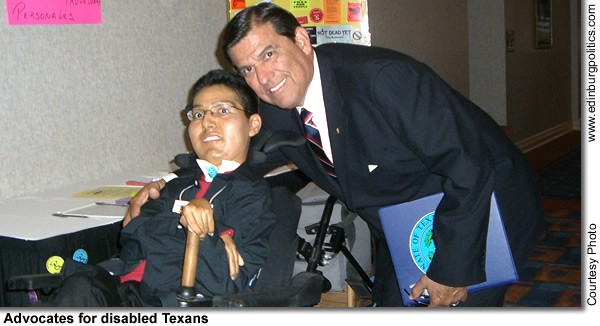 Sen. Eddie Lucio, Jr., D-Brownsville, recipient of the 2007 “Outstanding Legislator Award” by the Texas State Independent Council, congratulates Víctor Álvarez from McAllen, who was named “Consumer of the Year” by the organization. The 20-year-old, who requires round-the-clock care for spinal muscular atrophy, is a Bill Gates Millennium Scholar at the University of Texas-Pan American and writes a weekly column appearing in The Monitor.
••••••
 Heritage Ranch Gala Co-Chairmen Reba Showers and June Corso enjoy previewing El Canelo Ranch in preparation for March 24 event. See story later in this posting.
••••••
Robert Peña, Jr., bringing proven track record of successes in bid for ECISD Place 4 trustee slot
By DAVID A. DÍAZ
Robert Peña, Jr., 39, says if he is elected this spring to the Edinburg school board, the most important qualities of leadership he will bring to the community will be fairness, high goals, and common sense.
Peña, a native son, product of the Edinburg schools, and local businessman, said he decided to seek the Place 4 trustee slot in order to help raise the levels of expectations and community participation in the crucial arena of public education.
“We have an excellent school district, probably the best in South Texas,” Peña said. “I want to do whatever it takes to help our students, educators and staff get the well-deserved recognition as one of the best school districts in all of Texas.”
The former U.S. Marines platoon sergeant, whose nine-year military career included service in Saudi Arabia, Kuwait, and Iraq during the first Persian Gulf War, is owner of Development Consultants and Construction, an Edinburg residential and commercial builder, which he founded in 2001.
His immediate family includes his wife, the former Dora Denise González, a banker with Wells Fargo; his parents, Roberto and María Teresa Peña; sister and brother-in-law Norma and Óscar Villarreal; nephews Anthony and Joseph; niece Elizabeth; sister Anabelle Garza; nephew Steven; sister Nelda Iris Peña; and sister Genoveva Peña.
Many people already know him from his time spent as the executive director of the Edinburg Economic Development Corporation – the jobs-creation arm of the Edinburg City Council – which saw him work with political and business leaders to help usher a new age of economic prosperity and improved quality of life for the three-time All-America City.
He wants to apply the knowledge gained from, and discipline required by, his military, public service, and private sector experiences to provide what he says is a much-needed blueprint to effectively handle the district’s enrollment growth, now averaging more than 1,000 additional students per year.
“I feel our district lacks the efforts in planning for the future,” Peña said. “Although we have unsuccessfully attempted some (school facility) bond elections, I don’t believe we have a long-range plan in place that will help us address the growth of the services and needs of the district.”
If the school district has such a plan in place, “the public would be more aware of what our actual needs are, and then they could help the school board in developing a bond issue for our true needs,” Peña said. “But without a plan, without a vision, without direction, the public is not going to write a blank check for a bond issue.”
Using his expertise in construction, Peña said he would implement a facilities plan to address short-term and long-term needs of the Edinburg school district.
He said the district could utilize other resources, such as the University of Texas-Pan American, to help develop such a needs assessment and identify outside sources of grant funding.
Securing other governmental and private funding for facilities, technology, or other programs frees up more local funds for improved benefits and increased pay for teachers and staff, he suggested.
“I believe our school district has incorporated some tremendous improvements, but I want to take the challenge to the next level,” he said.
Rising to the occasion is nothing new for Peña.
As the point man for the EEDC from 1994 to 2001, Peña’s leadership and organizational skills helped the city’s elected leadership land huge economic development prizes, from the combined $500 million privately-owned power plants in north Edinburg to multi-million dollar entertainment venues, such as Carmike Cinemas 20, the city-owned Edinburg Baseball Stadium, and a professional baseball team.
Almost 30 projects were brought into Edinburg under his watch as EEDC director, a position he said gave him the opportunities to meet and work with people from all walks of life and political persuasions.
Such exposure, he said, taught him the valuable lessons of keeping an open mind, listening to new ideas, and setting the highest standards for himself and his hometown.
“The public can be assured they would be electing an independent voice with leadership qualities who will help our community to develop short-term and long-term vision for the district,” said Peña.
Leadership without accessibility is of little value, Peña believes, so he encourages residents to share their concerns and ideas with him, either by calling him at 956/318-1000, or by writing to him at his e-mail address, which is [email protected].
“Sen. Juan Hinojosa, a fellow Marine, says it best about people who are elected,” Peña said. “‘He said public office is a public trust, it belongs to the people. I agree with him 100 percent – and no one will need money, influence, or power to talk to me because I will be working with everyone.”
••••••
Edinburg OKs most stadium upgrades proposed, and to be paid for, by Coyotes professional baseball team
By DAVID A. DÍAZ
The Edinburg Coyotes on Tuesday, March 6, received approval from the Edinburg City Council that will allow the professional baseball team to invest almost $95,000 for key improvements to the city-owned, $5.6 million baseball complex.
The Edinburg Baseball Stadium serves as home of the Edinburg Coyotes minor league baseball squad, which is part of the six-team United League Baseball, and the University of Texas-Pan American Broncs NCAA Division 1 baseball team.
In exchange for the private investment, the city will repair the sound system, valued at about $5,000, but decided to wait on a request from the team owners for the city to build a three-foot retaining wall at the concourse, which would cost about $8,900.
The city council instead opted to monitor pedestrian traffic along the concourse in front of the stadium before making any moves to build a wall, which club officials said would help prevent cars from parking too close to the facility.
The deal, sought by Edinburg Equities, L.L.C., which owns the team, will result in some key new attractions to the stadium, according to officials with the team and its league, the United League Baseball.
Team and league representatives will soon begin work on building a covered picnic area valued at $15,000, an outdoor bar and grill, valued at $18,310, a large advertising video monitor, valued at $45,000, and a new ticket booth/modifications, valued at $16,430.
The improvements are scheduled to be ready for fans to enjoy on opening day later this spring.
Craig Brasfield, president/executive general manager of the six-member United League Baseball, in a memorandum delivered to the city council also provided updates on other key issues, including noting that naming rights for the stadium were currently under negotiations.
“The Coyotes are in conversation with several prominent and interested partners that are considering the possibility of becoming the naming rights sponsor for Edinburg Baseball Stadium,” he stated. “The City of Edinburg received 25 percent of all naming rights fees a sold by the Coyotes. Thus, I felt it necessary to let the Coyotes’ partner, the City of Edinburg, know the progress being made.”
Brasfield did not identify the prospective naming rights partners.
The most expensive addition, the video monitor, will serve as a stadium marquee sign, he added.
“The Coyotes are seeking to install a state-of=the art message center marque that will be placed in front of the stadium,” Brasfield continued. “Various messages promoting the Edinburg Coyotes and the City of Edinburg will run on this message center for anyone coming to a ball game or special events at the stadium, or simply by driving by. Also, the Coyotes see the marquee sign as a major professional upgrade to Edinburg Baseball Stadium with its perception as a preeminent facility.”
••••••
Edinburg’s jobless rate in January lowest in the Valley at 4.9 percent
By DAVID A. DÍAZ
Edinburg’s jobless rate, which is a key indicator of the strength of the local economy, remained the lowest in the Valley at 4.9 percent in January, keeping pace with the statewide average of 4.5 percent and the U.S. unemployment rate of 4.6 percent.
In 2006, the annual jobless rate for Edinburg was 5.3 percent, while in 2005, the annual jobless rate for Edinburg was 4.7 percent.
In 2006, the city’s jobless rate was the lowest in the Valley during five months, according to the Edinburg Economic Development Corporation, and Edinburg registered the second-best showing for most of the other months last year, edged out only by McAllen.
The EEDC is the jobs-creation arm of the Edinburg City Council.
The EEDC’s five-member governing board includes Mayor Joe Ochoa; former Mayor Richard García, who is president of the EEDC board of directors; and Fred Palacios, Mike Govind, and George Bennack.
As of January, according to the Texas Workforce Commission, 1,372 Edinburg residents were looking for jobs, while 28,120 local residents were employed.
The jobless rate, also known as the unemployment rate, is the number of persons unemployed, expressed as a percentage of the civilian labor force.
The civilian labor force is that portion of the population age 16 and older employed or unemployed.
To be considered unemployed, a person has to be not working but willing and able to work and actively seeking work.
The jobless rate for Hidalgo County was 7.7 percent in January, up from 6.9 percent in December. The January jobless rate for Hidalgo County represented 21,051 area residents without jobs, while 273,471 residents were employed during the first month of 2007.
McAllen had the second lowest monthly unemployment rate in January – 5.1 percent, or 2,065 of their citizens out of work, while 55,406 residents of the City of Palms were employed that month. In December, McAllen’s jobless rate of 4.4 percent.
Harlingen’s unemployment rate in January was 5.3 percent, while Pharr and Mission both reported a 6.2 percent jobless rate during the same month.
Brownsville’s unemployment rate in January came in at 6.8 percent, followed by Weslaco, which reported a 7.5 percent jobless rate during that same month.
Cameron County’s jobless rate in January was 6.6 percent, up from December’s 5.7 percent unemployment rate. In January, 9,603 residents of Cameron County were looking for work, while 135,343 residents were holding down jobs.
Harlingen had the third-best showing among major Valley cities in January, reporting a 4.7 percent jobless rate, followed by Mission and Pharr, which each registered 5 percent unemployment rates for that month.
According to the Texas Workforce Commission:
Texas’ seasonally adjusted unemployment rate fell to 4.5 percent in January from a revised 4.7 percent in December 2006 and down from 5.2 percent in January a year ago.
During the past 12 months, the Texas economy grew by 243,700 jobs for a growth rate of 2.5 percent, outpacing the nation as a whole.
The Texas Workforce Commission (TWC) annually revises the Total Nonagricultural employment and the Civilian Labor Force statistics, which includes the unemployment rate, under the guidance of the U.S. Department of Labor Bureau of Labor Statistics.
Eight Metropolitan Statistical Areas (MSAs) reported unemployment rates of 4.0 percent or lower.
The Midland MSA experienced the lowest unemployment rate in the state at 3.2 percent (not seasonally adjusted), and the Amarillo and Odessa MSAs followed at 3.6 percent.
“Our falling unemployment rate highlights the state’s healthy economic climate,” said TWC Chair Diane Rath. “Coupled with year-over-year, sustained job gains, these lower unemployment rates signify strength in the Texas labor market.”
In the past 12 months, the Professional & Business Services industry saw gains of nearly 50,000 jobs, followed by Leisure & Hospitality, which grew by 40,000 positions.
“Employers in the Lone Star State continue to set a tremendous pace with record job growth,” said TWC Commissioner Representing Employers Ron Lehman. “Ten industries spurred statewide job growth over the past year, with Manufacturing gaining 16,200 jobs and Construction growing by 26,600 positions.”
The Mining industry has added jobs every month since November 2003. In January, Mining gained another 1,800 positions, reaching an annual growth rate of 12.7 percent. Financial Activities grew for the third straight month, adding 1,500 jobs in January and 12,800 positions since January 2006.
“We’ve made great strides, with a record number of workers – 11,063,400 – in the labor force today,” said TWC Commissioner Representing Labor Ronny Congleton. “It’s always good news when more Texans find work.”
Initial claims for unemployment compensation in January 2007 were 59,196, down 2.6 percent from January 2006.
••••••
Sen. Hinojosa files bill to give Texans more control over their own health care
By MELISSA DEL BOSQUE
Saying Texans deserve more control over their own health care, Sen. Juan ‘Chuy’ Hinojosa, D-McAllen, on Tuesday, March 6, filed Senate Bill 1170 to increase fairness, transparency, and competition in the contracts that managed care organizations offer family physicians.
“Most of us know how time consuming and frustrating it is to fight with our health insurance company, imagine doing this every day, all day long. For most of our physicians, this is a painful reality,” Hinojosa said. “Our families need to know that their doctors are spending their time healing them, not hiring lawyers to decipher the contracts they are forced to sign with HMOs.”
Hinojosa said because managed care plans control a significant part of most physicians’ practices, they force physicians to sign take-it-or-leave-it contracts that are not only bad for the physician, but can be detrimental to patient care.
“It’s time to modernize our state statutes to reward fairness and transparency,” Hinojosa said. “This legislation is an effort to restore balance in the contracts between physicians and the large commercial, investor-owned health plans.”
SB 1170 would require full disclosure by health plans of payment terms so that physicians can make informed business decisions. It would also mandate that all contracts be written in plain language so that doctors no longer have to retain lawyers to deal with their correspondence with HMOs.
In addition, Hinojosa’s bill would prohibit the current practice of managed care organizations imposing new categories of coverage on doctors without their knowledge and require managed care organizations to notify doctors before unilaterally changing the terms of contracts.
“Giving family doctors more leverage to negotiate their contracts with managed care organizations will allow them to act in the best interest of their patients,” Hinojosa said.
••••••
Eight fallen Rio Grande Valley soldiers and their families honored at the Capitol
By ED SERNA
The Texas House of Representatives on Tuesday, March 6, honored eight Rio Grande Valley soldiers who lost their lives during Operation Iraqi Freedom and Operation Enduring Freedom.
Rep. Ismael “Kino” Flores, D-Palmview, filed memorial resolutions to pay tribute to the soldiers and their families, who were recognized on the House floor.
“It’s an honor to pay tribute to our brave soldiers who made the ultimate sacrifice while serving our country,” said Flores. “It’s also important that we extend our appreciation, thoughts, and prayers to the soldiers’ families who have been profoundly impacted by their loses.”
Memorial resolutions were filed and read honoring the following soldiers:
•HR 678- U.S. Marine Lance Corporal Benito A. Ramírez of Edinburg
•HR 679- U.S. Marine Lance Corporal Julio C. Cisneros Álvarez of Pharr
•HR 680- U.S. Marine Sergeant Juan Calderón, Jr. of Weslaco
•HR 681- U.S. Army Sergeant Daniel Galván of Mercedes
•HR 682- U.S. Army Sergeant Javier Marín, Jr. of Mission
•HR 683- U.S. Army National Guard Sergeant Tomás Garcés of Weslaco
•HR 684- U.S. Army Staff Sergeant Omar D. Flores of Mission
•HR 74- U.S. Army Specialist James C. Kesinger of Orange Grove/Pharr (resolution filed by Rep.
González-Toureilles)
Eleven Rio Grande Valley soldiers have died serving in Operation Iraqi Freedom and Operation Enduring Freedom. In addition to the eight soldiers honored on March 6, three soldiers, including Marine Private First Class Dustin Michael Sekula, Army Sergeant Christopher Ramírez, and Army Specialist Mark Zapata were honored at the Capitol earlier this year.
Flores represents District 36, which includes parts or all of Hidalgo, Granjeno, McAllen, Mission, Palmview, Penitas, and Pharr.
••••••
DPS trooper Eduardo Chávez of Edinburg, who died in the line of duty, honored by Sen. Hinojosa
The late Eduardo Chávez, a Texas Department of Public Safety trooper from Edinburg who was killed last spring in the line of duty, was honored by the Texas Senate on Tuesday, March 6.
His bravery and sacrifice was highlighted in Senate Resolution No. 387, filed by Sen. Juan “Chuy” Hinojosa, D-McAllen.
The memorial resolution follows verbatim:
SENATE RESOLUTION NO. 387
WHEREAS, The Senate of the State of Texas honors and commemorates the life of Eduardo Chávez, who died May 2, 2006, at the age of 30; and
WHEREAS, A highway patrolman with the Texas Department of Public Safety, Trooper Chávez died while responding to a call to assist his brother, Trooper Enrique Chávez, on a narcotics arrest; he had joined the Texas Department of Public Safety in 2003 and was stationed in Palmview; and
WHEREAS, He had formerly served as a deputy with the Hidalgo County Sheriff’s Department; in September of 2001, he risked his own life to save the life of a drowning child and to help a firefighter who was close to drowning; and
WHEREAS, Eduardo Chávez was born on December 1, 1975, in Reynosa, Tamaulipas, Mexico; he was a resident of Edinburg, Texas, for most of his life; a graduate of Edinburg High School, he attended South Texas Community College and The University of Texas-Pan American; and
WHEREAS, Eduardo Chávez had a special dedication to duty and strived for excellence in all of his endeavors; he had achieved a high level of expertise in the field of drug enforcement and was considered a true leader in his district; and
WHEREAS, State Trooper Eduardo Chávez was a courageous young man with spirit and enthusiasm who was dedicated to his work as a trooper and to protecting the citizens of this state; for his service and his sacrifice, Texas citizens are eternally grateful; now, therefore, be it
RESOLVED, That the Senate of the State of Texas, 80th Legislature, hereby pay tribute to the life of State Trooper Eduardo Chávez and extend sincere condolences to his bereaved family: his wife, Iliana Chávez; his son, Eduardo Chávez, Jr.; his parents, Enrique Chávez, Sr., and Isabel Chávez; his brothers, Enrique Chávez and Germán Chávez; and his sister, Mónica Chávez; and, be it further
RESOLVED, That a copy of this Resolution be prepared for the members of his family as an expression of deepest sympathy from the Texas Senate, and that when the Senate adjourns this day, it do so in memory of Eduardo Chávez.
••••••
Valley congressional delegation meets with Hidalgo County leaders to discuss levees, flood insurance
By ELIZABETH ESFAHANI
Congressmen Rubén Hinojosa, D-Mercedes, Solomon Ortiz, D-Corpus Christi, and Henry Cuellar, D-Laredo/McAllen on Wednesday, March 7, met with several Hidalgo County leaders to discuss the status of the Lower Rio Grande Flood Control Project as well as the impact of FEMA’s digital Flood Insurance Rate Map for Hidalgo County.
Among the officials present Tuesday were Hidalgo County Judge J.D. Salinas, Commissioner Hector “Tito” Palacios, Drainage District Director Godfrey Garza, as well as Louis Jones of Dannenbaum Engineering Corporation and Gume Ybarra of Dos Logistics Inc.
Specifically, the Hidalgo County delegation discussed arrangements with the International Border and Water Commission to recover $10 million in bond money raised from citizens of Hidalgo County for levee improvements. The officials also briefed the congressmen on the anticipated impact following the completion of the Hidalgo County Flood Map Modernization Project set for completion by late 2008. When finished, the modeling will identify the areas in Hidalgo County that are significant Flood Hazard Zones.
Funding for the Raymondville Drain Project was also addressed. This year, Hinojosa again requested that language be inserted into the Water Resources Development Act that would reimburse the county for work done to expedite the project.
“I truly appreciate the tireless work of my colleagues from Hidalgo County. Their efforts are integral in making sure the region is adequately protected from an unforeseeable natural disaster,” said Hinojosa. “The critical condition of the levees is of the utmost concern and rest assured that I will continue to push for levee repair that could potentially save hundreds of thousands of lives.”
Over the past several years, Hinojosa has worked with his colleagues from the Congressional Border Caucus to obtain additional federal money to repair and raise the levees to avoid potential catastrophic flooding in the Valley. The International Boundary and Water Commission recently completed a study with the Army Corps of Engineers that concluded that many sections of the levees are sub-standard and would not hold up under severe rain events. The IBWC’s Lower Rio Grande Flood Control Project’s placed the total cost of repair at $125 million.
“The mistakes of Hurricane Katrina must not and cannot be repeated,” said Hinojosa. “It is essential that we be as proactive as we can now in order to ensure that similar devastation doesn’t happen again.”
••••••
Congressman Hinojosa votes for clean water legislation, help for South Texas colonias
By ELIZABETH ESFAHANI
Congressman Rubén Hinojosa, D-Mercedes, Co-Founder and Chairman of the Congressional Rural Housing Caucus, on Wednesday, March 7, hailed passage of legislation reauthorizing $14 billion for the Clean Water State Revolving Fund over the next four years.
The program is the primary source of federal funding for clean water projects and provides low-interest loans to local communities for the construction of wastewater treatment facilities and other water pollution abatement projects. The 110th Congress marks the first time in 13 years that the fund has been reauthorized.
“With 20 percent of the country’s population living in rural communities, it’s critical that we address their infrastructure needs including access to clean water, working sewers, electricity, and other necessities. For more than a decade, the Clean Water State Revolving Fund has been an integral element in state and local efforts to deal with critical clean water infrastructure needs,” said Hinojosa.
“As a community, our progress must be judged not by the status of our most fortunate members of society, but by that of our most challenged members. That is why I am committed to fighting for the resources needed to ensure a better standard of living for all Colonia residents and why I voted in favor of H.R. 720,” said Hinojosa.
“There are more than 350,000 people who struggle in the unacceptable living conditions of the colonias every day,” said Hinojosa. “Today’s legislation addresses one of the fundamental goals of the Rural Housing Caucus and will go a long way toward improving the quality of life of those residents.”
In addition to H.R. 720, The House of Representatives passed the following bills on the House Floor this week on clean water:
• H.R. 569, The Water Quality Investment Act. There is an increasing problem in many local communities across the country that, after heavy rainfall, sewer systems can overflow – in some cases due to aging sewer systems. This bill is a second bill to improve water quality – by authorizing $1.8 billion in grants to local communities over the next five years to construct treatment works to deal with sewer overflows. This bill is crucial because sewer overflows represent a major public health hazard. It will aid cities and states that find building or improving sewer infrastructure financially impossible without help from the federal government.
• H.R. 700, the Healthy Communities Water Supply Act. This bill is a third bill to improve
water quality. It authorizes $125 million for pilot projects to increase an area’s usable water supply– by encouraging innovation in water reclamation, reuse and conservation. The bill will provide
funding for new technologies, including ideas like aquifer storage and retrieval and membrane
filtering technologies that have the potential to greatly increase our ability to use water more
effectively and efficiently. The bill will enhance usable water supplies in such areas as California
and parts of the Southwest that have long faced chronic water supply shortages amid continuing
population booms.
••••••
Congressman Cuellar secures commitment to help residents of colonias
By RUBÉN BAZÁN
The U.S. House of Representatives on Friday, March 9, passed H.R. 720, the Water Quality Financing Act of 2007. The bill will provide $14 billion in federal loan guarantees to help cities and towns finance water and sewer improvements.
During the floor debate, Congressman Henry Cuellar, D-Laredo/McAllen, secured an official commitment from Committee on Transportation and Infrastructure Chairman James L. Oberstar to help colonias and surrounding communities receive the help they need to improve living standards.“Colonias lack the basic infrastructure that most Americans take for granted,” said Cuellar. “With the negative impact on the health of residents, one of the greatest challenges facing colonias is access to water and sewer service.”H.R. 720 ensures clean water and fosters economic development in local communities by helping pay for the building and improving of wastewater treatment facilities.
The bill will help colonias through a provision that requires states to set aside 15% of the money to communities with less than 10,000 people.
“I assure the gentleman [Mr. Cuellar] that this bill will go a long way to help states target additional support to the colonias,” said Chairman Oberstar. “And we will work with the gentleman [Mr. Cuellar] to provide such language in the future.” Cuellar continued, “I believe it is important that our communities are heard in Congress, and I will continue working with my colleagues in Washington to solve this increasing problem.”
••••••
Sen. Lucio receives Outstanding Legislator Award for efforts on behalf of disabled persons in Texas
By DORIS SÁNCHEZ
For his support of expanding opportunities for independent living to disabled individuals, the Texas State Independent Council (SILC) on Monday, March 5, honored Sen. Eddie Lucio, Jr., D-Brownsville, with the Outstanding Legislator Award in Austin.Lucio, who was also singled out for his voting record in support of disabled people, said, “I am extremely flattered to be selected as the recipient of this award. I know there are some incredible Texans here tonight and I am honored to be in your presence.”
“We selected Sen. Lucio because he has been so concerned about human needs and health issues, and he knows from his own personal experience what recovering from a disability is all about,” said McAllen resident Morgan Talbot, vice chair of the Texas State Independent Living Council. “It is from his background that he understands the need for helping people with disabilities and he has been very supportive.” Lucio was dragged by a bus he tried to board when he was in kindergarten.
He was in a cast for months and began crawling to re-learn how to walk.SILC advocates for the 21 statewide centers that facilitate programs providing the support, tools and encouragement necessary to enable people with disabilities to live on their own in the community, rather than in nursing homes or assisted living facilities.
The agency also promotes expansion of these independent living centers to other areas of the state.In the Rio Grande Valley, the Valley Association for Independent Living (VAIL) served 732 people in 2005 and 811 in 2006. VAIL headquarters is in McAllen with an office also in Harlingen.
“Independent living services are extremely important, not only for the individuals they directly serve, but for society as a whole,” explained the senator. “The work the Council performs benefits not only the clients, but their families, communities, employers and friends as well.
“I support independent living efforts because if it means getting some recipients back to work and giving others the ability to hug their kids again, these services make a difference,” added Lucio. “The admirable achievements of Víctor Álvarez, who was named Consumer of the Year, can be partially attributed to the efforts of SILC and VAIL, but especially to his determination to succeed by utilizing the resources they make available to him.” For more information, the Texas State Independent Living Council maintains a website (www.texsilc.org).
••••••
Emergency hotline numbers, Email addresses posted for abuse allegations at Texas Youth Commission
By MELISSA DEL BOSQUE
A special command center has been set up to field complaints of abuse or exploitation at the Texas Youth Commission, Sen. Juan “Chuy” Hinojosa, D-McAllen, said Thursday, March 8.
“It’s important that families and youth know that 24-hour phone hotlines and email addresses have been set up to field complaints of abuse at the Texas Youth Commission,” Hinojosa said. “These are numbers where Texans can share confidential information that will help us reform the commission so that these horrible cases of abuse and exploitation never happen again.”
To report abuse, neglect or exploitation of youth call the Command Center at:
1(866)-477-8354 or email [email protected]
Families and youth can also call the Texas State Auditor’s Office to make a complaint:
1(800) 892-8348 or email [email protected]
••••••
Gov. Perry gives TYC legislation emergency status
Gov. Rick Perry on Monday, March 5 designated legislation addressing systemic failures at the Texas Youth Commission (TYC) as emergency items for the Texas Legislature. Perry also met with TYC special master Jay Kimbrough, TYC acting executive director Ed Owens and newly appointed TYC Chairman Don Bethel on Monday morning.
The emergency legislation would:
• Expand the jurisdiction for prosecution over crimes committed at TYC facilities to allow the current TDCJ special prosecution unit to handle such cases.
• Create a new TYC Inspector General with greater authority and independence of commission bureaucracy.
• Empower the Attorney General to have concurrent jurisdiction with the local county or district attorney for the prosecution of offenses involving TYC.
“If a local district attorney does not prosecute suspected child molesters, the state must have the authority to step in and enforce the law,” Perry said. “With an Inspector General that reports directly to the Commission Board, we can ensure that administrative investigations are conducted with greater authority, the power of subpoena and independence from the bureaucracy.”
On Friday, March 2, Perry appointed Jay Kimbrough as TYC Special Master and charged him with leading a commission-wide investigation of the commission’s policies and procedures, reports of failures and wrong-doings by commission staff and specific instances of abuse.
Kimbrough has since coordinated his activities with Acting Executive Director Ed Owens; Attorney General Greg Abbott; key staff members for Lt. Gov. Dewhurst, Speaker Craddick and lawmakers; State Auditor John Keel; Texas Rangers Chief Ray Coffman; and Texas Department of Criminal Justice Inspector General John Moriarty.
“Every agency and officeholder I’ve spoken with has offered complete support for this investigation,” Kimbrough said. “We have marshaled our resources, made assignments and have begun to execute our strategy. For the vast majority of youth commission workers who love their jobs and are committed to the mission, help is on the way.”
Kimbrough said that the State Auditor’s Office has agreed to provide an existing toll-free phone number, (800) TX-AUDIT, to report suspected criminal activity at TYC facilities.
••••••
Rep. Dunnam, House Democratic leader, calls on governor to fire TYC board
By KEVIN VICKERS
House Democratic Leader and Rep. Jim Dunnam, D-Waco, on Thursday, March 8, released the following statement in response to today’s meeting of the House and Senate’s Select Committee on Operation and Management of the Texas Youth Commission:
“Today, I am calling on Gov, Perry to fire the Board of the Texas Youth Commission.
“It is clear from the board members’ testimony today, that they are totally incapable of reforming the TYC and protecting vulnerable Texas youth. Unfortunately, the Board members have refused to resign. However, Governor Perry has the responsibility and authority under the Texas Constitution to remove the Board immediately. Nothing short of the complete removal of the TYC Board is acceptable; and the committee’s vote of no-confidence in the Board demonstrates that many of my colleagues agree.
“In spite of revealing testimony demonstrating the incompetence of the TYC Board, today’s hearing did not give us a definitive answer to the most crucial questions: who knew what, and when did they know it? I am glad that Travis County District Attorney Ronnie Earle will help us get to the bottom of this story by aggressively investigating and prosecuting the destruction or alteration of government records in this case. This is not about politics — it is about demanding government accountability and doing what is right.
“I was also deeply moved by the testimony of the Texas Ranger who investigated the original cases of abuse at the TYC West Texas school. Ranger Brian Burzynski’s dedication and commitment reflect the long and proud traditions of the Texas Rangers.
“Any Texas family who has experienced the horrible betrayal of sex abuse in TYC should come forward. It is now clear that sex abuse in TYC was not isolated to one facility in West Texas; instead it is a far too common occurrence at TYC facilities around the state.”
••••••
Rep. Dutton, chairman of key House committee, files legislation calling for sweeping reforms at TYC
By NICOLE R. BATES
Rep. Harold Dutton, D-Houston, Chair of the Juvenile Justice and Family Issues Committee, on Tuesday, March 6, filed House Bill 2512. The bill calls for sweeping reforms in the Texas Youth Commission’s (TYC) facilities in response to the recent allegations of abuse and mismanagement within the commission.
“It is imperative that we immediately restore public trust in our handling of juvenile offenders,” Dutton said. “Parents and the courts need to have confidence that we are doing our best to protect these children while giving them another chance.”
HB 2512 calls for limiting the total number of juvenile offenders detained by the TYC to a maximum of 3000 juveniles. This would ensure a more scrutinizing selection process so that only the most extreme offenders are detained by the TYC. Juvenile offenders of lesser crimes could be placed under the auspices of the Texas Juvenile Probation Commission or local community programs.
In an effort to remedy the myriad of problems caused by placing juvenile facilities in remote Texas locations and to make the detention facilities more accessible to offenders’ families and local community support, the bill also requires the establishment of one or more community-based residential facilities in any county with a population of 600,000 or more. This would mean that more offenders could serve their sentence in their county of residence, since many juvenile delinquents come from urban or heavily populated areas.
In addition, the bill would limit future TYC facilities to house no more than 100 juveniles at a time and all current TYC facilities would be transferred to the Texas Department of Criminal Justice to be used for drug rehabilitation programs for adult offenders..
“House Bill 2512 begins the structural and cultural changes that will strengthen our juvenile justice system and ensure the safety of Texas juveniles,” said Dutton.
••••••
House approves amendment to legislation that would punish alleged cover-ups at TYC facilities
By KEVIN VICKERS
Rep. Jim Dunnam, D-Waco, the House Democratic Leader, on Monday, March 5, offered an amendment to House Bill 8, also known as Jessica’s Law, to make it a second degree felony for a state employee or a contract employee working for the state to cover-up an offense of “Continuous Sexual Abuse of a Young Child or Children.”
The offense is punishable by two to twenty years in prison. The amendment was adopted on a vote of 135 to 7.
“In light of the abuses that have occurred at the Texas Youth Commission, this is a step in the right direction. I hope this legislation will help prevent future sexual abuse against Texas youth in state facilities.
“We must ensure that children in the state’s custody are safe. And in order to do that we must ensure that no one attempts to cover-up these abuses.”
Dunnam also on March 4 asked Speaker of the House Tom Craddick, R-Midland, to recognize him on a motion to bring House Bill 2340 to the House floor. HB 2340 would do several things to immediately help protect the youth in the care of the Texas Youth Commission (TYC).
Craddick’s response to Dunnam’s inquiry was “no.”
“Speaker Craddick’s disappointing and unfortunate action today speaks for itself. Apparently, neither Speaker Craddick nor Gov. Perry are willing to immediately address this sexual abuse scandal in a meaningful way.
“With all due respect, dispatching a couple of mini-vans of accountants to investigate serious allegations of criminal child sexual abuse in a state agency and a criminal cover-up of that abuse is like asking H&R Block to investigate a serial killer. Send in the Texas Rangers now. The safety of our children is at stake.”
With bipartisan support, Dunnam and Rep. Tommy Merritt, R-Longview, filed HB 2340 that would immediately place TYC into conservatorship and strengthen the power of the conservator to address the sexual abuse scandals and subsequent cover-ups.
The bill would ensure that a conservator may legally be appointed over the TYC and require the conservator to station a Texas Ranger at every TYC facility to ensure the health, safety and welfare of the children in TYC’s custody. It would also provide whistleblower protection for TYC employees who come forward with incriminating information.
The Dunnam-Merritt legislation would also create a specific toll-free number at the Texas Department of Public Safety to report information of improper behavior within TYC.
••••••Texas Senate approves measure by Sen. Lucio proclaiming “Desalination Day”
By DORIS SÁNCHEZ
Sen. Eddie Lucio, Jr, D-Brownsville, has introduced Senate Resolution 413 in the Senate Chamber that designated March 7, 2007, Texas Desalination Day to encourage ongoing investment in practical applications of desalination technology in the state.
Five years ago, Gov. Rick Perry launched an initiative to turn sea water into potable water. In late February, the Brownsville seawater desalination pilot was officially inaugurated, and soon the country’s largest inland brackish groundwater desalination facility will begin operations in El Paso.
“As a state, we need to continue supporting desal technology and initiatives. The same technology that is being used on our Gulf waters is also helping our inland communities turn brackish groundwater into drinking water,” said Lucio.
The idea for a desalination observance was developed jointly by members of the Texas Conservation Association and the South Central Membrane Association to raise awareness of the opportunities for this technology that exist in the state.
The senator explained, “I, for one, have seen—and tasted—the promise of desalinated water. I think no member of the Texas Legislature would argue when I say that of the many pressing demands on limited state resources, none is more important than water.”
The population of Texas is projected to more than double from 2000 to 2060, increasing from 21 million to 46 million inhabitants. This growth will boost water demand by 27 percent; however, water supplies are expected to decrease by 18 percent, primarily because of accumulating sediments in reservoirs and depletion of fresh water aquifers. Desalination of seawater is a proven technology providing water supply solutions for countries worldwide and to communities across Texas, from Cameron County to San Angelo.
Major funding for seawater desalination studies has been provided by the Texas Water Development Board through a legislative initiative proposed by Gov. Perry in 2002. Further appropriations by the Legislature has allowed the Texas Water Development Board to fund numerous brackish groundwater desalination studies with the goal of accelerating development of new water supplies in rural communities.
••••••
Sen. Zaffirini files legislation promoting higher education excellence
By NICK ALMANZA
Sen. Judith Zaffirini, D-Laredo, filed legislation on Thursday, March 1, aimed at ensuring access, affordability and excellence in Texas higher education.
The six bills address multiple issues regarding higher education, from work-study mentorships to strengthening regulations banning hazing, and build on Zaffirini’s highest legislative priority of supporting and advancing higher education throughout the state.
“Higher education, its practices and policies are of immense importance to our state’s future because our growth, both economic and cultural, is coupled fundamentally with the success of our students and institutions,” Zaffirini said. “These bills would enrich higher education practices and policies and help our students and institutions succeed.”
SB 1050 would create new work-study opportunities by developing a program through which students could serve as peer mentors and tutors as part of their work-study financial aid program.
SB 1051 would provide waivers to the core curriculum for foreign students enrolled in international institutions in a joint-degree program with Texas colleges and universities.
SB 1052 would address higher education affordability by developing financial incentives to encourage students to complete the core curriculum at a community college and transfer to a four-year institution.
SB 1053 would require the Higher Education Coordinating Board, advising professionals and higher education representatives to develop an assessment of advisors at institutions of higher education to improve the quality of advising.
SB 1054 significantly would strengthen and clarify provisions of existing statutes banning hazing in schools.
SB 1055 would establish a commission to study and report on the projected need for faculty at public and private institutions of higher education.
Zaffirini is chair of the Senate Higher Education Subcommittee and a member of the Senate Education Committee. Prior to the 2007 legislative session she pre-filed SB 49, which provides financial relief to college students by allowing them to purchase textbooks tax-free during the beginning of the fall and spring semesters. Senator Zaffirini has filed a total of 49 bills for this year’s 80th legislative session.
••••••
Sen. Lucio files bill to return power to set tuition rates back to the Legislature, away from colleges
By DORIS SÁNCHEZ
Sen. Eddie Lucio, Jr., D-Brownsville, on Monday, March 5, filed Senate Bill 1131 that would repeal tuition deregulation for higher education institutions in Texas and return control of setting tuition rates to the Legislature.
“In essence, my bill would freeze current college and university tuition rates at the 2006-07 levels,” said Lucio, who opposed the tuition deregulation bill that passed during the 78th Regular Legislative Session. “We cannot continue in the path we are headed. Students are being priced out of a college education.”
The statewide average for designated tuition for 15 credit hours in fall 2003, the last semester before tuition deregulation was implemented, was $625, and by fall 2006 it had risen to $1,125 according to estimates provided by the Higher Education Coordinating Board.
Since 2004, institutions have increased the total designated tuition charged to students from $51.8 million per year to $318.1 million for the 2006 year.
“I have been a college student for more than three years now, and I have never seen such an increase as the one we face today. With this increase, together with the high gas prices, it is making it even more difficult for students to continue with their higher education goal,” said Carlos A. Martínez, a student at the University of Texas at Brownsville.
“This bill truly attempts to make college more affordable not just for today’s students, but also for tomorrow’s students,” added Lucio.
Because most students will soon be pre-registered for fall classes, the bill would take effect immediately if it receives the necessary two-thirds vote in each chamber.
••••••
South Texas College President Dr. Shirley A. Reed honored at 2007 Border Texan of Year Dinner
By HELEN ESCOBAR
It was a night to remember for South Texas College President Dr. Shirley A. Reed, who was honored at the Border Texan of the Year Celebration Dinner on Wednesday, February 28 at Dodge Arena in Hidalgo.
Reed officially accepted the Border Texan of the Year award during the event, which is an annual tradition attracting more than 1,000 of the area’s business, professional and government leaders.
The award is given by the BorderFest Association, the Hidalgo Chamber of Commerce and the City of Hidalgo.
“I was very touched by the recognition from old and new friends from education, business, government and the community at large from across the Valley,” said Reed. “I have been so lucky in my career, coming to such a wonderful, thriving area with spirited, ambitious people. Yes, I have worked hard, but none of my accomplishments would have been possible without the support of every member of the Hidalgo and Starr county communities. I want to thank every single person that lives in the area. Your dedication to STC has been the cornerstone of my success. I accept this award on your behalf, as well as any woman struggling to reach for the stars. As I tell our students, anything is possible if you believe in yourself and give it 110%!”
Gary Gurwitz, founding member of STC’s Board of Trustees, provided a unique look at Reed’s personal life and biography, which moved many in the crowd.
“A number of the past recipients of this award have been national or statewide personalities,” said Gurwitz during his speech. “Our homegrown recipients have lived and worked in the Valley most of their careers and have been outstanding in law, banking, business, education and other disciplines over many years. By contrast, this year’s recipient is a relative newcomer to our Valley and our state and has achieved enormous results in just 13 short years. Just think of the tens of thousands of Valley people who have been positively impacted by what she has done in these few years and the best is yet to come.”
Reed joins a prestigious list of former honorees including Governors George W. Bush and Rick Perry, Senators Kay Bailey Hutchison and John Cornyn, former Senator Phil Gramm, and Ambassador Tony Garza.
Reed was the founding president of South Texas College. Under her leadership, STC has flourished rapidly, growing to serve more than 18,000 students. In 2006, STC was named #2 in the nation of community colleges awarding associates degree to Hispanics and #3 in the nation of community colleges for enrollment of Hispanic students. She has expanded STC from one location to three campuses and two centers.
She has led STC to offers more than 90 degree and certification program options spanning an array of fields and opportunities. Because of her vision, dual enrollment programs are offered with high schools throughout Hidalgo and Starr Counties, providing opportunities for students to earn free college credits. Additionally STC reached a new milestone in fall 2005 as it began offering a Bachelor of Applied Technology degree in Technology Management. The college was granted accreditation, as one of only three schools in Texas, from the Southern Association of Colleges and Schools (SACS), to offer the four-year degree.
••••••
GOP Chairman Benkiser applauds House GOP leadership for taking child predators off the streets
By HANS KLINGLER
Republican Party of Texas Chairman Tina Benkiser applauded Republican leaders in the Texas House of Representatives for passing the “Jessica’s Law” legislation. This legislation would strongly expand the criminal penalties for sexually assaulting a child.
“The Republican leadership in the Texas Legislature put sexual predators in this state on notice today. If you hurt our kids, you could suffer the ultimate penalty, the loss of your life,” she said.
In 2005, 9-year-old Jessica Lunsford was abducted from her Florida home, sexually assaulted, and murdered by a convicted sex offender. States across the nation have been enacting stricter penalties for sex crimes against children. House Bill 8 authored by Debbie Riddle (R-Houston) and supported in a bipartisan manner would enact very strict penalties when dealing with persons who are convicted of sexually violent offenses against children.
“We must send a zero-tolerance message to predators that prey on our kids. The children of Texas are too important. Don’t mess with them.” Benkiser warned.
House Bill 8 will now go over to the Texas Senate where it will be considered along with the legislative efforts by Republican state senators to address “Jessica’s Law”.
••••••
Pew Hispanic Center to release report on Internet use among Latinos
The Pew Hispanic Center, in partnership with the Pew Internet & American Life Project, will release a report on internet use among Latinos Wednesday, March 14.
The report describes internet use within the diverse segments of the Hispanic population. It finds, for example, that Latino internet users are more likely to speak and read English, to have a high school degree and to have been born in the U.S. Only about one-third of Spanish-dominant Latino adults go online, compared with about eight-in-ten English-dominant Latino adults.
The report will be available on the Center’s website, at 4:00 p.m., Wednesday, March 14, 2007.
The Pew Hispanic Center and the Pew Internet & American Life Project are non-partisan research organizations. They are part of the Pew Research Center and are funded by the Pew Charitable Trusts.
••••••
Texas Legislature Online offers wealth of information
By SEN. EDDIE LUCIO, JR.
For those of you with a little computer savvy and a big interest in the legislative process, information has just been made easier to access.
The Texas Legislature Online (TLO) web site (http://www.capitol.state.tx.us/ or http://www.legis.state.tx.us/ ) is considered one of the country’s leading internet applications. It was first introduced in 1996 and has gradually been enhanced since then. Designed for the casual user, this system is easy to use and even contains a glossary for the “lingo” we use in the Legislature.
“TLO is an important Internet tool because it allows all Texans, regardless of how close or how far they live from the state Capitol, access to current information about the actions of their legislature,” notes Linda Pittsford, manager of the Texas Legislative Council’s Computer Support Center.
Although this virtual marvel is equipped with hundreds of capabilities, one of its most attractive features is the ability to tune into live broadcasts of the proceedings, as well as archived real video.
It allows you to track a bill from its infancy to its success or demise, and for the novice or someone needing a quick refresher course, it teaches you how to follow a bill.
The system is so “high-tech” that you can set up bill alerts and receive emails on the status and movement of a bill through the process. But these alerts aren’t confined to email on your desktop computer; they are also available for email alerts through your cell phone or personal digital assistant (PDA). So you can be shopping at the grocery store, and that alert will go off telling you that the bill you’re concerned about just passed out of the committee to which it was assigned. The system is so well-designed, it walks you through the steps needed to create the alerts.
There is another option that permits you to subscribe to RSS feeds, sort of like on the CNN web page. The feeds let subscribers know that new information is available on-line and sends these feeds to your home computer. And TLO also walks you through this function and how to install the necessary software for it as well.
Another attractive component of TLO is that it allows a bill’s vote information to be accessed via several options, and House votes are posted within an hour. Before the House journal in which votes are recorded for the day is available, an unofficial vote report displays if it is a record vote and if the vote is not a record vote, a message that the journal is not available appears. Senate votes are available once the Senate Journal is published. However, all vote information for both the House and Senate prior to the 79th legislative session can be accessed only in the journals, also online.
One of the most talked-about abilities TLO provides is that of letting you create your own bill list, as simple or as elaborate as you need.
Another brand new feature is one that allows you to view the language of a House amendment while it is being discussed in the House Chamber. Amendments are provisions that are added to bills.
Committee reports are updated throughout the day on TLO. It also provides quick links to calendars that let you know what bills are up for consideration. This site includes links to the Texas statutes and committee reports on bills once they are heard.
Many people appreciate how interactive this system can be. It provides an area that allows you to ask questions or submit comments. With another click of the mouse or touch of the keypad, you can check and see who represents you not only in the House and Senate, but also in the U.S. Congress.
Remember, all it takes to access this and much more information is to log onto http://www.capitol.state.tx.us/ or http://www.legis.state.tx.us/.Online registration to receive emails and alerts is quick and simple.
Whether you live in a town near Austin, or as far away from the Capital City as Brownsville or El Paso, you can stay abreast of government in action. I highly recommend the Texas Legislature Online.
••••••
El Canelo Ranch hosts 2007 Heritage Ranch Gala
Heritage Associate FRIENDS and other guests to the Museum of South Texas History’s Heritage Ranch Gala will be treated to a “high ol’ time” at El Canelo Ranch in Kenedy County. Gourmet “grazing” and dancing under bright stars in a beautiful South Texas setting will make Saturday, March 24 an evening not to be missed.Stella García Zárate and her six children, Cecelia Dismukes of Houston, Laura Scanlan of Indianapolis,Mónica Burdette of El Canelo Ranch, Mike Zárate of Edinburg, Ricky Zárate of McAllen, and Vicky Adkins of Bainbridge Island, Washington will graciously open their family ranch for one evening to the Museum’s guests.
The Gala will be set up in a meadow of wildflowers at the site of the original ranch headquarters of Isabel Yturria García’s El Devisadero Ranch. Translated from Spanish, the name means overseer and was inspired by the fact that it sits on the highest elevation in Kenedy County and for hundreds of miles around. Isabel was the adopted daughter of Don Francisco Yturria (1830-1912), a prominent entrepreneur in South Texas and Northeastern Mexico.
To read more about the ranch history, visit the Museum’s website, http://www.mosthistory.org.
Beginning at 6:30 p.m., guests will arrive and enter the ranch driving past the El Canelo headquarters and on to El Canelo II where the Gala will take place. Spotting wildlife along the way is highly likely as the Zarate Family is a good steward of natural habitat. Arriving at the Gala site, guests will enter and walk through the charming hacienda-style house which is home to Monica & Ray Burdette and the Inn at El Canelo, the Rio Grande Valley’s first Bed & Breakfast. Leaving the house, guests will find themselves in a beautifully landscaped ranch garden where beverages will be available before making their way to the party site. There guests will mingle, enjoy hearty fare such as cabrito served on pan de campo cooked up by Don Strange of Texas, Inc., and kick up their heels to the tunes of Scott Randolph and White Lightening.
The Gala is the culmination of the Annual Heritage Associate Drive which raises a significant portion of the Museum’s annual operating funds. Heritage Associates are donors whose gifts of $1,000 or more support the operation of the Museum each year. These donors will be honored guests.
Reservations for the Heritage Ranch Gala may be made by calling the Museum with a credit card. Current FRIENDS of the Museum may make a reservation for $150 per person and those who are potential FRIENDS may make a reservation for $165 per person. One can also become a FRIEND or renew your FRIENDship while making your reservations and take advantage of the special price. For security reasons, no one may be admitted to the event without an advance reservation.
Reservations are limited and should be made by March 16 For more information, call 383-6911 or go to http://www.mosthistory.org .
by Legislative Media | Mar 6, 2007 | Politics

Area residents recently had the opportunity to view the U.S. Marines dress uniform, complete with military decorations, of the late Alfredo “Freddy” González of Edinburg. The Texas icon, whose bravery and sacrifice during the Vietnam War prompted the nation a generation ago to bestow upon him the Congressional Medal of Honor, has now been recommended for the state’s highest military award – The Texas Legislative Medal of Honor. Rep. Aaron Peña, D-Edinburg, has filed the needed legislation nominating the combat Marine for the exclusive state honor. See story later in this posting.
••••••
 Sen. Juan “Chuy” Hinojosa, D-McAllen, on Tuesday, February 27, spoke from the front steps of the Texas Capitol during a rally drawing attention to legislative efforts to reduce electricity rates for Texas residential users. A large gathering showed up for the event, which included members of the American Association of Retired Persons. AARP is supporting Hinojosa’s Senate Bill 444, a bill designed to bring stability to the state’s deregulated electricity market. Rates have risen by as much as 100 percent in the past five years, Hinojosa said, giving Texas one of the highest rates in the nation. See story later in this posting.
••••••
 Julie González of Edinburg. featured here in the Senate chamber with her boss, Sen. Eddie Lucio, Jr., D-Brownsville, is one of several Edinburg residents who are working in key positions of influence at the State Capitol in Austin. González is serving as a legislative aide with the Senate Committee on International Relations and Trade, which is chaired by Lucio, whose legislative district includes portions of Edinburg. See story later in this posting.
••••••
1,300 jobs, $90 million annual economic impact would be generated by shopping center, says EEDC
By DAVID A. DIAZ
A proposed $80 million retail shopping center that has been in the development stage for about a year would create 1,300 jobs and have an estimated $90 million annual economic impact in the three-time All-America City, the Edinburg Economic Development Corporation has announced.
The first major estimate of the economic impact of the complex was released by the EEDC during its board of directors meeting on Tuesday, February 27.
The shopping center, being developed by First Hartford Realty Corporation, Inc., which is based in Manchester, Connecticut, is scheduled to be built on about 130 acres of currently vacant fields in south-central Edinburg.
The targeted site is bordered by U.S. Expressway 281 and Business Highway 281 to its east and west, respectively, with Trenton Road serving as its southern border.
“The 1,300 jobs, and probably be more, represents employment at the shopping center, which will be developed in phases over three years, once that project is completed,” said EEDC executive director Ramiro Garza, Jr. “After that, over a 10-year period, the economic impact of the shopping center will approach $1 billion.”
Groundbreaking at the site for the first phase of the shopping center, which could take up to three years to complete, is tentatively scheduled for early summer, he said.
As part of its strategies to help promote the creation of the retail center, the EEDC board of directors on February 27 approved a resolution authorizing the EEDC, which is the jobs-creation arm of the Edinburg City Council, to participate in key incentives to help spur the project.
The EEDC, a governmental entity, is chaired by former Mayor Richard García, and includes Mayor Joe Ochoa, Fred Palacios, Mike Govind, and George Bennack on its five-member board of directors.
The board of directors are appointed by the city council, with the exception of the mayor, who is automatically on the governing board.
At that Tuesday evening public session, the EEDC gave its official approval to a proposed package of economic incentives – adopted a week earlier by the city council – that would help the outdoor retail stores developer cover certain portions of the costs of making the retail complex a reality.
Those incentives, which would involvement reimbursements for public infrastructure, such as new water and wastewater lines and roadway improvements, would materialize only if the shopping center meets specific benchmarks required under the incentives proposal.
“It’s all tied to their performance,” said Garza. “The agreement is structured in such a way that they have to hit certain performance measures.”
Those benchmarks include the shopping reaching a certain level of local sales taxes generated, new jobs created, and retail space constructed three years from its groundbreaking.
The proposal, approved by the city council and EEDC, “commits the developer to build at least 800,000 square feet of retail space and create 1,300 jobs over a period of three years,” Garza said.
The proposed incentives have been in the works for months by the city council and EEDC board of directors during their respective public meetings.
To that end, the city council has been working on creating a special city panel that could designate the shopping mile site as a Tax Increment Refinancing Zone, otherwise known as a TIRZ. But before that entity is formed, the city and EEDC wanted to have the incentives proposal ready, Garza added.
TIRZs are special districts created by a city council or other governmental entity, such as the county government, to bring new investments into a community.
TIRZs are authorized by state law to help local governments help pay the cost of redeveloping or encouraging development in a region that has no planned economic activity.
“That process will be initiated in the next month or so designating the areas of the TIRZ and capturing all the incremental value of the construction activity there, and utilizing that to reimburse (the shopping center developer) for public improvements,” he said.
First Hartford Realty Corp., Inc. is designing a “Lifestyle-Themed” complex to be located between U.S. Expressway 281 and Business Highway 281 in south Edinburg, bordering Trenton Road to the north.
Last spring, company leaders provided the first major update of their goals.
“We are pleased to announce our plan to develop the property which is being designed to host a variety of national and regional retailers, sit-down restaurants and other retail amenities,” said John Toic, Director of Project Development for First Hartford Realty Corp., Inc.
“In addition, the site is being designed to accommodate possible hotel and entertainment uses as well. The center will serve the expanding base of Rio Grande Valley shoppers and will draw shoppers from throughout the region and Mexico,” he added.
The company has more than 50 years of national real estate development experience.
The proposed retail mecca would be the latest big addition to the city’s continuing economic growth.
Plans for the shopping center were first announced about a year ago by then Mayor García, and both he and current Mayor Ochoa are leading the city’s efforts to package the incentives.
“Those involved in the development agreement that is currently being negotiated, and hopefully will be finalized very shortly, with the developers of the proposed mall project to provide an incentives- based economic development package,” City Attorney Dan Ríos said February 20. “If First Hartford meets certain specific goals throughout the development of the project, the city, in accordance with state laws, will provide for certain incentives for that development.”
He said some of those incentives to be offered by the city include “reimbursements for public improvements that would be dedicated for public use, and also involve certain levels of sales tax incentives and reimbursements, provided they meet construction of square footage. It is a phased-in incentive package.
“If they (First Hartford) meet additional goals, they would be able to seek additional economic incentives,” Ríos said. “Those items that have been negotiated over the past several months would bring a major impact in terms of development and growth that would benefit the city and its citizens. We are pleased with a developer that is contemplating making that type of investment in the area, and that investment, in the council’s view, justified serious consideration of this economic package.”
“First Hartford has advised the city that a significant contributing factor that would induce First Hartford to locate and construct the facility in the city is the ability to obtain certain economic development incentives to would assist First Hartford in being able to finance to facility,” Ochoa added.
One component of the economic development incentives being provided to the shopping center’s developer, under the development agreement by the city, is a commitment from the city to grant to the First Hartford a portion of the city’s one percent sales tax revenues collected within the Tax Increment Reinvestment Zone to be created by the city, said García.
The city is authorized under Texas law to grant public funds for economic development purposes pursuant to a “program” established under Chapter 380 of the Texas Local Government Code. A resolution approved Tuesday, February 20, by the city council authorizes the establishment of such programs, which must occur before the city grants public funds for economic development purposes.
As a result of the passage of that resolution that evening, the city is able to provide a one percent city sales tax grant detailed in the development agreement.
As part of its economic development strategies, the city council previously authorized the creation of the Local Government Finance Corporation (LGC) to assist with financing and constructing economic development projects within the city in order to promote economic development and to stimulate business and commercial activity in the city, all at the request of the city council.
More details on the mechanism of a Tax Increment Reinvestment Zone are provided by the City of Houston, which has 22 TIRZs.
According to the City of Houston’s web site:
What Are Tax Increment Reinvestment Zones (TIRZs)?
Tax Increment Reinvestment Zones (TIRZs) are special districts created by a city council or other eligible local government to attract new investment to an area. TIRZs help finance the cost of redeveloping or encouraging infill development in an area that would otherwise not attract sufficient market development in a timely manner. Taxes attributable to new improvements (tax increment) are set-aside in a fund to finance public improvements in the zone.
Zones in the City of Houston have been created for one of three reasons:
•To address inner city deterioration;
•To develop raw land in suburban fringe areas; or
•To proactively address the decline of major activity centers.
How They Work
TIRZs are most successful when the area’s tax base is at a low point of its valuation and there is a large property owner/developer who can expeditiously carry out the area’s redevelopment. The term TIF, or tax increment financing, is used interchangeably with TIRZs.
As new construction in the zone occurs, the resulting annual incremental increase in tax revenue above the base amount is returned to the zone for the duration of the zone. For example, if the assessed value for a base year is set at $6 million and improvements to the area increase the assessed value to $7 million; the taxes collected on the additional $1 million, or increment, is earmarked for the TIRZ fund to pay for project costs. TIRZs have no taxing or assessment powers.
Property owners pay a normally increasing tax bill. The cost to the city is that the increment that is captured is preempted for use in the zone rather than for the City’s general fund.
Eligible Project Costs
Eligible project costs are associated with public improvements. These improvements can include capital costs (the acquisition and construction of public works and public improvements, and building rehabilitation costs); financing costs (including all interest); real property assembly; relocation costs; professional services; and, creation, organization and administrative costs.
Projects that are implemented prior to an increment being realized are often financed by a developer and are later reimbursed as an increment is realized, or through the issuance of bonds. Projects can also be financed on a pay-as-you-go basis.
Types of Zones
TIRZ’s can be city-initiated, if less than 10% residential land area, or by a petition. TIRZs created by petition must be submitted by owners of property constituting more than 50% of the appraised value of the area. Additional areas can be annexed into the zone at a later time through the initiative of the city, if it meets the less than 10% residential rule, or by property owner’s petition. The zone, plus all other existing zones, may not exceed 15% of all taxable property in the city.
Governance
In Houston, a board of directors governs a TIRZ. Non-petitioned TIRZs are governed by between five and 15 directors. Each taxing jurisdiction levying taxes within the TIRZ are allotted one position on the board, while the Houston appoints a minimum of five directors. Petition TIRZ boards must have nine members that include: five city representatives (that must own or represent a property owner within the zone); one state senator appointment; one state representative appointment; one representative each from the county and school district (if participating in the zone). Houston city appointees serve two-year terms.
Houston may delegate to the board any powers granted under state law, except for eminent domain and taxing powers. Powers include land use controls, in special cases; design standards; recommendations for the administration of the zone; and, powers to implement a project and financing plan.
••••••
Sen. Hinojosa, Rep. Peña appointed by leadership to investigate problems in Texas Youth Commission
Lt. Governor David Dewhurst and Speaker of the House Tom Craddick, R-Midland, on Friday, March 2, announced Senate and House appointments – including Sen. Juan “Chuy” Hinojosa, D-McAllen, and Rep. Aaron Peña, D-Edinburg – to the newly created Joint Select Committee on the Texas Youth Commission (TYC).
The committee will be charged with studying recent allegations of sexual abuse at certain facilities administered by the TYC. It will also examine the agency’s policies and procedures, and make recommendations for how to improve its future oversight of youth being rehabilitated in these facilities.
“As leaders of this state, we will not tolerate abuse or cover up in any state agency,” Dewhurst said. “Our recommendation of a conservatorship allows immediate action to hold those involved accountable, correct any problems that still exist within TYC and put in place measures to prevent further abuse of those in the state’s custody and of the public trust.”
“The disturbing allegations about certain activities at the Texas Youth Commission warranted the immediate creation of this committee,” Craddick said. “I trust that the committee members will thoroughly review the situation in the Texas Youth Commission and ensure this agency gets back to helping our troubled youth.”
The committee will be co-chaired by Sen. John Whitmire D-Houston, Chair of the Senate Criminal Justice Committee, and Rep. Jerry Madden, R-Richardson, Chair of the House Corrections Committee.
The Senate appointees are Sen. Chris Harris, R-Houston; Sen. Juan “Chuy” Hinojosa, D-McAllen; Sen. Kel Seliger, R-Amarillo; Sen. Florence Shapiro, R-Plano; Sen. Royce West, D-Dallas; and Sen. Tommy Williams, R-The Woodlands.
The House appointees are Rep. Harold Dutton, D-Houston; Rep. Aaron Peña, D-Edinburg; Rep. Larry Phillips, R- Sherman; Rep. Debbie Riddle, R-Tomball; Rep. Sylvester Turner, D- Houston; and Rep. Corbin Van Arsdale, R-Tomball.
“Like many Texans I am outraged at the culture of neglect and deceit that is seemingly apparent at the Texas Youth Commission,” said Peña. “Since late 2005, when my office first received complaints out of the TYC’s Evins Unit, we have exerted considerable pressure on administration officials to address allegations of abuse and neglect. Despite assurances that the problems at the Evins Unit were isolated incidents it is abundantly clear that there are systematic deficiencies that must be addressed. I look forward to the opportunity to bring accountability to a system that appears broken.”
The Joint Select Committee on the TYC was created to coincide with the Legislative Audit Committee (LAC), which met on Friday, March 2, to examine the conduct and fiscal management at the TYC.
The committee voted unanimously to recommend that the governor appoint a conservatorship, and it also recognized that the Governor could create a state agency rehabilitation plan to be submitted within 15 days.
The LAC is a permanent standing joint committee, co-chaired by the Lt. Governor and the Speaker, whose role is to provide guidance to the State Auditor’s Office.
••••••
Texas Legislative Medal of Honor recommended for the late Sgt. Alfredo “Freddy” González of Edinburg
By DAVID A. DIAZ
More than a generation after Marines Sgt. Alfredo “Freddy” González died saving his troops in Vietnam, the Texas Legislature is poised to posthumously bestow upon him the state’s highest military decoration.
The Texas Legislative Medal of Honor, which has been awarded only three times previously, recognizes a member of the state or federal military forces “who performs a deed of personal bravery or self-sacrifice involving risk of life that is so conspicuous as to clearly distinguish the person for gallantry and intrepidity above the person’s comrades. Awarding this medal shall be considered on the standard of extraordinary merit. The medal may be awarded only on incontestable proof of the deed.”
The legislation, House Concurrent Resolution 121, was filed Monday, February 26, by Rep. Aaron Peña, D-Edinburg.
Sen. Juan “Chuy” Hinojosa, D-McAllen, is expected to sponsor the measure in the Senate, which will require approval by Gov. Rick Perry if the legislative resolution is adopted by the Texas Legislature.
“Freddy González is a true American hero,” said Peña. “It is the duty of our community to never forget the sacrifices of those brave men and women who serve our country. In recognizing Freddy González, we not only honor his remarkable life but we honor the countless contributions of many others who came before him.”
The military decoration is a neck ribbon is green with white stars, and the medal features an image of the Alamo Mission in San Antonio and the six historical flags of Texas.
John Flores, author of a new book, “Where the River Dreams” (Publisher: AuthorHouse), which chronicles the life of the Edinburg war hero, praised the decision to recommend the state’s highest military honor in memory of González.
“Freddy was a simple, hard-working country boy, humble and reserved, never seeking honors,” Flores said. “What Freddy did, he did for the men under his command. He was their leader at a time of maximum danger, and his greatest legacy is simply that they all knew Sgt. González would always be there right with them, no matter what the odds.”
The Texas Legislative Medal of Honor (TLMH) was established by the 58th Texas Legislature, and has been awarded three times throughout its history to those who voluntarily perform a distinguished deed of personal bravery, or self-sacrifice involving risk of life.
Prior to September 2003, the governor determined the TLMH nominees and awards the TLMH upon passage of a resolution confirming this person by both bodies of the legislature. Additionally, there were no residency requirements for the TLMH.
That law changed in September 2003, when the new law, authorized by House Bill 573, established certain residency requirements and TLMH nominating and awarding criteria. The legislation also established a committee of legislative branch officials and the Texas adjutant general to designate award recipients.
The resolution follows verbatim:
CONCURRENT RESOLUTION 121
WHEREAS, The Texas Legislative Medal of Honor was established to honor gallant and intrepid service by a member of the state military forces of Texas, and through his courageous actions in
Vietnam, Sergeant Alfredo “Freddy” González distinguished himself as a worthy recipient of this prestigious honor; and
WHEREAS, Born May 23, 1946, in Edinburg and a graduate of Edinburg High School, Sergeant González enlisted in the U.S. Marine Corps in May 1965; after his first tour of duty in Vietnam, he was chosen to train new marines for guerilla warfare; and
WHEREAS, A few months later, Sergeant González learned of an ambush in which men who had served under him had been killed; impelled by a strong sense of duty to his fellow marines and to his
country, he volunteered for a second tour in Vietnam; and
WHEREAS, When, at the end of January 1968, North Vietnamese and Viet Cong troops launched the massive Tet Offensive, Sergeant González and his platoon were ordered to Hue to relieve the pressure on that city; en route to Hue, the platoon’s convoy was hit by heavy fire on several occasions; during one such encounter, Sergeant González saw an injured marine lying in the road ahead and ran through enemy fire to carry the man to cover, receiving fragmentation wounds in the rescue; and
WHEREAS, With the column halted by withering fire from a fortified machine-gun bunker, Sergeant González proceeded to guide his men to a protective dike; he then moved out onto a road being
raked by the gun and destroyed the bunker with hand grenades; later, on February 3, Sergeant González was seriously wounded but continued to refuse medical treatment and to lead his men in their attack; and
WHEREAS, During fighting in Hue on February 4, his platoon of some 35 troops was again pinned down by a ferocious barrage; telling his unit to stay behind shelter, Sergeant González moved forward aggressively with hand grenades and small antitank rockets, firing numerous rounds against enemy emplacements; and
WHEREAS, Entering a church, where the North Vietnamese were heavily fortified, he succeeded in suppressing virtually all of their fire; before the last of it could be silenced, however, he was
mortally wounded; and
WHEREAS, Because he succeeded in destroying so many North Vietnamese positions, Sergeant González was credited with saving the lives of the men in his platoon; the following year, in consequence of his extraordinary and selfless action, he was posthumously awarded the Medal of Honor, becoming the only marine in combat during the Tet Offensive to receive that award; and
WHEREAS, For those with whom he served, the heroism displayed by Sergeant González was completely in character; “it seemed like he was everywhere all the time,” one remembered; “he was always there in the front, never in the back . . . he was always there for us”; and
WHEREAS, Among the awards subsequently conferred on Sergeant González were three Purple Hearts, four Presidential Unit Citations, and a Combat Action Ribbon, Good Conduct Medal, National
Defense Medal, and Cold War Certificate; in addition, he was the posthumous recipient of two South Vietnamese decorations–the Vietnam Cross of Gallantry with gold palm and star and the Vietnam
Service Medal with four bronze stars; in 1996, the U.S. Navy commissioned a new guided missile-destroyer in his honor; and
WHEREAS, Through his unhesitating selflessness and his unfaltering devotion to duty, honor, and his country, Sergeant Alfredo González embodied the highest ideals of the armed service, and he most assuredly merits the award of this state’s supreme military medal; now, therefore, be it
RESOLVED, That the 80th Legislature of the State of Texas hereby posthumously confer the Texas Legislative Medal of Honor on Sergeant Alfredo “Freddy” González in recognition of his heroic service and express to his family its deepest appreciation on behalf of all his fellow Texans; and, be it further
RESOLVED, That an official copy of this resolution be prepared for the family of Sergeant González as an expression of highest regard by the Texas House of Representatives and Senate.
••••••
Sen. Hinojosa, AARP rally for lower electric rates, stronger protection protections, more consumer choices
By MELISSA DEL BOSQUE
Members of the AARP gathered from all across the state Tuesday, February 27, to join State Sen. Juan ‘Chuy’ Hinojosa, D-McAllen, at a rally on the grounds of the Capitol in Austin, pressing their case for lower electric rates and more consumer choice.
“You voices are being heard inside this building today,” Hinojosa told the crowd. “And that’s why we are going to have lower electric rates, stronger consumer protections, more choice in electric providers, and fairer treatment for the elderly, the disabled, and other vulnerable Texans.”
AARP is supporting Hinojosa’s Senate Bill 444, a bill designed to bring stability to the state’s deregulated electricity market. Rates have risen by as much as 100 percent in the past five years, Hinojosa said, giving Texas one of the highest rates in the nation.
Hinojosa said he filed the legislation not to re-regulate the market but simply to fulfill the promises that were made when it was deregulated. His bill would lower electricity rates and strengthen consumer protections by:
•Creating a standard offer service that will be offered temporarily in the home services markets of former monopolies. This is a cost-based rate that includes a reasonable profit margin along with a mechanism to raise or lower the price as the costs of providing the service fluctuates;
•Giving customers the right to freely switch electric providers without being penalized by excessive or hidden fees. That means waiving security deposits for Texans with good payment histories and a standard service agreement so consumers can comparison shop for rates;
•Prohibiting electric companies from disconnecting electric service to vulnerable Texans (the elderly, the disabled, the poor) when temperatures hit record high or lows, as they have over the past year. Customers will still have to pay their bills but will be able to enroll in a five-month deferred payment plan;
•Restoring the state’s existing fund for seniors and low-income families. After all, Texans in deregulated markets still pay an average of 65 cents per month into this fund, known as the System Benefit Fund. But the money — currently over $400 million — is routinely used by for other programs; and
•Injecting true competition into the deregulated market by requiring electric companies to reserve at least 25 percent of their electric load for residential customers. No more cherry picking the Texas market by going after high-dollar commercial or industrial customers only.
“All Texans want is a fair price and to not have to wade through a confusing mess of rules and policies when they want to change their energy provider,” Hinojosa said.
••••••
Bill by Rep. Gonzáles, Sen. Lucio to protect names and addresses of victims of family violence, stalking, and sexual assault gets House committee hearing
By DAVID A. DIAZ
A bill that would allow the Texas Attorney General’s Office to establish an address confidentiality program to help protect victims of family violence, sexual assault, or kidnapping has passed its first hurdle by getting a public hearing before the House Juvenile Justice and Family Issues Committee.
The plan, which has 22 House co-authors, including Rep. Eddie Lucio, III, D-San Benito, and Rep. Juan Escobar, D-Kingsville/Willacy County, is being carried by Rep. Verónica Gonzáles, D-McAllen, and Sen. Eddie Lucio, Jr., D-Brownsville.
Almost 2,000 Texans would qualify for the protection in the first year, according to initial estimates presented to the Legislature, and would involve almost 114,000 piece of mail in its inaugural year.
Under the measure, the Attorney General’s Office would establish an address confidentiality program that would designate a substitute post office box address that a participant may use in place of the participant’s true residential, business, or school address; act as agent to receive service of process and mail on behalf of the participant; and forward to the participant mail received by the office of the attorney general on behalf of the participant.
Gonzáles’ version, House Bill 569, received a public hearing at the State Capitol on Wednesday, February 28. It was left pending, which is routine to allow proponents and opponents of the legislation time to hammer out compromises or add new language.
Lucio’s bill, Senate Bill 74, is awaiting a hearing before the Senate State Affairs Committee.
A similar bill, House Bill 597 by Rep. Ryan Guillen, D-Rio Grande City, also was heard on February 28 by the House Juvenile Justice and Family Issues Committee. It was also left pending.
The three measures are being opposed by the Texas Daily Newspaper Association.
According to the bill analysis prepared by the Legislative Budget Board, Gonzáles’ HB 569 would have the following impact:
Fiscal Analysis
The bill would require the Office of the Attorney General (OAG) to create and maintain an address confidentiality program to assist a victim of family violence, stalking, and sexual assault. In addition, the OAG would designate a substitute address for participants, act as the agent to receive and process mail received by the agency to participants. The OAG would also develop program and application information for participants. The bill also provides that the method of financing to implement these provisions may be from the compensation to victims of crime auxiliary fund.
Methodology
For purposes of analysis, it is assumed that approximately 1,989 participants would be included in the program in the first year and an approximate 5 percent growth rate would result in the program each following year. This information is based on comparison of other states that have similar programs.
As a result of the estimated number of participants and the requirement that the OAG receive, process, and forward first class mail and any mail sent by the government for participants in the program, it is assumed that approximately 113,134 pieces of would be received and forwarded to program participants. As a result, it is anticipated that an additional 2 FTEs would be required to handle the volume of mail and subsequent processing. The salary cost for these additional FTEs would be approximately $76,410. In addition, related costs totaling $16,156 would be required for items such as furniture, computers, and telephones. Other consumables each year thereafter would be approximately $3,500. Also for purposes of this analysis, it is estimated that 1 additional FTE would required each year thereafter as a result of a projected 5% growth rate in the number of participants in the program.
In addition to staff costs, it is assumed that approximately $83,000 would be required for envelopes, labels, and postage costs associated with forwarding mail to participants. For purposes of this analysis, a 5 percent growth rate per year in the volume of mail forwarded is assumed which would increase postage, labels, and envelopes by that percentage each year thereafter.
The OAG would also provide assistance to participants in the form of program information material and assistance with completing program applications. As a result, an additional 2 FTEs would be required at a salary cost of $91,720. In addition, related costs totaling $16,156 would be required for items such as furniture, computers, and telephones. Other consumables each year thereafter would be approximately $3,500. Furthermore, a cost of $23,000 would be required for printing brochures and application forms.
There would be no significant fiscal impact on technology.
Local Government Impact
Costs to local governmental entities to implement the provisions of the bill would depend upon the number of people who register for the address confidentiality program.
••••••
ECISD school board closes application process for superintendency position
BY GILBERT TAGLE
The Edinburg Consolidated ISD Board of Trustees has closed off the application process to fill the vacant superintendent of schools position, Dr. Jacques Treviño, school attorney, said Monday, February 26.
Treviño said the district had received 18 applications from persons interested in the job.
“Until further notice, Superintendent Gilberto Garza, Jr. will serve the Edinburg school district as interim superintendent,” said Treviño.
Garza was appointed as acting superintendent of schools last August before the start of the 2006-2007 school year. He was named interim superintendent in December.
Garza is a veteran educator (30 years) in the Edinburg school district who served as a teacher, an elementary school principal, and director of Elementary Education prior to being named by the school board as the interim superintendent of schools this.
As an administrator and interim superintendent, Garza has the responsibility of guiding and influencing the direction of an education program that will serve the needs of all students.
The Edinburg CISD is one the largest school districts in the Rio Grande Valley. It spans over 945-square miles and has s student membership nearing 30,000 in 35 schools.
••••••
Holiday retail sales in Edinburg up almost 8.3 percent over 2005
By DAVID A. DIAZ
Edinburg’s retail economy in December, as measured by the amount of local and state sales taxes generated by a wide range of local businesses, was up 8.24 percent over the same month in 2005, the Edinburg Economic Development Corporation has announced.
The EEDC is the jobs-creation arm of the Edinburg City Council.
It’s five-member governing board, which is appointed by the Edinburg City Council, includes Mayor Joe Ochoa, former Mayor Richard García, who serves as board president, Fred Palacios, Mike Govind, and George Bennack.
The figure translates into almost $1.3 million generated in local sales taxes in December. Those funds were sent in early February from the Texas Comptroller of Public Accounts, which collects the taxes from businesses, to the local communities in which the retail sales were made.
Retail businesses are required to collect both the local and state sales taxes and send them to the Texas Comptroller of Public Accounts, which soon after returns the local sales tax back to communities in the form of a rebate.
The local sales tax is used to help pay for dozens of major city services, ranging from new streets to city personnel.
January state sales tax collections and February’s local sales tax allocations primarily represent sales made in December, but also include earlier sales by businesses that report sales tax to the Comptroller on a quarterly or annual basis.
In December, Edinburg’s economy generated $1,290,247.84 in local sales taxes, compared with $1,192,007.34 in local sales taxes in December 2005.
Edinburg registered the second-best showing in Hidalgo County in December, with McAllen outpacing all major cities in the Valley.
McAllen’s economy generated more than $7.2 million in local sales taxes in December 2006, compared with more than $6.9 million during the same month last year.
According to the comptroller’s office, Hidalgo County also showed continued prosperity. In December, all cities in Hidalgo County generated more than $13.6 million in local sales taxes, up 12.22 percent over January 2005, which reached more than $12.1 million.
Neighboring Cameron County also registered economic growth, according to the state figures.
In December, all cities in Cameron County generated almost $6.5 million in local sales taxes, compared with $6.1 million during the same month in 2005.
Other major cities in Hidalgo and Cameron counties reported the following sales tax figures:
•Brownsville’s retail economy generated almost $3.6 million in local sales taxes in December 2006 compared with $3.4 million in December 2005, an increase of 5.25 percent;
•Harlingen’s retail economy generated more than $2 million in local sales taxes in December 2006, compared with more than $1.9 million in December 2005, an increase of almost five percent;
•Mission’s retail economy generated more than $1.1 million in local sales taxes in December 2006, compared with almost $993,000 in December 2005, an increase of more than 17 percent;
•Pharr’s retail economy generated more than $1 million in local sales tax activities in December 2006, compared with more than $981,000 during the same month in 2005, an increase of almost 2.7 percent; and
•Weslaco’s retail economy generated almost $870,000 in local sales tax activities in December 2006, compared with more than $757,000 in December 2005, an increase of more than 14.8 percent.
••••••
Rep. Gonzáles key author of legislation to reduce unplanned pregnancies, sexually-transmitted diseases
By RICARDO LÓPEZ-GUERRA
Rep. Verónica Gonzáles, D-McAllen, is a joint author of the Texas Prevention First Act (House Bill 1842), which aims to reduce unplanned pregnancies and curb the spread of sexually transmitted diseases (STDs).
Gonzáles said HB 1842 would expand access to preventative health care services and education programs and save public health funds for Texans across the state.
“I am proud to support the Texas Prevention First Act which will take essential steps to reducing unplanned pregnancies among our youth. Texas leads the nation in teenagers having babies, and one of every two deliveries in Texas is paid for with public dollars,” she said.
The cost of helping women prevent unplanned pregnancies is a fraction of the cost of providing government services to indigent women and their babies, she noted. A year of family planning services costs $170 for one woman, compared to $8,500 for the first year of a Medicaid-funded pregnancy.
Because of the cost effectiveness of family planning services, the federal government will provide $9 for every $1 Texas spends on our Women’s Health Program. At current levels, that program is projected to save the state $278 million over five years.
However, at current spending levels, when the Women’s Health Program is fully implemented in 2009, the program is projected to serve only 12% of the eligible population.
“Today’s investment in promoting the Women’s Health Program will benefit the State through significant savings to the State and federal government and dramatically reduce the abortion rate throughout Texas for years to come,” said Gonzáles.
“Supporting effective education and promoting statewide outreach for family planning services are essential to the successful goal to reduce unplanned pregnancies and ultimately reducing the need for abortions. The Prevention First Act is common sense, middle ground, and cost-effective policy,” Gonzáles added.
Gonzáles, Rep. Mark Strama, D-Austin, Rep. Rafael Anchia, D-Dallas;and Speaker of the House Pro Tempore Sylvester Turner, D-Houston, are joint authors for this legislation.
“Everyone should agree that reducing unplanned pregnancies is key to reducing the number of abortions. The more women that participate in this program, the fewer unintended pregnancies and abortions will occur,” said Strama.
Sen. Kirk Watson, D-Austin, and Sen. Jeff Wentworth, R-San Antonio, are authors of the companion (identical) bill in the Senate.
••••••
Sen. Lucio votes for resolution calling on audit of Texas Youth Commission
Sen. Eddie Lucio, Jr. on Wednesday, February 28, joined his colleagues in the Texas Senate as it suspended rules to meet after they adjourned earlier in the day. Senate Resolution 384 passed with a majority vote.
Lucio thanked Sen. John Whitmire, D-Houston, author of SR 384, and other senators for their leadership on this matter. He then offered the following comments:
“Members, this brings to mind a famous quote. I can’t remember whether it was Sir Winston Churchill or Pearl S. Buck, but to paraphrase the quote, it said something along the lines that ‘the true measure of a civilized society is how it treats its elderly and its prisoners.’
The idea that a situation like this could exist in our society, in Texas, in the 21st Century, speaks very poorly to our condition.
How this kind of institutionalized abuse against young people could go on for so long is a tragedy that must be rectified and those responsible held accountable. Members, we need answers and we need answers right away! I am nothing short of shocked and horrified.”
••••••
Julie González of Edinburg lands committee internship in Sen. Lucio’s Capitol office
By DORIS SÁNCHEZ
The 22-year-old recent anthropology graduate from the University of Texas Pan-American is excited to be assigned to the International Relations and Trade Committee at the Capitol that Sen. Eddie Lucio, Jr., D-Brownsville, chairs. Julie González, an Edinburg resident, underwent a rigorous selective process while trying to complete her studies to be considered for the Sen. Gregory Luna Legislative Scholar and Fellows Program.
The program, named after the late Sen. Gregory Luna of San Antonio, provides undergraduate and graduate students the opportunity to gain experience and develop leadership skills as full-time legislative assistants in the Texas Senate during legislative sessions.
“I feel very fortunate not just to have another Luna Scholar working in my office this legislative session, but I am especially thrilled that Julie is a bona fide constituent from my district,” said Lucio. “She is an asset to the work we are doing for the people of Texas.”
Ms. González is fulfilling a five-month internship in the senator’s IRT Committee that he chairs. Her duties include researching policy matters, constituent issues and helping develop legislation.
“I am very glad Sen. Lucio opens the doors of his office to Luna Scholars,” noted Ms. González. “I am learning a great deal about Texas government from him, and especially as a staff member of his IRT Committee.”
The former migrant student has overcome tremendous challenges to complete college. She credits her mother, Martina Salazar of Edinburg, with motivating her to excel and continue her education. Ms. González said that her stepfather, Frank Salazar of Edinburg, who died suddenly in March 2005, while she was a junior in college, left a deep void in her life but her mother’s strength “got her and her four siblings through it.”
Some of her goals are to complete graduate school—she is currently applying to several schools—and one day work at the United Nations. She enjoys helping colonia residents get involved in the political process, and she has volunteered her time to organize carpools in the colonias for the voting polls. Ms. González has deep religious convictions and considers her family, her church and her education primary in her life.
••••••
ECISD board awards $5.6 million contract to Descon Construction to add wings to six elementary schools
By GILBERT TAGLE
Construction on classroom wings at six elementary schools will soon begin following approval of Descon Construction LP of McAllen to serve as the project contractor.
The Edinburg school board approved RFP#17-110 to build classroom wings at Canterbury, Escandón, Zavala, Guerra, Kennedy and Truman elementary schools at a cost of $5.6 million to address the growth in the elementary schools.
In August, the school board adopted a district budget for the 2006-2007 school year which includes the funds necessary to build classroom wings to existing elementary schools to address rising student numbers at the elementary level.
The district’s student enrollment is at 29,000 students. The bulk of the new growth continues to be seen at the elementary level where the increased numbers equate to more than one new elementary school. Elementary figures for all 27 schools reached 15,401or 703 more students than last school year.
The majority of the new elementary growth is in grades one through four. The district has 2,514 first graders (an increase of 154); 2,375 second graders (an increase of 149); 2,297 third graders (an increase of 124); and 2,212 fourth graders (an increase of 115). Pre-kindergarten numbers are up by 69 students for a total of 1,348 students who attend a half-day of pre-school classes.
The district has five elementary schools whose numbers have surpassed the 700 mark and four that are near to reaching it. The five schools feeling the added strain are Ávila Elementary with 771 students, Eisenhower with 778 students, Escandón with 724 students, Villarreal with 734 students and Treviño with 716 students.
Nearing the 700 mark are Betts Elementary with 677 students, Freddy González with 660, Guerra with 655 students and Truman with 648 students.
••••••
Lincoln, Cavazos, Hargill schools named Title I Distinguished Performance School
By GILBERT TAGLE
Lincoln, Cavazos, and Hargill Elementary Schools have been recognized by the Division of the No Child Left Behind Program Coordination at the Texas Education Agency (TEA) as Distinguished Title I, Part A Schools.
The three Edinburg CISD schools are among 129 Texas schools recognized for their outstanding academic performance. According to the TEA, the campuses are being recognized for consistently strong academic performance while educating large populations of impoverished students during the three previous school years.
Under criteria set by the TEA’s No Child Left Behind division, a Title I campus
qualified for the honor if the campus:
•Met Adequate Yearly Progress standards under the federal accountability evaluation system both this year and in 2005;
•Earned the state’s highest accountability rating of exemplary in 2006; and
•Earned an exemplary or recognized rating, which is the second highest rating in the state accountability system, during the two previous school years.
The Edinburg CISD was one of five Valley school districts with schools recognized as Distinguished Title I, Part A Schools.
Title I, Part A is a federal program under the Elementary and Secondary Education Act (ESEA). It provides supplemental funding to school districts with high concentrations of students from low-income families. Funds support programs that enable all children to meet the state’s student performance standards. These programs must use instructional methods and strategies that are grounded in scientifically based research.
The performance standards increase each year in the state’s accountability system. Under the rating system in 2006, for example, schools that earned an Exemplary rating had passing rates of 90 percent or more on the Texas Assessment of Knowledge and Skills (TAKS) for all students and each student group; a passing rate of 90 percent or more on the State-Developed Alternative Assessment II (SDAA II) for all students; a high school completion rate of 95.0 percent and an annual dropout rate for students in grades 7-8 of 0.2 percent or less for all students and each student group.
To earn a recognized rating, the campus must have at least 70 percent of students pass TAKS and SDAA II for all students and each student group; have a high school completion rate of 85.0 percent; and an annual dropout rate of 0.7 percent or less.
AYP evaluations are based on participation and performance on state reading/English language arts (ELA) and mathematics exams in grades 3-8 and 10; graduation rates and attendance rates.
The data are analyzed for all students and each of the following student groups that meet minimum size requirements: African American, Hispanic, white, economically disadvantaged, special education and limited English proficient.
Edinburg CISD Interim Superintendent of Schools, Gilberto Garza Jr., said the Texas Education Agency bestows the prestigious Title I Distinguished School designation on identified Texas campuses due to their consistently strong academic performances while educating large populations of impoverished students during the three previous school years.
Garza said to qualify for this designation in Texas, a school must be a Title I campus, have earned the state’s highest accountability rating (called exemplary) in the last school year and earned either an exemplary or recognized rating, which is the second highest rating awarded by the state, during the two previous school years.
“Congratulations to these outstanding 129 distinguished performance schools and the 13 distinguished progress schools,” said TEA Commissioner of Education Shirley J. Neeley. “Their hard work has resulted in strong academic success.”
The honored schools are among 5,486 Title I schools that will receive $1.1 billion in federal funding through the Title I program in 2006-07. Federal law requires each state to identify those Title I schools that are meeting or exceeding the state’s definition of adequate yearly progress. The campuses will be recognized later this spring by their respective Education Service Centers.
••••••
EHS senior Luis Emilio Quintanilla at attend Presidential Classroom Scholars Program in D.C.
Edinburg High School senior Luis Emilio Quintanilla will attend the Presidential Classroom Scholars Program, in Washington D.C.
Presidential Classroom expands students’ knowledge of politics, government, and roles and responsibilities of institutions and organizations involved in policy-making. Through interactive sessions with international policy-makers, diplomats, scientists, military leaders, journalists, public officials and others, Luis will gain insights into the complexities of the policy-making process, as well as the interaction between government entities and organizations around the world.
Luis will work with peers from all over the nation on a group project throughout the week, applying new skills and ideas immediately after learning them.
“Presidential Classroom is dedicated to challenging the leaders of tomorrow to learn, understand and take action on the formidable problems that face our nation and our world,” said Presidential Classroom Executive Director Elizabeth A. Sherman, Ph.D. “With Washington, DC as our classroom, we attract outstanding high school students to a series of discussions with influential leaders and policy makers, site visits to national institutions, exercises and debates on topics of prominent importance, and interaction with teachers, mentors, and peers. I am delighted to welcome this student to join Presidential Classroom for what promises to be a vital step toward civic engagement and meaningful participation in public leadership.”
••••••
Congressman Cuellar announces $247,500 grant for Food Bank of the Rio Grande Valley
Congressman Henry Cuellar, D-Laredo/McAllen, on Friday, March 2, announced that the Food Bank of the Rio Grande Valley has been awarded $247,500 from Housing and Urban Development.
The Food Bank of the Rio Grande Valley is the fourth largest in Texas, and includes Starr, Hidalgo, Cameron, and Willacy counties. The grant is approved as an Economic Development Initiative (EDI) Special Project, a program under HUD.
“This grant will help further the Food Bank project, which assists many communities across the Rio Grande Valley,” said Cuellar.
While this grant may be used in a variety of ways, the grant will be used for the purchase and renovation of a 111,000 sq. ft. historic building in Pharr, Texas. EDI provides grants for two reasons:
•To enhance the security of loans guaranteed through the section 108 program, and
•To enhance the feasibility of the economic development and revitalization projects that they finance.
Terry Drefke, Rio grande Valley Food Bank Director, echoed these statements by saying, “We are very pleased to receive the EDI Special Project Grant for $247,500; it will be used for the renovation and purchase the Valley fruit and vegetable facility in Pharr. This money will have a significant impact on our project.”
Cuellar continued, “I would like to commend my colleague, Congressman Ruben Hinojosa, for his continued efforts to improve many communities in South Texas. I will continue fighting to ensure that every citizen is provided with the proper means to not go hungry and stay healthy.”
Congressman Henry Cuellar is a member of the House Homeland Security, Small Business, and Agriculture Committees in the 110th Congress; accessibility to constituents, education, health care, economic development, and national security are his priorities. Congressman Cuellar is also a Majority Senior Whip
••••••
Senate committee grills HHS commissioner Hawkins HBP vaccinations
Health and Human Service Commissioner Albert Hawkins appeared before the Senate Nominations Committee on Wednesday, February 28, to seek re-approval for his appointment, but Senators were less interested in his past performance than how he would administer a controversial vaccination program.
Earlier this year, Gov. Rick Perry issued an executive order directing the Commissioner of the HHSC to create guidelines requiring a vaccination for the human papillomavirus (HPV) for young girls entering the sixth grade. This has proved to be a controversial order, which has raised questions about the balance of power in state government, parents’ rights, and possible connections between the Office of the Governor and the company that makes the HPV vaccine.
Hawkins began by laying out the agency’s accomplishments since he took over in 2003. He says under his watch, HHSC has eliminated administrative waste and redundancies, implemented a preferred drug program that has saved the state $488 million since 2004, and improved Medicaid service.
The HPV vaccination executive order was the central theme of the questions asked by members to Hawkins. “Executive orders are for emergencies,” said Sen. Kevin Eltife, R-Tyler, “In your opinion as Commissioner of Health, is this [HPV] an emergency?” Hawkins said he could not answer the question, because he is “unable to make a predetermination about the outcome of the rules making process.”
Eltife, who after repeatedly rephrasing the question, was unable to get Hawkins to commit to a yes or no answer, and said that he could not support Hawkins’ nomination if he could not give a direct response.
Sen. Jane Nelson, R-Lewisville, who chairs the Senate Health and Human Services Committee, tried to get Hawkins to answer the emergency question another way, asking him to rank the top ten health issues facing Texas. Along with Medicaid, treatment of the elderly and disabled, and uninsured Texans, Hawkins said he felt that cancer treatment and prevention, including cervical cancer, was a top ten issue.
Nelson was also unhappy that a HPV study report mandated by one of her bills last session had not been delivered to Legislators by the stipulated date. “If I was the boss, and I found out who was in charge of getting that report to the Legislature, heads would roll,” she said.
Hawkins promised to discover why the report had yet to be delivered.
Following about two hours of questions, Nominations Committee Chairman Mike Jackson, R-La Porte, left Hawkins’ nomination as pending business before the committee to be voted on at a later date.
Also on February 28, Senate Education Committee Chair Florence Shapiro, R-Plano, announced legislation that would give parents with children with autism the right to transfer their children into schools that have better autism education programs.
Autism is a neurological disorder that impairs societal skills along a broad spectrum. It is the broad range of symptoms, said Shapiro, that makes it so hard to offer special education services to autistic children.
“Because symptoms can vary so greatly, a program that works for one child may not be effective for another,” said Shapiro. “That is why individualized programs are so important.” Senate Bill 1000 gfhywould permit parents of autistic children to move their children into another school, including an accredited private school. Schools that take these students would be reimbursed by the state at the same amount the student would receive in state funds at their old schools.
The Senate will reconvene Monday, March 5 at 3 p.m.
Session video and all other webcast recordings can be accessed from the Senate website’s audio and video archive pages.
••••••
Sen. Zaffirini files bill to protect Texans from “Botnets,” cybercrimes
By NICK ALMANZA
Sen. Judith Zaffirini, D-Laredo, filed legislation on Wednesday, February 28, to combat the use of “botnets”—networks of compromised computers used to perpetrate cybercrime. Senate Bill 1009 by Zaffirini will prohibit the creation of botnets and penalize convicted violators with significant fines.
“The rapid growth of e-commerce has led to the proliferation of online advertisements and devices that allow criminals to install dangerous software that victimizes Texas consumers,” Zaffirini said. “As legislators we have the responsibility to protect consumers and internet users from cybercrimes. This bill will not only protect online users in Texas from botnets, but also will enhance the security of personal and private information stored on computers.”
SB 1009 will define clearly the term “bot” as a software program that operates as an agent for a user, another computer program or simulates human activity, and “botnet” as a collection of computers that become compromised without the knowledge of the owner or operators. Compromised computers either run under a command and control infrastructure or are used to forward transmissions, including unsolicited e-mails and viruses, to other computers with online access. What’s more, the bill will authorize civil penalties for using botnets, including a cause of action for victims, and authorize the attorney general to seek injunctive relief and recovery of damages of $100,000 per violation.
Similar to SB 6 filed last week, SB 1009 builds on Zaffirini’s legislation that protects families from online crimes. In 2005 she authored and passed SB 327, the Consumer Protection Against Spyware Act, which made it unlawful for a person or entity to knowingly install spyware. The protections created by SB 327 produced a multimillion dollar settlement with Sony BMG Music, which installed harmful and problematic “spyware” on more than 100 compact discs sold to Texas consumers.
In 2005, Zaffirini also sponsored and passed HB 1098 by Rep. Brian McCall, R-Plano, which prohibited internet “phishing” or fraudulent websites and e-mails sent to induce victims to divulge personal financial information.
“Botnets allow cybercriminals to perpetrate a number of unauthorized actions, including sending unsolicited e-mails, attacking vulnerable computer systems and networks, committing click fraud, and hijacking personal information leading to identity theft,” Senator Zaffirini said. “Cybercriminals must be punished swiftly and decisively for their crimes, and consumers must remain confident that online transactions will be kept secure. I look forward to passing this bill and will continue to champion consumer rights and protections for all Texans.”
••••••
South Texas College to offer Mexican-American Studies Program starting fall 2007
By HELEN ESCOBAR
Starting in the fall 2007 semester, South Texas College will be offering a new Mexican-American Studies Program (MASP) providing students the opportunity to learn about more than 4,000 years of Mexican-American history, culture and heritage. Students following the program will earn a full Associate of Arts in Mexican-American Studies, which will provide a solid foundation for bachelor’s programs in Mexican-American Studies, education, English, government, political science, economics, history, art, business or a variety of other subjects.
“This is a real milestone for STC because we are located in the heart of the Rio Grande Valley and this topic is of utmost importance for our students and the community,” said Dr. Margaretha Bischoff, interim division dean of Liberal Arts and Social Sciences for STC. “Many of our students are interested in learning more about how they fit into the grand picture of Mexican-America today and this program will lay the foundation for them, outlining the accomplishments and the long history of Mexican-Americans. It will interweave history with developments in art, music, literature, language, economics and many other facets of culture to provide a clearer picture of what is has meant and means to be Mexican-American.”
STC is only one of six college’s offering a degree program in Mexican-American Studies in the entire state of Texas. Others include The University of Texas-Pan American, The University of Texas-Austin, The University if Texas-San Antonio, The University of Texas-El Paso and Sul Ross State University.
“I am thrilled that we are able to move forward with this important program for the college and our students and it is even more impressive that we are one of a handful of colleges, much less community colleges, in the state that are aggressively pursuing this opportunity,” said Gilberto Reyes, Jr., History instructor for STC. “I think many students will be surprised to learn about the history and culture associated with Mexican-Americans and will gain a better understanding of what the term ‘Mexican-American’ truly means. We are living in a post-NAFTA world in which Hispanics are gaining more and more influence in every level of society and it is important to explore our history and ideas to influence the future in positive ways.”
In addition to 15 credit hours in the MASP field of study, students interested in the program must take “Introduction to Mexican American Studies” and earn 45 credits in the college’s core curriculum. It is anticipated that the program will also overview local Valley culture and history, focusing on important influences originating from the Valley like Tejano and Conjunto music, Tex-Mex food and language deviations, political forces, as well as other topics.
“I think it will be great to for us to have the opportunity to learn about our culture, history, customs and our Mexican-American leaders,” said 23-year-old Education major Zandra Garcia. “I would really like to take some of the courses next semester.”
“I think this is great because it’s crucial that we learn about our culture and history, especially for members of the younger generation like me,” said 19-year-old Nursing major Omar Chavez. “We don’t know where we are going unless we know where we are from.”
To supplement the degree program, Mexican-American Studies Clubs will also be available for student participation at each of STC’s three campuses. The clubs will support academic instruction, providing opportunities for participation in a variety of cultural events, hands-on leadership projects and service projects.
For more information about this new program, area residents may contact Gilberto Reyes, Jr. at 872-2170 or [email protected].
••••••
Joaquín A. Rodríguez of Edinburg, 2007 Texas Youth of the Year finalist, honored by Texas Senate
Joaquín A. Rodríguez, a senior at Edinburg High School and a 2007 Texas Youth of the Year finalist for the Boys and Girls Club of America, on Tuesday, February 27, was honored for his many achievements by the Texas Senate.
The congratulatory measure, Senate Resolution No. 366 filed by Sen. Juan “Chuy” Hinojosa, D-McAllen, follows:
SENATE RESOLUTION NO. 366
WHEREAS, The Senate of the State of Texas is pleased to recognize Joaquín A. Rodríguez, a senior at Edinburg High School, who was recently named a 2007 Texas Youth of the Year finalist by the Boys and Girls Clubs of America; and
WHEREAS, Boys and Girls Clubs are neighborhood-based programs that address today’s most pressing issues for young people; the clubs promote improved self-image for members and
encourage community involvement, strong moral values, and improved life management skills; and
WHEREAS, Joaquín has been a member of the Boys and Girls Clubs of Edinburg for two years; he is regional president of the Business Professionals of America; he implemented a community service program, Operation Save the Fish, in which senior members of the Advanced Via Individual Determination program tutor freshmen members; and
WHEREAS, Joaquín serves on the Boys and Girls Clubs’ Teen Court and the National Steering Committee for the Keystone Club, the clubs’ leadership development program; he plans to study computer science and law at Stanford University; and
WHEREAS, Joaquín’s selection as a Texas Youth of the Year finalist is a tribute to his exceptional talents and his enthusiasm for service; he is an exemplary young man, and he demonstrates the fine spirit shown by the many young people in the State of Texas who volunteer to improve their communities; now, therefore, be it
RESOLVED, That the Senate of the State of Texas, 80th Legislature, hereby commend Joaquín A. Rodríguez for being a 2007 Texas Youth of the Year finalist and extend to him best wishes for success in the future; and, be it further
RESOLVED, That a copy of this Resolution be prepared for him as an expression of esteem from the Texas Senate.
••••••
Edinburg City Council to hear presentation on La Sienna Development during Tuesday, March 6 public session
EDINBURG CITY COUNCIL
CITY OF EDINBURG,
HIDALGO COUNTY, TEXAS
Location: University of Texas – Pan American
International Trade and Technology Building
1201 West University Drive
300 Block, Dr. Miguel Nevarez Drive
MARCH 06, 2007
WORK SESSION AGENDA 6:00 P.M.
I. Presentation on La Sienna Development by Bill Calderon with Hawes Hill Calderon LLP.
II. Discussion and Update on the Construction of Lift Station No. 25.
REGULAR MEETING AGENDA 7:00 P.M.
I. CALL TO ORDER, ESTABLISH QUORUM.
A. Prayer.
B. Pledge of Allegiance, Alma A. Garza, Councilmember
II. CERTIFICATION OF PUBLIC NOTICE.
III. PUBLIC COMMENTS.
IV. MAYOR’S REPORT.
V. CITY MANAGER’S REPORT.
VI. PRESENTATIONS.
A. Presentation of Proclamation Recognizing March 2007 as National Colorectal Cancer Awareness Month.
B. Presentation of Proclamation Recognizing March 4th-10th as Severe Weather Awareness Week.
C. Consider Presentation of Delinquent Tax Collection Report for the period of October 01, 2006 to February 28, 2007.
VII. PUBLIC HEARINGS/ORDINANCES.
A. Hold Public Hearing and Consider Ordinances Providing for a Comprehensive Plan Amendment From Auto-Urban Uses to General Commercial Uses and the Rezoning Request From R-A1, Single Family Residence District to C-2, General Business District, being 1.23 acres out of Lot 12, Block 2, Santa Cruz Gardens Unit No.3 Subdivision, located approximately 170.70 feet east of Gwin Road on the north side of Monte Cristo Road, as requested by Estefana Galvan.
B. Hold Public Hearing and Consider Ordinance Providing for the Rezoning Request from R-A1, Single Family Residence District to C-1, Local Business District, being 0.506 acre tract of land, more or less, out of lot 2, Section 275, Texas-Mexican Railway Company Survey, located approximately 433.50 feet south of Sprague Street on the east side of McColl Road, as requested by Amando Guerra.
C. Hold Public Hearing and Consider Ordinance Providing the Renewal of a Special Use Permit for an On-Premise Consumption of Alcoholic Beverages for Mango’s Sports Bar, being 1.87 acres out of Lot 5, Block B, Edinburg Adjacent Acreage, located at 909 North Closner Boulevard requested by Jose Francisco Quevedo.
D. Consider an Ordinance of the City of Edinburg, Texas Finding, after Reasonable Notice and Hearing, that AEP Texas Central Company’s Existing Rates are Unreasonable; Finding that AEP Texas Central Company’s Requested Revenues Resulting from Electric Transmission and Distribution Rates and Charges within the City Should be Reduced; Determining Just and Reasonable Rates; Adopting Recommendations of Consultants; Providing for Recovery of Rate Case Expenses; Preserving Regulatory Rights of the City; Providing a Waiver of the Three (3) Separate Readings; and Ordaining Other Provisions Related to the Subject Matter Hereof.
VIII. APPOINTMENTS.
Consider Appointments to the City Advisory Boards and Committees for the Following: Environment Board, Two Members, Community Development Council-Area 10, One Member, Parks and Recreation Board, One Member, Civil Service Commission, One Member.
IX. AWARDING OF BIDS/CONTRACTUALS.
A. Consider Awarding Bid No. 2007-44, Demolition and Reconstruction of a Two-Story Burn Complex to 5 Star Construction.
B. Consider Awarding Bid Number 2007-52, Reconstruction of One (1) Residence in the Housing Assistance Program to Benchmark Construction.
C. Consider Awarding Bid Number 2007-54, Reconstruction of One (1) Residence in the Housing Assistance Program to Benchmark Construction.
D. Consider Awarding Bid Number 2007-55, Colonia Rodriguez Water & Drainage Improvements to JLV Utility Construction, LLC, in the Amount of $222,540.
E. Consider Awarding of Bid Number 2007-57, Replacement of Plant Lift Gate Valves to American Machine Shop & Pumps, in the Amount of $45,000.
F. Consider Awarding Bid Number 2007-58, Lift Station No. 22-Pumps & Valves to American Machine Shop & Pumps, in the Amount of $24,892.
G. Consider Awarding Bid Number 2007-61, 2007 Haul Truck to South Texas Freightliner, in the Amount of $84,270.
H. Consider Awarding Bid Number 2007-62, 2007 End Dump Trailer to Rush Equipment Centers of Texas, Inc., in the Amount of $61,125.
I. Consider Purchase of Aeration Diffusers for the Utility/Wastewater Treatment Plant from Hartwell Environmental Corporation, in the Amount of $42,940.
J. Consider Selecting a Qualified Firm for the Construction Materials Testing and Geotechnical Services for the Edinburg West Water Treatment Plant and Authorize the Interim City Manager to Negotiate a Professional Services Agreement.
K. Consider Authorizing Interim City Manager to Accept Improvement Proposal and Execute the Necessary Construction Agreements for Improvements at the Edinburg Baseball Stadium, as submitted by Edinburg Equities, LLC.
X. CONSENT AGENDA.
A. Consider Resolution to the Board of Directors of the South Texas Higher Education Authority, Inc.; Approving Directors and Terms.
B. Consider Resolution by the City Council of the City of Edinburg, Texas, Relating to the Issuance of Obligations by the South Texas Higher Education Authority, Inc.; Approving the Issuance of Such Obligations; and Making Certain Findings in Connection Therewith.
C. Consider Authorizing Interim City Manager to Accept Proposal and Enter Into an Engineering Agreement with Golder Associates, Inc. for the Preparation and Procurement of an Air Emission General Operating Permit as Mandated Under Title 30 Chapter 122 of Texas Administrative Code, Pending Approval of Final Form by Interim City Manager and City Attorney.
XI. EXECUTIVE SESSION.
The City Council will convene in Executive Session, in accordance with the Texas Open Meetings Act, Vernon’s Texas Statutes and Codes Annotated, Government Code, Chapter 551, Subchapter D, Exceptions to Requirement that Meetings be Open, §551.071, Consultation with Attorney and §551.074, Personnel Matters; Closed Meeting.
1. Settlement Proposal Regarding Cause No. CCD-1493-A; City of Edinburg vs. Grande Valley Homes; In the County Court at Law No. 1 of Hidalgo County, Texas.
2. Evaluation of City Attorney.
3. Discussion on Personnel Matters: Search for City Manager.
4. Discussion: On Construction of Lift Station No. 25.
OPEN SESSION
The City Council will convene in Open Session to take necessary action, if any, in accordance with Chapter 551, Open Meetings, Subchapter E, Procedures Relating to Closed Meeting, §551.102, Requirement to Vote or Take Final Action in Open Meeting.
XII. ADJOURNMENT.
I hereby certify this Notice of a City Council Meeting was posted in accordance with the Open Meetings Act, at both bulletin boards located at the main entrances to the City Offices of the City of Edinburg, and at the 210 West McIntyre entrance outside bulletin board, visible and accessible to the general public during and after regular working hours. This notice was posted on March 2, 2007 at 7:05 p.m.
By: /s/Myra L. Ayala Garza, City Secretary
City of Edinburg, Texas
[All matters listed under Consent Agenda are considered to be routine by the Governing Body and will be enacted by one motion. There will be no separate discussion of these items. If discussion is desired, that item will be removed from the consent agenda and will be considered separately.]
by Legislative Media | Feb 26, 2007 | Politics
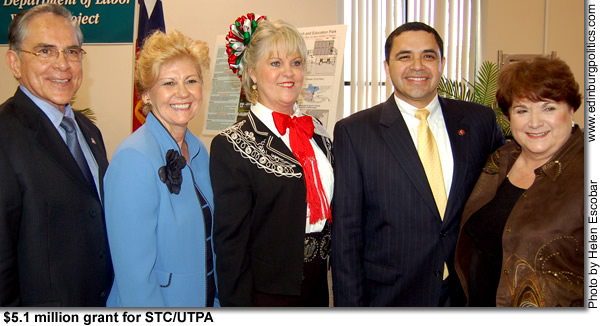
Congressman Rubén Hinojosa, D-Mercedes, and Congressman Henry Cuellar, D-Laredo, were in McAllen on Friday, February 23, to present a $5.1 million grant for the North American Advanced Manufacturing Research and Education Initiative to South Texas College and The University of Texas-Pan American. The grant, which is part of the U.S. Department of Labor’s WIRED (Workforce Innovation in Regional Economic Development) program, will go toward workforce development and the creation of a sustainable manufacturing infrastructure in South Texas’ Rio Grande Valley region. The plan includes the development of a rapid response manufacturing facility as well as integrated educational initiatives to produce skilled workers and managers. The event was held Friday afternoon at STC’s Technology Center at 3100 W. Military Highway. Featured in the photograph, from left, are: Hinojosa; STC President Dr. Shirley A. Reed; Wanda F. Garza, STC’s Executive Director for Workforce and Resource Development; Cuellar; and Dr. Blandina “Bambi” Cárdenas, president of UT-Pan American.
••••••

Joaquín A. Rodríguez was honored by the Edinburg City Council on February 6 for his selection on January 9 as the Boys and Girls Club of Edinburg Youth of the Year 2007. The Edinburg High School senior, currently ranked sixth out of 610 students in his class, has been publicly recognized by both the the city’s elected leadership and the Boys and Girls Club of Edinburg for his superior leadership skills, academic achievements, obstacles overcome, and his service to the three-time All-America City. Featured, from right, are Mayor Joe Ochoa; Joaquín; his father, Carlos Rodríguez; his mother, Nancy Rodríguez; and his brother.
••••••
City Council approves economic incentives for developer of $80 million shopping center
As part of the city’s efforts to bring an 800,000 square foot shopping center, valued at about $80 million and representing hundreds of jobs, the Edinburg City Council on Tuesday, February 20, approved a proposed package of economic incentives that would help the mall developer pay for a portion of the costs of making the retail complex a reality.
The proposed incentives, which will be soon be presented to First Hartford Realty Corporation, Inc., of Connecticut, have been in the works for months by local government leaders, including the Edinburg Economic Development Corporation.
The planned retail mecca would be the latest big addition to the city’s continuing economic growth.
Plans for the shopping center were first announced about a year ago by then Mayor Richard García, who now serves as president of the board of directors of the EEDC, which is the jobs-creation arm of the city council.
Mayor Joe Ochoa, who also sits on the EEDC board of directors, is leading the city council’s efforts to package an incentives deal to move the project forward.
“Those involved in the development agreement that is currently being negotiated, and hopefully will be finalized very shortly, with the developers of the proposed mall project to provide an incentives- based economic development package,” said City Attorney Dan Ríos. “If First Hartford meets certain specific goals throughout the development of the project, the city, in accordance with state laws, will provide for certain incentives for that development.”
He said some of those incentives to be offered by the city include “reimbursements for public improvements that would be dedicated for public use, and also involve certain levels of sales tax incentives and reimbursements, provided they meet construction of square footage. It is a phased-in incentive package.”
The city council and the EEDC since last year have been developing the economic incentives for the planned mall, which would be similar to The Shops at La Cantera in San Antonio.
“If they (First Hartford) meet additional goals, they would be able to seek additional economic incentives,” Ríos said. “Those items that have been negotiated over the past several months would bring a major impact in terms of development and growth that would benefit the city and its citizens. We are pleased with a developer that is contemplating making that type of investment in the area, and that investment, in the council’s view, justified serious consideration of this economic package.”
Ochoa noted that the agreement “states that First Hartford will be building a facility at least 800,000 square feet in size in multiple buildings to be located on approximately 128 acres of land at the northeast corner of the intersection of Business 281 and Trenton Road in Edinburg.
“First Hartford has advised the city that a significant contributing factor that would induce First Hartford to locate and construct the facility in the city is the ability to obtain certain economic development incentives to would assist First Hartford in being able to finance to facility,” the mayor added.
One component of the economic development incentives being provided to the shopping center’s developer, under the development agreement by the city, is a commitment from the city to grant to the First Hartford a portion of the city’s one percent sales tax revenues collected within the Tax Increment Reinvestment Zone to be created by the city, said García.
The city is authorized under Texas law to grant public funds for economic development purposes pursuant to a “program” established under Chapter 380 of the Texas Local Government Code. A resolution approved Tuesday, February 20, by the city council authorizes the establishment of such programs, which must occur before the city grants public funds for economic development purposes.
As a result of the passage of that resolution that evening, the city is able to provide a one percent city sales tax grant detailed in the development agreement.
As part of its economic development strategies, the city council previously authorized the creation of the Local Government Finance Corporation (LGC) to assist with financing and constructing economic development projects within the city in order to promote economic development and to stimulate business and commercial activity in the city, all at the request of the city council.
By DAVID A. DIAZ
[email protected]
••••••
United League Baseball, Edinburg Coyotes make pitch for improvements at city baseball stadium
The city-owned Edinburg Baseball Stadium, home of the Edinburg Coyotes professional baseball club and the University of Texas-Pan American Broncs baseball team, would benefit from the addition of a covered picnic area, an outdoor bar and grill, a large advertising video monitor, and other modifications, leaders of United League Baseball said Tuesday, February 23.
The Edinburg Coyotes are part of the six-member ULB.
Addressing the Edinburg City Council, ULB and Coyotes officials asked the elected leaders to consider approving the proposed capital construction projects, valued at about $100,000, which would be paid for by the league and team.
“This capital improvement project reflects our commitment to the community and the team to provide the best affordable family fun entertainment around,” said Gary Wendt, the principal owner of the Coyotes. “We hope that you approve it – it is a substantial investment by ourselves, and I think it is in everyone’s best interest to support it.”
In exchange for their investment, which must be approved by the city council, the Coyotes asked the city to repair or replace the baseball stadium sound system, to provide additional lighting for security purposes, and to add architectural barriers to prevent cars from parking on the outside concourse of the stadium.
Since the proposal by the ULB and the team came during the public presentation portion of the city council’s meeting, there could be no action taken. However, City Attorney Dan Ríos said the league and team soon would be receiving a written response from the city.
Craig Brasfield, ULB President and Executive General Manager, said the planned improvements are needed to enhance the entertainment value of the stadium, not only for baseball games, but for other outdoor events at the city-owned facility, which opened almost six years ago.
“One thing we recognize is that there is very little that has been done, on a large scale, since its opening in 2001,” Brasfield said. “We just need to do some things that will get the ‘wow’ back. Nowadays, in minor league baseball, if you don’t reinvent yourself, you kind of get stale. We have come up with some ideas we feel will give our organization a better chance for success, as well as offer a much more affordable family entertainment venue for the citizens of this region.”
The $5.6 million complex, which has hosted outdoor gatherings with more than 10,000 people, can continue to reach its potential with the added improvements, Brasfield explained.
“We want to build on the first base side of the stadium, overlooking the home side dugout, an outdoor cantina, or outdoor bar and grill, that will have upscale food, and the ability to serve mixed drinks, beers, soft drinks, and food that will make the experience of coming to an outdoor event much more pleasurable, and give us the chance to draw a day crowd,” Brasfield said. “It will also give us the opportunity to put on other off-game events that will be another reason to come to this facility.”
A second venue in the stadium is also being recommended by the team.
“We want to build a covered picnic pavilion. This is a must for an outdoor facility. We didn’t do very well last year in group outings and picnics because of the summer heat and the lack of cover,” he continued.
“Our idea is to build a 30 foot by 35 foot covered pavilion with ceiling fans and televisions, so now, when we go out to a major corporation to ask them to bring their employees and their families to an event, they can go to a nice covered area with catered meals,” Brasfield revealed. “This pavilion will also offer a great opportunity for the citizens for family reunions, wedding reception, and on and on.”
Both proposed additions would be consistent with the decor of the existing facility, he reassured the council.
The team also wants to build a new ticket booth at the stadium that would eliminate the long wait that many fans now endure.
“The existing ticket system is really tough for the fans,” he acknowledged. “Our idea is to build a ticket booth out in front that would service four to five windows.”
Out in the front of the stadium, facing traffic coming by and to the stadium, the team wants to add a $45,000 video monitor which would allow sponsors to advertise to the thousands of cars that travel by the stadium on a daily basis, much of that flow fed by the ever-expanding UTPA campus.
In addition to its baseball field matching or exceeding the size of many fields in Major League Baseball stadiums, the Edinburg Baseball Stadium also includes a diamond vision scoreboard and luxury boxes.
It is located at the intersection of Sugar Road and Schunior Street, immediately northwest of the University of Texas-Pan American.
By DAVID A. DIAZ
[email protected]
••••••
Luis M. Ríos, Sr., M.D., a pioneer among Hispanic plastic surgeons in Texas, remembered for his contributions to Edinburg and the nation
Luis M. Ríos, M.D., Sr. entered into eternal rest on February 18, 2007. He was born on February 12, 1935 in Mexico City, Mexico.
Dr. Ríos’ father passed away when Dr. Ríos was eight years old, leaving his mother as the sole provider as he grew up in Mexico City. Through the inspired devotion of his beloved mother, María Luisa de Ríos Pastrana, Dr. Ríos excelled in all of his educational pursuits, and graduated from college and medical school in Mexico with honor and distinction.
In 1960, Dr. Ríos was accepted to an internship program at the St. Mary of Nazareth Hospital in Chicago, Illinois where he met his wife, Mary Ann Mungovan. They were married in 1962. They were to celebrate their forty-fifth wedding anniversary on June 23rd of this year.
Soon after their marriage, Dr. Ríos accepted a position as a resident in general surgery at Creighton University in Omaha, Nebraska. He became chief resident of that program. During their time in Nebraska, Dr. Ríos and Mary Ann brought three boys into this world, Luis M. Ríos, Jr., M.D., Daniel G. Ríos and Edward X. Ríos. After the passing of his mother, the family moved to Mexico City in 1966, where Dr. Ríos practiced medicine until 1969. During that time, Jennifer Ann was born.
In 1969, Dr. Ríos entered the plastic surgery residency program at the University of Texas-San Antonio. He completed that program in 1971. Though heavily recruited from established plastic surgery programs from San Antonio and other large cities, Dr. Ríos made the decision to move to the Rio Grande Valley in 1971. He became one of the first Hispanic plastic and reconstructive surgeons in Texas, and was the first plastic and reconstructive surgeon in the Rio Grande Valley, where he treated patients from Starr County to Brownsville.
As his colleagues and thousands of patients can attest, Dr. Ríos dedicated himself to providing incomparable medical care to his patients. Whether destitute or of considerable means, Dr. Ríos never distinguished between his patients, and passionately strove to provide each with the best of care.
These virtues were perhaps best illustrated through his work as the founding member of the Rio Grande Valley Cranial-Facial Anamolies Advisory Group, where he, Dr. Phil Hunke, Dr. David Reed and others donated their time and skills to those, young and old, suffering from debilitating facial deformities. Dr. Ríos felt this group most exemplified the reasons why he became a doctor, and in 1993, the Valley Association of Speech Pathologists and Audiologists awarded him with its Lifetime Achievement Award.
In keeping with his calling, Dr. Ríos served his profession and community humbly, and with great dedication and distinction. He involved himself in many international, national, state, and local organizations, which included the American Society of Plastic and Reconstructive Surgeons, RGV Cranial-Facial Anamolies Advisory Group, American Cleft Lip and Palate Association, Royal Society of Medicine, Association of Military Plastic Surgeons, Texas Board of Medical Examiners, International Academy of Cosmetic Surgery, Hidalgo-Starr County Medical Society, Plastic Surgery Educational Foundation, American Board of Plastic Surgery, American College of Surgeons, Educational Council for Foreign Medical Graduates, Creighton Surgical Society, American Society of Aesthetic Plastic Surgery, Texas Society of Plastic Surgeons and the Maliniac Circle. While he was honored to dedicate much of his time to these organizations, Dr. Ríos never looked beyond the needs of his patients, whom always remained the most important priority of his professional life.
In 2005, the National Endowment for Plastic Surgery awarded Dr. Ríos with its prestigious “Citation for Excellence in Humanitarian Service”, formally recognizing his technical excellence and unwavering devotion to the medical needs of the people of the Rio Grande Valley. While he could not attend the ceremony, his son, Dr. Luis M. Ríos, Jr., also a plastic and reconstructive surgeon, proudly accepted this honor on his behalf.
Dr. Ríos also served his country as an officer in the United States Army where he achieved the rank of Lt. Colonel. He took great pride in applying his surgical skills for the benefit of the men and women serving in the United States Armed Services. He felt this was but a small token of his appreciation for the privilege of obtaining his United States citizenship and for the privilege of living in this country.
Dr. Ríos retired in 2002 and succumbed to a progressive and physically debilitating disease, the onset of which began shortly after his retirement. Throughout his long battle, he remained fully cognizant of his condition and surroundings. He enjoyed spending his last years with his family and grandchildren, Christopher Ríos, Emily Ríos, Nicole Childress, Alyssa Childress, Sydney Childress, Steven Childress, Edward Ríos and Sophia Ríos. During his difficult times, he especially enjoyed all of those friends and patients who visited him.
The family hopes that those, whose lives Dr. Ríos touched, remember him as a humble and skilled servant of his profession, a person who dedicated his heart and soul to the healing of his patients, no matter their circumstances.
Dr. Ríos was blessed to have wonderful doctors who attended to him faithfully, as he would have to them. For this, his family thanks Dr. Jetta Marie Brown, Dr. Tommy Yee, Dr. Roger Vitko, Dr. Ramiro Verdooren, and his beloved dentist, Dr. Joe Villarreal. The family also wishes to thank his caregivers who dedicated themselves to his well-being and comfort during his difficult times. They are Nick Bustamente, Olivia Rodríguez, Lisa Salazar of Innovative Home Health, and Scott Henderson of the Sandy Jo Funk Hospice.
A visitation was held at Kreidler Funeral Home at 314 N. 10th St., McAllen, between noon and 8 p.m. on Friday, February 23, 2007. The family received visitors between 4 p.m. and 8 p.m. There was a prayer service at 7:30 p.m on February 23. The funeral service began at 10 a.m., February 24, 2007, at St. Joseph’s Church in Edinburg.
Dr. Ríos is survived by his loving wife, Mary Ann, his children and grandchildren and Mrs. Luis M. Ríos, Jr., M.D. (Lisa), Mrs. Daniel G. Ríos (Mónica) and Mr. Brett Childress (Jennifer). The pallbearers honoring Dr. Ríos were Mr. David O. Rogers, Jr., José Luis Aliseda, M.D., Joe Villarreal, D.D.S., Mr. Gilbert García, Mr. Joel Huerta, Mr. Albert Bergh, Ali Seif, M.D. (in absentia), Mr. Bill Reynolds and Antonio Ulloa, D.D.S.
The family encourages memorial donations to the World Cranio-Facial Foundation, P.O. Box 515838, Dallas, Texas 75251, or the Parkinson’s Disease Center and Movement Disorders Clinic, Dept. of Neurology, Baylor College of Medicine, 6550 Fannin, Suite 1801, Houston, Texas 77030, or the Society for PSP, Executive Plaza III, 11350 McCormick Road, Suite 906, Hunt Valley, Maryland, 21031 (800)457-4777 or to a charity of one’s choice.
••••••
Sen. Hinojosa, Lt. Gov. Dewhurst announce filing of legislation to require defibrillators in public schools
Sen. Juan “Chuy” Hinojosa, D-McAllen, and Lt. Gov. David Dewhurst on Tuesday, February 19, announced legislation to put Automated External Defibrillators (AEDs) in all Texas public schools.
The bill is set for a public hearing on Tuesday, February 27, by the Senate Committee on Criminal Justice.
Hinojosa and Dewhurst provided details on Senate Bill 7, which will be carried by Hinojosa, during a Capitol news conference.
SB 7 would require every Texas public school to be equipped with a minimum of one AED and a staff member trained in its use.
“I don’t want a family to have to endure the loss of a child when it could have easily been prevented,” Dewhurst said.
Dewhurst thanked Hinojosa for sponsoring SB 7, a key component of the Dewhurst’s comprehensive Texas Children First plan.
“It’s clear that defibrillators save lives, and if we can save even one life by placing a defibrillator in every school, then the state’s investment has been well spent,” Hinojosa said.
Joining Hinojosa as co-authors of SB 7 are Sen. Jane Nelson, R-Lewisville; Sen. Leticia Van de Putte, D-San Antonio; Sen. Bob Deuell, M.D., R-Greenville; and Sen. Florence Shapiro, R-Plano.
According to the Texas Education Agency, almost 4,000 of the state’s nearly 8,000 public school campuses in Texas do not have these critical lifesaving devices. Funding options for acquiring the AEDs include public/private partnerships, donations, grant funding and state general revenue.
“With a solution to save young lives this simple, I can’t think of any reason why AEDs should not be in all public schools,” Dewhurst said.
Also joining Hinojosa and Dewhurst at the Capitol press conference was Laura Friend, co-founder of Parent Heart Watch, a nationwide advocacy organization dedicated to reducing Sudden Cardiac Arrest (SCA) in children.
Friend’s 12 year-old daughter, Sarah, died of SCA in 2004.
“This is an important public policy issue. Most occurrences of Sudden Cardiac Arrest in young people happen in public places like schools. Immediate response with an AED can literally mean the difference between life and death,” Friend said.
Parent Heart Watch supports placing AEDs in all Texas public schools.
Currently only five other states (New York, Maryland, Illinois, Pennsylvania and Rhode Island) have laws specifically regarding the placement of AEDs in public schools, school districts or athletic events. The estimated average cost of a portable AED is approximately $2,000.
••••••
ECISD among leading districts in Texas to place defibrillators in every school
The Edinburg Consolidated ISD is among a handful of school districts who have made it their goal to place an automatic external defibrillators (AEDs) in all 35 of its schools.
While many school districts in the Valley and the state already have AEDs in place in some of their schools through the help of a grant or partial donations to purchase limited amounts, the ECISD school board decided to budget them into their budget to ensure that every school will have one in place within 45 days.
The ECISD school board approved the purchase of AEDs for every campus at last week’s board meetings. The AEDs have been ordered and should be in place within 45-days.
The school district, which spans over a 945-sq. mile area, has 13 school campuses that are out of the Edinburg city limits. At least eight of those schools are located several miles from town where emergency medical services are readily available.
Albert López, coordinator of Health Services for the ECISD, said that placing AEDs in these schools (as well as in all schools) will provide valuable assistance in the event help is needed in these rural schools and an ambulance is several minutes away.
López said the district already has about 200 individuals who have been trained in cardiopulmonary resuscitation (CPR) and use of the AEDs and will bring these individuals together for additional training before the AEDs are put in place at the schools. Lopez said there will be yearly trainings as well to make sure that the AED operators are up-to-date on information and usage.
“The purchase of the AEDs for every campus is another effort by the school board to show the community just how valuable the lives of their students and staff are,” said Gilberto Garza, Jr., interim superintendent of schools. “It wasn’t hard to sell the need for AEDs in all of our schools to the board. They didn’t want to wait for the state to provide funding for them. The board moved quickly to budget the funds and make them available as soon as possible.”
López said AEDs are self-contained, portable medical devices that look somewhat like a briefcase and are easily carried by a handle. The AEDs contain a battery, a control computer and electrodes.
López said when the electrodes are placed on a person, the computer will determine the type of rhythm or arrhythmia present. The control computer will then set necessary power levels and signal whether or not a shock is needed, said López..
AEDs will not allow a shock to be delivered if the person does not require defibrillation. Once the signal is given to administer a shock to the person, the AED operator must be certain no one is touching the person and then manually press a button to deploy the shock, said López.
As more people begin to understand the importance of AEDs in addressing unexpected episodes of cardiac arrest, AEDs are being put into corporate offices, shopping malls, sports stadiums, college campuses, airports, community centers, schools and other places where large groups of people gather daily.
According to the American Heart Association (AHA), about 250,000 Americans die every year of sudden cardiac arrest. The AHA says the chances of a person surviving an unexpected cardiac arrest increases dramatically if defibrillation is available to the person suffering the attack within a few minutes.
Last October, the University Interscholastic League (UIL), the organization that provides educational extracurricular activity guidance for schools, made it a requirement that all public schools in Texas install at least one AED by Aug. 1, 2007. The UIL made this decision following the sudden death of several student athletes in Texas and the successful resuscitation of an athlete at a school equipped with an AED.
••••••
ECISD board approves turf makeover for Cats Stadium to enhance safety for players and others
Come this fall season, the football field at Cats Stadium will have a new look that both the district’s football teams and bands can use as necessary.
The Edinburg CISD school board approved the installation of a synthetic turf to replace the Greg Norman Grass Turf during a January session in which both the Athletic Department and the Fine Arts Department joined forces to ask the board for a new field.
Coach Robert Alaníz, athletic director, said the wear and tear on the present grass turf field does not make for a healthy field. Alaníz said that the use of the field by three high school football teams two to three times a week during the fall can create a situation where it becomes unsafe for a football player and even a member of the band marching on the field.
“Even the best turf cannot withstand the traffic and sustain a safe condition for the use of the field,” said Alaníz.
Alaníz said the new granular infill synthetic turf will be able to sustain daily sports use without any significant deterioration or danger. He said the school district’s sports teams and school bands will be able to use the synthetic turf without damaging the surface.
Alaníz explained that natural grass fields typically cannot be kept in good condition under heavy sports use, and with wet weather, the situation is made worse. The synthetic turf approved by the school board, on the other hand, is a durable product that can handle considerable wear and tear without field deterioration.
“The middle part of a grass football field experiences the worst deterioration,” said Alaníz. “The synthetic turf has the ability to remain uniformly safe across the entire playing surface regardless of the amount of play or weather conditions.”
Alaníz said the likelihood of head-to-ground impact injuries is greatly increased as the condition of a field deteriorates. Additionally, Alaníz said the possibility of rotational leg injuries due to a shoe or cleat binding in the turf are nearly eliminated by using a synthetic field.
He said that last year there 20 football games played at Cats Stadium with the school bands performing at halftime. The football teams and bands did not, however, practice on the field because it would deteriorate the field and create an unsafe playing field.
ECISD Fine Arts Director, Willie Pérez, said that marching bands, which have a reputation as being “grass killers,” can damage a grass field very quickly. The present stadium field, said Pérez, cannot be used because of safety issues for the band students.
Pérez said a synthetic turf will enable the three high school bands to practice and perform on the football field with a turf that is similar to the turf where competitions like the Pigskin Jubilee at McAllen Memorial Stadium, the Bands of America competitions at Rice Stadium and the UIL State Competitions at the Alamodome in San Antonio.
“The band department would be able to host competitions on a local, state and national level,” said Pérez. “These kinds of events here in Edinburg would draw the community together and help to boost the local economy.”
Alaníz said the present cost to maintain the grass field at the stadium is $66,400 per year or $3,320 per game for 20 games. The cost to maintain a synthetic turf for 40 games will be $59,000 per year or $1,475 per game.
Estimated construction costs for the new synthetic turf are $708,000 ($655,600 for the turf with $52,400 for engineering, project management and inspection).
The cost for the new turf is being funded through a budget amendment approved by the school board. Gilberto Garza Jr., interim superintendent of schools, said that the budget amendment allows the district to use budgeted monies from the both the current Athletic Department and the Fine Arts Department budgets. Garza said both departments have been very careful this year in their spending and that the cost for the new turf will be absorbed by the nearly $800,000 in cost savings realized by the departments.
Garza said the economic impact of Cats Stadium having a synthetic turf will greatly benefit the school district. The new turf would allow the district the option of hosting events like play-off games, band competitions and semi-pro games without the worry of damaging the field. He said that last year athletic ticket sales from all sports generated $320,000, of which $273,000 was from football ticket sales.
Construction of the new turf is anticipated to begin in mid-May with completion by August.
••••••
Edinburg Public Library to close down March 4 to prepare for move to Dustin Sekula Memorial Library
The Edinburg Public Library will officially close its doors on Sunday, March 4, at 5 p.m. in preparation of its move to 1906 S. Closner, across the street from the ECHO.
The public library will open as the Dustin Michael Sekula Memorial Library. The opening date of the new library will soon be finalized and announced
The new library will bear the name of local hero Lance Corporal Dustin Michael Sekula, who was the first Hidalgo County casualty of the Iraqi Freedom War. Sekula was an avid reader, cowboy and a brave Marine. The library seeks to reflect some of his outstanding qualities in hopes of inspiring the youth of our community.
This almost 36,000 sq. ft. library will include an expanded children’s area, a built in puppet stage, activity room and garden. Study rooms and a computer training room will also be available.
Materials may still be placed in the book drops at the current library until the opening of the new library. An amnesty period will be scheduled from March 5, 2007 through April 30, 2007 to ensure that all outstanding materials are returned without overdue fines. Patrons are encouraged to bring in any overdue materials during this time.
Library staff will work diligently to ensure that the move is done swiftly so that library services can resume as quickly as possible.
“We look forward to serving the community at our new library where we look forward to hold true to our new motto: ‘The Dustin Michael Sekula Memorial Library … Empowering Our Community,” said Head Librarian Letty Leija.
••••••
Dr. Alejo Salinas, South Texas College trustee and former Edinburg city commissioner, honored for public service
As part of Board Appreciation Month, South Texas College took the opportunity to honor Dr. Alejo Salinas Jr. and Roy de Le?n, as well as the entire Board of Trustees, recognizing their ongoing support of the college’s construction expansion and continued growth.
Salinas was an Edinburg city commissioner during the 1990s before being elected in 1996 as the District 5 trustee, which includes the three-time All-America City, on the community college governing board.
Salinas also is a former superintendent of Hidalgo ISD.
Salinas has served STC since 1996. He is superintendent emeritus for and a clinical lecturer at The University of Texas – Pan American. Roy de Le?n, representing District 7 that includes north east Edinburg, has served the board for 10 years. He was appointed by former Governor Ann Richards to fill the unexpired term of Congressman Ruben Hinojosa and was subsequently elected to the board in May 2002 to a six year term and serves as a vice president for Laredo National Bank.
“Of the many responsibilities the board members have had, none have been as demanding as the construction program implemented by the college since the passage of the $98.7 million bond issue on September 29, 2001,” said Dr. Shirley A. Reed, president of South Texas College. “Sixteen buildings in 16 months at five locations, with three more being completed, is no easy undertaking! The property owned by South Texas College has almost doubled in acreage and state-of-the-art facilities for students, faculty, and staff have now expanded to over 1.3 million square feet. Their commitment is steadfast, their integrity is above reproach, and their expectations for the highest standards and quality are firm. The board’s dedication to providing public accountability for the construction projects serves as a model for community colleges and school districts across this great state of Texas.”
In appreciation of their hard work, each board member was given a scrapbook highlighting the stages and completion of the construction project at the January 2007 Board meeting.
District 2 representative and education icon in the Rio Grande Valley, Irene García, serves as the chair of the board and has been a member of the board for more than six years. Jesse Villarreal, vice chair of the board, has represented District 6 for six years and works as a parent specialist for the Weslaco ISD. Mike Allen, widely known member of the McAllen Economic Development Corporation, serves as the secretary for the board and has been a member of the board since May 2004.
Atlas and Hall managing partner Gary Gurwitz, District 4 representative, and director of transportation for the Rio Grande City ISD Manuel Benavidez Jr., District 1 representative, were both hand-selected by former Governor Richards to serve on the board in 1993 with the inception of the college.
“These are the hardest working people in higher education in the Valley, donating their time supporting and developing new opportunities and initiatives for South Texas College and the citizens of Hidalgo and Starr Counties,” added Reed. “Words alone cannot substitute for the many hours they have taken away from their own profession and family to address the many challenges and opportunities placed before the college. The administration, faculty, staff and students at STC extend our deepest appreciation for their tireless support, dedication and commitment to serving the best interests of our college and the communities of Hidalgo and Starr Counties.”
••••••
Senate committee to investigate claims of abuses of youths in Texas Youth Commission
The Criminal Justice Committee of the Texas Senate on Tuesday, September 27, will delve into allegations of abuse at the state’s troubled Texas Youth Commission (TYC) during a public hearing in Austin scheduled to consider a comprehensive reform bill by Sen. Juan ‘Chuy’ Hinojosa, D-McAllen.
Hinojosa a member of the committee and longtime advocate for juvenile justice reform.
The hearing will be held in Room E1.016 (Hearing Room) in the State Capitol complex beginning at 1:30 p.m., or upon adjournment by the Senate.
Senate Bill 103 by Hinojosa would require TYC to provide 300 hours of training to guards before they begin duties at state facilities, increase staffing to at least one guard for every 12 youths in each facility, and prohibit the current practice of housing youth as young as 11 and 12 with those as old as 19.
Hinojosa’s bill would also authorize the Texas Rangers to make monthly unannounced visits to facilities and submit reports to the state’s Sunset Commission for inclusion in TYC’s review evaluations.
In addition, SB 103 would create a criminal investigations unit, reporting to TYC’s board of directors instead of the agency’s executive director. The investigators would be commissioned peace officers who would investigate criminal acts among TYC youth, guards, and other commission employees.
The Senate Criminal Justice Committee consists of the following members: Sen. John Whitmire, D-Houston, chair; Hinojosa; Sen. Kel Seliger, R-Amarillo; Sen. John Carona, R-Dallas; Sen. Bob Deuell, R-Greenville; Sen. Rodney Ellis, D-Houston; and Sen. Glenn Hegar, R-Katy.
••••••
“Jessica’s Law” clears House Criminal Jurisprudence Committee, now headed for debate on the House floor
The House Committee on Jurisprudence, chaired by Rep. Aaron Peña, D-Edinburg, on Wednesday, February 21, unanimously approved a measure that would deny parole to certain first-time sex offenders and put the death penalty in play for repeat offenders.
House Bill 8 by Rep. Debbie Riddle, R-Houston, has also become known as “Jessica’s Law”, named in memory of Jessica Lunsford, a 9-year old Florida girl who was murdered by a convicted sex offender in 2005.
“I think Chairman Aaron Peña and the other members of the committee should be applauded for the leadership they have shown on this issue,” Riddle said. “This is a clear sign of bipartisan unity, and a positive message to the whole state that politics is not going to stand in the way of the safety of our children.”
Riddle serves on the House Criminal Jurisprudence Committee.
The act would also extend the current statute of limitations on sexually violent offenses committed against children by 10 years, and would mandate GPS monitoring of all civilly committed offenders.
Gov. Rick Perry placed “Jessica’s Law” on his list of emergency issues earlier this session, giving the house permission to hear the bill before the 60 day moratorium on floor debate has elapsed.
••••••
Rep. Gonzáles votes for measure to extend school property tax cuts to senior, disabled homeowners
Rep. Verónica Gonzáles, D-McAllen joined her Democratic colleagues on Tuesday, February 20, in unanimously voting for a constitutional amendment, (SJR 13) extending the tax cuts passed last year to include seniors and disabled persons.
Though the amendment passed unanimously, it had been endangered a week earlier when it was attached to a highly controversial and unprecedented amendment to bust the constitutional state spending limit. Had the issues remained attached, it is likely that the senior tax cut would have died in the Senate as a result, she said.
In addition to passing the tax cuts, Democrats offered three amendments to the bill appropriating the funding for the property tax reductions promised last year (House Bill 2). The amendments would not change the allocation for property tax cuts, rather they would direct leftover money to three specific purposes should the actual cost of the cuts be less than the $14.2 billion set aside in the bill.
“I am proud to stand with all of my Democratic colleagues today. At our urging, the House (Republican) leadership abandoned its plans to hold seniors hostage to the budget debate,” Gonzáles said of the property tax cut. “When it comes to protecting our seniors and the disabled, I am proud we did the right thing.”
Despite its support for the senior tax cut, the American Association of Retired Persons (AARP) came out strongly against the Republicans’ decision to link the heated debate about busting the spending limit to tax cuts for seniors and the disabled, she said.
Because linking the two issues together put the passage of the senior tax cuts in danger, the AARP said last week that the Republican leadership was holding seniors hostage and using them as “political human shields,” she contended.
Under current law, seniors (65 and older) and individuals with disabilities qualify to receive a freeze on the amount of school property tax that can be imposed on their homestead residence. At the same time, other Texas homeowners’ property tax rates were lowered by legislation passed last year.
Without the proportional tax cuts delivered today, many seniors would have received a smaller tax cut than their neighbors. Some seniors and disabled individuals would have received no property tax reduction at all.
Last year, the Legislature met in a special session and passed legislation to cut local school district property taxes for Texas homeowners. At that time, Gonzáles voted to provide a proportionate reduction in property taxes for those seniors and disabled Texans receiving the tax freeze, but it died in the Senate.
In another attempt to fix this problem, immediately following the 2006 general election, several representatives filed legislation to ensure that seniors and disabled Texans receive the same proportional property tax cuts as every other homeowner, she said.
On February 20, Gonzáles again voted to provide seniors and disabled Texans the relief they deserve and, pending the voters’ approval, the legislation will become law.
“The seniors in the Valley can finally rest assured that they will get the same tax cut as everybody else,” Gonzáles said. “The last thing seniors should have to worry about is their financial stability. They have worked hard and they have earned peace of mind. We helped provide that with this vote today.”
Gonzáles said that Democrats offered three amendments to the property tax cut appropriations bill (HB 2):
•Should the price tag for the tax cuts come in under the $14.2 billion allocated for that purpose, the bill initially set aside all remaining funds for future cuts.
•House Democrats proposed using the extra money to improve public schools by funding a teacher pay raise and purchasing new textbooks.
•A third amendment offered by House Democrats proposed to use the excess to increase the homestead exemption to $45,000, which homeowners are allowed to deduct from the taxable value of their home. Middle class homeowners (the vast majority of Texas homeowners) would benefit most from that change.
“Once we have fulfilled our promise for property tax rate cuts, it is time to start talking about other important priorities for educating our children and expanding opportunity for the middle class once again,” said Gonzáles. “It is entirely possible to provide for quality teachers and return money to hardworking middle class homeowners.”
Texas teachers are still paid $4,000 below the national average annually, despite a pay raise passed last year. The state comptroller estimates that more than 37,000 teachers leave the profession every year.
••••••
Sen. Lucio: Teacher retirement pension fund needs upgrade
By Sen. Eddie Lucio, Jr.
We repeatedly hear about the need to pay teachers what they are really worth and to increase their benefits, especially health insurance.
A quieter but just as important related topic is what retired teachers receive from their pension plans. The amounts are not only pitiful, but they fall behind in terms of cost-of-living and inflation adjustments.
To alleviate the financial distress many retired teachers and retired school personnel encounter, I have filed Senate Bill 492. This legislation would increase a retired teacher’s monthly retirement, disability or death benefit by a five percent cost-of-living adjustment. Retired teachers have not received a cost of living increase since 2001.
One of the motivating factors that prompted me to file this bill came from a poignant message written in a letter sent to me by Ms. Sylvia G. Suárez from Brownsville. The retired teacher, who also serves as legislative chair of the Texas Retired Teachers Association (TRTA) for District 1 wrote, “We have given many hours to promote the best education and now we have been forgotten.” Who would not be stirred by such a moving and true comment?
Ms. Suárez also reminded us that “with the higher taxes, increased healthcare cost, higher cost of gasoline, electricity and higher cost of living” their retirement annuities have not increased to meet and maintain a healthy living standard.
As a former educator and someone with many siblings and relatives involved in public education, I can sympathize with the neglect our retired teachers endure. It has been tremendously rewarding to receive hundreds of phone calls from retired teachers throughout the state thanking me just for filing the bill. They understand that this is the first step in a lengthy process that also involves compromise at the financial rung of this legislative ladder.
As a member of the Senate Finance Committee, I will work with my colleagues to make possible this cost of living adjustment, which will be based on the performance of investments of the Teacher Retirement System pension fund. I was glad to be approached the other day by Sen. Robert Duncan, a member of Finance and chair of the State Affairs Committee, who differs slightly on the amount of the increase. He indicated that he would like to join me at the table in finding solutions to this issue.
Mr. Tim Lee, executive director of the TRTA says, “Providing retired educators with a real cost of living raise will help ensure their quality of life during their retirement years.”
The increase would also include retired school paraprofessionals, many of whom live at poverty levels. Some are reported to be receiving pension checks of between $300 to $600 a month. I’ve heard accounts that a retired teacher’s spouse dies and the retiree must sell their home because mortgage payments and upkeep become unaffordable. Texas can do better than this in taking care of the people who have devoted their lives to instructing generations of youngsters. I for one am committed to doing so.
••••••
Texas’ Permanent School Fund tops $25 billion
The Permanent School Fund, the state’s 153-year-old endowment for public schools, on Tuesday, February 20, topped the $25 billion mark for the first time in its history.
The Fund was originally created with a $2 million appropriation from the Texas Legislature in 1854.
“This is an important milestone for the Permanent School Fund. The Fund has consistently been one of the top funds in the world and has provided money for the public schoolchildren of Texas through both good and bad markets. Today, it is performing admirably under the leadership of Holland Timmins, executive administrator, and the prudent oversight of the State Board of Education,” said Geraldine “Tincy” Miller, chair of the State Board of Education.
The Permanent School Fund is the second largest education endowment in the country, trailing only the Harvard University endowment.
The Texas endowment fund experienced strong growth in 2006, earning a return of 14.98 percent, which outperformed the target policy return of 14.41 percent. In calendar year 2006 alone, the Fund grew from $21.9 billion to $24.4 billion.
Timmins said that “the Permanent School Fund is an extraordinary gem that benefits every person living in Texas from students to taxpayers. The Fund has crossed the $25 billion level now due to the very strong return that it experienced in 2006.”
Proceeds and sales from this perpetual fund are used to help finance Texas public schools. It expects to distribute about $1.7 billion to the schools during the 2006-2007 biennium.
The money available for distribution is used to fund the purchase of textbooks for the state’s 4.5 million schoolchildren. This function has earned the Fund the nickname “the children’s textbook fund.”
After paying for the books which are given free of charge to students, the remaining available money is distributed on a per capita basis.
For fiscal year 2006, the per capita distribution was $213 per student, up from 62 cents per student when first distributed in 1855. This is the only state revenue distributed to schools, regardless of the property wealth of a district.
Since 1983, the corpus of the Permanent School Fund has been used to guarantee school bonds. This strong backing means any bond guaranteed by the PSF has the equivalent of an AAA rating, the highest available, and that saves districts millions of dollars in interest and insurance costs.
During the past 24 years, the Bond Guarantee Program has guaranteed more than 3,347 school district bond issues. The amount of these issues is $64.5 billion.
••••••
Sen. Zaffirini files bill to protect Texas children from Internet predators
Sen. Judith Zaffirini, D-Laredo, on Wednesday, February 21, filed legislation to protect Texas children and families from internet predators and cyberstalkers. Part of Lt. Gov, David Dewhurst’s priority legislative package, Senate Bill 6 by Zaffirini significantly will strengthen laws aimed at preventing online child exploitation and cyberstalking, or the use of the internet as means to stalk and harass.
Protecting against internet crimes, exploitation and online solicitation of minors are top priorities outlined in the lieutenant governor’s Texas Children First plan, which promotes a safe and healthy environment for Texas children.
“This bill will protect children, improve public safety and ease concerned parents who want stronger laws to prevent and punish internet crimes in Texas,” Zaffirini said. “According to the Texas Council on Sex Offender Treatment, 45 percent of children nationwide are active online – more than 30 million who are younger than 18. With more than 560,000 sex offenders registered nationally, we must enhance the safety of our young internet users and punish online predators appropriately.”
SB 6 will require internet service providers (ISP) to comply fully with a uniform 48-hour time period to respond to subpoenas, search warrants or other court orders pertaining to the online solicitation of a minor. It will allow prosecutors to seek consecutive prison sentences for the online solicitation of a minor; make the penalty for a conviction of online sexual solicitation of a minor a second degree felony; increase penalties for sexually explicit online communication with a minor; use state rewards programs to emphasize reporting and apprehending predators and criminals; and create a clearinghouse of ISP contact information in the Attorney General’s office so prosecutors can access important information necessary to prevent online predatory behavior.
“I want to thank Sen. Zaffirini for her leadership and for her commitment to protecting our children,” Dewhurst said. “SB 6 is an important part of my Texas Children First plan and sends a strong message that Texas is serious about stopping child predators on the internet, as well as in our schools and neighborhoods.”
SB 6 builds on Zaffirini’s legislation that protects families from online crimes. In 2005 she authored and passed SB 327, the Consumer Protection Against Spyware Act, which made it unlawful for a person or entity to knowingly install spyware. Attorney General Greg Abbott announced last December that a lawsuit based on SB 327 resulted in a multimillion dollar settlement with Sony BMG Music, which installed harmful and problematic “spyware” on more than 100 compact discs sold to Texas consumers.
In 2005, Zaffirini also sponsored and passed HB 1098 by Rep. Brian McCall, R-Plano, which prohibited internet “phishing” or fraudulent websites and e-mails sent to induce victims to divulge personal financial information.
This year she also filed SB 120, which would protect children from internet predators by establishing a clearinghouse of educational resources related to on-line safety at the Attorney General’s office and directing school districts to update their discipline management program to prevent the use of the internet for sexual solicitation.
“Providing online users with safe internet services free from personal exploitation and protecting children and students from online predators are among my highest priorities. This is why I passed SB 327 and HB 1098 last session and filed SB 6 and SB 120 this year,” Zaffirini said. “I appreciate greatly Lt. Governor Dewhurst’s leadership in providing our families with effective and earnest solutions that will prevent our children from becoming victims of online exploitation and solicitation. I look forward to passing these essential bills that will increase public safety throughout Texas.”
••••••
South Texas fugitive child sex offenders arrested in sweep by Attorney General’s Office
Texas Attorney General Greg Abbott’s Fugitive Unit has arrested 12 convicted child sex offenders and two Louisiana criminals during a one-week South Texas fugitive operation.
The Attorney General’s investigators, working with local law enforcement officers in several South Texas counties, arrested eight men for violating Texas sex offender registration requirements. Six parole or probation violators were also arrested in the sweep, including two Louisiana fugitives who went into hiding during the 2005 Hurricane Katrina evacuation.
“Texans expect law enforcement to closely monitor convicted sex offenders. Protecting children is our highest priority,” Abbott said. “The Fugitive Unit will continue aggressively pursuing violent felons and missing parolees who pose a threat to our children. We are grateful to the local police and county sheriff’s departments that helped us locate and arrest these dangerous criminals.”
••••••
Gov. Perry joins leaders in cancer research and technology to champion cancer research initiative
At events in Houston and Dallas on Monday, February 22, Gov. Rick Perry joined leaders in cancer research and technology to champion a $3 billion research initiative focused on finding a cure for cancer. With the sale of the lottery, the state can dedicate $300 million annually toward research efforts. This funding will give stability to important scientific projects, while making Texas a national leader in cancer research.
“Steady funding is particularly important in research endeavors to ensure uninterrupted progression of scientists’ work,” Perry said. “This funding will unite today’s brightest minds in cancer research to work together with our universities and research institutions toward a common goal: curing cancer.”
Today, Texas is home to 400,000 cancer survivors. This year 95,000 people will be diagnosed with cancer, and 34,000 lose their battle with the disease. The resources made available through the cancer research initiative will be used to focus primarily on how cancer metastasizes and pharmaceutical development. Steady financial support also allows Texas to draw many esteemed researchers to the state to work together with universities and other research institutions.
In recent years, the lottery has yielded approximately $1 billion annually. However, this funding is an unstable source of revenue. Selling the lottery for a conservatively estimated $14 billion allows the state to invest in secure trust funds which would annually generate nearly $1.3 billion interest, $300 million more than yearly lottery returns. Gov. Perry proposes using the annual interest gained from the sale of the lottery to establish trust funds in perpetuity for cancer research efforts, public education, and a premium assistance program for the uninsured.
“How we finance cancer research is secondary to whether we do finance cancer research,” Perry said. “We have to reach for the stars today so we can promise a brighter future for the next generations of Texans.”
••••••
Sen. Cornyn lobbies Homeland Security Secretary Chertoff on issues important to border region
U.S. Sen. John Cornyn, R-Texas, Ranking Member of the Immigration, Border Security and Refugees subcommittee, hosted a meeting in Laredo on Wednesday, February 21, with Texas border mayors, county judges and U.S. Department of Homeland Security (DHS) Secretary Michael Chertoff to discuss issues important to the border region.
“It’s critical that local officials along the border continue to have input as we work to secure the border, ensure legitimate trade and travel and address the many issues facing the region,” Cornyn said. “This meeting provided Secretary Chertoff a first-hand look at the border and allowed him to hear the needs and concerns directly from the local community.”
The meeting comes as a follow-up to a recent one in Washington, D.C. co-hosted by Cornyn and Sen. Kay Bailey Hutchison, R-Texas, that brought together Texas border mayors and community leaders with Secretary Chertoff.
Cornyn said he continues working to bolster border security and implement broader reforms of the immigration system.
“Our nation’s security is paramount, but we must also ensure that any security measures adopted are balanced with the goal of facilitating legitimate trade and travel, which is so important to Texas communities along the border,” Cornyn said. “As we move forward on these critical issues, I’ll continue working closely with border leaders to make sure their voices are heard.”
Another topic discussed at the meeting was Cornyn’s work to bring about parity in the admission periods for Canadian and Mexican nationals. He recently introduced The Secure Border Crossing Card Entry Act of 2007, S. 422, which extends the initial period Mexican laser visa holders (who already cleared security checks) can remain in the U.S. from 30 days to six months.
“Laser visa holders are fully screened before being issued secure travel documents and are checked again at the border,” Cornyn said. “Many of them come here to do business and spend money, which boosts the economy in South Texas and contributes to job creation. So this bill maintains security, grows the economy and promotes fairness.”
Implementation of the US-VISIT program was also addressed.
Cornyn said we must ensure the program targets those who may be a threat to national security but also facilitates legitimate travel.
“DHS must continue working hard to ensure that it continually receives the input of the public and interested stakeholders, including officials along the Texas border, on any expansion efforts,” Cornyn said. “Southern border businesses and officials are concerned with the increased delays at border-crossing checkpoints and the impact of the delays on the local economy. We need to develop a quick and efficient process to identify those who may be a threat to national security while allowing legitimate, law-abiding travelers to enter and exit the U.S. in a timely manner.”
On a related note, Cornyn continues to fight against proposed funding cuts to the State Criminal Alien Assistance Program (SCAAP). Cornyn said reducing the critical funding will create unfunded mandates and cause border communities to pick up the tab for this law enforcement work.
“When the federal government fails to live up to its responsibilities on the border, states and counties shouldn’t—and in many cases can’t—pick up the tab,” Cornyn said. “They didn’t create this problem and local communities in Texas shouldn’t be forced to pay for it. As the budget and appropriations process moves forward this year, I will fight against funding cuts to this critical program.”
Cornyn serves on the Armed Services, Judiciary and Budget Committees. In addition, he is Vice Chairman of the Senate Select Committee on Ethics. He serves as the top Republican on the Judiciary Committee’s Immigration, Border Security and Refugees subcommittee and the Armed Services Committee’s Airland subcommittee. He served previously as Texas Attorney General, Texas Supreme Court Justice, and Bexar County District Judge.
••••••
Texas Senate approves memorial resolution honoring life and times of Valley music icon Freddy Fender
The late Valley music recording star Baldemar Huerta of San Benito, better known as Freddy Fender, has been honored by the Texas Senate with a memorial resolution chronicling some of the highlights of the internationally-renowned musician.
The resolution was authored by Sen. Eddie Lucio, Jr., D-Brownsville, and Sen. Juan “Chuy” Hinojosa, D-McAllen. It was unanimously approved by the Texas Senate on Monday, February 19.
The resolution’s text follows:
SENATE RESOLUTION NO. 264
WHEREAS, The Senate of the State of Texas commemorates the life of Freddy Fender, who died October 16, 2006, at the age of 69; and
WHEREAS, He was born Baldemar Huerta in 1937 in San Benito, where he was influenced by the Mexican-polka sound known as conjunto; the son of migrant workers, he worked alongside his
parents in the fields, and there picked up the melancholy sound of the blues in the songs of the black people he worked with; and
WHEREAS, While still just a boy, he was performing on radio and often won contests for his singing; he was proud of his Mexican-American heritage and sang popular tunes of the day in Spanish, including Elvis Presley’s “Don’t Be Cruel” and Harry Belafonte’s “Jamaica Farewell,” which became big hits in Mexico and South America; and
WHEREAS, He took the name Freddy Fender after signing on with Imperial Records in 1959; the following year he recorded “Wasted Days and Wasted Nights”; and
WHEREAS, In the 60s and early 70s, Freddy went through a time of adversity and disappointment, but he returned to prominence in 1974 with the hit, “Before the Next Teardrop Falls”; in 1975, he
won best new artist award from the Academy of Country Music and a rerelease of “Wasted Days and Wasted Nights” topped the country music chart and landed in the top 10 on the pop music chart; and
WHEREAS, He appeared in movies and received a star on the Hollywood Walk of Fame in 1999; he won a Grammy for the best Latin pop album in 2002 and shared two Grammy awards, one with the
Texas Tornados and one with Los Super Seven; and
WHEREAS, Freddy Fender was known for his unique sound and memorable music and he will long be remembered by his family and many fans; now, therefore, be it
RESOLVED, That the Senate of the State of Texas, 80th Legislature, hereby pay tribute to the life of Freddy Fender and extend sincere condolences to the members of his bereaved family; and, be it further
RESOLVED, That a copy of this Resolution be prepared for his family as an expression of deepest sympathy from the Texas Senate, and that when the Senate adjourns this day, it do so in memory of Freddy Fender.
••••••
Museum of South Texas History to offer Children’s class about Huastec culture on March 4
A new class about the Huastec culture in Mexico is being offered to children ages 6 through 12 at the Museum of South Texas History on Sunday, March 4.
There is no fee, other than general admission. Registration in advance is required by phoning 383-6911. Limited space is available. The class will hold 30 and meet two hours.
“The history of the Huastecos is a very complex and fascinating story,” said Melissa Tijerina, Programming Officer for the Museum of South Texas History. “The Huastec are an indigenous people of Mexico historically based in the states of Hidalgo, Vera Cruz, San Luis Potosi and Tamaulipas. The Huastec people call themselves ‘Teenek,’ also the name of their language, which means ‘those who live in the field.’ They were conquered by the Spanish between 1519 and 1530’s.
“The ancient Huastec culture is one of the pre-Columbian Mesoamerican cultures. According to archeological remains, they date back to about 10th Century B.C. The pre-Columbian Huastecs constructed temples, carved sculptures, made pottery and also were known for their musical abilities,” Tijerina added.
“Getting to Know the Huastecan Culture” will be presented by three teachers representing Language Success, a school where several languages are taught in McAllen.
Odette MacDonald, Maribel Nava and Araceli Rodríguez will present story-telling, water colors and pottery while explaining the vivid history of the Huastec Indians. The Huastecos are known for making beautiful pottery with intricate designs. The children who learn about them will learn to paint a sample of their designs.
The Sunday children’s program will teach them about many aspects of the ancient Huastec culture with hands-on activities.
The Museum of South Texas History is located in downtown Edinburg, where the entrance is one block north of the Hidalgo County Courthouse parking lot. Admission fees are $4 for adults, $3 for seniors 62 and over, $2.50 for students over 12 (with ID), and $1.50 for children 4 to 12. Children three and under are free.
by Legislative Media | Feb 19, 2007 | Politics
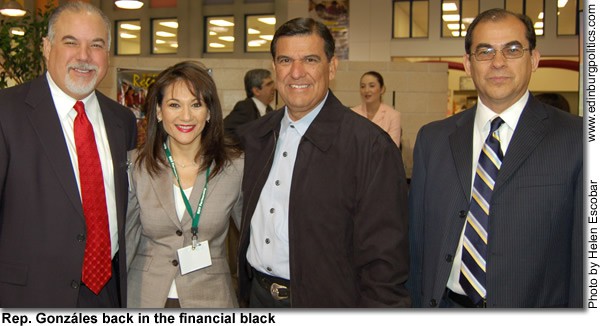
State Verónica Gonzáles, D-McAllen, has much to smile these days after finally paying off campaign loans that had helped finance her successful first run for elected office in the spring of 2004. The South Texas Democrat, featured her during a recent legislative session in McAllen at South Texas College, slowly but surely whittled away at $145,000 in campaign loans until she paid them off last fall. Her financial activities are detailed in her campaign finance report, released in mid-January, that covers the last six months of 2006. Details on her contributions and expenditures are provided later in this posting. Shown with her are from left: Jack Damonr, executive director of Region One Education Service Center in Edinburg; Sen. Eddie Lucio, Jr., D-Brownsville, and Mario Reyna, Division Dean of Business, Science and Technology for STC and president of the Mission Chamber of Commerce.
••••••
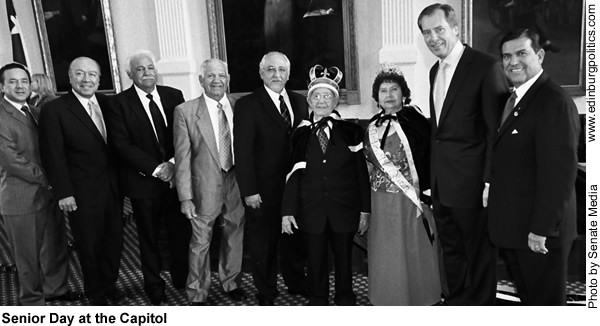
Representatives from Amigos Del Valle, Incorporated, on Tuesday, February 13, were honored with a resolution in the Senate chamber by Sen. Eddie Lucio, Jr., D-Brownsville, Sen. Juan “Chuy” Hinojosa, D-McAllen, and Lt. Gov. David Dewhurst, for their work to improve the lives of seniors citizens in the Rio Grande Valley. Amigos Del Valle is a consortium of county and city governmental entities that provide nutrition, transportation and housing services to the senior citizens of Cameron, Hidalgo and Willacy counties. “This agency assists and encourages senior citizens to live healthy, productive and self-sufficient lives,” said Lucio. “Their work is to be commended and supported.” Amigos Del Valle began offering services to seniors in 1975 with a budget of $375,000, and by 2005 the agency’s budget had increased to approximately $7 million. Thousands of senior citizens have used these services to maintain their health and to live their lives with dignity. The agency consists of an established network of employees and more than 500 volunteers, providing assistance through 32 senior centers, nine senior multifamily rental housing projects and a central kitchen facility. Organizations such as the National Council of La Raza, the Southwest Society on Aging and Hispanic Business Magazine have honored Amigos Del Valle for its outstanding services. Shown from left are: Sen. Carlos Uresti, D-San Antonio; Hinojosa; Emilio Vera, Amigos Del Valle board vice president; former Edinburg Mayor Pro Tem Fred Longoria, board member; José E. Garza, executive director; Luis González (King); Blanca Loya (Queen); Dewhurst; and Lucio.
••••••
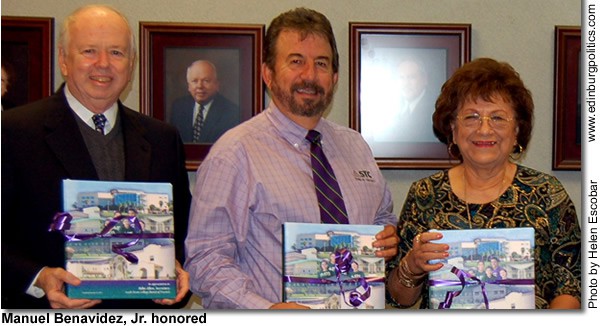
Manuel Benavidez, Jr., featured center, a founding and current member of the South Texas College Board of Trustees, was honored by the Texas House of Representatives for his recent selection as the 2006 Western Region Trustee Leadership Award from the Association of Community Colleges. Benavidez, who represents Starr County on the STC Board of Trustees, is shown here during a separate event involving the community college system, which serves Starr and Hidalgo Counties. Shown in this photo with him are trustees Michael Allen and Irene García. The House resolution honoring Benavidez was authored by Rep. Ryan Guillen, D-Rio Grande City. The text of that resolution follows later in this posting.
••••••
Rep. Verónica Gonzáles pays off final $50,000 in campaign loans that once towered at $145K
With no opponents to worry about last year, Rep. Verónica Gonzáles, D-McAllen, was able to raise enough money during the last six months of 2006 to finally pay off the final third of her campaign finance loans from a San Antonio bank that once found her $145,000 in debt.
Between July 1 and December 31, Gonzáles, whose House District 41 legislative district includes southwest Edinburg, the second-term lawmaker raised $78,560 in campaign contributions from scores of individuals and firms, which helped her pay off $49,999.90 in remaining campaign finance loans she originally drew in 2004 from Frost Bank in San Antonio.
Gonzáles used those loans, along with hundreds of thousands of dollars in additional financial contributions from her many supporters, to defeat long-time incumbent Rep. Roberto Gutiérrez, D-McAllen.
By not drawing any opponents last year – state representatives must run every two years –
Gonzáles was able to focus on raising money to get out of debt. Even after spending more than $63,000 during the last half of 2006 for political expenditures — much of that going to eliminate the bank loans balance – she wound up with more than a $25,000 surplus in her campaign account.
Her campaign finance reports are available online at:
http://www.ethics.state.tx.us/php/filer.php?acct=00054908coh
Gonzáles’ campaign finance report, along with the campaign reports of all state lawmakers, cover the period between July 1 and December 31, 2006.
Her loans from the bank, which were also guaranteed by some of her law partners in her McAllen law office, peaked at $145,000 as of June 20, 2004, and she whittled away at that debt until she made a final $15,000 bank loan repayment on October 30.
On her campaign form, she listed her officeholder address as 605 Water Lilly in McAllen. Her campaign treasurer was identified as one of her law partners, Charles Wesley Kittleman, who listed his address at 301 Toucan in McAllen.
Gonzáles, who says she is a business attorney, is a partner in the firm of Kittleman, Thomas,
Gonzáles, LLP, located at 4900-B North 10th Street in McAllen. Recently, two attorneys linked with political office joined her 13-member firm: Ramón Rosales, Jr., the municipal judge with the City of Mission, and Tracy A. Spillman, former senior attorney to Justice Fred Hinojosa, formerly of the 13th Court of Appeals.
Whether she draws any opponents next year – she will be on the March Democratic Party primary ballot in March 2008 and would have to face any Republican in the November 2008 general election – remains to be seen.
But she and her supporters have demonstrated the willingness to dig deep into their pockets to win and hold on to the legislative seat, spending hundreds of thousands of dollars in her successful rookie campaign against Gutiérrez in the 2004 Democratic Party primary and runoff.
Gonzáles campaign information
Like many well-financed candidates, Gonzáles is not without her share of generous/wealthy supporters, and she has effectively tapped into bankrolls of Austin-based lobbyists and political action committees which often represent the lion’s share of campaign finance contributions.
Her single largest contribution between July 1 and December 31 came from José González, Jr. of McAllen, an attorney with The Watts Law Firm, who gave her $5,000 on December 5.
The Watts Law Firm, a personal injury law firm based in Corpus Christi, is among the top political contributors to Democratic Party causes.
Other major contributors during the final six months of 2006 were:
•R.L. Glazer, chairman of the board of directors of Glazer’s Distributors of Dallas, gave her $3,000 on November 29;
•BG Distribution Partners of Houston, a beverage distributor, gave her $3,000 on November 29;
•Texas Association of Mortgage Attorneys PAC of Houston donated $2,500 on November 29;
•Farmers Employee and Agent PAC of Texas of Austin donated $2,500 on October 20;
•Advanced Orthopaedic Institute of McAllen on McAllen donated $2,500 on September 29;
•Eric Chin, owner of Dos Logistics of Weslaco donated $2,000 on December 5;
•Stanley and Linda Harper of Mansfield, cattle breeders with Harper Cattle Company, gave a total of $1,500 in $500 donations on July 24, August 6, and August 8; and
•Joe A. García of Austin, a lobbyist with The García Group who also represents the City of McAllen, gave a total of $1,500 with two donations – $1,000 on November 29 and $500 on July 24.
Twenty-one individuals or firms each gave her $1,000, one firm gave her $800, two individuals and two firms each donated $750, one individual donated $620, 33 individuals or firms each gave her $500, one individual donated $400, one individual gave her $350, and 30 individuals, firms, or couples each gave her between $100 and $250.
Her largest campaign expenditures were dominated by campaign finance loan repayment to Frost Bank. In addition to the $15,732.29 loan repayment on October 30, Gonzáles also made loan repayments to the bank of $15,000 on October 2, $10,000 on July 6, $5,000 on July 24, $3,062.85 on November 16, $2,000 on November 6, and $1,512.84 on July 13.
Other notable expenditures during the last half of 2006 included a $4,250 payment to Monte Cristo Golf and Country Club, Rt. 1, Box 985-D in Edinburg, for golf tournament fees relating to a campaign fundraiser on October 2, and a $1,000 payment to the House Democratic Caucus, P.O. Box 12453 in Austin, for the 2007 annual dues on December 13.
Contributions
Four individuals, one couple, and 16 firms each donated $1,000 to Gonzáles:
•Valero PAC of San Antonio on December 7;
•Texas Automobile Dealers Association PAC of Austin on December 6;
•Texas Consumer Finance Association PAC of Austin donated $1,000 with two $500 contributions (December 5 and July 24);
•Texas Dental Association PAC – DENPAC of Austin donated $1,000 with two $500 contributions (November 6 and July 11);
•Alan and Patti Harper of Arlington, cattle breeders with Harper Cattle Company, donated $1,000 with two $500 contributions (October 19 and July 24);
•Associated General Contractors of Texas – PAC of Austin on October 18;
•USA Logistics Carriers LLC of McAllen on October 9;
•Roerig Oliveira & Fisher of Brownsville, the law firm for which Rep. Rene Oliveira, D-Brownsville, is a partner, donated $1,000 with two $500 contributions (October 2 and September 26);
•Texas Friends of Time Warner of Houston on September 30;
•Jeffrey Sern of Bellaire, an attorney with Stern Miller & Higdon, on September 29;
•Gilbert Enríquez, former Edinburg school board trustee, on September 28;
•Texas Medical Association PAC – TEXPAC of Austin on September 27;
•Maxxam Inc. Texas PAC of Houston on September 25;
•Burton McCumber & Cortéz LLP of Brownsville on September 14;
•Atlas & Hall, LLP of McAllen on September 13;
•Glen E. Roney of McAllen, chairman of the board of Texas State Bank, on September 7;
•International Bank of Commerce PAC STATE of McAllen on September 6;
•Joseph F. Phillip of Mission, an investor, on August 16;
•HILLCO PAC of Austin on July 24; and
•AT&T Texas PAC of Austin on July 5.
One firm, the Texas Optometric PAC of Austin, on November 6 donated $800 to Gonzáles.
Two individuals and two firms each donated $750 to Gonzáles:
•Greg LaMantia of McAllen, a beer distributor with L&F Distributors LTD, on October 30;
•Carlos C. Guerra of Linn gave her a leather hanging travel bank valued at $750 on October 7;
•Texas Association of Defense Counsel PAC of Austin on October 4; and
•Texas Apartment Association PAC of Austin on September 26.
One individual, José Guerra of Linn, a realtor with El Sendero Properties, on September 30 donated $620 to Gonzáles.
Three individuals, two couples, and 28 firms each donated $500 to Gonzáles:
•ACC Capital Holdings – PAC of Austin on December 9;
•Texas Gas Service PAC of Austin on December 9;
•Abbott Laboratories Employee PAC of Abbot Park, Illinois on December 8;
•Robert De Los Santos, a project manager/developer of New Braunfels, on December 8;
•Association of Texas Professional Educators PAC of Austin on December 8;
•La Joya Federation of Teachers of McAllen on December 7;
•HSBC North American PAC of Prospect Heights, Illinois, on December 6;
•Robert and Gordon Johnson of Austin, attorneys with Johnson & Johnson, on December 6;
•Target Texas of Austin on December 6;
•Ron Lewis and Associates of Austin on December 5;
•Professionals Political Action Committee of Omaha, Nebraska, on November 29;
•Wholesale Beer Distributors of Texas PAC of Austin on November 29;
•Raba-Kistner PAC of San Antonio on November 29;
•HCA Good Government Fund of Austin on October 26;
•Wells Fargo Bank Texas State PAC of San Antonio on October 23;
•James & Kathy Collins of McAllen, a broker/real estate developer with Rioco Corporation, on October 20;
•Halff Associates State PAC of Dallas on October 20;
•Texas State Teachers Association PAC of Austin on October 20;
•Independent Bankers Association of Texas PAC of Austin on October 17;
•John King of McAllen, an attorney, on October 13;
•Carrigan McCloskey & Roberson LLP of Houston on October 12;
•Texas Bankers Association BANKPAC of Austin on October 10;
•Sen. Eddie Lucio Campaign Candidate Office Holder Account of Brownsville on September 30;
•Salinas and Sahadi LLP of McAllen on September 29;
•R.I. Pecina of Mission, a broker/owner of The Pecina Real Estate Group, on September 29;
•Strong Structural Steel LTD of McAllen on September 29;
•Glen and Pat Jarvis of McAllen, with the Law Offices of Glen Jarvis, on September 28;
•Jason Eberlie, president of Eberlie Materials, Inc. of Donna on September 28;
•Law Office of Jacques Treviñõ of Edinburg on September 28;
•Law Offices of García, Quintanilla and Palacios of McAllen on September 27;
•Lewis, Monroe & Peña of Edinburg on September 27;
•González, Gaytan, Garza & Castillo, LLP of McAllen on September 27;
•Wilette & Guerra LLP of McAllen on September 27;
•Robert Elizalde, an agent for State Farm Insurance, of McAllen on September 26;
•David Alaniz, president of Southern Mechanical Air Conditioning of McAllen, on September 20;
•Alejos Sánchez of Edinburg, a contractor, on September 20;
•Arthur Benjamin, president of ATI Enterprises of Dallas, on September 18;
•Mark Wright of McAllen on September 14;
•Robert F. Boggus of McAllen on September 12;
•Keith Patridge of Mission, president of the McAllen Economic Development Corporation, on September 8;
•Michael Toomey of Austin on July 23;
•The Texas Lobby Group LLP of Austin on July 23; and
•Russell Kelley of Austin, a lobbyist, on July 11;
One individual, Mario Martínez of Austin, on September 29, donated $400 to Gonzáles on September 29.
One firm, Trinity Industries Employee PAC of Dallas, on July 24 donated $350 to Gonzáles.
Four firms each donated $300 to Gonzáles:
•Cantey Hanger – PAC of Austin on November 7;
•Andy Brown for State Representative of Austin on November 1;
•Texas Credit Union League PAC of Dallas on August 16; and
•Fullbright & Jaworski LLP Texas Committee on Austin on July 24;
Seven individuals and 12 firms each donated $250 to Gonzáles:
•Chris Bell Campaign of Houston on December 9;
•Lloyd Gosselink Blevins Rochelle & Townsend, PC of Austin on December 9;
•Independent Insurance Agents of Texas PAC of Austin on December 8;
•Verizon Good Government Club of Austin on December 7;
•Caballero Governmental Affairs of Austin on November 29;
•Ch2M Hill Texas PAC of Dallas on November 29;
•Don Durden of Comfort on November 29;
•Hughes and Luce, LLP of Austin on November 29;
•TCB PAC of Houston on November 29;
•Texas Petroleum Marketers and Convenience Store Association PAC of Austin on November 29;
•Neal F. Runnels of McAllen on September 26;
•Merck PAC of Washington, D.C. on September 28;
•Bickerstaff Heath Pollan and Caroom LLP of Austin on September 21;
•Edward Thomas of Austin on September 21;
•Robert Galligan of Mission on September 15;
•Judy Bruce of Manchaca on July 24;
•Bill Pewitt of Austin on July 24;
•Dan Shelley of Austin on July 24; and
•Texas Hospital Association PAC of Austin on July 21.
One individual and one firm each donated $200 to Gonzáles:
•Robert Ramírez of McAllen on December 6; and
•Homepac of Texas of Austin on July 24.
One individual, Rosalie Weisfeld of McAllen, on July 7, donated $180 to Gonzáles.
One couple, two individuals and one firm each donated $150 to Gonzáles:
•Mario Muñoz of Austin on November 29;
•Once Call Concepts PAC of Austin on November 29;
•Bill Summers of Weslaco on November 16;
•Mr. and Mrs. Adolfo Martínez of Mission on July 26;
One individual, Michael Ramey of Pharr, on September 30, donated $120 to Gonzáles.
One couple, two individuals, and four firms each donated $100 to Gonzáles.
•McAllen Federation of Teachers on December 7;
•Friends of Clint Hackney and Company PAC of Austin on November 29;
•Clint Hackney of Austin on November 29;
•Fred L. Kurth of Mission, president of Melden & Hunt, Inc., on September 30;
•Richard and Elizabeth Cantú of Palmhurst on September 27;
•Texas Chiropractic Association PAC of Austin on September 12; and
•Security 1st Federal Credit Union of McAllen on August 16;
Expenditures
$15,732.29
•Frost National Bank, P.O. Box 1600 in San Antonio, for a campaign loan repayment on October 30.
$15,000
•Frost National Bank, P.O. Box 1600 in San Antonio, for a campaign loan repayment on October 2.
$10,000
•Frost National Bank, P.O. Box 1600 in San Antonio, for a campaign loan repayment on July 6.
$5,000
•Frost National Bank, P.O. Box 1600 in San Antonio, for a campaign loan repayment on July 24.
$4,250
•Monte Cristo Golf and Country Club, Rt. 1, Box 985-D in Edinburg, for golf tournament fees relating to a campaign fundraiser on October 2.
$3,062.85
•Frost National Bank, P.O. Box 1600 in San Antonio, for a campaign loan repayment on November 16.
$2,000
•Frost National Bank, P.O. Box 1600 in San Antonio, for a campaign loan repayment on November 6.
$1,512.84
•Frost National Bank, P.O. Box 1600 in San Antonio, for a campaign loan repayment on July 13.
$1,000
•House Democratic Caucus, P.O. Box 12453 in Austin, for the 2007 annual dues on December 13.
$741.51
•Jones & Cook Stationers, 5001 N. McColl Road in McAllen, for stationary on September 27.
$502.50
•HEB, 901 Trenton Road in McAllen, for turkeys donation reimbursement to Ricardo López-Guerra on November 21.
$500
•Palmer Drug Abuse Program, 115 North 9th Street in McAllen, for a donation on August 4.
$364.04
•CopyZone, 4131 North 10th Street in McAllen, for brochure printing reimbursement to Ricardo López-Guerra, on August 17.
$350
•Peak Performance, P.O. Box 427 in McAllen, for a benefit marathon sponsorship on November 2.
$278.48
•Esperanza Chapa, P.O. Box 6792 in McAllen, for Chrismas Card design and print on December 7.
$235
•McAllen Evening Lions Club, 205 N. 15th Street in McAllen, for a donation on August 3.
$232.72
•Texas Department of Criminal Justice Manufacturing and Logistics, P.O. Box 4013 in Huntsville, for a reimbursement to Ricardo López-Guerra for a constitutional chair on August 3.
$225
•Creative Academic Achievement Pro-Success Learning Center, 205 North 15th, McAllen, for a donation on November 21.
$200
•Muscular Dystrophy Association, 222 E. Van Buren in Harlingen, for a donation on August 14.
$170.46
•Sam’s Club, 1400 E. Jackson Avenue in McAllen, for a reimbursement to Ricardo López-Guerra for bottled water for a marathon sponsorship on November 28.
$120.70
•Central Market, 4001 N. Lamar Blvd in Austin, for gift baskets on July 28.
$106.96
•Hobby Lobby, 7600 N. 10th Street in McAllen, for a framing reimbursement to Edna Dougherty on July 1.
$101.21
•Hewlett-White, 212 North Main Street in McAllen, for a floral arrangement for a constituent on July 14.
$100 each
•Digital Graphics Concepts, P.O. Box 6792 in McAllen, for brochure design on August 15; and
Edinburg All-Stars Pinto Division, P.O. Box 3454 in Edinburg, for a donation of July 14.
$57.24
•Kittleman Thomas & Gonzáles LLP, 4900 N. 10th Street, Suite B, in McAllen for telephone/copy/fax expenses on September 11.
$46.71
•Kittleman Thomas & Gonzáles LLP, 4900 N. 10th Street, Suite B, in McAllen for telephone/copy/fax expenses on October 6.
$39
•Quips ‘n’ Quotes Post Office, 5011 North 10th in McAllen, as a reimbursement to Ricardo López-Guerra on December 12.
$23.40
•Quips ‘n’ Quotes Post Office, 5011 North 10th in McAllen, as a reimbursement to Ricardo López-Guerra on December 13.
$22.73
•CopyZone, 4131 North 10th Street in McAllen, for presentation reimbursement to Ricardo Lopez-Guerra on October 19.
$17.09
•Kittleman Thomas & Gonzáles LLP, 4900 N. 10th Street, Suite B, in McAllen for telephone/copy/fax expenses on December 5.
$15.60
•Quips ‘n’ Quotes Post Office, 5011 North 10th in McAllen, as a reimbursement to Ricardo López-Guerra on December 12.
$8.64
•HEB, 901 Trenton Road in McAllen, for a turkey donation reimbursement to Ricardo López-Guerra on November 22.
By DAVID A. DIAZ
[email protected]
••••••
Sen. Hinojosa files bill to allow greater access to state government documents
Sen. Juan “Chuy” Hinojosa, D-McAllen, on Friday, February 16, filed Senate Bill 446 to implement an Open Document Format for all government documents in Texas to insure that documents in Texas are free and accessible to every Texan.
SB 446 levels the playing field for multiple software providers and saves money for Texans since they will not have to buy specific software to access government documents.
Hinojosa said his bill will ensure that public documents are accessible to everyone in the future, and that Texas can manage its government documents in the most cost affordable way.
“As a representative of the people of Texas, I want to insure that our historical documents and our future government documents are always accessible to the people they belong too,” Hinojosa said. “Senate bill 446 allows our documents to be presented in an open format. Most Texans don’t realize that the fine print in corporate licensing agreements is creating a legal barrier that could deny access for future generations down the road.”
Jake Knoblach, founder of Uptime Computing, based in Austin, said that he was pleased to hear that Texas will be among the first states to begin using an open document format.
“Texans can be proud today knowing that Sen. Hinojosa understands that our government cannot be truly open when the people’s documents are kept in closed digital formats,” Knoblach said.
Open Document Format (ODF) is available for free and compatible with several different software packages. Massachusetts has already adopted Open Document Format for all of its government documents.
••••••
Rep. Peña files bill seeking $5 million in state funding for UT RAHC in Edinburg
Rep. Aaron Peña, D-Edinburg, has filed legislation which proposes to secure $5 million in state funding for the University of Texas Regional Academic Health Center at Edinburg. Peña filed House Bill 1375, which would appropriate the funds beginning in September 2007.
“We have a first-class research facility next the campus of the University of Texas Pan American,” said Peña. “These $5 million will help recruit and staff the RAHC with first-class scientists to match.”
Dr. Francisco Cigarroa, President of the University of Texas Health Science Center in San Antonio, lauded Peña’s efforts.
“The $5 million dollars is essential for the overall growth of the Regional Academic Health Center and the economic impact to the Rio Grande Valley and our great State of Texas.”
The University of Texas Health Science Center at San Antonio administers the RAHC’s medical education division in Harlingen and the medical research division in Edinburg. UTPA serves as a partner in providing faculty, administrative and research support for Edinburg’s facility. Research areas may include diabetes, emerging infectious diseases, aging, environmental health, mental health and health services.
“The RAHC not only serves as a medical research facility but it can spur economic development in our community,” said Peña. ‘”The influx of scientists, researchers and technology can have the effect of creating businesses to support their projects.”
The text of House Bill 1375 follows:
A BILL TO BE ENTITLED
AN ACT
relating to making an appropriation to The University of Texas Health Science Center at San Antonio for the purpose of supporting the Regional Academic Health Center.
BE IT ENACTED BY THE LEGISLATURE OF THE STATE OF TEXAS:
SECTION 1. In addition to other amounts appropriated for the state fiscal biennium beginning September 1, 2007, the amount of $5 million is appropriated for that biennium out of the general
revenue fund to The University of Texas Health Science Center at San Antonio for the purpose of supporting the Regional Academic Health Center established under Section 74.611, Education Code.
SECTION 2. This Act takes effect immediately if it receives a vote of two-thirds of all the members elected to each house, as provided by Section 39, Article III, Texas Constitution. If this Act does not receive the vote necessary for immediate effect, this Act takes effect on the 91st day after the last day of the legislative session.
Peña is serving his third term in the Texas House of Representatives. He is Chairman of the House Committee on Criminal Jurisprudence and is a member of the House Committee on Ways and Means.
••••••
Texas Daily Newspaper Association opposes public information restrictions proposed by some Valley lawmakers
The Texas Daily Newspaper Association, a membership service organization representing newspaper publishers and editors of Texas daily newspapers, is tracking state legislation that affects the media and the public. Included in the list of legislation it is tracking are several measures by Valley lawmakers.
Those bills, and the TDNA’s position on those measures as of February 19, follows:
•Senate Bill 74 by Sen. Eddie Lucio, D-Brownsville
The Texas Press Association OPPOSES SB 74.
Relating to the creation of an address confidentiality program to assist victims of family violence, sexual assault, or stalking in maintaining confidential addresses.
Type: public information
Status: referred to State Affairs, 1/23
Comments: [SAME AS HB 569 by Verónica Gonzáles.] Would amend Code of Criminal Procedure chapter 56, so that victims could participate in an address confidentiality program. Requires attorney general to destroy all information relating to a participant on the third anniversary of the date of participation in the program.
•House Bill 569 by Rep. Verónica Gonzáles, D-McAllen
The Texas Daily Newspaper Association OPPOSES HB 569
Relating to the creation of an address confidentiality program to assist victims of family violence, sexual assault, or stalking in maintaining confidential addresses.
Type: public information
Status: referred to Juvenile Justice, 2/6/07
Comments: [SAME AS SB 74 by Lucio.] Would amend Code of Criminal Procedure by adding Subchapter C titled ADDRESS CONFIDENTIALITY PROGRAM FOR VICTIMS OF FAMILY VIOLENCE, SEXUAL ASSAULT, OR STALKING. This simply may be conforming language: substantial protections already in statute, under Public Information Act 552.138 titled FAMILY VIOLENCE SHELTER CENTER and SEXUAL ASSAULT PROGRAM INFORMATION.
•House Bill 597 by Rep. Ryan Guillen, D-Rio Grande City
The Texas Daily Newspaper Association OPPOSES HB 597.
Relating to the creation of an address confidentiality program to assist victims of family violence or stalking in maintaining confidential addresses.
Type: public information
Status: referred to Juvenile Justice, 2/6/07
Comments: Would amend Code of Criminal Procedure by adding Subchapter C titled ADDRESS CONFIDENTIALITY PROGRAM FOR VICTIMS OF FAMILY VIOLENCE OR STALKING. This simply may be conforming language: substantial protections already in statute, under Public Information Act 552.138 titled FAMILY VIOLENCE SHELTER CENTER and SEXUAL ASSAULT PROGRAM INFORMATION. See similar bills, HB 172 by Raymond and HB 569 by Gonzáles.
•House Bill 1042 by Rep. Aaron Peña, D-Edinburg
The Texas Daily Newspaper Association OPPOSES HB 1042..
Relating to excepting certain crime victim information from required disclosure under the public information law.
Type: public information
Status: referred to Criminal Jurisprudence, 2/12/07
Comments: [SAME AS SB 636 by Hegar.] Would amend Public Information Act, Section 552.132, Government Code, titled EXCEPTION: CONFIDENTIALITY OF CRIME VICTIM INFORMATION. Adds “claimant” to the exception.
••••••
TV news icon Dan Rather addresses students and public at the University of Texas-Pan American
Distinguished TV journalist Dan Rather described himself as lifetime reporter not only from Texas but “of Texas” to a packed house at The University of Texas-Pan American Fine Arts Auditorium on Tuesday, February 13.
Rather addressed students, faculty and community members as the third speaker in this academic year’s Distinguished Speakers Series.
Still looking fit and strong of voice at age 75, Rather reflected on his beginnings in a business where he called himself lucky and how journalism had changed over the years from his start at a small radio station in Huntsville, Texas while going to college at then Sam Houston State Teacher’s College.
My goal early on was to become a world-class reporter with quality, integrity and trustworthiness,” said Rather, who only 48 hours earlier had been in Kabul, Afghanistan preparing a story for his current weekly news show “Dan Rather Reports” on the new cable channel HDNet. Rather left CBS in 2005 after more than 40 years with the network.
“I am humbled that I have been so blessed and lucky to be in journalism for as long as I have and that I have been able to live my dream,” said Rather, who has won numerous accolades for his work including Emmy and Peabody awards.
Rather, who first went to Afghanistan in 1980 during the Soviet invasion of the country, told local reporters at a press conference that there are great differences between Iraq and Afghanistan and predicted that 2007 would be a particularly bloody and expensive year for Afghanistan.
“In the long sweep of history, what happens in Afghanistan may be even more important to U.S. national security and peace and stability in the world than what happens in Iraq,” he said.
Another situation, Rather said, that is especially threatening to U.S. national security is the increasing influence of the drug cartels in northern Mexico, calling it an underreported important story.
“There is a tendency to say ‘it’s Mexico, it’s down there.’ But, what happens in Mexico affects everyone in the United States,” he said.
To a question about his use over the years of colorful, often folksy analogies and descriptions during live broadcasts, that have come to be called “Ratherisms,” Rather said they stemmed from growing up in Texas around people who talked that way.
“My father worked with his back and his hands all his life in the oil fields. It made the day go easier if you didn’t describe things the same old way every time. For example, you can say ‘the boss is mad’ but it gives everyone a little smile if you say ‘the boss is as mad as a rained-on rooster,’” the Wharton, Texas native said.
The Distinguished Speaker Series is funded by student fees with the goal of bringing prestigious speakers offering different world view perspectives to help educate and inspire students. During a private dinner with a group of student leaders and University administrators, Rather was able to share a bit of his story on how he became a journalist and where the future of media is headed before fielding questions.
Rather discussed with students the role of journalism in politics. He said journalists are a part of the “system of checks and balances” for the country as well as its watchdog.
“What does a good watchdog do? A good watchdog barks at everything that is suspicious … A watchdog is not an attack dog,” he said. “Despite what some people will have you believe, this is my opinion, the greater danger is not that the press in its watchdog role will become an attack dog, the greater threat is that it will become a lapdog.”
He also touched on how the Internet has changed the way the public gets its news. While Rather said he was bullish on use of the Internet in news reporting, he worries about its lack of accountability and said as the world dives deeper into the Internet era, a new definition for “news” will have to be identified.
“We need to redefine who is and who isn’t a journalist, and what is a journalist,” he said. “I will come straight out at you and be candid and I would prefer that this not nail me as yesterday’s man, but about this I am a little old fashioned. Not everybody who has some information and puts it out is a journalist or at least in my opinion is worthy of the name journalist.”
Before his remarks and a question and answer session at his public presentation to an audience of more than 700, Rather asked for a moment of silence to honor the contributions and sacrifices of the men and women in uniform in Iraq and Afghanistan. Rather, who has covered combat at the front lines from Vietnam to Iraq, several times choked back emotion when talking about covering American troops and his other significant life experiences.
Rather said his career started in an institution very much like UTPA where a lot of students were the first in their families to attend college. His parents, he said, never got an education beyond the ninth grade but recalled that his father was an avid reader of newspapers, calling them a “poor man’s University” and instilled in Rather the idea that news was important. That coupled with growing up hearing world-renown journalist Edward R. Murrow’s “This is London” reports during the London blitz in World War II cemented his goal to be a great reporter.
“Radio became my best friend. His (Murrow’s) reports were not only known for their news value but also for their immediacy, for the way they took the listener right into the heart of what was happening,” said Rather, noting Murrow’s coverage helped changed the course of history and showed Rather the power of great journalism.
“The news is the raw material of democracy. It is the best and sometimes only way for citizens to assess whether our elected leaders, our laws and our policies are serving our interests or not,” he said.
Rather expressed concern about the greater concentration of ownership of news outlets in fewer hands, many by conglomerates where news is not their primary business and where an important news story might conflict with the interest of one of their other businesses and be suppressed or with reporters being told how to write the news.
“News of integrity often begins and ends with news owners who have guts,” he said.
Rather ended his talk by giving the audience the best definition of news that he has found and encouraging continued interest by people, especially young people in current events and public life.
“News is something that you the public needs; it is something that is important for the public to know which someone, somewhere, most often a powerful person doesn’t want you to know. That’s news, all the rest is advertising,” he said. “Consider your news sources with care. Demand accuracy and truth from your news and from your elected leaders. Don’t be afraid, as too many of us journalists have become, of asking the tough questions. In a democracy, questioning authority is the purest form of patriotism.”
For Elvis Cavazos, a senior majoring in chemistry, meeting Rather at the dinner was very exciting and something he will always remember. He said he was amazed at how someone of Rather’s stature was so down to earth and approachable.
“I really enjoyed the fact that he is from Texas and that he has not lost any of that Texan mentality and I really enjoyed learning that after traveling the world he still identifies himself as a Texan rather than a citizen of the world or a member of the global community,” Cavazos said.
The Weslaco native said he appreciated hearing Rather’s own personal stories and his views on journalism and the direction the country is heading.
“I guess the main lesson I learned was to do the things you want to do and to not let anyone, no matter their position or your position, affect your decision in life,” Cavazos said.
••••••
Edinburg school board moves to make campus safety a priority, hires 18 more officers for elementary schools
In keeping with its commitment to make school safety a high priority, the Edinburg school board in December approved the funding for 18 new Police Security Officers (PSOs) to serve the district’s elementary schools who have not had the presence of security on their campuses, announced Gilberto Garza, Jr. interim superintendent of schools.
After a recent successful job fair at the Central Administration building specifically to fill new security officer positions, the Edinburg school district hired 18 new PSOs from among 100 plus applicants, said Garza.
The school board voted to amend the budget by $256,626 to hire the PSOs effective January 4 through the remainder of the 2006-2007 school year. The budget amendment covered costs for officer salaries for 97 days; costs for employee uniforms and equipment; and costs for employee benefits. The costs for the PSOs for the 2007-2008 school year will be included in the new budget when it is prepared.
“The board of trustees and the school district are completely and totally committed to making school safety a high priority,” said Garza. “We want to make every effort possible to ensure that our students, faculty, staff and parent volunteers who attend school and/or work at our 35 campuses are safe and secure each and every day.”
The addition of 18 officers brings the number of PSOs the district has to 40. B Because PSOs are not certified police officers, they are not licensed to carry firearms, but they do provide a police presence nevertheless. The district also has 50 commissioned police officers who are armed.
Garza said that each of the middle schools have three police officers; three PSOs; and a truancy officer to help the principal and staff maintain order and provide security. Each of the high schools has three police officers; four PSOs; a truancy officer; and a camera monitor for the security cameras, said Garza.
Garza said the Edinburg CISD is also implementing other efforts to address campus safety. He said every school campus has its own Emergency Operations, a plan that custom fits their school and its needs.
Additionally, Garza said there are school guidance activities; enforcement of the Student Code of Conduct; Crisis Management training and procedures; mutual aid partnerships with local, county and state law enforcement agencies; safety and security drills; campus visitor check-in procedures; and Lockdown and Intruder procedures that are some of the everyday Standard Operating Procedures the district is using to address school safety.
“Our lockdown procedures are initiated whenever it is determined by our campus principals there is an immediate and/or potential threat to our students and campus staff,” said Garza. “The purpose of the lockdown is to protect students and staff by keeping them inside of building and separating them from any and all imminent danger by locking doors and avoiding window areas, closing curtains and turning off lights.”
“During a lockdown, no one is allowed to enter or exit a building until the all-clear signal is given,” said Garza. “Our campus staff and students are familiar with the lockdown process.”
Visitors to school campuses are asked to sign in and show identity if they are seeking to check out students, Garza said.
“Our procedures call for students to only be released to individuals who have been authorized to pick up or check out students,” said Garza. “If an issue were ever to arise, rest assured that the campus principal, staff, central administration and school district police will mobilize to address the issue and bring about as quick and immediate a resolution as possible.”
••••••
Bill to set up video lottery terminals is filed by Rep. Flores
Rep. Ismael “Kino” Flores, D-Palmview, on Tuesday, February 13, filed legislation that will bring video lottery terminals (VLTs) to Texas, helping to keep gaming dollars in the state and provide more than $1.2 billion in new annual revenue.
HB 1405 would also help save the Texas horseracing industry, which is struggling to compete with tracks in neighboring states that offer alternative forms of gaming, including VLTs.
“When it comes to spending gaming dollars, it’s clear that a vast majority of Texans would rather spend it inside state lines,” said Flores. “Authorizing VLTs at locations where gaming is already conducted, such as racetracks, will level the playing field with neighboring states, bring significant new revenue, and promote economic activity around racing and agribusiness.”
Under HB 1405, VLTs – electronically stimulated games of chance displayed on video terminals – connected to a state-selected and state-controlled video lottery central system are to be placed at locations determined in accordance with the law.
According to the bill, only state-controlled video lottery games would be authorized to be conducted in Texas and only in locations licensed as video lottery terminal establishments, including racetracks and locations on Native American lands. Ultimately, voters would have to approve authorizing VLTs in Texas if the constitutional amendment passes both chambers.
HB 1405 will also help the agribusiness sector, which would benefit from increased sales of feed and equipment such as travel trailers. The Texas Department of Agriculture states that the overall Texas horse industry represents more than $16 billion in total expenditures. Of that amount, more than 33 percent can be attributed to racing and related production. The Texas racing industry is currently struggling to compete with neighboring states, which offer legalized alternative forms of gaming at their racetracks, and thus higher purses. Many horse breeders and related businesses are leaving the state due to low purses.
“Each year, billions of dollars leave Texas for neighboring states that have VLTs, which, among other things, is hampering our racing and agriculture industries,” said Flores. “This bill will help save the horseracing and related industries in Texas and stop the export of a homegrown state resource.”
During the 79th Legislature, the Perryman Group, an economic analyst firm, reported that VLTs operating tracks in Texas would provide almost $1.5 billion in yearly state revenue and would create 72,000 jobs. Much of the revenue would come from the reported $2.8 billion that leaves Texas every year when citizens go across state lines for gaming.
Under Flores’ bill, the state would receive 35 percent of the net terminal income for each video lottery terminal. The retailer or manager would retain 65 percent. The state share would be deposited in the State Video Lottery Account, which is a special account in the general revenue fund.
Flores serves as Chairman of the Committee on Licensing and Administrative Procedures and represents District 36, which includes parts or all of the Cities of Hidalgo, Granjeno, McAllen, Mission, Palmview, Penitas, and Pharr.
••••••
Hidalgo County delegation courts legislators
Hidalgo County Judge J.D. Salinas and several officials were in Austin on Friday, February 14, to visit state legislators at the Texas Capital in hopes of winning more state funding for their constituents.
“We send letters and make phone calls, so we’re in constant contact with our state representatives and senators,” Salinas said. “And we know they’re fighting hard for Hidalgo County.
“But there’s nothing like showing up on the House floor or the Senate floor and having the rest of the state take a look at us and making the connection to our needs here,” Salinas added. “We want more attention from the state for South Texas—and not just for immigration concerns, either. The state needs to help us with health care, roads and infrastructure.”
The delegation’s scheduled included resolutions in honor of Hidalgo County’s history and achievements which were read on the House and Senate floors, where Salinas met Speaker of the House Speaker Tom Craddick and Lt. Gov. David Dewhurst.
••••••
Hidalgo County honored by state lawmakers during Hidalgo County Day at Capitol
House Resolution 386, filed on February 14. recognized the history and achievements of Hidalgo County, one of the largest metropolitan regions of the state.
The legislation was jointly authored by Rep. Ismael “Kino” Flores, D-Palmview; Rep. Verónica Gonzáles, D-McAllen, Rep. Armando “Mando” Martínez, D-Weslaco; and Rep. Aaron Peña, D-Edinburg.
The test of the resolution follows:
RESOLUTION 386
WHEREAS, Citizens of Hidalgo County are gathering at the State Capitol to celebrate Hidalgo County Day on February 14, 2007; and
WHEREAS, Inhabited by humans for 11,000 years, this region of the Rio Grande delta has been the home of the Coahuiltecans, the Karankawa, the Lipan Apaches, and the Comanche; and
WHEREAS, The first Spanish visitors arrived in the 17th century; in 1749 Jose de Escandon established four towns along the Rio Grande; 19 land grants were issued in the area by the governments of Spain and Mexico, leading to the creation of many successful cattle and sheep ranches; and
WHEREAS, After the end of the Mexican-American War in 1848, the region became part of the United States and a popular way station for prospectors traveling to the California Gold Rush;
established in 1852, Hidalgo County was named for Miguel Hidalgo y Costilla, an advocate for Mexican independence; in the early 20th century, the town of Chapin was renamed Edinburg and made county seat; and
WHEREAS, The arrival of the railway in 1904 helped introduce large-scale farming in the county, particularly of citrus, cotton, corn, and sugarcane; with the establishment in 1924 of a regional
Texas Agricultural Experiment Station in Weslaco, the towns along Highway 83 began to thrive and came to be described as “the longest main street in the world”; and
WHEREAS, While farming and ranching remain important to the county, the discovery of oil in 1934 increased the region’s prosperity; today the county is a major port of entry into the United States, and the shipment of goods from Mexico is an essential part of the county’s economy; and
WHEREAS, The educational needs of the county’s citizens are well served by The University of Texas-Pan American in Edinburg and South Texas College in McAllen; the county also boasts the Museum for South Texas History, which explores the history and blended cultural heritage of South Texas, and the International Museum of Art and Science, an affiliate of the Smithsonian Institution; the Valley Symphony Orchestra and Chorale performs a six-concert subscription season every year, as well as eight educational concerts; and
WHEREAS, Residents and visitors alike enjoy the many attractions of Hidalgo County; the Texas Citrus Fiesta in Mission every winter features a carnival and the Parade of Oranges; in Weslaco the Rio Grande Valley Onion Festival in April includes food booths, entertainment, and onion recipe contests; the Rio Grande Valley Livestock Show in Mercedes draws an average attendance of
160,000 every March; with nearly 400 species of birds, the Santa Ana National Wildlife Refuge near Alamo is an international destination for birders; and
WHEREAS, Led by County Judge J. D. Salinas and County Commissioners Sylvia S. Handy, Hector “Tito” Palacios, Joe M. Flores, and Óscar L. Garza, Jr., the residents of this dynamic region of the Lone Star State have much to be proud of, as they celebrate the past and work to build a bright and prosperous future; now, therefore, be it
RESOLVED, That the House of Representatives of the 80th Texas Legislature hereby recognize February 14, 2007, as Hidalgo County Day at the State Capitol and extend to the visiting delegation
sincere best wishes for an informative and enjoyable visit to Austin.
••••••
“Jessica’s Law” set for public hearing on Tuesday, February 20, before House Committee on Criminal Jurisprudence
The House Committee on Criminal Jurisprudence announced on Wednesday, February14, that t it would consider House Bill 8, also known as Jessica’s Law, in a public hearing on Tuesday, February 20.
The bill’s author, Rep. Debbie Riddle, R-Houston, said the legislation will make Texas a leader in the fight against sex offenders.
“In Texas, we have always set the mark for other states when it comes to the way we deal with our most evil and violent criminals,” Riddle said. “There is nothing more evil than a person who would sexually assault a child, and there is no higher priority for this legislature than making sure our children are safe from these predators.”
Jessica Lunsford was only 9 years old in February of 2005 when she was abducted from her bedroom in Florida by convicted sex offender, John Couey. He took her to his house and sexually assaulted her for three days before burying her alive in his backyard.
The Florida legislature was the first to pass “Jessica’s Law” that same year, and since then the title has been shared by dozens of pieces of legislation in more than 20 states that aim to increase penalties for sex offenders.
Riddle said HB 8 would deny parole to those convicted of sexually assaulting victims younger than 14 years old on a first offense, and would make repeat offenders eligible for the death penalty on a second offense. The bill also lengthens by ten years the statute of limitations for sexual assault of a child, and mandates GPS monitoring of civilly committed offenders.
The committee will meet at 2:00 p.m. in room E2.016.
Riddle is a member of the House Committee on Criminal Jurisprudence, serving as chairman of budget and oversight for that panel on the House Appropriations Committee.
Rep. Aaron Peña, D-Edinburg, is chairman of the House Committee on Criminal Jurisprudence, and as such, determines what legislation is heard by that committee.
The committee hearing agenda follows:
HB 62
Leibowitz
Relating to the proximity of the residences of certain sex offenders or sexually violent predators to schools; imposing a criminal penalty.
HB 63
Leibowitz
Relating to the proximity of a school bus stop to the residence of a sex offender.
HB 165
Raymond
Relating to certain requirements imposed on a sex offender who enters the premises of a public park.
HB 8
Riddle / et al.
Relating to the prosecution, punishment, and supervision of certain sex offenders and to certain crimes involving sex offenders.
HB 148
Phillips
Relating to the eligibility of certain repeat sex offenders for release on parole.
HB 1042
Peña
Relating to excepting certain crime victim information from required disclosure under the public information law.
••••••
Speaker Craddick appoints Rep. Guillen to serve on Border Legislative Conference
Rep. Ryan Guillen, D-Rio Grande City, on Friday, February 16, was appointed by Speaker of the House Tom Craddick, R-Midland, to represent the Texas House of Representatives on the Border Legislative Conference (BLC).
“I’m pleased to name Ryan to the BLC,” Craddick said. “His motivation and dedication will greatly benefit the conference.”
The Border Legislative Conference is a binational program that brings together legislators from the ten U.S. and Mexico border states to address challenges and economic opportunities common to both countries. The BLC serves as a mechanism for sustained dialogue and collaboration among its members. Its goal is to strengthen legislative institutions and empower state legislators to develop effective public policy for the border region.
“I am honored by my appointment,” Guillen said. “I hope to make a contribution to the BLC with my ideas and hard work as we focus on the most effective ways to improve the quality of life on both sides of the US-Mexico border.”
Guillen was elected to the Texas House of Representatives in 2002 and is currently serving his third term. He is vice chair of the powerful Appropriations Committee and also serves on the Calendars and Natural Resources Committees.
••••••
Rep. Peña votes for measure that would reduce school property taxes for elderly, disabled home owners
The House Committee on Ways and Means on Wednesday, February 14, unanimously voted in favor of legislation that will cut school property taxes for the elderly and disabled.
State Rep. Aaron Peña, D-Edinburg, is a member of the tax writing committee. He is also a coauthor of the tax proposal carried in House Bill 5 and House Joint Resolution 1.
“This is a significant step towards cutting property taxes for our senior and disabled Texans,” said Peña. “There is no reason why these valued citizens should not enjoy the full tax relief granted to other Texans. This is a wonderful example of another bipartisan effort to bring meaningful relief to our community. I am happy to have had a part in this worthwhile effort.”
Property tax cuts passed in the last legislative session exempted those homeowners who qualify for a school property tax rate freeze.
HB 5 would provide a reduction of the limitation on the total amount of property taxes that school districts may impose, reflecting any reduction in the rate of those taxes. HJR 1 requires that the proposed constitutional amendment be put to the voters of the state of Texas.
The Wednesday, February 14 vote occurred during the first meeting this session of the House Committee on Ways and Means. Peña said he was eager to work on and pass legislation that would reduce the tax burden on those members of our community who could least afford it.
“We have a duty to provide a fair and equitable tax system,” said Peña. “I will keep working to ensure that tax relief goes to those who need it the most.”
According to the bill analysis of the measure, whose principal author is Rep. Leo Burman, R-Tyler, House Bill 5 was prompted by the following events:
During the 79th Legislative, 3rd Called Session, legislation was passed to provide homeowners with a reduction in their ad valorem taxes. Under Section 1-b (d), Article VIII, of the Texas Constitution, homeowners who are 65 years of age or older, or homeowners who have a disability, are eligible to receive a ceiling on the amount of school property taxes they will owe on their homestead based on the amount they owed the year they qualified for the freeze. Therefore, in order for elderly and disabled Texans to receive a proportional reduction in ad valorem taxes, there must be an allowance for such a reduction in the Texas Constitution and a statutory change in law.
HB 5 would provide a reduction of the limitation on the total amount of ad valorem taxes that school districts may impose on residence homesteads of the elderly or disabled to reflect any reduction in the school districts tax rate and would provide protection to a school district that would lose any local revenue.
••••••
Sen. Lucio votes for lifting spending cap and extending school property tax cuts to seniors
In order to pay for the local property tax cut passed last session, the Texas Senate voted on Wednesday, February 14, voted to approve a measure that would allow the state budget to exceed the spending cap for the upcoming biennium.
According to the state constitution, the budget may not exceed estimated economic growth in Texas, as determined by the Legislative Budget Board. This year the LBB determined that growth was anticipated at 13.11 percent, which caps the budget at $63 billion in non-dedicated state funds. Cutting property taxes down to $1 per $100 valuation will require $14 billion in general revenue funds to offset the revenue loss to local school districts, but that expenditure would put the state over the budget cap.
On Wednesday, Finance Committee Chair Steve Ogden, R-Bryan, introduced Senate Concurrent Resolution 20 before the Senate, which would permit lawmakers to write a budget that would exceed the spending cap, permitting an appropriation of $14.19 billion devoted solely to cutting property taxes by one-third.
Sen. Eddie Lucio, Jr., D-Brownsville, said he voted for Senate Concurrent Resolution (SCR) 20 because he said it would guarantee property tax relief “as we promised during the last special legislative session and to move the budgetary process forward.
“Without this vote our hands would have been tied and I would not have been able to work on a budget that I hope will restore funding to the Children’s Health Insurance Program or other vital state services,” Lucia said. “However, my primary reason for giving my approval to lifting the budget cap was for our school children. Nothing is more important to me than our children and funding our public schools adequately.”
Ogden said this resolution would allow the Legislature to deliver on last session’s promised cuts without drastically slashing government services.
“If we are going to live up to our promises, which is to cut property taxes by $14 billion and pay for it with general revenue, and we are going to write a state budget that is at least as good as the base bill, we have got to vote to exceed the constitutional spending cap of $63 billion by at least $9 billion,” Ogden said.
Also Wednesday, the Senate approved Senate Joint Resolution 13, by Sen. Kip Averitt, R-Waco. This measure would pass along the one-third property tax cut to Texans over 65, whose property taxes were frozen at a lower rate by past Legislatures.
Lucio said he also supported that measure.
“I was also glad to support SJR 13 that will extend property tax cuts to our seniors. Our seniors, more than most, deserve to be part of the property tax cuts we enacted last year,” Lucio explained.
••••••
Francisco Barrientes, Edinburg war hero, state role model, honored by Texas House of Representatives
Francisco Barrientes, who recently had an Edinburg middle school named in his honor, was again recognized with a House resolution documenting his many achievements on behalf of his community and nation.
On Thursday, February 15, the House of Representatives approved House Resolution 364, authored by Rep. Aaron Peña, D-Edinburg.
The text of the resolution follows:
RESOLUTION 364
WHEREAS, Francisco Barrientes of Edinburg is receiving due acknowledgment for his years of exemplary service to the youth of his community with the dedication of a new middle school in his
honor; and
WHEREAS, A lifelong resident of the town he is proud to call home, Mr. Barrientes has registered thousands of hours of volunteer work in behalf of area children over the past 35 years; his outstanding contributions to public education have been previously recognized by Governor Rick Perry and the State Board of Education with a prestigious Texas Hero for Children award; and
WHEREAS, This graduate of Edinburg High School and decorated veteran of the U.S. Army dedicated himself to making a positive difference in the lives of his fellow man after sustaining serious injuries in the Vietnam War; miraculously surviving enemy grenade fire and a gunshot wound to the face, he recognized he had been given a second chance at life, and that new life would be one of meaningful service to others; and
WHEREAS, Ably fulfilling his mission, Mr. Barrientes has given wholeheartedly of his time and talents to his community; his efforts at local schools began in 1980, and over the last 2-1/2
decades, he has volunteered more than 22,000 hours to the children and staff of Lyndon B. Johnson Elementary, fulfilling a range of duties, including assisting with traffic control, helping to coordinate student transportation for field trips, and working to ensure the success of fund-raising events; in addition, he is often called on by parents, who seek his wise counsel in instilling positive values in their children; and
WHEREAS, Mr. Barrientes also has been involved with the Edinburg Parks and Recreation Department and Edinburg Pony League baseball; in addition, he is a regular speaker at Veteran’s Day activities across the Rio Grande Valley, as well as a longtime and valued member of Holy Family Catholic Church; and
WHEREAS, A loving husband and father of three, Francisco Barrientes is an inspiration to all those whose lives have been enriched by his commitment to the youth of Edinburg, and as the halls of the middle school bearing his name are soon filled with children, we may hope that they too will come to learn of and respect this extraordinary man and that their hearts are filled with his sincere desire to serve; and
WHEREAS, Representative Aaron Peña has justly recognized Francisco Barrientes by authoring this resolution in his behalf during the Regular Session of the 80th Texas Legislature; now, therefore, be it
RESOLVED, That the House of Representatives of the 80th Texas Legislature hereby congratulate Francisco Barrientes on the naming of an Edinburg middle school in his honor and extend to him best wishes for the future; and, be it further
RESOLVED, That an official copy of this resolution be prepared for Mr. Barrientes as an expression of high regard by the Texas House of Representatives.
••••••
José Delgado, 2006 honor graduate of Edinburg High School, honored by Texas House of Representatives
José Delgado, an Edinburg man, who is now a student at Texas A&M University majoring in aerospace engineering, has been honored by the Texas House of Representatives for his many achievements during his young life.
The public recognition, contained in House Resolution 365 filed by Rep. Aaron Peña, D-Edinburg, follows:
RESOLUTION 365
WHEREAS, José Delgado, a 2006 honor graduate of Edinburg High School, was named a 2006 Texas Migrant Interstate Program (TMIP) Exemplary Student at a ceremony on South Padre Island on November 17, 2006; and
WHEREAS, Currently enrolled at Texas A&M University in College Station, where he is majoring in aerospace engineering, Mr. Delgado was one of three students selected by TMIP and the Texas
Education Agency to receive this prestigious honor; and
WHEREAS, During his years as a migrant student, Mr. Delgado maintained a high standard of academic success while staying actively involved in the migrant education program; and
WHEREAS, José is the son of Mr. and Mrs. Guadalupe Delgado, who support him in his desire to take a proactive role in giving migrant students the opportunity to break away from the migrant life cycle; and
WHEREAS, The impressive achievements of José Delgado are a testament to the determination as well as abilities of this remarkable young man, and he truly may look forward to a future bright with promise; and
WHEREAS, Representative Aaron Peña has justly recognized José Delgado by authoring this resolution in his behalf during the Regular Session of the 80th Texas Legislature; now, therefore, be
it
RESOLVED, That the House of Representatives of the 80th Texas Legislature hereby congratulate José Delgado on his impressive academic accomplishments and extend to him best wishes for
continued success and happiness; and, be it further
RESOLVED, That an official copy of this resolution be prepared for Mr. Delgado as an expression of high regard by the Texas House of Representatives.
••••••
Manuel Benavidez, Jr., founding board member of South Texas College trustee, honored by House of Representatives
Manuel Benavidez, Jr., a current member of the South Texas College Board of Trustees who is a founding member of the two-county community college, has been honored by the Texas House of Representatives for his many efforts and successes on behalf of higher education in deep South Texas.
House Resolution 417, filed by Rep. Ryan Guillen, D-Rio Grande City, was approved by the House of Representatives on Friday, February 16.
The text of the resolution follows:
RESOLUTION 417
WHEREAS, Manuel Benavidez, Jr., of Rio Grande City received the 2006 Western Region Trustee Leadership Award from the Association of Community College Trustees, presented at the ACCT
Annual Community College Leadership Congress in Orlando, Florida, on October 12, 2006; and
WHEREAS, A founding member of the Board of Trustees of South Texas College in McAllen, Mr. Benavidez was appointed by Governor Ann Richards at the time of STC’s founding in 1993 to represent Starr County in the creation of a new community college for South Texas; he won a six-year term as trustee in 2000 and was reelected in 2006; and
WHEREAS, As a member of STC’s Board of Trustees, he has served as chair, vice chair, and secretary of the board; he has also chaired the Facilities Committee and served on the Education and Workforce Committee; and
WHEREAS, A staunch advocate for the growth of STC, Mr. Benavidez was instrumental in helping the college pass a $98.7 million bond for the expansion of its five campuses; he worked to include STC as one of three Texas community colleges offering a bachelor of applied technology degree; at the Summit on College Readiness in February 2006, he opened the summit by addressing 150
educators, business leaders, and government officials on the need to prepare students for higher education; and
WHEREAS, Mr. Benavidez has been active in promoting community colleges generally; his testimony before the Texas Legislature to advocate allowing eligible high school students to attend
college-level technical classes while still in high school helped ensure enactment of such legislation; he served on the ACCT’s Board of Directors from 2003 to 2005, chairing the ACCT Diversity Committee during that same period; he has also been the Western Region representative for the Association of Latino Community College Trustees; and
WHEREAS, Mr. Benavidez was recognized at the ACCT Annual Congress in 2005 with the Lifetime Membership Award for his leadership on the issues of diversity and equal opportunity; he has
been an indispensable participant in the improvement of educational opportunities in Starr County and in the growth and success of South Texas College, and he is most deserving of special recognition; now, therefore, be it
RESOLVED, That the House of Representatives of the 80th Texas Legislature hereby congratulate Manuel Benavidez, Jr., on his receipt of the 2006 Western Region Trustee Leadership Award from
the Association of Community College Trustees and extend to him best wishes for his continued success; and, be it further
RESOLVED, That an official copy of this resolution be prepared for Mr. Benavidez as a token of high regard by the Texas House of Representatives.
••••••
Heart attack prevention bill will save lives, reduce costs
By Rep. René Oliveira
Coronary heart disease is the single largest killer of Americans, and responsible for more than one- half million deaths each year. Heart disease now kills more Hispanics than any other group in America. For decades, African Americans were heart disease’s most prevalent victims, but Hispanics now lead the nation in per capita heart disease-related deaths.
As a representative from the heavily Hispanic Rio Grande Valley, and a beneficiary of a recent heart scan that saved me from a potentially life-threatening heart attack, I am proposing that insurance companies cover the costs of such heart scans in patients who are at risk of a heart attack through the Texas Heart Attack Prevention Bill, H.B. 1438, the first of its kind in the nation.
The Association of Eradication of Heart Attack analyzed the costs and benefits of heart scan screening tests. It determined that, in Texas, 4,300 cardiovascular disease deaths would be prevented each year through Computed Tomography, or CT scan screening, saving an estimated $1.6 billion annually.
Texas has learned the life-saving and cost-saving lessons of early detection and prevention of breast cancer through mammography which was once not covered by most insurers. Instead of reacting to a costly health catastrophe, pro-actively using the latest technology to save lives while reducing and containing long-term medical costs makes sense for both patients and insurers.
According to the Texas Heart Attack Prevention Bill, patients determined to be at intermediate or high risk by a formula considering age, family history, and other risk factors, would have their atherosclerosis tests (Heart CT Scan or Cartoid Artery Ultrasound) covered by insurance. Also, anyone with diabetes would be covered. The legislation limits the insurance reimbursement for the test to $200.
Currently, the test costs patients $300 to $600 or more, but many heart experts believe that the additional volume of tests being performed will reduce the costs of screening.
But costs associated with heart disease reach far beyond a hospital bill. The emotional toll on the victim’s family, loss of income, loss of productivity in the workplace, and the cost to employers of hiring and retraining new workers, are all significant.
Half of Americans who suffer heart attacks do not survive them. And 80 percent of men and women who suffer heart attacks would have been considered at low to intermediate risk the day before their events if tested by conventional means.
Most people are completely unaware that their lives are in danger until heart attack strikes. Any step we take to fight the nation’s number one killer, while reducing costs to patients and insurers alike, is a giant step in the right direction.
René Oliveira is state representative for District 37. A Democrat, Oliveira resides in Brownsville.
••••••
Comprehensive wellness program proposed for state employees by Sen. Lucio
As part of his continuing effort to improve nutrition and overcome the obesity crisis among Texans, Sen. Eddie Lucio, Jr., D-Brownsville, is proposing legislation that will enhance the health and wellness outlook of state employees through innovative policy.
Senate Bill 72 encourages employee participation in wellness activities through incentives, such as allowing all state employees to dedicate 30 minutes, three times per work week, to physical activity. They would also be encouraged to take advantage of on-site wellness seminars and allowed eight hours of additional leave time if they fulfilled certain health requirements, including a physical examination and health risk assessment.
“It is my earnest hope that we motivate as many state employees as we can through programs that should produce positive results, like weight loss, stress reduction, and improved mental and physical health,” said Lucio. “The goal is a healthier and happier state workforce.”
The bill would create a 17-member Worksite Wellness Advisory Board, administratively connected to the Department of State Health Services (DSHS). In addition to the Advisory Board, the bill would establish wellness councils at state agencies to generate employee involvement and identify inner-agency wellness policies. An agency with over 5,000 employees would be required to hire a full-time wellness coordinator.
The Advisory Board would have to:
• adopt an online health risk assessment that employees can utilize
• create and maintain internet links to health links for employees
• design an outreach campaign to educate state employees
• create a list of healthy food items and encourage cafeterias to serve items recognized by the board as “healthy”
• negotiate gym discounts for state employees
• host an annual conference for agency wellness councils
• review best practices and participation rates.
Overweight and obesity costs for Texas adults that included healthcare expenditures, indirect lost productivity, costs of illness and premature death for 2001 totaled $10.5 billion. It is projected that it will cost this state $26.3 billion for overweight- and obesity-related problems by 2040.
“Certain parts of Texas rank among the highest in the country in rates of diabetes and heart disease caused by poor nutritional habits and inactivity that result in overweight and obesity,” said Lucio. “SB 72 should be a beacon of promise in alleviating these and other life-threatening illnesses among one of the state’s largest workforce segments.”
••••••
Senate Higher Education subcommittee, chaired by Sen. Zaffirini, held first hearing on February 12
The Senate Higher Education Subcommittee held its first hearing of the 80th Legislative Session on Monday, February 12, and heard testimony from Dr. Raymund Paredes, commissioner of higher education, who reviewed the status of higher education in Texas and priority issues.
Sen. Judith Zaffirini, D-Laredo, chair of the subcommittee, described the legislative panel’s higher education priorities and praised Lt. Gov. David Dewhurst’s leadership in appointing the subcommittee and defining its important charges.
“The subcommittee’s priorities include tuition deregulation, the top ten percent law, financial aid, affordability, graduation rates, accessibility and incentives to improve the efficiency and transparency of our higher education institutions,” Zaffirini said.
Paredes summarized strategies associated with the “Closing the Gaps by 2015” plan that seeks to close gaps in higher education participation rates; the state’s need to graduate more students in science, technology, engineering and math (STEM); and the importance of early education in creating a “college going culture.” He also underscored the disproportionate representation of low-income students at community colleges and the need to improve transfer rates from two- to four-year institutions.
“Our priorities include improving access to and the affordability of higher education, especially for low- and middle-income families,” said Zaffirini. “We must examine the state financial aid programs to see how we can make them more efficient and effective in achieving the goals of Closing the Gaps.”
Dewhurst recently re-appointed Zaffirini to chair the subcommittee. Members are Sens. Kip Averitt, R-Waco; Dan Patrick, R-Houston; Royce West, D-Dallas; and Tommy Williams, R-The Woodlands.
••••••
Sen. Hutchison files bill to establish Hispanic Serving Institutions graduate program
Sens. Kay Bailey Hutchison, R-Texas, Chairman of the Senate Republican Policy Committee, and Jeff Bingaman, D-New Mexico, a member of the Health, Education Labor and Pension Committee, on Tuesday, February 13, introduced the Next Generation Hispanic Serving Institutions (HSI) Act, legislation to establish an HSI graduate program.
“Hispanic-Serving Institutions strengthen our educational system and enhance academic opportunities,” said Sen. Hutchison. “This legislation builds on the early success of HSIs to create a graduate program which will help open new doors for our students.”
The legislation provides fellowships and support services for graduate students as well as facility and faculty improvements. It provides new technology for distance education and collaborative arrangements with other institutions. In addition, the legislation increases the authorization of the current HSI program to $175 million and authorizes $125 million for the new HSIs graduate program for Fiscal year 2008.
Sen. Hutchison organized and serves as the co-chair of the Hispanic-Serving Institutions Coalition in the Senate. Under her leadership, HSI funding has increased more than 800 percent since Fiscal Year 1995. This funding has allowed more of the 42 HSIs in Texas to receive development grants.
In November 2006, Sen. Hutchison passed a resolution that recognizes the national role of the Hispanic Association of Colleges and Universities as an advocate and champion for Hispanic higher education and congratulates the organization on its 20th anniversary. The resolution further applauds HSIs for their work to provide quality education for all students and encourages the institutions and their supporters to continue their outstanding efforts.
The Hispanic Association of Colleges and Universities was founded in San Antonio, Texas with 18 founding member institutions. The organization has grown to include 207 certified HSIs, 126 associate members, 79 partners and over 45 institutions in Latin America, Spain and Portugal. Certified HSIs currently enroll more than half of all Hispanic students in college.
••••••
Gov. Perry: First high-intensity phase of Operation Wrangler made Texas safer
Gov. Rick Perry on Tuesday, February 13, announced that the first high intensity phase of Operation Wrangler led to the apprehension of numerous criminals and drug shipments and made Texans safer. The first high-intensity phase of Operation Wrangler was conducted from January 17 to January 29, and involved the coordinated efforts of state, local and federal law enforcement agencies. Operation Wrangler remains an active law enforcement operation and will reenter the high intensity or “surge” phase in various geographic regions at various times in the future.
“The initial high intensity phase of Operation Wrangler has taken hundreds of criminals and thousands of pounds of illegal drugs off Texas streets,” Perry said. “This latest operation has not only made Texans safer, it underscores the need for lawmakers to provide the $100 million Texas needs to continue these operations while the federal government implements new border security measures.”
Operation Wrangler is the second phase of Operation Rio Grande, which was launched February 2006 and reduced all crime by an average of 60 percent in sheriff-patrolled areas of border counties during five surge operations. Operation Wrangler is the statewide expansion of those highly successful border security surge operations.
“We have a border security strategy that works,” Perry said. “When we substantially increase law enforcement personnel and resources, we see a significant disruption of criminal and illegal activity.”
Under continuing Operation Wrangler efforts, Perry said his office will continue to coordinate and stage similar intelligence-driven security operations along the border and drug and human smuggling corridors across the state.
“The international drug cartels and human smuggling rings will not be given the advantage of knowing when or where these operations will occur, what type of activities they will encompass, or how long the operations will last,” Perry added. “But they can be certain that when it comes to border security, Texas is not sitting idly by.”
The Border Security Operations Center within the State Operations Center serves as a central point of coordination for state, local and federal officials during Operation Wrangler. The 11 Joint Operational Intelligence Centers (JOIC) are positioned throughout the state and provide real-time information and intelligence in support of these surge operations. The JOICs located at border patrol offices along the border include El Paso, Marfa, Del Rio, Laredo and McAllen. Other centers are located along smuggling corridors at area law enforcement departments in Houston, Corpus Christi, Garland, Waco, Lubbock and Midland. Several New Mexico law enforcement agencies, including the state police and the border sheriffs, participated in this coordinated effort.
In addition to the more than 1,700 Texas Army National Guard (TANG) troops Gov. Perry activated for Operation Jump Start to support U.S. Border Patrol activities, he activated an additional 604 troops, comprising 12 armed security platoons. The TANG will continue to be deployed to various crossovers along the Rio Grande River to support Operation Wrangler, and will be accompanied by a Border Patrol agent and a local law enforcement officer.
Local, state and federal agencies involved in the statewide surge of Operation Wrangler included local sheriffs’ offices and police departments; the Texas Department of Public Safety; the Texas Department of Transportation; the National Park Service; the Texas Parks and Wildlife Department; the U.S. Department of Homeland Security; the Texas Civil Air Patrol; the Texas Cattleman’s Association; Texas Military Forces; Texas Task Force 1; the U.S. Customs and Border Protection Agency; the U.S. Drug Enforcement Agency; the Federal Bureau of Investigation; Immigration & Customs Enforcement; the Railroad Police; the U.S. Transportation Security Agency; the U.S. Postal Service; the U.S. Coast Guard; and the University of Texas Center for Space Research. The above agencies and others will continue to work together, and targeted surge operations will be conducted based upon the evolving threat.
Perry has proposed that the Texas Legislature approve an additional $100 million during the legislative session to sustain border security efforts and ongoing operations.
“As I have said before, a strong Texas border means a safer America,” Perry said. “And until the federal government fulfills its responsibility to secure the nation’s borders, we will continue to exhaust all available means at the state level to secure the Texas-Mexico border and protect our families and communities.”
••••••
Charles Gary Rodríguez sworn in by governor as Lieutenant General in the Texas National Guard
Gov. Rick Perry on Thursday, February 15, administered the oath of office to Charles Gary Rodríguez as lieutenant general in the Texas National Guard. Lt. Gen. Rodriguez serves as the State of Texas Adjutant General and is stationed at Camp Mabry in Austin. As adjutant general, Rodríguez is responsible for command of more than 21,000 soldiers, airmen and civilians of the Texas military forces, which include the Texas Army and Air National Guard, the State Guard and the Adjutant General’s Department.
In September, Perry announced the promotion of Major General Rodríguez to the rank of lieutenant general in the Texas National Guard. On Thursday, February 15, Perry pinned a third star on Rodríguez, officially promoting him to lieutenant general. Very few Texas National Guardsmen earn this honor.
Rodríguez previously served on the development advisory board of the Texas A&M University College of Education as former co-chair of the education council in the San Antonio Greater Chamber of Commerce School Boards Committee. Additionally, he served eight years as a board member of Texas STARBASE, a youth development non-profit organization in Houston, and three years as president of the Graduate Alumni Association of the Union Institute.
A 1975 graduate of the U.S. Military Academy at West Point, Rodriguez received a Bachelor of Science degree in electrical engineering with a humanities concentration. He also received a Master of Arts degree in marketing research from Wheaton College Graduate School in Illinois, a master’s degree in marketing from Keller Graduate School of Management in Illinois, and a doctorate in philanthropic leadership from the Union Institute and University in Ohio.
Rodríguez received numerous military awards and decorations, including the Legion of Merit, Meritorious Service Medal (with two Oak Leaf Clusters), Army Commendation Medal (with two Oak Leaf Clusters), the Army Achievement Medal, the Army Reserve Component Achievement Award (with 4 Oak Leaf Clusters), the Overseas Service Ribbon, the TX Lone Star Distinguished Service Award, the TX Medal of Merit, the TX Faithful Service Medal, and the Air Assault Badge.
Rodríguez has more than 31 years of commissioned service and served as the Texas Assistant Adjutant General for Homeland Defense in the Texas Joint Force Headquarters, stationed in Austin. He is married to Cappy Rodriguez, a 20-year commissioned officer veteran of the U.S. Army Reserve. Their two adult children are married and reside in San Antonio. Rodríguez is the son of the late Army Col. Joseph Rodríguez. His father received the Congressional Medal of Honor for service with valor during the Korean War. His mother lives in El Paso.
••••••
Sens. Cornyn, Feinstein introduce bill to ensure Homeland Security funding is based on risk
Sen. John Cornyn, R-Texas, Vice Chairman of the Republican Conference, joined U.S. Sen. Dianne Feinstein, D-Calif. on Thursday, February 15, to introduce bipartisan legislation requiring that federal homeland security grants for state and local governments be allocated on a risk-based assessment.
The Risk-Based Homeland Security Grants Act of 2007, S. 608, would improve the way homeland security dollars are distributed and ensure funding goes to the most vulnerable places in the country in a fiscally responsible way.
“We must ensure that homeland security funding goes where it’s needed most,” Cornyn said. “It’s critical that we more effectively protect our nation’s citizens, vulnerable infrastructure and places where an attack could devastate the economy. So I hope our colleagues will support this bill to greatly improve the way homeland security resources are allocated.”
The Risk-Based Homeland Security Grants Act of 2007 would ensure that funding is most efficiently allocated by establishing a formula for homeland security grants based on risk, which takes into consideration threat, vulnerability and consequence. It requires states to quickly distribute federal funds to areas where they are most needed, provides greater flexibility and allows states to use the funding for other hazards consistent with federally established capability standards.
The Feinstein-Cornyn legislation would amend the Homeland Security Act of 2002. It is an updated version of a bill introduced last year and is in line with Department of Homeland Security changes for 2007. It also simplifies the Urban Areas Security Initiative by ensuring that all previously eligible areas are certified.
The bill is co-sponsored by Sens. Barbara Boxer, D-Calif., Robert Menendez, D-N.J., Frank Lautenberg, D-N.J., Charles Schumer, D-N.Y., Kay Bailey Hutchison, R-Texas, Hillary Rodham Clinton, D-N.Y., and Barack Obama, D-Ill.
••••••
One-Stop-Shop for auto and home insurance policies
By Sen. Eddie Lucio, Jr.
Texans may get a “one-stop-shop” offering them homeowners and automobile insurance information with just a click of the mouse.
I recently filed Senate Bill 611 that would offer people the ability to log onto a website and view a listing of each insurer writing residential property and automobile insurance in this state.
An information vacuum has occurred since the Legislature and the Texas Department of Insurance (TDI) allowed carriers to offer different homeowners insurance policies.
Since coverage levels vary so greatly between the different policies, policyholders cannot shop based on price alone.
Senate Bill 611 directs TDI and the Office of Public Insurance Counsel (OPIC) to develop this website allowing consumers to easily make side-by-side comparisons of different policies, rates charged, the percentage by which rates have fallen or risen in the past three years, as well as companies’ complaint data, enforcement actions, penalties, financial ratings and other relevant information.
All this information will help consumers choose the insurance company and the coverage that best meets their insurance needs.
Alex Winslow, executive director of Texas Watch, a statewide consumer advocacy and research organization actively involved with insurance issues, said that “this legislation will give homeowners greater ability to shop the insurance market. Homeowners need as much information as possible so that they can make smart and informed decisions.”
Information already published by TDI and OPIC should be gathered in one convenient place and publicized widely in order to help consumers shop the market.
As more people gain access to the Internet, and as we expand telecommunication services to rural and remote areas of the state, this bill can facilitate what is currently one of the most complex financial services to decipher and decide upon. If we require drivers to buy auto insurance and homebuyers to insure their properties, then we should simplify the insurance seeking process and make it more accessible. An informed consumer is a wiser shopper.
The proposed web site would include basic information, such as the insurer’s full name, address, phone and fax numbers and even email if available.
Whether an insurer uses credit scoring in underwriting would also be available on this site, as well as a link to the insurer’s credit model or a link explaining how to request the credit model. Also available would be an insurer’s financial rating and an explanation of the meaning and importance of the rating. I would venture to say that almost any question a person may have regarding these two types of insurance would be found on the website, and all would be provided at no cost to the consumer.
Insurers would have to report quarterly with the Commissioner of Insurance any changes in losses, premiums and market share since Jan. 1, 1993. Of course the Commissioner would in turn report to the Governor, Lieutenant Governor, Speaker of the House and the Legislature on market share, profits and losses, and other facets of the industry that affect each insurer.
As Mr. Winslow explains, “This legislation will go a long way toward making our insurance market more transparent for consumers by giving them tools they need to make the best choices for their families.
••••••
City Council sets Tuesday, February 20, work session on Sugar, Canton road work, will also consider retail center, baseball stadium projects
EDINBURG CITY COUNCIL
CITY OF EDINBURG,
HIDALGO COUNTY, TEXAS
Location:
University of Texas – Pan American
International Trade and Technology Building
1201 West University Drive
300 Block, Dr. Miguel Nevarez Drive
FEBRUARY 20, 2007
WORK SESSION AGENDA
6:30 P.M.
I. Discussion and Update on the Following Projects:
Sugar Road
Canton Road
REGULAR MEETING AGENDA
7:00 P.M.
I. CALL TO ORDER, ESTABLISH QUORUM.
A. Prayer.
B. Pledge of Allegiance by Noe Garza, Councilmember.
II. CERTIFICATION OF PUBLIC NOTICE.
III. PUBLIC COMMENTS.
IV. MAYOR’S REPORT.
V. CITY MANAGER’S REPORT.
VI. PRESENTATIONS.
A. Presentation of Proclamation Recognizing February 24, 2007 as National Trio Day, as Requested by the UTPA Upward Bound Program.
B. Presentation on Proposed Improvements to the Edinburg Baseball Stadium by the Edinburg Coyotes Baseball Team.
VII. AWARDING OF BIDS/RESOLUTIONS.
A. Consider Authorizing the Purchase of Tennis Court Lighting from Musco Sports Lighting, L.L.C., in the Amount of $45,430.
B. Consider Authorizing the Purchase of Eighteen (18) Computers for the Dustin Michael Sekula Memorial Library from Monies Provided by the Bill and Melinda Gates Foundation’s PAC-HUG Program, in the Amount of $16,249.86.
C. Consider Authorizing the Purchase of Playground Equipment for Escandon Park from the Playwell Group, Dallas, TX., in the Amount of $79,217.85.
D. Consider Awarding Bid No. 2007-51, Los Lagos Entry Monument Signs, to Peterson Construction Inc., from McAllen, Texas, in the Amount of $40,000.
E. Consider Rejecting Bid Number 2007-53, Reconstruction of One (1) Residence in the Housing Assistance Program.
F. Consider Resolution Authorizing the Interim City Manager to Execute a Multiple Use Agreement with the State of Texas, Texas Department of Transportation for the Installation of Bus Shelters and Other Related Improvements on State Highway Right-of-Way.
G. Consider Resolution Approving Economic Development Programs Pursuant to Chapter 380 of the Texas Local Government Code.
H. Consider Resolution Approving an Economic Development Agreement Relating to the Development and Construction of a Retail Shopping Center.
VIII. CONSENT AGENDA.
A. Consider Authorizing Interim City Manager for the Renewal of Interlocal Cooperation Agreement with Hidalgo County and the City of Edinburg for Providing Services through the Hidalgo County Library System.
B. Present Annual Report for Officer Initiated Contact Data By the Police Department, as Required by the Texas Racial Profiling Law, (S.B. Number 1074).
C. Consider Authorizing Interim City Manager to Execute a Lease Renewal Agreement to Provide for Congressional District No. 15 Local Office.
IX. EXECUTIVE SESSION.
The City Council will convene in Executive Session, in accordance with the Texas Open Meetings Act, Vernon’s Texas Statutes and Codes Annotated, Government Code, Chapter 551, Subchapter D, Exceptions to Requirement that Meetings be Open, §551.071, Consultation with Attorney; Closed Meeting.
1. Legal Discussion Regarding: Tax Increment Reinvestment Zone Requested By First Hartford Realty Corporation.
2. Legal Discussion Regarding: The Construction Agreement with Velasco Construction Development L.P. for the Public Safety Complex Addition and Renovation.
3. Legal Discussion Regarding: Status on Negotiations with Fortuna Enterprises.
4. Legal Discussion Regarding: Status of Interlocal Agreement Between the City of McAllen and the City of Edinburg on Drainage Improvements.
OPEN SESSION:
The City Council will convene in Open Session to take necessary action, if any, in accordance with Chapter 551, Open Meetings, Subchapter E, Procedures Relating to Closed Meeting, §551.102, Requirement to Vote or Take Final Action in Open Meeting.
X. ADJOURNMENT.
I hereby certify this Notice of a City Council Meeting was posted in accordance with the Open Meetings Act, at both bulletin boards located at the main entrances to the City Offices of the City of Edinburg, and at the 210 West McIntyre entrance outside bulletin board, visible and accessible to the general public during and after regular working hours. This notice was posted on February 16, 2007 at 7:18 p.m.
By: /s/Myra Garza, City Secretary
City of Edinburg, Texas
[All matters listed under Consent Agenda are considered to be routine by the Governing Body and will be enacted by one motion. There will be no separate discussion of these items. If discussion is desired, that item will be removed from the consent agenda and will be considered separately.] IF ACCOMMODATIONS FOR A DISABILITY ARE REQUIRED, NOTIFY THE CITY SECRETARY DEPT. AT 383-5661 PRIOR TO THE MEETING DATE. WITH REGARD TO ANY ITEM, THE CITY COUNCIL MAY TAKE VARIOUS ACTIONS; INCLUDING BUT NOT LIMITED TO RESCHEDULING AN ITEM IN ITS ENTIRETY FOR A FUTURE DATE OR TIME. THE CITY COUNCIL MAY ELECT TO GO INTO EXECUTIVE SESSION ON ANY ITEM WHETHER OR NOT SUCH ITEM IS POSTED AS AN EXECUTIVE SESSION ITEM AT ANY TIME DURING THE MEETING WHEN AUTHORIZED BY THE PROVISIONS OF THE OPEN MEETINGS ACT.
by Legislative Media | Feb 12, 2007 | Politics
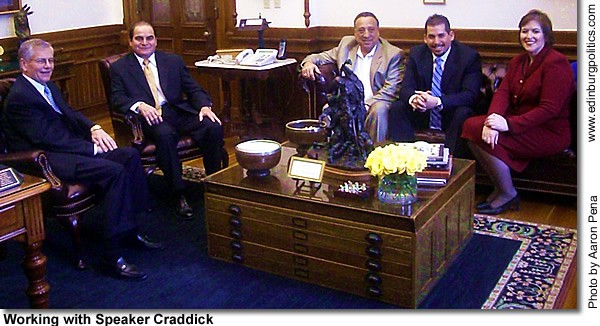
The city’s elected leadership, led by Mayor Joe Ochoa, on Thursday, February 8, met with Speaker of the House Tom Craddick, R-Midland, at the State Capitol in Austin to lay out some of the major legislative priorities for the three-time All-America City. Craddick, featured left in this photograph, heard from the mayor and the Edinburg City Council about key funding issues important to Edinburg, including securing $5 million in state funding to hire scientists for the $20 million University of Texas Regional Academic Health Center Biomedical Research Facility in Edinburg. The delegation, which also included Mayor Pro Tem Noe Garza, Councilmember Gus García, Jr., and Councilmember Alma A. Garza, also worked with state lawmakers to push for debt service funding on student tuition revenue bonds that will build a $50 million Performing Arts Center at UT-Pan American. Debt service is the series of payments of interest and principal required on a debt, such as tuition revenue bonds, over a given period of time. Tuition revenue bonds are bonds – long term-debt – that are paid for by money generated from tuition (fees) paid by university students. The city’s legislative agenda is a combined effort of the Edinburg City Council, led by the mayor, and its jobs-creation arm, the Edinburg Economic Development Corporation, led by former Mayor Richard García as the chairman of the board of directors, and Mayor Ochoa, who serves on the EEDC board of directors. Featured in this photo, taken by Rep. Aaron Peña, Jr., D-Edinburg, are, from left: Craddick; Ochoa; Noe Garza; Gus García, Jr., and Alma A. Garza. In addition to presenting the city’s legislative priorities, the Texas Legislature honored the community by designating Thursday, February 8, as Edinburg Day at the State Capitol. The legislative resolution is included later in this posting.
••••••
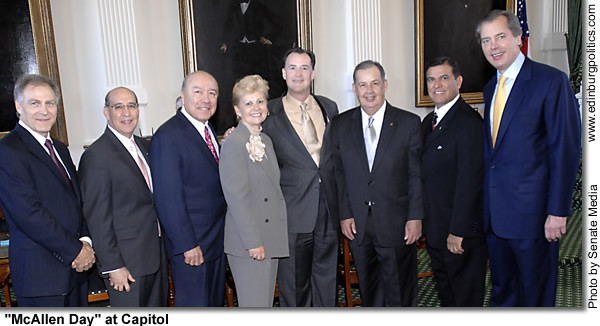
Sen. Juan “Chuy” Hinojosa, D-McAllen, and Sen. Eddie Lucio, Jr., D-Brownsville, on Tuesday, February 6, joined Mayor Richard Cortéz and McAllen leaders in the Senate chamber to celebrate McAllen Day at the Texas State Capitol with a Senate Resolution, SR 184. “We are one of the fastest growing areas in the nation as well as a key region for international trade with Mexico and the rest of Latin America. I am very proud to celebrate McAllen Day here at the Capitol and to make other state leaders aware of the importance, both culturally and economically, of McAllen,” Hinojosa said. Lucio, who also represents portions of McAllen in his legislative district, added: “Over the years, McAllen has been privileged with great leadership in the city’s administration, school boards, medical and business communities, South Texas Community College and other organizations that promote economic development and quality of life. McAllen can be extremely proud of its advances, and it was an honor for me to join Sen. Hinojosa in welcoming this city’s impressive delegation to the Texas Capitol.” Featured in this photo taken in the Senate chamber are, from left: Keith Partridge, CEO of the McAllen Economic Development Corporation; Adrian Arriaga, a McAllen business leader; Hinojosa; Dr. Shirley Reed, president of South Texas College; McAllen City Commissioner John Ingram; Cortéz, Lucio, and Dewhurst.
••••••
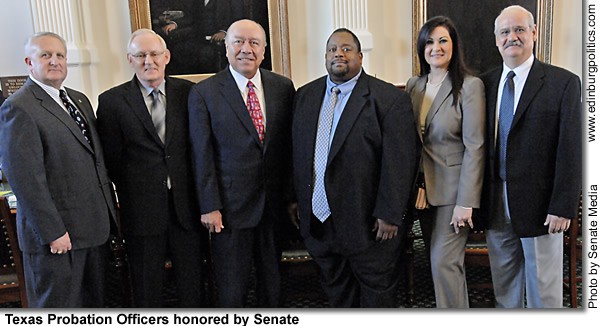
Sen. Juan “Chuy” Hinojosa, D-McAllen, on Tuesday, February 6, joined members of the Texas Probation Association in the Texas Senate to honor the contributions of Texas probation officers with a Senate Resolution, SR 170. “I want to honor the men and women across Texas who tirelessly work to improve our public safety and perform this difficult but important job to keep Texans safe while helping rehabilitate people in the criminal justice system,” Hinojosa said. SR 170 honors the Texas Probation Association which represents professionals in nearly 300 adult and juvenile probation departments across the state. The association was formed in 1974. Featured from left are: John D. McGuire, supervisor for the Brazos County Community Supervision and Corrections Department; Tommy W. Ellis, fiscal officer for the Montgomery County Department of Community Supervision and Corrections; Hinojosa; Aris Johnson, Chief Juvenile Probation Officer for Gregg County; Angie Castillo-Sáenz, Supervisor of the Cameron-Willacy Community Supervision and Corrections Department; and Israel “Buddy” Silva, Jr., Director of the Hidalgo County Juvenile Center.
••••••

Sen. Eddie Lucio, Jr. D-Brownsville, on Wednesday, February 7, welcomed the 2006-2007 Leadership Harlingen Class to the Texas Capitol, where he presented them with certificates of excellence for outstanding community leadership and class participation. Leadership Harlingen is a program of the Harlingen Area Chamber of Commerce that seeks to identify and train current and emerging leaders to make them more effective community volunteers. Ms. Melissa Boykin, Special Events Manager, said “The purpose behind the trip to Austin is to met their elected representatives, as as expose them to state government at work. We hope to give them as much opportunity to develop their leadership skills with information and insight on the ins-and-outs of not only their community and how it works, but how decisions made in Austin affect their community. Lucio said, “This program develops and enhances community leadership by giving participants expanded knowledge and awareness of the strengths, needs and issues within the Harlingen area. It offers program participants a broader view of civic leadership through direct contact with a wide spectrum of institutions and people that make the Harlingen area a vital and growing community.” Participants making the trip were, in alphabetical order: Brad Baumunk; Scott Bradwell; Chris Elliff; Mitchell Fladerman; Steven Glover; Paula González; Richard Guerrero; Brenda Heredia; Alberto Jáimez; Bertha Klefisch; Michael Lamon; Ericka Lopez; Sandra López; David Luna; Héctor Heira; Angelina Ochoa; Nilda Pérez; Steven Salinas; Juan Silva; Rod Snell; Rose Snell; and Joe Treviño.
••••••
Rep. Peña, Rep. Gonzáles provide glimpse of city’s history, milestones in “Edinburg Day” resolution
House Resolution 266, authored by Rep. Aaron Peña, D-Edinburg, and co-authored by Rep. Verónica Gonzáles, D-McAllen, whose legislative district includes southwest Edinburg, on Thursday, February 8, passed the legislative proclamation honoring the three-time All-America City at the State Capitol.
The text of the resolution follows:
R E S O L U T I O N
WHEREAS, Members of the Texas House of Representatives are pleased to join with a delegation of citizens of Edinburg in celebrating Edinburg Day at the State Capitol on February 8, 2007; and
WHEREAS, Long considered the gateway to the lower Rio Grande Valley, Edinburg was originally known as Chapin when it became the Hidalgo County seat nearly 100 years ago; it was a ranching
community in its early years, then the arrival of the railroad and the introduction of irrigation in the early 20th century shifted the emphasis of the local economy to the farming of cotton, grain,
and citrus; and
WHEREAS, Officially incorporated in 1919, Edinburg experienced a period of growth and prosperity fostered by the foresight of such city leaders as John Closner and W. F. Sprague; as a thriving center for agricultural marketing and processing, Edinburg experienced a building boom that included the construction of the Grandview Hospital and the Sam Houston and Stephen F. Austin Elementary Schools, all of which still stand; and
WHEREAS, The educational needs of area students are capably met by the Edinburg Consolidated Independent School District; encompassing 945 square miles, the district includes 27 elementary
schools, four middle schools, three high schools, and an alternative campus; and
WHEREAS, Founded in 1927 as Edinburg Junior College, The University of Texas-Pan American remains one of the Valley’s premier institutions of higher learning; the university has recently established a master’s degree program in creative writing in order to foster a new generation of South Texas writers; nearing completion on campus is a $20 million Regional Academic Health
Center that will develop treatments for illnesses prevalent along the Texas-Mexico border; the university’s Wellness and Recreation Sports Complex, encompassing more than 150,000 square feet, is scheduled to open in August 2007, and a proposed fine arts facility will include classrooms, practice rooms, and event space; and
WHEREAS, The Edinburg Children’s Hospital has a 24-hour pediatric emergency room; the Doctors Hospital at Renaissance offers a full range of medical and surgical services; and the new Women’s Hospital at Renaissance, due to open in spring 2007, will be able to handle the delivery of 8,000 babies a year; and
WHEREAS, The vibrant history and culture of the region are highlighted by the Museum of South Texas History; the facility’s recent expansion includes the Rio Grande Legacy exhibit, tracing
the history of the Valley from prehistoric times to the 19th century; further expansion of the museum will include the continuation of the Rio Grande Legacy exhibit to the present day, as
well as the construction of the Will Looney Legacy Park; and
WHEREAS, Other Edinburg attractions include the 40-acre wetlands of the World Birding Center, where waterfowl and native plants can be viewed from winding trails and viewing platforms;
events such as the annual All-American 10K Run/Walk promote health and fitness, attracting participants from all over Texas and the world; Edinburg is also home to the Texas Cook’Em cook-off, where grill cooks compete to prepare the best steaks, chicken, spare ribs, and brisket; and
WHEREAS, Under the able leadership of Mayor Joe Ochoa and city commissioners Gene Espinoza, Agustín G. García, Noe Garza, and Alma A. Garza, the city has experienced steady and positive growth, and Edinburg has been recognized three times by the National Civic League as an All-America City; and
WHEREAS, Proud of their rich history, the people of Edinburg are determined to preserve the best of the city’s past while joining together to build a future full of hope and opportunity; and
WHEREAS, Representative Aaron Peña has justly recognized the city of Edinburg by authoring this honorary resolution in its behalf during the Regular Session of the 80th Texas Legislature; now, therefore, be it
RESOLVED, That the House of Representatives of the 80th Texas Legislature hereby recognize February 8, 2007, as Edinburg Day at the State Capitol and extend a warm welcome to the delegation from Edinburg.
••••••
Edinburg school board approves order calling for school board trustee elections on Saturday, May 12
The Edinburg school board has approved a resolution and an order calling for a school board trustee election on Saturday, May 12.
The election is to fill positions for Place 4 and Place 5 on the board currently held by Melba González and Gregory “Greg” García, respectively.
González is being challenged by Robert Peña.
García has drawn two rivals: Dr. Martin Castillo and former Edinburg school board member Cris Treviño.
The election will be held at 11 polling places. Those locations are:
•Hargill School: Precincts 30, 105 and 109
•Jefferson School: Precinct 14
•Freddy González School: Precincts 52, 73 and 106
•Francisco Barrientes MS: Precincts 53 and 110
•Fountain Center: Precincts 31, 69 and 108
•Lee School: Precincts 13, 54 and 107
•Capilla de San José-Lull: Precincts 68 and 129
•San Carlos School: Precincts 15, 43, 104 and 119
•Hargill School: Precinct 18
•Brewster School: Precinct 19
•McCook: Precincts 24, 75, 76 and 89
The polls will be open on Election Day from 7 a.m. to 7 p.m.
Important dates for the May 12 school board elections are:
February 10, 2007
First day to apply for a place on the ballot
March 12, 2007
Deadline to file application for a place on the ballot
March 13, 2007
Ballot position drawing
March 13, 2007
First day to accept applications for early voting mail ballots
March 20, 2007
Last day for a candidate to withdraw in an election
March 28, 2007
First day to begin mailing early voting ballots to applicants
April 12, 2007
Last to register to vote in May 12, 2007 election
April 30, 2007
First day to vote early in person
May 4, 2007
Last day to receive application for an early mail ballot
May 5-6, 2007
Weekend early voting from 1-5 p.m.
May 8, 2007
Last day to vote early by personal appearance
May 12, 2007
Election Day
••••••
The late Elias Longoria, Sr., former longtime Edinburg school board member, honored by Rep. Peña, House of Representatives
The late Elias Longoria, Sr., 75, a well-known community and political leader in Edinburg until his passing in August 2006, was honored on Thursday, February 8, with a memorial resolution authored by Rep. Aaron Peña, D-Edinburg, and approved by the House of Representatives on Thursday, February 8.
The text of the legislative measure, House Resolution No. 209, follows:
R E S O L U T I O N
WHEREAS, A full and generous life came to an end with the passing of Elias Longoria, Sr., of Edinburg who died on August 7, 2006, at the age of 75; and
WHEREAS, Born on April 26, 1931, in La Reforma, Elias Longoria graduated in 1950 from Edinburg High School, where he excelled in both academics and athletics; he earned a scholarship to attend Pan American College and played as a third baseman for the baseball team before leaving school to serve his country; a veteran of the Korean War, he served as a member of the U.S. Navy from 1951
to 1955; and
WHEREAS, This esteemed Texan shared his time and talents with the Edinburg community as a member of the school board for nearly a decade, including serving as the first Hispanic president; his tenure was characterized by his efforts to ensure fair hiring practices, and he was instrumental in hiring the district’s first Hispanic superintendent; in addition, he volunteered for more than
20 years as a coach for local youth baseball teams; and
WHEREAS, After retiring from a distinguished career with Southern Pacific Railroad, Mr. Longoria continued to fulfill his civic duty, serving on the grievance committee of the Edinburg Housing Authority and as a member of the Hidalgo County Grand Jury; moreover, he was a faithful congregant of El Buen Pastor Methodist Church; and
WHEREAS, A devoted husband and father, Mr. Longoria shared nearly 50 years with his wife, the former Maruca Garza, and their union was blessed with four children, Elias Longoria, Jr., Luis
Longoria, Leticia Lankford, and Victor Longoria; and
WHEREAS, Elias Longoria, Sr., was a man known for his strong sense of responsibility and for his humility in the face of numerous accomplishments, and he will be remembered with great affection by all those who held him dear; and
WHEREAS, Representative Aaron Peña has justly recognized Elias Longoria, Sr., by authorizing this resolution in his memory during the Regular Session of the 80th Texas Legislature; now, therefore, be it
RESOLVED, That the House of Representatives of the 80th Texas Legislature hereby pay tribute to the life of Elias Longoria, Sr., and extend sincere sympathy to the members of his family: to his wife, Maruca Longoria; to his children, Elias Longoria, Jr., and his wife, Laurie, Luis Longoria and his wife, Noelia, Victor Longoria and his wife, Kristy, and Leticia Lankford and her husband, Gary; to his grandchildren, Philip, Aaron, Julia, Jon Eli, Adam, Gram, Gray, Marco, Amanda, Chad, Isabella, and Abigail; to his sisters, Rosa Elena March, Elma Vela, and Lidia Gordon; and to his other relatives and many friends; and, be it further
RESOLVED, That an official copy of this resolution be prepared for his family and that when the Texas House of Representatives adjourns this day, it do so in memory of Elias Longoria, Sr.
••••••
Australians purchase Texas firm that owned Edinburg Review, RGC Herald, and Town Crier
Halyard Capital recently announced that its announced that its portfolio company, American Consolidated Media, has entered into an agreement with Macquarie Media Group (MMG) to be acquired for $80 million.
The acquisition is subject to regulatory approval and other customary closing conditions. Other financial terms of the transaction were not disclosed.
American Consolidated Media (ACM), which is based in Dallas, was formed in 1998 by Jeremy L. Halbreich, formerly president and general manager of The Dallas Morning News. The company publishes 40 community newspapers and shopping publications serving nine communities throughout Texas and Oklahoma.
Among those publishing ventures are the Edinburg Review, the Rio Grande City Herald, the Valley Town Crier, the Rio Grande Valley Business Journal, Bargain Books, and the Winter Texan.
Macquarie Media Group (MMG) is an investment fund established to create a flexible platform for investments in a broad range of media assets globally, and is listed on the Australian Stock Exchange (ASX: MMGCA).
MMG seeks to combine operational expertise from quality media operators with Macquarie’s financing and acquisition expertise, to access investments across the media sector globally, and provide investors with stable cash yields, the benefits of organic growth through market growth and asset performance improvement, as well as growth through acquisition.
In July 2004, Halyard made its investment in ACM to facilitate the acquisition of Valley Media, a publisher of the shopper and community newspaper publications with a significant Hispanic audience in the Lower Rio Grande Valley, one of the fastest growing regions in the U.S.
“Halyard was attracted to ACM community papers’ strong franchise values in high-growth communities where there are few local media competitors. In locations where there are competitive publications, ACM generally owns the dominant paper,” said Christopher Ruth, a partner at Halyard Capital. “Most of its publications are mature brands with a strong, loyal readership and long relationships with local advertisers. In addition, ACM’s publications are geographically clustered, providing operating leverage and cost synergies in the areas of distribution, printing, newsprint and
administration. All these factors increased ACM’s attractiveness as a media investment.”
“We are delighted to have partnered with Jeremy and his team in our firm’s fourth successful investment in the newspaper industry. Jeremy and his team have demonstrated exceptional execution capabilities and will continue to drive the growth in the business with MMG through their focus on targeted community content,” Ruth added.
“Halyard Capital has demonstrated throughout our relationship a deep understanding and extremely valuable commitment to our business, our operating strategy and our people,” said Halbreich. “Along with fellow investors Arena Capital Partners and BancBoston Ventures, they have served as true partners in facilitating and supporting the growth and development of ACM,” he added.
Other Halyard investments in the sector have included ImpreMedia, Herald Media, and American Community Newspapers. Dirks, Van Essen & Murray acted as the company’s financial advisor and Paul, Weiss, Rifkind, Wharton & Garrison LLP as well as Akin Gump Strauss Hauer & Feld LLP served as legal advisors to the company.
Halyard is a private equity fund with $350 million of capital under management focused on investing in media, communications and business services companies. The firm specializes in middle-market leveraged buyouts, growth equity and structured equity investments. Halyard invests in and works closely with exceptional management teams in companies with defensible market positions and franchise characteristics, which generate strong cash flow and operate in attractive growth markets.
The firm will commit up to $40 million to individual portfolio companies with a focus on investments of between $15 million and $30 million. Halyard has the ability to complete larger transactions utilizing its network of investment partners.
For more information, please visit http://www.halyard.com.
••••••
Rep. Guillen lands plum spots as Vice-Chairman of House Appropriation Committee, General Calendars Committee
Rep. Ryan Guillen, D-Rio Grande City, was appointed by Speaker of the House Tom Craddick, R-Midland, to arguably the most powerful position of any Valley state representative.
Guillen was selected by the Republican speaker to serve as vice-chairman of the House Appropriations Committee, which writes the state budget that is almost always adopted by the 150-member House of Representatives.
The House’s version of the state budget then is matched up against the Senate’s version of the state budget, and leaders from both chambers hammer out compromises to arrive at a single spending plan.
As vice-chairman, Guillen is automatically one of the handful of state senators and state representatives who serve on what is called a “conference committee” to come up with the final budget plan for approval by the full Legislature.
A conference committee is composed of five members from each house appointed by the respective presiding officers to resolve the differences between the House and Senate versions of a measure, such as the state budget, when the originating chamber refuses to concur in the changes made by the opposite chamber. Upon reaching an agreement, the conferees issue a report that is then considered for approval by both houses.
The key Appropriations appointment makes Guillen the first House legislator from the South Texas border to be named to the high-level post in 40 years. Rep. Maurice Pipkin, D-Brownsville, was named to that position in 1967.
As news of the appointments spread throughout South Texas and across the state, community leaders offered praise for the decision.
“For the short tenure he has had in Austin, these appointments speak volumes for what he has been able to accomplish and are a feather in Starr county’s cap. He is an up and coming representative and I have faith he will accomplish whatever goals he sets his sights on,” said Starr County Judge Eloy Vera said after the announcement in late January.
“For a 29-year-old legislator to be named to such high ranking positions in the Texas Legislature clearly demonstrates Rep. Guillen’s highly-regarded leadership and future potential,” said McAllen Mayor Richard Cortéz.
Guillen also was appointed by Craddick to serve on the House General Calendars Committee, which decides what House and Senate bills are scheduled for action by the full House of Representatives.
The House Calendars Committee serves as a control valve for all bills and resolutions to reach the House Chamber for a vote. These committees control the agenda of the Texas Legislature.
Guillen also was appointed to the Natural Resources Committee which oversees the Texas Commission on Environmental Quality and the Texas Water Development Board and controls all legislation dealing with the development of land and water resources in Texas.
“I am humbled by Speaker Tom Craddick’s confidence in my abilities and I look forward to working hard to get the job done for the people of Texas,” Guillen said.
••••••
Rep. Guillen bill would excuse lawmakers from being called into lawsuits when they are in session
State lawmakers would be able to postpone testifying or being deposed in a lawsuit anytime the Texas Legislature is in session under a bill filed on January 30 by Rep. Ryan Guillen, D-Rio Grande City.
The text of the measure, House Bill No. 965, follows:
A BILL TO BE ENTITLED AN ACT
relating to excusing a member of the legislature from being compelled to testify or give a deposition in a civil suit or contested case when the legislature is in session.
BE IT ENACTED BY THE LEGISLATURE OF THE STATE OF TEXAS:
SECTION 1.
Chapter 30, Civil Practice and Remedies Code, is amended by adding Section 30.0035 to read as follows:
Sec. 30.0035.
TESTIMONY OR DEPOSITION OF MEMBER OF LEGISLATURE.
(a) In this section, “contested case” has the meaning provided by Section 2001.003, Government Code.
(b) This section applies to:
(1) a civil suit, including a matter of probate or condemnation proceeding, and to any matter ancillary to a civil suit at which the testimony of a witness may be taken or in which a person may be required to give a deposition; and
(2) a contested case before a state agency.
(c) This section does not apply to a member of the legislature who is a party to the suit or contested case in which the person is called to testify or give a deposition.
(d) At any time when the legislature is in session, on application of a member of the legislature who has been called, by subpoena or other method, to testify as a witness or to give a deposition in a suit or contested case to which this section applies, or who in discovery has been named as a potential witness by a party to the suit or contested case, the court in which the suit is pending or the official conducting the contested case hearing, as applicable, shall excuse the member from being compelled to testify as a witness or to give a deposition as provided by this section.
(e) A member of the legislature seeking to be excused under this section must file a request for the excuse with the court in which the suit is pending or with the official conducting the contested case hearing, as applicable. On receipt of the request, the court or official shall excuse the member from being compelled to give testimony or a deposition in the suit or contested case until a time and place agreed to by the member or until a date not earlier than the fifth day after the date the legislative session ends.
(f) This section does not diminish or affect any immunity or privilege of a member of the legislature under other law, including the constitution or common law.
SECTION 2.
This Act takes effect September 1, 2007.
••••••
Pensions for retired teachers would increase under measure filed by Sen. Lucio
Retired teachers in Texas stand to receive a boost to their pensions under a bill introduced by Sen. Eddie Lucio, Jr., D-Brownsville, on Thursday, February 7. Senate Bill 492 would increase a retired teacher’s monthly retirement, disability or death benefit by a five percent cost-of-living adjustment. Retired teachers have not received a cost of living increase since 2001.
“The Legislature can from time to time provide a cost of living adjustment based on the performance of investments of the Teacher Retirement System pension fund,” said Lucio. “These retirees have lost 16 percent spending power over the last six years from inflation, not counting the 50 percent increase in health care costs they must additionally contend with.”
“Sen. Lucio is addressing a situation that has languished since 2001,” said Tim Lee, Executive Director of Texas Retired Teachers Association (TRTA). “Providing retired educators with a real cost of living raise will help ensure their quality of life during their retirement years. His leadership on this issue is greatly appreciated by the hundreds of thousands of employees who dedicated their lives to Texas public education.”
“For Sen. Lucio to have filed this bill is awesome,” said Sylvia Suárez, a retired teacher and legislative chair for TRTA District 1. “We are ecstatic. We feel that this bill would help not only teachers, but everyone who retires from a school district, like support staff. Retired educators and paraprofessionals are not eligible for social security. Some retired support staff receive only from $300 to $600 a month (total retirement pension). When their spouses die, some are forced to sell their homes because they cannot get their social security benefits.”
Many retired teachers cannot afford health insurance with the average monthly premiums of $300 they must pay and are living below the poverty level. This bill offers equity in the state contribution through a small adjustment that can help retired teachers keep up with increasing costs of living.
••••••
ECISD sets new school boundaries for 2007-2008 school year
The Edinburg CISD school board has approved a comprehensive rezoning plan that goes into effect in the 2007-2008 school year.
Gilberto Garza Jr., interim superintendent of schools, said the opening of the district’s fifth middle school next fall and the construction of classroom wings at Canterbury, Escandón, Zavala, Guerra, Kennedy, Truman and Lincoln elementary schools, have made the new boundaries necessary as the school district attempts to address the continued new student growth.
Garza said the new boundaries will enable the school district to evenly distribute students with regard to building capacity.
The boundary changes will directly affect 19 of 27 elementary schools; the four middle schools and the high schools, said Garza. The elementary schools that will not be affected are Austin, Brewster, Cano-González, De la Viña, Guerra, Hargill, Jefferson, Lee, Travis and Truman schools.
Garza said a 13-person Rezoning Committee met nine times to study several different possible new boundary options. The criteria the committee used in order to arrive at a recommendation for the school board included:
•To keep within the neighborhood school concept as much as possible;
•To take the building capacity into consideration;
•To maintain a workable and safe student membership at each affected campus; and
•To minimize as much as possible the number of students impacted by the rezoning.
Central Administrative staff took a final recommendation to the school board in early January for approval. The changes will become affective for the 2007-2008 school year, said Garza.
As it stands currently, the Edinburg school district has grown by 1,333 students over the 2005-2006 school year, Garza said. He said the elementary totals show 15,359 students (an increase of 674 students) in 27 elementary schools. Of that total, Garza said, Ávila, Eisenhower, Escandón, Treviño and Villarreal elementary schools are well over the 700 mark and rapidly approaching 800 students. Additionally, Betts, Freddy González, Guerra and Truman elementary schools are bordering on the 700 student mark.
The new boundaries will impact the middle school levels the most, Garza said. The district has 6,441 students in its four current middle schools. The opening of the district’s fifth middle school, Francisco Barrientes Middle School, in August, will enable the district to more evenly distribute middle school students, Garza said. Barrientes Middle School is currently under renovation to accommodate middle school students. The middle school should be ready by June 2007.
The impact to the high schools will be minimal, said Garza. Although the three schools will be somewhat impacted by the new boundaries, Garza said, the boundaries at the high schools will not be as impacting as at the middle schools where the growth has been greater.
For any questions regarding individual school boundaries, contact the school principals.
••••••
Public meetings set for faculty, parents with questions about new school boundary changes
The Edinburg school district will host several public meetings to provide parents and school staff information on the new school boundary changes for the 2007-2008 school year. Information letters will also be sent out to the parents of students to be impacted by the boundary changes.
Elementary schools will host individual public meetings on their respective campuses between February 26 and March 1.
The middle school schedules are:
South – February 22;
Harwell – February. 26;
B.L. Garza – March 1; and
Memorial – March 8.
The high schools’ schedules will be announced later in February.
••••••
Gov. Perry designates six additional emergency items for Legislature to quickly consider
Gov. Rick Perry on Monday, February 5, declared additional emergency items for the 2007 legislative session. The emergency designation will allow lawmakers to begin considering these issues in the initial 30 days of the legislative session.
The emergency items include:
• The general appropriations bill;
• Legislation relating to making supplemental appropriations and reductions in appropriations;
• Legislation relating to making appropriations to the Texas Education Agency for the purpose of school district property tax rate reductions;
• Legislation relating to the management of the water resources of the state, including the protection of instream flows and freshwater inflows;
• Legislation relating to the allocation and use of the sporting goods sales tax revenue to fund state and local parks; and
• Legislation relating to the prosecution, punishment, and supervision of certain sex offenders and to certain crimes involving sex offenders.
“The sooner these legislative items are addressed, the sooner taxpayers will see results on these important issues,” Perry said. “By designating these issues emergency items, the Legislature can begin working on them very soon.”
••••••
Rep. Peña applauds governor’s move to place child predator legislation as emergency item for action
Rep. Aaron Peña, D-Edinburg, is applauding Gov. Rick Perry’s decision declaring legislation relating to the issue of sexual assault against children as an emergency matter for the 80th Texas Legislature.
Issues listed as emergency items are considered a top priority and are treated as such in the legislative process.
“Texas has some of the toughest laws regarding those who perpetrate sexual crimes against children,” said Peña. “There can be no doubt that we are going to continue to look for ways to keep our children safe from sexual predators.”
As Chairman of House Criminal Jurisprudence, Peña will lead the committee charged with tackling this critical issue. Earlier this mont, Peña asked Perry to consider adding the item to the emergency call since House rules prevent regular legislation from reaching the floor within 60 days of the start of the session.
In the Senate, Lt. Gov. David Dewhurst has championed legislation modeled after Florida’s “Jessica’s Law.” The statute is named after Jessica Lunsford who was kidnapped, raped and killed in 2005 by a convicted sex offender.
Some provisions of the law include satellite monitoring of those convicted and subsequently released of sexual assault of a child, larger safe harbor zones around parks and schools, the doubling of the statue of limitations and mandatory punishment of a minimum 25 years prison sentence for first time offenders.
There are several bills that have been filed in the House and Senate modeled in part by the Florida law.
“We will keep sending the message that Texans will not tolerate these crimes against children,” said Peña. “There are some concerned about the unintended consequences that some of the proposed legislation may have and we will take that into consideration. There is important work before this committee and we are ready to take on the responsibility.”
Peña is finalizing committee staff appointments. The committee is expected to hold its first meeting on Wednesday, February 13. Peña expressed his support for getting started working on the issue at the earliest possible date.
“This legislation will receive the highest priority in the House Criminal Jurisprudence Committee. I fully expect that it will be the first bill considered on our agenda,” the Edinburg lawmaker said.
••••••
Gov. Perry outlines proposed $163.7 billion, two-year state budget that would begin on September 1
Gov. Rick Perry on Tuesday, February 6, outlined his 2008-09 budget proposal that establishes a new, higher standard for fiscal responsibility and truth-in-budgeting while meeting key priorities for Texas. The governor’s budget slows government growth, provides $15 billion in property tax relief, allocates $5.4 billion to pay for past accounting gimmicks such as delayed payments and leaves a $4.3 billion balance in the Economic Stabilization Fund untouched.
Perry proposes a stricter spending cap tied to the average of inflation and population growth. In this session, the governor’s proposed spending cap would be 3.5 percent lower than the current limit. Because the goal of a spending cap is to limit spending, not tax relief, property tax relief would be excluded from the governor’s proposed cap. The governor’s budget complies with this new proposed spending limit.
In total, Perry’s budget provides $167.3 billion from all funds, including $15 billion in tax relief. Absent tax relief, this represents an increase of $9.8 billion, or 6.9 percent over 2006-07. Spending from general revenue absent tax relief totals $71.4 billion, an increase of $5.8 billion or 8.8 percent over the 2006-07 biennium.
••••••
Rep. Gonzáles expresses concerns about plan by Gov. Perry to sell Texas Lottery to private investors
Rep. Verónica Gonzáles, D-McAllen, on Wednesday, February 7, issued the following statements in response to Gov. Rick Perry’s State of the State address.
“I hope Gov. Perry will deliver on the promises he made in today’s speech. “I have been working to make quality, affordable health care accessible to the families in our area, and I am glad that the governor has said he will join that fight. Gov. Perry says he wants to invest in cancer research, and I look forward to joining him in that effort.”
I am also fighting to fully fund the Children’s Health Insurance Program. Cancer research can help Texans in generations to come and I hope Gov. Perry will join in that fight as well. I am committed to giving hardworking Texas families access to health care for their children today.”
In addition to proposing increased funding for cancer research, Gov. Perry also used his State of the State address to propose a controversial plan to sell the state lottery to a private company.
“I want to learn more about the governor’s proposal to sell the state lottery before making up my mind on this issue. I also want to hear from the constituents I serve. While the governor’s plan to sell the lotto may provide a short term financial boost for the state, I have grave concerns that this plan may cost us money in the long run.
“Some of our highways have already been sold to a Spanish company, there was an attempt to sell our state parks to a company in Mexico, our Children’s Health Insurance Program has been outsourced to a company in the Bahamas and now there is a proposal to sell the lottery—I think we need to take a hard look at his plan and proceed with caution.”
“I look forward to working with Gov. Perry when we agree on proposals that will bring good jobs, quality education and affordable health care to our state and our district. But I will stand up to the governor if I believe his policies are wrong for Texas, and I will always put the families of our community first.”
••••••
Gov. Perry: Selling state lottery would help fund cancer research, public education
Gov. Rick Perry on Thursday, February 8, told the Texas Public Policy Foundation that his proposal to sell the Texas Lottery for a 40 year private concession is a fiscally sound proposal that will benefit the state. Financial experts conservatively predict the lottery may be sold for $14 billion, generating an estimated $1.3 billion annual interest based on an average return of 9 percent.
“Selling the lottery will work for Texas,” Perry said. “The financial gains the sale will generate can effectively provide a long-lasting source of revenue that can ensure we have the money we need to invest in the great challenges we face.”
In recent years, the lottery has yielded approximately $1 billion annually. However, this funding is an unstable source of revenue. Selling the lottery for a conservatively estimated $14 billion allows the state to invest in secure trust funds which would annually generate nearly $1.3 billion interest, $300 million more than yearly lottery returns. Perry proposes using the annual interest gained from the sale of the lottery to establish trust funds in perpetuity for cancer research efforts, public education, and a premium assistance program for the uninsured.
This session, legislators have discussed efforts intended to make Texas a leader in cancer research. With the sale of the lottery, the state can dedicate $300 million annually to finding a cure. Steady funding is particularly important in research endeavors to ensure uninterrupted progression of scientists’ work.
The governor also proposes using close to $800 million in earned trust fund interest to fund public education. The governor’s budget allocates additional general revenue for public education to ensure there is no gap in education funding.
“Without the sale of the lottery, legislators must fund cancer research from general revenue or through a bond proposal, which will inflate a $3 billion price tag for 20 years to a total of $6 billion due to debt,” Perry said. “If legislators are willing to find $300 million in general revenue to finance bonds to fund cancer research, then why not use a smaller amount instead to make education funding whole under the alternative scenario of selling the lottery?”
Additionally, $270 million in annual trust fund earnings is proposed to create a premium assistance program for the uninsured. More than 2 million uninsured Texans are below 200 percent of the federal poverty limit. Perry’s proposed “Healthier Texas” program would help individuals purchase health insurance through employer-based programs or private plans.
“This is a unique opportunity for our state to invest in the pillars of prosperity: education, jobs and healthcare,” Perry said. “Let’s invest in a better Texas through wise use of our resources and a continued commitment to fiscal responsibility.”
••••••
Sen. Lucio wants governor to help promote health science center/medical school, I-69 development
Sen. Eddie Lucio, Jr., D-Brownsville, on Tuesday, February 6, issued the following statements regarding Gov. Rick Perry’s State of the State address:
“I sincerely believe that Gov. Rick Perry has the best interest of the state at heart, as do I. Many of his proposals certainly hold my interest and many of his efforts have my support. Our agendas for the people of Texas share many commonalities, but until we take the pencil to the speech will we know exactly what these words will mean for Texas to become a leader of the 21st Century.
“In his remarks, Gov. Perry said that this state is building roads faster than any state in the nation. However, the Rio Grande Valley still lacks an interstate highway and thus lacks connectivity to the rest of this country. In light of the population growth of South Texas and its increase in traffic from this growth and from NAFTA, our roads aren’t being built fast enough, yet we continue in the struggle for approval and funding.
“Another issue raised was the rising cost of health care as an obstacle to prosperity. I concur!
“Gov. Perry said five and a half million Texans are uninsured. In my senatorial district, 25 percent of the residents are without insurance. His Healthier Texas plan proposes that the state pay $150 monthly per individual for health insurance, depending on the family’s income. That certainly sounds like a step in the right direction, as does his commitment to continue the necessary funding to operate the Irma Rangel Pharmacy School at Texas A&M at Kingsville.
“I am also seeking his commitment for my bill that will create a health science center and medical school in South Texas. These facilities will certainly improve and increase access to quality health care in the area. And of course, we must accelerate and expand the Children’s Health Insurance Program for our Texas children.
“I support the governor’s plan to increase financial aid by $360 million for our college students, but not at the expense of curtailing programs that have successfully increased college participation along the Texas border, like the South Texas Border Initiative.
“Increasing teacher pay has been my mantra for many years. Although we have made some inroads in this arena, we still underpay the people who teach and guide our future generations.
“The governor has ideas about immigration that deserve attention. Texas is being forced to look at a primarily federal issue of great impact to Texas handled with little compensation from Washington, D.C. I continue to frown upon building any fences or walls between our two countries, while keeping a positive attitude toward guest worker programs that protect our economy, our businesses and American workers.
“Texas faces many challenges, and the governor outlined them well. I’ve voiced my motto for this session: Finding Solutions Together. It appears that the many issues the governor touched on today certainly stand a better chance of being solved if we work in unison rather than along party lines. And they will fare better if we all keep the welfare of Texans uppermost in our minds and actions.”
••••••
Sen. Zaffirini supports more money for universities, wants to protect special funding for border colleges
Sen. Judith Zaffirini,, D-Laredo, on Tuesday, February 6, issued the following statements in response to Gov. Rick Perry’s State of the State address
“I congratulate Gov. Rick Perry on delivering his fourth State of the State address and look forward to working with him and the members of the Texas Legislature toward our mutual goals of establishing and enacting a positive agenda that benefits and champions Texas families.
“Gov. Perry’s emphasis on education and increased resources for health and human services certainly is promising. His calling for an additional $80 million to expand the ‘Texas Early Start’ pre-kindergarten program demonstrates a strong commitment to improving public education. What’s more, I am especially pleased the governor intends to dedicate additional funding to early education programs since I filed legislation that would expand Texas Early Education Model (TEEM) sites throughout Texas while increasing the recruitment of highly-trained, qualified early childhood education professionals.
“Because higher education is my top legislative priority, I also am pleased that Gov. Perry is placing it high on his list of priorities. Higher education is an impressive economic multiplier. The governor’s proposal of $1.7 billion in new money for higher education is a great investment in our state’s future that is certain to deliver remarkable economic and social returns. His support of funding increases to my B-on-Time zero-interest higher education loan program and measures to increase graduation rates across the board will help students be graduated timely and successfully.
“While I remain concerned about proposed funding reallocations that would accompany the governor’s higher education proposals, especially cuts to university special items that include institutional enhancements such as the South Texas Border Initiative, I remain optimistic that our state government will produce well-measured policies that will assist all Texas institutions.
“I look forward to working with Gov. Perry, Lt. Gov. David Dewhurst, and my colleagues in the Senate and House in providing Texas students with an excellent education; eliminating all access-to-care waiting lists while increasing access to affordable, quality health care; and providing a better quality of life for all Texas families.”
••••••
House Democratic Caucus leaders say Gov. Perry “misses the important priorities” in his state budget
Reps. Jim Dunnam, D-Waco, Garnet Coleman, D-Houston, and Pete Gallego, D-Alpine, on Tuesday, February 6, responded to Gov. Rick Perry’s State of the State address.
The House Democrats maintained that despite a few forward-looking recommendations, Perry failed to recognize many of the most essential priorities the legislature must address to move Texas forward.
“The people of Texas deserve a state government that works as hard for them as they work for their families,” Coleman, Chair of the Legislative Study Group said. “Unfortunately, the Governor failed to address too many of the fundamental priorities that impact the pocketbook and quality of life for every Texas family that works for a living.”
When Texans voted last fall, they made their priorities clear: improve our children’s schools, make college affordable again, provide access to health coverage for all Texas children, and lower the cost of our electric bills. In terms of dollars and cents, however, the governor’s budget priorities focus almost entirely on property tax cuts that disproportionately benefit wealthy property owners at the expense of needs that are even more important to the future of our state’s economy.
“We all support lower property taxes, but Texans are also demanding greater investments in our children’s schools, affordable college for our families, and a healthier Texas,” Gallego, Chair of the Mexican-American Legislative Caucus, observed. “The Governor talks about these things, but he doesn’t offer a plan to put our money to work for us on these critical matters.”
Coleman said the state must increase teacher pay across the board to attract and retain quality teachers for our classrooms, and that those teachers should no longer be forced to teach only to a standardized test.
“After twelve years of learning and study in the classroom, graduation should not be based solely on a test that tries to boil it all down to ‘A, B, C, or none of the above’,” Coleman said.
Dunnam, Chair of the House Democratic Caucus, agreed that the state should increase student assistance for college, but added that eliminating tuition deregulation is a more important step if we are to make college affordable again for all Texas families.
“Unfortunately, tuition deregulation has led to tuition increases that are pricing many students from middle class families out of the opportunity that can only be provided by a college education,” Dunnam said.
He cited figures that show a 47% increase in the cost of tuition to the University of Texas at Austin has led to a tuition increase of $2,500 per year. And the problem isn’t just at UT – there has been a 54% increase in tuition at UT-Brownsville, a 34% increase in tuition at Texas Tech, and a 49% increase in tuition at the University of Houston.
Coleman said the governor should be commended for acknowledging that Texas has the highest rate of people without health insurance in the country – 24.5% of all Texans. However, he said the Governor’s speech failed to adequately address this critical need.
“We cannot gamble on a return from privatizing the Texas Lottery to fund a limited health insurance program for adults,” Coleman said, adding that “we must closely watch proposed cuts to Medicaid benefits to make sure they do not result in a similar loss of heath coverage that resulted from the 2003 cuts to the Children’s Health Insurance Program.”
“The fastest way to insure the children of Texas is to repeal the policies enacted in 2003 that caused 200,000 Texas children to lose their CHIP coverage, policies that cost us $893 million in federal matching funds,” Coleman noted.
Gallego, speaking about taxes said, “All Texans should expect truth in taxation, so that our tax dollars go where we expect them to go. The taxes on sporting goods should go to improve state parks, as promised. We also need to prevent the governor from eliminating the System Benefit Fund, which helps the very poor pay their utility bills. Texans shouldn’t have to choose between groceries and keeping the lights on.”
The Democratic leaders said the state should work to increase the use of renewable energy technologies like solar energy. Such new technologies will help answer the state’s growing need for additional energy sources and mitigate the need for unhealthy options such as the new coal plants Perry is currently attempting to fast-track to completion.
“Texans know how the sun beats down on us, so it’s time we put it to work for us instead of fast-tracking coal plants that increase health risks, including the risk of cancer,” Gallego said.
“Texans are calling for action on these important priorities, but the Governor keeps trying to give that responsibility to private interests who want to use our tax dollars to make a profit,” Dunnam said.
“From private school vouchers to private call centers for CHIP to toll roads, privatization has failed us, and it’s time for the state of Texas to work for the people again and not for profit,” Dunnam concluded.
••••••
Senate panel unanimously approves bill by Sen. Zaffirini to strengthen child passenger safety
The Senate Committee on Transportation and Homeland Security on Wednesday, February 7, unanimously recommended Senate passage of Senate Bill 60 by Sen. Judith Zaffirini, D-Laredo, which strengthens current child passenger safety protections.
The bill requires that children younger than eight years, unless they are four-feet nine-inches in height, be secured properly while riding in a motor vehicle.
“Each year more than 1,600 children die in vehicular accidents,” Zaffirini said. “This is the leading cause of unintentional, injury-related death among children 14 and younger. SB 60 would save lives and would make certain our younger children are safe and secure while riding on Texas roads and highways.”
Current law requires only children who are younger than five years of age and shorter than 36 inches be properly secured in child-passenger safety seats during the operation of a vehicle. Children between the ages of five and eight and who are between 36 and 57 inches represent an age group that is at great risk of death or severe injury due to the gap in current law.
SB 60 will eliminate this gap and strengthen current child passenger safety protections. It provides for a four-month temporary grace period to inform Texas drivers about the new measure.
“Unrestrained children are more likely to be injured, suffer more severe injuries and possibly die in motor vehicle accidents than children who are restrained,” Zaffirini said. “I am very pleased that the Senate Transportation and Homeland Security Committee favorably and unanimously recommended my SB 60, and I look forward Senate passage. We anticipate a remarkable victory for child and public safety.”
••••••
Rep. Martínez throws support behind energy assistance program for low-income electricity users
Rep. Armando “Mando” Martínez, D – Welaco, is one of several Valley lawmakers who have signed on as co-authors of House Bill 551, which deals with eligibility of low-income families for an energy assistance program.
The principal author of the legislation is Rep. Sylvester Turner, D-Houston, who is the Speaker of the House Pro Tempore – second-in-command of the House of Representatives.
“House Bill 551 would provide assistance to low-income electric customers by providing a targeted energy efficiency program,” Martínez said. “A customer qualifies under the system benefit fund if the household income is not more than 125 percent of the federal poverty guideline.”
A resident is also qualified if they meet one of the following:
•Receives food stamps.
•Receives federal housing asístanse.
•Has a child enrolled in the national school lunch program, or reduced-price lunches.
•Receives lifeline telephone service.
“Assisting the economically disadvantaged individuals is one of my goals while in Austin.” Martínez said., “I will assist with the passage of this legislation. Not only for the benefit of my constituents, but for all Texans.”
The other Valley legislators listed as co-authors are Rep. Verónica Gonzáles, D-McAllen; Rep. Eddie Lucio, III, D-San Benito; and Rep. Juan Escobar, D-Kingsville. Esocobar’s legislative district includes Willacy County.
A co-author is a legislator authorized by the primary author to join in the authorship of a bill or resolution. A coauthor must be a member of the chamber in which the bill was filed.
••••••
Rep. Martínez co-authors measure that would increase public awareness of children’s health insurance program
Rep. Armando “Mando” Martínez, D-Weslaco, has signed on as a co-author for Bill 109, which would require the state government to inform more Texans that they qualify for the Children’s Health Insurance Program (CHIP).
“Under this bill, a commission would provide information through community outreach programs and an education campaign on the availability of health benefits for children who qualify,” said Martínez, “The campaign will involve the efforts of school health clinics and make available a toll-free telephone number that will provide information about health coverage for children.”
“Assisting families’ maintain the health of their children is one of my goals here in Austin,” Martínez, said, “I hope legislation will be passed so that all Texas children will have an opportunity to receive the health care they need and deserve.”
The principal authors of House Bill 198 are Rep. Sylvester Turner, D-Houston, who is the Speaker of the House Pro=Tempore, and Rep. Aaron Peña, D-Edinburg.
A co-author is a legislator authorized by the primary author to join in the authorship of a bill or resolution. A coauthor must be a member of the chamber in which the bill was filed.
••••••
Congressman Cuellar, Hinojosa to host government contracting workshop in McAllen on February 21
Hidalgo County’s two U.S. congressmen – Ruben Hinojosa, D-Mercedes, and Henry Cuellar, D-Laredo/McAllen, will host a federal grants workshop to be be held in McAllen on Wednesday, February 21.
The event will be conducted from 5:30 p.m. to 8 p.m.
The workshop, which is being held at the McAllen Chamber of Commerce, will include presenters from the Small Business Administration, the General Services Administration, and Boeing Corporation. The workshop’s primary focus will be on preparing small business owners for doing business with the federal government.
The McAllen Chamber of Commerce is located at 1200 Ash Avenue.
••••••
Congressman Hinojosa supports National Consumer Protection Week
The U.S. House of Representatives on Monday, February 5, passed by a vote of 398-0 a resolution introduced by Rep. Rubén Hinojosa, D-Mercedes, co-chair of the Financial and Economic Literacy Caucus, that recognizes the importance of consumer protection.
“Technological advances have made it easier than ever for criminals to take advantage of our nation’s consumers,” said Hinojosa. “We must remain vigilant in providing our citizens the best tools to combat the growing number of frauds and deceptions bombarding them.”
H. Res. 94 supports the goals and ideals of National Consumer Protection Week, which is Feb. 4th through 10th, and seeks to boost awareness of consumer protection options among Americans. To highlight the week’s importance, Hinojosa is collaborating with the Federal Trade Commission and 14 other federal agencies on a Consumer Education Fair scheduled for Feb. 8th in 1302 Longworth House Office Building from 9 a.m. until noon. The fair will be open to all Capitol Hill staff as well as Members of Congress who would like material on how to help constituents improve their financial literacy levels. The general public is also welcome to attend.
In 30 states, the Federal Trade Commission (FTC) reports that more than 60 individuals per 100,000 population were victims of identity theft in 2005. In Texas alone, there were over 26,000 reports of identity theft in one year. According to the FTC, Texas ranks among the top five states where consumers are most likely to have their personal information compromised.
The theme of this year’s National Consumer Protection Week, “Read Up and Reach Out: Be an Informed Consumer,” encourages people to utilize the wealth of online resources that can vastly improve their confidence in the marketplace. Consumers can boost their knowledge by simply logging on to the National Consumer Protection Week’s Web site, http://www.consumer.gov/ncpw, where they can find useful tips on how to make well-informed purchase decisions.
“It’s critical that Americans take the necessary steps to protect themselves from consumer fraud and identity theft,” said Hinojosa. “I urge everyone to take advantage of the numerous available tools that will help them better secure their information.”
••••••
Regents told that the UT System enrolling more minority students that five years ago
Institutions within the University of Texas System are enrolling more minorities, graduating more students in critical math and science fields and producing substantially more research than they were a half-decade ago, according to a report prepared for the UT System Board of Regents.
Regents on Thursday, February 8 approved the wystem’s fourth annual Accountability and Performance Report, which provides data and analysis on a variety of academic, health-care and service missions across the System’s nine academic and six health institutions.
The report uses 135 measures to gauge such things as enrollment, diversity, student outcomes, faculty productivity, clinical care and community impact over five years at all 15 institutions as well as System administration.
“We are leaders nationally in pioneering this process and making our institutions transparent to the public, and this report demonstrates that,” UT System Chancellor Mark G. Yudof said. “What’s significant in this accountability study is we offer proof to the public that tax dollars are being used efficiently and productively.
“Moreover, this document is a useful tool in helping us identify those things we wish to improve to make our institutions even better.”
Among some of the report’s highlights:
• Research expenditures at UT System institutions grew 36 percent since 2002 to more than $1.8 billion in FY 2006. And the total number of new inventions rose by roughly one-third, from 459 in 2001 to 613 in 2005. The UT System in 2004 ranked fourth nationally in the number of patent awards received.
• Enrollment at UT System academic campuses increased by an average of 17 percent from 2001 to 2005, and the proportion of Hispanic freshmen at those institutions (39 percent) exceeded the proportion of Hispanic students graduating statewide from high schools (35 percent).
• UT System institutions, which already account for about one-third of the degrees conferred in the state, awarded 23,167 undergraduate degrees in 2005, a 22 percent increase from 2001. Four institutions were among the top 10 in the nation in the number of undergraduate degrees they awarded to Hispanics.
• Twenty-five percent of all degrees conferred at UT System institutions were in the critical areas of science, technology, engineering and math, which was significantly higher than the national average of 17 percent.
• Faculty from UT System health institutions treated 79,262 patients in state-owned hospitals in FY 2005, up roughly one-third from the 60,785 they treated in FY 2001.
Other noteworthy findings revealed nearly half of undergraduate students received some form of need-based financial aid, which covered nearly 80 percent of their total academic costs. Also, all academic institutions improved six-year graduation rates from 2001 to 2005, five of them by four or more percentage points; and seven of eight four-year campuses showed gains in four-year graduation rates. Seniors at eight academic institutions performed at or above expected levels on the Collegiate Learning Assessment Performance Task scale.
“This report clearly shows progress across the board at our academic and health institutions, but we will continue to evaluate where improvement is most needed and adjust our efforts accordingly,” said Dr. Geri Malandra, interim executive vice chancellor for academic affairs and vice chancellor for strategic management.
The UT System Accountability and Performance Report is regarded as one of the top models for higher education accountability in the nation. The System was the first higher education body in the state to devise a comprehensive model for public accountability.
“We are proud of the progress our institutions have made and this study continues to serve us well in developing strategies to make our campuses even stronger,” said James R. Huffines, chairman of the UT Board of Regents.
Serving the educational and health care needs of Texans for more than 125 years, the UT System is one of the nation’s largest higher education systems with 15 campuses – including nine academic and six health institutions – and an annual operating budget of $10 billion (FY 2007). Student enrollment exceeded 190,000 in the 2006 academic year. The UT System confers one-third of the state’s undergraduate degrees and educates three-fourths of Texas health care professionals. With more than 76,000 employees, the UT System is one of the largest employers in Texas.
••••••
Sen. Hutchison cosponsors bill to create National Museum of the Latino
U.S. Sen. Kay Bailey Hutchison, R-Texas, chairman of the Republican Policy Committee, on Thursday, February 8, signed on as an original cosponsor of a bill to establish a commission on the National Museum of the Latino. The legislation, S.500, creates a 23 member commission and authorizes funding to help establish a national museum honoring Hispanic heritage.
“Since the very founding of our great nation, American society has benefited from the contributions of myriad cultures and backgrounds,” Hutchison said. “I am pleased to cosponsor this legislation to honor the heritage of our many Hispanic citizens. The museum would also serve as an educational resource for people interested in learning about Latino history and traditions.”
The legislation introduced today establishes a 23 member commission with appointments from the president and bi-partisan leaders from both the U.S. Senate and House of Representatives. It calls for the development of a fundraising plan with a national conference, and a report to determine location and governance for the museum. In addition, the legislation authorizes funds for use by the commission.
••••••
Lt. Gov. Dewhurst announces two new appointments to the Texas Ethics Commission
Lt. Governor David Dewhurst has announced the appointments of James Graham and Paula Mendoza to the Texas Ethics Commission.
Graham, a resident of Dallas, is currently an investment manager at Hunt Realty Corporation. He is a graduate of Miami University and George Washington University.
Mendoza, a resident of Houston, is owner of Possible Missions, Inc., a small business consulting firm. Mendoza is the Chairwoman of the Texas Association of Mexican-American Chambers of Commerce. She is a graduate of University of Houston.
The Texas Ethics Commission, created by Constitutional amendment in 1991, is responsible for administering and enforcing political contribution and expenditure laws, lobbyist activities, state officers’ financial disclosure statements, state officers’ salaries, and other ethics issues.
by Legislative Media | Jan 29, 2007 | Politics
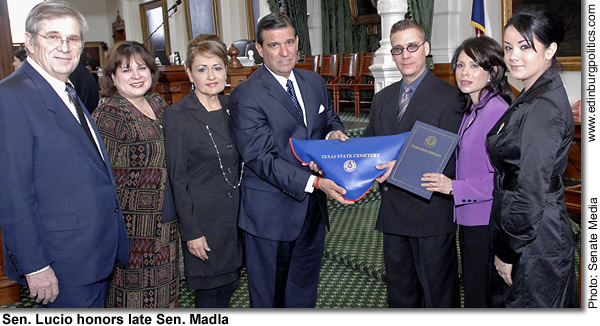
State Sen. Eddie Lucio, Jr., D-Brownsville, on Tuesday, January 23, honored the memory of the late Sen. Frank Madla, D-San Antonio – which would have been Madla’s 70th birthday. The veteran lawmaker was killed November 24, 2006 in a house fire in San Antonio. Co-authoring the Memorial Resolution was Sen. Leticia Van de Putte, D-San Antonio, who also honored Madla’s five-year-old granddaughter, Aleena, and his mother-in-law, Mary Cruz, 81, both of whom perished in the fire, with separate resolutions that Lucio coauthored. The entire body of the Senate signed onto all three documents. Accepting the resolutions were Madla’s wife, Helen Madla; son, Dr. Frank Madla III; daughter, Marci Madla; brother, Ralph Madla; and other members of the family. Featured in this portrait, which was taken on the floor of the Senate chambers, are Lucio (center), presenting a Texas State Cemetery flag to Dr. Frank Madla, Jr. and his wife, Nenette, pictured to the right of Lucio. At the far right is Marci Madla, who also received a flag. Left to right are Sen. Chris Harris, R-Arlington; Van de Putte, and Helen Madla, who received the flag that was draped over her husband’s coffin at the burial.
••••••

The City of Edinburg, the Edinburg Chamber of Commerce and the Edinburg Economic Development Corporation have announced the revitalization of the “I Shop Edinburg” campaign. The renewed campaign kicked off in early January, and will continue through December 2008. The mission of I SHOP is to promote economic growth in Edinburg resulting in improved city services by encouraging residents to trade with local merchants, who will provide quality goods and services, thus securing a better future for the Edinburg community. All Edinburg businesses are invited to participate. Any business owner interested in benefiting from the I Shop Edinburg campaign may call the Edinburg Chamber of Commerce to get a logo. Shoppers can save money by patronizing participating businesses by looking for the I SHOP logo. To pick up an I SHOP savings card, stop by the Edinburg Chamber of Commerce, Edinburg City Hall, the Edinburg Economic Development Corporation, or call 956-383-4974 for more information about the program.
••••••

On Tuesday, January 16, Kiwanis Clubs of District 11 were honored with a visit by Texas/Oklahoma Kiwanis Governor William E. Crump, III and his wife Jane, at the ECHO Hotel. Crump updated area Kiwanis Clubs on local Texas/Oklahoma initiatives and asked for the clubs support with issues such as events, fundraisers, meetings and seminars occurring across the state. He has served as an active member of the Kiwanis Club organization for the past thirty-two years with thirty years perfect attendance of club meetings. Lt. Gov. Terry Wilson who represents District 11 was also present at the special event. The Edinburg Kiwanis Club hosts community events and fundraisers throughout the year. The annual Pancake Breakfast will be held on Saturday, February 3, 2007 from 7-11 a.m. at the ECHO Hotel. Tickets are only $3 and include all the pancakes you can eat, free coffee or milk, and one serving of sausage. Tickets can be purchased at the door or through any Edinburg Kiwanis member. For more information, please call Letty Martínez at 956-383-4974.
••••••
Edinburg’s jobless rate in December drops to 4.2 percent, best in Valley, better than state average
Edinburg’s jobless rate, which is a key indicator of the strength of the local economy, dropped to 4.2 percent in December, the best showing in the Valley for the fifth month in 2006, according to the Edinburg Economic Development Corporation.
At 4.2 percent, the local showing was also better than the Texas average of 4.5 percent, which is the lowest statewide average in five years, according to the Texas Workforce Commission.
The EEDC is the jobs-creation arm of the Edinburg City Council.
The EEDC’s five-member governing board includes Mayor Joe Ochoa; former Mayor Richard García, who is president of the EEDC board of directors; and Fred Palacios, Mike Govind, and George Bennack.
As of December, according to the Texas Workforce Commission, 1,169 Edinburg residents were looking for jobs, while 26,752 local residents were employed.
The jobless rate, also known as the unemployment rate, is the number of persons unemployed, expressed as a percentage of the civilian labor force.
The civilian labor force is that portion of the population age 16 and older employed or unemployed.
To be considered unemployed, a person has to be not working but willing and able to work and actively seeking work.
The jobless rate for Hidalgo County was 6.6 percent in December, same as the previous month, representing 18,649 area residents without jobs, while 262,795 residents were employed during that month.
McAllen had the lowest monthly unemployment rates during seven months of 2006, followed by Edinburg, which had that distinction during five monthly reporting periods.
In December, McAllen reported a 4.4 percent jobless rate.
Cameron County’s jobless rate in December was 5.7 percent, representing 8,404 people looking for work and 138,090 residents holding down jobs.
Harlingen had the third-best showing among major Valley cities in December, reporting a 4.7 percent jobless rate, followed by Mission and Pharr, which each registered 5 percent unemployment rates for that month.
Also for December, Brownsville posted a 5.7 percent jobless rate, followed by Weslaco, with its 6.1 percent unemployment rate.
According to the Texas Workforce Commission:
Texas’ seasonally adjusted unemployment rate dropped to 4.5 percent from 4.7 percent in November and from 5.2 percent in December 2005.
The declining unemployment rate continues to set records for the lowest rate in five years. The state unemployment rate matches the U.S. seasonally adjusted unemployment rate of 4.5 percent.
Seasonally adjusted nonagricultural employment grew by 15,600 jobs in December as Texas employers continue adding jobs.
Over the last 12 months, the Texas economy grew by 213,200 jobs, with an over-the-year growth rate of 2.2 percent. Texas employers now have added jobs for 27 consecutive months.
“Record-setting low unemployment rates and high job growth highlight the strength of the Texas economy,” said Texas Workforce Commission (TWC) Chair Diane Rath. “Employers are displaying confidence as they continue to add jobs.”
Trade, Transportation & Utilities contributed 6,700 jobs in December, the largest increase within a sector.
Employment in Construction rose by 2,800 jobs over the month, for a total of 44,700 jobs since December 2005.
“Both the goods producing and service providing sectors experienced broad-based growth in December,” said TWC Commissioner Representing Employers Ron Lehman. “Employment gains in Construction jumped 7.7 percent over the year, and Professional & Business Services added 46,000 jobs over the same period.”
Financial Activities employment displayed a significant increase of 3,100 jobs in December. This was the largest December job gain recorded in the group in over a decade. Financial Activities completed 2006 with a total of 19,300 jobs created for an annual growth rate of 3.1 percent.
“For Texans seeking employment, now is the time to find work,” said TWC Commissioner Representing Labor Ronny Congleton. “The tremendous job growth means many opportunities in a variety of industries.”
Natural Resources & Mining employment increased for the seventh consecutive month, adding 1,500 jobs in December.
The industry finished the year with a total of 11,800 positions gained in 2006 representing an annual growth rate of 6.9 percent.
Initial claims for unemployment compensation in December 2006 were 56,501, down 4.8 percent from a year ago.
The Texas Workforce Commission is a state agency dedicated to helping Texas employers, workers and communities prosper economically.
For details on TWC and the programs it offers in unison with its network of local workforce development boards, call (512) 463-8556 or visit http://www.texasworkforce.org.
By DAVID A. DIAZ
[email protected]
For more information on the people and politics that impact Edinburg, please log on to http://www.EdinburgPolitics.com
••••••
Mayor Ochoa to deliver The State of the City address during Wednesday, January 31 luncheon at ECHO
Mayor Joe Ochoa will address the community as part of the upcoming Public Affairs Luncheon, hosted by the Edinburg Chamber of Commerce, on Wednesday, January 31, from 11:30 a.m. to 1 p.m. at the ECHO Hotel in Edinburg.
Ochoa will present the annual State of the City speech, which will cover topics such as major city projects, economic overview, and the legislative agenda for the City of Edinburg.
Ochoa is a graduate of the University of Texas at Austin with a Bachelor of Science Degree in pharmacy with certification in immunization, diabetes care, and nutrition. He is self-employed as a retail pharmacist and owner of two community pharmacies and other business ventures.
Ochoa has served as mayor for several terms, from May 1993 to May 2003, and from May 2006 through the present. His current term continues through May 2009.
Ochoa served as an Edinburg school board member from May 1981 to May 1993, is past President and current member of Edinburg Economic Development Corporation, co-chairman of I-69 Alliance – Highway 281, past chairman and present member of Hidalgo County Metropolitan Planning Organization.
Also, other public service endeavors include him serving as a member South Texas Border Partnership, past member of NAITCP (National Association of International Trade Corridor Partnership), has achieved two “All American City” awards as Mayor for Edinburg in 1995 and 2000 plus an Outstanding Business Award 1995 from UTPA-SIFE, Ochoa received the Leadership in Economic Development award from the American Economic Development Council in 1995 and lastly, received the Clean Cities Award in 2000 and 2001, which held State of Texas Recognition.
The Public Affairs Luncheons are a new initiative introduced in 2006 and part of the chamber’s vision to inform, involve and educate chamber members and civic leaders. The event allows business people to meet, network and create opportunities for the companies they represent.
“The chamber of commerce encourages all chamber investors and others interested in learning about hot topics affecting our community and the Rio Grande Valley to attend,” commented Elva Jackson-Garza, Vice Chair of the Edinburg Chamber of Commerce Membership Committee. “We would like to thank our sponsors for their generous time and donations: Edwards Abstract & Title Co., AT&T, and Time Warner Cable.”
The cost to attend is $10 per person, and will include a hot lunch, beverage and dessert. For more information on programs and events sponsored by the Edinburg Chamber of Commerce, please call 956-383-4974.
••••••
Sen. Hinojosa presses Gov. Perry, U.S. officials to improve access by children to medical care
Sen. Juan “Chuy” Hinojosa, D-McAllen, on Friday, January 28, released the following statement regarding the visit by U.S. Health and Human Services Secretary Mike Leavitt to announce to offer federal assistance for Texas-based initiatives to improve access to health care:
“I applaud the effort to free up state leaders to explore innovative ways to make sure all eligible Texans have access to the high-quality, affordable health care they deserve, especially when it comes to the federal Medicaid program and how it serves children.
“My bottom line is simple and straightforward — if a criminal has the right to see an attorney, a child should have the right to see a doctor. Period.
“How we reach that goal should be a top priority of this legislative session.
“U.S. Sen. Kay Bailey Hutchison (R-Texas) estimates that Texas forfeits more than $600 million in available federal funding each year by not enrolling more eligible children in the successful Children’s Health Insurance Program. This makes no moral or financial sense.
“I look forward to working with Governor Rick Perry, Lt. Gov. David Dewhurst, and my colleagues in the Texas Senate to make sure we take advantage of this new-found freedom announced today to try to find new ways to make Medicaid more effective and efficient as part of a comprehensive agenda for addressing the health care needs of all Texans.”
••••••
Gov. Perry and U.S. Department of Health and Human Services Secretary Leavitt discuss restructuring Medicaid
Gov. Rick Perry on Friday, January 26, joined U.S. Department of Health and Human Services (HHS) Secretary Michael Leavitt and state lawmakers to discuss restructuring the state’s Medicaid program. As the cost of managing the Medicaid program continues to grow, the state must develop new approaches to sustain the program that serves 2.7 million vulnerable, disabled and elderly Texans.
“Texas cannot continue to take a ‘one size fits all’ approach to Medicaid,” Perry said. “Escalating costs and increasing enrollment has made our current system unsustainable. Together, with our state and federal partners, we must develop a more flexible and efficient system of providing safe, quality medical care to those who need it most.”
In 10 years (1994 to 2004), the cost of Medicaid doubled in Texas, now constituting 26 percent of the state’s budget. In the near future, Gov. Perry will suggest reforming Texas’ Medicaid program through:
• Providing customized benefit packages for specific populations;
• Providing assistance for enrollment in private insurance and employer-sponsored plans; and
• Promoting consumer choice through health savings accounts and consumer directed services.
At the January 26 event, Perry emphasized the importance of greater flexibility in managing diverse Medicaid populations. Children represent 70 percent of the Medicaid population and only 30 percent of the cost, while the elderly and those with special needs represent 21 percent of the Medicaid population and account for about 60 percent of the cost.
“The best insurance plan for pregnant women and children is not the same as the best plan for elderly Texans who need long-term care,” Perry said. “I would like to create Medicaid benefit packages that target specific groups, such as a plan for healthy children and adults, a separate plan for children with special needs, and a third plan for adults with disabilities and long-term care needs.”
On Thursday, January 25, HHS awarded Texas $4 million for Medicaid “transformation grants” to support the development of electronic health passports for children in foster care. Electronic health passports ensure greater continuity of care for a population of children that often receives treatment from a variety of physicians due to changing living arrangements.
••••••
Rep. Peña’s appointment as House panel chairman in honor of his late son, says Speaker Craddick
State Rep. Aaron Peña, D-Edinburg, on Friday, January 26, was appointed to serve on two House committees, including serving as chairman of the House Committee on Criminal Jurisprudence.
The committee assignments were made by Speaker of the House Tom Craddick, R-Midland.
Craddick said he selected Peña to lead the House Committee on Criminal Jurisprudence, not only because he was qualified, but also because the Speaker of the House made a special effort to recognize the representative’s late son.
“I am proud to make this appointment in the memory of John Austin Peña,” Craddick said, noting that Pena’s son was the motivation for his father to eventually enter public service.
Peña said he was grateful for the appointment, and vowed to work on behalf of all Texans who face difficulties in their lives, particularly from the threat or consequences of crime, including substance abuse.
“I am honored to have been given the opportunity to lead this very important committee,” said Peña. “Chairing Criminal Jurisprudence and being named to Ways and Means gives our community a stronger voice in the leadership of the state. These assignments give me a special opportunity to keep working on substance abuse and mental health policy.”
The House Committee on Criminal Jurisprudence has nine members, with jurisdiction over all matters pertaining to:
(1) criminal law, prohibitions, standards, and penalties;
(2) probation and parole;
(3) criminal procedure in the courts of Texas;
(4) revision or amendment of the Penal Code; and
(5) the following state agencies: the Office of State Prosecuting Attorney and the Texas State Council for Interstate Adult Offender Supervision.
During the 2005 regular session, Peña served as a member of the House Committee on Criminal Jurisprudence. The top position on that House panel became available when Rep. Terry Keel, R-Austin, retired from the Legislature.
But as a result of his Peña’s chairmanship, under the rules that govern the Texas House of Representatives, a state representative who is chairman of a House committee can not serve on the House Appropriations Committee, which develops the state budget for the House of Representatives.
Peña selection to the House Committee on Ways and Means, which has nine members, will give him considerable influence over the following legislation and issues:
(1) all bills and resolutions proposing to raise state revenue;
(2) all bills or resolutions proposing to levy state taxes or other fees;
(3) all proposals to modify, amend, or change any existing state tax or revenue statute;
(4) all proposals to regulate the manner of collection of state revenues and taxes;
(5) all bills and resolutions containing provisions resulting in automatic allocation of funds from the state treasury;
(6) all bills and resolutions diverting funds from the state treasury or preventing funds from going in that otherwise would be placed in the state treasury;
(7) all bills and resolutions relating to the Tax Code; and
(8) the following state agencies: the Office of Multistate Tax Compact Commissioner for Texas and the State Comptroller of Public Accounts.
Peña’s promotion to chairmanship came after he supported Craddick’s bid for reelection to a third-two year term as Speaker of the House, arguably the most powerful state legislator in state government.
The Speaker of the House is elected every two years, on the first day of the regular session, by a vote among the 150-members of the House of Representatives. The Speaker of the House needs 76 votes to secure a victory.
Peña supported Craddick against Rep. Senfronia Thompson, a Democrat from Houston, who announced for speaker last spring before dropping out of the race late last year. Then, Peña stood by Craddick – even seconded his nomination on the House chamber – when Craddick was unsuccessfully challenged by Rep. Jim Pits, a Republican from Waxahachie.
Hidalgo County Democratic Chairman Juan Maldonado summed up the sentiments of many community leaders regarding the chairmanship.
“Rep. Peña continues to serve his constituents well,” said Maldonado. “South Texas needs more good Democrats to assume leadership roles in our state government.
Peña said his selection to the House Committee on Ways and Means is significant but more importantly and of greater impact to South Texas was his appointment to serve as Chairman of the House Committee on Criminal Jurisprudence.
Peña noted that Rep. Ismael “Kino” Flores, D-Palmview, retained his chairmanship of the House Committee on Licensing and Administrative Procedures, which has jurisdiction over legislation dealing with businesses, industries, general trades, and occupations regulated by the state.
Peña said the appointments made by Craddick along with other top assignments “have led many to consider this Rio Grande Valley legislative delegation as the strongest in the history of the state.
“I am honored to have been given the opportunity to lead this very important committee,” said Peña. “Chairing this committee and being named to Ways and Means gives our community a stronger voice in the leadership of the state.”
Rep. Ryan Guillen, D-Rio Grande City, was another Craddick loyalist who was repaid with plum committee assignments. Guillen was selected by Craddick as the Vice Chair of Appropriations,
“Rep. Peña has always been a strong advocate for the Rio Grande Valley. His leadership appointment brings strength to the South Texas and border delegations,” said Guillen.
As Chairman of the Criminal Jurisprudence Committee, Peña has the power to call meetings, set the agenda and influence legislation in that committee.
“The committee is especially significant because many members of the Texas House file numerous
bills regarding criminal jurisprudence issues,” Peña said.
The committee is charged with writing state criminal laws, prohibitions, standards, and penalties. It also has jurisdiction over probation, parole and criminal procedure in the courts of Texas. The committee maintains sole control over any changes made to the Texas Penal Code, which determines punishment for our most serious crimes.
“As our state grows so do the challenges facing our criminal justice system,” said Peña. “Many of our jails are operating at maximum capacity and we are once again faced with the decision of building more prisons or expanding probation and diversion programs. As the Lt. Gov. mentioned in his inaugural speech, we face critical problems regarding sexual predators in our communities. I am ready for the challenge of finding solutions to these complex issues.”
••••••
Rep. Gonzáles will influence health care, Texas courts with appointments to House Public Health, Judiciary committees
State Rep. Verónica Gonzáles, D-McAllen, on Friday, January 25, was appointed by Speaker of the House Tom Craddick, R-Midland, to serve on the House Public Health and Judiciary committee.
“I am thrilled that I received my top two choices for committee assignments,” said Gonzáles. “Health care is an extremely critical issue in our state and our nation, and is especially important in the Rio Grande Valley, where so many do not have access to healthcare,” said the House District 41 lawmaker, who represents southwest Edinburg. “The tremendous need for public health issues to be addressed is evident by the many hospitals and medical facilities serving Valley residents in my district.”
The Public Health Committee is responsible for the protection of public health, including supervision and control of the practice of medicine and dentistry and other allied health services.
The Public Health Committee has nine members, with jurisdiction over all matters pertaining to:
(1) the protection of public health, including supervision and control of the practice of medicine and dentistry and other allied health services;
(2) mental health and the development of programs incident thereto;
(3) the prevention and treatment of mental illness;
(4) oversight of the Health and Human Services Commission as it relates to the subject matter jurisdiction of this committee; and
(5) the following state agencies: the Department of State Health Services, the Anatomical Board of the State of Texas, the Texas Funeral Service Commission, the State Committee of Examiners in the Fitting and Dispensing of Hearing Instruments, the Texas Optometry Board, the Radiation Advisory Board, the Texas State Board of Pharmacy, the Board of Nurse Examiners, the Texas Board of Chiropractic Examiners, the Texas Board of Physical Therapy Examiners, the Texas State Board of Podiatric Medical Examiners, the Texas State Board of Examiners of Psychologists, the State Board of Dental Examiners, the Texas State Board of Medical Examiners, the Advisory Board of Athletic Trainers, the Dental Hygiene Advisory Committee, the State Board of Barber Examiners, the Texas Cosmetology Commission, the Texas Cancer Council, the Texas State Board of Acupuncture Examiners, the Health Professions Council, the Office of Patient Protection, the Texas Board of Occupational Therapy Examiners, the Texas State Board of Examiners of Perfusionists, and the Texas Health Care Information Council.
“I appreciate the importance of good health and look forward to working on legislation that will improve the quality of public health for my constituents,” said Gonzáles.
“I am likewise pleased to be reappointed to serve on the Judiciary committee which oversees matters relating to judges and the creation or changes to courts in the State of Texas,” she continued. “Last session, I was able to secure the passage of legislation that created a new district court, a new county court, increased jury pay and salary increases to our Texas judges. I feel confident that my experience as an attorney will continue to benefit my service on this committee and the legal system in Texas.”
The Judiciary Committee has nine members, with jurisdiction over all matters pertaining to:
(1) uniform state laws;
(2) creating, changing, or otherwise affecting courts of judicial districts of the state;
(3) establishing districts for the election of judicial officers;
(4) the Texas Judicial Council;
(5) the State Commission on Judicial Conduct;
(6) the Office of the Attorney General, including its organization, powers, functions, and responsibilities;
(7) courts and court procedures except where jurisdiction is specifi cally granted to some other standing committee; and
(8) the following state agencies: the Supreme Court, the Courts of Appeals, the Court of Criminal Appeals, the State Commission on Judicial Conduct, the Office of Court Administration of the Texas Judicial System, the State Law Library, the Texas Judicial Council, the Office of the Attorney General, the Court Reporters Certification Board, and the Board of Law Examiners.
Gonzáles explained that thousands of pieces of legislation will be considered by the Legislature this session, and the committee process closely analyzes legislation before Representatives vote on bills on the House Floor. Taking an active role as a committee member enables her to have greater input on a large number of bills covering a wide range of issues.
••••••
Speaker Craddick outlines process for committee appointments, appoints 14 new committee leaders
Speaker of the House Tom Craddick, R-Midland, on Friday, January 26, announced the House committee assignments. The appointments are a culmination of weeks of meetings between Craddick and the members in what was a long and thoughtful process.
“The committee assignments reflect the preferences of each individual member, to the degree that it could be achieved,” Craddick said. “I made these appointments after weeks of discussions with legislators, and I believe this leadership team strikes a balance between experience and the diverse interests of this state. The subsequent selection of subcommittee chairmen will round out the committee process. I want these members to go forth in carrying out the business of the state and in achieving the goals they have set for themselves and their constituents.”
Craddick appointed 14 new chairmen to reflect the ever-changing face of the House membership. He expressed his belief that the committees are one of the most important components of the legislative process.
Faced with challenging issues such as appraisal reform, property tax relief, water conservation and healthcare costs, the House leadership team will focus on reaching solutions in a bipartisan and pragmatic manner, said Craddick, who added he wished to thank the House members for their patience and goodwill throughout the whole committee selection process.
••••••
Sen. Hinojosa says scholars program for Hispanic legislative interns reaches $200,000 funding goal
Sen. Juan “Chuy” Hinojosa, D-McAllen, on Thursday, January 25, said the innovative Senator Gregory Luna Memorial Luna Scholars and Fellows Program met its fundraising goal of $200,000 when Lt. Governor David Dewhurst, a Republican, and others gave generous contributions to provide fellowships for Texas’ future leaders and make it possible for them to work in the Texas Legislature during the current session.
Hinojosa, chairman of the Senate Hispanic Caucus, which oversees the fellowship program, thanked his Senate colleagues and Dewhurst for their commitment to the innovative program.
“Hosting these young scholars and mentoring them helps build the future leaders of Texas,” Hinojosa said. “It is especially important for them to have the opportunity to serve in a vital office like the Lt. Governor’s, and we are especially pleased by his support and commitment and his leadership in helping us surpass our fundraising goals for this important program.”
Hinojosa also congratulated the 16 scholars currently participating in the fellowship program, which is named after the late Gregory Luna, a longtime Texas senator, a strong education advocate and onetime chair of the Senate Hispanic Caucus.
••••••
Hidalgo County revisits issue of illegal drug use by employees; Judge Salinas, Commissioner Garza volunteer to be first to be tested
Hidalgo County Judge J.D. Salinas, along with Precinct 4 Commissioner Oscar Garza Jr., on Wednesday, January 24, volunteered to be the first to submit to random drug testing.
“Hidalgo County employees need to be sober, sincere and professionally accountable to taxpayers,” Salinas said. “I am more than willing to go first and I’m also volunteering the staff of the county judge’s office to be tested right away.”
Garza said his office was also volunteering to lead the way.
“Everyone from me to the janitor will be tested,” Garza said. “And we don’t mind going first.”
Hidalgo County’s drug and alcohol policy came under fire when a county employee returned to his job of interviewing inmates at the detention facility, after he allegedly consumed alcohol during his lunch hour.
That employee was initially given a punishment of three months probation, but was eventually fired.
The county adopted a policy in 2005 and a drug testing company was contracted, however pre-employment testing and random checks were never implemented.
Salinas said he wants both random drug tests and pre-employment screens to begin immediately. Officials expect both tests to begin as early as next week.
“I’m interested in knowing why the drug testing was never started in 2005,” Salinas said. “But I’m even more interested in getting the testing started immediately.”
Members of the Hidalgo County Commissioners’ Court will vote on the revised drug testing policy at their Monday, January 29 meeting.
••••••
Mrs. Francisca V. Flores, 72, mother of Rep. Flores, passes away
Francisca V. Flores, 72, mother of State Rep. Ismael “Kino” Flores, D-Palmview, passed away on Monday, January 22, at Lifecare Hospitals of South Texas in McAllen.
Born October 19, 1934 in Cuevitas, Texas to Nieves and María Luisa Villalón, Mrs. Flores was married for 54 years to Gumaro Flores.
She was a patient, forgiving, and educating person, always taking the opportunity to teach and pass on knowledge as evident having worked more than 30 years with children. She will be missed by all who knew her.
She was preceded in death by her parents and her two sisters, Estela Flores and Josefina Gómez, and by her brother Nieves Villalón, Jr.
She is survived by her loving husband, Gumaro Flores; her daughter Esmeralda Amany, and her son, Rep. Ismael “Kino” Flores. She is also survived by her only only daughter-in-law, Debra Y. Flores, Kino’s loving wife of 29 years. Debra has always been supportive of her husband and her mother-in-law.
Also surviving her are three grandchildren, Kino, Jr., Kareema Anany, and Eric Daniel Flores.
Pallbearers for her funeral were Ismael Flores, Jr., Hugo Villalón, Isaac Suelmana, Isaias García, Macario Solís and Arnulfo Flores.
Honorary pallbearers were Kino, Jr., Kareema Anany and Eric Daniel Flores.
Visitation for Mrs. Flores was held Tuesday, January 23 from 6 p.m. to 9 p.m. with prayer service at 7 p.m. at L&I Funeral Home, 1005 West Expressway 83 in Peñitas.
Funeral mass was celebrated Wednesday, January 24 at 2 p.m. with Pastor Jaime Chapa from El Faro Bible Church at L&I Funeral Home Chapel in Peñitas.
Burial followed at New Sullivan City Cemetery in Sullivan City. L&I Funeral Home was in charge of the funeral arrangements.
••••••
Former Congressman Kika de la Garza, wife Lucille, honored by Rep. Gonzáles, House of Representatives
The Texas House of Representatives on Wednesday, January 24, unanimously approved House Resolution 86, authored by Rep. Verónica Gonzáles, which honors the lifetime contributions of former U.S. Congressman Kika de la Garza, D-Mission, and his wife, Lucille, who is an Edinburg native.
The text of the congratulatory resolution follows:
WHEREAS, The Honorable Kika de la Garza and his wife, Lucille de la Garza, have been selected to receive the Golden Eagle Award from the McAllen Hispanic Chamber of Commerce in recognition of their many significant contributions to the benefit of their fellow citizens; and
WHEREAS, The first couple to jointly receive this award, the de la Garzas are highly regarded for their efforts in support of their community, most notably through Congressman de la Garza’s
dedicated public service as a longtime member of the Texas and U.S. House of Representatives and through Mrs. de la Garza’s myriad civic endeavors; and
WHEREAS, Congressman and Mrs. de la Garza both hail from the Rio Grande Valley, he from Mercedes and she from Edinburg, and they continue to make their home in the Valley today as residents of McAllen; reminders of the respect and admiration felt for the de la Garzas abound, including such namesakes as the Kika de la Garza Border Crossing Station, Lucy’s Garden at the Butterfly Gardens in Mission, and the Kika de la Garza Federal Building in McAllen; and
WHEREAS, A 12-year member of the Texas House of Representatives and a 32-year member of the United States Congress, Congressman de la Garza cofounded the Congressional Hispanic Caucus
and was a driving force for positive change during his legislative tenure, and he has rendered invaluable service to this state and nation as an expert in national and international law as it relates to agriculture and commerce; his extensive list of honors includes distinguished service awards from Texas A&M University and the American Farm Bureau Federation, the Lifetime Achievement Award from Hispanic Farmers and Ranchers, and the Order of the Aztec Eagle, Mexico’s highest honor for foreigners; and
WHEREAS, Mrs. de la Garza has deep roots in the Valley, descending from a long line of area Democrats and regional pioneers; named Distinguished Democrat of the Year for 2002 by the
Hidalgo County Democratic Party, she currently serves on the Advisory Board for the North American Butterfly Association and Lucy’s Garden; honored as the first Mother of the Year by AVANCE-Rio Grande Valley, she joins former First Lady Barbara Bush as one of only two people to have christened two U.S. Navy vessels; and
WHEREAS, Congressman and Mrs. de la Garza have earned the esteem of countless people in Texas and beyond through their civic, charitable, and political efforts, and their selection as recipients of the McAllen Hispanic Chamber of Commerce Golden Eagle Award is indeed well-deserved; now, therefore, be it
RESOLVED, That the House of Representatives of the 80th Texas Legislature hereby congratulate the Honorable Kika de la Garza and Lucille de la Garza on their receipt of the Golden Eagle Award from the McAllen Hispanic Chamber of Commerce and commend the de la Garzas for their extensive contributions to residents of the Rio Grande Valley and the Lone Star State; and, be it further
RESOLVED, That an official copy of this resolution be prepared for the de la Garzas as an expression of high regard by the Texas House of Representatives.
••••••
Congressman Cuellar appointed to chair Homeland Security subcommittee
Congressman Henry Cuellar has been selected to serve as Chairman of the Homeland Security Subcommittee on Emergency Communications, Preparedness & Response.
The Subcommittee’s jurisdiction includes: interoperability and other emergency communications; first responders; the Federal Emergency Management Agency (FEMA); state and local preparedness and response; private sector preparedness; national response plans and planning; and public health preparedness.
“I’m deeply honored and humbled to have been chosen to serve as the chairman of such an essential subcommittee,” said Cuellar. “The Emergency Communications, Preparedness & Response Subcommittee plays a crucial role in ensuring that our local police and fire departments have the tools they need to effective. I look forward to working with my committee colleagues to improve our nation’s ability to respond to emergency situations. Whether it’s local first responders or federal disaster response, Americans should have faith in their government’s ability to respond to unforeseen incidents.”
Homeland Security Committee Chairman Bennie Thompson, D-Mississippi, said, “It gives me great pleasure to welcome Henry to the Committee on Homeland Security. As one of Laredo’s favorite sons, Congressman Cuellar, came to Washington with a promise to keep his focus and priorities relevant to his constituents. His leadership on the Committee, balancing privacy protections as much as homeland protections, will be an invaluable asset.”
Cuellar was also appointed to serve as a member of the Border, Maritime, and Global Counterterrorism Subcommittee. This Subcommittee oversees operations along the border, including the implementation and construction of a border fence.
“This subcommittee assignment will help me to ensure that the views and opinions of those that live along the border are heard when Congress considers issues of border security,” noted Cuellar. “I will fight to protect the interests of our border communities, while working to enhance our nation’s safety and security.”
Cuellar is a member of the House Homeland Security and Agriculture Committees in the 110th Congress; accessibility to constituents, education, health care, economic development, and national security are his priorities.
••••••
Gov. Perry emphasizes need for additional border security during visit to McAllen
Gov. Rick Perry on Wednesday, January 24, encouraged the Texas Legislature to support a $100 million border security package to be proposed this session.
Perry made this announcement at a press conference in McAllen about the recent launch of Operation Wrangler, a statewide expansion of highly successful border security surge operations.
“We have launched a statewide operation this week, Operation Wrangler, to send a message to drug traffickers, human smugglers and criminal operatives that their efforts to exploit our international border will come at a great cost,” Perry said. “In order to continuously fund surge operations like this one in the future, I am asking the legislature to join me in supporting a $100 million investment in border security.”
Operation Wrangler is a coordinated interagency law enforcement surge effort intended to prevent and disrupt all crime, including illegal international drug and human trafficking. It is the second phase of Operation Rio Grande, launched February 2006, which reduced all crime by an average of 60 percent in sheriff-patrolled areas of border counties during five surge operations last year.
“There can be no safe haven for drug traffickers and human smugglers anywhere in Texas,” Perry said. “If legislators pass my $100 million border security package, we can take back our streets, neighborhoods and private ranches from the criminal scourge that currently jeopardizes them.”
Operation Wrangler will involve federal, state and local ground, air and water-borne assets, including more than 6,800 personnel, 2,200 vehicles, 48 helicopters, 33 fixed wing aircraft and 35 patrol ships. Up to 90 sheriffs’ offices and 133 police departments are participating, as well as 604 Texas Army National Guard (TANG) troops activated by Perry. These TANG troops comprise 12 armed security platoons that will deploy to various traffic crossovers along the Rio Grande River and will be accompanied by a Border Patrol agent and a local police officer.
Local, state and federal agencies involved in Operation Wrangler include the Texas Department of Public Safety; the Texas Department of Transportation; the National Park Service; the Texas Parks and Wildlife Department; the U.S. Department of Homeland Security; the Texas Civil Air Patrol; the Texas Cattleman’s Association; Texas Military Forces; Texas Task Force 1; the U.S. Customs and Border Protection Agency; the U.S. Drug Enforcement Agency; the Federal Bureau of Investigation; Immigration and Customs Enforcement; the Railroad Police; the U.S. Transportation Security Agency; the U.S. Postal Service; the U.S. Coast Guard; and the University of Texas Center for Space Research.
“The best border security policy involves more boots on the ground, more patrol cars, more helicopters and fixed wing aircraft, more patrol boats and the latest law enforcement technology. All of this costs money; but our security is worth a whole lot more.”
Perry was joined at the press conference by local, state and federal officials.
••••••
Rep. Gonzáles files House Bill 701 to restore CHIP medical benefits to thousands of Texas children
State Rep. Verónica Gonzáles, D-McAllen, has filed House Bill 701 to restore health coverage through the Children’s Health Insurance Program (CHIP) for hundreds of thousands of children in Texas.
In 2003, the Texas Legislature reduced state funding for CHIP and passed House Bill 2292, which significantly increased the difficulty for enrollment. Since the restrictive policies were enacted in 2003, almost two hundred thousand children have lost their health coverage.
“Providing health coverage for our children is one of my top priorities,” Gonzáles said. “I believe we must put our children and our families first. Lets remember CHIP is not free; it was created to help families who are helping themselves. My bill will move forward with positive change for our children’s health coverage by repealing restrictive policies that have needlessly kicked children in our community off the CHIP program.”
Restoring the CHIP program to the enrollment levels that existed before 2003 would not cost the state any money. According to data collected from the Texas Health and Human Services Commission (HHSC), during the 2006 budget year, the State of Texas left unspent $400 million in state funds dedicated for CHIP and Children’s Medicaid. Those dollars could easily cover every child that has lost CHIP coverage since 2003.
“It would take no more than 1/100th of our $14 billion surplus each year to restore CHIP for our children,” Gonzáles said. “We have the money – there’s no question about that. The only question is if we have the will.”
Gonzáles joined dozens of other House members on Wednesday, January 24, to advocate and raise awareness for the repealing of the restrictive CHIP policies.
“Common sense policies – like reducing paperwork, deducting child care costs when determining eligibility and not counting families’ savings against them – will ensure that more of our kids have health care,” Gonzáles said. “We’ve heard it time again, Children are an asset to our state; a healthy child is a successful child.”
••••••
Rep. Peña signs up as joint author for legislation to overcome cuts to Children’s Health Insurance Program
State Rep. Aaron Peña, D-Edinburg, has signed up as a joint author for House Bill 109 in an effort to restore cuts to the Children’s Health Insurance Program.
The legislation seeks to bolster the CHIP program to pre-2003 levels. Peña joins House colleague Sylvester Turner, D-Houston, and Sen. Leticia Van de Putte, D-San Antonio, in the effort to provide health care to more Texas children.
Turner is the Speaker Pro-Tempore, which is the top lieutenant to Speaker of the House Tom Craddick, R-Midland.
“By expanding the number of children who are eligible to receive care under CHIP we are investing in a stronger, healthier Texas,” said Peña. “Our goal is to provide primary and preventive health care to almost 3/4 of a million children.”
There are over 700,000 children who are eligible to receive health care under the CHIP program. As of January 2007, only 321,815 are enrolled. At its peak, in 2002 CHIP served more than 500,000 children and Texas was lauded nationally for the success and enrollment rates of the program.
“I voted against those cuts two sessions ago,” said Peña. “Last session we went back and restored some of those programs. This session we are going to do what it takes to make sure that all kids who qualify have access to health care.”
Highlights of the legislation include:
•The reinstatement of twelve months of continuous coverage instead of 6 months;
•The reinstatement of “income disregards,” expenses that drop a family’s income to the eligibility level, such as child care expenses or work related expenses;
•The reinstatement of community outreach and education campaigns, utilizing school-based health clinics, community based organizations and coalitions to provide information and education to the community; and
•The elimination of the assets test. Texas is one of two states that maintains this standard and the other state’s asset test is capped at $20,000 whereas Texas is at $5,000.
“Other than our public schools I can not think of any other program that has done more good for so many kids,” said Peña.
The Children’s Health Insurance Program was created in 1999 by SB 445 with broad bi-partisan support in the Texas Legislature.
The program is designed for families who earn too much money to qualify for Medicaid, yet cannot afford to buy private insurance for their children. CHIP provides eligible children with coverage for a full range of health services including regular checkups, immunizations, prescription drugs, lab tests, X-rays, hospital visits and more.
Peña currently sits on the powerful House Appropriations Committee. He is serving his third term in the Texas House.
••••••
Lt. Gov. Dewhurst outlines Senate Bill 1 and budget priorities, including $3 billion in property tax cuts
Lt. Gov. David Dewhurst on Wednesday, January 25, unveiled Senate Bill 1, the Legislative Budget Board’s base budget for 2008-09 and outlined his budget priorities in a Capitol news conference.
The two-year LBB budget totals $147.6 billion.
It funds essential services and a separate bill will deliver $14.2 billion in local school property tax cuts passed by the Legislature last spring.
“Four years ago we faced a $10 billion budget deficit that threatened to cripple the state’s ability to provide essential services. By keeping taxes low, holding the line on state spending and passing conservative budgets, we helped generate billions in new revenue. Our conservative fiscal policies are working and there’s no reason to change course now,” Dewhurst said.
Dewhurst was joined by Speaker Tom Craddick, R-Midland, Senate Finance Committee Chairman Sen. Steve Ogden, R-Bryan, and Vice Chair Sen. Judith Zaffirini, D-Laredo.
“Thanks to fiscal discipline, new jobs and a robust economy, Texas has gone from a $10 billion deficit to $14.3 billion in new money – a $24.3 billion upswing,” Craddick said. “I am looking forward to continuing this success by working with the Lieutenant Governor, the Senate and the House to make investments in our most critical needs and possibly look at further tax relief.”
Dewhurst’s top priority in the 2008-09 state budget is to return taxpayers’ money to Texas families. To pay for the $14.2 billion in local school property tax cuts, Dewhurst proposes using a portion of new available state revenue along with revenue from tax reform passed last spring to provide a net tax cut of over $6 billion for the biennium.
Dewhurst will also ask the Legislature to set aside at least $3 billion in new revenue to continue local school property tax cuts in 2010-11.
“Cutting local school property taxes isn’t just good fiscal policy, it’s keeping the commitment we made to taxpayers. When we’re blessed with billions in new revenue, we should return as much money as possible to Texas taxpayers,” Dewhurst said.
As introduced, Senate Bill 1 increases the General Revenue budget by $4.6 billion. Over half the increase, $2.5 billion, is not an increase in overall spending but repaying the Foundation School Program deferral in used 2003 and transferring payment of some Child Protective Service reform and public education items to General Revenue from the Rainy Day Fund.
The remaining $2.1 billion increase in the base budget is continuing spending for public schools passed during the Spring Special Session and a net increase for population growth in Medicaid, CHIP, prisons and education which represents a conservative increase in real spending of 3.2% over the biennium, or about 1.6% per year, a rate less than inflation.
Local school property tax cuts and modest growth in essential services will commit approximately $12 billion of the $14.3 billion in new available revenue announced by the Comptroller earlier this month. In this plan approximately 70% of the new available revenue is dedicated to items that do not increase government spending, including tax cuts and paying back money borrowed in 2003.
“I’m going to make sure every penny of the local school property tax cut gets to the taxpayers. I also want to make sure we’re in good shape if our economy slows down,” Dewhurst said.
Details of the Legislative Budget Board’s base budget can be found at http://www.lbb.state.tx.us.
••••••
Rep. Riddle takes case to eliminate in-state tuition for illegal immigrants to national airwaves
State Rep. Debbie Riddle, R-Austin, on Monday, January 21, continued her efforts to repeal a Texas law which allows illegal immigrants to receive discounted tuition at state universities with an appearance on CNN’s Lou Dobbs Tonight.
“We have got hardworking Texans, hardworking folks here in Texas that are playing by the rules, abiding by the law.” Riddle told Tonight’s Bill Tucker. “It is their tax money that is helping pay for the college education for folks that, quite frankly, should not even be here in Texas, should not even be here in the United States because they’re illegal.”
Texas was the first state to enact the policy in 2001. Nine other states have since enacted similar legislation.
“It all comes down to this: either our immigration laws matter or they don’t,” Riddle said. “I think that they should matter, and I don’t think you should get a discount on your tuition as a reward for breaking the law, most especially if that reward is being paid for by the taxpayers who are breaking the bank to send their own kids to college.”
Riddle’s House Bill 104 would amend current statute to stipulate that only legal residents are eligible for in-state tuition. The bill will is expected to be debated during the state’s legislative session, which began on Jan 9 and will continue until the end of May.
••••••
Sen. Cornyn named top Republican on Immigration, Border Security panel
U.S. Sen. John Cornyn of Texas on Thursday, January 25, was officially named the top Republican on the Immigration, Refugees and Border Security subcommittee on Thursday during Judiciary Committee approval of subcommittee leaders and members.
In addition, Cornyn was selected to serve as a member of the following three subcommittees:
The Constitution; Human Rights and the Law; Terrorism, Technology and Homeland Security.
“These subcommittees will allow me to continue working on several of the top challenges of our day, including securing our border and homeland, implementing comprehensive immigration reform and fighting and winning the war on terror,” Cornyn said. “Securing the border and fixing our broken immigration system is one of the most pressing domestic issues facing Texas and our nation and we must work together to address it.”
In the previous Congress, Cornyn and Sen. Jon Kyl, R-Ariz, introduced the Comprehensive Enforcement and Immigration Reform Act to dramatically bolster border security, strengthen interior enforcement and implement broader reforms of our immigration laws.
Cornyn said the newly formed Human Rights subcommittee will “provide the opportunity to ensure we continue taking steps to end the atrocity of sex slavery and international human trafficking and smuggling.”
Cornyn led a bipartisan effort in the last Congress to combat sex trafficking, a crime that disproportionately victimizes women and children. He introduced legislation to target and reduce demand of trafficking as well as increase penalties for human smuggling. In addition, he has worked with federal, state and local officials to establish task forces in several Texas cities to combat human trafficking and slavery.
Regarding the Terrorism subcommittee, Cornyn said, “We must build on last year’s efforts to provide the necessary tools to fight and win the war on terror, including the ability to detect, deter and disrupt terrorist attacks.”
Below is more information about Cornyn’s Judiciary Committee subcommittees–
Immigration, Refugees and Border Security
Jurisdiction: (1) Immigration, citizenship, and refugee laws; (2) Oversight of the immigration functions of the Department of Homeland Security, including U.S. Citizenship and Immigration Services, U.S. Customs and Border Protection, U.S. Immigration and Customs Enforcement, and Ombudsman Citizenship and Immigration Services; (3) Oversight of the immigration-related functions of the Department of Justice, the Department of State, the Department of Health and Human Services Office of Refugee Resettlement, and the Department of Labor; (4) Oversight of international migration, internally displaced persons, and refugee laws and policy; and (5) Private immigration relief bills.
The Constitution
Jurisdiction: (1) Constitutional amendments; (2) Enforcement and protection of constitutional rights; (3) Statutory guarantees of civil rights and civil liberties; (4) Separation of powers; (5) Federal-State relations; and (6) Interstate compacts.
Human Rights and the Law
Jurisdiction: (1) Human rights laws and policies; (2) Enforcement and implementation of human rights laws; (3) Judicial proceedings regarding human rights laws; and (4) Judicial and executive branch interpretations of human rights laws.
Terrorism, Technology and Homeland Security
Jurisdiction: (1) Oversight of anti-terrorism enforcement and policy; (2) Oversight of Department of Homeland Security functions as they relate to anti-terrorism enforcement and policy; (3) Oversight of State Department consular operations as they relate to anti-terrorism enforcement and policy; (4) Oversight of laws related to government information policy, electronic privacy and security of computer information, Freedom of Information Act, and Privacy Act; (5) Oversight of encryption policies and export licensing; and (6) Oversight of espionage laws and their enforcement.
••••••
Other UT System campuses join UT-Pan American in offering tuition breaks to low-income students
With an eye toward making college more affordable for economically disadvantaged Texans, The University of Texas System’s academic institutions are establishing guaranteed financial aid programs for students who come from low-income families.
Although eligibility and criteria vary somewhat by campus, the programs effectively guarantee qualifying students that their tuition and mandatory fees will be covered so long as they perform well in their studies and graduate on time.
Most of the guaranteed financial aid programs will begin this fall and apply primarily to incoming freshmen who come from Texas households which earn fewer than $25,000 annually. Three campuses have extended the guaranteed financial aid initiative to eligible students regardless of their class standing.
UT Arlington and UT Dallas were the most recent academic institutions to announce guaranteed financial aid programs, meaning all nine academic institutions in the UT System will have programs available beginning in Fall 2007. UT Arlington will offer its program, called the Maverick Promise, to students who take as few as six hours per semester. UT Dallas’ program is called the UT Dallas Tuition Promise.
“This demonstrates the UT System’s continued commitment to enhance higher education opportunities for financially disadvantaged Texans, and sends a clear message to deserving students that their socio-economic status shouldn’t be a barrier to their college aspirations,” UT System Chancellor Mark G. Yudof said. “We believe these programs will not only get more students into college, but provide them with the incentives to make good grades and graduate on time,” Yudof added.
The programs could have a profound impact at campuses that serve the state’s most impoverished regions.
At UT Pan American in Edinburg, it is possible that as many as one-half of the student population may meet the financial qualifications for the program, said Elaine Rivera, the university’s director of financial aid.
She expects the initiative, known there as UTPAdvantage, to have a positive impact on the college graduation rate for the Rio Grande Valley, which has a degree attainment rate of about 11 percent – well below the state average of 20 percent.
“This has the potential to change the lives of countless families in the Rio Grande Valley,” Rivera said.
At UT El Paso, where the UTEP Promise launched in the Fall 2006 semester, about 600 students took advantage of the program.
And at UT San Antonio, where the average cost of tuition and mandatory fees hovers at about $6,000 per year for a total of 30 semester hours, the program also includes a work-study component that allows participants to earn additional money to offset the costs of room and board.
The UTSAccess program, as it is known, will also provide support programs such as heightened academic advising, financial aid counseling and tutoring to help students handle the program requirements and graduate on time.
“Access to higher education just got easier for cash-strapped families who want to send their children to UTSA,” President Ricardo Romo said. “This not only helps the students and families that we serve; it adds to the vitality of Texas’ future workforce – and everyone benefits from that.”
At UT Tyler, that campus created the Pathway to Success Program, which allows incoming freshmen from households earning $25,000 or less to participate as long as they complete a minimum 12 semester credit hours in the fall and spring semesters (plus six more in the summer) and maintain at least a 2.0 grade point average.
UT Permian Basin offers the UTPB Promise financial aid program and UT Brownsville/TSC plans to announce its program this month.
The first campus to start such a program was The University of Texas at Austin. Since 2003, eligible students there have had all increases in flat-rate tuition covered by the program if they come from households that earn up to $40,000 per year and, on average, eligible students have had all their flat-rate tuition paid by financial aid.
To become eligible for any of the programs, students must be Texas residents and apply for federal financial aid by the March 31 deadline. Once qualified, they must fulfill academic requirements set forth by each campus and graduate on time.
The programs will be funded through a mix of federal, state, institutional and private sources. Although many of the qualifying students already would’ve qualified for federal and state aid, each institution has promised to fill in the gaps to cover the entire cost of tuition and fees.
Students who come from families that earn more than the limit necessary to qualify for the program are also encouraged to apply for federal financial aid by the March 31 deadline to help reduce their college costs.
Although they may not qualify for the program, they still could qualify for significant financial aid. To find out how much aid you may qualify for, visit the UT System’s TexasCollegeMoney.org Web site. For more information about each campus program, please visit the respective institutions’ Web site.
Serving the educational and health care needs of Texans for more than 125 years, the UT System is one of the nation’s largest higher education systems with 15 campuses – including nine academic and six health institutions – and an annual operating budget of $10 billion (FY 2007). Student enrollment exceeded 190,000 in the 2006 academic year. The UT System confers one-third of the state’s undergraduate degrees and educates three-fourths of Texas health care professionals. With more than 76,000 employees, the UT System is one of the largest employers in Texas.
••••••
Texas Senate Week in Review: Lawmakers file legislation as session gears up
Though Senate rules prevent legislation from being debated on the Senate floor for the first 60 days of session, senators aren’t wasting any time getting their bills in the parliamentary pipeline. Only bills on the governor’s emergency agenda, or those that get four-fifths approval can be brought to the floor before sixty days, but any bill can get a committee hearing with the chairman’s approval.
Among the bills already filed is Senate Bill 1, the base budget bill. This legislation will act as a framework for the final appropriations bill, which sets state priorities for spending and provides the money for essential services.
Lt. Governor David Dewhurst laid out the base budget bill Tuesday, January 22, with the help of Senate Finance Chair Steve Ogden, R-Bryan, and Vice-Chair Judith Zaffirini, D-Laredo. Dewhurst wanted to make clear exactly how much of a budget surplus the state has available for the upcoming 2008-2009 biennium.
Some media outlets have been reporting the surplus as the full $14.3 billion in new revenue, he said, but the state has obligations for most of that money.
“We’ve got enough money to be able to balance our budget over the next four years, provide for modest increase in our essential services, and still provide the promised local school property tax cuts that we outlined last May, a little over $7 billion in local school property taxes each year for the next four years,” said Dewhurst.
After paying back state funds used to balance the budget in past sessions, debt service on bonds, Medicaid expense increases, new education reforms, and the cost of lowering property taxes from $1.50 per $100 valuation to $1, Dewhurst said the budget surplus will be about $2.5 billion. He said lawmakers will have to decide how to spend that new money, with competition among higher education, prison construction, border security, and others.
Sen. Rodney Ellis, D-Houston, filed a bill Wednesday, January 23, that he says would pressure the Sudanese government to stop the genocide being committed in the Darfur region of that country. Senate Bill 247, the “Stop Darfur Genocide Act” would prohibit state pension funds, notably the Teachers and Employees Retirement System funds, from investing in companies that do business with the Sudanese government, and require them to divest funds already invested with these companies.
Ellis said that economic pressure is the best way for Texas to affect the domestic policy of the Sudan.
“This targeted disinvestment approach will maximize the impact to the Sudanese government, while minimizing harms to the Sudanese citizens and investment returns,” said Ellis.
Also filed Wednesday, January 23, was a bill that puts single, first-time mothers in contact with qualified nurses to teach them to be better parents.
Senate Bill 156, filed by Sen. Florence Shapiro, R-Plano, would expand the Nurse/Family Partnership initiative (NFP) from a pilot program in Dallas to 11 other urban areas in Texas. NFP provides in-home counseling and training to mothers from pregnancy up to two years after birth.
House sponsor Rep. Jerry Madden, R-Richardson, who chairs the House Corrections Committee, said this preventative program is among the most successful ever in reducing future crime and increasing the quality of life among participants.
“The Nurse/Family Partnership has demonstrated consistent, quantifiable outcomes that are verifiable through multiple randomized tests with the first populations [in NFP]. It works everywhere,” he said.
Shapiro pointed out that this program offers a good return on investment for Texas. She cited a Rand Corporation study that showed that for every dollar invested in NFP, communities reap $5.70 in social benefits, from increased productivity to decreased crime and learning impairment. “I have always believed in evidence based prevention programs,” she said, “I believe in the long-term effects of a long-term initiative that will truly save dollars, not just talk about it, and we’ve seen the evidence that goes along with it.”
It was announced Monday, January 21, that Senate President Pro Tempore Mario Gallegos, D-Houston, underwent a liver transplant over the weekend. Close friend and colleague Sen. John Whitmire, D-Houston, said he visited Gallegos, and that the senator was alert, conscious, and optimistic about his prognosis.
Dewhurst said Gallegos told him he could be back to work in Austin in a few weeks.
The Senate will reconvene Monday, January 29, at 1:30 p.m.
Session video and all other webcast recordings can be accessed from the Senate website’s audio and video archive pages.