by Legislative Media | Jun 11, 2007 | Politics
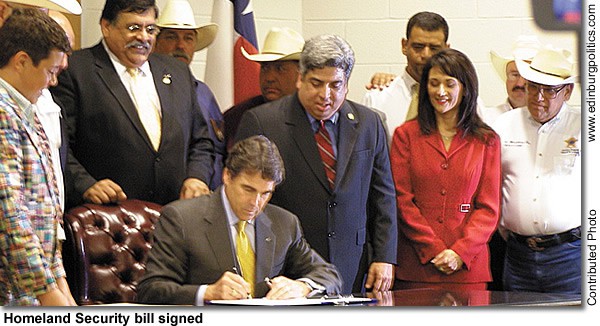
Gov. Rick Perry on Wednesday, June 6, was in Edinburg to sign into law Senate Bill 11, creating the Border Security Council, which will help him in allocating border security funding. The ceremony, which featured local lawmakers and border county sheriffs, took place at the Hidalgo County Sheriff’s Office in Edinburg. Area dignitaries featured with Perry, from left, include Rep. Juan Escobar, D-Kingsville (behind Perry), the governor, Rep. Aaron Peña, Jr., D-Edinburg, and Rep. Verónica Gonzáles, D-McAllen. Not shown, but also at the event, was Sen. Juan “Chuy” Hinojosa, D-McAllen, Hidalgo County Sheriff Lupe Treviño, and Cameron County Judge Carlos Cascos. See story later in this posting.
••••••

An estimated 1,000 people will be showing up in McAllen on June 20 – 21 for the South Texas Business Contracting Expo, which will include visits from Congressman Rubén Hinojosa, D-Mercedes, and Congressman Henry Cuellar, D-Laredo/McAllen. Featured here are members of the 2007 STBBCE Planning Committee. Seated, from left, are Minnie Lucio, Cameron Works; Desiree Méndez-Caltzontzint, Office of Congressman Hinojosa; Cynthia Sakulenzki, McAllen Hispanic Chamber of Commerce; Froy Garza, Office of U.S. Congressman Henry Cuellar; and Elizabeth C. Martínez, The Business Times of the Rio Grande Valley. Standing, from left, are Esperanza Pérez Delgado, University of Texas-Pan American Small Business Development Center; Mary Garza, Texas State Technical College; Matt Ruszczak, UTPA SBDC; Alex Valdéz, UTPA Hub Program; Johnny Clark, Thomas/Price and Associates; María Juárez, UTPA SBDC; Mark Winchester, UTPA SBDC; Gisela Palacios, UTPA Veteran’s Business Outreach Center and Jessica Salinas, UTPA VBOC. See story later in this posting.
••••••
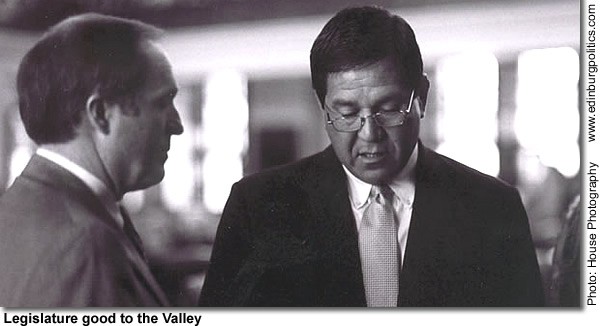
Rep. Ismael “Kino” Flores, D-Palmview, reviews some of his legislation on the House floor earlier this spring. Flores said South Texas came out very well during the five-month regular session of the Texas Legislature, which concluded May 28. “Although there is always more work to do, I’m pleased by the results of this session, especially when you consider how my district stacks up against other districts across the state,” said Flores. “From education to health care to economic development, I’m proud of the measures that I worked hard to get passed that will undoubtedly improve the quality of life for my constituents.” See story later in this posting.
•••••• (more…)
by Legislative Media | Jun 6, 2007 | Politics

Eagle Pass Mayor Chad Foster, center, chairman of the Texas Border Coalition, is flanked by mayors from Alamo, El Paso, Laredo, and McAllen, along with the Hidalgo County judge, during a Friday, June 1 news conference in McAllen detailing strategies to block plans for a fortified security fence along the Texas-Mexico border. Featured with Foster, from left, are Alamo Mayor Rudy Villarreal, El Paso Mayor John Cook, Hidalgo County Judge J.D. Salinas, Foster (at the podium), Laredo Mayor Raúl Salinas, and McAllen Mayor Richard Cortéz. Judge Salinas said there were “more important issues to South Texas – safety and health issues – than a fence that is going to cost $16 million a mile. That’s why we are here today. We feel a Veterans Hospital, taking care of the levees which may be built where they want the fence, are more important than a plan that was (drawn)on a napkin by the Border Patrol over lunch.” See story later in this posting.
••••••
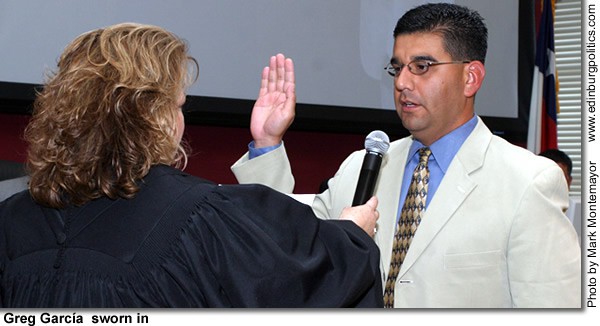
Edinburg school board trustee Greg García was sworn in recently following his successful reelection campaign against two challengers, Cris Treviño and Martin Castillo. Garcia, along with newcomer Robert Peña, Jr., who defeated incumbent Melba González, will each serve three-year terms. The new school board is now led by Carmen González (no relation to Melba), who is president of the ECISD board; Omar Palacios, vice-president; and Ciro Treviño, treasurer. Jaime Chavana and David Torres round out the school board. Featured swearing-in García is Hidalgo County 389th District Court Judge Letty López.
••••••

Sylvia Cardona, 32, formerly of Edinburg, and who practices commercial litigation and international law in the San Antonio office of Langley & Banack, Inc., was recently named 2007 president-elect of the Texas Young Lawyers Association (TYLA). The significance to the local and statewide legal community is twofold: it is only the second time in 20 years that a San Antonio attorney has been elected to this office; and it is the first time in the organization’s 77-year history that a female Hispanic will hold this position. See story later in this posting.
••••••
Texas leaders finalizing political groundwork for legislative assault on planned border wall
By DAVID A. DÍAZ
Texas border leaders on Friday, June 1, said they are about to embark on a summer-long campaign to rally growing opposition to a planned “border wall” they say will have little effect on curbing illegal immigration and waste precious federal resources that can be used for more effective homeland security and economic development measures.
The Texas Border Coalition, an alliance of mayors, county judges, and economic development leaders from El Paso to Brownsville, met at the McAllen Convention Center to finalize strategies on how to deal with the proposed high-security fence, dubbed by critics as the “border wall”, that could be built in deep South Texas in 2008.
The border wall is part of plans by the federal government to build 153 miles of fortified fences in the state, mostly along the Lower Rio Grande Valley. This project is part of a proposed 700 miles of additional fence, promoted as a way to curb illegal immigration, through Texas, New Mexico, Arizona, and California that could cost more than $1 billion.
Hidalgo County Judge J.D. Salinas said border leaders will continue to pressure the federal government and Congress to listen to the concerns of border communities.
“If we start holding them accountable like local taxpayers hold us accountable, to a plan, then we should start getting answers,” the county judge said. “This is not just about elected officials trying to get a sound bite, this is not a Democratic or Republican issue, this is a Texas issue that needs to be listened, to make sure we fix the future of the economy of South Texas.”
Judge Salinas dismissed the plan by the U.S. Border Patrol to build the barrier, which targets deep South Texas.
“There are more important issues to South Texas – safety and health issues – than a fence that is going to cost $16 million a mile. That’s why we are here today,” the county judge insisted. “We feel a Veterans Hospital, taking care of the levees which may be built where they want the fence, are more important than a plan that was (drawn) on a napkin by the Border Patrol over lunch.”
Major summit ahead
TBC officials said they want to raise the public’s awareness of the chaos they contend will result from the border wall, and galvanize public opinion in order to force political change in Congress, which has the final say on if, when, and where the wall will be constructed.
The planned wall in Texas is part of the immigration reform debate taking place in Congress. The U.S. House of Representatives could take action on immigration reform in August.
“This is in preparation for a summit that we hope will take place within the next couple of weeks,” explained Eagle Pass Mayor Chad Foster, who also serves as chairman of TBC. “I think we are making an impact. I think we have some traction. I think we have some momentum. The Texas Border Coalition, which represent the mayors, cities, counties, and economic development entities from El Paso to Brownsville, in combination with archaeologists, environmentalists, we can be the conduit. Together, we can make much more impact on this issue. For that reason, we had a very successful meeting.”
More than two million Texans live in counties that border Mexico.
El Paso Mayor John Cook said in the past, border leaders were told by federal government officials that they would be a key part of any decision-making process that impacted their communities.
But that trust was broken, TBC leaders contend, when they were surprised in May about plans to build the border wall, without their input, despite promises early this year by Michael Chertoff, the Secretary of the U.S. Department of Homeland Security, to keep border elected officials involved in all major developments regarding the wall.
Hearts and minds
TBC will now include in its political fight a battle for the hearts and minds of the U.S. public.
“Our strategy back in January was we wanted to work very closely with our elected delegation in Washington,” Cook said. “The strategy that you see us embarking upon today is we are going to use the media to our advantage, to let the American people know what life on the border is like.
“It’s not like the video game that has been shown around the country that depicts our city and our sister city of Cuidad Juárez as being a war game. That’s not the reality of life on the border,” Cook continued. “That may be somebody’s reality in Washington, but it’s not ours. We live it every single day. We are going to use the media to our advantage.”
Cook and Judge Salinas were joined by McAllen Mayor Richard Cortéz, who hosted the morning-long strategy session, along with Laredo Mayor Raúl Salinas (no relation to the county judge), Alamo Mayor Rudy Villarreal, and Rio Grande City Mayor Kevin Hiles.
Prior to the Friday, June 1 noon press conference at the convention center, the TBC leaders heard from environmental groups, farmers and ranchers, and other invited guests who shared serious concerns about the damage that would be caused by the construction of the planned border wall.
Town hall meetings
Mayor Salinas called on TBC to speed up plans of its own to hold public hearings on the controversy in order to generate a loud and consistent message to Congress.
“We’ve been burned so many times,” the Laredo mayor said of the federal government’s handling of the border wall plans, but added that he was “cautiously optimistic.
“But here we have the mayors and the judges together like never before, and who’s listening? We’re knocking at the door, and nobody is answering the call. It’s really time for a wake-up call,” Mayor Salinas continued. “But we need to get together and get these public hearings and these public meetings so we can be heard, so the people can be heard. I think it is offensive when we don’t give people the opportunity to speak. We’re big cities. We deserve that decency to be heard.”
Hiles said property rights are also at stake, noting that the border wall could have literally physically separate Texas land from the U.S.
“When you are talking about the issue of a fence, you’re not talking about just a barrier,” Hiles illustrated. “You are talking about eminent domain, you are talking about comprehensive issues and how those are going to be dealt. You are talking about where is the fence going to go. Is the fence going to be the new border?”
Eminent domain is the power of a governmental entity to take private real estate for public use, with or without the permission of the owner, often without fair compensation to the property owner.
TBC supports security
In McAllen, commerce from Mexico represents about 40 percent of the economy in that border city.
The planned border wall threatens that economic vitality of that, and many other communities, without increasing the nation’s security.
“What I want the American people to know is that we’re not trying to protect our turf by simply saying (the border wall) would hurt our economy,” said Cortéz. “We want to be good Americans. We want to secure our borders, we want to stop illegal immigration. Our quarrel is not with the goals of our country, our quarrel is how they are going about it to solve these problems.”
Cortéz and other border leaders scoff at the idea that a physical structure would stem the tide of illegal immigration, given that even a natural boundary – the Rio Grande River – is not able to discourage crossings from Mexico into Texas.
“If you didn’t catch them crossing the river, what’s adding another layer to that process going to do? We think it is just a waste of time,” he said. “But we also think that America needs to pay attention to core of the problem. We have illegals coming because we have a failed legal immigration system. It affects not only McAllen, it affects all of us in this country.”
Cortéz said more federal manpower and high-technology equipment are much better ways to address the issue of illegal immigration.
“We have been begging (the federal government) for more officers, not only Border Patrol, but U.S. Customs, immigration people,” he said. “We enjoy a tremendous amount of trade with Mexico. Eighty-five percent of the trade that we have Mexico, which is very substantial, comes through land ports of entry.”
A port of entry, such as a city on a land border, is a place where one may lawfully enter a country.
“What we have been hearing for years and years and years is that ‘we don’t have any money to invest in legal ports of entry’, and then we hear they have $52 million to build a fence that we think, we’re pretty sure, is not going to work,” Cortéz said. “Then, we question the logic of Congress. I’m sorry, but that’s how we feel.”
In addition to the border leaders who participated in the McAllen strategy session, other TBC members include: Brownsville Mayor Eddie Treviño, Jr. (until his successor is selected in a runoff later in June); Cameron County Judge Carlos H. Cascos; Edinburg Mayor Joe Ochoa; El Paso County Attorney José Rodíguez; Hidalgo Mayor John David Franz; Maverick County Judge José Pepe Aranda; Mission Mayor Norberto Salinas; Pharr Mayor Leopoldo Palacios, Jr; Roma Mayor Rogelio Ybarra; Val Verde County Judge Manuel “Mike” Fernández; Weslaco Mayor Joe V. Sánchez; Mike Allen of McAllen, a member of the South Texas College Board of Trustees, and Pat Townsend Jr., president and CEO of the Mission Economic Development Agency, and other community leaders.
The Texas Border Coalition maintains a web site at http://www.texasbordercoalition.org.
••••••
Sen. Hinojosa secures new funding to protect state’s valuable agricultural industry in deep South Texas
By MELISSA DEL BOSQUE
As the regular session of the Texas Legislature drew to a close Monday, May 28, Sen. Juan “Chuy” Hinojosa, D-McAllen, commended his colleagues for agreeing to take immediate steps to guarantee the safety of Texas’ valuable agriculture industry by combating specific diseases that could threaten South Texas growers and severely impact the local economy.
“Protecting Texas valuable agriculture from extremely damaging invasive pests and disease is a top priority,” Hinojosa said.
Hinojosa authored a budget rider to secure $1.6 million for research into a virus that causes disease in potatoes. The rider creates an agreement between the Texas Department of Agriculture and the Texas A&M Extension Station to conduct comprehensive research into the harmful virus called Zebra Chip after the dark stripes it makes on affected potatoes. The disease has already resulted in millions of dollars in crop losses for South Texas growers. There is also concern that the virus could spread northwards, ruining Texas’ potato industry. An economic impact study by Texas A&M showed that losses from Zebra Chip would reach $100 million in lost business in Texas and almost 1,000 jobs.
In addition, Hinojosa worked with Texas Agriculture Commissioner Todd Staples to secure $1.3 million for 12 new employees to undertake inspections for harmful plant diseases, including the citrus canker that could put South Texas’ valuable citrus crops at risk.
“Under the plan, inspections will increase dramatically,” Hinojosa said. “Plant shipments entering Texas will be subject to more than 350 additional quarantine inspections and more than 8,500 additional man hours of scrutiny by state inspectors.”
••••••
Former Edinburg City Secretary Mary Villarreal honored for her dedication to open government
By DAVID A. DÍAZ
If “a cultivated mind is the guardian genius of democracy,” as Mirabeau B. Lamar, the president of the Republic of Texas, once so eloquently put it, then city secretaries throughout the Lone Star State are the protectors of open government.
A city secretary, which is an appointed official who makes sure that a municipal government operates in full view of the community, is the oldest public service role in local government.
Villarreal completed almost 30 years of public service in 2004 as Edinburg City Secretary in order to pursue an equally impressive career as co-owner, along with her husband, Romeo, of Edinburg Child Care, Inc.
But for the statewide-recognized advocate of the people’s right to know, the concept of open government – from fair elections to easy access of public documents – has always been more than a lofty ideal.
It has been her life’s calling.
“It’s astounding just how much local governments affect our lives,” said Villarreal. “So it is very important for citizens to understand that they have the right and the power to get information about their government’s activities, no questions asked.”
Her determination to help citizens empower themselves with such knowledge has earned her, along with five other former Valley city secretaries, with lofty praise from their colleagues in the Lower Rio Grande Valley City Secretaries/Clerks Association.
“Keepers of the Archives”
“The LRGV City Clerks Association recognizes the contributions made by city secretaries now retired from public service,” Annette Villarreal (no relation to Mary), McAllen’s City Secretary and president of the organization, proclaimed at the group’s April 18 meeting in Port Isabel.
Mary Villarreal, former Weslaco City Secretary Hilda Adame, former Pharr City Secretary Dora Garza, former Mission City Secretary Mona Martínez; former Pharr City Secretary Mary Muñoz, and the late Natividad (Tiva) Sánchez, a former McAllen City Secretary, all were recognized by the Valley organization.
The former city secretaries “have contributed to the success of this association, leaving a legacy to be utilized by their successors in the efficient operation of their offices and their service to the public,” Annette Villarreal acknowledged. “We recognize and thank them for the imprint they have left in the association for the benefit of their peers and the public.”
According to the South Texas organization, the role of the city secretary has existed before Biblical times. Some of the designations include “Keepers of the Archives”, and before writing came to use, they were referred to as “Remembrancer” because their memory served as the public record.
During the Middle Ages, only municipal clerks and clergy could read or write.
Fast forward more than 1,000 years, the role of the 21st century city secretary has taken even greater prominence, especially in the information-intensive and Internet-connect world of today.
The major duties of a city secretary include attending all government meetings and keeping accurate records of all actions taken, setting up and protecting a secure archival system for all public records and documents, and serving as the election officer for all of the government’s elections.
Open government
In the mid-1990s, Villarreal was one of the strongest supporters for a plan by Mayor Joe Ochoa and City Manager John Milford to team up with the University of Texas-Pan American to create the Edinburg Cable Network.
“We now take it for granted, but not too long ago, Edinburg residents had to break away from their busy schedules if they wanted to see what was going on during a city council or Edinburg Economic Development Corporation meeting,” she said. “But the creation of the Edinburg Cable Network has done away with that burden. We can now see, in the comfort and privacy of our homes, exactly what is going on during those meetings, literally with the touch of a button on the TV remove control. That’s a powerful tool for democracy.”
The Edinburg Cable Network is available on Time Warner Cable Channel 12, or on the Internet by logging on to the city government’s website at http://www.thecityofedinburg.com
In addition to the city and EEDC meetings, the Edinburg Cable Network also produces local newscasts and stories featuring major activities in the three-time All-America City. In addition, programming from the University of Texas-Pan American is also featured on ECN.
When the Internet was starting to make its mark in local government, Villarreal made sure her department was the first at City Hall to implement a computer network. This process involves the
use of a network of computers and computer terminals by individuals at various locations to interact with each other by entering data into the computer system.
She also introduced an imaging system in the department, that allows for the scanning of all documents onto computer discs, not only for archival purposes, but also to allow rapid and inexpensive reproduction of all public documents.
Staying ahead of the curve, she also made Edinburg’s City Secretary Department one of the few local governments which are authorized by the U.S. government to issue passports, a service that provides convenience to residents while generating money for the city treasury.
“…know the truth…”
Villarreal still keeps a close eye on state and federal legislative proposals that seek to curtail, or improve, the public’s knowledge of their governments’ actions.
Over the years, she has championed the cause of open government and public disclosure initiatives, tracking major state and federal bills on those issues, and urging politicians in Austin and Washington, D.C. to favor an informed electorate.
She expressed disappointment that a proposed reporters shield law that would have helped journalists protect their sources was apparently killed in late May on a technicality in the Texas Legislature.
The so-called “shield law” would have allowed journalists, in certain cases, to protect the identity of their news sources in order to encourage people to reveal, through the press, unethical or illegal activities in the public and private sectors.
Opponents of the measure feared it would give journalists a right that other citizens do not possess.
According to newspaper accounts, the shield law was defeated on what is called a “point of order” when opponents noted a grammatical error in the legislation that doomed it to defeat.
“This is a perfect example of how difficult it is to pass a law to help people know what is going on in their government,” Villarreal said.
Regardless of that setback, Villarreal added that there are still very good state and federal laws in place to protect the public’s right to know.
She noted with amazement that in ancient Greece, the birthplace of democracy, the Town Clerk, during the meetings of the government, placed a curse on anyone would would try to deceive the public.
Acts 19:22.41, according to the LRGV City Secretaries/Clerks Association, gives an accounting of a Town Clerk who dispersed a riotous crowd to insure the safety of Saint Paul and his followers.
With a strong faith in her Christian roots, Villarreal said she was thankful for the role of the Town Clerk cited in the Bible, although she said she drew the line at the use of curses in ancient times.
“I believe that the role of today’s city secretary, with the duties to inform the people, is much more in line with the proclamation in John 8:32,” she said. “‘Ye shall know the Truth, and the Truth shall set you free.”
••••••
Rep. Peña says he will run for reelection after all, top goal will be creation of a Valley medical school
By DAVID A. DÍAZ
Saying he was boosted by his legislative achievements and inspired by well-wishers back home, Rep. Aaron Peña, D-Edinburg, said on Thursday, May 31, that he will indeed campaign for a fourth two-year term in the Texas House of Representatives.
Peña said his success in securing $3 million, in the just-concluded legislative session, for a drug treatment center to be located in Edinburg fulfilled the main reason he ran for office in the first place. Now, he is setting his sights on a medical school complex for the Valley that would include and enhance the Regional Academic Health Center in Edinburg.
In mid-May, Sen. Eddie Lucio, Jr., D-Brownsville, passed legislation to create a medical school, which would located in Brownsville. That measure did not receive a committee hearing in the House of Representatives.
Peña’s comments, posted on his website, http://www.ACapitolBlog.com, represent his first public pronouncements since a Saturday, May 29, story by the Freedom Newspaper chain portrayed him as leaning against running for reelection.
Peña’s term ends in early January 2009. The party primaries will be held in March 2008, and the general election in November 2008.
Peña v. Sáenz, Part II?
Eddie Sáenz, a civil engineer who ran against Peña in 2006, is expected to challenge Peña, an attorney, once again. They battled in the Democratic Party primary in March 2006.
If both the Republican and Democratic parties field candidates in March, then the November 2008 general election – which will include the race for U.S. president – will focus on the effort to represent House District 40, which includes all but southwest Edinburg, the Delta Area, La Joya, Sullivan City and smaller communities in northern Hidalgo County.
Promise kept
Peña laid out his reasons for running again in his website, which featured a return to his first campaign platform – addressing the blight of illegal drug usage in deep South Texas.
“Long ago in the hills of Central Texas on the banks of the Guadalupe River that passes next to La Hacienda Drug Treatment Center, I made a promise to bring a drug treatment center to our small community in South Texas. Our small band of misfits walked 125 miles from Hunt, Texas, where La Hacienda is located, to our state capitol in Austin to bring attention to the lack of treatment services in our community. Our first goal was accomplished on May 18th of this year when the conference committee of both the Senate and House announced that the drug treatment center we long advocated for was coming to my hometown of Edinburg.”
Following that legislative achievement, Peña, who was among a handful of Valley Democratic state representatives – the so-called Craddick D’s – who supported the reelection in January of Speaker of the House Tom Craddick, a Republican.
Peña contends his controversial support for the Republican speaker wound up getting big projects financed for his legislative district. More important, when Craddick was under blistering attack at the end of May from both Republican and Democratic rivals, who sought to unseat the speaker for his leadership style, Peña remained steadfast in support of Craddick.
Peña suggested that his loyalty to Craddick has paid dividends for House District 40, and constituents recognize the power of Peña’s seniority in bringing home the political bacon.
“With that goal (the drug treatment center) complete, I returned home fully prepared to return to civilian life. When I returned home yesterday, I was pleasantly surprised by well wishers from the community and more importantly members of my family who after reading newspaper reports of my potential departure from office, encouraged me to continue my work in the legislature and to build on the successes we saw last session,” Peña said.
“Therefore, let me announce to you the faithful readers of this site, that it is my full intention to once again seek election to office so that I can continue serving the people of this community at their capitol.”
Valley medical school plans
Earlier in the spring, Sen. Eddie Lucio, Jr. D-Brownsville, secured Senate funding to expand the University of Texas Regional Academic Health Center, which has sites in three Valley cities, including Edinburg, into a full-fledged medical school system.
The Senate bill did not make it out of the Legislature, however.
Peña said now is the time to begin working on the medical school project for the 2009 legislative session.
“My first order of business is to announce our second legislative goal for our South Texas community, that being the construction of a medical school,” Peña said. “I have instructed my staff to begin drafting legislation for the construction of a medical as well as other professional schools for our community. These may seem like mere dreams not likely to have a chance of success but so was the drug treatment center when we started.”
Peña’s call for a medical school comes after several legislative efforts by Lucio, the Brownsville senator, to upgrade the UT Regional Academic Health Centers in the Valley to a four-year teaching institution with degree-granting powers.
The UT-RAHC (pronounced rack) campuses in Edinburg, Harlingen, and Brownsville are branch campuses of the UT Health Science Center at San Antonio.
•••••
Texans to vote on bill by Reps. García, Branch to publicly record all votes by state lawmakers
By ELIZABETH PEARSALL LIPPINCOTT
Amidst the turmoil of a late-night challenge to Speaker Tom Craddick, Rep. Juan García, D-Corpus Christi, secured final passage on Friday, May 26, for a far-reaching measure that will allow Texas voters to enshrine open government in the Texas Constitution.
House Joint Resolution 19, which García joint authored with Rep. Dan Branch, R-Dallas, will place a constitutional amendment on the November 6, 2007 statewide ballot to require the Texas House and Senate to record all final votes, publish the votes on the Internet and maintain the voting records online for at least two years.
HJR 19 won final House approval minutes before a midnight deadline Friday for the House to consider Senate amendments. The legislative session ends at midnight on Monday May 28.
“This November, the people of Texas will have an historic opportunity to send a message to their Legislature demanding more transparency in government,” García said. “When the people of Texas pass this Constitutional amendment, it will forever change the culture of our government to make it more open to all Texans.”
Thanks to the García amendment, which he added to the House Rules during the first week of the legislative session, the public can view the record vote on HJR 19 and other legislation on the Internet at http://www.capitol.state.tx.us. The direct link for HJR 19 is http://tlis/BillLookup/History.aspx?LegSess=80R&Bill=HJR19.
Also this session, García filed House Bill 2801, which would have required record votes for preliminary “second readings” as well as votes on final passage. García’s HB 2801 would also have required the Legislature to publish all record votes within one hour, committee votes within 24 hours and maintain all record vote information online for at least 10 years. However, when it became clear that HJR 19 was the record vote measure with the best chance of passing this session, he joined the bipartisan group supporting the constitutional amendment.
“I will continue to fight for even more openness in the Texas Legislature,” García said. “We can continue to use the House rules to improve the public’s access to voting information that will hold their legislators accountable.”
With the Friday, May 26 passage, HJR 19 goes to Texas Secretary of State Roger Williams for preparation of the November 6, 2007 statewide constitutional ballot. If Texas voters approve the constitutional amendment to require record votes in House and Senate, it will be significantly more binding on legislative procedure than a regular statute.
The proposed constitutional amendment would read: “The constitutional amendment to require that a record vote be taken by a house of the legislature on final passage of any bill, other than certain local bills, of a resolution proposing or ratifying a constitutional amendment, or of any other nonceremonial resolution, and to provide for public access on the Internet to those record votes.”
García represents the 32nd District in the Texas House of Representatives. Elected in 2006, he is an attorney and second-generation naval aviator. Garcia lives in Corpus Christi with his wife Denise and their four children.
••••••
EEDC considering funding infrastructure to promote development in East Edinburg
By DAVID A. DÍAZ
The latest business hot spot in the three-time All-America City, anchored by the planned Fiesta Chevrolet in east Edinburg, could soon be getting an additional spark from the Edinburg Economic Development Corporation.
On Tuesday, May 30, the EEDC board of directors authorized its executive director, Ramiro Garza, Jr., to begin negotiations on a development agreement with Fiesta Chevrolet, for the EEDC to pay for needed water and wastewater lines to serve the planned complex, and other businesses that should develop in the corridor as well.
The growth of that region is sure to benefit from another major development – plans for the $80 million Shoppes at the Rio Grande Valley, a 1.1 million square-foot retail complex that will be located a few blocks west of the new car dealership.
The incentive to be offered to Bert Ogden RGV by the EEDC, which is the jobs creation arm of the Edinburg City Council, could represent a public investment of $150,000 or more to pay for water and wastewater lines leading to the car dealership site, owned by Bert Ogden Rio Grande Valley.
The offer of public investment would involve Bert Ogden RGV agreeing to meeting specific job creation, construction investment, and timetable criterion.
The EEDC board of directors would have to review the agreement in open session, during a publicly-posted meeting in the near future.
The EEDC board of directors includes Mayor Joe Ochoa, and its president is former Edinburg Mayor Richard García. The other EEDC board members are Fred Palacios, Mike Govind, and George Bennack.
Company leaders have previously said that the new Fiesta Chevrolet will employ up to 150 people, represent an investment of $2.5 million, and occupy six acres of the 17-acre site.
Eventually, three car dealerships, owned by Bert Ogden RGV, will be located on that site, and represent a private investment by Bert Ogden RGV of $15 million, Garza said.
On April 10, Bert Ogden RGV broke ground for its Fiesta Chevrolet dealership as the first phase of that development. That property was formerly an empty tract of land near the intersection of Trenton Road and the North U.S. Expressway 281 bypass in east Edinburg.
Currently, Fiesta Chevrolet is located near downtown Edinburg, and was the former Roberts Chevrolet dealership. But the current Fiesta Chevrolet complex has been sold to the county, which will build a second public parking lot for courthouse visitors.
Garza said the investment of public funds for the water and wastewater lines will help speed up the development of the 17-acre Bert Ogden RGV complex, and generate construction of additional businesses along that corridor.
“Because of the incentive that we are looking at offering, they are considering expediting their investment in building,” said Garza. “The return for the city is the development of that corridor. It will allow for further development along U.S. Highway 281. When we invest in certain areas, it helps not only that development, but opens up other developments along those corridors.”
By helping generate new economic development, the EEDC is able to help keep the city’s property tax rate from increasing, he added.
“Our focus has been to help different commercial growth,” Garza said. “It is increasing our tax base. which offsets the need for the city to increase the tax rate. We make sure there is new tax base that results in less burden on taxpayers and the creation of more jobs.”
••••••
Summer of 2007 to continue major changes in county government’s presence in Edinburg
By DAVID A. DÍAZ
With an rapidly increasing population that he estimates at about 800,000 residents, Hidalgo County Judge J.D. Salinas says plans are underway for the county government to physically keep up with the growth.
Salinas is a former two-term Hidalgo County County Clerk and a protege of state political icon John Sharp, a Democrat who is the former Texas Comptroller of Public Accounts. The county judge, who took office in January, addressed some of the major issues and projects facing Edinburg, which is the county seat, during a presentation in Edinburg on Thursday, May 17.
His presentation, the latest in a series of Legislative Luncheons sponsored by the Edinburg Chamber of Commerce, covered a wide array of issues, from transportation concerns to improving the Edinburg downtown area.
Those luncheons, which also feature a question and answer format, are coordinated by Ramiro Garza, executive director of the Edinburg Economic Development Corporation, which is the jobs-creation arm of the Edinburg City Council. Garza also serves as head of the Public Affairs Committee, which organizes the legislative luncheons for the local chamber.
The EEDC is governed by a five-member board of directors, which includes Mayor Joe Ochoa, former Mayor Richard Garcia, who is president of the EEDC board, George Bennack, Mike Govind, and Fred Palacios.
Salinas said building a new county courthouse would be out of the question because of the expense. He said there is no concrete estimate regarding what a new courthouse complex would cost.
“Let’s face it, I’m going to be honest with you: what is it that we should do?” Salinas reflected.
“Probably build a new courthouse. But how is that going to happen? We’d have to raise from 59 cents (the county property tax rate) probably to 65 cents, but I’m sorry – that’s just not going to happen while property valuations are going up every year.”
He said that working with available resources, through remodeling, is part of an immediate strategy to handle the growing demands on the courthouse complex and its branch facilities.
“Right now we are developing a short-term plan, because, as you know, we have a new district court that opened about a month ago,” Salinas noted.” We had to accommodate him right away.”
Gov. Rick Perry on Monday, March 26 appointed Thomas P. Wingate of Mission as judge of the 430th Judicial District Court serving Hidalgo County. Wingate will serve until the next general election.
The 430th District Court is currently being housed at leased building located two blocks west of the
Courthouse, according to Cari Lambrecht, public information officer for the county.
Hidalgo County has a lease on this building through July 13, 2007 and is advertising
sealed bids for lease of space to house a trial court, she said. This building recently housed the
Juvenile Justice Court, which now is permanently located at the New Mario E. Ramírez, Jr.
Juvenile Detention Facility on the corner of Richardson and Doolittle roads.
In addition to the courthouse, which has been the dominant landmark in the downtown area for decades, the county government’s physical presence also includes the County Administration Building, located at 100 East Cano, and the former K-Mart Building, located in south Edinburg at Closner Boulevard and Canton Road.
Often overlooked, because many people mistakenly believe it is owned by the city, is the downtown parking lot, more commonly known as the downtown square.
For years, that site has been overwhelmed by potential jurors, lawyers, and scores of county residents needing to come to Edinburg to go to the courthouse or to County Administration Building, which houses the county judge’s office, among other major departments.
Sallnas said the county has made a major move to address that shortcoming.
“We are already expanding our parking. As you know, that is one of our biggest problems,” Salinas said, noting the county bought the former Roberts Chevrolet facility, now Fiesta Chevrolet, in order to eventually raze the buildings and make a second county parking lot.
Fiesta Chevrolet is located at 317 N. Closner Boulevard, just north of the courthouse complex, and within walking distance of the courthouse. The county bought the property for $5.7 million in February 2007 from the LJ Roberts Family Limited Partnership, Lloyd J. “Bob” Roberts and David Mitchell Roberts.
The purchase contract requires vacancy of the property by November 2007. The county could potentially net more than 900 spaces between the courthouse downtown square and the Roberts Chevrolet (now Fiesta Chevrolet, owned by Bert Ogden RGV) site, said Lambrecht.
A few miles down the road, the former K-MART Building is getting ready to take in major county operations.
The county acquired the former K-MART Building in 2005 at a cost of $1,635,000.00. It consists of a building with 55,552 square feet and 6.24 acres of land, county officials noted.
The renovations of the building began late in 2006 at a total cost to date of $3,127,000.00. It was purchased from CapRealty 01-Edinburg LLC, 205 E. 42nd. St., RM 1916, New York, NY 10017-5700.
The departments that will be occupying the former K-MART Building are as follows:
- Hidalgo County Tax Assessor-Collector (both tax and auto divisions);
- Hidalgo County Treasurer’s Office;
- Hidalgo County Auditor;
- Hidalgo County Veteran’s Service Office;
- Hidalgo County Fire Marshall Office;
- Hidalgo County Purchasing Department;
- Hidalgo County Agenda Coordinator; and
- Hidalgo County Office of Budget & Management (which includes Safety Division, Risk Management, Worker’s Comp., Litigation, Health Insurance & Agenda Coordinator).
Beginning June 15, those departments will begin the move to the former K-MART building.
••••••
Edinburg’s Sylvia Cardona will be first female Hispanic to lead Texas Young Lawyers Association
By KATY AKIN
Sylvia Cardona, 32, formerly of Edinburg, and who practices commercial litigation and international law in the San Antonio office of Langley & Banack, Inc., was recently named 2007 president-elect of the Texas Young Lawyers Association (TYLA). The significance to the local and statewide legal community is twofold: it is only the second time in 20 years that a San Antonio attorney has been elected to this office; and it is the first time in the organization’s 77-year history that a female Hispanic will hold this position.
A nomination committee comprised of TYLA past-presidents and officers chose Cardona as one of two candidates in February. She spent 20 days in March campaigning throughout the state, making trips to McAllen, Corpus Christi, Houston, Dallas and El Paso, among other locations. Ballots were distributed to approximately 26,000 TYLA members in early April and were due no later than Tuesday, May 1, when it was announced that Cardona had beaten her opponent from Dallas by a 12 percent margin.
TYLA is a department of the State Bar of Texas (SBOT). Attorneys who are 36 years old or younger, or who have practiced law five years or less (regardless of age) are eligible for membership. The president-elect office is the only position that requires an election by TYLA members. Cardona will serve as president-elect for one year beginning in June. In her role, Cardona will serve on the TYLA board of directors and the SBOT board of directors. She will also act as a Texas delegate to the American Bar Association (ABA). In June, 2008 she will take office as president of TYLA at the SBOT annual meeting.
Cardona was raised in Edinburg as part of a family that considered discipline, motivation and a strong work ethic its core values. Her parents, both of whom were migrant farm workers, instilled a respect and appreciation of education in the young Cardona, who became the first member of her family to graduate from college. She earned a bachelor of arts degree in political science and Mexican American studies from the University of San Antonio in 1998 and a doctor of jurisprudence from the University of Oklahoma Law Center in 2001. She received a master of laws (LL.M.), an advanced degree in international and comparative law, from Georgetown University Law Center in 2002. Cardona has been an associate at Langley & Banack, Inc. for four years.
Langley & Banack, Inc. is one of South Texas’ most recognized full-service law firms, with 50 attorneys and offices in San Antonio, Eagle Pass and Carrizo Springs. The firm has received the highest rating granted by Martindale-Hubbell for competency in the practice of law and ethical conduct and has been designated as a member of the Martindale-Hubbell Bar Register of Pre-Eminent Lawyers. Langley & Banack, Inc. is the only San Antonio member of MERITAS Law Firms Worldwide, an affiliation of nearly 170 independent member firms throughout the world, providing the resources of approximately 4,800 attorneys in 61 countries.
••••••
Five Rio Grande Valley residents indicted for voter fraud allegedly from 2006 election cycle
RIO GRANDE CITY – Five Starr and Hidalgo County residents face voter fraud charges for their conduct during the 2006 election cycle, Texas Attorney General Greg Abbott announced on Friday, June 1. A week earlier, a Brooks County grand jury returned felony indictments against the five defendants in an investigation that began with a complaint filed by Starr County Elections Administrator Rafael R. Montalvo.
José René Gómez, 33, was indicted for voting twice during the November 2006 general election in Starr County, a third-degree felony. The grand jury charged four other defendants with conducting an illegal mail-in ballot scheme during the March 2006 primary election in Starr County. They are Oralia Frausto, 49; Dolores Gutiérrez, 58, also known as María González; and Gómez, all of Starr County, and Óscar Ríos, 37, of Hidalgo County. Ríos was arrested Thursday by Precinct 3 Constable Lazaro Gallardo, Jr. Arrests of the remaining defendants remain pending.
“Our democratic system of government depends upon fair elections,” said Abbott. “Texans will not tolerate illegal schemes that undermine the electoral process. Voters can rest assured that the Office of the Attorney General will protect the validity of their votes and defend the integrity of the ballot box. We are grateful to Starr County Elections Administrator Montalvo for uncovering this extraordinary election fraud case.”
Defendants Frausto, Gutiérrez and Ríos collectively face more than 50 counts of possessing the ballot of another person without consent, a state jail felony. Prosecutors with the Office of Attorney General, who presented all five cases to the Brooks County grand jury, will prosecute each of the defendants.
Abbott added, “The Office of the Attorney General has received critical assistance from Starr County Sheriff Reymundo Guerra and Constable Lazaro Gallardo for their efforts to cooperate and assist with the arrests of the suspects in this case.”
According to the Attorney General’s investigation, false addresses and the names of nonexistent Starr County voters were used to illegally obtain voter registration cards. The addresses that appeared on those cards were not actual voters’ residences, but rather were vacant lots and condemned buildings.
Fraudulently obtained registration cards enabled the defendants to complete mail-in ballot applications, which instructed the Starr County elections office to send mail-in ballots to Hidalgo County addresses, presumably where the “voters” would be present during the March 2006 Starr County Democratic primary election. The four defendants picked up the ballots at the Hidalgo County addresses. The ballots were then filled out and mailed them to the Starr County elections office.
During the March 2006 primary election, Starr County Elections Administrator Montalvo noticed a large number of irregularities with both voter registration applications and applications for mail-in ballots with Hidalgo County destinations. Many of these “voters” provided abandoned properties and vacant lots as their primary residences in Starr County. While canvassing the ballots, the administrator also detected that Gómez cast two votes, one in each of two polling locations. The administrator subsequently referred the matter to the Secretary of State, who certified a complaint to the Office of the Attorney General.
••••••
Rep. Peña presents recognition to Edwards Abstract and Edinburg’s Elva Jackson Garza
By ORLANDO SALINAS
Edwards Abstract and Title Company celebrated the grand opening of their new headquarters in Edinburg on May 31. Hundreds of community members were on hand to tour the two-story, southwestern themed building located on Freddy González and McColl.
Rep. Aaron Peña joined the festivities, where he presented a state recognition commemorating the occasion and another honoring Edwards Abstract staff member and longtime community leader Elva Jackson Garza.
“Edwards Abstract and Elva Garza represent the embodiment of service and commitment to community,” said Peña. “I had the honor of presenting and passing two resolutions in the final hours of the legislative session recognizing their contributions.”
The Texas House of Representatives passed House Resolution 2910 commemorating the grand opening of the new Edwards Abstract and Title Company headquarters.
The resolution recognizes the company’s founding in 1880 by Judge J.Hl. Edwards and it’s continued service to Edinburg and the Rio Grande Valley. Its products and services now include title commitment, insurance, and reports and escrow, tax, and closing services at offices in Edinburg, McAllen, Weslaco, Mission and Sharyland Plantation.
The new facility will also be the home of the law firm of Lewis, Monroe, and Peña, Edinburg Escrow Branch Office, and Edwards Title Plant.
Peña also presented House Resolution 1801 honoring Elva Jackson Garza for contributions to her community. The resolution highlights Garza’s outstanding record of service to organizations like the Edinburg Chamber of Commerce, Kiwanis and many other civic and business groups. She has worked with Edwards Abstract since 2002 where she serves as Vice President and Director of Marketing. She is married to Alfredo Ruben Garza.
Peña is serving his third term in the Texas House of Representatives. He is chairman of the House Committee on Criminal Jurisprudence and a member of the House Committee on Ways and Means.
David A Diaz contributed to this article
••••••
Sen. Lucio highlights state budget approved by Legislature, praises work by his son, Rep. Lucio, III
By DORIS SÁNCHEZ
Sen. Eddie Lucio, Jr., D-Brownsville, on Sunday, May 27, voted in favor of the State Budget Bill (Conference Committee Report to House Bill 1) totaling $153 billion for the 2008-09 biennium. The amount reflects an increase of $10 billion or 7 percent from the 2006-07 biennial level. The approved budget excludes the $14.2 billion for property tax relief passed earlier in the session.
“As a member of the Finance Committee, I am thankful that the conferees approved a proposal that will provide nearly $10 million to improve and renovate our Harlingen-South Texas Hospital, solving a 10-year funding problem,” Lucio said. “I am proud of my son, Rep. Eddie Lucio, III (D-San Benito)—a member of the House Appropriations Committee—whose efforts helped this and other goals become reality. I am equally elated that we were able to receive an additional $5 million for the Regional Academic Health Center (RAHC) sites in Harlingen and Edinburg, which will allow for improved health services for the people of the area.”
A huge success this session includes $7.2 million in new money for the Texas A&M University System Health Science Center – Irma Rangel School of Pharmacy in Kingsville. Student financial Aid was increased by $140 million for a total funding of $533.8 million, representing an increase of 35 percent to serve 80,000 students in FY 2008 and 83,000 in FY 2009.
Non-profit zoos across this state and South Padre Island will benefit by a couple of proposals authored by Lucio.
“Of the two million dollars that we were able to set aside for non-profit zoos in Texas from local matching grants, $600,000 is earmarked for the Gladys Porter Zoo in Brownsville. Together with the $300,000 matching grant for Sand Source Studies (to develop an inventory and preliminary dredging plan to nourish Gulf of Mexico beaches), the zoos and beaches in Cameron County will greatly benefit from this appropriation,” explained Lucio.
As Chairman of the Senate International Relations and Trade Committee (IRT) and as a member of the Finance Committee, Lucio was able to get many of the proposals IRT recommended to the Legislature funded in the State Budget. IRT recommended a significant increase in funds for the Bootstrap Program via an increased appropriation to the Housing Trust Fund (HTF) and the necessary funding to reinstate the Office of the Attorney General’s Colonia Prevention Law Enforcement Investigators.
“I had requested $30 million for the Housing Trust Fund. Although we were not successful in obtaining complete funding, we were able to garner an additional $5 million to double existing resources for the Bootstrap Program to provide affordable housing for low-income households. I thank Lt. Gov. David Dewhurst for his support of this funding,” said Lucio. “The constituents I represent all along the border region also thank the Legislature for funding IRT’s recommendation to reinstate the Attorney General’s Office Colonia Investigators with nearly half a million dollars to enforce our colonia prevention laws.”
Another appropriation in the state budget recommended by IRT and authored by Lucio improves the outlook of colonia residents by providing the necessary debt service ($4.4 million) for water and wastewater services bonds ($37.5 million for the biennium).
Lucio’s Senate Joint Resolution 20, which proposes a constitutional amendment to authorize $250 million in additional general obligation bonds for the economically distressed areas program, will provide essential water and wastewater services to distressed areas of the state.
The Legislature also approved IRT’s recommendation and Lucio’s proposal to provide the necessary debt service to issue another $43 million in bonds for the Colonia Road Access Bond program. “With these $43 million, we are continuing our effort started in 2001 to build needed roadways in our colonias,” said Lucio.
The senator further noted, “From the budget that will be going to the Governor’s desk, we made it possible to add 127,000 more youngsters to the Children’s Health Insurance Program (CHIP) by allowing a one-year enrollment period rather than the six-month period, which caused many children to be dropped from the rolls. We funded CHIP at $2.1 billion, representing an increase of $213.2 million for perinatal services, dental premiums, caseload increases, cost growth, as well as rate restorations and increases. This appropriation also includes an increase of $89.5 million to change certain CHIP eligibility standards.”
Money was also made available for more children throughout the state to receive dental health care from mobile dental units with an appropriation of $150 million.
Medicaid services will see an increase of $2.3 billion at all Health and Human Services agencies to address the caseload increases and fund acute care cost growth.
“Our teachers and state employees will see small raises. Teachers will average about $425 extra per year. The state’s contribution for retired teachers increased from 6 percent to 6.58 percent. I will continue to work towards raising teacher salaries to be comparable with the national average, and to increase retired teachers’ pensions, because this is not satisfactory in my view,” said Lucio. “I strongly believe we should approve a yearly cost of living adjustment for them.”
School Facilities Funding, or IFA, was funded at $87.5 million, showing an increase of $37.5 million.
Lucio was “pleased to work alongside Sen. Juan ‘Chuy’ Hinojosa, D-McAllen, to secure $49 million for the new regional Department of Public Safety facility in McAllen and $456,000 million for a drug incinerator for the border.
“I thank Sen. Steve Ogden for his leadership as Chairman of the Senate Finance Committee, as well as my fellow Senators for their hard work on developing this budget,” added Lucio. “It doesn’t meet every need that I would like to see met; however, we have set aside funding to improve or continue valuable programs that will provide housing, water and wastewater services, increased health care programs and funding for future expansion of medical facilities in South Texas.
“I especially want to thank Gov. Dewhurst for my appointment to the Senate Finance Committee and for my IRT Chairmanship, which allowed me the opportunity to deliver so many programs and initiatives for the benefit of the entire border region and for economically distressed areas of the state,” concluded Lucio.
••••••
Reps. King, Guillen, Sen. Zaffirini expand higher education exemptions for dependents of volunteer peace officers
By NICK ALMANZA
Dependents of volunteer law enforcement officers who were killed or disabled in the line of duty are now exempt from higher education tuition and fees at public higher education institutions in Texas. House Bill 741 by Rep. Tracy King, D-Batesville, Rep. Ryan Guillen, D-Rio Grande City, and Sen. Judith Zaffirini, D-Laredo, was signed into law on Friday, May 25. These tuition and fee exemptions are effective immediately.
“This very important exemption gives financial relief and opens the doors of higher education to the children of the brave men and women who volunteer to protect our communities,” Zaffirini said. “I truly am grateful for Reps. King’s and Guillen’s leadership in authoring and sponsoring this important bill and am delighted it will now help children whose parents made the ultimate sacrifice for public service and safety.”
Exemptions from tuition and fees at public higher education institutions now are available for the children of full-paid firefighters, police offices, volunteer firefighters and volunteer law enforcement officers who have been killed or disabled in the line of duty. Volunteer peace officers often receive the same training and fulfill the same duties as full-paid law enforcement officers. Their inclusion in these tuition and fee exemptions greatly is warranted.
••••••
Gov. Perry signs legislation by Sen. Zaffirini, Reps. Duke, Coleman to improve access to health care
By NICK ALMANZA
A new law passed recently by the Texas Legislature greatly increases the effectiveness of the Office for the Elimination of Health Disparities (OEHD) and the Health Disparities Task Force (HDTF). The Office and its task force are responsible for eliminating health and health access disparities throughout Texas.
House Bill 1396 by Rep. Dawnna Dukes, D-Austin, Rep. Garnet Coleman, D-Houston, and Sen. Judith Zaffirini, D-Laredo, was signed into law on Friday, May 25k and is effective September 1. The bill enhances the productiveness of the OEHD and the HDTF by reassigning their administration from the Department of State Health Services (DSHS) to the Health and Human Services Commission (HHSC).
“The OEHD reported recently that many programs that potentially could reduce health disparities exist within HHSC’s agencies,” Zaffirini said. “In 2006 the Health Disparities Task Force requested to move the administration of the OEHD and its task force to the Office of the Executive Commissioner of HHSC to increase its efficiency and effectiveness. HB 1396 focuses on eliminating health disparities and increasing access to health services for Texas families.”
The OEHD was created from the re-design and reorganization of the Office of Minority Health, which was administered by DSHS. The organization’s mission is to identify and address disparities in certain health services programs relating to multicultural, disadvantaged and regional populations. HB 1396 will facilitate OEHD’s identification of health programs hindered by disparities, most of which exist within HHSC agencies outside the authority of DSHS.
••••••
Congressman Cuellar calls for a study on how planned border wall would affect environment
By LAUREN SMITH
Rep. Henry Cuellar, D-Laredo/McAllen, continues to provide the most recent, accurate information regarding the possibility of the construction of a fence along the Texas-Mexico border. On Thursday, May 24, he called for a study to be conducted assessing the impact a potential border fence would have on the environment. Cuellar has been instrumental in making sure that local input is heard at the federal level.
“Customs and Border Protection Commissioner Ralph Basham has assured me that environmental impact studies will be performed prior to making a decision on building a fence. Although no fence will be built in Texas this year, letters will be sent out notifying communities of the commencement of these studies. I have advocated for these studies to begin and encouraged the Border patrol to work directly with local residents,” said Cuellar.
In late May, Cuellar hosted a videoconference with high-ranking federal officials and local officials and landowners. Border Chief David Aguilar of CBP and representatives from the Department of Homeland Security (DHS) and SBINet were present for the meeting. They answered questions and addressed the concerns of the residents of South Texas who participated from McAllen and Laredo.
“As a citizen of Laredo, I know how important the issue of building a fence is to residents near our international borders. I have established an ongoing line of communication between the residents of Texas and the federal government and will continue to ensure that people are getting the most up-to-date information,” said Cuellar.
The federal officials reasserted that they would partner with the people of the communities that would be affected by any fence construction. Local outreach will begin in the near future, and information will be readily available to the public through local border communications contacts. During the meeting, some of the topics addressed were the status of fence construction, continued access to the Rio Grande River for landowners and possible environmental impact.
“I believe that we can find a variety of solutions that are tailored to each geographic area. I will continue to work with federal officials and in Congress to reach a solution that is the most effective and efficient combination of resources available,” said Cuellar.
••••••
Sen. Cornyn files legislation to block sale on Internet of “murderabilia”, protect victims of heinous crimes
U.S. Sen. John Cornyn, a member of the Senate Judiciary Committee and former Texas Attorney General, on Tuesday, May 29, announced new legislation to protect victims’ rights and combat the exploitation of criminal activity. Before Congress adjourned the previous week, Cornyn introduced the Stop the Sale of Murderabilia to Protect the Dignity of Crime Victims Act of 2007, S. 1528.
“It is with startling and increasing frequency that prisoners are turning to the Internet and seeking to profit from their deplorable crimes. This heinous activity hurts the victims and their families yet again,” Cornyn. “This new legislation would cut off the source of these murderabilia Web sites—by simply prohibiting state or federal prisoners from placing almost any item into the mail for purposes of interstate commerce. Experts like Andy Kahan think this approach will shut down the industry, and I hope and pray they are right. I intend to push this legislation until this despicable industry is gone forever.”
Cornyn’s office has worked closely this year with Andy Kahan, longtime director of the Houston Mayor’s Office Crime Victims Assistance Division and Kim Ogg, a former Harris County Prosecutor and former head of Houston Crimestoppers, on federal legislation to combat the sale of “murderabilia.”
Kahan coined the term “murderabilia,” which refers to the (almost exclusively online) industry in which tangible goods owned or created by convicted murderers are sold for profit. Kahan was successful in convincing eBay in 2001 to cease the sale of murderabilia on its site. But independent online dealers are now numerous. Some prisoners are even setting up their own Web sites to sell murderabilia.
Background:
1) Lee Boyd Malvo was convicted for the 2002 Beltway sniper attacks in Maryland and Virginia, killing 10 people and critically wounding 3 more.
• In all, Malvo is believed to have been involved in 16 murders and 7 additional attempted murders. Victims included people from Texas, California, Arizona, Louisiana, Alabama, Georgia, Maryland and Virginia.
• A sketch of Osama bin Laden drawn by Malvo was recently listed on MurderAuction.com and could be bid on or bought outright for $500.
• Denise Johnson, whose husband was killed in the shooting, and Victoria Snider, whose sister was killed in the shooting, both expressed shock and outrage that the items could be sold legally.
2) In 2000, authorities charged Nathaniel Bar-Jonah with the murder of 10-year-old Zach Ramsay, whose remains have never been found. Authorities found evidence that Bar-Jonah butchered Zach and cannibalized his body in meals served to neighbors. (These charges had to be dropped, however, after Zach’s mother said she would testify that she believed her son was still alive.)
• Bar-Jonah was later sentenced to 130 years for kidnapping, sexually assaulting and choking a different teenage neighbor boy.
• The Great Falls Tribune reported that Bar-Jonah appeared to be sending personal items to a woman in Utah who was selling them on his behalf.
•In December 2006, he listed 30 items, including shoes, bifocals, artwork and his own hair for sale on MurderAuction.com. He also listed court documents from the Zach Ramsay disappearance.
••••••
Congressman Hinojosa investigating aid to institutions serving minority, low-income students
By ELIZABETH ESFAHANI
Congressman Rubén Hinojosa, D-Mercedes, Chair of the Higher Education, Lifelong Learning, and Competitiveness Subcommittee, on Monday, June 4, held a field hearing in Austin to investigate the increasing need for Title III and Title V grants authorized under the Higher Education Act. These grants provide funds for Minority-Serving Institutions, which traditionally have limited resources and serve large numbers of low-income and minority students.
Specifically, these titles include programs for Tribally-controlled colleges and universities, Historically Black Colleges and Universities, Native Alaskan and Native Hawaiian-Serving Institutions, and Hispanic-Serving Institutions. For an annual federal investment of roughly $500 million, they provide support to over 670 institutions. These colleges and universities award 30 percent of the bachelors’ degrees earned by African American students and enroll 47 percent of Hispanic students.
“Currently close to half of our public school children are racial or ethnic minorities – one in five is Hispanic,” noted Hinojosa. “It is clear that Minority-Serving Institutions will only grow in importance and we must provide them the necessary resources so that they can properly educate our next generation of college graduates.”
Below are Congressman Hinojosa’s opening remarks as prepared for delivery:
Good Morning. Welcome to the Subcommittee on Higher Education, Lifelong Learning, and Competitiveness hearing on the Higher Education Act and Institutional Support for Colleges and Universities under Title III and Title V.
I would like to thank our hosts at Austin Community College. President Kinslow and the Austin Community College staff and community have shown us tremendous hospitality. It is a privilege to hold this hearing on your campus. I would like to also thank my good friend and colleague Congressman Raúl Grijalva of Arizona for joining us in Austin today. A member of the full Education and Labor Committee, Congressman Grijalva is a guest member of our subcommittee today. It is a measure of his commitment to access to higher education for low-income and minority students that he has traveled to Texas to participate in this hearing. Thank you, Congressman Grijalva.
Today’s hearing is our fifth subcommittee hearing in preparation for the reauthorization of the Higher Education Act. We have looked at the scale of the challenge to produce the college graduates our economy needs to remain globally competitive. We have considered how well we are preparing our next generation of college students. We have discussed how low and middle-income families finance college and the critical role of student financial aid. We have focused on teacher preparation and the vital role that our institutions of higher education play in equipping our teachers to deliver high quality instruction to all of our students – especially those in high need public schools.
Today, we will discuss how the Higher Education Act supports the key institutions that are the gateways of access to higher education for low-income and minority students.
Title III and Title V of the Higher Education Act provide grants for institutional development and capacity building for colleges and universities that serve high populations of low income and minority students with low resources compared to other institutions. These titles include specific programs for Tribally-controlled colleges and universities, Historically Black Colleges and Universities, Native Alaskan and Native Hawaiian-Serving Institutions, and Hispanic-Serving Institutions.
For an annual federal investment of a little over $500 million, we provide support to over 670 institutions. These are the colleges and universities that award 30 percent of the bachelors’ degrees earned by African American students and enroll 47 percent of Hispanic students. They are engines of economic development for their communities.
These institutions are only going to grow in their importance for ensuring that our nation continues to have enough college graduates to fill the jobs in our knowledge-based economy. The 2007 Condition of Education reports that 42 percent of our public school children are racial or ethnic minorities – one in five is Hispanic.
These students face many challenges. 70 percent of black 4th graders, 73 percent of Hispanic 4th graders, and 65 percent of Native American fourth graders are eligible for free and reduced priced lunches. These students are also concentrated in our highest poverty public schools where over 75 percent of the students are from low-income families.
These schools are the focus of the No Child Left Behind Act. They are the feeder schools to our Title III and Title V institutions.
During the reauthorization of the Higher Education Act, we have the opportunity to further strengthen and expand the capacity of the institutions that will be increasingly called upon to prepare our next generation of teachers, scientists, engineers, doctors, lawyers, and other professionals.
For HSIs, we will continue to focus on enacting the provisions of H.R. 451, the Next Generation Hispanic-Serving Institutions Act, to create a graduate program at Hispanic–Serving Institutions.
This has been a long-standing priority for me and other members of the Congressional Hispanic Caucus. We also stand in solidarity with our colleagues to support efforts to strengthen all of the developing institutions programs.
I would like to thank you witnesses for joining us today. We are eager to hear your recommendations on how we can improve and expand programs for Title III and Title V institutions.
Thank you and I now recognize my good friend and colleague Raúl Grijalva for opening remarks.
••••••
Lt. Gov. Dewhurst gavels out 80th Legislature; congratulates Texas Senate on successful session
By RICH PARSONS
Lt. Gov. David Dewhurst on Monday, May 28, gaveled the 80th Legislative session of the Texas Senate to Sine Die. The 140-day, biannual session convened on January 9, 2007.
“I want to congratulate members of the Texas Senate and House for their five months of hard work on behalf of the people of this great state. This has been a productive session. We’ve delivered the largest tax cut in Texas history, increased funding for schools, colleges and universities, enhanced border and homeland security, cracked down on child predators, and held down spending to less than the rate of population growth plus inflation,” Dewhurst said.
Key legislation passed by the Texas Senate and the 80th Legislature this year includes:
•$152.5 billion budget that reduces local school property taxes by $14.2 billion in Fiscal Years 2008-2009, and sets aside $7.5 billion to guarantee continued property tax relief in 2010-2011;
•Texas’ version of Jessica’s Law to strengthen laws against child predators, including mandatory minimum 25-years to life sentences on a first sexually violent offense and allows prosecutors the option of seeking the death penalty on a second offense;
•Comprehensive water legislation to ensure Texas has an adequate new water supply for the future;
•Over $200 million for additional law enforcement officers and improved technology to enhance border and homeland security capabilities
Dewhurst thanked legislators for passing legislation that comprised his Texas Children First initiative. In addition to Jessica’s Law, these successful measures include legislation to: enhance penalties against anyone who solicits a minor on the internet (SB 6); require all public schools to have at least one automated external defibrillator on campus (SB 7); institute mandatory, random steroid testing for high school athletes (SB 8); require background checks for anyone who comes in contact with children on a public school campus (SB 9).
“I believe by protecting our children, we protect the future of our great state and I can’t thank the members enough for all they have done this session to make sure our children have the opportunity to grow into safe, healthy and productive adults,” Dewhurst said.
Dewhurst also praised the Legislature for taking action to improve air quality, expand access to children’s health insurance, and deliver local school property tax relief to the elderly and disabled. Additional achievements include funding for teacher pay raises and incentives to improve performance and decrease dropouts as well as more than $1.3 billion in new funding for universities and community colleges.
••••••
Gov. Perry likens Texas legislative session to Clint Eastwood film, “The Good, The Bad and The Ugly
Gov. Rick Perry on Tuesdaay, May 29, commented on legislative action taken during the 80th Legislative Session. The governor highlighted several achievements from the past 140 days, while also addressing disappointment in the resistance of the legislature to advance certain issues.
“We can say as a result of this session that the border will be more secure, healthcare will be better funded, college will be more accessible and school property tax rates will continue to decrease,” said Perry. “However, like the old Clint Eastwood movie, this was a session of The Good, The Bad and The Ugly. Much work was left undone, and I hope legislators will fix their eyes on the unfinished business of the people instead of the political squabbles when they return to Austin.”
In February, Perry proposed a budget that established a new, higher standard for fiscal responsibility and truth-in-budgeting, while meeting key priorities for Texas. The result would be slowed government growth, $15 billion in property tax relief, and an end to accounting gimmicks with the use of a one-time $5.4 billion payment. Additionally, $4.3 billion balance in the Economic Stabilization Fund would be left untouched.
On Monday, May 28, lawmakers effectively passed a $153 billion budget financing the record school property tax cut of 2006, creating a cancer research fund, funding a health opportunity pool that will help more Texans buy private health insurance, largely increasing college financial aid, creating a new incentive program to meet higher education goals, and dedicating $100 million to border security.
The legislature’s budget included many of the governor’s priorities presented in his State of the State Address. Though there were some issues left unfinished, such as property tax relief, true budget and spending reform, and appraisal relief, Gov. Perry commended legislators’ for their service and looked optimistically toward the future.
“My quarrel is not with where the dollars flow, but the lack of transparency, accountability and budgetary honesty involved in how they are allocated,” said Perry. “That being said, important investments have been made that legislators can proudly proclaim. Lawmakers came here with high hopes and have laid firm tracks that will continue Texas’ stride as a prosperous state.”
••••••
Sol Technologies makes it easy to go green with solar lighting in Weslaco
By BRANDY CELEDON
The citizens of Weslaco are pleased to embrace renewable energy upon the donation of a solar light for their new skate park located at the Isaac Rodriguez Park.
This fixture will be the first of its kind to provide lighting in Weslaco.
The donation was was scheduled to be formally accepted at the June 5 public session of the Weslaco City Council.
“A combination of solar panels and the sun offers not only energy independence, but an alternative to traditional electric lighting,” said René Ortíz, president of the newly established Sol Technologies, a Weslaco-based solar energy company.
“We believe that solar energy is the revolution to light in the Rio Grande Valley,” Ortíz added.
Weslaco City Manager Anthony Covacevich, is excited to accept the donation valued at more than $3,000 with the added benefit of never having to pay an electric bill is plus.
“It’s eco-friendly and it saves taxpayer dollars on electricity, everyone wins, said Covacevich.”
“We are pleased to demonstrate how Sol Technologies’ products can help the community reduce emissions and strain on the local utility-grid,” said Ortíz.
Sol Technologies LLC: Sol Technologies distributes lighting products, as well as other solar power solutions while protecting the environment and providing sustainable energy solutions using solar technologies.
by Legislative Media | May 29, 2007 | Politics

Some of the major economic development leaders in Edinburg and Hidalgo County discussed their strategies for continuing the growth, which has lead to record-low jobless rates in Edinburg, during a May 17 luncheon at the ECHO sponsored by the Edinburg Chamber of Commerce. The meeting, which featured a presentation on key initiatives by Hidalgo County Judge J.D. Salinas, included local elected and appointed political and business officials. Salinas, featured center, seated, along with Mayor Joe Ochoa, featured to the judge’s left, was also joined for this portrait by Ramiro Garza, executive director for the Edinburg Economic Development Corporation; Dennis Burleson of Mission, chairman of the Hidalgo County Regional Mobility Authority; J.J. Rodríguez, city manager; Mike Govind, member of the EEDC board of directors; Mayor Pro Tem Gene Espinoza; Fred Palacios, member of the EEDC board of directors; and former Edinburg Mayor Richard García, who also serves as the president of the EEDC board of directors. The judge’s presentation is available on the internet (http://www.cityofedinburg.com/) or on the Edinburg Cable Network, which is on Time Warner Cable channel 12. See story later in this posting.
••••••

Diana Rath, chair of the Texas Workforce Commission, has praised the legislative passage of a bill supported by the Texas Border Coalition, which will protect more than $12 million in state funds to help businesses and community colleges train employees. Rath, shown here during a visit to South Texas College in February, said thousands of workers along the Texas border region will benefit from the legislation, which is awaiting anticipated approval from Gov. Rick Perry. See story later in this posting.
••••••
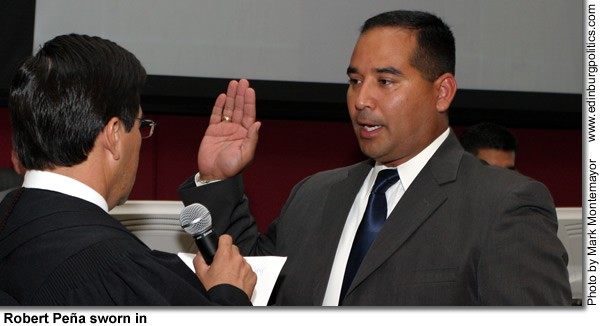
Robert Peña, Jr., 39, is the newest member of the Edinburg school board, winning in his inaugural bid for public office. Peña, former executive director for the Edinburg Economic Development Corporation, now owns a small business in the community. The Edinburg native, a former U.S. Army Sergeant, also served in the first Persian Gulf War. Peña succeeds former ECISD school board president Melba González. Hidalgo County County Court No. 1 Judge Rodolfo González (no relation to Melba González) administered the oath of office to Peña during swearing-in ceremonies at the Edinburg School Administration Building a few days after his election.
•••••
Rep. Peña reportedly leaning against reelection bid
By DAVID A. DÍAZ
Rep. Aaron Peña, D-Edinburg, is reportedly leaning against a bid for a fourth two-year term, a move that would cost his hometown powerful seniority in the Texas House of Representatives, where a bitter political struggle during the waning days of the legislative session was underway to replace his friend, Speaker of the House Tom Craddick, R-Midland.
The five-month regular session was scheduled to end at midnight on Monday, May 28.
Following reports in the Valley news media on Saturday, May 26, that quoted Peña expressing serious reservations about running for reelection in the March 2008 Democratic Party primary, the veteran legislator has not issued any additional public statements nor has he denied the news reports being carried in Valley news outlets.
A top staff members with his Capitol office on Sunday said Peña would provide more details on his published comments, most likely after the legislative session wraps up.
His first scheduled public appearance in Edinburg is set for Thursday, May 31, from 5 p.m. to 8 p.m. during grand opening ceremonies of Edwards Abstract & Title Company, 3111 W. Freddy González Drive, in Edinburg.
As of late Monday evening, Peña had not addressed the news article on his website, http://www.acapitolblog.com/. During his posting on his website on Sunday, May 27, he focused on the House passage of legislation to expand the Children’s Health Insurance Program to potentially more than 120,000 additional children of working families.
Late Friday evening, May 25, Peña expressed great dismay with an unprecedented political battle in the House of Representatives that on Saturday, May 26, made national news.
CBS News described the chaos Friday evening as a “five-hour rebellion on the House floor that included a bold attempt to boot him from office, the physical restraint of insurgent lawmakers trying to overtake the speaker’s podium, and the House parliamentarian nearly pushed to tears before resigning.”
Peña, who seconded Craddick’s nomination for Speaker of the House in January, was clearly disheartened by the political meltdown that is historic in nature.
“Words alone can not begin to communicate the troubling events at your Texas capitol,” Peña reported on his website, even posting a photo of a dark and angry sky descending upon the Texas Capitol. “We are but two days away from completion of the 80th Regular Session of the Texas Legislature and a conflict over who will be the occupant of the chair of the body has erupted.
Peña added, “Last night (Friday) every seat in the gallery was filled. The tensions and rhetoric were high. Each side of the argument has made their positions known to the body the only question that remains is the forum to decide the ultimate question. I still expect that forum to be the brutal primaries of March. For now, the passage of the budget is the last remaining necessity this Texas House must pass. I would hope that the anarchy we are presently observing does not interfere with our responsibility to pass the only bill we are required to pass each session.”
Craddick was still in control late Monday evening, the last day of the regular session, presiding over the House debate over the state budget and other major legislation.
If Peña chooses not to seek reelection – he has handily won three challenges – the political landscape in the city is sure to change with an open seat suddenly and unexpectedly coming available in the spring 2008 Democratic and Republican party primaries.
If both parties field candidates in March, then the November general elections in the city will include a campaign to represent House District 40, which includes all but southwest Edinburg, the Delta Area, La Joya, Sullivan City and smaller communities in northern Hidalgo County.
On Monday evening, Peña repeated his concerns about the political turmoil in the House of Representatives in his latest posting on his website, but again stated nothing to dispel the published reports that he may not seek reelection.
“As I have repeatedly noted before the bitterness and uber-partisanship that poisons Washington now infects the Texas State Capitol,” Peña chastised Craddick’s opponents. “Like the fall of ancient Rome when its generals put personal ambitions over their responsibility to the people of their state, our great state is poisoned by those who fail in their responsibilities to the governed. My hope is that today we, the elected officials of this state, will rise to the responsibility entrusted to us by the governed and get on with finishing the business of the state.”
••••••
“Ronald Reagan Republicans” form PAC to counter alleged retaliation by Speaker Craddick
In a move to redirect the Republican leadership of the Texas House of Representatives, Republicans opposing the reelection of Texas House Speaker Tom Craddick, R-Midland, have filed paperwork at the Texas Ethics Commission to form a political action committee to protect Republican legislative incumbents and candidates from attack in the upcoming 2008 primary.
The new PAC is titled “Ronald Reagan Republicans for Local Community Control and Speaker Term Limits.” The new PAC’s Board of decision makers will include the four House Republicans running for Speaker against Craddick (Jim Keffer, Jim Pitts, Brian McCall and Fred Hill) and the new PAC’s treasurer will be State Representative Byron Cook (R-Corsicana).
According the Ethics Commission filing, the new PAC will use the acronym: “3 R PAC.”
“The 3 R PAC will promote speaker term limits to make sure that the office of Speaker is dedicated to following the rules of procedure for the benefit of all 150 House districts, rather than twisting the rules of procedure to perpetuate the personal power of one member,” said Cook.
“The is a battle between Republicans over whether our party will follow the current path of infighting and self-destruction which has resulted in a loss of seven seats in the Texas House since Craddick took over or to follow the path of leadership through integrity exemplified by former Republican President Reagan,” Cook added.
Cook said the purpose of this PAC is to raise money to protect Republican incumbents and legislative candidates from vindictive acts and retaliation by Speaker Craddick and his supporters.
Over the past two weeks Craddick supporters have actively sought to recruit primary opponents for some of the Republicans opposing Craddick including Keffer and Cook.
“President Reagan’s11th Commandment was to not attack fellow Republicans,” Cook added.
“This PAC will be a watchdog to condemn any attempt by Craddick or his supporters to usurp decisions which should made by local Republican primary voters and not outside special interest agendas.”
••••••
Sen. Hinojosa says funding for key projects in Edinburg, county, to be included in final state budget
By MELISSA DEL BOSQUE
Sen. Juan “Chuy” Hinojosa, D-McAllen, a member of the Senate Finance Committee, announced on Friday, May 25, that millions of dollars in new appropriations will go to Hidalgo County in the next biennium for important issues such as water and health.
Hinojosa said a new substance abuse and primary care facility will be constructed in Edinburg.
“I worked very closely with the chair and members of finance to bring a substance abuse and primary care facility to Hidalgo County,” Hinojosa said. “Our communities are very much in need of substance abuse services and primary care. I want to also thank Rep. Aaron Peña (D-Edinburg) for his commitment and work on this issue.”
In addition, Hinojosa also worked to get $2 million to relocate the Boeye Reservoir in McAllen. That money will be used to relocate the reservoir and expand its capacity.
“McAllen and the region are growing so fast that we need to think ahead about our water supply and plan for the future,” Hinojosa said. “This will allow us to move the reservoir away from the McAllen Airport to a more secure location where the reservoir can be expanded and improved.”
••••••
Texas Border Coalition scores big victory with protection of Skills Development Fund
By DAVID A. DÍAZ
Legislation designed to protect over the next two years more than $12 million in the state’s Skills Development Fund, which helps provide customized workforce training to thousands of border residents, has been approved by the Texas Legislature.
House Bill 48 by Rep. Norma Chávez, D-El Paso, preserves a funding formula that dedicates money to the Skills Development Fund and the Texas Enterprise Fund, two major economic development programs used by the state to create thousands of jobs.
The Skills Development Fund is an important part of the Texas Border Coalition’s efforts to bring higher paying jobs to the border areas by providing a trained workforce.
TBC is an alliance of elected leaders and economic development officials representing more than 2 million residents who live Texas counties that border Mexico.
More than $40 million dollars was appropriated by the Texas Legislature for the 2006-2007 biennium, and grant applications are accepted year round, according to the Texas Workforce Commission. Since the inception of the Skills Development Fund in 1996, more than 168,110 Texas workers have received training. Through collaborations between private industry and training providers, the Skills Development Fund is designed to assist employers meeting the demands of the ever-advancing marketplace and to help workers acquire new skills or upgrade existing skills, the TWC reports.
On Friday, May 18, HB 48 was approved by the Senate, and has been sent to Gov. Rick Perry for his approval. Sen. Judith Zaffirini, D-Laredo, was the Senate sponsor for HB 48.
“I am delighted that the Texas Senate unanimously passed HB 48,” said Zaffirini. “This bill ensures continued state funding for skills development programs that greatly benefit Texas’ workforce. Retaining the current funding ratio allows the state workforce to remain competitive by providing sufficient resources for skills training. This results in additional training for more than 5,000 Texas workers per year.”
Under current law, 1/10th of 1 percent of Unemployment Insurance Fund, paid into by all employers, is used to fund the Skills Development Fund and the Texas Enterprise Fund. From the Unemployment Insurance Fund, 33 percent goes to the Skills Development Fund and 66 percent goes to the Skills Development Fund.
Without HB 48, the funding formula was going to change on September 1, 2007, which would have resulted in a $6.4 million a year decrease in the Skills Development Fund.
“House Bill 48 keeps the ‘split’ of funding between the Texas Enterprise Fund and the Skills Development Fund at its current and original level,” said Chávez. “Maintaining the current split will allow 10,240 more workers to be trained by the TWC over the next two years.”
In 2005, Chávez and Zaffirini also sponsored House Bill 2421, which established the Employment and Training Investment Assessment (ETIA) that allocated funding to the Texas Enterprise Fund (TEF) and the skills development program. It was HB 2421 that directed 67 percent of the ETIA holding fund to the TEF and the remaining 33 percent to the skills development fund.
Diane D. Rath, an appointee of Gov. Rick Perry and chair of the Texas Workforce Commission who represents the public, said HB 48 is important to the state.
“By developing skills training to meet the specific needs of employers, the Skills Development Fund has proven to be a well-structured formula for workforce development success,” said Rath. “We are grateful for the ongoing support of the Legislature for Texas’ premier job-training program.”
On May 16, TBC and other border leaders testified in support of HB 48 when it went before the Senate Finance Committee, which includes border lawmakers Sens. Juan “Chuy” Hinojosa, D-McAllen, Eddie Lucio, Jr., D-Brownsville, and Zaffirini.
Among those witnesses were TBC members Wanda F. Garza with South Texas Community College, who also serves as chair of the TBC Workforce Development Committee; Ricardo Pérez of Mission; and Pat Townsend, Jr., President and CEO of the Mission Economic Development Authority and TBC treasurer.
“The passage of HB48 was a landmark decision of the Texas Legislative that will invest the Unemployment Insurance Funds to increase the Skills Development Fund to $52 million. These funds will provide job training opportunities for thousands of new and incumbent workers. Sen. Zaffirini, Rep. Chávez and the Texas Legislature are to be applauded for their commitment to raising the skill levels of our workforce,” said TBC’s Garza. “Building a skilled workforce will provide the state with the competitive edge needed to compete in a global market. Gov. Perry kept his promise to support increasing the Skills Development Fund to $50 million. We thank them.”
Rep. Ryan Guillen, D-Rio Grande City, Rep. Aaron Peña, D-Edinburg, and Rep. Joaquin Castro, D-San Antonio are joint authors of the measure.
“This is a great bill,” said Peña.”Workforce training is such an important economic development tool.”
Members of TBC also include: Eagle Pass Mayor and TBC Chairman Chad Foster; Brownsville Mayor Eddie Treviño, Jr.; Cameron County Judge Carlos Cascos; Del Rio Mayor Efraín Valdéz; Edinburg Mayor Joe Ochoa; El Paso Mayor John F. Cook; El Paso County Attorney José Rodríguez; Harlingen Mayor Chris Boswell; Hidalgo Mayor John David Franz; Hidalgo County Judge J.D. Salinas; Laredo Mayor Raúl G. Salinas; McAllen Mayor Richard Cortéz; Maverick County Judge José “Pepe” Aranda, Jr.; Mission Mayor Norberto Salinas; Pharr Mayor Leopoldo Palacios, Jr.; Roma Mayor Rogelio Ybarra; and Weslaco Mayor Joe V. Sánchez.
The Texas Border Coalition maintains a web site at http://www.texasbordercoalition.org.
••••••
County Judge Salinas, regional leaders call for Veterans’ Hospital for the Valley
By CARI LAMBRECHT
As we honor the brave men and women who have passed away defending this nation and standing up for its principals of liberty, independence and justice this Memorial Day, let us not forget to also protect and provide for those veterans who come back to us, Hidalgo County Judge J.D. Salinas said Friday, May 25, in recognition of Memorial Day.
American citizens owe all veterans a debt of gratitude, Salinas said. And this is exactly why the judge and the region’s leadership have pledged not to give up the fight for a Veterans’ Hospital in Deep South Texas. In fact, Salinas said, the fight is just beginning.
On Monday, May 21, more than 60 veterans from numerous organizations gathered with Salinas, Cameron County Judge Carlos Cascos and Refugio County Judge René Mascorro for the second of two town hall meetings at Weslaco City Hall to address the health care needs of approximately 114,000 area veterans — as estimated by the Veterans’ Administration.
Sen. John Cornyn, R-Texas, Sen. Kay Bailey Hutchison, R-Texas, Rep. Henry Cuellar, D-Laredo/McAllen, and Rep. Rubén Hinojosa, D-Mercedes, were also represented at the meeting by local staff members.
Salinas vowed that he would convince all 24 county judges south of San Antonio to pass a resolution in support of U.S. House Resolution 538 — a bill sponsored by Rep. Solomon Ortiz, D-Corpus Christi, calling for the construction of a veterans’ hospital in the 24 county area. Salinas will call on his fellow county judges at an upcoming meeting of the South Texas County Judges’ and Commissioners’ conference. The group on Monday, May 25, also discussed with Hutchison’s representative how to get a sister bill sponsored in the U.S. Senate. Information was passed out regarding a fierce letter writing campaign, too.
“We’ve had plenty of studies. We don’t need to wait for any more ‘magic studies’ to tell us what we already know — that veterans’ health care in deep south Texas is not on par with that in the rest of the state or the nation,” Salinas said. “The reason why doesn’t matter as much as how much we need to fix its sorry state.”
“The veterans’ population here continues to grow, and the Rio Grande Valley contributes more men and women per capita than nearly any other area in the United States to our armed services. We will not be forgotten for our valiant efforts,” added the Hidalgo County judge.
Salinas, with the help of Cascos, is organizing a summer trip to Washington D.C. with many of the veterans to lobby face-to -ace with key members of the Veterans’ Administration Committees in both sides of Congress. They plan on educating Congress that Texas doesn’t end in San Antonio, which has the closest VA hospital to the Valley, yet still requires area veterans to travel eight hours round-trip for 15 minutes appointments.
Emilio de los Santos, Hidalgo County veterans’ service officer, said it is essential that the region continues to speak as one voice as it strives toward achieving the ultimate goal in building a VA hospital in Deep South Texas.
“Our leaders understand that this resolution will provide the best health care needs for veterans and their families in South Texas,” de los Santos said.
The VSO said he is reminded of a quote by Theodore Roosevelt when reflecting on this situation: “A man who is good enough to shed his blood for his country is good enough to be given a square deal afterwards.”
••••••
Congressman Hinojosa criticizes plans by Iraqi government to take vacation during wartime
By ELIZABETH ESFAHANI
On Thursday, May 24, Rep. Rubén Hinojosa, D-Mercedes, released the following statement on the passage of the new Iraq Supplemental Appropriations bill.
“The war in Iraq is the most critical issue facing our nation, not only because of the human and financial resources it is consuming, but because of its effect on our nation’s reputation globally and our domestic security.
“Congress has cast a critical vote that will impact our troops in Iraq and Afghanistan and bring about a new direction in Iraq. While the bill does not have specific timelines for troop withdrawal, it is a realistic compromise that addresses the political realities we face here in Washington. This responsible piece of legislation fully funds our troops. It also calls for real accountability by requiring the Iraqi government to meet the 18 benchmarks established by Sen. Warner or face losing funds for Iraqi reconstruction. The Iraqi government must realize that America will not continue to sacrifice our young men and women while they go on vacation and fail to make the necessary political changes.
“The funding for the Iraq war will expire at the end of September. At that time, my Democrat and Republicans colleagues agree that we must reassess the progress that has been made over the summer before providing any additional funding for the war.
“For far too long, President Bush has received a blank check from Congress to do as he pleases without accountability. With this vote, we will finally hold the Administration responsible and insist on real progress in Iraq.”
••••••
$3 million drug treatment center to be located in Edinburg included in state budget by Rep. Peña
By ORLANDO SALINAS
Negotiations over the state’s biennial budget has yielded a drug treatment center to be located in Edinburg. The proposed $3 million facility was approved by the House and Senate conference committee on House Bill 1.
Rep. Aaron Peña, D-Edinburg, continued to work with the negotiators in the last few weeks to ensure that the drug treatment center stayed in the budget after adding a rider to the bill during debate in the Texas House.
“The realization of this drug treatment center in Edinburg fulfills one of my primary goals in becoming a state legislator,” said Peña “Treatment and rehabilitation are important strategies in combating the terrible effects that illegal drugs have in our community.”
The treatment center is part of a broader state-wide strategy to address substance abuse and rehabilitation issues in our communities before they become issues in the criminal justice system. The state budget includes more funding for substance abuse treatment and diversion programs for low level, non-violent offenders at the Texas Department of Criminal Justice.
It adds treatment and capacity dollars at the local level to give judges and the parole board an alternative to sentencing offenders and considering probation and parole options.
The exact location, size and capacity of the center have yet to be formalized. The drug treatment facility would compliment the existing Mental Health and Mental Retardation operations in Edinburg.
“There needs to be a three prong approach to combating the devastating effects of substance abuse in our communities,” said Peña.
“We have to keep educating children and adults about the dangers of drug and alcohol abuse. This session we’ve allocated more funding for law enforcement to stem the flow of drugs through our borders and we are now investing more in treatment and rehabilitation.”
The Texas Legislature has allocated over $100 million for border security.
As the five-month regular session approached its conclusion at midnight on Monday, May 28, the House and Senate were negotiating the exact details of the border security bill. The negotiations on the budget bill needs to be agreed upon by the House and Senate before being sent to the Governor.
“The entire Rio Grande Valley legislative delegation needs to be applauded for working together to get these important programs for South Texas,” said Peña. “Rep. Guillen (D-Rio Grande City) fought hard on the conference committee to keep this drug treatment center funded. Senators (Juan ‘Chuy’) Hinojosa (D-McAllen) and (Eddie) Lucio (Jr., D-Brownsville) were instrumental in taking care of business over in the Senate.”
Peña is the Chairman of the House Committee on Criminal Jurisprudence and is a member of the House Committee on Ways and Means. He is serving his third term in the Texas House.
******
Sweeping legislation by Sen. Hinojosa approved by lawmakers, will reform Texas Youth Commission
By MELISSA DEL BOSQUE
After more than two years of tackling the myriad problems plaguing the Texas Youth Commission, Sen. Juan “Chuy” Hinojosa, D-McAllen, passed his sweeping legislation on Friday, May 25, to reform the troubled commission.
Following several days of negotiations in conference committee between the House and Senate, Senate Bill 103 passed both the Senate and the House and now awaits the governor’s signature.
Rep. Jerry Madden, R-Plano, and chairman of the House Committee on Corrections, was the House sponsor of the bill. Rep. Rene Oliveira, D-Brownsville, was a co-sponsor of SB 103.
Sen. Judith Zaffirini, D-Laredo, was a co-author of the measure.
“Overall, the negotiations made SB 103 a better bill for the state and the people of Texas,” Hinojosa said. “It’s been a long road, and Rep. Madden was a pleasure to work with in serving Texas’ families. With the passage of this bill today, I am confident that the children in the state’s care will receive the rehabilitation they need, and that the people of Texas will have a Commission worthy of them.”
Hinojosa began looking into the juvenile justice system two years ago when riots broke out at the Evins Regional Juvenile Center in Edinburg, Hidalgo County. Hinojosa pre-filed his comprehensive reform legislation last year and has continued to work with stakeholders to rebuild the troubled commission after the TYC scandal erupted.
Hinojosa’s bill calls for improved security by requiring TYC guards to undergo at least 300 hours of training before being assigned to guard duty, and it caps the guard-to-youth ratio at no more than 12 to 1 to maintain order and safety. It also requires fingerprint and national criminal history checks for employees, volunteers, and advocates working within TYC facilities.
SB 103 also creates a Parents’ Bill of Rights to guarantee swift and accurate access to information about caseworkers’ duties and the agency’s grievance policies.
In addition, Hinojosa’s reforms call for the establishment of a panel within TYC to review sentencing extensions, thus bringing strict accountability to the process. His bill features structural improvements to TYC’s governing board and strengthens the agency’s emphasis on community rehabilitation instead of automatic incarceration.
Hinojosa’s legislation ends the practice of housing 10- or 11-year-olds with 19- or 20-year-olds; creates an authority of law-enforcement trained personnel within an Inspector General’s Office to ensure law and order in TYC facilities; and authorizes child advocacy groups to visit facilities and work with youth.
To ensure that these and other improvements are properly implemented, extensive reporting measures were put into place so that parents and the public can access information regarding investigations, extensions of youth’s sentences, and prosecutions of crimes occurring within TYC. The bill also requires TYC develop a plan to move towards acquiring national accreditation of their facilities.
“SB 103 will make tremendous changes to the Texas Youth Commission, and we will continue to work with the agency and evaluate its progress through the Sunset Commission.” said Hinojosa. “We have appropriated $525 million for the TYC to give them the necessary resources to implement the SB 103 reforms. The Texas Legislature has made improving this agency a top priority, and we expect success.”
••••••
South Texas College receives legislative approval to permanently offer university-level degree
By ED SERNA
The House of Representatives on Friday, May 25, today passed House Bill 2198 by Rep. Ismael “Kino” Flores, D-Palmview, that will make the baccalaureate programs at three junior colleges, including South Texas College, permanent.
The measure, which was sponsored by Sen. Kyle Janek, R-Houston, has gone to the governor for his approval.
“This bill provides an affordable and accessible college education opportunity for local citizens and helps meet the local workforce needs of the surrounding communities,” Flores said. “Students wishing to get a baccalaureate in Applied Science and Technology will be able to pursue a degree closer to home. This is great news for the Valley.”
In 2005, the Legislature authorized a pilot project allowing three public junior colleges, including South Texas College, Brazosport College, and Midland College, to offer limited baccalaureate degrees in Applied Science and Technology.
The pilot program provided the opportunity to examine the effectiveness and feasibility of a permanent program. The three pilot institutions have made long-term financial investments in preparation for offering the baccalaureate degree, including the expansion of library resources and adding doctorate-level faculty to teach in these programs.
“This project is a tremendous success and has been met with great enthusiasm and support by students and local businesses. My bill enhances educational opportunities in the region and will promote economic development that ultimately improves the lives of many,” said Flores. “The importance of education can’t be overstated, for not only the students and their families, but also for the Valley’s prosperity.”
Flores represents District 36, which includes parts or all of the cities of Hidalgo, Granjeno, McAllen, Mission, Palmview, Penitas, and Pharr.
••••••
Sen. Hinojosa passes legislation to require heart defibrillators on every Texas school campus
By MELISSA DEL BOSQUE
Sen. Juan “Chuy” Hinojosa, D-McAllen, on Tuesday, May 22, passed Senate Bill 7, which will put an automatic external defibrillator (AED) in every public and private school campus across the state and provide for training in CPR and defibrillator use for school staff and high school students.
Sen. Judith Zaffirini, D-Laredo, was a co-author of the bill. Rep. Rob Eissler, R-The Woodlands, was the House sponsor of the measure.
According to the American Heart Association, which supported the Hinojosa bill, an automated external defibrillator (AED) is a computerized medical device. An AED can check a person’s heart rhythm. It can recognize a rhythm that requires a shock. And it can advise the rescuer when a shock is needed. The AED uses voice prompts, lights and text messages to tell the rescuer the steps to take.
AEDs are very accurate and easy to use. With a few hours of training, anyone can learn to operate an AED safely. There are many different brands of AEDs, but the same basic steps apply to all of them. The AHA does not recommend a specific model.
SB 7 was a priority for Hinojosa during the 80th Legislative session.
“Requiring defibrillators in our schools is a positive and responsible move. There’s wide agreement that we should have AED’s in all of our Texas schools, not only to save students’ lives, but to save the lives of educators and school personnel,” Hinojosa said.
The American Heart Association commended the senator on the passage of the bill.
“This important piece of legislation helps to make our schools safer for the children of this state. The bill is an extraordinary effort to move the state forward in Emergency Cardiac Care,” said Dr. Henry Lucid, American Heart Association State Advocacy Committee member.
SB 17 has also been part of the Lt. Governor David Dewhurst’s priority legislation for the 80th session.
“I want to thank the Lt. Governor for his leadership and support in passing this bill,” Hinojosa said. “This is something the state can provide schools that will save students, educators, and families a lot of heartache.”
••••••
Bill by Sen. Lucio, Rep. Gonzáles, Rep. Guillen to protect family violence victims sent to governor
By DORIS SÁNCHEZ
The Texas Legislature on Friday, May 25, sent a bill by Sen. Eddie Lucio, Jr., D-Brownsville, to the governor that creates an address confidentiality program to assist eligible victims of family violence, sexual assault or stalking. The bill was amended to include the use of pseudonyms to further assist victims.
Rep Verónica Gonzáles, D-McAllen, and Rep. Ryan Guillen, D-Rio Grande City, were joint sponsors of the bill.
“I want to thank all the supporters of this bill, and my colleagues in the House, Rep. Gonzáles and Rep. Guillen, for their work on Senate Bill 74,” said Lucio.
Gonzáles, who provided great leadership to this issue, said, “A victim of abuse should not have to go underground to escape his or her assailant. This legislation allows a victim to receive mail, register to vote and blend back into society without having his or her location discovered.”
SB 74 directs the Attorney General to designate a substitute post office box address that a victim of these crimes can use in lieu of a physical address. There is currently no mechanism in Texas to help victims of family violence, sexual assault or stalking keep where they reside confidential. Now qualified applicants will have this measure of protection, plus the ability to use pseudonyms when filling out forms for law enforcement officers or agencies in domestic violence cases. The pseudonym would be confidential and disclosed only to the defendant or the defendant’s attorney, except when a court order is issued for other matters.
Without this program, certain victims live in constant fear of being located.
“I think about the address confidentiality program as something which could have saved my grandmother’s life if it had been available to her,” said Donna Bloom of the Texas Advocacy Project, whose grandmother was killed in her home by her grandfather after she had ended the relationship.
In cases of family violence, the abuse often escalates when victims leave the relationship and seek a new address. According to the Texas Council on Family Violence, 143 Texas women were killed by their male intimate partners in 2005. Sixteen of those victims were killed as they were leaving the relationship or after they had already left.
More than a million women and nearly 400,000 men are stalked annually, and one in 12 women and one in 45 men will be stalked in their lifetimes. The majority of victims are stalked by someone they know. Of those women who have been killed by an intimate partner, 76 percent were stalked by that partner in the year before their deaths, and 81 percent of women stalked by a current or former intimate partner are eventually physically assaulted by that individual.
••••••
Edinburg, McAllen share lowest jobless rates in Valley for April, posting 4.3 percent unemployment
By DAVID A. DÍAZ
Edinburg’s jobless rate, which is a key indicator of the strength of the local economy, and McAllen in April posted the lowest jobless rates in the Valley, with each city reporting a 4.3 percent unemployment rate, according to the Texas Workforce Commission.
The latest figures also means the three-time All-America City had the lowest jobless rate for the fourth consecutive month in 2007, according to the Edinburg Economic Development Corporation.
The EEDC is the jobs-creation arm of the Edinburg City Council.
The EEDC’s five-member governing board includes Mayor Joe Ochoa; former Mayor Richard García,
who is president of the EEDC board of directors; and Fred Palacios, Mike Govind, and George Bennack.
In March, Edinburg’s jobless rate was 4.4 percent, in February it was 4.8 percent, and in January it was 4.9 percent. Those figures were the best in deep South Texas for their respective months.
The city’s unemployment rate was keeping pace with the statewide average in April of 4.2 percent and the U.S. unemployment rate of 4.5 percent.
In 2006, the annual jobless rate for Edinburg was 5.3 percent, while in 2005, the annual jobless rate for Edinburg was 4.7 percent.
In 2006, the city’s jobless rate was the lowest in the Valley during five months, according to the Edinburg Economic Development Corporation, and Edinburg registered the second-best showing for most of the other months last year, edged out only by McAllen.
In April, according to the Texas Workforce Commission, 1,207 Edinburg residents were looking for jobs, while 26,965 local residents were employed.
The jobless rate, also known as the unemployment rate, is the number of persons unemployed,
expressed as a percentage of the civilian labor force.
The civilian labor force is that portion of the population age 16 and older employed or unemployed.
To be considered unemployed, a person has to be not working but willing and able to work and actively seeking work.
The jobless rate for Hidalgo County was 6.1 percent in April, an improvement from 6.5 percent in March, 7.4 percent in February, and 7.7 percent in January.
The April jobless rate for Hidalgo County represented 16,453 area residents without jobs, while 254,466 residents were employed during the fourth month of 2007.
McAllen top showing in April of 4.3 percent represented 2,498 of their citizens out of work that month, while 55,855 residents of the City of Palms were employment. In March, McAllen reported a 4.6 percent jobless rate, 5 percent in February, and 5.1 percent in January.
Cameron County’s jobless rate in April was 5.5 percent, down from the March level of 5.8 percent. In April, 7,896 residents of Cameron County were looking for work, while 135,384 residents were holding down jobs.
Harlingen’s unemployment rate in April was 4.6 percent, down from 4.9 percent in March, while Pharr in April posted a 5 percent jobless rate, down from 5.3 percent jobless rate in March.
Mission came in with a 5.2 percent jobless rate in April, down from its 5.4 percent unemployment rate in March, followed by Weslaco at 5.3 percent in April, down from 5.9 percent in March.
In Cameron County, Brownsville’s unemployment rate in April was 5.6 percent, down from 5.9 percent in March.
According to the Texas Workforce Commission:
Seasonally adjusted nonagricultural employment in Texas grew by 23,500 jobs in April for a total of 240,800 jobs in the past year.
The state’s annual job growth rate rose slightly in April to 2.4 percent from last month’s 2.3 percent.
The April seasonally adjusted unemployment rate dropped to 4.2 percent, down from 4.3 percent in March and 5.0 percent a year ago.
The Midland Metropolitan Statistical Area (MSA) experienced the lowest unemployment rate in the state at 2.7 percent (not seasonally adjusted). The Odessa MSA was second at 3.0 percent, followed by the Lubbock MSA at 3.1 percent.
“Our sustained job gains and falling unemployment rate exemplify the underlying strength of the Texas economy,” said Texas Workforce Commission (TWC) Chair Diane Rath. “The Texas unemployment rate dropped to 4.2 percent, well below the national unemployment rate of 4.5 percent.”
Professional & Business Services gained jobs for the ninth consecutive month, adding 11,700 jobs in April. The industry has gained 61,100 jobs in the past year. The Leisure & Hospitality sector followed with an increase of 5,000 jobs in April, for a year-over-year gain of 39,400 positions.
“Texas employers continue to create jobs at a tremendous pace, benefiting our regional economies and communities,” said TWC Commissioner Representing Employers Ron Lehman. “With expansion in 10 of 11 industries, we’re seeing significant annual job growth rates such as 5.0 percent for Business & Professional Services, and 10.0 percent for Mining.”
Trade, Transportation & Utilities added 3,600 jobs in April, with 26,300 jobs created since last year. Education & Health Services increased by 2,500 jobs in April for a total of 24,700 since April 2006.
“It’s always a great sign when the ranks of the unemployed are declining and more Texans are back to work,” said TWC Commissioner Representing Labor Ronny Congleton. “It’s rewarding to know that in the past four weeks we’ve added more than 23,000 jobs.”
••••••
Hidalgo County District Clerk Hinojosa unveils vision for 2007 in Quarterly Progress Report
By RICARDO CONTRERAS
Hidalgo County District Clerk, Laura Hinojosa, commemorated her 100th day in office on Thursday, May 24, by unveiling the mission and vision for the District Clerk’s Office for 2007. Hinojosa presented her “Quarterly Progress Report” which highlights some of her administration’s achievements, organizational changes and things to come.
“One hundred days ago I outlined my priorities for the Hidalgo County District Clerk’s Office and committed to maintaining an open government in a firm, fair and consistent manner,” said Hinojosa. “I can proudly say that we’ve been able to accomplish this. However, I can also acknowledge that we still have a lot of work to do.”
The Quarterly Progress Report was initiated by the office in an effort to keep the public informed on the most up-to-date activity in the office. The report outlines the office’s accomplishments which consist of simplified processes, new and enhanced policies and procedures, randomization of court assignments, ongoing professional development, new and reliable office systems, and implemented emergency safety plans. The report also includes a newly created mission statement, the office’s organizational chart and information regarding the different departments within the District Clerk’s Office. Those departments include Administrative Services, the Civil and Criminal Bureau, the Financial Bureau, Tax and Jury, and Registry of the Court.
“These are exciting times for the District Clerk’s Office,” said Hinojosa. “I am more committed than ever to improving customer service, developing our staff and organization, and continuing to restore the public’s trust and confidence in the District Clerk’s Office.”
The office staff will observe this day by spending their lunch hour at a staff development luncheon on County grounds.
Laura Hinojosa was elected Hidalgo County District Clerk in November 2006. She was inaugurated on January 1, 2007. Her father is U.S. Congressman Rubén Hinojosa, D-Mercedes.
******
Congressman Hinojosa votes for new tools to fight record high gasoline prices as summer approaches
By ELIZABETH ESFAHANI
As Americans approach the summer driving season, Rep. Rubén Hinojosa, D-Mercedes, joined an overwhelming bipartisan majority in Congress and voted to approve new tools to fight record high gas prices. On Tuesday, May 22, and Wednesday, May 23, Hinojosa voted for legislation to crack down on gas price gouging and OPEC state-controlled entities average of $3.09 per gallon of regular gas, which is 132 percent higher than the average in 2001.
“Families in Texas are suffering each time they go to the gas station,” said Hinojosa. “This legislation will help crack down on price gouging and fight against those who attempt to fix the price of oil and stick the American people with the bill.”
On Tuesday, May 22, the House approved H.R. 2264 to authorize the Justice Department to take legal action against OPEC state-controlled entities that participate in conspiracies to limit the supply, or fix the price, of oil. Nations or organizations that limit oil supply can artificially inflate the cost of gas and hurt American consumers.
On Wednesday, May 23, the House approved The Federal Price Gouging Prevention Act, H.R. 1252, which would give the Federal Trade Commission the authority to investigate and punish companies that artificially inflate the price of gas. The bill sets criminal penalties for price gouging, and permits states to bring lawsuits against wholesalers or retailers who engage in such practices.
While a bipartisan majority in Congress supports these bills, President Bush has threatened to veto both pieces of legislation.
“As the summer driving season approaches, families can barely afford to drive to the local pool, much less go on vacation,” Hinojosa said. “President Bush is wrong to oppose these bills and I urge him to join our efforts to bring down the cost of gasoline.”
Nationwide, families are paying $3.22 a gallon on average for regular gasoline – more than double the cost when Bush took office, up 89 cents from the beginning of the year. Last year, families paid $1,000 more on average for gasoline than in 2001, and each additional 10 cents per gallon of gasoline adds $14 billion to America’s annual gasoline bill.
The high cost for families come as oil companies continue to prosper. The six largest oil companies announced $30 billion in profits for the first quarter of 2007. This is on top of the $125 billion in record profits they made in 2006.
In addition to the legislation approved this week, the Democratic Congress has already voted to roll back $14 billion dollars in taxpayer subsidies for Big Oil companies and reinvest the money in clean, alternative fuels, renewable energy and energy efficiency. Democrats are also developing an Independence Day package to boldly address energy independence and global warming by rapidly expanding the production of clean, alternative fuels and increasing energy efficiency, which will help protect our environment and bring down the cost of fuel for American consumers.
••••••
Let’s do immigration reform right negotiated in private, bill deserves a full public airing
By U.S. SENS.
KAY BAILEY HUTCHISON
and JOHN CORNYN
As your U.S. senators, we have been heavily involved in the congressional debate on immigration reform for several years. We have taken a leadership role on this issue because we represent a state that uniquely benefits from the contributions of legal immigrants, but is also uniquely vulnerable to the dangers of illegal immigration. Throughout this process, our principles have been clear and consistent: We must secure our borders, and we cannot encourage illegal behavior through amnesty.
Two weeks ago, the Bush administration, along with a small group of senators, announced a compromise immigration bill that would take a necessary first step in improving border security. We did not join in the announcement. While our efforts had a positive influence, we were not convinced the announced proposal guarantees repair of our current broken system. We are particularly concerned that we may be repeating the mistakes of the failed 1986 national amnesty.
As of late Friday, May 18, the actual text of the “grand compromise” had not yet been published. Major questions remain about details of the plan, and how it would work. We believe the bill, which was negotiated privately, deserves a full public airing before it’s considered.
The bill promises some long-term positive changes, including significant border security measures, an end to chain migration and a switch to green card distribution based on merit.
But many problems have not been satisfactorily addressed. For example, we must make certain that convicted criminals are not eligible for any legalization, and if these individuals attempt to stay here, that they are arrested and promptly deported.
We must ensure that only those who have played by the rules and not those engaged in identity theft receive Social Security benefits. This proposal would enable illegal immigrants to collect Social Security benefits for the time they were unlawfully in our country. At a time when we are already facing major shortfalls in our ability to pay benefits for future retirees, this represents an unfair burden on the American taxpayer. We must end the rampant document fraud that plagues our workplaces today, and do it in a way that is legally enforceable.
Some of our colleagues, sensing the fragile nature of the proposed compromise, want to rush it through the Congress immediately. This would be a major mistake. It is too important and too complicated to rush. The legislation requires extended Senate debate, with full opportunity for public input and criticism, and an open process for amendments to strengthen its provisions.
In 1986, the Congress approved a similar compromise plan that, in return for amnesty for most immigrants here illegally, promised an end to porous borders and disregard for our laws. Those promises were not honored. The amnesty legislation instead actually encouraged further disrespect for our laws, and led directly to the situation we face today.
As the bill reaches the Senate floor this week, our goal will be restoring the integrity of our borders, providing guest workers with opportunity, not amnesty, and preserving our Social Security for all who legally qualify. Our contributions to the debate will continue to be positive and constructive.
Our country needs immigration reform. We must ensure that it’s done, and done correctly.
Hutchison and Cornyn, both Republicans, represent Texas.
••••••
Texas House passes legislation by Rep. Peña, Sen. Zaffirini targeting online sexual child predators
By ORLANDO SALINAS
The Texas House of Representatives approved legislation on Friday, May 25, making the Internet safer for children from online sexual predators. Senate Bill 6 by Sen. Judith Zaffirini, D-Laredo, and Rep. Aaron Peña, D-Edinburg, is on the way to the governor.
SB 6 increases the penalty for sexually explicit online communication with a minor who is 14 to 16 years old from a state jail felony to a third degree felony. It increases the penalty for online sexual solicitation of a minor who is 14 to 16 years old from a third degree felony to a second degree felony and provides that sentences for certain offenses arising out of the same criminal offense may run concurrently or consecutively.
“Online solicitation and sexually explicit communication with a minor are serious and dangerous offenses,” said Peña. “Sexual predators are using the Internet and other technology to prey upon our children. The legislation we passed today gives law enforcement more tools to apprehend and prosecute these offenders.”
SB 6 instructs the Attorney General to establish an Internet Service Provider (ISP) database and require the preservation of certain records and information. The bill establishes a timeline for ISPs to respond to subpoenas, search warrants and other court orders. This bill also directs the Crime Stoppers Advisory Council to emphasize programs targeted at detecting unregistered sex offenders.
“Internet Service Providers, citing privacy concerns, have sometimes been reluctant to cooperate with law enforcement authorities,” said Peña. “We need to have the opportunity to quickly obtain information to combat and stop these online threats. If one of these predators has made contact with a child we need to verify his identity and find him.”
NBC’s Dateline program, To Catch a Predator, has shown the public the opportunity and ease in which these child predators operate in our communities. The Dateline program has identified over 200 child predators in its televised stings. Local, state and federal officials also continue to operate stings designed to catch these people engaged in online solicitation of minors.
SB 6 will now face one more procedural vote before being sent to the Governor’s desk. Peña is the Chair of the House Committee on Criminal Jurisprudence and is a member of the House Committee on Ways and Means. He is serving his third term in the Texas House.
••••••
MySpace.com to turn over information on sex offender profiles to Texas Attorney General Abbott
Texas Attorney General Greg Abbott on Monday, May 21, ordered MySpace.com to release the names of all convicted sex offenders who have set up online member profiles.
MySpace.com agreed to turn over first and last names of its online users that are registered sex offenders in Texas. MySpace.com will also provide IP addresses, E-mail addresses, and their online profile information. This data will help the attorney general crack down on sex predators who use the Internet to prey on children.
“By providing this information, MySpace.com is helping law enforcement crack down on online sex predators,” Abbott said. “Social networking sites must continue to make their Web sites and content safer for our children. We urge all social networking Web sites to take all necessary steps to keep children safe from the unwanted advances of online predators.”
Abbott, a nationally recognized leader with more than 500 sex predator arrests, has repeatedly pressed MySpace.com and other social networking sites to implement definitive safety measures to protect young users of their Web sites from sexually explicit images and unwanted solicitations. Since the push from Attorney General Abbott and other attorneys general, MySpace.com has taken steps to improving safety on its site, including screening profiles for inappropriate content and making certain profiles private.
“The incorrigible nature of sex predators requires public officials, law enforcement, industry leaders and parents across Texas to join together to make the Internet a safer place,” Attorney General Abbott added. “Without meaningful safeguards in place, no child is safe from the unwanted advances of chat room predators.”
The Attorney General, along with state leaders, has also fought to make Texas the toughest state in the nation, creating one of the nation’s toughest versions of “Jessica’s Law”, tightening penalties for Internet predators and providing district attorneys more tools to prosecute child sex crimes.
Last March, the Texas Senate passed Senate Bill 6, which provides additional tools that will improve law enforcement’s ability to investigate cyber crimes. Under SB 6, authored by Sen. Judith Zaffirini, Internet Service Providers (ISPs) are required to promptly respond to court orders and subpoenas issued by law enforcement. Today, when the Texas House of Representatives debates SB 6, legislators will consider an amendment that would amend SB 6 by expanding its applicability to entities such as MySpace.com. If passed, this provision would further improve the Attorney General’s ability to quickly obtain critical information about cyber predators from ISPs, social networking sites, and other online resources.
Abbott has earned a national reputation for aggressively arresting and prosecuting online child predators. In 2003, he created the Cyber Crimes Unit, which protects children from online sexual exploitation. The Cyber Crimes Unit and the Fugitive Unit, which locates sex offenders who have violated the terms of their parole and could be stalking children, have combined to arrest more than 500 sex offenders. Cyber Crimes Unit investigators also have traveled to schools and communities statewide to offer educational cyber safety programs.
In May 2006, Abbott’s Cyber Crimes Unit was awarded a $300,000 grant from the U.S. Department of Justice’s Office of Juvenile Justice & Delinquency Prevention to establish an ICAC Task Force. The Texas Attorney General’s ICAC Task Force is one of almost 50 federally funded task forces across the country dedicated to this project.
In July 2006, Abbott was invited by U.S. Congressman Joe Barton to testify at a congressional hearing in Washington on federal legislation limiting access to commercial social networking sites at publicly funded schools and libraries.
To find out more about Abbott’s efforts to crack down on sex predators, visit the Attorney General’s Web site at http://www.oag.state.tx.us or call (800) 252-8011.
••••••
Expert on birding warns of dire consequences to environment, economy if border wall is built in area
By KEITH HACKLAND
When I moved to the Lower Rio Grande Valley in 1997 I did not have the knowledge to appreciate the richness of our birds and wildlife here. After nine years of exploring, photographing, guiding, reading, listening, teaching, writing, and marketing our area to birders, I am just beginning to grasp what makes this the richest, most diverse birding spot in United States and Canada. As I continue to observe and explore this amazing place, I have discovered that the forest along the river is the richest of all.
During the past 100 years of border economic growth, Texas and Mexico cleared and ploughed the Lower Rio Grande floodplain, destroying over 95 percent of the river forest. The dams (Falcon in 1953) and levees built to stop annual floods have caused our floodplain to become drier, resulting in shrinkage of remaining river forest. “Periodic droughts are probably the factor triggering death of many large trees. In these areas, a “reverse succession” allows thorny trees and shrubs – retama, huisache, prickly pear, granjeno, and others – to invade,”(Page 35, Timothy Brush, Nesting Birds of a Tropical Frontier).
Since the 1940s samples of river forest have been saved, and we are replanting corridors of trees along the river, to connect these survivors. The best samples can be seen at Santa Ana National Wildlife Refuge, Sabal Palm Sanctuary, and Bentsen RGV State Park, around seasonally filled resacas (oxbow lakes) that keep the earth damp. At Santa Ana NWR follow “A Trail” to Willow Lake. Starting out in thorn forest with prickly pear and lacy mesquite, retama and huisache, there is an abrupt transition to river (riparian) forest, containing “. . . taller trees and more luxuriant vegetation than do other wooded habitats. Mexican ash, black willow, sugar hackberry, and cedar elm are common in moister sites, while Texas ebony, anacua, and coma grow on higher, drier terraces.” (Page 34, Timothy Bush).
The tall, damp “. . .riparian forests support some of the rarest breeding birds in the United States: Muscovy Duck, Gray Hawk, Red-billed Pigeon, Rose-throated Becard, Northern Beardless-Tyrannulet, Brown Jay, Clay-colored Robin, Altamira Oriole, and Tropical Parula,” (page 35, Timothy Brush). Spanish moss and ball moss, amazing butterflies, rare dragonflies, amphibians and reptiles flourish.
The unique birds in our river forest bring birders from across United States, Canada and Europe. Birders spend hundreds of millions of dollars, paying for the jobs of thousands in the Valley. Here in Alamo, the Gateway to Santa Ana NWR, at Alamo Inn I make my living providing services to birders, and our city restaurants, motels, and shops all serve them too. At El Dorado restaurant they recognize the many birders eating there. Alamo’s Casa Santa Ana is a birder’s B&B located adjacent to Santa Ana NWR. The birding industry is big not only in Alamo, but in cities all across the Valley.
Remove the Valley’s river forest, and 100,000 to 200,000 birders a year, including thousands of long stay Winter Texan birders, would not visit us. That would be an economic disaster for thousands of Valley workers, costing hundreds of millions of dollars annually. Furthermore, it would dramatically reduce birding and nature tourism across the Texas Coastal Region, Texas Hill Country, West Texas, and North East Mexico, where birders attracted to the Lower Rio Grande extend their tours and spend additional hundreds of millions of dollars annually.
Yet that is literally the plan, starting this summer. The Department of Homeland Security (DHS) distributed maps indicating they have plans that will have to include bulldozing and clearing the Texas banks of the Rio Grande to install river patrol roads and river fencing. DHS is a protected part of the Federal Government that can operate without being sued and without consulting residents. The Secretary of Homeland Security, Michael Chertoff, has the power to wave any and all federal laws in the name of homeland security. He can authorize the construction of river fences and any other structure on federal and private lands without the landowner’s consent. This is supported in Section 102 of the 2005 REAL ID Act which states: “…the Secretary of Homeland Security shall have the authority to waive, and shall waive, all laws such Secretary, in such Secretary’s sole discretion, determines necessary to ensure expeditious construction of the barriers and roads under this section.”
The Lower Rio Grande Valley National Wildlife Refuge includes property along 80 miles of the Lower Rio Grande’s last 240 miles (Boca Chica to Falcon Dam) and it protects a significant part of what little river forest remains (less than five percent of the historic river forest). DHS plans could clear-cut much of our remaining river forest. DHS river fences could cut us off from access to our drinking water, and leave it and the adjoining land under the control of Mexico. DHS plans could cut ranchers and farmers and their livestock off from water. DHS river fences could prevent birding and fishing the river. DHS plans could destroy our rarest and most valuable birds and butterflies, amphibians and plants. The critical Rio Grande river forest grows adjacent to the Rio Grande from Boca Chica (its mouth at the Gulf of Mexico) through Cameron, Hidalgo and Starr counties, to Falcon Dam. Some of our most rare river forest birds (Brown Jay, Muscovy Duck, Red-billed Pigeon) now occur chiefly along the river in Starr County where it is quieter with less river forest disturbance, but where the river forest is thinnest and most fragile.
DHS river fence plans could close down our top birding sites and destroy our thriving birding tourism industry. Look at a detailed map of the Lower Rio Grande. Our three top river forest refuges, Sabal Palm Sanctuary, Santa Ana NWR, and Bentsen RGV State Park all occupy bends in the Rio Grande, peninsulas pointing into Mexico. A straight fence could cut off the peninsula refuges from Texas and birders, abandoning that land and our river to Mexico. That would devastate our Texas birding industry because Santa Ana NWR is number one, our most visited refuge, and Sabal Palm and Bentsen RGV State Park are in the top ten refuges.
The Rio Grande is already a barrier to illegal immigrants. No one drives across it, so we don’t need a fence adjoining it, because those who swim or boat the river will simply use ladders. Furthermore, a twisting and curving river fence system following the river bank would be very unsafe, allowing border patrol units to be trapped, possibly between two fences, out of sight of other units.
The million people living in the Valley do not support the river fence plan. There are workable alternatives to a river wall, river fence, or river road. A virtual (electronic) fence could be deployed to track people. Control mechanisms, whether virtual or physical, could follow the extensive existing infrastructure, building them alongside the existing levee road system, and next to military highway, thereby minimizing the effect on river forest. Also, if we make legal immigration to United States easier and faster, the legitimate majority will cross at bridges and submit to thorough background checks, screening, and documentation, reducing the volume of illegal crossings, and documenting all residents.
Please visit birding sites on the Rio Grande to show your support. It could be your last chance. Join Friends of Santa Ana NWR (956-784-7500). Join Valley Nature Center, which educates 80,000 Valley children, adults and visitors annually about Valley birds and nature, because it needs your support to extend its work (956-969-2475). Talk to people and share this information about the river fence and its threat to birding tourism across the state of Texas.
Most important of all, please write your politicians at every level this week and ask for help to change the DHS Rio Grande river fence plan. The best way to change it is through the same political process that launched it. You could make a difference.
References:
1. Nesting Birds of a Tropical Frontier, The Lower Rio Grande Valley of Texas, by Timothy Brush, 2005. Dr Brush is an ornithologist who teaches at UTPA, Edinburg, TX
2. Numerous TexBirds list serve discussions
3. Numerous articles in Advance News Journal (Pharr, TX), The Monitor (McAllen, TX), Houston Chronicle (Houston, TX)
4. Updates from Martin Hagne, Executive Director of Valley Nature Center, Weslaco, TX http://www.valleynaturecenter.org
5. http://www.southtexasnature.com
Keith Hackland is an innkeeper from Alamo, Texas. He writes extensively on birding in the Rio Grande Valley.
••••••
Former Dallas Cowboys Walls honored by House for donating a kidney to teammate Springs
Rep. Helen Giddings, D-Dallas, on Friday, May 25, honored her constituent, former Dallas Cowboys football player Everson Walls, on the House floor. In February, 2007, Walls selflessly gave one of his kidneys to his former Cowboys teammate and close friend, Ron Springs.
While many individuals struggle with becoming organ donors for a family member much less a stranger or a friend, Walls generously gave his friend what he so desperately needed, a kidney.
Springs has experienced serious health problems as a result of diabetes yet as a result of the transplant surgery his prognosis has increased dramatically. As a result of this remarkable gift, Springs is expected to regain the use of his hands, to walk again on his own, and to be able to end his dialysis treatments.
“Everson Walls and Ron Springs are a shining example of the power of love and lifelong friendship. Mr. Walls is an inspiration. Recognition on the House and the Senate floor are the least the state of Texas could do to recognize such a compassionate and upstanding citizen. Many people have stood where Mr. Walls stood today, and few have been more deserving of this recognition. He reminds us all that one of God’s greatest gifts to man kind is the gift of friendship – a gift that really does keep on giving,” Giddings said.
The bond between these former athletes was forged in the early 1980s when both were members of the Cowboys. Walls began his NFL career in Dallas in 1981 after starring as an All-American defensive back for Grambling State University. In his 13 seasons as a professional he was named to four Pro Bowl teams, led the league in interceptions in 1981, 1982, and 1985, and was recognized as one of the top cornerbacks in the game. He has been inducted into the Grambling State University Athletic Hall of Fame, the Louisiana Sports Hall of Fame, the Texas Black Sports Hall of Fame, and the Southwestern Athletic Conference Hall of Fame.
A Dallas native who continues to reside in the Metroplex, Everson Walls hopes that his compassionate action in helping his friend will also work toward a greater good as he and Ron Springs plan to create a foundation that will encourage organ donation. The publicity surrounding the transplant has already focused attention on this important medical issue.
“It is my hope that the bond between Mr. Walls and Mr. Springs inspires each of us to do what we can to help our fellow man. Furthermore, I commend the two gentlemen for having the initiative to begin a foundation to encourage organ donation for both living and deceased donors. With death can spring life, and with compassion spring hope,” Giddings explained.
by Legislative Media | May 21, 2007 | Politics
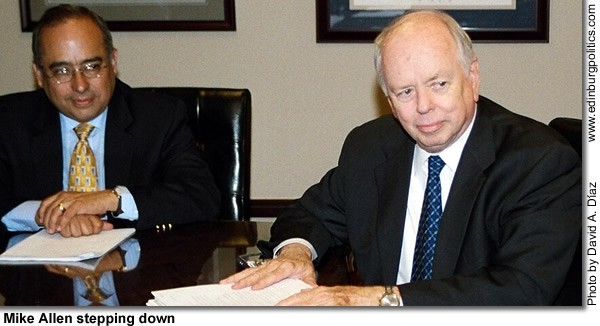
Mike A. Allen, featured right, founder and former chairman of the Texas Border Coalition, has announced he will resign from the organization in order to focus on medical treatments for an undisclosed illness. Allen is also stepping down from the McAllen Economic Development Corporation, but he will remain on the South Texas College Board of Trustees. Shown with Allen is Maverick County Judge José “Pepe” Aranda. See story later in this posting.
••••••
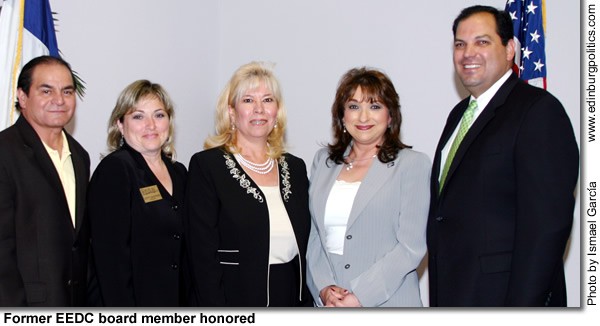
Elva Jackson Garza, a former member of the Edinburg Economic Development Corporation board of directors, has been honored for her community service by the Texas House of Representatives. House Resolution 1801, authored by Rep. Aaron Peña, D-Edinburg, was unanimously approved by state lawmakers on Friday, May 18. Featured with her on Thursday, May 17, are, from left: Mayor Joe Ochoa; Letty Martínez, president of the Edinburg Chamber of Commerce; Garza; Cris M. Torres, incoming chair of the Edinburg Chamber of Commerce; and Hidalgo County Judge J.D. Salinas. See story later in this posting.
••••••
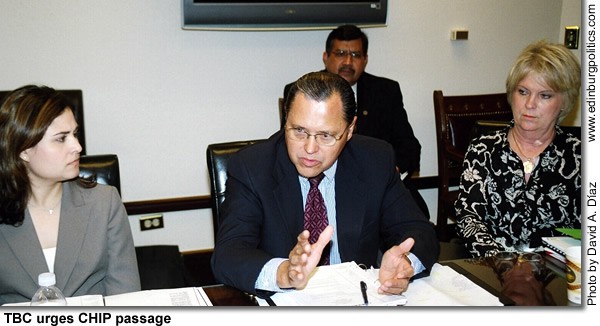
El Paso County Attorney José R. Rodríguez, chairman of Texas Border Coalition’s Committee on Border Health, has delivered a letter in behalf of TBC to Lt. Gov. David Dewhurst requesting his supports to expand medical coverage for children under the Children’s Health Insurance Program. The Texas Border Coalition, an alliance of elected leaders and economic development officials from El Paso to Brownsville, support efforts to make it easier to qualify for, and remain on, the CHIP. Featured with Rodríguez during a recent legislative TBC update in Austin are, to his left, Veronica Cantú, legislative liaison for the city of Laredo, and Wanda F. Garza, Executive Director for Workforce and Resource Development at South Texas College. See story later in this posting.
••••••

Alex Hernández, standing, is featured with State Rep. Aaron Peña, D-Edinburg, recently on the floor of the Texas House of Representatives. Hernández has been in Austin since the beginning of the 80th Legislative Session in January as a legislative aide working with the local lawmaker. See story later in this posting.
••••••
Mike Allen resigns from Texas Border Coalition to battle illness; will remain on STC Board of Trustees
By DAVID A. DÍAZ
Mike Allen, a major player in the Texas political and economic development arenas, announced on Tuesday, May 15, that is resigning from the Texas Border Coalition in order to concentrate on medical treatments for an undisclosed illness.
The Texas Border Coalition, formerly known as the Texas Border Infrastructure Coalition, is an alliance of elected leaders and economic development officials representing more than 2 million residents who live along the Texas-Mexico border.
Allen is the founder, former chairman, and the driving force for TBC, which lobbies Congress and the Texas Legislature for laws and policies that benefit the border region from El Paso to Brownsville.
Allen also will step down as Executive Vice President of Strategic Affairs and External Projects with the McAllen Economic Development Corporation. He was the longtime president of the MEDC, but voluntarily reduced his oversight role in the jobs-creation non-profit entity when he first learned of his illness.
Both actions were effective Friday, May 18.
Allen later did say that he would remain a member of the South Texas Community College Board of Trustees, which is an elected governing body.
“Because of my health situation it has become necessary to resign in order to take some specialized treatments over the next several months,” said Allen. “I do not believe I can adequately handle some of the responsibilities that I currently have.”
Sen. Juan “Chuy” Hinojosa, D-McAllen, said Allen has contributed in more ways than one to the improvement of his fellow man.
“In his remarkable career, Mike Allen has used his wonderful talents to inspire a huge number of people from all walks of life to seek and achieve a better way of life,” Hinojosa said. “There are a lot of people who will be praying for a very successful outcome for him.”
In his letter of resignation, Allen expressed confidence in the work of the Texas Border Coalition.
“I know that with the structure that we have now and the people that are involved with this organization, we will continue to be a driving force in supporting the Workforce, Healthcare, Transportation, and other Border Issues in our communities,” Allen said. “I appreciate the support everyone has provided me during my tenure with the Texas Border Coalition.
“I would like to thank (Eagle Pass) Mayor (Chad) Foster (chairman of TBC) and all of you, whom I had the opportunity to work with,” Allen wrote to his fellow TBC leaders. “It has been a great experience and I certainly think we have achieved many great things for the border. I hope that I can stay in touch with each and every one of you.”
Allen has been in the forefront of some of the most important legislative and economic developments for the Texas border region, ranging from helping lobby for more than $1 billion in new state money for border highway projects to participating in congressional hearings on matters ranging from transportation and international trucking to health care and infrastructure development.
His current work includes rallying border political and business leaders to oppose plans by the federal government to build reinforced fencing – characterized as a border wall by its critics – along more than 100 miles of the Texas boundary with Mexico. Opponents say the border wall, which is intended to help reduce illegal immigration from Mexico, will cause economic chaos in many border cities.
“For nearly two decades, Mike Allen has rendered extraordinary service to the people of the Rio Grande Valley as he has sought to address the development needs of one of the fastest growing metropolitan areas in the United States, and for his tireless dedication and remarkable vision,” Rep. Verónica Gonzáles, D-McAllen, stated in a resolution she authored honoring Allen in 2005.
Some of Allen’s many other accomplishments are noted in the House resolution honoring him. That resolution states:
WHEREAS, Michael A. Allen has long played an instrumental role in the economic development of McAllen and the Rio Grande Valley; and
WHEREAS, President and chief executive officer of the McAllen Economic Development Corporation since its inception in 1988, this esteemed Texan has led MEDC to repeated success in its mission to attract new industry, upgrade local infrastructure, and facilitate trade and commerce; and
WHEREAS, With Mr. Allen at the helm for the past 17 years, MEDC has recruited to the U.S. side of the border more than 215 companies, employing over 18,000 persons; the corporation has also
brought more than 250 companies to Reynosa, Mexico, thereby adding another 75,000 jobs to the area; and
WHEREAS, Mr. Allen and his staff have generously shared the knowledge and expertise of MEDC with their Mexican counterparts; at the invitation of Don Florencio Salazar, coordinator with Plan Puebla-Panama, Mr. Allen consulted on the economic development of a number of Mexican states and the city of Merida; during that trip, he and other MEDC staff met with various state governors and economic development teams and offered insights into how to attract industry to each of their regions; and
WHEREAS, Under Mr. Allen’s guidance, MEDC has also sought to forge international links by fostering sister-city relationships with more than 10 cities in Mexico, as well as with cities in Canada and China; and
WHEREAS, Mike Allen’s personal achievements include his contribution as a cofounder of the South Texas Border Partnership, a coalition of five cities in Hidalgo County, and as the founder and chairman of the Texas Border Infrastructure Coalition, which has brought job training funds to the Valley and secured $1.1 billion in highway funds for the region stretching from El Paso to Brownsville; and
WHEREAS, In addition, he has campaigned for the Anzalduas International Crossing, a project jointly supported by the Cities of McAllen, Hidalgo, and Mission; he has also worked to unite customs brokers, truckers, and Mexican officials in efforts to expedite trucking, and he has coordinated those same groups, together with civic leaders in Hidalgo County, in developing
support for the construction of Interstate 69; and
WHEREAS, Mike Allen can take tremendous pride, moreover, in MEDC’s involvement in the creation of the Regional Academic Health Center, a Lower Rio Grande Valley extension of The University of Texas Health Science Center at San Antonio; division campuses of the RAHC have been established in McAllen, Brownsville, Edinburg, and Harlingen; and
WHEREAS, Affiliated with numerous economic development organizations, Mr. Allen has further served as a member of the Governor’s Task Force on Management and Relations, as a board member of the Alliance for Security and Trade and of the Border Trade Alliance, as a director of the Rio Grande Valley Council of Governments, and as a trustee of South Texas College; the breadth of his knowledge is reflected in his participation in congressional hearings on matters ranging from transportation and international trucking to health care and infrastructure development; and
WHEREAS, For nearly two decades, Mike Allen has rendered extraordinary service to the people of the Rio Grande Valley as he has sought to address the development needs of one of the fastest growing metropolitan areas in the United States, and for his tireless dedication and remarkable vision he is indeed deserving of warmest commendation; now, therefore, be it
RESOLVED, That the House of Representatives of the 79th Texas Legislature hereby honor Michael A. Allen for his immeasurable contributions to expanding economic opportunity on both sides of the Rio Grande and extend to him sincere best wishes for continued success in all his endeavors; and, be it further
RESOLVED, That an official copy of this resolution be prepared for Mr. Allen as an expression of high regard by the Texas House of Representatives.
••••••
Texas Border Coalition urges Lt. Gov. Dewhurst to support expansion of CHIP health insurance
By ELHIU DOMÍNGUEZ
and
DAVID A. DÍAZ
Efforts to make it easier to qualify for, and remain on, the Children’s Health Insurance Program (CHIP) is in the hands of Lt. Gov. David Dewhurst, who is being urged by the Texas Border Coalition to support House Bill 109, a measure that could help reverse the increase in the number of uninsured children in Texas.
Rep. Aaron Peña, D-Edinburg, is a joint author of HB 109, which also in co-authored by the majority of the Texas border legislative delegation in the House.
CHIP is health insurance designed for families who earn too much money to qualify for Medicaid, yet cannot afford to buy private health insurance, according to the Texas Health and Human Services Commission. CHIP enrollment fees and co-payments are based on the family’s income. Enrollment fees are $50 or less per family for each six-month term of eligibility and most co-payments for doctor visits and prescription drugs range from $3 to $10.
The Texas Border Coalition is an alliance of elected leaders and economic development officials representing more than 2.1 million residents who live on the Texas side of the border with Mexico.
El Paso County Attorney José R. Rodríguez, chairman of TBC’s Committee on Border Health, has delivered a letter in behalf of TBC to Dewhurst requesting his support to expand medical coverage for children under the CHIP program.
In his letter, Rodríguez requested Dewhurst to “please lead the Texas Senate in passing comprehensive legislation this session that simplifies the CHIP enrollment process.”
The letter also suggest that, in exchange for the implementation of yearly renewals, a system could be set up to closely monitor those applicants with incomes near the limits imposed by the federal government, reducing the likehood of families with earnings 200 % above the poverty level from remaining enrolled in the program.
Rodríguez added that expanding coverage of the Children’s Health Insurance Program (“CHIP”) is a wise decision, because “it saves local tax dollars, helps education and improves our state’s economy.”
TBC contends that only Dewhurst’s strong support can assure that a similar bill filed in the Senate is brought up for a vote before the legislative session comes to an end. In the past weeks, Dewhurst has expressed his opposition to any bill that would allow children to apply every year instead of every 6 months as it is currently required.
However that particular change is considered key to increase the number of children enrolled in the program.
Since September 2003, when the 6 month re-enrollment provision was adopted, the number of children covered under the program declined more than 35 % of the total. The decrease affects particularly border communities such as El Paso, who now have the highest rates of uninsured children among all Texas counties.
Besides negatively impacting children’s health, high rates of uninsured hurts local communities in many ways, Rodríguez said. It costs counties and hospitals millions of dollars in paying for unnecessary emergency room services; it costs the school districts millions in absenteeism, and the state misses the opportunity to tap into hundreds of millions of dollars in federal funding.
Dewhurst has expressed his willingness to work out a compromise to allow the annual renewals if a system is set in place to ensure that only eligible children are covered.
••••••
Elva Jackson Garza, former EEDC board member, honored with resolution by House of Representatives
Elva Jackson Garza, a familiar face in Edinburg business and political circles, has been honored for her community service by the Texas House of Representatives. House Resolution 1801, authored by Rep. Aaron Peña, D-Edinburg, was unanimously approved by state lawmakers on Friday, May 18.
Garza, a public relations expert, is a former member of the Edinburg Economic Development Corporation board of directors, among her many achievements. Currently, she serves as Vice President and Marketing Officer with Edwards Abstract and Title Company.
According to the company, Jackson joined the Edwards Team in 2002 as Vice President and Marketing Officer. She has devoted almost 30 years to the marketing and public relations field. Her experience includes nine years as marketing officer in the banking industry and eleven years with the Edinburg Chamber of Commerce.
In addition to her marketing and advertising duties, Elva also handles all of the employee and customer education programs for the company. She is recognized as a civic leader with an economic development background serving on various leadership positions such as chairman of the board of the Edinburg Chamber of Commerce; President of the Kiwanis Club of Edinburg; President of the Valley Chamber of Commerce Executives and Edinburg Economic Development Corporation board of directors.
Garza’s achievements were also highlighted in the legislative resolution adopted in her honor:
RESOLUTION 1801
WHEREAS, Elva Jackson Garza has made a lasting impact on the Edinburg community through her active civic engagement, and her achievements are truly worthy of commendation; and
WHEREAS, Mrs. Garza has served the local chamber of commerce for nearly a quarter century; currently in her fifth term on the executive board, she was chair in 1999-2000, and her efforts have helped to shape a number of the organization’s programs, including the Edinburg Today Breakfast, membership campaigns, and Fiesta Edinburg; and
WHEREAS, In addition to her work with the chamber, Mrs. Garza has served on the board of directors for the Edinburg Economic Development Corporation and has been a valued member of the Valley Chamber of Commerce Executives and Edinburg Industrial Foundation; moreover, she has shared her time with such groups as the American Heart Association, American Cancer Society, United Way, and Edinburg Citizens Against Graffiti, which she served as chair; and
WHEREAS, This notable Texan is also a leader in the Kiwanis Club, becoming the first female president of the Edinburg chapter;and
WHEREAS, Mrs. Garza has been vice president and marketing manager of Edwards Abstract and Title Co. since 2002; a number of professional organizations have benefited from her talents, including the Greater McAllen Association of Realtors, Rio Grande Valley Builders Association, Women’s Council of Realtors, and the Hidalgo County Bar Association; and
WHEREAS, Blessed with a loving family, Mrs. Garza credits much of her success to the guidance provided by her parents, the late Albert Jackson, Jr., and Maria Sidia Gracia Jackson, and to the encouragement of her husband, Alfredo Ruben Garza; and
WHEREAS, The strength of our communities depends on the commitment and dedication of civic leaders such as Elva Garza, whose contributions to Edinburg have produced results of lasting benefit to countless Texans; now, therefore, be it
RESOLVED, That the House of Representatives of the 80th Texas Legislature hereby commend Elva Garza for her work in behalf of the citizens of Edinburg and extend to her sincere best wishes for the future; and, be it further
RESOLVED, That an official copy of this resolution be prepared for Mrs. Garza as an expression of high regard by the Texas House of Representatives.
••••••
Alex Hernández of Edinburg completing legislative internship in Austin with Rep. Aaron Peña
By ORLANDO SALINAS
Alex Hernández of Edinburg has taken advantage of the opportunity to work at the Texas Capitol through the Moreno/Rangel Legislative Leadership Program.
The Moreno/Rangel Legislative Leadership Program is an intense program which provides a unique opportunity for Latino undergraduate and graduate students from across Texas to gain first-hand governmental experience working in the Texas House of Representatives during a legislative session.
He is one of only 12 students to be selected this year to participate in the program.
Hernández is currently a senior at the University of Texas Pan American and will graduate this December with a Bachelor of Arts Degree in Criminal Justice and a minor in Spanish. He then plans on attending law school.
He spent his high school years holding various jobs and being involved with numerous school organizations.
At 18, he was able to attain a home for his family with the small income he earned from multiple jobs and the guidance of many. While working, he managed to keep his grades high enough to graduate at the top of his class.
Hernández hopes to one day have a role in shaping policies that affect Latino families.
••••••
Governor signs into law a bill by Rep. González to expedite property tax disputes in local district courts
BY NICK ALMANZA
Ad valorem tax disputes will be prioritized and given expedited status in local district courts of communities with populations of less than 175,000 persons, effective Sept. 1. More timely resolution of property tax disputes will provide appraisal districts and school districts with a clearer picture of their expected tax revenues.
Senate Bill 57 by Sen. Judith Zaffirini, D-Laredo, and Rep. Verónica González, D-McAllen, which authorizes this change, was signed by Gov. Rick Perry on Friday, May 11.
“Ad valorem tax disputes often take years to resolve and can result in costly delays of tax revenue receipts for small and rural counties that depend on this revenue to operate school districts and support their communities,” Zaffirini said. “This new law builds on my previous efforts to provide smaller communities and school districts with means to receive their tax revenue timely despite the occurrence of a dispute. I thank Rep. González for her hard work in passing this bill in the House and am delighted that Gov. Perry signed it into law.”
SB 57 is Zaffirini’s third effort to pass the bill suggested by Live Oak County Judge Jim Huff. Her SB 82 (2003) and SB 103 (2005) were passed by the Senate but died in the House of Representatives.
Currently property tax valuation disputes often take from two to three years to be resolved in the courts. Persons or entities who dispute a property tax valuation are required to pay only the amount of tax not in dispute. This adversely affects small and rural counties by causing costly delays in tax revenue receipts that may be crucial to operating a school district.
This new law will provide relief to small and rural counties by applying expedited status to tax disputes and ensuring small counties receive tax-related revenues without delays.
Live Oak County Judge Jim Huff and Gregory-Portland Independent School District (ISD) Superintendent Paul Clore testified in favor of SB 57 during its consideration in the Senate Jurisprudence Committee. The comptroller estimates that there are $39 billion worth of property valuations disputed statewide. Gregory-Portland ISD estimates an annual loss of $800,000 due to tax disputes and Three Rivers ISD estimates $350,000 to $400,000 of lost revenue.
The new law will increase county and ISD funding for education by reducing the turnaround time for appeals of property tax payments. San Patricio and Live Oak county ISDs anticipate that they could receive an estimated $1.2 million each year in property tax revenues if tax disputes are expedited.
••••••
Construction activities in Edinburg pass $76 million in first quarter of 2007
By DAVID A. DÍAZ
Total construction activities in Edinburg during the first quarter of the year totaled more than $76 million, with new construction of commercial businesses leading the way from January through March at more than $48.5 million.
The city’s construction level from January through March continued to outperform last year’s pace, which had reached more than $52.6 million during the first quarter of 2006.
For the month of March – the latest figures available from the city government – Edinburg generated almost $13.7 million in total construction, compared with more than for $18.7 million in March 2006.
The latest numbers, compiled by the city’s Code Enforcement Department, were released by the Edinburg Economic Development Corporation, which is the jobs-creation arm of the Edinburg City Council.
The EEDC is governed by a five-person board of directors, which includes Mayor Joe Ochoa, former mayor Richard García, who is the EEDC board president, and Fred Palacios, Mike Govind, and George Bennack.
A breakdown of the major construction categories year-to-date and by month in Edinburg includes:
•Total new construction, January through March, was $76,665,481, compared with $52,640,845 during the same period in 2006;
•Total new commercial construction, January through March, was $46,584,375, compared with $24,789,000 during the same period in 2006.
•Total new construction of single-family homes, January through March, was $15,832,066, compared with $17,877,989 during the same period in 2006; and
•The construction of single-family homes in the first three months of 2007 totaled 154, compared with 204 from January through March 2006.
Two construction projects each passed the $1 million mark in March.
Johnson Brothers Construction was issued a building permit for work valued at $2 million on a commercial facility located at 4002 South Highway 281 in the Kelley-Pharr Tract Subdivision.
The Rio Grande Valley Bible Institute was issued a building permit, valued at $1,450,000, for additions/remodeling at its campus, located at 4651 South Expressway 281 in the ML Woods Tract No. 4 Subdivision.
A building permit is permission issued by a city’s planning department to oversee and approve any changes to structures.
They are documents designed to guarantee that any construction work, from remodeling to demolition to building a new home or business facility, meets the city’s building codes.
The value of construction projects is included when the city issues a building permit.
The building permits do not include the price of the lot.
Four other projects – all new commercial buildings – were each issued building permits for work valued in the half-million dollar range.
Auriel Investments received a building permit for work valued at $550,000 for a facility at 2224 W. Trenton Road in the Jackson Corner Subdivision.
Texas National Bank is building two facilities, each valued at $500,000, located at 4980 South Jackson Road in the Stoneworks Plaza Subdivision.
Auto Zone also received a building permit for work valued at $500,000 for a new commercial facility to be located at 112 W. Monte Cristo Road in the Juniors Business Plaza Subdivision.
Other significant construction projects in March included:
John Champion, new commercial facility, valued at $350,000, at 4901 S. McColl Road in the Plaza de Oro Subdivision;
Legacy Growers, commercial addition/repairs, valued at $331,000, at 9001 N. Expressway 281 in the Monte Cristo Heights Subdivision;
City of Edinburg, addition/remodeling, valued at $309,000, at 1313 N. Doolittle Road in the Tex-Mex Subdivision; and
The most valuable home built in March belongs to Óscar Cantú, valued at $200,000. That home is located at 3211 Page Avenue in the West Meadows Phase II Subdivision.
••••••
Rep. Flores wants disabled veterans to be exempt from paying property taxes on their homesteads
By ED SERNA
Soldiers who are deemed 100 percent disabled would be exempt from taxation of the total appraised value of the veteran’s residence homestead under a bill sponsored by Rep. Ismael “Kino” Flores, D-Palmview.
Senate Bill 666, authored by Sen. John Carona, R-Dallas, on Tuesday, May 15, was explained in the Ways & Means Committee by Flores, and the measure received unanimous support.
The bill is now before the House Calendars Committee, which sets the dates for all bills to be considered by the full House.
“These soldiers answered the call and gave so much to our country and deserve as much assistance as they can get to retain their most important assets, especially their homes,” said Flores. “I am honored to work with Sen. Carona to get this important measure passed so that our state’s injured soldiers can began realizing additional relief.”
SB 666 will exempt persons who are 100 percent disabled as a result of a service-connected disability according to the U.S. Department of Veterans’ Affairs (VA) from all ad valorem property taxes on their homestead. Currently, soldiers returning from conflict due to injuries receive a grade from VA on the severity of their disability.
“Most disabled veterans now are only eligible for varying levels of property tax exemptions, which is based on a veteran’s disability rating,” said Flores. “This bill helps ensure that veterans who are severely injured fighting for our country are completely exempted from ad valorem property taxes.”
If passed, SB 666 would be taken to the voter of Texas for approval of the corresponding constitutional amendment. The elections would be held throughout Texas in November 2007.
Flores, an Army veteran, has been actively involved in honoring Rio Grande Valley veterans past and present. Flores played a critical role in securing funding for the Valley’s first state veterans cemetery. He also authored and passed the legislation in 2001 that created the Rio Grande Valley State Cemetery in Mission, which was officially dedicated in November 2006.
Flores represents District 36, which includes parts or all of the Cities of Hidalgo, Granjeno, McAllen, Mission, Palmview, Penitas, and Pharr.
••••••
South Texas needs, deserves professional schools
By SEN. EDDIE LUCIO, JR.
Except for the Irma Rangel School of Pharmacy at Texas A&M University in Kingsville, South Texas has no other professional schools. It is a serious concern that needs to be addressed now or we will continue to shortchange the region.
The five-county area of Cameron, Hidalgo, Willacy and Starr has seen a population growth of 39.4 percent from 1990 to 2000, compared to the state’s of 22.8 percent for that same time period. Many South Texans aspire to obtain professional licenses and degrees, but their financial situations prevent them from leaving home to study elsewhere.
A professional school would draw from a big pool of qualified applicants. Studies show that border college students tend to study closer to home; about three in four enroll in local universities. And local graduates would also have a higher tendency to stay and practice where they live, thus curbing the “brain drain” we suffer from.
South Texas has been improving its higher education infrastructure since a 1987 lawsuit drew the attention of state leaders from outside the border to the lack of funding for graduate and undergraduate degree programs. We have seen an increase in Master’s degree programs, Ph.D.s and of course, the implementation of the pharmacy school. But we still lack professional institutions, like a medical and law school.
To address these needs, I have proposed two bills this legislative session. Senate Bill 420 lays the foundation for a free-standing medical facility that would be called the University of Texas Health Science Center—Rio Grande Valley. Establishing the UTHSCRGV, a system to include a medical school and many health-related degree programs, will increase access to health care and supply a labor pool for jobs that are already becoming hard to fill. The current labor force can’t keep up with the health care needs of a burgeoning population, many of them experiencing serious illnesses like diabetes, heart disease and others.
According to state labor projections, by 2014 employment at public and private hospitals will have increased 44 percent and jobs at physicians’ offices by 46 percent over 2004 levels in Hidalgo, Starr and Willacy counties. The story verified that hospital administrators agree our population growth is the main driver for the increasing number of health care jobs in the Valley.
The UTHSCRGV would serve Cameron, Hidalgo, Starr, Willacy, Brooks, Jim Hogg, Kenedy and Zapata counties, which would expand health related services and provide a wide range of employment opportunities.
The counties designated for service by the health science center have been classified as “Medically Underserved Areas” by the Department of State Health Services. A medical school would help recruit doctors to improve the underserved area. Also, it is known that medical students from underserved areas are more likely to stay and practice in those areas.
Under my proposal, research and training facilities would be established within the existing infrastructure of the Regional Academic Health Center (RAHC) at U.T. Brownsville, U.T. Pan American and at Harlingen, with an estimated cost of $28 million for startup. The primary goal for the upcoming sessions is to obtain the necessary funding to establish and expand such a health system. Currently, there are eight medical schools in other areas of Texas, with the southernmost in San Antonio.
Developing these facilities would increase the availability of physicians culturally sensitive to the area’s population. Fewer miscommunication problems occur when health care providers understand and are educated to work with the cultural composition of the population.
The Texas Higher Education Coordinating Board’s 2002 study on new medical schools designated the Rio Grande Valley and El Paso as potential sites for a new medical school. SB 420 passed in the full Senate but is awaiting House approval.
The other bill I filed (Senate Bill 1400) would establish the first public law school in South Texas at U.T. Brownsville. In 2002, the Coordinating Board determined that South Texas is the region of the state with the greatest need for a law school. It is also underrepresented for Texas attorneys. On average, there is one attorney for every 328 people. Cameron County has an attorney to population ratio of 1:788 and Hidalgo County of 1:821, more than twice the state average.
With the success of programs such as the Pharmacy School and the RAHC, it is evident that South Texans have a strong desire to pursue professional degrees for the betterment of the area. I welcome support from the community and the media so that our voices ring loud in Austin.
••••••
Gov. Perry urges Texans to prepare for 2007 hurricane season
Gov. Rick Perry has proclaimed May 20-26, 2007, Hurricane Awareness Week. Perry, along with the National Weather Service and the Governor’s Division of Emergency Management, is urging all Texans to be prepared for the 2007 hurricane season, which officially starts June 1.
“I urge all Texans to be mindful of the dangers presented by hurricanes, to stay informed about current threats, and to take steps toward preparedness,” Perry said. “While residents along the coast are among the first impacted by a hurricane, we must keep in mind that these massive storms can cause flooding and tornadoes hundreds of miles from the coastal areas where they make landfall.”
Families should designate a place to go in case of evacuation, develop an emergency plan for communicating with relatives and friends in other areas, and put together a “readiness kit” of important supplies, including items such as a battery-operated radio and flashlight. Texans are also urged to heed all warnings, information and instructions provided by emergency management personnel.
In fall 2005, Perry appointed the Task Force on Evacuation, Transportation and Logistics to take testimony from local officials, emergency response personnel and citizens on lessons learned from Hurricane Rita. In March 2006, the governor issued an executive order implementing the task force recommendations, which focus on five key areas: the evacuation of people with special needs; command, control and communications; traffic management; fuel availability; and public awareness.
Two weeks ago, the Governor’s Division of Emergency Management hosted the 2007 State Hurricane Preparedness Conference in Galveston, where local, state and federal officials and the emergency response community joined to discuss preparations for the upcoming hurricane season. From June 4 – 7, the state will also conduct a multi-dimensional Hurricane Preparedness Exercise, involving local, state, federal and private sector partners.
“State officials and first responders have collaboratively enhanced the state’s hurricane preparedness and response plans following the recent devastating hurricane seasons,” said Perry. “But there is still more we must do. Advanced planning and preparation by officials and residents are essential to protecting property, reducing risk and ultimately, saving lives.”
For more information about hurricane preparedness, please visit the Governor’s Division of Emergency Management website at http://www.txdps.state.tx.us/dem/
••••••
Texas Task Force Two created to help in times of hurricanes, other emergencies in state
Gov. Rick Perry on Thursday, May 17, praised the recent addition to Texas’ urban search and rescue capabilities, Texas Task Force 2 (TTF2). TTF2 was developed by the City of Dallas and received training and developmental support provided by Texas Engineering Extension Service Texas Task Force 1. TTF2 will be activated and deployed by the governor with the concurrence of the City of Dallas city manager.
“Texas Task Force 2 will play a vital role in search and rescue missions throughout the state in times of disaster,” Perry said. “Texas is uniquely prepared for disaster situations with the skilled emergency personnel of Texas Task Force 1, and now, Texas Task Force 2, who are all trained to act swiftly to protect and save lives when Texans are most vulnerable.”
TTF2, a Type III Urban Search and Rescue Task Force, is located in Dallas and is administered by the Dallas Fire Department. With more than 160 members trained in multiple disciplines, the task force is capable of deploying to areas across the state with one of three 42 member platoons. TTF2 emergency response includes the capability to perform technical searches, technical rescues, canine searches, address medical needs, respond to hazmat incidents, provide logistical support and planning, and provide a sophisticated, interoperable communications platform.
Texas Task Force 1 is a 300-member force that is nationally recognized for its unique search and rescue capabilities. It was deployed to New York City following the terrorist attack on 9/11, to New Orleans following the landfall of Hurricane Katrina, and most recently, the full Task Force was deployed to assist in search and rescue operations in Maverick County as a result of the tragic tornado that struck that area April 24. Texas Task Force 1’s urban search and rescue and water rescue teams have expertise in responding to both man-made and natural disasters. Members include firefighters, medical specialists, canines and handlers, heavy equipment operators, structural engineers and other specialty emergency responders.
••••••
Legislature approves constitutional amendment to provide $250 million for water/wastewater services
By DORIS SÁNCHEZ
The Texas Legislature on Wednesday, May 16, provided final approval of Senate Joint Resolution 20 by Sen. Eddie Lucio, Jr., D-Brownsville, that would allow the Texas Water Development Board (TWDB) to issue an additional $250 million in general obligation bonds for economically distressed areas to obtain water and wastewater services statewide if approved by Texas voters.
Lucio is the Chairman of the International Relations and Trade Committee (IRT),
“As Chairman of IRT, for the last four years, I’ve been working with Lt. Gov. David Dewhurst to address the water and wastewater needs of distressed areas of our state. SJR 20 will be part of the November 6, 2007, Constitutional Amendment Ballot, he said. “Between now and the November election, I will be meeting with different communities across this state to inform them of the importance of this Constitutional Amendment in order to bring essential water and wastewater services to the most economically distressed areas in Texas.”
“On behalf of the communities impacted by the IRT Committee, I want to thank Lt. Gov, Dewhurst for appointing me to the powerful Senate Finance Committee,” said Lucio. “This appointment enabled me to work with Finance Committee Chairman Steve Ogden and Natural Resources Committee Chairman Kip Averitt to address a number of issues outlined in our IRT Interim Report, including acquiring the necessary funding to finish out the original Economically Distressed Areas Program — EDAP I — and setting aside the necessary debt service revenue in the base state budget to support the newly expanded statewide EDAP II program, which would be funded by SJR 20.”
SJR 20 is the accompanying joint resolution of the bill Lucio amended last session with the help of Sen. Mario Gallegos, D-Houston, and Rep. Kevin Bailey, which took the Economically Distressed Areas Program statewide. SJR 20 provides for a constitutional amendment that if approved would give the TWDB up to $250 million in Bonding Authority to address the estimated $5.4 billion in water & wastewater needs for distressed areas of the state.
Lucio added, “Throughout the last four years, my committee, along with the Texas Water Development Board, identified communities statewide during the interim that are in dire need of water and wastewater services, and SJR 20 will afford them an opportunity to apply for critical EDAP funding.”
“I want to commend Rep. Norma Chavez (D-El Paso), Rep. Ryan Guillen (D-Rio Grande City), Rep. Tracy King (D-Eagle Pass), Rep. Abel Herrero (D-Corpus Christi) and Rep. Eddie Lucio, III (D-San Benito) for their leadership and for working together with their House counterparts to ensure passage of SJR 20 in the Texas House of Representatives. Their understanding of the water/wastewater needs of Texas ensure that SJR 20 made it to the overnor’s desk,” added Lucio.
••••••
Senate endorses bill by Sen. Lucio to require lap and shoulder seat belts in school all new school buses
By DORIS SÁNCHEZ
The Senate on Thursday, May 17, unanimously approved a bill by Sen. Eddie Lucio, Jr., D-Brownsville, that requires lap and shoulder seat belts in all new school buses. The bill applies to new buses purchased by a school district on or after Sept. 1, 2010, and all school chartered buses operated after Sept. 1, 2011.
“Today we purchase cars with no thought to the cost of seat belts. Eventually that will also hold true for the purchase of school buses in this state,” said Lucio. “It’s time we stop giving our children mixed messages by requiring them to buckle up in a car but not in a school bus. This law is just common sense.”
The legislation is partly in response to an accident occurring March 29 of last year in which a chartered bus carrying 23 soccer players from West Brook High School in Beaumont was involved in an accident en route to a playoff game. The bus overturned and two players — Ashley Brown and Alicia Bonura — were killed and others severely injured. Despite their grief, parents of the students actively campaigned for change. Their advocacy led to Beaumont I.S.D. becoming the first Texas school district to require all new buses to be equipped with seat belts and to passage of the legislation.
Brad Brown, Ashley’s father, said, “The families of the Brown’s and the Bonura’s are ecstatic over the passage of House Bill 223 sponsored by Lucio. We feel this is a wonderful legacy to the memory of our two girls, and a legacy of hope and safety for all Texas school children.”
“The West Brook bus crash families are thrilled and overwhelmed by the unanimous support of the Senate and their decision that this seat belt legislation is the right thing to do to protect our children in Texas,” said Mr. Steve Forman, Allison Forman’s father, who was critically injured in the wreck.
Under this new bill, each new bus transporting school children in the state must be equipped with three-point (lap and shoulder) seat belts for the driver and each passenger. The bill will take effect only if the Legislature appropriates the necessary funds to reimburse school districts that comply with the Act. However, individuals who want to donate the safety belts for individual buses can do so at the discretion of the school board. If approved, the board may acknowledge the donation by recognizing the donor with a small sign on the side or back of the bus.
To install lap-shoulder three-point restraint seat systems on a new bus, it costs from $7,000 to $10,000. “That’s less than 10 percent of the total cost of a new bus,” explained Lucio. “It’s about two to three cents per student rider per day. Compare this to the staggering cost of even one accident.”
Since 2002, new technology lap-shoulder belt restraint seating for school buses has been available from several manufacturers at a reasonable price. Although built safely, current technology of school buses is 30-years-old. They are designed for frontal impacts, and not for accidents involving side impact or rollover collisions. With nothing restraining students in their seats, they can be thrown around the inside of the bus, collide with hard surfaces, or ejected from the bus.
Lucio is deeply grateful to the families of the children involved in the West Brook bus accident, as well as to his co-authors, Sens. John Carona, R-Dallas; Robert Deuell, R-Mesquite; Rodney Ellis, D-Houston; Mario Gallegos, D-Houston; Eliott Shapleigh, D-El Paso;Leticia Van de Putte, D-San Antonio; Tommy Williams, R-The Woodlands; and Judith Zaffirini, D-Laredo; and the House author, Rep. Mike Hamilton, R-Mauriceville.
After the House concurs with the changes, the bill will be sent to the governor.
••••••
Task force will work with educators, local law enforcement to examine school safety protocols
Texas Attorney General Greg Abbott and several state attorneys general on Wednesday, May 16, launched a coordinated effort to improve school safety. The Task Force on School Safety will examine how states can ensure their children have safe learning environments.
“Children are the future of our great state,” Abbott said. “Texas must ensure that its children attend safe, secure schools. The Office of the Attorney General is committed to working with educators, local law enforcement and school safety experts to ensure that our children are free from fear and violence.”
The task force will identify innovative programs, policies, and legislative initiatives that would improve school safety. The attorneys general will cultivate relationships and seek input from educators, law enforcement, and public and private educational advocacy groups across the nation.
“There are a number of critical areas this task force must address, including examining strategies for improving inter-agency communication and training to strengthen response by law enforcement to crisis situations that occur in the educational environment,” said Rhode Island Attorney General Patrick Lynch, a co-chairman of the task force. “Attorneys general are well-equipped to assist local law enforcement authorities and make recommendations on where our jurisdictions stand in terms of crisis preparedness.”
Abbott has made protecting children a top priority of his administration. In 2003, he created the Cyber Crimes Unit, which protects children from online sexual exploitation. Cyber Crimes Unit investigators have traveled to schools and communities across the state to offer educational cyber safety programs. The Cyber Crimes Unit, a member of the Internet Crimes Against Children Task Force of Texas, and the Fugitive Unit, which locates sex offenders who have violated the terms of their parole and could be stalking children, have combined to arrest more than 500 sex offenders.
In addition to protecting children from sex predators, Abbott has overseen the collection of more than $7 billion in child support for Texas families. In 2006 alone, the Child Support Division handled nearly one million cases and collected $2 billion.
••••••
Congressman Hinojosa votes to restore COPS law enforcement program originally created during Clinton Administration
By ELIZABETH ESFANANI
Rep. Rubén Hinojosa, D-Mercedes, on Tuesday, May 15, joined a bipartisan majority in the House of Representatives to pass H.R. 1700, the COPS Reauthorization Act.
COPS is a program created under the Bill Clinton Administration; it means Community Oriented. Policing Services.
This measure relaunches the COPS hiring grants program and will help local law enforcement agencies hire an additional 50,000 police officers over the next six years. In Texas alone, an additional 2,567 officers will likely be hired over the course of the next six years.
“This legislation will once again give our local law enforcement agencies the tools they need to bring crime rates back down,” said Hinojosa. “Independent studies have confirmed that the COPS hiring grants program played a substantial role in the drop in crime rates. We are making our nation safer by reviving this effective program.”
The COPS hiring grants program was created under the Clinton Administration in 1994. From 1995 to 2005, this program enabled local law enforcement agencies to hire 117,000 additional police officers, which helped to significantly reduce crime across the country. Over those 10 years, Texas received over $450 million in COPS hiring grants funding, which made it possible for the state to hire 6,000 police officers. According to nonpartisan GAO study, between 1998 and 2000, the grants were responsible for reducing crimes by about 200,000 to 225,000 crimes – one third of which were violent.
Under President Bush, funding for COPS hiring grants was sharply reduced – funding declined from more than $1 billion a year in the late 1990s to $198 million in 2003 and $10 million in 2005. In 2006, the Republican-led Congress completely eliminated the program.
At the same time, violent crime has spiked across the nation. Earlier this year, the Police Executive Research Forum, a prominent law enforcement association, released a report which found that violent crimes rose by double digit percentages over the last two years.
Among the cities surveyed, since 2005, 71 percent had an increase in homicides, 80 percent saw robberies rise and 67 percent reported an increase in aggravated assaults with guns.
This legislation has been endorsed by the International Association of Chiefs of Police, the National Sheriffs Association, the Fraternal Order of Police, the National Association of Police Organizations, the U.S. Conference of Mayors, and the National League of Cities.
••••••
New law to provide greater access to state resources for film and television production companies
By NICK ALMANZA
The Texas Legislature recently passed legislation to ensure Texas retains more jobs and generates more in-state spending by enhancing access to state resources for film and television production companies. House Bill 374, sponsored by Sen. Judith Zaffirini, D-Laredo, and authored by Rep. Joe Pickett, D-El Paso, creates an essential framework to help film and production companies coordinate efficiently their use of Texas building and land resources.
Effective Sept. 1, the bill authorizes the Texas Music, Film, Television and Multimedia Office to administer cost-effective and accountable procedures for using state buildings and grounds in film productions. Currently there are no coordinated efforts or procedures in Texas that provide film and production companies with easy access to state resources, a standardized fee schedule for use of resources or a state supported entity to help schedule production efforts. HB 374 will provide this.
“Texas certainly has the potential as a successful marketplace for the film and television industry,” Zaffirini said. “This new law is a positive first step in creating much needed incentives and standard rate-guidelines for the use of state resources in films. I thank Rep. Pickett for his leadership in authoring this bill that greatly will help Texas’ film industry thrive and provide valuable jobs and revenue.”
“Texas now has one more incentive to attract film producers to Texas,” Pickett said. “We are opening our state properties and park sites to the movie business. We have diverse, historic and beautiful sites to offer the imagination of the film industry.”
According to the Texas Film Commission, Texas lost approximately $306 million of in-state spending and more than 4,100 jobs to states that provide basic incentives to film and television production companies.
••••••
Sen. Zaffirini receives communication awards from Press Women of Texas for speech, newsletter
By NICK ALMANZA
Sen. Judith Zaffirini, D-Laredo, has received six awards in the 2006-07 Press Women of Texas Communications contest. She received two first-place awards for her motivational children’s book, If Judy Pappas Can Do It, Anybody Can! and for her 2006 University of Texas at Austin Law School commencement speech titled “Who Lives? Who Dies? Who Decides?”
Senator Judith Zaffirini Reports to the Families of District 21, an annual newsletter for constituents, won third place. News releases announcing her pre-filed legislation for the 2007 legislative session and her appointment as chair of the Senate Subcommittee on Capital Funding for Higher Education won second and third places, respectively. A media advertisement wishing her constituents a happy holiday season won honorable mention.
The Press Women of Texas and the National Federation of Press Women hold an annual competition to recognize excellence in writing and communications. Award categories range from news reporting to books.
Sweepstakes and group awards are given to top winners from newspaper, university and individual or “other” participant classifications. Zaffirini placed fourth overall and first in the individual grouping.
“I am delighted and honored to receive these awards from the Press Women of Texas, of which I have been a member since 1973,” Zaffirini said. “I especially am pleased that If Judy Pappas Can and my senatorial district newsletter won these coveted awards.”
If Judy Pappas Can Do It, Anybody Can! was published by the Laredo National Bank/BBVA, for students at Zaffirini Elementary School. It highlights milestones from her first memory of learning to read at the age of three to her accomplishments as a state senator.
Last May, Zaffirini delivered the commencement address to the 2006 class of UT Law Students. Her speech impressed upon the new attorneys their responsibility for answering the critical questions of our day, particularly: Who lives? Who dies? Who decides? Her son, Carlos Zaffirini Jr., was among the graduates.
Zaffirini has won more than 560 awards for her professional and public service work, including more than 100 for communication projects. This year she received the 2007 Leadership Award from the Arc of Texas for outstanding support and advocacy for persons with intellectual and developmental disabilities and received a gavel from Lt. Gov. David Dewhurst for casting her 35,000th consecutive vote in the Senate.
••••••
Congressman Cuellar announces $292,189 grant for Upward Bound program at South Texas College
By LAUREN SMITH
The U.S. Department of Education on Monday, May 14, awarded $292,189 to South Texas College under the Upward Bound Program. Upward Bound projects are designed to help young adults develop the skills and motivation necessary for success in education beyond secondary school. The grant awarded to South Texas College will support approximately 75 participants in Upward Bound programs.
“I congratulate (STC president Dr.) Shirley Reed and her colleagues at South Texas College on receiving this grant. With the work of dedicated people in our education system, we will see continued success and increased education opportunities for our young people,” said Congressman Henry Cuellar, D-Laredo/McAllen.
Upward Bound provides fundamental support to participants in their preparation for college entrance. The program provides opportunities for participants to succeed in their pre-college performance and ultimately in their higher education pursuits. The goal of Upward Bound is to increase the rate at which participants complete secondary education and enroll in and graduate from colleges and universities.
The projects provided by Upward Bound serve high school students from low-income families, high school students from families in which neither parent holds a bachelor’s degree, and low-income, first-generation military veterans who are preparing for post-secondary education. These projects provide academic instruction in math, laboratory sciences, composition, literature and foreign languages. Tutoring, counseling, mentoring, cultural enrichment and work-study programs are also supported by Upward Bound.
“Ensuring that every person who wants to pursue a college education is able to is a top priority of mine. Programs like Upward Bound help to give students the tools, resources and motivation they need to be successful in reaching their academic goals,” said Cuellar.
••••••
AG Abbott helps shut down alleged real estate scam in Austin that targeted Hispanic home buyers
An enforcement action brought by Texas Attorney General Greg Abbott on Friday, May 18, shut down an Austin real estate scam that targeted Hispanic home buyers.
A permanent injunction issued by the 126th Judicial Court prohibits Roberto Flores and his Galindo Trust from selling homes to consumers without disclosing that the property is encumbered by pre-existing liens. The court also ordered the defendants to pay more than $1.4 million in civil penalties for violating the Texas Deceptive Trade Practices Act. Flores must provide restitution to consumers who were harmed by the defendants’ unlawful scheme.
“Home ownership lies at the heart of the American dream,” Attorney General Abbott said. “Texans will not tolerate those who exploit the dream of home ownership for their own unlawful gain. We must aggressively protect those who aspire to own a home.”
Flores sold homes to consumers without disclosing that the properties were encumbered by pre-existing liens. Shriners Hospital, the original owner of the properties, sold and financed the homes to Flores, who made mortgage payments through Galindo Trust. Flores re-sold the properties, but subsequently stopped making payments to Shriners Hospital, putting the homes at risk of foreclosure. When some consumers who financed their homes through Galindo Trust tried to sell their property, they were unable to do so because of Shriners’ pre-existing liens.
Shriners Hospital, which was unaware of the fraudulent arrangement, is working with the Office of the Attorney General and Volunteer Legal Services of Travis County to help consumers get proper titles to their properties.
Flores also misrepresented to consumers that property taxes and homeowners’ insurance payments were being made on their behalf. In fact, Flores stopped paying insurers and taxes, causing insurance policies to lapse and consumers to become delinquent on their property taxes.
Abbott offered consumers the following tips when buying a home:
• Be wary of high-pressure sales tactics and sellers who press for an immediate decision to buy a home or sign documents.
• Review all documents carefully before signing; take them to a trusted, independent person, such as a lawyer, to help review the terms if they are unclear.
• Involve a title search company in the transaction to determine who the owner of the property is and whether there are liens or outstanding debts for which the buyer could be held liable.
• Never make cash payments. Use checks or money orders. Avoid making large cash deposits upfront before closing.
• If monthly payments to the seller or financing institution include homeowners’ insurance and property taxes, check periodically with the county tax assessor and with the insurance company to ensure that accounts are current.
Consumers who believe they have been deceived in the purchase of real estate should report it to the Office of the Attorney General by calling 1-800-252-8011 or by filing a complaint online at http://www.oag.state.tx.us.
by Legislative Media | May 15, 2007 | Politics

Gov.-elect Mark White celebrated with Mrs. Gloria G. Saca of Edinburg during White’s successful bid to defeat Republican Bill Clements in 1982. Mrs. Saca, a lifelong Democrat, was a strong advocate for programs to help the elderly and the disabled in Texas. Tuesday, May 15 marked the second anniversary of her passing. See feature story in this posting.
••••••

Mrs Gloria G. Saca always believed in helping the underprivileged in the Valley, such as volunteering with the Salvation Army during Christmas seasons.
In Memorium: Gloria G. Saca remembered as a champion of the elderly and disabled in Texas
Let us throw off everything that hinders…and let us run with perseverance the race marked out for us.
– Hebrews 12:1
By DAVID A. DÍAZ
 Beloved mother, grandmother, role model, and friend, Mrs. Gloria Garza Saca, 78, passed away, surrounded by her family, at her home in Edinburg on Sunday, May 15, 2005.
Mrs. Saca exemplified the best traits of South Texans: intelligence, determination, achievement, humility, and compassion.
She earned her credentials and many accomplishments the American way –successes forged from hard work that overcame economic and cultural obstacles.
An exemplary mother of three daughters and two sons, Mrs. Saca demonstrated courage and tenacity when at the age of 43, she enrolled at Pan American University and would go on to earn a Bachelor of Science with honors in Psychology.
She reached the heights of her chosen profession when she was named director of the Area Agency on Aging, where she pioneered key programs for the elderly and disabled in Texas.
Her skills were recognized at the national level, when in 1980, she was the only Mexican American woman from Texas invited to a White House conference on aging in Washington, D.C.
The highlight of that visit was a personal audience with First Lady Rosalynn Carter.
In 1978, Mrs. Saca was promoted to director of the Area Agency on Aging, a move that would define the path her successful career would take.
Breaking the barriers for minority women in the work force, she undertook this position with boundless talent and a unique perspective that would transform her into a champion for elderly rights.
Mrs. Saca traveled through Cameron, Hidalgo, and Willacy counties identifying and assessing the needs of older citizens. She worked tirelessly to plan, coordinate, and pool resources in an effort to develop a comprehensive and well-coordinated system of health and support services for the seniors of deep South Texas.
Her ultimate goal was to keep the elderly out of nursing homes in order to ensure their dignity and independence.
During her tenure as director, Mrs. Saca pioneered a vast array of committees and programs that are still in existence. They were developed to help older citizens by allowing them to be productive, worthwhile members of society.
Some of these efforts included: Senior Companion Program; Retired Senior Volunteer Program; Foster Grandparent Program; and Ombudsman Program.
Mrs. Saca also oversaw other key initiatives for South Texans.
Health screenings and health awareness seminars were organized for the first time. Funding was secured to purchase new vans for local housing authorities that served elders. These vans would provide medical transportation.
Senior service centers and nursing homes were monitored closely. An ombudsman program, the first of its kind in the Valley at that time, was established to advocate for quality of life, and to care for clients in nursing homes.
Area residents participated in the Senior Olympics at the Texas Senior Games Competition in Arlington after Mrs. Saca secured funding to bus and house them at various statewide competitions.
Mrs. Saca also helped expose the plight of the terminally-ill elderly patient by participating in the development of the first hospice care for the Rio Grande Valley.
After she retired from her professional life, she continued to serve her fellow Texans in many ways, donating her skills and contacts for many benevolent efforts, ranging from securing affordable housing for the needy to providing scholarships for deserving high school students.
In addition to her many charitable contributions, she continued to volunteer her time and efforts at the political levels, helping elect some of the most prominent public servants in South Texas.
Her family remained the focus of her life, and when she had successfully completed her professional goals, she made the most of her freedom by spending much of her time with her adult children and her grandchildren.
Mrs. Saca is preceded in death by her parents, Alfredo Garza and Beatrice Chapa Garza; husband Carlos Saca; sons Dr. Carlos Ramón Saca, M.D., and Jorge Jaime “Jimmy” Saca; brother Alfredo Garza, Jr.; and sisters Blasita Califa and Beatrice Flores.
Mrs. Saca is survived by her loving daughters Tula (Irineo) González, Judy (David) Díaz, and Sophia Margot (Rolando) Pérez; sister Sofia Canales; grandchildren Marieana Saca, Lauren Saca,
James Saca, Robert Riggio, Monette Rodríguez, Dr. Sonia Razzetti, and Judin Pérez; and great-grandchildren Karolina Rodríguez, Christopher Rodríguez, Noah Razzetti, and Ella Maria Razzetti.
The Saca family gave a special thanks to her caregiver Lydia Bravo for her compassionate and caring manner in which she took care of Mrs. Saca for eight years.
Having the distinguished honor to serve as pallbearers were Max Ceballos, Hector Pulido, Jerry Canales, Dr. Larry Balli, Brandon Balli, Fred A. Garza and Ricky Alamia.
Honorary pallbearers were Senator Juan “Chuy” Hinojosa, State Rep. Aaron Peña, Fred R. Garza, Richard Alamia, Dr. Ramiro Flores, Jr., M.D., and Salvador S. Díaz.
by Legislative Media | May 14, 2007 | Politics
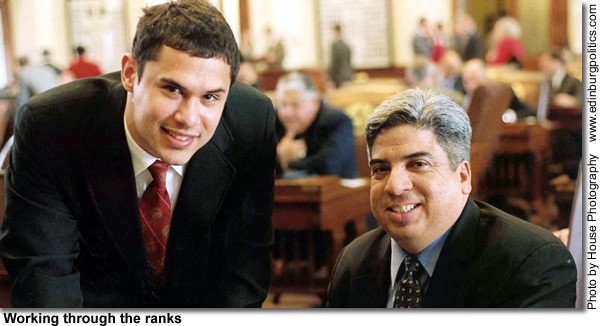
John de la Viña of Edinburg, featured left, has worked his way up from serving in the Office of the House Sergeant-at-Arms, which works with lawmakers and their staffs, to a position on the legislative staff of Rep. Aaron Peña, D-Edinburg. De la Viña, son of Danny and Judith De la Viña of Edinburg, plans to attend St. Mary’s University Law School in San Antonio this fall.
••••••
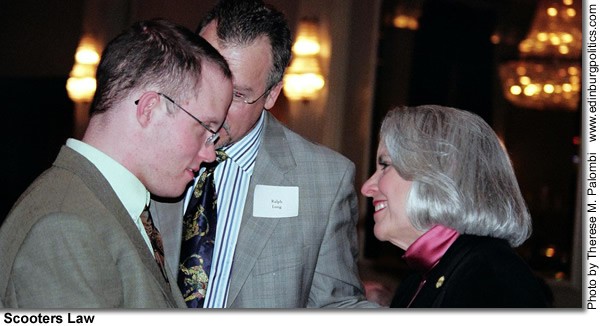
Sen. Judith Zaffirini, D-Laredo, greets Gene “Scooter” Long and his father Ralph at the Arc of Texas 2007 Leadership Award Ceremony where Zaffirini was honored for her outstanding support and advocacy of persons with intellectual and developmental disabilities. Scooter’s Law is effective immediately. See story later in this posting.
••••••

Texas A&M officials recently met with administrators from South Texas College to discuss the program and support opportunities for students. From left are Isai Morales, advisor for Valley Scholar’s and Honors Program for STC; Wanda Spratt, division dean of Nursing and Allied Health for STC; Paul Hernández, dean of Counseling and Advising for STC; Guadalupe Chávez, coordinator of Dual Enrollment Academies for STC; Dr. Ali Esmaeili; Dr. Juan Castro; Marie Olivarez, coordinator of Valley Scholar’s for STC; and Raymond Joyce, program coordinator for the Partnerships for Primary Care for the Texas A&M Health Science Center. See story later in this posting.
••••••
Senate approves measure by Sen. Lucio to build UT Health Science Center in Valley, including Edinburg
By DORIS SÁNCHEZ
The Senate on Friday, May 11, gave its approval to a bill by Sen. Eddie Lucio, Jr., D-Brownsville, that allows the Board of Regents of the University of Texas System to establish a free-standing U.T. Health Science Center in South Texas that includes a medical school and other health-related degree programs.
“This lays the foundation for a full-fledged medical school by requiring that the first two years of a degree program for medical students be offered at the University of Texas at Brownsville,” said Lucio, who added an amendment with this provision to Senate Bill 420 as requested by Rep. Eddie Lucio, III.
The amendment adds Brooks, Jim Hogg, Kenedy and Zapata counties to the area to be served by the medical school. The original bill would have included only Cameron, Hidalgo, Starr and Willacy counties in the school’s region.
“The opening of a medical school in the Rio Grande Valley would help recruit doctors to an underserved area and provide students in the region an opportunity to attend a professional school,” said Sen. Lucio. “Currently, only one professional school exists south of San Antonio: the Irma Rangel School of Pharmacy at Texas A&M University in Kingsville.”
The new bill requires research and training facilities to be established within the existing infrastructure of the Regional Academic Health Center (RAHC) at U.T. Brownsville, U.T. Pan American and at Harlingen, with an estimated cost of $28 million for startup. Currently, there are eight medical schools in Texas, with the southernmost in San Antonio.
SB 420 is also important because it would increase the availability of physicians who are culturally sensitive to the area’s population. Miscommunication problems are less frequent when health care providers understand and are educated to work with the cultural composition of the population. Additionally, studies show that medical students from underserved areas are more likely to practice in those areas.
Texas also has a below-average doctor-per-capita ratio (152 per 100,000) compared to the rest of the nation (220 per 100,000), which compounds the health care crisis: a rapidly growing population with an increasing susceptibility to obesity, diabetes, hypertension, heart disease and cancer. By 2020 or 2025, the deficit could be as great as 200,000 physicians, or 20 percent of the workforce. Recent studies indicate that the Rio Grande Valley counties have been designated as Medically Underserved Areas by the Department of State Health Services.
The Higher Education Coordinating Board’s 2002 study on new medical schools stated that if additional schools were to be established, they should: (1) have a high population area served by significantly fewer than the state average number of physicians; (2) show the potential to address issues of geographic access, with physician workforce diversity; and (3) provide the state the ability to build on significant prior investments that it and other entities have made for medical education and services. The Rio Grande Valley and El Paso were listed as potential sites.
“We need to press ahead with a medical school in the South Texas region, or we will further shortchange the medical needs of the area and its people,” added Sen. Lucio. “It is time we get the process moving.”
The bill is now headed to the House for consideration.
••••••
House passes border security bill to help fight border crime, improve homeland security coordination
By ALEXIS DeLEE
The Texas House of Representatives on Tuesday, May 8, gave final approval to House Bill 13 by Rep. David Swinford, R-Dumas, to improve the coordination of homeland security operations along the Texas border and reduce criminal activity.
All Valley state representatives supported the measure. It was scheduled for a public hearing on Monday, May 14, before the Senate Transportation and Homeland Security Committee.
Rep. Juan Escobar, D-Kingsville/Willacy County, and Rep. Ryan Guillen, D-Rio Grande City, are joint authors of the bill.
Sen. John Carona, R-Dallas, is the Senate sponsor of HB 13.
“Mexican cartels take advantage of our porous border with Mexico to traffic drugs and other criminal activity throughout Texas and the rest of the United States,” Swinford said. “Portions of our border with Mexico are controlled by drug lords where murder and crime is skyrocketing. We must take control of our border, and this legislation will get us closer to that goal.”
Swinford’s legislation creates the Border Security Council whose members will be appointed by the governor and whose function will be to oversee the distribution of $103 million to border law enforcement agencies.
A legislative committee would be created to monitor this activity and report back to the legislature on the effectiveness of these programs. Concurrently, state funds could be leveraged with federal funds under legislation currently pending before Congress.
The bill also encourages cities and counties to cooperate with federal agencies in immigration matters, allowing for the withholding of homeland security funding in the event they actively disregard federal laws.
A legislative study will also be conducted to evaluate the expedited deportation of illegal immigrants held in state jails and prisons for criminal offenses.
“This is one of the most important pieces of legislation that we will pass this session as it affects the safety of every citizen of this state and country,” said Speaker Tom Craddick, R-Midland. “I want to thank Chairman Swinford for putting forth a bipartisan bill that will beef up the homeland security structure in Texas.”
••••••
Congressman Cuellar addresses lack of outreach to border communities by federal government about plans for proposed border wall
By LAUREN SMITH
Rep. Henry Cuellar, D-Laredo/McAllen, on Monday, May 7, facilitated a video conference between federal and local officials to continue dialogue regarding the proposed border fence and address the lack of outreach to local citizens and officials.
The meeting included top-ranking officials from the Department of Homeland Security (DHS), Chief David Aguilar of U.S. Customs and Border Protection (CBP), and SBINet Executive Director Greg Giddens. Staff members of Cuellar, Sen. Kay Bailey Hutchison, R-Texas, Sen. John Cornyn, R-Texas, local leaders and elected officials also participated, including Webb County Judge Danny Valdéz, Dennis Nixon of International Bank of Commerce, and Laredo Mayor Raúl Salinas.
During the video conference, CBP and DHS officials agreed to engage local communities in an outreach campaign and said they will continue communicating with border leaders before any action on the proposed fence is taken. Officials also explained that the proposed fence location was drafted before SBINet measures were implemented and that DHS officials will monitor the results of a pilot program in Ariz. to determine if these security measures are good for the entire U.S.-Mexico Border.
Cuellar said he will also coordinate a visit to study the pilot program in Arizona, with the intention of determining the feasibility of a similar project along the Texas-Mexico Border.
“We will look to find the best options to increase border security, including the possibility of SBINet technology,” said Cuellar. “The SBINet technology– including air surveillance, cameras, ground sensors and ground radars– would help minimize the number of miles of fencing along our borders.”
Aguilar, an Edinburg native, welcomed town hall meetings along the border as a part of the CBP outreach initiative.
“I will work to bring SBINet Executive Director, Border Patrol Chiefs, border mayors, county judges and other officials who are stationed along the Texas-Mexico borderto Laredo for a border town hall meeting in the near future,” said Cuellar.
“Two people who will become major players in how we secure our borders will be Chief David Aguilar and Greg Giddens. In addition, we need to involve our Border Patrol Chiefs because they are the ones in the trenches and protecting our borders,” said Cuellar.
DHS representatives stated that their top priority along the international border in Texas is not building a fence, but cooperating with local citizens and representatives to improve border security and efficiency. Cuellar has long been an advocate for such communication as well as for clearing the banks of the Rio Grande.
“I applaud the Department of Homeland Security for recognizing the need to maintain an open line of communication with citizens in border communities, and I want to thank everyone for working to have such a positive meeting regarding border security,” said Cuellar. “I will continue to advocate for efficient and beneficial solutions at the border in Texas, utilizing the best combination of technology, infrastructure and construction to secure our border.”
“My goal is to facilitate communication and progress between local citizens and the federal government. By helping to address the local needs with federal solutions, we will truly be on track to bring about progress at the border,” said Cuellar.
Cuellar is a member of the House Homeland Security, Small Business, and Agriculture Committees in the 110th Congress; accessibility to constituents, education, health care, economic development and national security are his priorities. Congressman Cuellar is also a Majority Senior Whip.
••••••
Edinburg’s retail economy in February up almost 18% over same month in 2006
By DAVID A. DÍAZ
Edinburg’s retail economy in February 2007, as measured by the amount of local and state sales taxes generated by a wide range of local businesses, was up 17.75 percent over the same month in 2006, the Edinburg Economic Development Corporation has announced.
The EEDC is the jobs-creation arm of the Edinburg City Council.
It’s five-member governing board, which is appointed by the Edinburg City Council, includes Mayor Joe Ochoa, former Mayor Richard García, who serves as board president, Fred Palacios, Mike Govind, and George Bennack.
The figure translates into more than $1.4 million generated in local sales taxes in February, and sent back to the Edinburg city government on April 13 by the state comptroller of public accounts.
The local sales taxes are generated by the city’s 1 1/2 local sales tax and the 1/2 economic development sales tax that is administered by the EEDC.
Retail businesses are required to collect both the local and state sales taxes and send them to the Texas Comptroller of Public Accounts, which soon after returns the local sales tax back to communities in the form of a rebate,
The local sales tax is used to help pay for dozens of major city services, ranging from new streets to city personnel.
In February, Edinburg’s economy generated $1,406,491.03 in local sales taxes, compared with $1,194,371.11 in local sales taxes in February 2006.
During the first two months of 2007, Edinburg’s retail economy has generated almost $5.8 million in local sales taxes, up more than seven percent over the first two months of last year.
Edinburg registered the second-best showing in Hidalgo County in February, with McAllen outpacing all major cities in the Valley.
McAllen’s economy generated more than $5.5 million in local sales taxes in February, compared with more than $5.2 million during the same month last year, an increase of almost five percent.
According to the comptroller’s office, Hidalgo County also showed continued prosperity. In February 2007, all cities in Hidalgo County generated more than $11.8 million in local sales taxes, up 10.12 percent over February 2006, which reached more than $10.7 million.
During the first two months of 2007, all cities in Hidalgo County generated more than $52.6 million in local sales taxes, up more than 11 percent over the $47.2 million mark set in January and February 2006.
Neighboring Cameron County also registered economic growth, according to the state figures.
In February, all cities in Cameron County generated almost $5.9 million in local sales taxes, compared with more than $5.5 million during the same month in 2006, an increase of almost six percent.
Other major cities in Hidalgo and Cameron counties reported the following sales tax figures:
•Brownsville’s retail economy generated more than $3 million in local sales taxes in February 2007 compared with almost $2.8 million in February 2006, an increase of almost six percent;
•Harlingen’s retail economy generated more than $1.8 million in local sales taxes in February 2007, compared with more than $1.7 million in February 2006, an increase of five percent;
•Mission’s retail economy generated almost $1.1 million in local sales taxes in February 2007, compared with slightly more than $1 million in February 2006, an increase of 6.4 percent;
•Pharr’s retail economy generated more than $1.1 million in local sales tax activities in February 2007, compared with almost $1.4 million during the same month in 2006, a drop of more than two percent; and
•Weslaco’s retail economy generated more than $904,000 in local sales tax activities in February 2007, compared with more than $770,000 in February 2006, an increase of almost 17.5 percent.
Statewide, Texas Comptroller Susan Combs said the state received $1.53 billion in sales tax revenue in March, up 11.9 percent compared to March 2006.
State sales tax revenue for March, and April payments made to local governments, represent sales that occurred in February.
“The national economy is showing signs of a slowdown, particularly in the housing sector, but we are still seeing healthy growth in the Texas economy and a corresponding growth in state sales tax revenue,” Combs said.
Local sales tax revenues also continue to grow. Combs sent $404 million in April sales tax allocations to cities, counties, transit systems and special purpose taxing districts, a 9.7 percent increase compared to April 2006. So far this calendar year, sales tax allocations to local governments are up 6.4 percent.
Combs sent April sales tax allocations of $272.4 million to Texas cities, up 9.3 percent compared to April 2006. Calendar year-to-date, city sales tax allocations are running 7.1 percent higher than last year. Texas counties received sales tax payments of $24.8 million, up 11.1 percent compared to one year ago. Calendar year-to-date, county sales tax allocations are 8.4 percent higher than last year.
Another $12.5 million went to 115 special purpose taxing districts around the state, up 17.2 percent compared to last April. Ten local transit systems received $94.1 million in sales tax rebates, up 9.8 percent compared to a year ago.
For details of April sales tax payments to individual cities, counties, transit systems and special purpose districts, visit the Monthly Sales and Use Tax Allocation Comparison Summary Reports page on the Comptroller’s Web site at http://www.window.state.tx.us/taxinfo/allocsum/compsum.html.
••••••
House Approves bill by Rep. Gonzáles to bring street lighting to colonias in rural areas
By RICARDO LÓPEZ-GUERRA
Rep. Verónica Gonzáles, D-McAllen, welcomed House support for passage of House Bill 573, relating to street lighting in unincorporated areas along the border. The bill made it out of the House on Friday, May 11, at a critical time nearing the end of session, where it is expected to receive a hearing and be voted on in the Senate, bringing street lighting one step closer to the colonias.
Gonzáles is the prime author of the measure; joint authors include Rep. Rene Oliveira, D-Brownsville, and Rep. Ryan Guillen, D-Rio Grande City. Rep. Eddie Lucio, III, D-San Benito is a co-author of the bill.
“Last session I worked to secure funding for installation of street lights in the colonias,” said Gonzáles. “The colonia residents provided support and compelling testimony to the Legislature how street lighting could make a huge difference in their neighborhood. I am confident that HB 573 will finally make lighting a reality for these residents.” Cameron County and Hidalgo County commissioners’ courts stood behind Gonzáles’ legislative measures to secure that lighting is delivered to colonia streets and both commissioners’ courts presented resolutions supporting HB 573.
Gonzáles added, “Passage of this bill establishes a better standard of living for residents by reducing crime and increasing security in the community. No neighborhood should be left in the dark, and I am hopeful that this bill will light the way for safer colonias.”
In 2005, Gonzáles passed legislation with the support of colonia residents. “The community support has been tremendous,” she said. “The initial legislation established for federal grant money to fund the installation of street poles and HB 573 gives the border counties a means by which to pay for the electricity to ensure that the street lights are provided.
••••••
Senate approves resolution by Sen. Lucio to extend visa laser card to Mexicans
By DORIS SÁNCHEZ
The Texas Senate on Friday, May 10, gave its thumbs up to a Resolution by Sen. Eddie Lucio, Jr. encouraging the U.S. Congress to enact the Secure Border Crossing Card Entry Act of 2007 to extend the laser visa length of stay from 30 days to six months granting Mexican visitors parity with their Canadian counterparts.
“Senate Concurrent Resolution 43 is a way for the Legislature to show support to our Texas Congressional delegation,” said Lucio.
The federal Act, sponsored by U.S. Sen. John Corny, R-Texas, and U.S. Rep. Henry Cuellar, D-Laredo/McAllen, would extend the length of stay to Mexican visitors to support the economic needs of Texas with the goal of successfully balancing national security with the benefits of legitimate trade and travel.
Bill Summers, President and CEO of the Rio Grande Valley Partnership, said, “According to the U.S. Department of Transportation, from Brownsville to El Paso, more then 120 million visitors cross a year from Mexico into Texas. According to surveys, they spend on average $152 per person per trip. For the state of Texas, that amounts to $3 billion in total expenditures; $417 million in taxes collected; and 63,314 jobs created.”
Lucio added, “We have been approached by several businesses and the banking community along the border to carry this bill.”
Summers compared the dollar value of U.S. commerce crossing the border during one month at Laredo, Texas from Nuevo Laredo equal to the sum value of U.S.-China trade for an entire year.
••••••
Sen. Hinojosa passes bill to prevent dating violence in public schools
By MELISSA DEL BOSQUE
Sen. Juan “Chuy” Hinojosa, D-McAllen, and Rep. Dawnna Dukes, D-Austin, on Tuesday, May 8, passed House Bill 121 to help prevent dating violence in public schools.
Rep. Eddie Lucio, III, D-San Benito is a co-author of the measure.
“This bill takes a proactive approach by requiring schools to address teen dating violence and how to prevent it before a tragedy occurs,” Hinojosa said.
HB 151 requires school districts to include a plan to address dating violence prevention in schools. Schools already include procedures on how to address suicide prevention, conflict resolution and violence prevention.
Sheryl Cates, chief executive officer of the Texas Council on Family Violence, said the passage of the bill would provide an added safety net for youth attending school who may find themselves in an abusive relationship. The Texas Council of Family Violence found that 75 percent of young people in Texas ages 16 to 24 reported they had personally experienced dating violence or knew someone who had.
“With the passage of HB 121, requiring school districts to adopt policies addressing teen dating violence, we are providing enhanced safety for our youth who may be in abusive dating relationships,” Cates said. “This legislation will begin to help students in this situation to get help. Sen. Hinojosa has worked for the safety of victims and the prevention of family violence his entire public career, and this is another in a long line of his successful efforts to improve public policy in Texas.”
Hinojosa thanked Dukes for her leadership in the House and for being a longtime advocate in preventing dating violence. HB 121 will now be sent to the governor for his approval.
••••••
Small contractors would have better access to state contracts under bill by Sen. Lucio
By DORIS SÁNCHEZ
Small contractors in Texas will gain an equal footing in competing for state projects through a bill by Sen. Eddie Lucio, Jr., D-Brownsville, that would expand an existing capacity building program.
Senate Bill 704 would add bonding assistance and safety training to the Small Contractor Participation Assistance Program, originally established in 1993 under the Texas Building and Procurement Commission. This legislation would implement and expand the program to include in-depth technical assistance in insurance and bonding, as well as safety training.
It was approved by the Senate on Wednesday, May 2. It is scheduled for a public hearing on Monday, May 14 in the House Committee on Government Reform.
“It is more difficult for small contractors to secure insurance and bonding than to find work,” said Lucio. “Public works contracts tend to be huge multi-million dollar agreements, and few small contractors win these contracts because they lack adequate bonding coverage to handle these large projects. My bill attempts to level the playing field.”
“Sen. Lucio’s bill will give small and minority contractors an opportunity to bid for more public works projects,” said Frank Fuentes, Chairman of the US Hispanic Contractors Association. “In turn, the state will save money through a more competitive bid process.”
Contracts for public works projects of over $1 million would be eligible under the program, which would benefit the state by increasing the number of businesses eligible to submit pubic works bids and lowering the risk of small contractors. The program would also implement a centralized system of purchasing certain coverage and bonds, as well as provide a public outreach plan to encourage participation.
“I believe that a coordinator under this program can provide one-on-one assistance to small contractors and walk them through the procurement process, particularly within facility renovation and building construction projects,” explained Lucio. “Networking with existing public and private contractors would be another resource provided.”
“This is a good program that will improve the small contractor’s access to bonding, increase the number of bids submitted for public works and expand the likelihood that small contractors will be awarded contracts.”
••••••
Measure to establish organ donation registry supported by Rep. Gonzáles goes to governor
By NICK ALMANZA
Texas legislators have unanimously renamed the Texas Donor, Education, Awareness and Registry program (DEAR) the Glenda Dawson Donate Life-Texas Registry to honor the late state representative who received a kidney from her sister.
Senate Bill 1500 by Sen. Judith Zaffirini, D-Laredo, was approved by the Senate on Friday, May 4.
Rep. Verónica Gonzáles, D-McAllen, is a joint author of House Bill 2145, which is the companion (identical) bill to SB 1500.
SB 1500 is a follow-up to SB 24 and HB 120 (2005) by Zaffirini, which created the state’s organ and tissue donor registry.
It will enable the state’s organ and tissue donor registry to affiliate with the National Donate Life America alliance and campaign, allowing it to educate and reach more potential donors by using Donate Life America’s established brand equity.
“The more Texas increases public awareness and education regarding the importance of organ and tissue donation, the more lives will be saved,” Zaffirini said. “The bill would raise organ donor awareness statewide and would provide a fitting tribute to its champion, former Rep. Glenda Dawson, by making her the namesake of the Texas donor registry.”
Dawson, a transplant recipient, died last September.
“The general public’s response to donating blood is successful because of public education campaigns. I am confident that our efforts will achieve similar public awareness and will also honor my former colleague, Rep. Dawson, who not only championed the organ donor registration, but was a recipient of a kidney donation,” said Gonzáles.
Nationally, more than half of states have renamed their state registries to reference “Donate Life” a nationally known non-profit. By renaming the registry to reference the national non-profit, the State’s program will improve its campaign awareness among the public and share visibility to registries nationwide.
Information about becoming an organ donor is available via the internet at http://www.shareyourlife.org or http://www.texasdear.org.
(Ricardo López-Guerra contributed to this article.)
••••••
House Democrats prioritize teacher pay raise while preserving property tax cut, say legislative leaders
By KEVIN VICKERS
House Democratic Leader Jim Dunnam, D-Waco, on Friday, May 11, led a bipartisan majority in passing an amendment prioritizing a $6,000 pay raise for teachers, librarians and school counselors.
Dunnam amended a bill that directed $2.5 billion to additional property tax cuts. Previously this year, the legislature passed a separate $14 billion property tax cut. The Dunnam amendment requires that teachers receive the $6,000—which will bring them up to the national average in teacher pay—prior to the additional property tax cut becoming effective.
“I voted for the big property tax cut, but additional property tax cuts cannot be our 1st, 2nd and 3rd highest priorities for the state. Today, a bipartisan Texas House majority stood up to (Speaker of the House) Tom Craddick (R-Midland) and said that improving our public schools is more important,” said Dunnam.
Dunnam explained that most of a record $14 billion state budget surplus has already been dedicated to reducing property tax rates by one-third. House Bill 2785 proposed an additional six percent rate reduction that would cost an additional $2.5 billion of state general revenue funds every two years. The Dunnam amendment made raising teacher pay to the national average a requirement for putting the additional rate cut into effect.
“Nothing is more important to our children’s future and our state’s economic future than making sure every child has a qualified teacher in the classroom,” Dunnam said. “With Texas teacher pay lagging almost $6,000 below the national average, the House said today that Texas schools are an important priority and rejected the leadership’s plan to spend almost every last penny of a record state surplus on big tax shifts that primarily benefit wealthy political contributors.”
Rep. Garnet Coleman, D-Houston, Chairman of the Texas Legislative Study Group, noted that the new business tax bill authored by the state Republican leadership in 2006 is falling billions of dollars short of paying for the property tax reductions already in place, and that additional tax rate cuts would drain off state funds needed to restore critical program cuts made in 2003 when there was a state budget shortfall.
“House Bill 2785 would have sent the few who benefit from the proposed tax cuts to the front of the line for state dollars and sent everyone else to the back,” Coleman said. “Today’s vote made it clear that our children’s teachers, full CHIP restoration, access to higher education, and other important priorities are just as important as property tax cuts.”
Rep. Pete Gallego, D-Alpine, Chairman of the Mexican American Legislative Caucus, observed that the House leadership was prepared to dedicate $2.5 billion more to property tax cuts when, just yesterday, the leadership had insisted there was not sufficient revenue available to fund a $3 billion cancer research fund and delayed full funding for cancer research until 2010.
“The legislative leadership’s budget priorities are not only morally wrong, they also don’t make any sense financially,” Gallego said.
“A House majority said today that if money is available to set aside for tax relief tomorrow, there is also the money to use today to improve our schools, restore CHIP and fund cancer research,” Gallego concluded.
••••••
Measure by Rep. García to help military families adopt children is approved by House
By ELIZABETH LIPPINCOTT
Legislation by Rep. Juan M. García III, D-Corpus Christi, which would prohibit discrimination against military families who want to adopt children, passed the House of Representatives on Tuesday, May 8, and now moves to the Senate for consideration.
García introduced the measure, House Bill 3537, after military families across Texas complained that their frequent deployment status and frequent moves were counting against them when they were assessed for suitability as adoptive parents.
“Texas has a waiting list of 35,000 children waiting to be adopted. Yes, in a military family one parent is frequently away. But I believe that is greatly outweighed by the benefits that come with the military lifestyle, including healthcare, housing, daycare, and youth sports ” García said. “It’s important for our adoption rules to embody that.”
HB 3537 provides a safeguard for military families involved in the adoption process. The legislation is designed to dissuade child placement agencies and courts from having a negative view of military life based on the fact that a parent might be deployed or that the family will move periodically.
“A parent who’s in the military may not be home for dinner every night at 6:00 p.m., but that’s because they’re doing hard work that benefits others, and that’s worth making some sacrifices,” García said. “What could be a better lesson for a child to learn?”
García emphasized that the military supports adoptive families with leave policies, health care benefits, educational resources and reimbursement for certain adoption costs.
García, a career military officer, has four children, and his father was also a career naval aviator.
García represents the 32nd District in the Texas House of Representatives. Elected in 2006, he is an attorney and second-generation naval aviator. He lives in Corpus Christi with his wife Denise and their four children.
••••••
Attorney General Abbott takes action against EZ Pawn Shop chain for exposing customers’ records
Texas Attorney General Greg Abbott on Tuesday, May 8, took legal action against Texas-based EZCORP Inc., and its subsidiary, EZPAWN, for systematically exposing its customers to identity theft at stores in Texas, including the Rio Grande Valley.
According to documents filed by the Attorney General, EZCORP violated the law by repeatedly failing to protect customer records that contain sensitive personal information.
Investigators with the Office of the Attorney General discovered that several San Antonio EZPAWN stores exposed customers’ personal identifying information by discarding business records in easily accessible trash cans behind the stores. According to investigators, the records included promissory notes and bank statements that contained names, addresses, Social Security and driver’s license numbers, and checking account information.
“Identity theft is one of the fastest growing crimes in the United States,” Abbott said. “Texans expect their personal information to remain confidential. The Office of the Attorney General will take all necessary steps to protect consumers from identity thieves.”
Investigators also found evidence of similar instances of improper document dumping at a dozen other EZPAWN locations around the state, including stores in Austin, Houston, Lubbock and the Rio Grande Valley.
The defendants are accused of violating the Texas Deceptive Trade Practices Act (DTPA) and the 2005 Identity Theft Enforcement and Protection Act, which requires the safeguarding and proper destruction of clients’ sensitive personal information. Under the law, the Office of the Attorney General has the authority to seek penalties of up to $25,000 per violation of the DTPA and $50,000 per violation of the Identity Theft Enforcement and Protection Act.
The Attorney General also charged EZCORP and EZPAWN with violating Chapter 35 of the Business and Commerce Code, which requires businesses to develop retention and disposal procedures for their clients’ personal information. The law provides for civil penalties of up to $500 for each abandoned record.
The Office of the Attorney General is investigating whether any exposed data has been used illegally. Consumers who interacted with EZPAWN stores should carefully monitor bank, credit card and any similar statements for evidence of suspicious activity. Customers should also obtain free copies of their credit reports.
Consumers who wish to file a complaint may contact the Office of the Attorney General at (800) 252-8011 or do so online at http://www.oag.state.tx.us, where they can also obtain information on identity theft detection and prevention.
The May 8 legal action against EZCORP is the Office of the Attorney General’s fifth identity theft enforcement action in recent weeks. In April, Abbott took legal action against CVS/pharmacy and RadioShack Corporation for exposing hundreds of customers to identity theft by failing to properly dispose of records that contained sensitive information.
In March, the Attorney General filed an enforcement action against Jones Beauty College in Dallas for improperly discarding student financial aid forms with Social Security numbers and other personal information. Also in March, Abbott took legal action against On Track Modeling, a North Carolina-based talent agency that abruptly shut down its Grand Prairie office and abandoned more than 60 boxes containing hundreds of confidential client records.
••••••
Senate passes bill by Sen. Zaffirini to establish tax-free purchase periods for college textbooks
By NICK ALMANZA
The Texas Senate on Tuesday, May 8, passed Senate Bill 49 by Sen. Judith Zaffirini, D-Laredo, which would provide financial relief to college students by allowing them to purchase textbooks tax-free at the beginning of the fall and spring semesters.
Sen. Eddie Lucio, Jr., D-Brownsville, is a co-author of the bill. Rep. Juan Escobar, D-Kingsville/Willacy County, is a co-sponsor the measure.
The bill would establish two 10-day periods per year during which a college student with a valid student identification card could purchase textbooks tax-free.
“The impassioned testimony before the Senate Finance Committee by students supporting SB 49 sends a clear message that college students are in need of financial relief from the escalating costs associated with higher education,” Zaffirini said. “I truly am delighted that this bill was passed by the Senate and thank Lt. Gov. David Dewhurst and the student organizations who worked closely with me to pass SB 49.”
This is Zaffirini’s third attempt to pass this legislation. She authored similar bills during the 2005 Regular and Special Legislative Sessions.
The bill must be passed by the House of Representatives before it can be sent to Gov. Rick Perry for final approval.
••••••
New law allows students with disabilities to participate in graduation, receive attendance certificates
By NICK ALMANZA
Gov. Rick Perry on Tuesday, May 8, signed into law Senate Bill 673, known as “Scooter’s Bill,” by Sen. Judith Zaffirini, D-Laredo, and Rep. Rob Eissler, R-The Woodlands.
Sen. Eddie Lucio, D-Brownsville, is a co-author of the measure.
Effective immediately, it will allow students with disabilities who are in individualized education programs (IEP) and who have completed four years of high school to participate in graduation ceremonies and receive attendance certificates. They would receive their diplomas upon completing their IEP.
“I was proud to sponsor and pass Scooter’s Bill and am delighted that it is now Scooter’s Law,” Zaffirini said. “The new law will provide students in IEP programs with the opportunity to graduate with their peers and obtain a sense of closure as their classmates move on from high school. This is a fitting and pleasant end to Scooter Long’s story of hard work and advocacy on behalf of students with disabilities.”
SB 673 is named “Scooter’s Bill” in honor of Gene “Scooter” Long, a Dallas IEP student who was denied participation in his class’s graduation ceremonies by the Dallas Independent School District.
The new law calls for a consistent policy throughout Texas. What’s more, it will allow students to continue their IEP programs after participating in commencement ceremonies and would not preclude their receiving high school diplomas upon completing the program.
••••••
Texas A&M recruits STC students for early admission to medical school
By HELEN ESCOBAR
“We see the Valley as an area of shortages in many medical fields, but in particular for doctors. Our goal is to recruit students from South Texas College who are eager to take on the challenges of medicine, and who are willing to come back home and help to address the local health care needs,” said Dr. Juan F. Castro, associate dean for Coastal Bend Affairs for the Texas A&M Health Science Center College of Medicine. “We are recruiting students now as the turn cycle from medical student, to resident, to doctor takes seven or more years depending on the selected specialty.
We want to ensure that students attending South Texas College through its Dual Enrollment Medical Science Academy and Valley Scholars Program are aware of the Partnership for Primary Care Program, our early admissions program. We see these students who can maintain high academic standards as prime candidates for our College of Medicine.”
Any student involved in STC’s Valley Scholars Program or Dual Enrollment Medical Science Academy (DEMSA) who is interested in becoming a doctor is eligible for the Texas A&M Health Science Center College of Medicine Early Admissions Program. To be considered, students must apply and be taking courses at South Texas College in a relevant field of study. They must fill out and submit an application for early admission to the program, have an excellent academic track record, an SAT score of 1200 or above and a successful interview with the Texas A&M College of Medicine officials.
Once accepted to the program, students are guaranteed acceptance into the Texas A&M College of Medicine. In order to maintain their placement, students must maintain their high academic standards, earn their associate’s degree from STC and then transfer to Texas A&M University at College Station to complete their bachelor’s degree. Upon earning their bachelor’s degree, students will be able to automatically take their place at the Texas A&M College of Medicine and continue their studies.
“I can not stress what an amazing opportunity this is for any student who is considering becoming a doctor,” said Dr. Ali Esmaeili, associate dean for Bachelor Programs and University Relations for STC. “Placement at medical schools across the country is extremely competitive and most students must struggle and worry for years about whether or not they will be able to get in. STC students have the unique opportunity to guarantee their admission at the start of their college career. They see the light at the end of the tunnel and know that they are working toward their goal. This program is a huge advantage for students in Hidalgo and Starr Counties and I hope that they will start taking advantage of it now.”
In addition to offering early admission opportunities, the Texas A&M Health Science Center – College of Medicine through its offices in South Texas is willing to provide other tools to keep students motivated throughout the course of their studies.
“We want to provide guest speakers, workshops and other programs that can keep these students focused,” added Raymond Joyce, Partnership for Primary Care recruiter. “At times I see students who are thrilled to be part of the program, but for whatever reason, they get discouraged and do not complete the requirements. STC is a great partner for us because the college has so many support systems in place to ensure student success and we want to do our part to buttress that system.”
Students attending STC in the college’s Valley Scholar’s and DEMSA programs have access to free tutoring, one-on-one guidance and counseling, free college tours, book-sharing systems, as well as a variety of other benefits.d
“We are also looking at ways to include other bright and talented STC students who are not in the DEMSA or Valley Scholar’s Program, but who have shown a zest for medical sciences and have superior GPAs and extracurricular activities,” said Paul Hernandez, dean of Counseling and Advising for STC. “This is such a wonderful opportunity and we believe we can find a way to open it up to everyone in the near future.”
“We know this is a model partnership between STC, Texas A&M University and Texas A&M Health Science Center-College of Medicine, and will benefit students and the community,” concluded Dr. Castro. “We hope that we can develop similar programs in other fields such as pharmacy and dentistry as there are shortages in these areas also.”
For more information about the program contact Dr. Ali Esmaeili, associate dean for Bachelor Programs and University Relations at 872-7270.
by Legislative Media | May 8, 2007 | Politics
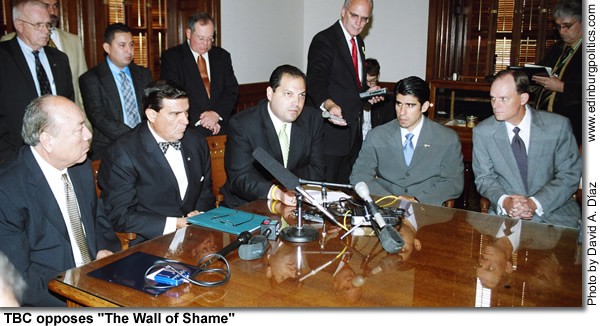
Hidalgo County Judge J.D. Salinas, center, on Wednesday, May 2, emphasized opposition from border leaders to plans by the federal government to build a border wall that could disrupt commerce between Texas and Mexico without increasing homeland security. Salinas was joined at a State Capitol news conference by numerous political and business officials, including, from left: Sen. Juan “Chuy” Hinojosa, D-McAllen; Sen. Eddie Lucio, Jr., D-Brownsville; Salinas; Rep. Eddie Lucio, III, D-San Benito, and Rep. Tracy King, D-Eagle Pass. Hinojosa, a U.S. Marine combat squad leader during the Vietnam War, called the proposed barrier “The Wall of Shame”.
••••••

McAllen Mayor Richard Cortéz emphasizes the strong opposition to a planned border wall in deep South Texas that is being considered by the federal government as a way to curb illegal immigration. The wall would hurt the economies of the border region and Texas, Cortéz said during a May 2 press conference in Austin by the Texas Border Coalition. Featured with Cortéz are Rep. Verónica Gonzáles, D-McAllen, and Eagle Pass Mayor Chad Foster, chairman of TBC. “No one wants border security more than we do. However, we support security that is smart, takes advantage of our natural geographic barrier – The Rio Grande River – and doesn’t repeat the mistakes of the past,” Foster said. “Building a wall along the Rio Grande River accomplishes none of these goals.”
••••••
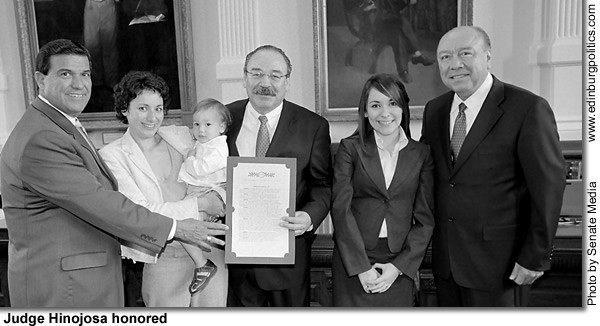
Former Cameron County Judge Gilberto Hinojosa (center) proudly displays the Senate Resolution honoring him for his years in public service presented on Tuesday, May 1 in the Texas Senate Chamber by Sen. Eddie Lucio, Jr., D-Brownsville (left). Joining Judge Hinojosa are Gina Hinojosa-Donisi (daughter) with her son Mateo, Xochitl Hinojosa (daughter) and Sen. Juan “Chuy” Hinojosa, D-McAllen (no relation to judge’s family).
•••••• (more…)
by Legislative Media | Apr 30, 2007 | Politics

Presidential candidate and U.S. Sen. John McCain, R-Arizona (second from left), reviews plans by the City of Laredo to help curb illegal crossings from Mexico into their community during his recent visit to that community where he met with the Texas Border Coalition, an alliance of elected leaders and economic development officials from the 14 counties which border Mexico. TBC is championing major improvements for border security, and increased commerce and travel through the legal ports of entry along the Texas-Mexico border, says TBC chairman Chad Foster, who serves as mayor of Eagle Pass. But Foster adds that the group stands united against plans that call for paying billions of dollars for fencing – more commonly referred to as a wall – to be constructed along the U.S.-Mexico border. “The Texas Border Coalition has a resolution that we are against the wall,” said McAllen Mayor Richard Cortéz. “Sen. McCain said he was also against the wall. He recognizes there have to be some kind of barriers to protect the border, but he favored more technology, more sensors. He felt the wall was a waste of money.” See related story later in this posting.
••••••
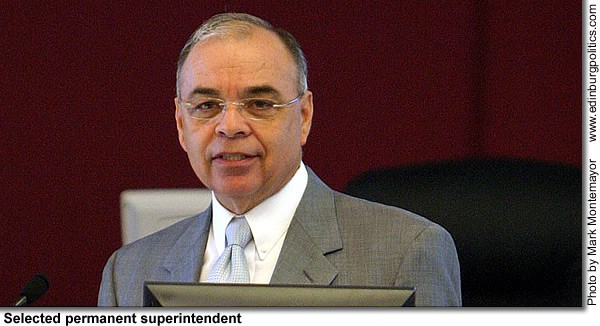
Gilberto Garza, Jr., formerly interim superintendent for the Edinburg school district, on Tuesday, April 24, was appointed permanent superintendent by the Edinburg school board.
In naming Garza as superintendent, the school board provided him with a 14-month contract that runs through June 2008 and a salary of $172,000, plus a $1,000 monthly stipend for auto allowance, cell phone, and other incidental expenses. The school board approved the contract on a 6 – 0 vote, with trustee Jaime Chavana absent for the vote.
••••••
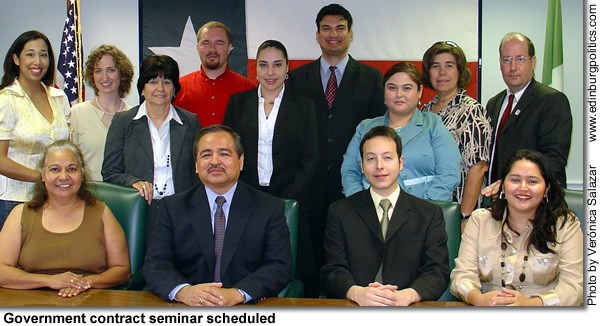
The South Texas Border Business Contracting Expo Planning Committee is looking for Valley businesses interesting in obtaining government and corporate contracts. The STBBCE is scheduled for June 21 at the McAllen Convention Center. Seated Brenda Lee Huerta, McAllen Hispanic Chamber; Robert Chavarría, U.S. Small Business Administration; Froy Garza, Office of Congressman Henry Cuellar; and Desiree Méndez-Caltzontzint, Office of Congressman Rubén Hinojosa. Standing are Elizabeth C. Martínez, The Business Times of the Rio Grande Valley; Beth Walker, Rio Grande Valley Partnership; Minnie Lucio, Cameron Works; Matt Ruszczak, the University of Texas-Pan American Small Business Development Center; Alex Brimer, UTPA Veterans Business Outreach Center; Johnny Clark, Thomas/Price and Associates; Esperanza Pérez, SBDC; Maggie Treviño, Central & South Texas Minority Business Council; and Mark Winchester, SBDC. For more on this story, please see article later in this posting.
••••••
Presidential candidate John McCain, Texas Border Coalition both oppose construction of border wall
By DAVID A. DÍAZ
U.S. Sen. John McCain, R-Arizona, who is also a candidate for President in 2008, covered a wide array of issues crucial to Texas and the border region, including the opposition to a proposed border wall between the U.S. and Mexico, during a key session in Laredo on Monday, April 16, with the Texas Border Coalition.
The Texas Border Coalition is an alliance of elected leaders and economic development officials from the 14 Texas counties that border Mexico.
“It was a rare and special occasion to have the opportunity to have a sit-down, face-to-face meeting with a presidential candidate,’ said Eagle Pass Mayor Chad Foster, chairman of the Texas Border Coalition. “We had a lot of issues to discuss, but the focus was on immigration reform and especially border security, which is the top priority, not only for Texas, but for the nation.”
As part of his visit with TBC, McCain shared his belief that the nation’s immigration policies must be humanitarian.
“We talked about the illegal acts of people who come here illegally, but the exploitation and the mistreatment of people who come to our country who have no protection under our law — terrible things happen and terrible things are done by coyotes that are unspeakable,” McCain told the Laredo Morning Times and other border news media.
TBC is championing major improvements for border security, and increased commerce and travel through the legal ports of entry along the Texas-Mexico border, but the group stands united against plans that call for paying billions of dollars for fencing – more commonly referred to as a wall – to be constructed along the U.S.-Mexico border.
“The Texas Border Coalition has a resolution that we are against the wall,” said McAllen Mayor Richard Cortéz. “Sen. McCain said he was also against the wall. He recognizes there have to be some kind of barriers to protect the border, but he favored more technology, more sensors. He felt the wall was a waste of money.”
Increased funding for the U.S. Border Patrol, lighting, vehicle barriers, sophisticated high technology sensors, and access roads are among some of the options to a wall that have been proposed to increase border security.
“We were very happy with most of the issues he shared with the border mayors and county judges. We will continue to have a friend in Sen. McCain for us to advance the needs for the southern border, for our national government to favor us more financially to improve our ports of entry. There has been a lot of investment in the infrastructure and personnel in our ports of entry,” Cortéz reported. “Overall, I believe we all left the meeting feeling pretty good that we had a senator who was going to support, substantially, the positions of the Texas Border Coalition,”
Brownsville Mayor Eddie Treviño Jr., who also participated in the TBC session with McCain, shared his thoughts about the meeting, particularly what he called the “wall to nowhere.”
“As border leaders, I believe Sen. McCain heard our united focus and concerns about immigration reform and the proposed ‘wall to nowhere’. We alerted him to the fact that the Secure Fence Act, which calls for the building of the wall, included a provision directing the U.S. Dept. of Homeland Security to investigate, study and then make recommendations on how to better secure our border with Canada. We all felt that this same method of fact-finding should have also been utilized as to our border with Mexico before, not after the passage of this legislation. Border security must take into account our border economies, and not take them for granted.”
Among the positions McCain has publicly taken on the issue of immigration are the following proposals:
•Vastly improve border surveillance and enforcement capabilities;
•Increase the manpower, infrastructure and capabilities necessary to block, apprehend, detain and return those who try to enter the country illegally;
•Strengthen the laws and penalties against those who hire illegal aliens and violate immigration law;
•Achieve and maintain the integrity of official documents to stop fraud, verify immigration status
and employment, and enforce immigration law; and
•Encourage immigrants to come out of the shadows so we know who is in this country and develop a
sensible guest worker program that will serve the nation’s best economic and security interests.
Laredo Mayor Raúl G. Salinas noted the significance of the Arizona senator’s meeting with the organization. “We welcome people from all parties and want someone with an open mind to do what’s right for mankind, especially as we go through immigration reform,” Salinas told the Laredo Morning News.
Foster, Cortéz, Treviño, and Salinas were joined at the Laredo session with McCain by other key members of the coalition, including Del Rio Mayor Efraín Valdéz; Hidalgo County Judge J.D. Salinas; Cameron County Judge Carlos Cascos; and Webb County Judge Efraín Valdéz.
Mike Allen, TBC vice-chairman representing the McAllen Economic Development Corporation, said the gathering was the latest in a series of efforts “to continue bringing the border region together on key issues that affect all of us.”
The other members of TBC are: Pat Townsend, Jr., TBC treasurer representing the Mission Economic Development Agency; Brownsville Mayor Eddie Treviño, Jr.; Edinburg Mayor Joe Ochoa; El Paso Mayor John F. Cook; Hidalgo Mayor John David Franz; Maverick County Judge José Pepe Aranda; Mission Mayor Norberto Salinas; Pharr Mayor Leopoldo Palacios, Jr; Roma Mayor Fernando Peña; and Weslaco Mayor Joe V. Sánchez.
The Texas Border Coalition maintains a web site at http://www.texasbordercoalition.org.
••••••
Rio Grande Valley Partnership supports high-security driverslicense, opposes creation of a border wall
By DAVID A. DÍAZ
A proposed new type of drivers license that would help Texans more easily travel in and out of Mexico, while increasing border security, has been endorsed by the Rio Grande Valley Partnership, which also has come out against calls for a “border wall” that would separate the U.S. from Mexico.
The Rio Grande Valley Partnership is a regional chamber of commerce for deep South Texas. Active at many different levels, including economic development and state and federal legislative affairs, it is headquartered in Weslaco.
On Thursday, April 26, the Rio Grande Valley Partnership approved Resolution No. 2007, which endorsed the passage of Senate Bill 2027 by Sen. Elliot Shapleigh, D-El Paso, that proposes the establishment of a pilot program that could lead the the issuance of high-security drivers licenses for state motorists.
Resolution No. 2007 also objects to the federal Secure Border Initiative, a plan that calls for the construction of barriers, most commonly referred to as a “border wall”, between the U.S. and Mexico.
The action by the Rio Grande Valley Partnership is consistent with the positions that have been previously taken by the Texas Border Coalition, an alliance of elected leaders and economic development officials representing the 14 Texas counties which border Mexico.
The Valley Partnership’s Resolution No. 2007 contends that any such border wall, “be it fences, barriers, or other mechanisms, is inhospitable, a stark contrast to the gracious and genteel qualities that characterize local border communities; moreover, its construction, particularly through the application of eminent domain, is insidious, an affront to the pride and privilege of land ownership.”
Such barriers could cost billions of dollars, according to federal government estimates, and opponents say those resources could be better used for other homeland security measures that would not hurt international commerce, economic development, and good will between the two nations.
“As the regional chamber of commerce, the Rio Grande Valley Partnership works to build business and to foster goodwill with our neighbors in Mexico,” said Bill Summers, its president and chief executive officer. “A border wall goes against everything this organization has been working towards for more than sixty years, and everything our local business work towards every day. By our resolution today, we commend Sen. Shapleigh in the Texas Legislature for his proactive efforts to create mechanisms that facilitate business and goodwill, rather than some federal initiatives that wedge barricades against them.”
Measures such as Shapleigh’s SB 2027 are much better and more effective solutions that help improve homeland security, the Rio Grande Valley Partnership maintains.
As proposed, SB 2027 authorizes the Department of Public Safety to initiate a permissive high security driver’s license pilot program, to adopt rules to implement the program, and to enter into a memorandum of understanding with any federal agency for the purposes of facilitating the movement of people between Texas and Mexico, according to the bill analysis of the measure.
SB 2027 was unanimously approved by the Senate Committee on Transportation and Homeland Security on April 24, and is awaiting a scheduled date for action by the full Senate.
According to the bill analysis of SB 2027, recently, the State of Washington enacted a high security driver’s license pilot program to provide enhanced driver’s licenses and personal identification certificates (certificate). Under this program, applicants have the option of choosing standard or enhanced driver’s licenses or certificates. Those who choose an enhanced license or certificate receive a license or certificate that appears standard, but contains a radio frequency identification chip that will include certain information that can be scanned at entry points on the border. Noted advantages of the enhanced license or certificate include lower costs and faster turnaround time compared to a passport. It may benefit both the state and persons traveling between Texas and Mexico to implement a similar program.
••••••
Edinburg school board names Gilberto Garza Jr. as new ECISD superintendent
By GILBERT TAGLE
The Edinburg Consolidated ISD Board of Trustees has named Gilberto Garza, Jr. as the new superintendent of schools for the Edinburg school district.
Garza has been serving as the interim superintendent of schools since last December. He was named acting superintendent last August before the start of the 2006-2007 school year.
In naming Garza as superintendent, the school board provided him with a 14-month contract that runs through June 2008 and a salary of $172,000.
Garza has resided in Edinburg since he graduated from San Isidro High School in 1966. He received his Bachelor’s of Science and Master’s Degree in Education from the University of Texas – Pan American. Other certificates that he has received include supervisory, mid-management and superintendency from UTPA.
He served as a teacher and as a principal at Hargill Elementary, De la Viña Elementary and San Carlos Elementary, before becoming the district’s Director of Elementary Education in 1997.
Garza is married to the former Anita Requenez of Edinburg (a retired teacher) and they have two children and four grandchildren. Garza comes from a family of educators whose siblings are either retired administrators or retired teachers.
In making the announcement, Melba González, president of the school board, said, “Gilbert Garza is a proven leader in education and education administration in the Edinburg school district. His 30 years of experience as a teacher, a principal, and as Director of Elementary Education have made him a well-rounded and respected educational leader.”
“In the period that Gilbert Garza has served as acting superintendent, the Edinburg school district has made many important strides that have taken the district forward,” said González. “Under his leadership, the district has taken measures to address the need for additional classroom space at the elementary level; the renovation of a school facility to serve as a new middle school; and the implementation of a comprehensive program to improve the safety at the campuses for all students and staff.”
“Gilbert Garza has proven that he can lead this great district with great vision, understanding, temperament and respectability for all teachers and campus staff as well as for the Edinburg community,” she added.
The Edinburg CISD is the second largest school district in the Rio Grande Valley. It spans over 945-square miles (largest in the state) and has a student membership of 29,000 plus and more than 4,200 employees.
As an administrator and interim superintendent, Garza will have the huge responsibility of guiding and influencing the direction of an education program that will serve the needs of all students in one of the Rio Grande Valley’s fastest growing school districts.
Carmen González (no relation to Melba González) , vice president for the board, said “Gilbert Garza is the type of leader that inspires the best in others to come out.”
“His leadership and character serve to unite and inspire passion among his teachers and principals, paraprofessionals and classified employees to do the best job they can and not forget that the whole purpose of education is to Teach the Children.”
••••••
Congressman Hinojosa votes for phased pull-out of U.S. troops from Iraq by March 2008
By ELIZABETH ESFAHANI
Rep. Rubén Hinojosa, D-Mercedes, on Wednesday, April 25, joined a majority in the House of Representatives to approve the conference report on the U.S. Troop Readiness, Veterans’ Health and Iraq Accountability Act.
This measure demands accountability from the Bush Administration, delineates a phased plan for the Iraqis to take responsibility for their own future, and outlines a timeline for the redeployment of U.S. combat troops from Iraq. Specifically, the report calls for the redeployment of U.S. combat troops to begin by October 2007, at the latest, with a goal of being completed by March 2008. This represents the approach recommended by the bipartisan Iraq Study Group, which also called for a goal of redeployment being completed by March 2008.
Hinojosa said:
“Today I cast my vote for a plan that will take Iraq in a new direction. While I will continue to see that our military has all the equipment and training they need, I cannot support an Administration policy that puts more troops in harm’s way with no clear goals on how to win the fight.
“It is time the President be made accountable for his gross mismanagement of this war. The Administration did not have accurate information four years ago when we went to war with Iraq and they do not have an accurate picture of the situation now.
“Instead, our troops are now caught in the middle of a civil war between religious groups that have hated each other for centuries. The task of imposing and growing democracy in a place where it has never been is not the job for our military. It must come from the political will of the Iraqi people.
“Only the Iraqis can decide whether they want to put aside centuries of discord and come together to create a stable, democratic country where the rights of every group is recognized. This bill demands that the Iraqi government take responsibility for its own future.
“Now is the time to reevaluate our strategy in Iraq. We need to redeploy our troops so they are not targets and the source of increased tension. We need to show the Iraqi government that they must step up to the plate now and make the hard political decisions necessary to save their country. They will never do this if we continue to prop them up.
“I call upon the President to sign this bill and show his support for our troops and veterans. A veto would only be another case of the President’s destructive irresponsibility.”
••••••
Edinburg’s jobless rate in Marchbest in Valley again at 4.4 percent
By DAVID A. DÍAZ
Edinburg’s jobless rate, which is a key indicator of the strength of the local economy, remained the lowest in the Valley for the third consecutive month in 2007, averaging 4.4 percent in March, an improvement from 4.8 percent in February and 4.9 percent in January.
The city’s unemployment rate was keeping pace with the statewide average in March of 4.3 percent and the U.S. unemployment rate of 4.5 percent.
In 2006, the annual jobless rate for Edinburg was 5.3 percent, while in 2005, the annual jobless rate for Edinburg was 4.7 percent.
In 2006, the city’s jobless rate was the lowest in the Valley during five months, according to the Edinburg Economic Development Corporation, and Edinburg registered the second-best showing for most of the other months last year, edged out only by McAllen.
The EEDC is the jobs-creation arm of the Edinburg City Council.
The EEDC’s five-member governing board includes Mayor Joe Ochoa; former Mayor Richard García,
who is president of the EEDC board of directors; and Fred Palacios, Mike Govind, and George Bennack.
As of March, according to the Texas Workforce Commission, 1,245 Edinburg residents were looking for jobs, while 26,969 local residents were employed.
The jobless rate, also known as the unemployment rate, is the number of persons unemployed,
expressed as a percentage of the civilian labor force.
The civilian labor force is that portion of the population age 16 and older employed or unemployed.
To be considered unemployed, a person has to be not working but willing and able to work and actively seeking work.
The jobless rate for Hidalgo County was 6.5 percent in March, an improvement from 7.4 percent in February and 7.7 percent in January.
The March jobless rate for Hidalgo County represented 17,623 area residents without jobs, while 254,508 residents were employed during the third month of 2007.
McAllen had the second lowest monthly unemployment rate in March – 4.6 percent – or 2,698 of their citizens out of work, while 55,864 residents of the City of Palms were employed that month. In February, McAllen’s jobless rate was 5 percent, while in January, its jobless rate was 5.1 percent.
Harlingen’s unemployment rate in March was 4.9 percent, while Pharr posted a 5.3 percent jobless rate that month.
Mission came in with a 5.4 percent unemployment rate in March, followed by Weslaco at 5.9 percent.
In Cameron County, Brownsville’s unemployment rate in March came in at 5.9 percent.
Cameron County’s jobless rate in March was 5.8 percent. In March, 8,356 residents of Cameron County were looking for work, while 135,427 residents were holding down jobs.
According to the Texas Workforce Commission:
The March seasonally adjusted unemployment rate dropped to 4.3 percent, down from 4.5 percent in February and 5.0 percent a year ago.
Seasonally adjusted nonagricultural employment in Texas grew by 15,000 jobs in March. This increase followed a revised gain of 32,100 jobs in February 2007.
With an annual job growth rate at 2.3 percent, the Texas economy gained 225,500 jobs over the past 12 months. The Midland Metropolitan Statistical Area (MSA) experienced the lowest unemployment rate in the state at 2.9 percent (not seasonally adjusted).
The Odessa MSA was second at 3.3 percent, followed by the Amarillo MSA at 3.4 percent.
“Our falling unemployment rate and continued job growth are clear-cut indicators of a healthy Texas labor market,” said Texas Workforce Commission (TWC) Chair Diane Rath. “The Texas unemployment rate now stands at 4.3 percent, below the national unemployment rate of 4.4 percent.”
Leisure & Hospitality posted the biggest gain, adding 5,300 jobs in March. Trade, Transportation & Utilities followed with 4,400 jobs added over the month and 21,600 jobs added in the past 12 months. Professional & Business Services went up by 3,600 jobs over the month, for a 4.0 percent gain since March 2006.
“Sustained job growth drives our state’s economic development,” said TWC Commissioner Representing Employers Ron Lehman. “Employers are recording impressive annual job growth rates in industries, including Mining at 11.6 percent and Construction at 4.2 percent.”
Jobs in Construction increased by 2,100 positions in March, following February’s substantial gain of 7,900 jobs. In the past 12 months, the industry has added 25,300 jobs.
“Employment is up, and that means more workers are finding jobs,” said TWC Commissioner Representing Labor Ronny Congleton. “The labor force in Texas is now at an all-time record, with more than 11,078,300 workers employed.”
Initial claims for Unemployment Compensation in March 2007 were 52,901, down 2.1 percent since March 2006.
••••••
Judge J.D. Salinas pushes for improvements on U.S. Highway 281 north of Hidalgo County
By CARI LAMBRECHT
Hidalgo County Judge J.D. Salinas III and leaders of cities along U.S. Highway 281 recently met to discuss plans to convert the main northbound route from Hidalgo County into an interstate-like non-stop thoroughfare.
The purpose of the “U.S. 281 Coalition” meeting, called by Judge Salinas, was to garner support for the highway’s inclusion in plans for Interstate 69, a trans-national trade route envisioned to be the shortest and fastest link between the economic centers of the United States, Mexico and Canada. Because the majority of cross-border trade moves by truck, I-69 is needed to increase mobility, safety, air quality and fuel economic development opportunities.
There have been discussions about whether to designate U.S. 281 or U.S. 77 as the route for I-69. Factors such as environmental impact studies, cost-benefit analysis and economic considerations will be key determinants. A commission will ultimately make the final decision — both highways could be included in the final plan — but regardless, U.S. 281 needs to be prepared.
“The bottlenecks have got to go,” said Salinas.
Several TxDOT-proposed improvements along U.S. 281 would make it more attractive for the I-69 project. The proposed improvements are:
1) Direct connectors from U.S. 59 Eastbound to IH-37 Northbound and from U.S. 59 Westbound to U.S. 281 Southbound in George West;
2) An overpass in the school zone in Ben Bolt; and
3) A possible tolled relief truck route around Premont or tolled freeway though Premont. Construction is expected to start as early as the end of this year on seven miles of freeway with three overpasses in Falfurrias.
“First and foremost, making these improvements along U.S. 281 is vital to relieving congestion, increasing safety, facilitating trade and improving our evacuation routes,” said Salinas.
“In addition, wherever TxDOT puts I-69 will determine growth. The question we aim to answer is how do we position ourselves to benefit from the economic activity that will be generated from increased trade along this route? What the coalition does collectively impacts the economic future of the entire region.”
Discussions about U.S. 281/I-69 are by no means over. Salinas will meet with the County Judges of Jim Wells, Live Oak and Brooks counties just before a quarterly meeting of the I-69 Alliance from 9 a.m. to 11 a.m. on Friday, May 4, 2007, in Corpus Christi.
••••••
Rep. Martínez votes against voter ID bill, contends it amounts to a “modern day poll tax” on the poor
By SCOTT JENKINES
Rep. Armando “Mando” Martínez, D-Weslaco, on Tuesday, April 24, joined Democratic Senators, leaders from the America Association of Retired Persons, the League of Women Voters, and other groups Monday in opposition House Bill 218, which would require voters to present a qualified voter ID before casting a ballot.
The legislation was approved by the House of Representatives, with all Valley state representatives voting against the measure on third reading, which is the final vote taken on a measure.
Martínez said HB 218 was “an assault on Texans’ voting rights,” contending the bill, if passed into law, which would substantially decrease voter participation in Texas.
“I find it very hard to believe that there are individuals out there who are still trying to make it difficult for minorities and seniors to vote, but that is what happened with the passage of HB 218”, Martínez believes. “We all live in a country where one’s right to vote is the very foundation of our society. When a person is issued a voter’s registration card, that should be sufficient. There is no reason to require and implement additional hurdles for the voting public.”
Passed in the House on a party-line vote, if the “voter suppression bill”, as Martínez labeled it, becomes law, it will require voters to present a photo ID card at the polls, in addition to a valid voter registration card, in order to vote. As a practical matter, this requirement would disenfranchise thousands of elderly and minority Texans by denying the right to cast a ballot that counts, he said.
“A recent study commissioned by the Federal Election Assistance Commission found that, in 2004, states with Voter ID laws, such as HB 218, have experienced a 10% drop in the turnout of Hispanic voters. We should find ways to encourage individuals to go out and vote, not ways to discourage voting,” Martínez said.
••••••
Texas GOP says voter ID legislation will help crack down on voter fraud, protect election integrity
The Republican Party of Texas on Tuesday, April 24, applauded Rep. Betty Brown, R-Terrell, for authoring and passing legislation which would require photo identification to vote in Texas. The Texas House of Representatives voted 76 to 68 to pass House Bill 218 by Representative Betty Brown.
All Valley state representatives voted against HB 281 on third reading, which is the final vote taken on a bill. Those legislators are all Democrats.
“We applaud Rep. Brown for authoring and passing a common sense bill which safeguards the electoral process from voter fraud. Her leadership and perseverance served the voters of Texas well today,” said Hans Klingler, spokesman for the Texas GOP.
House Bill 218 would codify what most Texans do already which is provide some form of photo identification to cast a ballot in Texas. The bill has a fail-safe system for eligible voters over 80 years of age by exempting these individuals from this legislation. Since 2004 Attorney General Greg Abbott, also a Republican, has prosecuted several cases of voter fraud in Texas, including one case in Bee County in South Texas where the accused posed as their deceased mother to vote after her mother had passed away.
“House Bill 218 will ensure that an eligible voter’s ballot is not cancelled out by someone who is casting a ballot fraudulently. This is a safeguard which is supported overwhelmingly in Texas and long overdue,” continued Klingler.
House Bill 218 will now move to the Texas Senate where it will be considered in the coming weeks. Lt. Governor David Dewhurst, a Republican, has signaled publicly his support for the bill.
••••••
Counties could provide street lighting to rural areas under legislation authored by Rep. Gonzáles
By DAVID A. DÍAZ
Texas counties located within 150 miles of the Mexican border would be able to establish, maintain, and charge rural residents for street lighting in neighborhoods that are outside the city limits under a measure filed by Rep. Verónica Gonzáles, D-McAllen.
The legislation, House Bill 573, was approved by the House Committee on County Affairs on Monday, April 24, and is awaiting action by the House Local and Consent Calendars Committee, which sets the date for House votes on noncontroversial or unopposed bills.
It was requested by the Hidalgo County Commissioners Court.
In addition to Gonzáles, who is the prime author of the bill, joint authors include Rep. René Oliveira, D-Brownsville, Rep. Ryan Guillen, D-Rio Grande City, Rep. Norma Chávez , D-El Paso, and Rep. Richard Raymond, D-Laredo. Rep. Eddie Lucio, III, D-San Benito, is a co-author of the measure.
According to the bill analysis of the bill:
Currently, municipalities have the authority to assess fees for the costs of installation, operation and maintenance of street lighting to the citizens that it benefits. However, in unincorporated areas, a county does not have this same authority even when residents of a subdivision are perfectly willing to incur a cost in order to obtain street lighting.
The version of Gonzáles’ bill approved by the House committee will grant authority to certain counties so that they may distribute the cost of installation, operation and maintenance of street lighting to the citizens it benefits, currently a common practice within municipalities and further allows the county to contract with an outside party for the collection of those fees.
House Bill 573 amends Chapter 280, Transportation Code, by adding Section 280.003 to provide counties that have any of their territory within 150 miles of the border the ability to charge residents of unincorporated areas for the installation, operation and maintenance of street lighting. It also adds a provision which ensures that the section does not supersede applicable provisions for street light service contained in the tariff of an electric utility.
If approved by the Texas Legislature and Gov. Rick Perry, the bill would go into effect on September 1, 2007.
••••••
Sen. Zaffirini, Rep. Guillen appointed to conference committee that will hammer out state’s budget
By NICK ALMANZA
Lt. Governor David Dewhurst on Wednesday, April 25, named Sen. Judith Zaffirini, D-Laredo, to the appropriations conference committee that will write the final draft of the $153 billion state budget. The committee comprises five senators and five representatives who will reconcile the Senate and House versions of the appropriations bill.
This is Zaffirini’s seventh appointment to the appropriations conference committee. She is serving her third consecutive term as vice chair of the Senate Finance Committee, on which she has served since 1991.
“I truly am grateful that Lt. Governor Dewhurst again appointed me to the appropriations conference committee, and I am committed to working closely with him and my fellow conferees to produce a comprehensive and cooperative budget that prioritizes families,” Zaffirini said. “My priorities include providing funding for the maximum reduction of community-based and home services waiting lists, which includes more than 90,000 Texans; providing essential funding for early education and higher education excellence; and funding for important programs and projects statewide and in Senate District 21.”
During conference negotiations Zaffirini will work to increase the Senate’s $107.1 million to reduce community-based, home services and care waiting lists and to fund the $75 million in the Article XI “wish list.” Zaffirini also will seek $150 million in new grants for the Instructional Facility Allotment (IFA) that helps poor school districts with facility construction.
Included in the Senate’s version of the budget are funding increases for both the UT Health Science Center in San Antonio (UTHSCSA) and Texas A&M International University in Laredo. Among Zaffirini’s priorities are increased funding for early childhood education, the Texas Early Education Model (TEEM) and advanced research programs within the Higher Education Coordinating Board.
The committee substitute for House Bill 1 by Rep. Warren Chisum, R-Pampa, and Sen. Steve Ogden, R-Bryan, reflects more than a six percent increase over the 2005 budget. The Senate version spends approximately $2.1 billion more than its House counterpart.
Senate Finance Committee members named by Dewhurst to the appropriations conference committee are Senators Ogden, chair; Robert Duncan, R-Lubbock; John Whitmire, D-Houston; Tommy Williams, R-The Woodlands; and Zaffirini.
House Appropriations Committee members named by Speaker Tom Craddick are Representatives Chisum, chair; Ryan Guillen, D-Rio Grande City; Dan Gattis, R-Georgetown; Lois Kolkhorst, R-Brenham; and Sylvester Turner, D-Houston. Conferees will develop a final proposal that will be voted on in both chambers before the session ends on May 28.
••••••
Sen. Cornyn, Texas border sheriffs meet with DHS Secretary on immigration reform, border security
U.S. Sen. John Cornyn, the top Republican on the Immigration and Border Security subcommittee, met with Texas border sheriffs and Homeland Security Secretary Michael Chertoff on Tuesday, April 24, in Washington. The meeting, held at Cornyn’s request, focused on issues important to the border region, including border security, immigration reform and funding for law enforcement efforts.
It is essential that local officials along the border continue to have input as we work to secure the border,” Cornyn said. “This meeting was a good opportunity for Texas border sheriffs to voice their needs and concerns directly to Secretary Chertoff.”
The meeting was part of Cornyn’s ongoing efforts to ensure the voices of state and local officials are being heard in Washington. He has continually worked in the Senate to assist the law enforcement community with resources to crack down on violence, drug smuggling and other crimes.
On hand for the discussion were members of the Southwest Border Sheriffs Coalition (SWBSC) from Texas and other border states, including Sigifredo González, Jr., of Zapata County, Texas —Chairman of the SWBSC Intergovernmental Relations Committee. Leaders of the Texas Border Sheriffs Coalition and the National Sheriffs Association also participated.
“We must provide those who work on the front lines of border security every day the resources they need to do their jobs,” Cornyn said. “I will continue working closely with law enforcement officials and other local leaders on the border as we work to improve border security and reform our broken immigration system.”
Cornyn reiterated his support for the State Criminal Alien Assistance Program (SCAAP), which reimburses states and counties for the costs of detaining illegal immigrants arrested in connection with crimes other than immigration violations.He said Congress must provide adequate funding for the program. In addition, Sen. Cornyn co-sponsored an amendment last year to provide $50 million for border law enforcement.
Cornyn said reforming our immigration laws and securing our borders is among the top priorities this year for Congress. “We’ve taken some needed steps to improve border security, but we can and must do more,” he said.
The Southwest Border Sheriffs Coalition unites sheriffs’ departments in counties along the border in Texas, New Mexico, Arizona and California in their law enforcement efforts.
Earlier this year, Sen. Cornyn hosted a similar meeting in Laredo with Texas border mayors, county judges and Secretary Chertoff.That meeting came as a follow-up to a discussion in Washington co-hosted by Cornyn and Sen. Kay Bailey Hutchison, R-Texas.
••••••
Sen. Hutchison address border issues with Southwestern Border Sheriffs Coalition
By GEOFF EMBLER
Senator Kay Bailey Hutchison (R-TX), Chairman of the Republican Policy Committee, on Wednesday, April 25, hosted a meeting with the Southwestern Border Sheriffs Coalition in her Washington, D.C. office to address border security issues and federal funding for costs associated with immigration enforcement.
“We must support and gather input from border sheriffs who are on the ground working to secure our borders,” Hutchison said. “Local officials dealing with these threats must be part of the solution, and I am committed to providing them with the resources they need to safeguard our nation.”
Hutchison has long advocated federal support for border security duties carried out by local officials.
In September 2006, Hutchison announced the Texas Border Sheriffs Coalition would receive a $4.9 million grant from the U.S. Department of Justice to provide equipment and supplies for the Operation Linebacker Task Force. She has consistently backed measures that provide funding for increased border security personnel and infrastructure, including the $250 million Border Law Enforcement Relief Program and the State Criminal Alien Assistance Program.
Hutchison hosted a February 9, 2007 meeting with Cornyn, U.S. Department of Homeland Security Secretary Michael Chertoff and border mayors and local leadership to give them an opportunity to provide local input on border fencing concerns.
••••••
House approves bill by Rep. Gonzáles to set up “Genuine Texas” branding program for industry
By RICARDO LÓPEZ-GUERRA
State Rep. Verónica Gonzáles, D-McAllen, on Thursday, April 26, saw passage by the House of Representatives of one of her legislative initiatives, the so-called “Genuine Texas” branding program.
Gonzáles is one of five joint authors of the measure, which calls for the establishment of a branding program to be named “Genuine Texas” for products manufactured in the state.
The legislation, which still has to clear the Senate, would develop a campaign to provide a competitive edge for Texas manufacturing industry by creating the logo for Texas-made goods for consumers to identify.
“The ‘Genuine Texas’ campaign will be the ‘Don’t Mess With Texas’ of this century,” said Gonzáles. “I am excited for this bill’s potential to encourage consumers to support Texas manufactured goods. We have seen the effective efforts through the Texas Parks and Wildlife anti-littering campaign; ‘Don’t Mess With Texas’ and I look forward the implementation of this program that will further fuel Texas manufacturing.”
Under the measure, House Bill 3446, a fee of up to $100 can be charged for the right to use the exclusive state logo, “Genuine Texas”. The branding program would also establish product quality standards for Texas manufacturers, set penalties for violations of improper use of the logo by manufacturers and create an advisory board of members.
“Texans have a long honored legacy of state pride and this bill promotes state pride through support of the manufacturing industry here at home,” said Gonzáles.”While the manufacturing sector is a strong contributor to the State’s economy, the branding program would keep the state competitive against increased cheap labor available overseas which could take manufacturing jobs away from Texas.”
••••••
Sen. Lucio says Senate ready to act on Rep. Flores’ bill to exempt travel trailers from property taxes
By DORIS SÁNCHEZ
Sen. Eddie Lucio, Jr., D-Brownsville, author of the Senate legislation that would exempt certain recreational vehicles from ad valorem taxation, announced on Friday, April 27, that the bill has gained full approval from the House and will soon be considered by the entire Senate.
Rep. Kino Flores, D-Palmview, authored the companion bill to Lucio’s in the House.
The bill specifies that because recreational vehicles (RVs) are not real property and are not substantially affixed to real estate or permanent fixtures, owners of these RVs must pay sales taxes on their units and maintain current auto vehicle registrations. Therefore, this property tax has created a hardship for many of these occupants, especially since their average age is 69. Eighty percent of Winter Texans live in mobile RVs.
“This unfair tax impacts so many of our Winter Texans because they are generally the people who own the kind of recreational vehicle that is currently assessed this tax,” said Lucio. “My bill primarily ends the practice of subjecting to ad valorem taxation those travel trailer owners who are not local residents and are not offered the right to participate in local government, like real property owners.”
The Rio Grande Valley benefits from the $450 million in revenues these visitors inject into the economy. However, the usual 150,000 Winter Texans who visit every year is down 20 percent from 2002, when the tax became effective. A constitutional amendment in 2001 inadvertently allowed counties to impose a tax on RVs.
“The increased sales tax revenue and tourism dollars generated by the influx of visitors as a result of lifting this tax will far outweigh any property tax revenue loss in those counties, and as a result there will be no quantifiable harm to school funding,” added Lucio. “Since only a few counties in Texas, including Cameron and Hidalgo, tax these trailers as real property, there should be no significant loss to general revenue.”
This bill also provides a narrow definition of park model travel trailers for taxation purposes that conforms to the existing definition already in state statute, and is also the nationally recognized standard. This bill clarifies that structures that are primarily used for temporary living arrangements, built on a single chassis, and less than 400 square feet are exempt from ad valorem taxation.
The senator added, “We are looking to protect park model travel trailer purchasers from unjust double taxation. Passage of this bill will encourage tourism and economic activity in the state of Texas and help local businesses by encouraging more people to stay in Texas for an extended period of time.”
••••••
Senate passes Sen. Zaffirini’s SB 1052 to provide financial incentives for community college students
By NICK ALMANZA
The Texas Senate on Tuesday, April 24, passed Senate Bill 1052 by Sen. Judith Zaffirini, D-Laredo, which would provide financial incentives for students who complete core curriculum requirements at community colleges to transfer to four-year institutions.
Providing incentives for students to transfer from two- to four-year institutions would increase college accessibility and affordability while helping increase attendance and participation at universities throughout Texas. The bill significantly would help close educational gaps within the state and promote student success and institutional excellence.
“The rapid growth of our state, coupled with the goal of enrolling another 600,000 students in higher education, require planning and incentives,” Zaffirini said. “By promoting transfers from two- to four-year institutions, we increase students’ options for success. SB 1052 is essential to closing the gaps in higher education by providing an incentive for students to transfer from two- to four-year institutions.”
The bill must be passed by the House of Representatives before it can be sent to Gov. Rick Perry for final approval.
••••••
Gov. Perry announces drop in border crime as a result of Operation Wrangler III
Gov. Rick Perry on Tuesday, April 24, announced the reduction of crime by 30 percent in the El Paso area during a recent border security operation known as Operation Wrangler III. Operation Wrangler III was a high-intensity surge operation that lasted 30 days in the El Paso border region.
“The success of this border security surge operation demonstrates once again that more boots on the ground, working together as a team, increases our safety and border security,” Perry said. “When criminal organizations are forced to shut down their smuggling activities, our communities are safer, and the quality of life improves for all Texans.”
As in previous state-led surge operations, the objective of Operation Wrangler III was to shut down organized smuggling activity between the Ports of Entry to prevent the illegal crossing of drugs, contraband and people into Texas. Local sheriffs’ offices and police departments worked side-by-side with their state and federal partners in three Texas counties (El Paso, Hudspeth and Culberson counties) and two New Mexico counties (Dona Ana and Luna counties) to deny Mexican criminal organizations and transnational gangs entry into the U.S.
A key benefit of securing the border is crime reduction. Operation Wrangler III resulted in the overall reduction of crime by 30 percent during the 30 day period of operation. The El Paso Sheriff’s Office documented an 82 percent reduction in aggravated assaults and 43 percent reduction in robberies. The El Paso Police Department reported a 16 percent reduction in robberies and 26 percent reduction in sexual assaults during the period of this operation.
“We are sending a clear message that an increased law enforcement presence is the key to securing our border,” Perry said. “Working with numerous state, federal and local agencies we can reduce drug trafficking, human smuggling and other crime in a significant way.”
In addition to the successes of Operation Wrangler III, border-wide surge operations have had a sustained impact on crime along the entire Texas-Mexico border. With 13 of the 18 border counties reporting, January-April of this year saw a 20 percent decrease in overall crime along these border areas compared to the same period of time last year. The 13 counties include Brewster, Culberson, Dimmit, El Paso, Hidalgo, Hudspeth, Maverick, Pecos, Star, Terrell, Val Verde, Zapata and Zavala.
The statistics from local law enforcement agencies in these 13 counties comparing January-April, 2006, to January-April, 2007, revealed the following overall results:
• Criminal Mischief reduced 34 percent
• Theft reduced 30 percent
• Burglary reduced 13 percent
• Aggravated Assault reduced 16 percent
• Sexual Assault reduced 59 percent
• Murder reduced 15 percent
••••••
South Texas Border Contracting Expo Expo to bring contracting opportunities to South Texas businesses
By ELIZABETH MARTÍNEZ
The 2007 South Texas Border Business Contracting (STBBC) Expo will be held on June 20-21 at the new McAllen Convention Center located at 700 Convention Center Blvd. The expo will offer area small businesses and manufacturers an opportunity to obtain contracting awards by government buying agencies, federal prime corporations and other corporate purchasers.
Honorary Co-Chairs of the 2007 STBBC Expo are Congressman Ruben Hinojosa (District 15) and Congressman Henry Cuellar (District 28).
The McAllen Hispanic Chamber of Commerce President and Chair of the STBBC Expo Planning Committee Cynthia Sakulenzki is expecting approximately 150 exhibitors, such as Lockheed Martin, Boeing, the University of Texas System Office of Facilities,
Planning and Construction, Texas Department of Transportation, Texas Lottery
Commission, Texas Transportation Institute, Texas Workforce Commission, Texas Health and Human Services Commission, and the University of Texas Health Science Center San Antonio.
This exciting event will not only include an exhibit hall filled with agencies and corporations looking to do business with South Texas businesses, but will also include match-making sessions, and four different training tracks that incorporate several seminars that will help businesses succeed in obtaining contracts. Networking events and optional Valley excursions, such as a Maquila Tour, a golf tournament at Palm View Golf Course, and lunch in Progreso, Mexico will be available to help participants acquaint themselves with each other and the region.
To register or for more information on how you can participate in the 2006 STBBC Expo, please call the McAllen Hispanic Chamber at 928-0060 or visit http://www.borderbusinesscontractingexpo.com. Conference cost for small businesses is $50 per person. Sponsorship opportunities are available. Deadline to register is June 1, 2007.
The 2007 STBBC Expo Planning Committee includes representatives from the following organizations: Texas State Technical College, U.S. Small Business Administration, S.C.O.R.E., the University of Texas-Pan American Veterans Business Outreach Program, UTPA Texas Manufacturing Assistance Center, McAllen Chamber of Commerce, Southwest Community Investment Corp., Texas Department of Agriculture Rural Economic Development Division, Rio Grande Valley Partnership, The Business Times of the Rio Grande Valley, Thomas/Price & Associates, Time Warner Fable, Office of Hidalgo County Judge, UTPA Small Business Development Center, Texas Department of Agriculture, Central & South Texas Minority Business Council, and the UTPA HUB Program.
•••••
Senate passes Sen. Zaffirini’s bill to protect against “botnets,” cybercrimes
By NICK ALMANZA
The Texas Senate on Thursday, April 26, passed Senate Bill 1009 by Sen. Judith Zaffirini, D-Laredo, which combats the use of “botnets” — networks of compromised computers used to perpetrate cybercrime.
Senate Bill 1009 will prohibit the creation of botnets and penalize convicted violators with significant fines.
“Botnets are being used by criminals around the globe to steal bandwidth from hijacked computers and make money from nefarious Internet activity,” Zaffirini said. “They are used primarily to send messages or software without the user’s knowledge, to make a computer resource unavailable to its intended users, to commit click fraud or to steal personally identifiable information. My bill combats the use of botnets by updating Texas’ cybercrime statute and strengthening laws to protect valuable Texas e-commerce.”
SB 1009 clearly will define the term “botnet” as a collection of computers that become compromised without the knowledge of the owner or operators. Compromised computers either run under a command and control infrastructure or are used to forward transmissions, including unsolicited e-mails and viruses, to other computers with online access. What’s more, the bill would authorize civil penalties for using botnets, including a cause of action for victims, and provide injunctive relief and the recovery of actual damages or $500,000 per violation.
The bill must be passed by the House of Representatives before it can be sent to Gov. Rick Perry for final approval.
••••••
House passes Congressman Hinojosa’s amendment to improve America’s science laboratories
By ELIZABETH ESFAHANI
Congressman Rubén Hinojosa D-Mercedes, on Tuesday, April 24, applauded the passage of legislation that will help reinvigorate and modernize America’s ailing high school science laboratories. The House of Representatives overwhelmingly passed the “10,000 Teachers, 10 Million Minds Science and Math Scholarship Act,” which included the Partnerships for Access to Laboratory Science amendment that Hinojosa introduced earlier this year.
“For more than 150 years, lab experiments have been an essential ingredient in a comprehensive science education,” said Hinojosa. “Unfortunately, the quality of today’s laboratory instruction is woefully under-par in most schools. Our future scientists and engineers are attending institutions that lack the resources required to develop their talents.”
Specifically the amendment authorizes a $5 million grant to establish a laboratory science pilot program at the National Science Foundation. Projects funded by the grant will go toward enhancing the quality of instruction and developing models for redesigning laboratories in high-poverty high schools.
Hinojosa’s legislation could not have come at more critical time: The National Research Council recently released a report concluding that the current state of laboratory experiences is poor for most students. The group also found that schools with higher concentrations of non-Asian minorities and higher concentrations of poor students are less likely to have adequate lab facilities than other schools. In fact, the latest Nation’s Report Card revealed an astonishing figure: only one in four Black or Hispanic students take the three major laboratory sciences – biology, chemistry, and physics – needed to pursue science, technology, engineering, and mathematics (STEM) majors during college.
“With these types of statistics, it should come as no surprise that we are losing our edge in producing experts in math, science, and engineering,” said Hinojosa.“We must redouble our efforts to engage young people in these fields early on in their academic careers. Our nation’s future competitiveness depends on it.”
••••••
Senate passes SB 1234 to enhance Texas’ higher education master plan
By NICK ALMANZA
The Texas Senate on Thursday, April 26, passed Senate Bill 1234 by Senators Judith Zaffirini, D-Laredo, and Kirk Watson, D-Austin, which would redefine planning for higher education. It would require the Texas Higher Education Coordinating Board (THECB) to redirect its higher education master plan to prepare students to participate effectively in the state’s public affairs and in the global economy.
To meet the goals of closing the gaps in higher education, SB 1234 would provide greater specificity as to how the Coordinating Board develops its plan and would ensure that the state is best able to address the needs of its students and institutions.
“SB 1234 combines three effective bills that will enhance greatly the state’s ability to create higher education excellence,” Zaffirini said. “In Closing the Gaps, Texas established an ambitious plan to ensure that more students are able to receive an outstanding college education. My and Sen. Watson’s bill improves this plan by directing the Coordinating Board to consider more detailed and more specific issues leading to statewide higher education success.”
“This legislation offers a roadmap to make Texas a force in the 21st Century economy,” Watson said.”Texas can and must do a better job of preparing future generations for the possibilities and challenges that lie ahead.Here, we will approach higher education through a long-range lens, and that holds great promise for our children and our state.”
The bill would require THECB’s master plan to define the missions and roles of public institutions of higher education consistently with state needs and goals; establish more effective methods for funding higher education; establish a coherent long-term financial aid strategy that takes into account both needs and merit; strengthen collaboration between two- and four-year institutions; and develop and institutionalize long-term collaboration between primary, secondary and higher education.
What’s more, it includes provisions from SB 1055 by Zaffirini, which would direct the THECB to consider the number of new faculty members needed to achieve the goals of Closing the Gaps, as well as the disciplines in which these faculty members would be needed; the number of qualified persons available to serve as faculty members in Texas and throughout the nation and the demand for their services; and the capacity of institutions in Texas to prepare future qualified faculty members.
SB 1234 includes provisions from SB 1919 by Watson, which would charge the THECB with considering the state’s allocation of and need for resources for medical education, including graduate medical education; geographic distribution of these resources; and the value of associating a medical school with a top-tier academic campus.
The bill also includes provisions from SB 1772 by Watson, which would charge THECB with discovering incentives and requirements for seamless student transitions between and among high schools, community and technical colleges, universities, and health-related institutions, including concurrent enrollment and dual credit; examining the current and projected capacity concerns of The University of Texas at Austin and Texas A&M University in College Station; methods for ensuring that these institutions maintain their competitiveness with other flagship universities; the creation of additional flagship public research universities; alternative methods of funding universities and community colleges, in particular whether and how research universities should be funded; and a new component of the TEXAS Grant program to include a work study program that targets students in grades P-12 to ensure that they become college ready.
The bill must be passed by the House of Representatives before it can be sent to Governor Rick Perry for final approval.
••••••
Congressman Cuellar announces $4 million renovation of Falcon Dam
By LAUREN SMITH
Rep. Henry Cuellar, D-Laredo/McAllen, on Friday, April 27, announced that a $4 million federal grant has been awarded for the renovation of the facilities at Falcon Dam. Located near the dividing line between Starr and Zapata Counties, the Falcon Dam facilities will be renovated internally and externally.
“The renovation of facilities at our international borders is vital to increasing the efficiency and security of our border communities. In Congress, we are working hard to make sure that citizens in these communities benefit from federal funding and resources,” said Congressman Cuellar.
Originally constructed and dedicated on Oct. 19, 1953, the federal facilities at Falcon Dam serve as a point of entry between Mexico and the United States. President Dwight D. Eisenhower and Mexican President Adolfo Ruiz Cortines originally dedicated the facilities and spoke of a lasting international friendship.
“I want to thank Elsie Acevedo from the General Services Administration and Chris Cantú from the Customs and Border Protection for their efforts in making the renovation of Falcon Dam a reality, and I also commend the partnership between federal and local agencies,” said Cuellar.
“Securing federal funds for vital projects in Texas’ 28th District is a key priority of mine. When our communities prosper and grow, all of South Texas and our friends across the border reap the benefits,” said Cuellar. “Enhancing trade and tourism while maintaining and improving border security is a critical issue in border communities, and I will continue work hard to increase access to federal aid for projects in these areas.”
••••••
Senate Passes SB 120 by Sen. Zaffirini to help preventing online solicitation of minors
By NICK ALMANZA
The Texas Senate on Monday, April 23, passed Senate Bill 120 by Sen. Judith Zaffirini, D-Laredo, which would help protect children from online solicitation and exploitation by establishing a clearinghouse of educational resources related to Internet safety at the Texas School Safety Center.
The bill also would direct school districts to update their discipline management programs to prevent the use of the Internet for sexual solicitation and would increase the penalty for an adult convicted of online sexual solicitation of a minor.
“Children are especially vulnerable to victimization over the Internet,” Zaffirini said. “More and more children are using the Internet on a daily basis, which provides offenders with easy and anonymous means to find and exploit them. SB 120 addresses this growing problem by increasing the educational resources regarding online solicitation that are available to families and schools and by providing school districts with programs designed to combat and prevent online solicitation of minors.”
SB 120 works in conjunction with Zaffirini’s SB 6, which the Senator passed in March. SB 6 increases the penalty for sexually explicit on-line communications with a minor who is from 14 to 16 years old from a state jail felony to a third degree felony and increases the penalty for on-line sexual solicitation of a minor who is from 14 to 16 years old from a third degree felony to a second degree felony.
SB 6 also will require internet service providers (ISP) to respond immediately to subpoenas, search warrants or other court orders during an emergency; will allow prosecutors to seek consecutive prison sentences for the online solicitation of a minor; direct the Crime Stoppers Advisory Council to use state rewards programs to emphasize reporting and apprehending predators and criminals; and create a clearinghouse of ISP contact information in the Attorney General’s office so prosecutors can access important information necessary to prevent online predatory behavior.
The bills must be passed by the House of Representatives before they can be sent to Governor Rick Perry for final approval.
••••••
University of Texas-Pan American moves spring graduation to new McAllen Convention Center
By MELISSA VÁSQUEZ
This spring semester, The University of Texas-Pan American will be changing the venue for the commencement ceremonies, scheduled for Saturday, May 12, from the UTPA Fieldhouse to the new McAllen Convention Center, located on South Ware Road and Expressway 83.
The University’s decision to move the commencement venue was prompted by the increase in UTPA graduates and their guests over the years said Dr. Ana María Rodríguez, chair of the Commencement Committee and senior vice provost for undergraduate studies. This semester, the 1,452 prospective candidates for degrees include 1,103 for bachelor’s degrees, 336 candidates for master’s degrees and 13 for doctoral degrees.
“Our fieldhouse can only accommodate so many people. When we began to issue a limited number of tickets to students, they began to request that we look at holding commencement at a location where we could accommodate more people. Therefore, the administration’s decision to change the venue was made in response to student needs and with a great deal of student input. The safety of graduates, their families and guests was also an issue that was considered,” Rodríguez said.
The McAllen Convention Center will seat 528 graduates and 4,894 guests, while the UTPA Fieldhouse seats between 450-500 graduates on the floor and 3,700 guests on the bleachers.
The committee took two years in exploring several venues around the Rio Grande Valley before settling on the $62 million facility she said. The committee found the UTPA commencement calendar, which is planned three to four years in advance, and the convention center calendar were a good match for this academic year.
“The McAllen Convention Center is a new venue in the Rio Grande Valley that is able to accommodate a large number of people for one event,” she said. “The staff at the convention center has worked well with us in planning and designing the event, since an event such as this will be a first. There is also ample parking spaces available to accommodate the guests.”
This semester, prospective graduates will be allotted 12 tickets for their family members and guests to comply with the Fire Marshal’s Code of maximum seating capacity for the convention center. In previous semesters they were designated six tickets each. Guests attending the commencement ceremonies will be required to present a ticket to be admitted.
“Graduates, their families, guests and audience can expect grand ceremonies, solemn and celebrative, as they have always been at the UTPA Fieldhouse, but now held in a brand new majestic center,” Rodríguez said.
Also this semester, the University will go to a three-ceremony format starting at 9 a.m. with the College of Education, which features 393 prospective graduates, the largest group in any of the six colleges. At 1:30 p.m. the College of Business Administration (224) and College of Health Sciences and Human Services (240) will share the arena. The final ceremony of the day at 5:30 p.m. will combine the College of Arts and Humanities (223), College of Science and Engineering (218) and College of Social and Behavioral Sciences (154).
Serving as the 2007 spring commencement speakers will be Noé Hinojosa Jr., president and CEO of Estrada Hinojosa & Company, Inc., who will be speaking at 9 a.m.; Edward H. Muñoz, principal of Muñoz Group, who will be addressing the 1:30 p.m. ceremony; and Sylvia M. Courtney, vice president of engineering for Raytheon Company, will speak at 5:30 p.m.
For more information or special accommodations, contact the Office of the Registrar at 956/381-2389 no later than Thursday, May 10.
••••••
Congressman Ortíz details frustrations faced by veterans because there is no VA Hospital in RGV
U.S. Rep. Solomon Ortíz, D-Corpus Christi, testified Thursday, April 26, before the U.S. House Committee on Veterans’ Affairs’Committee’s Subcommittee on Health about the plight of veterans in South Texas who have to travel many hours for health care services that are not available to them near where they live.
Several members of the Veteran’s Alliance of the Rio Grande Valley were in attendance, showing committee members the faces of veterans in need. Veteran’s Alliance members attending the hearing were: José María Vásquez, Rubén Córdova, and Max Belmarez, Polo Uresti, Frank Albiar, and Félix Rodríguez.
Ortíz’s testimony:
Mr. Chairman, thank you for this opportunity to speak on behalf of South Texas veterans and help this subcommittee understand the urgent need for a veterans’ hospital for the men and women who fought for us.
Here with me today are members of the Veterans Alliance of the Rio Grande Valley/America’s Last Patrol – so you can see the faces of the South Texans affected by the lack of a hospital. Here with me are: José María Vásquez, Córdova, and Max Belmarez … and Mr. Félix Rodríguez.
My legislation gives the government flexibility in establishing a way to deal with hospital services in South Texas… but the only real solution for the area is a hospital. Bottom line: veterans’ in-patient health care must be available where the veterans live, not several hours away. These guys have fought, bled and sacrificed for this nation – they need something that belongs to them … a hospital that gets them the care they need where they live – not five hours away.
We know the VA plays the numbers game – but the numbers do not reflect the need… particularly in the Rio Grande Valley. When the VA commissioned their CARES study they recognized the Far South Texas area was in need of acute inpatient care. They decided to meet this demand through contracting or leasing beds in local communities, an approach simply not working. Veterans are still traveling in large numbers to Audie Murphy in San Antonio for care, and for many who are treated for emergencies at area hospitals, the bills go unpaid by VA.
Many veterans are so disgusted by the level of VA health services, they simply do not sign up for VA health care. You have heard me describe the conditions of South Texas Vets; today I want to show you experiences of veterans themselves … veterans who shed blood for our nation … veterans whose health care is utterly inferior. South Texas veterans regularly travel five hours there and back to a 15 minute appointment that took months to get.
Sometimes they need to stay overnight in San Antonio… sometimes, veterans find after the strenuous trip, their appointment has been canceled. We’ve scrubbed the names to prevent any retaliation for truth telling…. And my time will run out before I’m done, but want you to hear the stories I hear:
1) A 21-year-old Iraq war veteran came home badly wounded in his spine. He’s now at Audie Murphy in San Antonio. He was being moved by hospital staff from the bed to a wheelchair – but they moved too quickly and damaged his spine even more. He has a lifetime of going back and forth to San Antonio for treatment … and his family has a lifetime of committing to take him there regularly.
2) One veteran underwent emergency heart surgery; his wife called the local clinic and she was directed to call 911; he was admitted for the emergency surgery locally. His benefits coordinator told him to follow up with a local cardiologist to chart his progress since there wasn’t a cardiologist at the clinic. He did, but VA did not pay and on the third visit, the cardiologist’s office told him to pay up front for all services.
The VA clinic then told him he should have gone to a cardiologist in San Antonio. By now, his sutures were infected and leaking. Eventually, he got an appointment to see a VA cardiologist five weeks later. The stress from all this prompted his psychiatrist to increase the dosage on his meds.
When he got to San Antonio, the cardiologist was surprised to learn he had surgery. He was prescribed more high blood pressure medication. That made him faint from low blood pressure, panicking his wife … she called a home health nurse who suggested stopping all meds and going immediately to the hospital.
He did not want to go the hospital because they had not been paid and he might be refused. He was poor – so the nurse recommended that he drink a coca cola with crackers, which helped temporarily. Due to a faulty medical records system, he was prescribed too much medication. Since then, he travels to San Antonio to monitor his heart.
He travels five hours, has a ten minute procedure done, and once was told to return in 48 hours. He did not qualify for lodging so he returned to the Valley. After two days he returned for a procedure that took under five minutes. That equals two trips to San Antonio in two days … traveling about 25 hours … to be seen a total of 15 minutes.
3) A retired disabled veteran is in the midst of several surgeries to correct service injuries, in numerous visits to San Antonio, the nearest VA hospital to the Valley. When he had shoulder surgery, he spent the night in his car so the anesthesia could wear off… and he didn’t take any pain medication so he could make the four hour drive back home. He had to stop several times along the way to vomit from the pain. He also had to sleep once slept in his car in San Antonio to make an early appointment because by the time he arrived in San Antonio all the rooms available for veterans had been taken.
4) A constituent’s brother had a triple by pass done in San Antonio Audie Murphy Veterans Hospital in 2005. During the course of his recovery at home, he developed complications that needed to be monitored closely. The VA medical provider told him that he needed to be monitored closely; then later that day, got a call from the VA Clinic that he needed to go to the nearest hospital taking Veterans.
Once there, he was moved by ambulance to another area hospital, where he was admitted after advising the hospital he was a Veteran and showed his ID Card. The hospital got the clearance from San Antonio VA and admitted him. His medical bills there have not been paid because the VA is claiming that “VA facilities were feasibly available to provide the care.”
The VA said his brother could have traveled to San Antonio under the dangerous medical problems he was having. His brother does not want to “rock the boat” because of his heart condition and other medical problems. In a sense, he is held hostage by our government.
5) A family member said this: Congress should also hear about the hardship that the vet’s family must also endure. She has a full time job but must miss work, taking leave, to take a loved one to San Antonio. She cannot let him go by himself whenever they do procedures that require anesthesia or manipulation of his neck or spine.
He is usually in so much pain and/or drowsy with medication that he cannot drive. He has a hard time sitting for long periods, and San Antonio is five hours away. They must also make arrangements for the kids if they are not getting back before school’s out. A couple of times he’s had to go alone because she couldn’t leave work or find another driver. Then she is so worried about him driving that she cannot function at work, going out several times to call to make sure he is OK.
She also notes the travel pay is woefully insufficient, given gas prices. They have to fill up twice to get there and back, plus pay for meals. She notes that hospitalized vets would be better off near friends and family to keep them in good spirits.
6) A Vietnam vet still being treated for post-traumatic stress disorder; has two sons, both active-duty military, who have served multiple tours in Iraq. After a late-night phone call from a son saying that he’d been hurt in an IED explosion, his Post Traumatic Stress surfaced … when he called to see the psychiatrist, he was told the soonest appointment was in six months.
7) The district director for the Veterans of Foreign Wars in the Valley says VA provides good medical care. The doctors and staff do the best they can with what they have. The problem is getting into the system to get the care. He says, “We believe we’ve earned the right to see a doctor where we live.”
8) State Rep. Aaron Peña says what isn’t spoken is the sense that veterans are being ignored despite the long history of Hispanics’ service to the U.S. military. We’ve fought in almost every American war … and we’re still being ignored.
9) The disabilities of a Port Isabel veteran who served 2 tours in Viet Nam are made worse by a round trip on a crowded van, and an overnight stay in a dirty hotel. 14 months ago he went to a private emergency room, which then sent him by ambulance to San Antonio to treat a kidney infection. VA still has not paid for the emergency visit – ironically today, April 26, is his deadline to pay the local hospital $10,000 since VA won’t pay.
10) An Iraq veteran is haunted by some of the terrible things he saw in combat leading to depression and thoughts of suicide. His friend got him to go to the VA office … where he was referred to the VA hospital in Waco for evaluation for post-traumatic stress. He was told him he needed to begin regular sessions, and said he’d get an appointment in the mail. Three weeks later, he got a letter from VA that he could see the doctor in eight months.
11) Another veterans notes: “It’s hard to hold a job when you have to miss work four or five times a month to travel to San Antonio for medical appointments.”
12) One veteran has utilized the V.A. health care systems in Reno, Nevada and Fargo, North Dakota, and he reports both were very good. Conversely, his experience with the clinics in Harlingen and McAllen are “ongoing nightmares.” Lately he’s been trying to get an appointment with the psychiatrist in Harlingen. Every time he calls, he’s put on hold and eventually hangs up after waiting and waiting. He was not alone among veterans who suspect some manner of “federal racism” when our nation is only anxious to send border patrol agents, but no hospital to treat military veterans who live here.
13) A daughter who misses her dad says her father served in the U.S. Army and came home needing psychological care catered to what a veteran experiences – and taking into consideration the stigma a Hispanic man feels with depression. She lost her father to suicide and wishes that care was available.
14) Another veteran learned the VA now accepted that Agent Orange could have affected sailors in the Tonkin Gulf. The VA did not respond to him since he was not a “wounded veteran.” He also has diabetes for which they will not treat him. He believes they want to wait until he cannot care for himself at all rather than helping him prevent the devastation of diabetes while he can.
15) A former military wife said her ex husband and daughter now live in San Antonio and her son has plans of retiring there too – merely to be closer to military medical facilities. Veterans are forced to choose between living near home and family, or living near health care.
16) Another veteran notes many Soldiers from the Valley can not afford the trip, much less the expense it takes to visit these facilities. He notes many veterans have died never getting the Medical attention they needed. He calls the VA health system in South Texas a “disastrous situation.”
17) A former sergeant says: the cruel irony of extra stress on various disabilities caused by traveling 5 hours to a VA hospital makes conditions even worse. And like several others I heard from, he issued an invitation for any of my colleagues here today to join them the 5 hour ride to SA in the van.
18) A retired Major notes local access would promote early diagnosis and early cure for ailments that would otherwise generate higher treatment costs if left untreated. He also has the novel suggestion of using hospital ships as a veteran’s hospital.
19) A retired Air Force sergeant – who is covered by Tricare benefits – knows he is lucky to have access to local Medical facilities. Always a soldier, he volunteered to drive the van to San Antonio. He would drive from Raymondville to Brownsville to pick up veterans at 6 a.m. then to San Benito then Harlingen and then back Raymondville, where the actual trip to San Antonio commenced.
He reiterated what many people said: It’s not a straight five-and-a-hour trip since they had to stop various times for rest rooms breaks. And he was prohibited from helping the vets in and out of the van out of liability concerns. Most Veterans he drove had to wait hours to be seen for just a 15 minute visit, then they began the long trek back.
20) The widow of a Vietnam-era vet said he died nine years ago of a heart attack and almost certainly from a lung problem associated with his exposure to Agent Orange. He never pursued a diagnosis because the San Antonio facility was too far and he was not able to make the trip. The one time he did for hearing loss from a mortar concussion while in Viet Nam, he found that the number of people they were trying to serve was too great for quality care. He never went back again.
21) A Captain with the 1st Cav in Iraq was wounded in 2003 by IED that ruptured both ears drums and left his right side littered with pieces of shrapnel, many still remain. He plans to retire in the next four years. He said he’s gotten good treatment while on active duty, but worries about the time when he retires, and no local VA Hospital in the area. He talks regularly with local Veterans that can not afford to make the drive to San Antonio because they can’t afford the gas or can’t drive or have no one to take them.
22) Another veteran echoes many voices in saying south Texas veterans should be treated by local medical resources. He lives in Corpus Christi, but worries about what the cost of transportation does to an aging veteran’s population with higher poverty rates in the Rio Grande Valley. Extended trips place unnecessary physical stress on veterans, it places a financial burden on valley veterans and their families as well.
He sustained a head injury, which resulted in a visible dent in the skull. After headaches and memory issues, the V.A. physician sent him to Audie Murphy for a CT scan; and he had no option but to drive the 300 mile round trip to the VA facility. That trip not only put him at risk, but the safety of other drivers as well.
23) Another veteran invites all of us to come experience the long and painful ride from South Texas to San Antonio to visit a doctor.
24) A South Texan speaks on behalf of friends married to veterans; she is incensed that for health care they must be inconvenienced financially (gas, food, overnight stays for vets and families) and time-wise, which interferes with their jobs.
25) The brother of a constituent is medically retired from the Air Force and must travel to San Antonio every month for his medical treatments. It takes a day out of his life and requires a long ride back and forth.
26) Another retired veteran chooses the expense of private care over the time it takes waiting at the local clinic or taking the time to travel to San Antonio.
27) Another veteran also speaks to the trouble and time consuming nature of going so far for procedures. He knows that by the time you arrive your problems just seem to increase.
28) A Corpus Christi Veteran laid out the context of getting treatment in San Antonio: she said it is a 12 hour ordeal to get to San Antonio, get tended to at Audie Murphy, and return home. It costs two gas tanks and a whole day of work. The $26.00 dollars for travel does not cover nearly the cost.
29) Plácido Salazar, State Veterans’ Affairs Officer of The American GI Forum of Texas tells me that Valley were recently in San Antonio for three days of appointments; they told him that a manager at the associated hotel would not release a room to them until 6:00pm, (using very abusive language); with one of the veterans not getting a meal in more than 24 hours.
Solomon P. Ortíz is member of Congress for the 27th Congressional District in Texas. A Democrat, Ortiz resides in Corpus Christi. He is also an Army veteran.
by Legislative Media | Apr 23, 2007 | Politics
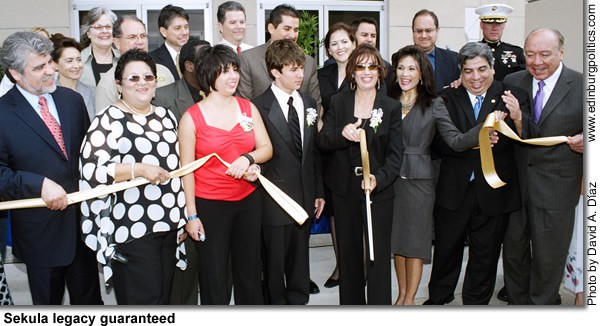
Elisa Guerra Sekula, featured front row, fourth from right, rejoices as she holds the ceremonial scissors she used to celebrate the grand opening on Friday, April 20, of the $3 million, 36,000-square-foot Dustin Michael Sekula Memorial Library, named in honor of her late son, an 18-year-old U.S. Marine who was the first Hidalgo County resident killed in action in Iraq. Among the scores of family members, dignitaries, and well-wishers that joined her for the event were, front row, from left: former Mayor Richard García; Librarian Leticia S. Leija; Dustin’s sister, Danielle; Dustin’s brother, Derek; Dustin’s mother, Elisa; Rep. Verónica Gonzáles; Rep. Aaron Peña; and Sen. Juan “Chuy” Hinojosa. Not shown is Dustin’s father, Daniel, and Mayor Joe Ochoa, who was absent because of a death in his family.
••••••
With passing of his brother, Mayor Ochoa loses his mentor and father-figure in life
By DAVID A. DÍAZ
As profound as the loss of a brother is to anyone, the death on Wednesday, April 18, of Alejandro Ochoa, Sr. of Edinburg marked a solemn day for his surviving brother, Mayor Joe Ochoa, who said he lost his mentor and father-figure as well.
Alejandro, 72, a life-long Edinburg resident and Korean War veteran who was wounded in the line of duty, would come back from overseas as a proud U.S. Marine to work with the City of Edinburg for more than three decades.
The former veteran, whose prayer services on Friday, April 20, prominently featured the flag of the U.S. Marine Corps, impacted the development of his community not only as a public servant, but also as a beloved and trusted advisor to his younger brother, Joe, who has been mayor for more than a decade.
“He worked for the City of Edinburg for 34 years, and we would always discuss different issues,” the mayor reflected Friday evening, after a rosary for his brother was concluded. “What always impressed me about him was that he was a very well-organized individual. He planned way ahead on things to come. A lot of my vision, my planning and organizational skills are skills that he instilled in me. I attribute a lot of my successes to him.”
In the mayor’s eyes, Alejandro was a man of humility who stood tall as a mountain.
“My brother was a very simple individual. He never asked anything of anyone. He served his country well as a Korean War veteran, where he was wounded,” Mayor Ochoa said. “He has always been that type of person.”
Alejandro, who along with his wife, Hilda, would successfully raise a wonderful family, also accepted the mantle of responsibility for his siblings after their own parents’ untimely deaths.
The mayor remembered that as a young man, their parents – who came from humble beginnings – both passed away, and Alejandro helped fill the devastating void that was left,
“Coming back from college, I was only able to enjoy my parents for two years after that, because they died when I was in my mid-20s,” Mayor Ochoa said. “He led me through some difficult times. He was my advisor, and then my father when my parents died when I was getting out of college. He was my mentor.”
Alejandro was generous with his time and his resources, even though the family had struggled financially as they were growing up.
“We didn’t have any money – my father was a laborer, my mother washed clothes and ironed for people,” Mayor Ochoa recalled. “One of the things I remembered was going off to the University of Texas and not having any money. Students didn’t get their loans and grants coming in until the middle of the school semester. He sent me money to be able to survive that first semester. That was my big brother.”
Several hundred people attended the Friday evening prayer service, including elected officials and community leaders.
As part of the eulogy, delivered by the mayor, Alejandro, true to form, had prepared in advance for the terrible day that was sure to come, taking care of all his affairs in order to reduce the trauma for his family, the mayor said.
Alejandro especially wanted to comfort his relatives and friends, instructing several months earlier that the following passage be read during his services:
“I know you’re sad and afraid, because I see your tears. I’ll not be far, I promise that and hope you’ll always know that my spirit will be close to you, wherever you may go.
“Thank you so for loving me, you know I love you too. That’s why it’s hard to say goodbye and end this life with you.
“So hold me now, just one more time and let me hear you say, because you care so much for me, you’ll let me go today.”
Alejandro entered into eternal rest on Wednesday, April 18, 2007, at Retama Manor Nursing Home in Edinburg. He was born July 17, 1934 in Hargill and lived all his life in Edinburg. He was preceded in death by his parents, Aniceto and Angélica Ochoa; a sister, Irene Ochoa; a brother, Aniceto Ochoa, Jr.; and his best friend, Óscar Ponce.
He is survived by his loving wife, Hilda; two sons, Alejandro Ochoa, Jr. (Rosalinda), Alberto Ochoa; a grandson, Alejandro Ochoa, III; and granddaughter, Carolina Ochoa; a brother, Mayor Joe Ochoa; a sister, Alicia O. (Fidel) Rodríguez; mother-in law, Esperanza R. Sáenz; and numerous nephews and nieces.
Alejandro was a loving husband, father, grandfather and a true friend to all. He took great pride in being a Marine and served his country during the Korean Conflict. After leaving the corp he went to work for the City of Edinburg and retired in 1991 after 34 years.
The family thanked the dedicated nurses, nursing assistants and the physical therapy staff of Retama Manor Nursing Home, Dr. Miguel Alemán and his staff for their care and concern shown to Alejandro and his family.
A very special thank you was extended to Mr. Miguel (Mike) Cruz, who helped care for Alejandro at home, in the hospital and at the nursing home for the last five months.
He was loved by many and will be greatly missed by all that knew him.
Visitation was held from 5 to 9 p.m. with a 7 p.m. rosary on Friday, April 20, 2007, at Memorial Funeral Home, 208 E. Canton in Edinburg. Funeral service was at 9 a.m. Saturday, April 21, 2007, at Sacred Heart Catholic Church in Edinburg. Interment followed at Hillcrest Memorial Park in Edinburg. Military honors were conducted by the U.S. Marines Corps.
Pallbearers were Jaime Rodríguez, Luis Rodríguez, Óscar Rodríguez, Ricky Rodríguez, Omar Ochoa and Carlos Ochoa.
Funeral services were under the direction of Memorial Funeral Home in Edinburg.
••••••
Despite being wounded, Dustin Sekula sacrificed life to save trapped Marines
“Although he was just barely 18 years old, he was as big a man as you will ever see.”
-Major John Terri, U.S. Marine Corps,
recalling Dustin Sekula’s heroism
By DAVID A. DÍAZ
Several hundred residents at the Friday, April 20 grand opening of the Dustin Michael Sekula Memorial Library found out, without a doubt, that the namesake of the $3 million, 36,000-square-foot learning center was a true American hero in every sense of that word.
The 18-year-old U.S. Marine from the three-time All-America City was killed in action on April 1, 2004. He was the first resident of Hidalgo County to be fatally wounded in combat in Iraq.
That sacrifice moved the Edinburg City Council, under the leadership of then-Mayor Richard García, to announce that a planned new city library would bear his name in his honor.
Few in South Texas knew the full details of his bravery, with official military statements revealing little, only that Sekula, a graduate of Edinburg North High School, “died due to injuries sustained from enemy fire in Al Anbar Province, Iraq.”
But with heavy cloud cover blocking out the sun during the Friday morning ceremonies, the true nature of Sekula’s courage came to light, bringing honor upon himself, his family, his hometown, his fellow Marines, and his beloved nation.
The day after he died, Sekula was bestowed with the Purple Heart, which is a military honor awarded in the name of the President to veterans who are killed or wounded in combat.
Heroism revealed
Three years after his death, the Marines announced that Sekula was also posthumously bestowed with the Navy-Marine Corps Commendation Medal with Combat V, a decoration signifying heroism.
Major John Terri, representing the U.S. Marine Corps, said that Sekula’s conduct under fire went beyond the call of duty.
“It was really determined that some extraordinary action on Dustin’s part took place, and it was determined that more honor should be bestowed upon this Marine,” Terri said. “I can tell you that on that night, on April 1, Dustin stood up. Although he was just barely 18 years old, he was as big a man as you will ever see. It’s important to Lisa that you know exactly what happened that night.”
Terri then read the official account of Sekula’s actions that led to his death, but that saved the lives of his brothers-in-arms.
According to the Summary of Action prepared by Sekula’s company commander:
At approximately 2200 hours on 1 April 2004, the 3rd section of the 81mm Mortar Platoon was on a combat patrol escorting an Explosive Ordnance Disposal (EOD) team to an enemy weapons cache south of the city of Kubaysah in the Eastern Al Anbar Province of Iraq.
Private First Class Sekula (he was posthumously promoted to Lance Corporal) was riding in an open high-back HMMWV as a member of the security element for this patrol. As the patrol reached the edge of the city, Anti-Coalition Forces (ACF) initiated an ambush with a volley of automatic weapons fire from a concealed machine gun position.
Private First Class Sekula’s HMMWV was to the left of the enemy firing position at a distance of approximately ten meters. The enemy was firing from a ditch that was not visible to the patrol due to low visibility and terrain.
Fought fearlessly
During the initial volley of enemy fire, Private First Class Sekula was struck in his right shoulder, and was knocked to the floor of the vehicle, temporarily incapacitated by the impact of the round.
Private First Class Sekula, determined to fight on, lifted himself to the edge of the vehicle and immediately returned a heavy volume of fire on the enemy while the driver attempted to move out of the kill zone.
Disregarding the proximity of his exposed position to the enemy machine gun and ignoring the pain of his own wounds, Private First Class Sekula continued to provide suppressive fire, which enabled the remainder of his squad to dismount, return fire, and managed to move the HMMWV to a position approximately thirty meters from the enemy firing position.
At this point, another volley of machine gun fire was directed at the vehicle. Realizing that his vehicle was still in the kill zone and his fellow Marines were not in a position to return fore on to the enemy position, Private First Class Sekula held firm, returning suppressive fire from his exposed position in the open cargo bed of the vehicle.
He continued to fight fearlessly. As he maintained suppressive fire on the enemy position, he was struck again, this time in the face and mortally wounded by enemy machine gun fire.
Because of his sustained suppressive fire, the Marines of the patrol were able to assault the machine gun position and force the enemy to break contact.
In disregarding his own wounds and maintaining fire on the enemy position, Private First Class Sekula paid the ultimate sacrifice so he could protect the men of his patrol and accomplish the mission they had been assigned.
His actions that night demonstrated, in the clearest focus, what is means to be a sturdy professional, and his actions have served as inspiration to all those around him.”
Sekula is survived by his immediate family, which includes his father, Daniel, his mother, Elisa, his brother, Derek, and his sister, Danielle.
(The Dustin Michael Sekula Memorial Library, located at 1906 South Closner, has all of the resources it offered at its now-former location at 401 East Cano, plus new services and features, such as teen programs, Wi-Fi Internet access, independent study rooms, a computer training room, a young adult reading area, and a children’s reading area. Residents may call the library at 383-6246 for more information.)
••••••
Library marks political and personal milestones for former Mayor García
By DAVID A. DÍAZ
As the solemn drama and joyful celebration surrounding the grand opening of the Dustin Michael Sekula Memorial Library played out on Friday, April 20, former Mayor Richard García – who spearheaded the construction and naming of the multi-million dollar complex – took the high road by being low-key about the role he played in bringing the dream into reality.
Normally, any public project that carries the price tag and emotional symbolism of the library, named after one of Edinburg’s fallen heroes from the war in Iraq, draws every political figure that had anything to do with it.
Sekula is a U.S. Marine who in April 2004 became the first Hidalgo County resident killed in action in the war in Iraq.
He is survived by his immediate family, which includes his father, Daniel, his mother, Elisa, his brother, Derek, and his sister, Danielle.
Then-mayor García and the Edinburg City Council had already planned to build a new library, but when the tragic news broke of Sekula’s death in combat, they announced their desire to name the facility in honor of the 18-year-old native son.
That vision came to fruition on April 22, when the grand opening ceremony opened the doors of one of South Texas’ latest advancements in education.
But in García’s case, the one-time U.S. Army veteran didn’t even ask to be among the dignitaries at the front podium who shared center stage with Sekula’s immediate family, state and local leaders.
Instead, García sat quietly among the seated audience, beaming with pride over the state-of-the-art public library, reflecting over the loss of Dustin Sekula’s life, and hoping that the addition of this learning resource will help countless residents make a better life for themselves.
“It is just fabulous to see what this developed into,” said García, who continues to serve the city as president of the five-member Edinburg Economic Development Corporation, which is the jobs-creation arm of the Edinburg City Council.
“I expected to see something great for the city, but it is beyond great,” he said of the $3 million, 36,000-square-foot, two-level building. “They did a beautiful job. I can’t get over the size.”
The aesthetics of the building’s architecture and furnishings notwithstanding, García said thee library is above all, an education resource for all.
“I think there is a lesson here. When I was growing up, this was a sleepy little village. A few of us received an education,” he said. “Many of the people I went to school didn’t go on to college because finances were a problem for all of us.”
But a public library breaks down the wall facing many working families who thirst for knowledge and education.
“In Spanish, we say, ‘querer es poder,’ which has a double meaning. It can mean desire is power, but it can also mean that ‘where there is a will, there is a way,’ García said.
“When they came to me and my city council with this need for a library in this city, that is the first thing that came to my mind: ‘querer es poder,'” he remembered. “We sat the city staff down, and even though there were budget considerations, I said, ‘Let’s find a way.’ I am thankful to them for all their work, because they did find a way, and we have this today. That is a lesson to be learned. It should guide our lives in the way we look at things.”
Although very pleased with this major achievement from his administration, García said he also had a lot of personal satisfaction invested in the former library, whose future use has not yet been determined by the city.
“I was remembering the former library, and I was just looking at my name up on the Founder’s Wall from the old library,” he reflected. “I guess I have lived a lifetime since we broke ground a year ago. I remember my wife (Peggy, who passed away in 2006) used to do puppet shows on Saturday mornings (at the old library) as a volunteer many years ago. My daughters used to hang out in the children’s wing.”
But life goes on, he acknowledged, and he views the new library as the hope and salvation of today’s young people and future generations to come, including his own family.
“I have gained a grandson since then, and maybe he will get a shot at doing the same thing, being an Edinburg resident,” García added. “And I am pleased about that, too, of course.”
••••••
Senate passes Sen. Hinojosa’s comprehensive reforms for Texas Youth Commission
By MELISSA DEL BOSQUE
After two years of comprehensive work on youth corrections reform, Sen. Juan ‘Chuy’ Hinojosa’s omnibus Texas Youth Commission reform bill, Senate Bill 103, was unanimously voted out of the Senate on Thursday, April 19.
The entire Senate was signed on as co-authors of the measure. It now goes to the Texas House of Representatives for action in that chamber.
“I want to thank the entire Senate and Lt. Gov. David Dewhurst for their assistance in getting this bill passed and for their input in this comprehensive legislation.” said Hinojosa. “We are rebuilding the Texas Youth Commission from the ground up so that we have a humane system for rehabilitating youth that is accountable to the people of Texas.”
Hinojosa and his staff began looking into the juvenile justice system two years ago when riots broke out at the Evins Regional Juvenile Center in Edinburg. Hinojosa pre-filed his comprehensive reform legislation and has continued to work with stakeholders since the TYC controversy erupted to rebuild the scandal-wracked commission.
Hinojosa’s bill calls for improved security by requiring TYC guards and other staff to undergo at least 300 hours of training before being assigned to guard duty; caps the guard-to-youth ratio at no more than 12 to 1 to maintain order and safety; and requires fingerprint and national criminal history checks for employees.
SB 103 also creates a Parents Bill of Rights to guarantee swift and accurate access to information about caseworkers’ duties and the agency’s grievance policies.
In addition, Hinojosa’s reforms call for the establishment of a panel within TYC to review sentencing guidelines bringing strict accountability to the process. His bill features structural improvements to TYC’s governing board and strengthens the agency’s emphasis on community rehabilitation instead of automatic incarceration.
The senator’s bill also provides for the creation of a criminal investigation unit to look into crimes committed by TYC youth, or against them by guards and other juvenile justice employees.
Hinojosa’s legislation ends the practice of housing 10- or 11-year-olds with 19- or 20-year-olds; creates an independent authority and law enforcement trained personnel from the Inspector General’s Office to ensure safety in TYC facilities; and authorizes child advocacy groups to visit facilities and work with youth.
“I look forward to working with the House now to pass comprehensive reforms for TYC,” Hinojosa said.
••••••
House approves giving retired teachers a one-time “13th check” in September to boost pension earnings
By ORLANDO SALINAS
and
DAVID A. DÍAZ
Thirteen could wind up being a lucky number for state lawmakers seeking reelection in 2008 if a bill that would give a one-time, extra monthly pension check in September to qualified retired teachers becomes law.
On Monday, April 16, the House of Representatives unanimously approved House Bill 1105 by Rep. Ruth McClendan, D-San Antonio, that would require the Teacher Retirement System to make a one-time supplemental payment, or “13th check,” to eligible TRS annuitants no later than September of 2007, according to the House Research Organization.
This additional payment would be equal to the amount of the annuitant’s August 2007 gross annuity payment and subject to all applicable tax withholding and other required deductions, the HRO noted.
The House Research Organization is a non-partisan team of lawyers and researchers, funded by the House of Representatives, that provides detailed background on all major legislation considered by the full House.
While McClendan is the main author of the legislation, Rep. Aaron Peña, D-Edinburg, was one of five joint authors of the measure, which must still still be approved by the Senate and Gov. Rick Perry.
The rest of the Valley state representatives also were listed as co-authors of HB 1105.
“Providing a benefit increased to our retired teachers is long over due,” said Peña. “At the beginning of session I made a promise to local retirees that we would get something done. This bill allows us to provide some immediate relief to our retired teachers while laying the foundation for a permanent annuity increase.”
A week earlier, the House of Representatives approved their version of the state budget that included funding to cover the cost of HB 1105.
The bill increases the state’s contribution to the TRS Pension Fund from the current constitutionally mandated minimum of 6 percent to 6.7 percent. That increase will allow the pension system to amortize its liabilities over 31 years. State fiscal policy does not allow the Teacher Retirement System to increase benefits unless the fund is deemed actuarially sound.
“We will require TRS to cut a 13th check for our current retirees,” said Peña. “For too long these Texans have lived on fixed incomes while inflation has far outpaced any recent cost of living adjustments. I am proud that the Texas House is trying to fulfill our commitment to the men and women in communities all across the state who dedicated their lives to educating our children.”.”
The Texas Constitution, Art. 16, sec. 67(b)(3) requires that the state contribution to state retirement systems, including the Teacher Retirement System (TRS) pension fund, be at least 6 percent and no more than 10 percent of payroll. These constitutional limits are established in statute in Government Code, sec. 825.404(a).
The current statutory state contribution rate to the TRS pension fund is 6 percent of payroll. Government Code, sec. 811.006 prohibits the Legislature from granting benefit increases to retirees unless the pension fund is considered “actuarially sound,” meaning that the pension system is able to amortize all of its liabilities over 31 years.
••••••
Sen. Lucio appointed vice chair of Texas Legislative Tourism Caucus
By DORIS SÁNCHEZ
The South Texas enator who represents one of the areas with the highest tourism rates, Sen. Eddie Lucio, Jr., was recently named Vice Chair of the Legislative Tourism Caucus for 2007-08.
Rep. Lois Kolkhorst from Brenham is the new Chair of this 80-member body dedicated to maintaining and expanding the state’s travel and tourism industry. Lucio has served two consecutive terms on the Board of Directors. He is Chair of the Senate International Relations and Trade Committee and serves on the Committees on Business and Commerce, Finance, State Affairs, and the Subcommittee on Emerging Technologies & Economic Development.
Rep. Tony Goolsby, R-Dallas, will serve as Secretary and Sen. Bob Deuell, R-Greenville, as Treasurer. Members of the newly elected Board of Directors include: Rep. Alma Allen, R-Houston; Sen. Kim Brimer, R-Fort Worth; Rep. Betty Brown, R-Terrell; Rep. Pete Gallego, D-Alpine; Rep. Harvey Hilderbran, R-Kerrville; Rep. Bryan Hughes, R-Mineola; Rep. Tracy King, R-Batesville;, Sen. Kel Seliger (Amarillo), Rep. Vicki Truitt, R-Southlake; and Sen. Judith Zaffirini, D-Laredo.
“I consider this appointment extremely important, especially to my district where thousands of tourists annually visit South Padre Island and the surrounding area, including a constant flow of visitors from Mexico,” said Lucio. “Tourism generates jobs and spurs both our local and state economies.”
The Economic Development and Tourism Division in the Office of the Governor reported that Cameron County hosts an estimated two million domestic visitors annually, and in 2005 they contributed more than $625 million to the local economy through visitor spending. This spending supports nearly 8,000 tourism industry jobs with wages totaling around $135 million. Visitor spending also generates approximately $34 million in state tax receipts and $13 million in local tax receipts.
Most of these visitors vacation in South Padre Island and many also cross the border into Mexico for a day. Conversely, Mexican visitors’ expenditures along the U.S.-Mexico border reportedly generate $9 billion in sales annually.
“It will be my goal to ensure that Texas continues to expand its travel and tourism opportunities so that people from throughout the country, the world and our own Texas residents can enjoy our marvels, attractions and hospitality, and so that we can benefit economically from this great industry,” added Lucio.
Tourism is a $49 billion industry for the state, and visitor spending in the state directly supports more than 500,000 jobs.
The Texas Gulf Coast region alone draws millions of visitors, stretching 350 miles from South Padre Island and the Rio Grande Valley, all the way to Beaumont and the Louisiana border. In 2006, South Padre Island was named by the National Geographic Adventure Magazine as one of the top 10 nationwide Trips with a Splash for 2006. South Padre Island was selected for its exceptional water sports, and even received recognition on ABC’s “Good Morning America” show.
“Tourism has long been recognized as a strong economic development generator of revenue and jobs for the Texas economy,” noted Lucio. “I am proud to be a part of the Tourism Caucus to help promote this industry for the benefit of Texas.”
••••••
Sen. Hinojosa pushing for new state holiday honoring Hispanic icon Dr. Héctor P. García
By DAVID A. DIAZ
The late Dr. Héctor Pérez García of Corpus Christi, a Texas political giant and civil rights champion whose distinguished life included time spent in Edinburg and Hidalgo County, could have a new state holiday named in his honor if a bill by Sen. Juan “Chuy” Hinojosa, D-McAllen, is approved by the Texas Legislature.
Senate Bill 1805, which was approved by the Texas Senate on Thursday, April 20, would designate the third Wednesday of September – which also falls in the middle of National Hispanic Heritage Week – as Dr. Héctor Pérez García Day in memory of his significant contributions to the Mexican American civil rights movement.
The holiday wouldn’t involve any day-off for government employees or public schools, but it would require that “Dr. Héctor Pérez García Day” would be “regularly observed by appropriate ceremonies and activities in the public schools and other places to properly commemorate the importance of the contributions made by the longtime South Texas leader,” according to Hinojosa.
It also would be the second state holiday designated in honor of an Hispanic. In 1999, legislation filed by Sen. Carlos Truan, D-Corpus Christi, was approved designating March 31 as “César Chávez Day” in Texas.
“This bill would incorporate into the state academic curriculum lessons learned from Dr. García’s efforts on behalf of civil rights and veteran causes,” said Hinojosa, himself a U.S. Marines combat squad leader in Vietnam. “That day would committed to teaching the lessons of Dr. Hector P. García.”
García was born in Llera, Tamaulipas, Mexico, according to archives, and his parents and family fled with him to escape the Mexican Revolution in 1917, immigrating to Mercedes. He attended Edinburg Junior College as a young man, hitchhiking 30 miles daily. He would go on to attend the University of Texas at Austin.
An identical measure – House Bill 3535 by Rep. Juan García, D-Corpus Christi (no relation to Dr. García) – was heard in a public hearing on Monday, April 17, before the House Culture, Recreation and Tourism Committee.
Rep. Juan Escobar, D-Kingsville/Willacy County, is a joint author of HB 3535, while two other Valley state representatives – Armando “Mando” Martínez, D-Weslaco, and Rep. Eddie Lucio, III, D-San Benito – are co-authors of HB 3535.
“Dr. García left an undeniable impact on Texas, the nation, and the world,” said Hinjosa. “His service and accomplishments in life were many and included some of the most memorable occasions in recent Texas history.”
In 1948, García founded the American GI Forum, aimed at giving Hispanic veterans equal access to the education, job training, and home loans promised by the GI Bill of Rights, Hinojosa noted.
García, whose passing in 1996 left a remarkable legacy, was a physician/surgeon, Army veteran who served in World War II, a civil rights champion, and a recipient of the Presidential Medal of Freedom, among his many achievements.
But he was most famous for the role he took in the first major political stance taken by his GI Forum, when a Mexican American soldier who was killed in action was refused a burial site in Three Rivers because it was reserved for Anglos.
“Dr. García made national headlines with the group’s first big fight, which came after the family of a Hispanic World War II veteran killed in the Philippines was turned away at a Three Rivers funeral home and told to bury him in a segregated cemetery for Hispanics,” Hinojosa recalled. “The doctor contacted state and federal lawmakers and eventually secured a full military burial for the veteran, Private Félix Longoria, in Arlington National Cemetery.”
The event made the cover of the New York Times and marked the launch of the American GI Forum as a civil rights organization, according to a Senate committee bill analysis of the proposed holiday.
From then until his death in 1996, García fought for Mexican-American rights, both locally as a respected doctor and in the national arena, the bill analysis noted.
García was an alternate ambassador to the United Nations, the first Mexican-American to serve on the U.S. Commission on Civil Rights, and a recipient of the nation’s highest civilian honor when he received the Presidential Medal of Freedom in 1984.
Throughout his distinguished career, García was awarded multiple accolades from various governments and other organizations. They include:
?The U.S. Army’s Bronze Star and six battle stars, 1942-1946;
?The American G.I. Forum’s Medalla al Merito, 1952, for his work with Mexican American
veterans;
?The Republic of Panama’s Condecoracion, Orden Vasco Nunez de Balboa, with the rank of
commander, 1965;
?The 8th United States Marine Corps District honored him with a plaque in recognition of
his service to the war deceased, 1967;
?A humanitarian award from the National Association for the Advancement of Colored People’s
Corpus Christi chapter, 1969;
?The Distinguished Service Award from the National Office of Civil Rights, 1980;
?The Presidential Medal of Freedom, 1984;
?Honor Al Merito Medalla Cura Jose Maria Morelos y Pavon A.D.P.E., Mexico City, México.
?Corpus Christi Human Relations Commission’s Community Service Award, 1987;
?The Coalition of Hispanic Health and Human Services Organization’s Humanitarian
Award, 1988;
?The National Hispanic Leadership Conference’s Hispanic Heritage Award, 1989;
?The Midwest/Northeast Voter Registration Project’s National Hispanic Hero Award, 1989;
?MAPA Award for outstanding service to Hispanics from the Mexican American
Physicians’ Association, 1990;
?The National Association of Hispanic Journalists’ Distinguished Lifetime Service Award,
1990;
?The Equestrian Order of Pope Gregory the Great from Pope John Paul II, 1990; and
?Corpus Christi State University’s first honorary doctorate of Humane Letters, 1991.
••••••
Senate passes Sen. Zaffirini’s measure to improve the Community Living Options Process
By NICK ALMANZA
The Texas Senate on Thursday, April 19, passed the committee substitute for Senate Bill 1870 by Sen. Judith Zaffirini, D-Laredo, which would require the Department of Aging and Disability Services (DADS) to contract with local mental retardation authorities (MRA) to implement the community living options process (CLOP) for adults residing in Texas state schools.
The bill would ensure the integrity of the process by requiring that it be conducted free of conflicts of interest so it provides maximum benefits for persons with intellectual disabilities who reside in state facilities.
Current law perpetuates a conflict of interest by allowing state school personnel to administer the CLOP to residents aged 22 or older. The CLOP was created to inform persons with intellectual disabilities and related conditions and their legally authorized representatives about alternative community living options.
“This bill ensures that adults with disabilities who are residents of state schools receive complete information regarding their community living options,” Zaffirini said. “As legislators we have an obligation to improve and enhance the quality of life for persons who have developmental disabilities. Providing comprehensive information for them and their families is essential to meet this goal, and I am proud to sponsor this legislation.”
In 2006 the U.S. Department of Justice (DOJ) investigated the Lubbock State School and found that Texas fails to provide community services to persons who reasonably can be accommodated, and, contrary to the Americans with Disabilities Act of 1990, that interdisciplinary teams appear to endorse and promote the retention of persons in state institutions.
CSSB 1870 would enable DADS to respond to DOJ by requiring DADS to contract with local MRAs to develop a more effective community living options information process. What’s more, the bill would eliminate the conflict of interest created when state school personnel are responsible for informing residents of their community living options.
The bill must be passed by the House of Representative before it can be sent to Gov. Rick Perry for final approval.
••••••
Texas House approves bill that would help save fuel taxes for Edinburg fire department fire trucks
By ORLANDO SALINAS
Volunteer fire departments all across the state, including Edinburg’s fire department, would be exempt from paying gasoline and diesel taxes if actions by the Texas House become law.
State Rep. Aaron Peña, D-Edinburg, is one of five joint authors of HB 685 which would give volunteer fire departments an opportunity to receive a state tax rebate for gasoline and diesel purchased for official firefighting business.
“Volunteer fire departments provide critical emergency services to almost every community in my legislative district,” said Peña. “These brave men and women donate their time and sometimes their own resources to operate and maintain these departments. This sales tax rebate will allow these departments to provide more essential services to our communities.”
The state tax on gasoline and diesel fuel is 20 cents per gallon. Volunteer fire departments will be eligible to apply for a rebate with the State Comptroller of Pubic Accounts for fuel purchased for fire department business. The bill precludes volunteer fire fighters from using the rebate for their own personal vehicles.
The cost of fueling emergency service vehicles and fire trucks constitutes a large portion of a volunteer fire department’s budget. These departments usually receive some funding from a local government or a local emergency service district. Many departments supplement their budgets with grants, private donations, and fundraisers.
“These fire engines and heavy duty emergency service vehicles aren’t known for their fuel economy,” said Representative Peña. “As fuel prices continue to rise it is appropriate that the state provide some help to these departments that serve the public good.”
HB 685 is now headed to the Senate.
David A. Diaz contributed to this report.
••••••
Senate approves bill by Sen. Hinojosa, Sen. Lucio to create mechanism to help cities obtain water rights
By MELISSA DEL BOSQUE
Sen. Juan “Chuy” Hinojosa, D-McAllen, and Sen. Eddie Lucio, D-Brownsville, passed Senate Bill 847 on Thursday, April 20, to create a mechanism for transferring water rights for municipalities.
Currently, there is no existing law providing a fair mechanism for the transfer of irrigated water rights to municipal water rights in the Lower Rio Grande region, according to a bill analysis of the measure. A process needs to be established for the subdivision of urban non-agricultural land on water rights in certain counties, including Willacy, Cameron, and Hidalgo counties.
SB 847 authorizes irrigation water rights owned by water districts, other than a drainage district, in the Lower Rio Grande region that cover counties adjacent to Mexico and the Gulf of Mexico or adjacent to such a county to be converted from irrigation water rights to municipal water rights for use by municipal suppliers in the region and details the conversion process in a uniform manner for the Lower Rio Grande region.
“For many years there has been much debate over how to transfer irrigation water rights to municipalities,” Hinojosa said. “We are one of the fastest growing areas in the country and water has become the top issue of concern for our region. This bill helps address some of the issues we have been grappling with regarding the prices and processes for the conversion of water rights.”
Lucio, Jr. is co-author of SB 847.
“I commend my colleague, Sen. Hinojosa, for spearheading this bill which will shape the future of South Texas when it comes to water rights,” Lucio. “It was a pleasure working alongside Sen. Hinojosa in bringing together the coalition that has helped us solve major water rights problems for the entire region.”
SB 847 is the result of 18 months of negotiation from stakeholders representing the irrigation districts and the municipalities.
“This bill is the product of a lot of hard work and negotiations from all of the parties involved,” Hinojosa said.
An identical bill is being carried in the House of Representatives by Rep. Verónica Gonzáles, D-McAllen. That measure, called a companion bill, is House Bill 1803, which was approved by the House Natural Resources Committee on Wednesday, April 11.
••••••
Reforming Windstorm Insurance
By REP. JUAN GARCÍA
D-Corpus Christi
Despite being promised that the 2003 changes in insurance law would provide relief, Texas homeowners continue to pay the highest premiums in America.
Windstorm insurance rates in Texas are twice the national average. Responsible home and business owners know they need an insurance policy, but they’re forced to assume more and more of the risk through higher deductibles, caps on replacement costs, and fights over payouts. Along the coast, companies are refusing to renew tens of thousands of property policies. It’s no coincidence that “Home For Sale” signs increasingly dot the Coastal Bend as many families simply can’t keep up.
What steps is the Texas Legislature considering to address this crisis?
One proposal calls for changing the State Insurance Commissioner from a gubernatorially-appointed position, as it is now, to an elected one, as twelve other states do. The idea is that if the commissioner were directly accountable to voters every four years, he or she would be much more responsive to consumers, and help end the “revolving door” between the office and the corporate boards of large insurance companies. Opponents contend that this would only invite those same large insurance interests to “buy” their candidate with exorbitant campaign contributions. However, Texas voters already select the state’s agriculture commissioner, the state’s chief tax collector, and the railroad commissioners (overseers of the oil and gas industry).
Another measure addresses policy-owner frustration over a spike in their premium anytime they actually make a claim. The bill would guarantee that homeowners would not be penalized for making their first claim by prohibiting insurance companies from increasing premiums until after a second claim during a given three-year period. Policy-holders should not be punished for making legitimate claims on a policy they have faithfully made monthly payments on for years.
Still another idea being debated is an attempt to stem the flow of insurers willing to write windstorm policies in the so-called “Tier 1” areas (the coastal counties). The measure would end “cherry-picking” and provide an incentive for companies to stay in the area by prohibiting them from writing homeowners insurance anywhere in Texas for five years after they quit writing such policies along the coast. The legislation would not apply retroactively, so companies that have already left would be welcomed back, and hopefully those considering leaving, after weighing the loss of the entire Texas market, would think twice.
A final initiative would address the shortfalls of the Texas Windstorm Insurance Association (TWIA), the last resort for citizens when coverage is not available. The TWIA, or the ‘Pool’ as it is commonly referred to, has over the years been allowed to slip into disrepair, with assets equaling only a tenth of exposure. Fixing it will require accepting as a premise that when a major hurricane comes, the damage will not be just a coastal disaster, but will have a severe impact on the entire state (residents of northern Mississippi and northern Louisiana learned this when foodstuffs, petrol, and manufacturing goods couldn’t get in or out of devastated ports after Katrina). The measure calls for an additional fee on premiums statewide, either pre or post-event, to be used in the bond market to fill the gap in the Pool’s mismanaged resources.
Statistics indicate that the “Big Storm” striking the Coastal Bend is not a question of ‘if’, but a question of ‘when’. Hurricane Season is just a few months away. Finding the right formula of measures is critical for this legislative session.
Rep Juan Garcia represents Calhoun, Aransas, San Patricio, and parts of Nueces Counties.
••••••
Senate approves measure by Sen. Zaffirini to modify repayment portion of “B-On-Time” Loan Program
By NICK ALMANZA
The Texas Senate on Wednesday, April 18, passed Senate Bill 1496 by Sen. Judith Zaffirini, D-Laredo, which would amend the loan forgiveness provision of the Texas B-On-Time Loan Program to allow students who are graduated within five years from an eligible four-year institution with at least a 2.5 grade point average (GPA) to have 50 percent of their loans forgiven.
SB 1496 builds upon the success of SB 4 (2003) by Zaffirini, which created the B-On-Time Loan Program. It provides Texas students with a zero-interest higher education loan and requires them to be graduated with a 3.0 GPA within four years for a four-year degree or within five years for a five-year degree to have 100 percent of their loans forgiven.
“This legislation is a priority of Lt. Gov. David Dewhurst,” Zaffirini said. “The bill would promote timely graduation, ease the cost of higher learning and increase higher education access.”
SB 1496 would encourage students to complete their degrees timely and make the requirements for loan forgiveness less stringent. Its purpose is to increase student participation.
Several universities and community colleges throughout the state reported recently that work-study and low-income students seldom take out student loans. These students, many of whom must work, claim the loan forgiveness criteria of B-On-Time are difficult to satisfy. SB 1496 would enhance higher education access and affordability by modifying the B-On-Time program to make loans more appealing to students.
“I truly am delighted this bill was passed by the Senate, and I appreciate especially the leadership of Lt. Gov. Dewhurst in including the B-On-Time loan program among his higher education priorities,” Zaffirini said. “We created B-On-Time to make college more affordable and to encourage students to be graduated timely.”
The bill must be passed by the House of Representative before it can be sent to Governor Rick Perry for final approval.
••••••
CVS/pharmacy cited by Attorney General Abbott for allegedly exposing hundreds of customer records
Texas Attorney General Greg Abbott took legal action on Tuesday, April 17, against CVS/pharmacy for allegedly exposing its customers to identity theft.
According to court documents filed by the Attorney General, CVS violated a 2005 law requiring businesses to protect any customer records that contain sensitive customer information, including credit and debit card numbers.
Investigators with the Office of the Attorney General (OAG) discovered that a CVS store in Liberty, near Houston, exposed hundreds of its customers to identity theft by failing to properly dispose of records that contained sensitive information. The investigation was launched after reports indicated that bulk customer records were tossed in a dumpster behind the store. Investigators also found several medical prescription forms that included each customer’s name, address, date of birth, issuing physician and the types of medication prescribed. The documents obtained by OAG investigators also contained hundreds of active debit and credit card numbers, complete with expiration dates.
“Identity theft is one of the fastest growing crimes in the United States,” Attorney General Abbott said. “Texas law protects sensitive personal information in order to prevent this widespread crime. Texans can rest assured that we will continue aggressively cracking down on vendors who jeopardize the confidentiality of their clients’ sensitive information.”
CVS is accused of violating the 2005 Identity Theft Enforcement and Protection Act, which requires businesses to protect and properly dispose of documents that include clients’ sensitive personal information. Under the law, the OAG has the authority to seek penalties of up to $50,000 per violation.
The Attorney General also charged CVS with violating Chapter 35 of the Business and Commerce Code, which requires businesses to develop retention and disposal procedures for their clients’ personal information. The law provides for civil penalties of up to $500 for each abandoned record.
Attorney General investigators are also working to determine if any exposed data has been used illegally. Consumers who interacted with CVS’ Liberty location should carefully monitor their bank, credit card and any similar statements for evidence of suspicious activity. Customers should also consider obtaining free copies of their credit reports.
Consumers who wish to file a complaint may contact the Office of the Attorney General at (800) 252-8011 or file a complaint online at http://www.oag.state.tx.us. Consumers can also obtain information on how to detect and prevent identity theft.
The April 17 legal action against CVS is the fourth identity theft enforcement action by the Office of the Attorney General in recent weeks. On April 2, Attorney General Abbott took legal action against Fort-Worth based RadioShack Corporation after a Corpus Christi-area store improperly dumped several boxes of receipts that contained customer-identifying information.
On March 14, the Attorney General took legal action against Jones Beauty College in Dallas for improperly discarding student financial aid forms with Social Security numbers and other personal information. Also in March, Attorney General Abbott took legal action against On Track Modeling, a North Carolina-based talent agency that abruptly shut down its Grand Prairie office and abandoned more than 60 boxes containing hundreds of confidential client records.
••••••
Senate approves Sen. Lucio’s bill to create address confidentiality program to protect crime victims
By DORIS SÁNCHEZ
Sen. Eddie Lucio, Jr. announced the Senate has approved his bill that would create an address confidentiality program to assist eligible victims of family violence, sexual assault or stalking.
Currently, an address confidentiality program does not exist for victims of family violence in Texas. According to the Texas Council of Family Violence, 143 women died in 2005 as a result of domestic violence, some of which might have been avoided if the addresses of family violence victims had been kept confidential.
In cases of family violence, the violence often escalates when victims leave the relationship and seek a new address.
Without the existence of such a program, many victims of family violence do not obtain a driver’s license or register to vote, for fear of making their address open to the public. There is an increasing need for address confidentiality for victims of family violence due to the public’s increased accessibility to personal information.
The purpose of an address confidentiality program would be to protect the identity of victims of family violence, sexual assault, and stalking through the establishment of a confidential mailing address. Such programs protect these victims by allowing them to conceal their whereabouts so their assailants cannot locate them.
Lucio’s Senate Bill 74, which was approved by the Senate on Thursday, April 12, would direct the Attorney General to establish the program by designating a substitute post office box address that a victim of these crimes can use in lieu of a physical address.
“There is currently no mechanism in Texas designed to help victims of family violence, sexual assault or stalking from keeping their locations confidential to protect them from their assailants,” said Lucio. “This program affords such protection.”
These particular crimes are intrusive to the victims because of the ongoing threat that those who harmed or stalked them can still locate them. “I think about the address confidentiality program as something which could have saved my grandmother’s life if it had been available to her,” said Donna Bloom of the Texas Advocacy Project, who testified in support of SB 74 and whose grandmother was killed in her home by her grandfather after she had ended the relationship.
Lucio added, “Often, victims of these crimes remain in danger even if they move, so if we can create a safety net for them through this program, then perhaps we can protect more lives.”
The bill must now be considered in the House.
Rep. Verónica Gonzáles. D-McAllen, is carrying an identical measure – House Bill 569 – which was approved by the House State Affairs Committee on Thursday, April 4.
Gonzáles is the primary author of HB 569, while Rep. Armando “Mando” Martínez, D-Weslaco, Rep. Eddie Lucio, III, D-San Benito, and Rep. Juan Escobar, D-Kingsville/Willacy County, are joint authors of the Gonzales measure.
••••••
Rep. Martínez appointed to Health Committee of the National Conference of State Legislatures
By SCOTT JENKINES
Rep. Armando “Mando” Martínez, D-Weslaco, on Wednesday, April 18, was appointed by House Speaker Tom Craddick, R-Midland, to serve on the Health Committee of the National Conference of State Legislatures.
The National Conference of State Legislatures’ (NCSL) “Strong States, Strong Nation” 2007 annual meeting on August 5-9 in Boston, Massachusetts is expected to draw more than 7,000 attendees, including state legislators, legislative staff and private sector representatives.
“It is an honor to have been appointed to serve on the Health Committee of the National Conference of State Legislatures,” Martínez said. “I feel the issues facing this committee directly affect us all no matter where we reside, we are all affected. I am proud to be serving this federal responsibility to this extent.”
Martínez said the National Conference of State legislators will have the opportunity to share ideas and learn from experts about how to build and maintain strong state governments. The annual conference provides several forums to discuss legislation on various specific public policy issues including: higher education, civic education, health care and state economies.
“Knowledge and accessibility to health care is not only an issue affecting my district, but one that affects all Americans,” Martínez observed. “It is my hope that I, along with my fellow colleagues, will be able to compare and share innovative public policy on health care, so that all children and adults will have an opportunity to access quality and affordable health care.
by Legislative Media | Apr 16, 2007 | Politics

Mission Mayor Norberto Salinas, who also serves on the Texas Border Coalition, on Friday, April 13, helped honor law enforcement officers and firefighters in his hometown during the city’s Second Annual Law Enforcement and Firefighters Appreciation Day, sponsored by the Mission Housing Authority. Featured in this photo at the event with the mayor, whose work with TBC includes efforts to improve homeland security and economic growth for the border region, are, from left: Romeo de la Garza, MHA board member; his wife, Norma de la Garza; José Garza, Chairman of the Board of the Mission Housing Authority; the mayor; Rolando Pérez of Edinburg, owner of Keys and Hardware; and Joel González, executive director of the Mission Housing Authority. For more information on the Texas Border Coalition, see story later in this posting.
••••••

Eddie Aldrete, Senior Vice President for International Bank of Commerce in Laredo, focuses on major immigration issues of importance to the Texas Border Coalition during a recent TBC legislative strategy session in Austin. TBC, an alliance of elected leaders and economic development officials from the Texas border region, is supporting legislation in Austin that could help stem the flow of undocumented immigration and help the border and state economies. See story later in this posting.
••••••

Aerospace giant Lockheed Martin on Tuesday, April 10, donated 50 computers to the Hidalgo County government to help train county employees in the use of software that will improve their work production and help serve more residents. On hand for the dedication were, from left: Mike Robledo, Hidalgo County Information Systems Administrator; JD Salinas, Hidalgo County Judge; Steve Hawkins, Lockheed Martin; Rusty Boone, Lockheed Martin; Renan Ramírez, Hidalgo County Chief Information Officer. See story later in this posting.
••••••

Edinburg Mayor Joe Ochoa, featured center, joined Bob and Janet Vackar, featured to his left, and other dignitaries on Tuesday, April 10, for the groundbreaking of a new, multi-million dollar Fiesta Chevrolet dealership that is being built along U.S. Expressway 281 near Trenton Road in east Edinburg. Up to 150 people will eventually be employed at the facility, which is set to open for business on July 1. City leaders predict other major businesses will soon locate along that stretch of prime real estate as part of the continuing economic boom in Edinburg. See story later in this posting.
••••••
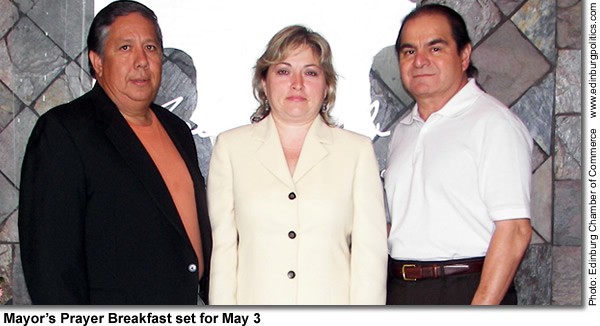
Mayor Joe Ochoa and the City of Edinburg proclaimed Thursday, May 3, as National Day of Prayer (NDP). As part of the NDP, the Edinburg Chamber of Commerce is inviting the community to join the mayor for a prayer breakfast to be held at The Social Club, located on 205 Conquest Blvd in Edinburg. The event begins at 7 a.m. The cost to attend is $10 and includes breakfast along with a chorale, invocation, the presentation of colors, and other custom activities that take place on this special day. The intention of the National Day of Prayer is to have a day where members of all faiths can pray together. In 1952, a bill unanimously passed by both houses of congress proclaiming an annual National Day of Prayer. President Truman signed the bill into law. The bill required the President to select a day for national prayer each year; and in 1988, a bill was introduced to Congress which fixed the annual National Day of Prayer as the first Thursday in May; and on May 05, 1988, the bill was signed into law by President Reagan. “We are very lucky to have the freedoms to celebrate such an important proclamation” said Ochoa. More information is available through the Edinburg Chamber of Commerce at 956/383-4974.
••••••
Bert Ogden RGV breaks ground for Fiesta Chevrolet in east Edinburg
By DAVID A. DÍAZ
Bert Ogden Rio Grande Valley, one of the premier vehicle dealerships in the nation, on Tuesday, April 10, broke ground along the U.S. Expressway 281 frontage road in east Edinburg for its latest addition – Fiesta Chevrolet, a multi-million dollar facility that will showcase, sell, and service the American-made passenger vehicles.
The complex, located immediately north of the U.S. Border Patrol Headquarters near the intersection of Trenton Road and U.S. Expressway 281, is the first phase of development on the 17-acre tract of land, which was purchased by the Valleywide dealership, which has deep roots in the three-time All-America City.
Fiesta Chevrolet will employ up to 150 people, and represent an investment of $2.5 million, company leaders confirmed. It will occupy about six acres of the site, which is currently vacant.
The late Bert Ogden of Edinburg opened his first car dealership more than a generation ago, and his vision – following his and his wife’s untimely passing 15 years ago – was proudly carried on by their son-in-law and daughter, Bob and Janet Vackar, said Richard García, president of the Edinburg Economic Development Corporation board of directors.
The EEDC is the jobs-creation arm of the Edinburg City Council.
In addition to García, the EEDC governing board includes Mayor Joe Ochoa, Fred Palacios, Mike Govind, and George Bennack.
“From those local beginnings, the Ogden/Vackar families have become a major economic force and employer in deep South Texas, with state-of-the-art facilities in McAllen, Mission, Harlingen and Edinburg – which will now open this latest complex as early as July 1,” added García.
Ochoa, who was one of dozens of company officials and local dignitaries on hand for the Tuesday morning ground breaking ceremony, said the east Edinburg site will be a major boon for that part of the community.
“The vision always has been to improve the development of infrastructure in these areas because we knew they would be huge attractions for commercial development, and this is exactly what is transpiring,” Ochoa said. “It will bring opportunities for the expansion of Trenton Road to the east side, and be able to connect to the feeder of I-Road. This is one of the first businesses that will be going up in this area, and we look forward to seeing many, many more.”
Bob Vackar, who serves as CEO for the Bert Ogden dealerships, shared the bright economic forecasts of the city leaders.
“We are sitting right here on the bypass of U.S. 281, which will be Interstate Highway 69 in the future,” Vackar said. “You have to be proud of Edinburg and what has been been going on in the last 10 years.”
He said Fiesta Chevrolet will carry the honored tradition not only of the Odgen/Vackar families, but also of Roberts Chevrolet, which was purchased by Bert Ogden Rio Grande Valley.
“We acquired Roberts Chevrolet, which has now been renamed Fiesta Chevrolet, and we are building it on this six-acre site here,” he said. “We are looking to take this facility to about 100 new Chevrolets a month, 50 to 60 used cars, maybe 200 retail units a month. By the end of 2008, we will have to move the Bert Ogden Buick/Pontiac/GMC out here (from its current location at Trenton and Business 281). We will have a major facility here with six acres reserved for any future dealerships or future development.”
The former Roberts Chevrolet, located north of the downtown square, was bought in March by Hidalgo County for $5.7 million. The former Roberts Chevrolet will become the site of the county courthouse’s new parking lot by next fall.
Meanwhile, when Bert Ogden Buick/Pontiac/GMC comes online at the new location, Vackar said the company will have invested about $7 to $8 million on the two dealerships.
“We are looking at a 32,000-square-foot facility, with a parts department, a service department, and a showroom (for Fiesta Chevrolet). When we build the Buick/Pontiac/GMC dealership, Fiesta
Chevrolet will feature a Chevrolet showroom only, and they will share the service facility,” Vackar added.
As for the current Buick/Pontiac/GMC complex in Edinburg, Vackar said the latest plans call for it to eventually be transformed into a Mazda dealership.
Initially, Bert Ogden RGV officials were considering relocating its existing Edinburg dealership to the new site, but once news broke of an $80 million shopping center to be built near the current facility, their plans changed for the better.
“Unbeknown to us, when we first bought this property, we wanted to make a move (from its current Edinburg location). But now that there will be a new mall, there is going to be a retail boom in the area,” he said. “There is going to be a lot of traffic coming into Edinburg.”
That renovation of its existing dealership will occur as the planned Shoppes at Rio Grande Valley begins to materialize.
“We will bring the General Motors products over here, and when the shopping center comes in, we will build a new Mazda dealership,” he said. “We will tear down the north end of the current structure down, and we will build a new Mazda Revolution architecture.”
••••••
Sen. Juan “Chuy” Hinojosa secures $49.2 million for Regional DPS Facility
By MELISSA DEL BOSQUE
Sen. Juan “Chuy” Hinojosa, D-McAllen, on Wednesday, April 11, announced that he has succeeded in securing $49.2 million in the Senate budget bill for a new DPS regional office to be located in Hidalgo County.
The facility will help accommodate the growth in the region and give DPS officers a new crime lab and an expansion of office and storage space, Hinojosa said, as well as enough resources for necessary construction of new buildings.
“Our DPS officers are working hard to deal with rapid growth in a region that faces such serious challenges as the prevention of drug smuggling and ensuring public safety,” Hinojosa said. “Officers covering the 13 counties along our section of the border are long overdue for a facility that can accommodate the growing number of employees we have at the regional office.”
Senate Bill 1, the appropriations bill for the Senate, passed out of the Senate Finance Committee on Tuesday, April 9. Hinojosa is a member of the committee.
“My fellow senators realize that the border region is one of the fastest growing regions in the nation,” said Hinojosa. “South Texans appreciate their cooperation with me to secure the funding for this important facility.”
The $49.2 million will be financed through General Obligation bonds and general revenue.
Rep. Aaron Peña, D-Edinburg, said he would work with House members to secure matching funds for the DPS complex.
“South Texas is the fastest growing region in the state,” said Peña. “The Department of Public Safety must keep up with that growth. We have some unique border security issues that troopers don’t see in other parts of the state and we need to ensure that we provide them the resources they need to keep doing their outstanding work. This funding request is similar to a rider we filed in last session’s budget and I am going to continue to work with my colleagues to fight for this important state appropriation.”
Orlando Salinas contributed to this report.
••••••
Texas Border Coalition wants Legislature to help Mexico reduce flow of undocumented immigration
By DAVID A. DÍAZ
The Texas Border Coalition is supporting a plan that would establish a joint interim legislative study to look at programs that can contribute to increased economic prosperity in the home countries of incoming immigrants.
The study, according to a bill analysis provided by the House Border and International Affairs Committee, would examine opportunities to encourage business and economic development, both in Texas communities that receive immigrants, and in the countries and states from which they come, as a way to stem the tide of undocumented immigration and ensure prosperity in Texas communities.
It is one of the top legislative priorities of the Texas Border Coalition. TBC is an alliance of elected officials and economic development leaders from the 14 Texas counties which border Mexico. They represent an estimated 2.1 million residents.
Members of TBC are: Chad Foster, TBC chairman and Eagle Pass mayor; Mike Allen, TBC vice-chairman and representing the McAllen Economic Development Corporation; Pat Townsend, Jr., TBC treasurer representing the Mission Economic Development Agency; Brownsville Mayor Eddie Treviño, Jr.; Cameron County Judge Carlos Casco; Del Rio Mayor Efraín Valdéz; Edinburg Mayor Joe Ochoa; El Paso Mayor John F. Cook; Harlingen Mayor Richard Rodríguez; Mayor John David Franz of Hidalgo; Hidalgo County Judge J.D. Salinas; Mayor Raúl G. Salinas of Laredo; Mayor Richard Cortéz of McAllen; County Judge José Aranda of Maverick County; Mayor Norberto Salinas of Mission; Mayor Leopoldo Palacios, Jr. of Pharr; Mayor Fernando Peña of Roma; and Mayor Joe V. Sánchez of Weslaco.
The goals are contained in House Bill 2717, jointly-authored by Rep. Tracy King, D-Eagle Pass, who is chairman of the House Border and International Affairs Committee, and Rep. Verónica Gonzáles, D-McAllen. An identical measure – known as a companion bill – is Senate Bill 1139 by Sen. Carlos Uresti, D-San Antonio.
HB 2717 was unanimously approved on Tuesday, April 11, and is now before the House General Calendars Committee, awaiting a scheduled date for action before the full House. If approved by the Texas Legislature and Gov. Rick Perry, HB 2717 would become effective on September 1, 2007.
According to the bill analysis:
Texas has experienced a large influx of immigrants over the past 15 years. Along with the large number of legal immigrants, there are also many undocumented immigrants, often from Latin America. Some of the root causes of this immigration are the lack of job, education, and business opportunities in the immigrants’ home countries.
HB 2717 would require the Senate Committee on International Relations and Trade, the House Committee on Border and International Affairs, and the House Committee on Financial Institutions to conduct a joint interim study to investigate current programs in Texas or in other states and possible new programs, that would provide opportunities for immigrants to voluntarily invest in development efforts in their home states or countries, or offer certain exchange programs between Texas, Mexico, or other Latin American countries.
The bill requires the study include an assessment of the viability and capacity of the State of Texas to facilitate such programs.
The bill requires the Senate Committee on International Relations and Trade, the House Committee on Border and International Affairs, and the House Committee on Financial Institutions to report the results of the joint interim study, along with recommendations for statutory changes, to the governor, the lieutenant governor, the speaker of the house of representatives, and members of the 80th Legislature on or before September 1, 2008.
The bill provides that this Act would expire October 1, 2008.
Joe García, one of the legislative consultants for the Texas Border Coalition, represented the group’s support for the measure during the House committee hearing. Other individuals/groups registering in support of HB 2717 were: John Guerra, representing the Texas Association of Mexican American Chambers of Commerce; Rebecca Bernhardt, representing the America Civil Liberties Union of Texas; Ann Baddour, representing Texas Appleseed; and Luis Figueroa, representing the Mexican American Legal Defense and Educational Fund.
TBC maintains a web site at http://www.texasbordercoalition.org
House Bill 2717, as approved by the House committee, follows verbatim:
A BILL TO BE ENTITLED
AN ACT
relating to a joint interim study of ways to promote economic development in nations that are a primary source of undocumented immigrants in Texas.
BE IT ENACTED BY THE LEGISLATURE OF THE STATE OF TEXAS:
SECTION 1.
(a) The Senate Committee on International Relations and Trade, the House Committee on Border and International Affairs, and the House Committee on Financial Institutions shall conduct a joint interim study to investigate:
(1) current programs operating in Texas or in other parts of the United States that:
(A) provide opportunities for immigrants to voluntarily invest in development efforts in their home states or countries; or
(B) offer exchange programs between teachers, medical professionals, business people, or local government officials from the United States and professionals in Mexico or other Latin American countries;
(2) possible new programs that would:
(A) provide opportunities for immigrants to voluntarily invest in development efforts in their home states or countries; or
(B) offer exchange programs between teachers, medical professionals, business people, or local government officials from the United States and professionals in Mexico or other Latin American
countries; and
(3) the viability of programs described by Subdivisions (1) and (2) of this subsection and the capacity of the State of Texas to facilitate such programs.
(b) The Senate Committee on International Relations and Trade, the House Committee on Border and International Affairs, and the House Committee on Financial Institutions shall report the results of the joint interim study conducted under Subsection (a) of this section, together with recommendations for statutory changes, to the governor, the lieutenant governor, the speaker of the house of representatives, and the members of the 80th Legislature on or before September 1, 2008.
SECTION 2. This Act expires October 1, 2008.
SECTION 3. This Act takes effect September 1, 2007.
••••••
Senate panel approves TYC reform bill championed by Sen. Hinojosa
By MELISSA DEL BOSQUE
After two years of comprehensive work on youth corrections reform, Sen. Juan ‘Chuy’ Hinojosa’s omnibus Texas Youth Commission reform bill, Senate Bill 103, was approved Wednesday, April 11, by the Senate Criminal Justice Committee.
“The young people in state care, their parents and loved ones, and the taxpayers who foot the bill deserve a system that rehabilitates our youth, not a system that systematically abuses them and then throws away the key,” said Hinojosa. “My intent with SB 103 is to rebuild the commission from the ground up so that we have a humane system for rehabilitating youth that is accountable to the people of Texas,”
Hinojosa and his staff began looking into the juvenile justice system two years ago when riots broke out at the Evins Regional Juvenile Center in Edinburg in Hidalgo County. Hinojosa pre-filed his comprehensive reform legislation and has continued to work with stakeholders since the TYC scandal erupted to rebuild the scandal-wracked commission.
Hinojosa’s bill calls for improved security by requiring TYC guards and other staff to undergo at least 300 hours of training before being assigned to guard duty; caps the guard-to-youth ratio at no more than 12 to 1 to maintain order and safety; and requires fingerprint and national criminal history checks for employees.
SB 103 also creates a Parents Bill of Rights to guarantee swift and accurate access to information about caseworkers’ duties and the agency’s grievance policies.
In addition, Hinojosa’s reforms call for the establishment of a panel within TYC to review sentencing guidelines bringing strict accountability to the process. His bill features structural improvements to TYC’s governing board and strengthens the agency’s emphasis on community rehabilitation instead of automatic incarceration.
The senator’s bill also provides for the creation of a criminal investigation unit to look into crimes committed by TYC youth, or against them by guards and other juvenile justice employees.
Hinojosa’s legislation ends the practice of housing 10- or 11-year-olds with 19- or 20-year-olds; creates an independent authority and law enforcement trained personnel from the Inspector General’s Office to ensure safety in TYC facilities; and authorizes child advocacy groups to visit facilities and work with youth.
“The current problems in the Texas Youth Commission demand short-term and longer-term challenges to improve security, provide more training, and enforce strict accountability measures so that the mistakes that led to recent scandals never happen again,” Hinojosa said.
••••••
Criminal Justice Committee approves Sen. Zaffirini’s bills protecting Texans from sexual offenses
By NICK ALMANZA
The Senate Criminal Justice Committee on Wednesday, April 11, recommended passage of Senate Bill 120 by Sen. Judith Zaffirini, D-Laredo, and House Bill 76 by Rep. Elliott Naishtat, D-Austin and Zaffirini, which would strengthen laws to prevent sexual offenses, including the online solicitation of a minor, and require state law enforcement agencies to collect pertinent information from victims of sexual assault.
HB 76 by Naishtat and Zaffirini would require the Department of Public Safety’s (DPS) Bureau of Identification and Records to collect comprehensive information regarding sexual assault for the purposes of statewide statistical reporting. Current law requires DPS to collect data regarding family violence offenses, but not for sexual assault offenses, and does not require local law enforcement agencies to report sexual assault statistics to DPS for statewide data collection. HB 76 changes that.
“The Texas Association Against Sexual Assault (TAASA) reports that 13 percent of Texans are sexually assaulted during their lifetime, but only 18 percent of those assaults are reported,” Zaffirini said. “This bill would increase required reporting to enhance agencies’ ability to prevent sexual offenses.”
SB 120 by Zaffirini would help protect children from internet predators by establishing a clearinghouse of educational resources related to on-line safety at the Texas School Safety Center and directing school districts to update their discipline management program to prevent the use of the internet for sexual solicitation.
These bills build on Zaffirini’s legislation that protect persons and families from sexual offenses and sexual exploitation. Last month the Senate unanimously passed SB 6 by Zaffirini, which would protect Texas children and families from sexual communication and solicitation via the internet.
“As legislators we have an obligation to protect persons, families and communities from sexual crimes,” Zaffirini said. “These bills greatly would improve procedures for preventing and prosecuting sexual offenses. I look forward to passing these bills.”
••••••
Work at Doctors Hospital, five schools helps power construction in Edinburg
By DAVID A. DÍAZ
Total construction activities in Edinburg during the first two months of the year totaled more than $63 million, readily outpacing the $34 million level reached during the same period last year, the Edinburg Economic Development Corporation has announced.
The EEDC is the jobs-creation arm of the Edinburg City Council.
It is governed by a five-person board of directors, which includes Mayor Joe Ochoa, former mayor Richard García, who is the EEDC board president, and Fred Palacios, Mike Govind, and George Bennack.
For the month of February, total construction activities in the city were more than $20.2 million, compared with almost $14.9 million in February 2006.
Doctors Hospital at Renaissance again achieved top billing for the most valuable construction project in the latest monthly report, for work valued at almost $6.1 million for a medical facility being built at 5501 Raphael Drive in the Doctor’s Center Phase II Subdivision.
The major medical complex is undergoing an estimated $150 million expansion in southwest Edinburg.
A building permit is permission issued by a city’s planning department to oversee and approve any changes to structures.
They are documents designed to guarantee that any construction work, from remodeling to demolition to building a new home or business facility, meets the city’s building codes.
The value of construction projects is included when the city issues a building permit.
The building permits do not include the price of the lot.
Building permits for new construction in February 2007 also included other major commercial projects.
The Edinburg school district was issued building permits for work on four of its campuses: Edinburg CISD at 3615 W. Rogers Road; Truman Elementary at 701 Rogers Road; Cantterbury Elementary at 2821 Canton Road; and Escandon Elementary at 1100 E. Trenton Road.
The value of work for each of the school district projects is $933,000.
Meanwhile, the private Discovery School, located at 1711 W. Alberta Road, in February also began work, valued at $800,000, for additions/remodeling of its facility.
Steve Heb Da was issued a building permit for work, valued at $882,000, for a commercial facility being built at 2137 W. Trenton Road in the Trenton Crossroads Plaza Subdivision.
Ector Casas was issued a building permit for work, valued at $500,000, for a commercial facility being built at 303 Conquest in the Sheaval Subdivision.
••••••
Edinburg’s jobless rate in February lowest in the Valley at 4.8 percent
By DAVID A. DÍAZ
Edinburg’s jobless rate, which is a key indicator of the strength of the local economy, remained the lowest in the Valley for the second consecutive month in 2007, averaging 4.8 percent in February.
The city’s unemployment rate was keeping pace with the statewide average of 4.5 percent and the U.S. unemployment rate of 4.5 percent.
In 2006, the annual jobless rate for Edinburg was 5.3 percent, while in 2005, the annual jobless rate for Edinburg was 4.7 percent.
In 2006, the city’s jobless rate was the lowest in the Valley during five months, according to the Edinburg Economic Development Corporation, and Edinburg registered the second-best showing for most of the other months last year, edged out only by McAllen.
The EEDC is the jobs-creation arm of the Edinburg City Council.
The EEDC’s five-member governing board includes Mayor Joe Ochoa; former Mayor Richard García,
who is president of the EEDC board of directors; and Fred Palacios, Mike Govind, and George Bennack.
As of February, according to the Texas Workforce Commission, 1,370 Edinburg residents were looking for jobs, while 26,920 local residents were employed.
The jobless rate, also known as the unemployment rate, is the number of persons unemployed,
expressed as a percentage of the civilian labor force.
The civilian labor force is that portion of the population age 16 and older employed or unemployed.
To be considered unemployed, a person has to be not working but willing and able to work and actively seeking work.
The jobless rate for Hidalgo County was 7.4 percent in February, down from 7.7 percent in January.
The February jobless rate for Hidalgo County represented 20,199 area residents without jobs, while 254,041 residents were employed during the second month of 2007.
McAllen had the second lowest monthly unemployment rate in February – 5 percent, or 2,952 of their citizens out of work, while 55,761 residents of the City of Palms were employed that month. In January, McAllen’s jobless rate of 5.1 percent.
Harlingen’s unemployment rate in February was 5.5 percent, while Pharr posted a 5.8 percent jobless rate.
Mission came in with a 6.1 percent unemployment rate in February, followed by Weslaco at 6.9 percent.
In Cameron County, Brownsville’s unemployment rate in February came in at 6.7 percent, while Harlingen reported a 5.5 percent jobless rate that month.
Cameron County’s jobless rate in February was 6.6 percent, the same as in January. In February, 9,525 residents of Cameron County were looking for work, while 134,719 residents were holding down jobs.
According to the Texas Workforce Commission:
Seasonally adjusted nonagricultural employment in Texas increased by 14,300 jobs in February – almost double the five-year average February job gain. With an annual job growth rate at 2.3 percent, the Texas economy gained 231,200 jobs over the past 12 months.
The February seasonally adjusted unemployment rate held steady at 4.5 percent, down from 5.1 percent a year ago.
The Midland Metropolitan Statistical Area (MSA) experienced the lowest unemployment rate in the state at 3.2 percent (not seasonally adjusted). The Amarillo and Odessa MSAs followed at 3.7 percent.
“The Texas labor market continues to grow at a rapid pace across many different industries,” said Texas Workforce Commission (TWC) Chair Diane Rath. “Broad-based job growth and an unemployment rate in line with the national rate of 4.5 percent are clear signs of our state’s robust economy.”
Professional & Business Services gained 5,500 jobs, posting a seventh consecutive month of over-the month increases. Trade, Transportation & Utilities added 4,400 positions, for a year over year gain of 25,900 jobs.
“The Texas business outlook continues to show sustained job growth,” said TWC Commissioner Representing Employers Ron Lehman. “Over the past year, Texas employers have posted widespread industry job gains which benefit employers, workers and communities alike.”
The Construction industry recorded a gain of 3,700 positions in February for a strong annual job growth rate of 4.4 percent. Mining employment gained 1,800 jobs, following an increase of 1,400 positions in January. In the past 12 months, Mining gained 20,700 jobs.
“More jobs mean more opportunities for Texans to find work,” said TWC Commissioner Representing Labor Ronny Congleton. “Continued job growth in 10 of 11 sectors the past year creates more opportunities for workers of all skill levels.”
Initial claims for Unemployment Compensation in February 2007 were 43,908, down 25.8 percent from January 2007 and 1.6 percent since February 2006.
••••••
Rep. Gonzáles wants Texas to provide Spanish translation services to help treat medical patients
By DAVID A. DIAZ
A measure filed by Rep. Verónica Gonzáles, D-McAllen, which would set up Spanish language interpreter services for physicians, hospitals, and health care professionals to help them communicate with Spanish-speaking patients, continues to move through the legislative process.
Rep. Juan Escobar, D-Kingsville/Willacy County, is a joint author of the measure, House Bill 161.
According to a bill analysis of the measure, HB 161 would require the Texas Department of State Health Services to provide oral language interpreter services for certain health care providers via a toll-free telephone number. Interpreter services would be available 24 hours a day, seven days a week.
HB 161 received widespread support during its public hearing in late March, when it cleared the
House Public Health Committee, and is now before the House General Calendars Committee.
The House General Calendars Committee sets the dates for which all major legislation is debated by the full House.
No date for a House vote had been set as of Sunday, April 15.
The plan, is enacted into law, would go into effect on September 1, 2008.
According to the bill analysis:
BACKGROUND AND PURPOSE
Currently, no statewide oral interpreter service is available to our physicians, hospital employees or other healthcare providers in the event that an onsite interpreter is unavailable to patients whose primary language is Spanish.
HB 161 establishes a toll-free number for healthcare providers to assist them in supplying expedient healthcare services to persons with limited English proficiency and ultimately reduces medical liability associated with miscommunication. The toll-free number will operate 24 hours a day, seven days a week and will be answered by a healthcare interpreter trained to orally communicate with physicians, hospital employees and other healthcare providers attempting to administer medical services to individuals whose primary language is Spanish.
ANALYSIS
HB 161 defines a health care interpreter (interpreter) as a person who is trained to orally communicate with a person whose primary language is Spanish by accurately conveying the meaning or oral health care related statements in English and Spanish. The bill requires the Department of State Health Services (department) to establish a telephone number that is answered by an interpreter 24 hours a day, seven days a week.
The interpreter shall provide certain services to physicians, hospital employees, and other health care providers to assist those individuals in communicating with patients whose primary language is Spanish. The bill requires the executive commission to adopt rules to implement the bill, including establishing qualifications required for interpreters who answer the toll-free telephone number.
The bill would require the executive commissioner of the Health and Human Services Commission (HHSC) to adopt rules to implement the provisions of the bill. HHSC indicates rules could be developed and adopted within the agency’s existing budget.
The Department of State Health Services (DSHS) indicates 5 full-time-equivalent positions would be needed to provide interpreter services 24 hours a day, seven days a week. It is assumed salaries and associated operating costs would total $283,233 in General Revenue in fiscal year 2008 and $277,548 in General Revenue in each subsequent fiscal year.
Technology
DSHS estimates information technology costs of $6,740 per fiscal year for computer hardware and software.
Local Government Impact
No fiscal implication to units of local government is anticipated.
No one testified against the measure when it was considered by the House Public Health Committee. According to the committe minutes, the following individuals were present for the public hearing:
For:
Adams, Gordon Lee (Texas Academy of Physician Assistants)
Courtney, Skip (Universal Health Services)
Díaz, Esther (Self and Austin Area Translators & Interpreters Assn. & Texas Association of Healthcare Interpreters & Translators)
On:
Jourdan, Laura (Tx Health & Human Services Commission)
Registering, but not testifying:
For:
Banda, Jennifer (Texas Hospital Association)
Capelo, Jaime (Texas Academy of Physician Assistants)
Ellis, Randall (Legacy Community Health)
Figuevoa, Luis (Mexican American Legal Defense & Educational Fund (MALDEF))
Finch, Dan (Tx Medical Assn)
Hernández, Benny (American Civil Liberties Union of Texas)
Jamison, Mazie (Children’s Medical Center Dallas)
Parker Coburn, Katie (Texas Association of Community Health Centers)
Trolin, Brenda (Catholic Health Assn of Texas)
Wilkes, Catherine (Christus Health)
On:
Patrick, Donald (Self and Texas Medical Board)
••••••
Senate budget includes $6 million for UT-Pan American’s Starr County Upper Level Center
By NICK ALMANZA
The Texas Senate on Thursday, April 12, passed CSHB 1, which would allocate $152.9 billion to fund state programs.
Sen. Judith Zaffirini, D-Laredo, vice chair of the Senate Finance Committee, secured funding for several top priority projects and institutions throughout Texas and within her senatorial district.
CSHB 1 includes $313 millionfor the debt service for $1.9 billion in tuition revenue bonds authorized by Zaffirini’s HB 153 (2006), including $37.6 million for A&M International and $6 million for UT-Pan American’s Starr County Upper Level Center. The bill authorized 63 projects at 48 higher education institutions, the largest investment in higher education ever made in Texas.
CSHB 1 includes more than a six percent increase in spending, compared with the previous (2005) legislative session’s budget. The Senate’s version of the budget, however, spends approximately $2.1 billion more than the House version.
“Working with Lt. Gov. David Dewhurst and Senate Finance Committee members, I am committed to developing a budget that prioritizes the needs of Texas families,” Zaffirini said. “Communities in my senatorial district and throughout the state greatly will benefit from the funding we worked hard to secure in this budget.”
Included in CSHB 1 is a $21.3 million increase compared with current level spending for the UT Health Science Center in San Antonio (UTHSCSA) and a $13.8 million increase for Texas A&M International University in Laredo. Funding includes $3 million for expanding programs at the Laredo campus of UTHSCSA and $2 million for the Student Success Program and a PhD program in business at A&M International. Included in Article XI of CSHB 1 is $6 million for the San Antonio Life Sciences Institute — a joint program between UT San Antonio and the UTHSCSA.
Zaffirini also secured $100 million in new grants for the Instructional Facility Allotment (IFA), which helps poor school districts with facility construction; $1.5 million for the Surplus Agricultural Product Grant Program, which offsets the costs of harvesting, gleaning and transporting agricultural products to Texas food banks; and $8.4 million for debt service for interest on $87.5 million for the Economically Distressed Areas Program, contingent upon passage of a statewide bond election.
CSHB 1 also includes $120 million above the bill as filed for state parks; $448.5 million for State Water Plan programs; $1 million for a new independent living center that could be established in Laredo; $5 million to help compete for a wind turbine contract located largely in Senate District 21; $5 million for waste tire remidiation; and $800,000 to combat zebra chip disease threatening Texas potato crops.
“Although proud of much of what we have accomplished in this budget, more must be done to ensure Texas appropriately funds our priorities,” Zaffirini said. “I look forward to working under the leadership of Lt. Governor Dewhurst and our colleagues in the legislature to ensure that we continue to serve persons most in need.”
The House version of the budget was passed on March 30, and members from both the House and Senate soon will be appointed to the Appropriations Conference Committee so differences in both budget versions may be reconciled.
••••••
Statue of César Chávez to be unveiled October 9 at The University of Texas at Austin
The unveiling of a statue of civil rights leader César Chávez at The University of Texas at Austin has been scheduled for Oct. 9 as part of a celebration honoring his legacy for social justice. It will become the first statue of a Hispanic person on the 123-year-old campus.
Stacy Torres, chair of the university’s César Chávez Statue Committee, said the artist, Pablo Eduardo of Gloucester, Mass., plans to complete the sculpture this spring. Work on the site preparation and foundation are expected to begin in early summer. The statue will be placed on the West Mall between Battle Hall and the West Mall Office Building.
“Our committee is excited to move forward with plans for this historic event,” said Torres, a senior majoring in government and one of the Student Government leaders instrumental in moving the statue project forward in recent years. “The unveiling ceremony will be a day of great joy as we honor the life and legacy of Mr. Chávez and celebrate the contributions of students as the driving force of this project since its inception.”
Dr. Juan González, vice president for student affairs, said, “We are proud of the students of The University of Texas at Austin for conceiving and bringing this concept to fruition on the campus. We also want to recognize the significant achievement of the committee in the realization of this long-time dream of the students.”
For many years, members of the university community have discussed the need for ethnic and gender diversity represented by statues and other works of art prominently displayed on campus. The ideas for the statue of Chávez and also a statue of Barbara Jordan, the first African American woman from the South to serve in the U.S. Congress, came from students. The committee for the Jordan statue project is in the process of selecting an artist.
Chávez, who fought for the rights of farm laborers and minorities, was chosen by the We Are Texas Too student organization, which prompted the formation of the César Chávez Statue Committee.
The issue was taken to a campus-wide student referendum during the spring 2003 semester and was approved by the University of Texas System Board of Regents that summer. During the 78th legislative session, the Texas House of Representatives and the Texas Senate approved House Bill 1537 supporting a student fee to pay for the statues. Gov. Rick Perry signed the bill into law on June 20, 2003.
Collection of the student fees began in the spring 2004 semester and will conclude with the summer session of 2007. Leftover money will go toward a scholarship fund.
••••••
Mexican American Legislative Caucus elects Rep. González to executive committee
By RICARDO LÓPEZ -GUERRA
The Texas House Mexican America Legislative Caucus has elected Rep. Verónica Gonzáles, D-McAllen, as Secretary for the 80th Legislative Session. MALC addresses legislative issues affecting Latinos across the State.
Gonzáles expressed her enthusiasm to being elected to the Caucus’s Executive Committee.
“MALC has been instrumental this session in advocating legislation that impacts the Latino population positively and in fighting legislation that is harmful to our constituents. MALC remains committed to championing legislation to decrease the number of uninsured children in Texas and to serve as the clearinghouse to provide analysis on potentially divisive immigration bills,” said Gonzáles. “Since the State Affairs Committee is not representative of border Texans, it is vital for MALC to serve as advocate on this immigration issues and ensure the State makes the federal government accountable in enacting comprehensive immigration reform.”
Gonzáles is the only member from the Rio Grande Valley to hold an officer position in both the House Democratic Caucus and the Mexican American Legislative Caucus, of which she also serves as Chair of the Immigration Task Force.
“I value the confidence of my fellow Caucus members and look forward to the opportunity to further contribute to MALC,” said Gonzáles.
••••••
Reporters’ “Shield Law,” co-authored by Sen. Hinojosa, approved by Senate committee
By JEREMY WARREN
The Senate Jurisprudence Committee on Wednesday, April 11, passed Senate Bill 966, the Free Flow of Information Act, by Sen. Rodney Ellis, D-Houston, to protect journalists from being forced to testify or disclose confidential sources.
The “Free Flow of Information Act” is also commonly referred to as a “shield law” for journalists because it offers protections from prosecution for news media reporters who, under certain circumstances, refuse to reveal the identify of their confidential sources.
Senate Bill 966, co-authored by Senator Robert Duncan, R-Lubbock, and Sen. Juan “Chuy” Hinojosa, D-McAllen, and sponsored in the House by Corbin Van Arsdale, R-Houston, and Rep. Aaron Peña, D-Edinburg, passed 4-0 and will now be considered by the full Senate.
“This effort is about the public’s right to the free flow of information,” said Peña. “Information regarding corruption from whistleblowers should be encouraged. The legislation I championed seeks to strike a delicate balance that allows information to be gathered while at the same time allowing prosecutors to seek justice.”
In 2003, Peña filed House Bill 188, a similar bill that would have created a privilege for journalists.
“The press plays a vitally important role in our democracy and must be protected from government intimidation,” said Ellis. “With the face of journalism and law enforcement rapidly changing in the 21st century, it is time for Texas to pass the Free Flow of Information Act to ensure journalists and their sources are protected in their jobs of keeping the public informed.”
Thirty-two other states and the District of Columbia currently have some form of law protecting journalists and their sources, including California, Florida, Georgia, Pennsylvania, North Carolina, and every single state bordering Texas. Similar legislation is on its way to Washington Governor Christine Gregoire’s desk; the United States Congress is also currently debating legislation — offered by two Republicans – to enact a federal free flow of information law.
There is currently no state or federal constitutional protection for journalists who are called to testify, turn over reporters notes or otherwise participate in a criminal case in the state of Texas. Ideally the First Amendment would be such a shield, but the courts have largely taken away the understood privilege of the press to protect whistleblowers. The need to protect the confidentiality of sources is often fundamental to a reporter’s job.
“Senate Bill 966 strikes the delicate balance between preserving the public’s right to know the truth from an independent press, and the state’s ability to uphold justice,” said Ellis. “It ensures journalists can keep their sources and notes confidential, while still allowing law enforcement the ability to acquire truly necessary material. It is not an unbreakable shield, but simply a limited privilege for journalists to protect the confidentiality of their sources.”
“Today marks the furthest advancement of this bill,” said Representative Peña. “This is a result of intense negotiations and is an attempted compromise between the competing interests. I will continue to advocate for its passage.”
Orlando Salinas contributed to this report.
••••••
Congressman Hinojosa applauds report calling for higher education policy reform for immigrants
By ELIZABETH ESFAHANI
Congressman Rubén Hinojosa, D-Mercedes, chair of the Subcommittee on Higher Education, Lifelong Learning and Competitiveness, on Wednesday, April 11, urged the expansion of access to higher education in light of a groundbreaking study released today by the Institute for Higher Education Policy.
The report, Opening the Door to the American Dream: Increasing Higher Education Access and Success for Immigrants, found that immigrants have lower college enrollment and graduation rates because of multiple barriers that prevent them from accessing and succeeding in higher education. The report is the most comprehensive examination to date of one of the nation’s largest but unrecognized student populations.
“The immigrant population is growing faster than it ever has; this country will be at a very serious disadvantage if it does not extend higher education to the whole of its population,” said Hinojosa. “Equity of college opportunity is one of the most important ways we can ensure that our workforce remains competitive and our nation is at the forefront of global economic and social development.”
The report found that legal immigrants are more likely to experience risk factors linked to dropping out of college, such as family and work responsibilities, financial need, and lack of university-level English skills. It also states that while legal immigrants currently comprise 12 percent of the undergraduate population, a percentage that puts them on par with other minority student groups in the United States, only 23 percent of those who enroll actually graduate.
To combat these troubling statistics, the study recommends that legal permanent residents be eligible for all forms of state and federal financial aid, including the Academic Competitiveness Grants and the National Science and Math Access to Retain Talent (SMART) Grants, which are currently limited to U.S. citizens. It also advocates increasing the availability of English as a Second Language classes for both teenage and adult immigrants, as well as developing programs designed to assist Latino immigrants and those who immigrate as teenagers–the two immigrant groups least likely to enroll in college. It further endorses a more transparent financial aid and college application process, including widespread dissemination of information, resources, and contacts in immigrant communities.
“Higher education is an integral part of the American Dream and we must make certain that all our nation’s students have the opportunity to attend and graduate from college,” said Hinojosa. “The reauthorization of the Higher Education Act gives us our opportunity to do that. I want to thank IHEP for its timely contribution to our deliberations.”
••••••
Gov. Perry joins state legislators in support of the Religious Viewpoint Anti-Discrimination Act
Gov. Rick Perry on Tuesday, April 10, joined by state legislators and Texas families, stood in support of House Bill 3678, the Religious Viewpoint Anti-Discrimination Act. The bill, authored by Rep. Charlie Howard, R-Sugar Land, does not expand religious expression in schools, but reiterates a student’s existing right to expression. The bill offers clarity for teachers and administrators who may be confused about what religious rhetoric is permitted.
“Freedom of religion should not be mistaken for freedom from religion. It is one thing to prevent government from sponsoring or endorsing a particular religious view. It is quite another for government to sanitize all dialogue from religious viewpoints in a public setting,” said Perry. “The constitution prohibits the former, but was never meant to prohibit the latter.”
The United States Supreme Court holds religious discussion in schools legal. However, some schools have found to be misapplying the law and restricting legal expression. In an effort to promote a neutral learning environment, some schools are unintentionally suppressing religious expression.
Isolated instances in Texas public schools led to the creation of HB 3678. In one case, a school prohibited students from wishing troops serving overseas a “Merry Christmas.” Another school reprimanded a first grader for invoking the name and image of Jesus when she was asked what she thinks of when she thinks of Easter.
“We don’t need to shield our children from religious expression and allow them to only be exposed to the religion of secularism in our schools,” said Perry. “Discussion does not lead to indoctrination. Rather, it leads to open-mindedness and personal and educational betterment.”
••••••
Hidalgo County accepts donation of 50 computers from aerospace giant Lockheed Martin
Lockheed Martin Corporation on Tuesday, April 10, donated 50 personal computers to Hidalgo County during a ceremony at the Hidalgo County Courthouse in Edinburg.
The computer systems will be used by county employees to learn software applications used by the county and to enhance their computer skills to better serve the residents of Hidalgo County.
The ceremony took place at the weekly commissioner’s court meeting at 1100 Closner Blvd in Edinburg.
County Judge J.D. Salinas, and Precinct Commissioners Sylvia S. Handy, Héctor ‘Tito’ Palacios, Joe M. Flores, and Óscar L. Garza, Jr. were all on hand to receive the donation. The effort was spearheaded by Mike Robledo, Information Systems Administrator of Hidalgo County and Stephen Hawkins, Director of State & Local Information Technology Solutions for Lockheed Martin.
“This donation by Lockheed Martin is a great example of the type of partnerships with the private sector that benefit our employees and also saved taxpayers $42,000 in computer costs,” Salinas. “We hope this partnership opens the door for discussions about how we can work with Lockheed Martin and other similar companies to expand technology education and employment opportunities in this region.”
••••••
Rep. Eddie Lucio pushing legislation to help secure health insurance for children with Down’s Syndrome
By RUBEN O’BELL
State Rep. Eddie Lucio III, D-San Benito, has laid out a bill in the House Human Services Committee that could provide affordable health insurance to children with disabilities.
The measure, House Bill 1738, received the House committee public hearing on Thursday, April 5. It was left pending for further action.
HB 1738, also known as Zariah’s Bill, would create a Medicaid buy-in program for families with disabled children. Often times these families have incomes too high to qualify for Medicaid, but must still pay the high costs of medical care for their disabled child with no assistance.
“Hearing stories about families who move to lower paying jobs, refuse promotions, and even file for divorce just so they can qualify for Medicaid is heartbreaking,” said Lucio. “These hardworking families are doing everything they can to meet the special needs of their children, and the State should do its best to provide them with affordable healthcare.”
The bill would allow these families to receive coverage under Medicaid by paying a small monthly premium that is based on their income. Currently, children with disabilities whose families have incomes above the Medicaid guidelines can only receive coverage through special waiver programs.
“The waiting lists for these waivers in Texas can be incredibly long,” said Lucio. “Children can sometimes spend years on a waiting list and never even receive coverage. I feel blessed to be in a position where I can help to change this. Children are the future of our state, and we need to do everything that we can to help those who are most needy.”
Special guests from Lucio’s legislative district attended the hearing to testify in favor of the bill, including the family of Zariah Zarate, a young girl with Down Syndrome, and representatives from several children’s advocacy groups, including Down By the Border and the San Antonio Down’s Syndrome Association.
Down’s syndrome is the most common cause of mental retardation and malformation in newborns. It occurs because of the presence of an extra chromosome.
“For me the committee hearing was a very emotional time,” admitted Lucio, “seeing how much these families have gone through and how hard they are working to care for their children is extremely humbling. Their bravery and faith is a constant inspiration to me, and I hope to do everything I can this session to fight for them.”
Lucio and his staff are working closely with various health care agencies and advocacy groups, and will continue to collaborate with other Representatives on this very important bill.
Other highlights of Lucio’s bill, contained in a bill analysis provided to the committee, include:
The bill would add Section 32.02491, Medical Assistance for Children with Down Syndrome, to Subchapter B, Chapter 32 of the Human Resources Code.
It would require the Health and Human Services Commission (HHSC), regardless of the availability of federal matching funds, to provide medical services to a person younger than 18 who has a diagnosis of Down Syndrome, and who is not otherwise eligible for Medicaid. The bill would require HHSC to adopt rules that require the agency to provide services only to the extent that the person has no other health insurance or other plan under which services are available.
The bill requires HHSC to actively pursue federal authorization for Medicaid matching funds to provide services under this section. The bill would take effect September 1, 2007.
Methodology
For the purposes of this cost estimate, it is assumed that medical services include both acute and long-term care services. Therefore, the cost of acute care, vendor drug and community-based care are included above. The cost is allocated to General Revenue; however, under the provisions of the bill the agency is directed to seek federal financial participation. Should this occur, approximately 60 percent of the cost could be funded with Federal Funds.
HHSC states that there are approximately 7,500 instances of Down Syndrome children per year. It is assumed that 40 percent are not currently on Medicaid and that 46 percent of this sub-set are people without private insurance. It is assumed that private insurance may cover some long-term care services.
The first year impact is assumed to be one-third, due to time required to implement the program. This provides a caseload impact of 460 in FY 08 and 1,380 in fiscal years 2009 through 2012. No growth in caseload is assumed from FY 09 forward.
Cost estimates are assumed to be $12,906 per year for acute care services through HHSC and $34,407 per year for community-based care at the Department of Aging and Disability Services (DADS). The cost for acute care services is based on the cost to serve disabled and blind individuals in the Medicaid program currently. DADS’ estimate of cost is the same as that for the CLASS waiver.
Multiplying caseload times cost results in a total of $21.7 million in fiscal year 2008 and $65.3 million in fiscal year 2009 through fiscal year 2012.
In addition, HHSC states they would require 1 FTE in fiscal year 2008 at a cost of $95,364 and 3 FTEs in fiscal year 2009 and beyond, costing $286,092 per year. Professional services costs, travel, cost pool and start up costs add $201,291 in fiscal year 2008. These costs going forward are $159,936 per year.
••••••
Texas House votes to support cost savings on certain energy efficiency products used in home
By ORLANDO SALINAS
Texans may be able to enjoy additional tax free weekends if legislation joint-authored by Rep. Aaron Peña, D-Edinburg, becomes law.
Peña joined House colleague Lon Burnam, D-Ft. Worth, as a primary joint-author of the legislation.
On Wednesday, April 11, the Texas House of Representatives unanimously approved Pena’s bill for the creation of two tax free weekends for energy efficient appliances. House Bill 1000 would exempt certain energy efficient products from sales taxes on two weekends per year.
“This simple piece of legislation will allow the people of our communities an additional tax free weekend to purchase energy efficient products for their homes,” said Peña. “This bill is good for our people and good for our state.”
HB 1000 would create a sales tax exemption during the Memorial Day weekend and the weekend closest to the Fourth of July, beginning in 2008, on certain Energy Star products and appliances.
The products must be purchased for noncommercial home or personal use in order to be tax exempt.
The bill exempts the following energy efficient products from sales tax: air conditioners, a split system ducted residential air conditioning system with a seasonal energy efficiency ratio (SEER) at least two point higher than that required by federal law, clothes washers, ceiling fans, dehumidifiers, dishwashers, compact fluorescent light bulbs, programmable thermostats, and refrigerators whose sales price does not exceed $2,000 in 2007, with an increase of $100 until 2016 and does not exceed $3,000.00 in and after 2017.
“Every year our state adds more demands to the electric grid,” said Peña. “HB 1000 not only promotes energy efficiency, potentially providing real savings to homeowners, but it also provides consumers with a tax break and helps lessen our impact on the environment.”
The bill received broad support from both consumer organizations and the business community. That broad based support was reflected in the unanimous vote. Wednesday’s vote effectively sends the bill to the Senate for approval.
••••••
Gov. Perry reiterates need for border security funding, praises radio communications plan
Gov. Rick Perry on Wednesday, April 11, praised the progress of the state’s radio communications capabilities. At the governor’s direction, local officials have worked with the state’s 24 regional councils of government to help Texas reach a key milestone in radio communications interoperability.
Perry also reiterated his support for HB 13 and Rep. David Swinford’s effort to dedicate $100 million to Texas border security efforts.
One of the key recommendations of the 9/11 Commission is to ensure that when disaster strikes, first responders are able to communicate. A network of interoperable radio systems is a vital component to a swift, coordinated disaster response strategy. Two years ago, Perry set forth an ambitious priority objective to achieve level four radio interoperability throughout Texas by January 2007.
“Radio interoperability in Texas is particularly challenging because of its size and geographic diversity,” Perry said. “As a result of local leadership, I am proud to report to you today that Texas has achieved level four radio interoperability throughout the state, and in some areas, it is as high as level six.”
Level four radio interoperability allows fire fighters, emergency medical responders, police officers, deputy sheriffs and state troopers to go anywhere in the state and have immediate radio communications with each other using their own equipment on established channels.
“The importance of achieving this goal was demonstrated last year when first responders from around the state battled devastating wildfires and floods, and for the first time, were able to communicate with one another using their own radios to coordinate their efforts,” Perry said.
Perry also reiterated his support for HB 13 by Rep. Swinford which will increase border security funding by $100 million. Texas has launched several major border security operations, beginning with Operation Linebacker in 2005, Operation Rio Grande in 2006, and most recently and still ongoing, Operation Wrangler. These surge operations have a proven record of significantly reducing crime, and Perry will continue to urge the Texas Legislature to approve funding to sustain border security efforts for the next two years.
“In Texas, we have a border security strategy that works,” Perry said. “When we substantially increase law enforcement personnel and resources, we see a significant disruption of criminal and illegal activity. I urge the Texas legislature to fully fund these proven strategies and pass HB 13.”
Perry was joined at the news conference by U. S. Homeland Security Deputy Secretary Michael Jackson, Congressman Michael McCaul, Austin Mayor Will Wynn and members of the Texas Radio Coalition.
••••••
Congressman Cuellar, TXDot’s Jorge, meet to discuss Starr County highway projects
By LAUREN SMITH
Congressman Henry Cuellar, D-Laredo/McAllen, on Monday, April 9, met with Texas Department of Transportation (TXDoT) district engineer Mario Jorge and other county and city officials to discuss upcoming projects that will affect Starr County.
Among the numerous issues discussed were the implementation of new traffic lights along U.S. Highway 83, improvements to FM 755 and the refurbishing of rest areas.
“These projects represent significant improvements to the infrastructure in Starr County,” said Cuellar. “Starr County has provided an example of how a community can benefit by partnering with the federal government, and I want to thank Mario Jorge for all of his hard work.”
The design work for the traffic lights is in the early stages and is expected to be completed this summer. The Texas Department of Transportation expects to begin work in late July and complete the work by the end of August.
The realignment of FM 755 will occur at the Starr/Camargo Bridge and will improve the flow of traffic to and from the international border crossing. Also along FM 755, drainage will be improved by the construction of a one-way curb and gutter section.
TXDoT is currently working with the Rio Grande City Maintenance foreman to upgrade the current rest areas in Zapata and Starr Counties. The refurbishing of the rest areas will include re-roofing and re-painting of existing facilities.
“I am glad to see these projects moving forward. By communicating with TXDoT, local officials and Starr County residents, we have been able to bring much-needed assistance to our local communities. As a Member of Congress, I will continue working with community leaders to ensure that the people of South Texas experience further progress and improvements to our transportation systems,” said Cuellar.
••••••
Film documenting modern-day slavery of women, children premieres Thursday at Cine El Rey theater
By VAHE MANSOURIAN
Slavery thrives!
Inspired by a true story, a new generation of filmmakers portrays the modern global slave trade, which is larger than slave trade in 19th century.
This intense and inspiring film depicts an innocent woman who is recruited by traffickers with promises of prosperity in America. Upon arrival to New York City, not only does she find herself trapped in slave prostitution, but also her child is sold to the highest bidder. Refusing to give up hope, this severely abused victim fights against the traffickers despite the odds of saving her child and herself.
Dedicated executive producer Scott Elliot Mann has put his money where his mouth is. He has exposed an elapsed age-old human evil—sex slavery. “Fighting this scourge successfully will take more than another United Nations treaty—we must use our artistic might!” protests Mann.
Your attendance will be a tremendous support for all victims of human trafficking and crucial step toward abolition of slavery.
The screening location is at Cine El Rey theater, 311 S. 17th, McAllen, TX 78501 at 7:30 p.m. The tickets are $7 apiece. For more information, please, call 213-926-2987 or email at [email protected]
All proceeds from the screening will go directly to the Human Trafficking Project at Texas Rio Grande Legal Aid.
••••••
Sen. Cornyn to file legislation to streamline federal agencies
By SEN. JOHN CORNYN
R-Texas
Congress recently passed a five-year, $15 trillion federal budget just as many Americans were looking up from calculating their federal income tax bills.
Taxpayers probably didn’t like what they saw, and I don’t blame them. One trillion is one thousand billion. By any standard, $15 trillion is an unimaginable amount of money.
What troubles me is that in this budget Congress is not proposing to eliminate a single program or government agency. Though the administration budget process includes an annual review of ongoing programs, Congress isn’t doing its part.
Many accounts are funded year after year because there are small — but vocal — interest groups backing them — and no effective congressional oversight to determine when ideas have run their course.
In an effort to correct these problems, I’m introducing legislation that would create a federal “sunset” commission to identify federal agencies and programs that should be reviewed — and perhaps trimmed or even eliminated.
Many of our best ideas for the federal government “bubble up” from individual states. That’s the case here. In Texas, the sunset process has led to elimination of dozens of agencies and has saved Texas taxpayers hundreds of millions of dollars.
Most federal programs are authorized by Congress only for a certain number of years. My bill would establish a commission to scrutinize carefully all unauthorized (technically expired) programs that the federal government continues to fund.
There will be plenty of candidates. A recent 83-page report from the nonpartisan Congressional Budget Office found that Congress spent just under $160 billion in 2006 on programs and activities — even though their authorization had expired.
The list included hundreds of accounts, big and small, ranging from the Coast Guard ($8 billion) to the Administration on Aging ($1.5 billion) to Section 8 tenant-based housing ($15.6 billion) to foreign relations programs ($9.5 billion). Many of these programs — perhaps most — deserve reauthorization. But Congress should determine whether they’re working as intended.
The bipartisan sunset commission I am proposing would ask a question similar to one the Texas Sunset Advisory Commission asks: “Is an agency or program still needed?”
It would then evaluate each unauthorized agency or program and recommend to Congress whether it should be abolished, streamlined, consolidated or reauthorized with recommendations for improvements. It would also require congressional action on each report.
About half of our states now have a similar process. It’s time the federal government provided equivalent oversight of our massive and growing federal bureaucracy.
I’m also co-sponsoring the Fair Tax Act again, which would eliminate income, capital gains, payroll, estate, gift, corporate and self-employment taxes, and would replace them with a national retail sales tax. The move would have the net effect of “sunsetting” a good part of the Internal Revenue Service as well.
The Fair Tax Act would apply only to the sale of new goods and services made to consumers. To eliminate hardship, it would provide every household with a monthly rebate check to offset the tax imposed on essential goods and services.
We spend an estimated $300 billion filling out forms in our 67,204-page tax code. The simplifications in the Fair Tax Act would eliminate much of that wasted time and reduce a significant drag on our national economy.
Unfortunately, inertia often becomes the rule in Washington. Inefficient agencies, outdated programs and increasingly complicated taxes can attain the status of immortality. And it’s all augmented by a congressional addiction to increased spending.
From property taxes to income taxes, the overall tax burden continues to rise. This year, Texans will have to work from Jan. 1 through April 19 just to pay their combined taxes for the year.
The United States remains a great place to innovate and do business. Our country has prospered because the Founding Fathers provided for limited government and maximum personal freedom. But keeping that legacy requires our constant vigilance.