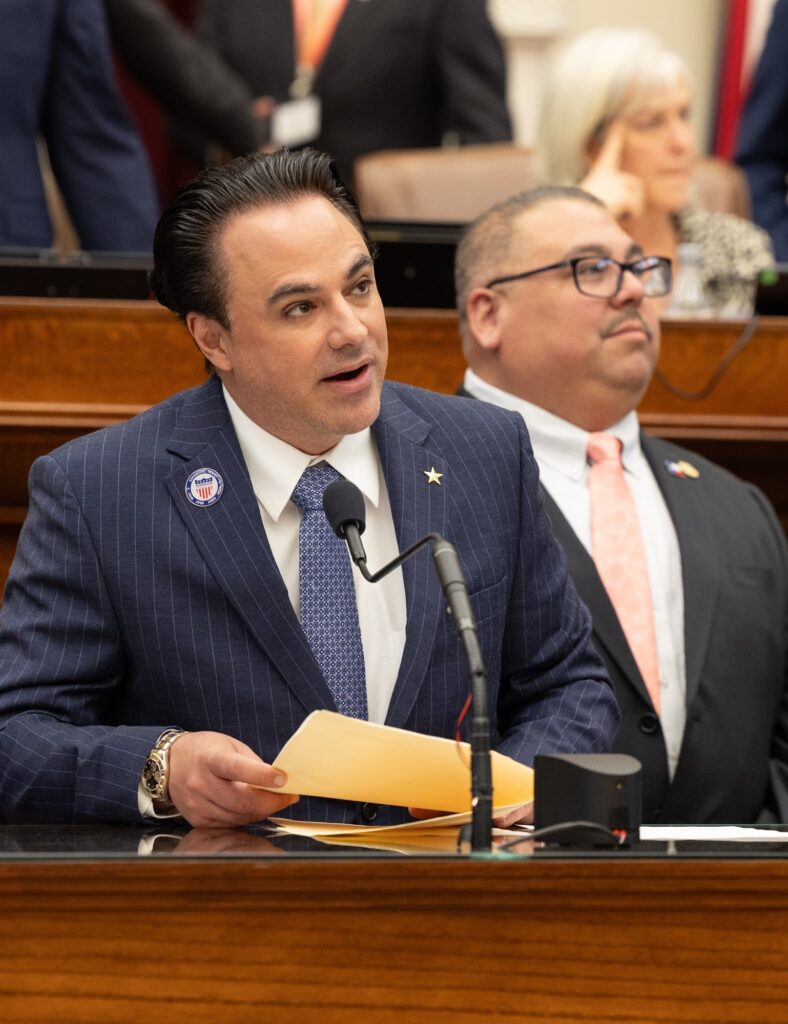
FEATURED, FROM LEFT: Rep. Terry Canales, D-Edinburg, and Rep. Ryan Guillén, R-Rio Grande City. In this image, Canales addresses fellow state lawmakers from the fixed microphone on the floor of the Texas House of Representatives chamber in the Texas Capitol during the 89th regular session in 2025.
Photograph By HOUSE PHOTOGRAPHY
••••••
Stronger public safety, improved rehabilitation for inmates, $150 million in taxpayer savings, among major improvements to Texas Department of Criminal Justice under milestone state law led by Rep. Terry Canales, D-Edinburg
By DAVID A. DÍAZ
[email protected]
Stronger public safety for Texans, improved programs for rehabilitation and reentry into society for inmates, and an estimated $150 million in taxpayer savings over the next five years are the result of landmark legislation, led by Rep. Terry Canales, D-Edinburg, and Sen. Tan Parker, R-Flour Mound, that went into effect last fall.
Legislation is a proposed or enacted (approved) law or group of laws.
Senate Bill 2405 was overwhelming passed by the Texas Legislature on Sunday, June 1, 2025 and signed into law on Friday, June 20, 2025 by Gov. Greg Abbott. It became state law on Monday, September 1, 2025.
Rep. Gina Hinojosa, D-Austin, who was born and raised in the Rio Grande Valley, and who is the Democratic nominee for Texas governor in the November 2026 general election, also voted for Senate Bill 2405.
Senate Bill 2405, authored by Parker and sponsored by Canales, is a comprehensive legislative bill aimed at enhancing the operational efficiency and accountability of various Texas criminal justice entities, including the Texas Department of Criminal Justice, the Board of Pardons and Paroles, and the Windham School District.
A bill is a type of legislative measure that is the primary means used to create and change the laws of the state.
A bill becomes law on its effective date if it is passed by both chambers of the Texas Legislature and is not vetoed by the governor. A veto by the governor stops a bill approved by lawmakers from becoming law.
As the lead sponsor, Canales was the main lawmaker who guided Senate Bill 2405 through the Texas House of Representatives.
“There are major improvements coming about as a result of Senate Bill 2405, and one of those life-changing advances will be expanding higher education opportunities for qualified inmates who meet specific academic, disciplinary, custody, and administrative criteria set by both the prison system and the partnering college,” Canales explained. “This will make it possible for those inmates to come out of prison with the essential skills and positive attitude to find good paying jobs.”
Among programs offered to inmates in the Texas prison system are academic and basic education, career and technical education, and higher education and specialized programs.
The role of the Texas Department of Criminal Justice is to manage the state’s adult criminal justice system by operating prisons, supervising parolees, and funding community supervision. Its core mission is to provide public safety, promote positive change in offender behavior, reintegrate offenders into society, and assist crime victims.
The Rio Grande Valley houses state correctional facilities managed by the Texas Department of Criminal Justice in Edinburg and Raymondville, specifically the Lopez State Jail / Segovia Unit complexand theWillacy County State Jail. [1, 3].
“Senate Bill 2405 also requires the Texas Department of Criminal Justice to develop a long-term plan for facility and capacity needs and make related changes to how unit capacity was reviewed, approved, and established,” Canales added. “No later than December 1, 2026, and every four years after that date, the Texas Department of Criminal Justice is required to submit a plan identifying the agency’s facility and capacity needs, considering regional needs and any ancillary or community benefits associated with TDCJ facilities.”
Those updates have to be submitted to the governor, lieutenant governor, speaker of the house of representatives, and each legislative committee with jurisdiction of state money over the Texas Department of Criminal Justice.
Senate Bill 2405 came about as a result of the Texas Sunset process, which evaluates state agencies every 12 years through self-evaluation, staff reviews, and public hearings, and legislative action to determine if they should be continued, restructured, or abolished. Managed by the Texas Sunset Advisory Commission, it sets an automatic expiration date on agencies unless the Legislature passes a bill to renew them.”
The current biennial operating budget for the Texas Department of Criminal Justice for the 2026-2027 biennium totals approximately $9.58 billion to $9.84 billion in All Funds, reflecting a roughly 10.2 percent to 13.1 percent increase from the previous 2024-2025 cycle.
A biennium is a two-year period for which general state funding of state programs are made. The state biennium runs from September 1 of an odd-numbered year through August 31 of the next odd-numbered year.
A new report by Texas 2036, a nonprofit, nonpartisan public policy research and advocacy organization which helps drive state policy solutions with data, also gave Parker/Canales’ Senate Bill 2405’s expansion of higher education for qualified inmates the group’s endorsement.
“Higher education for incarcerated Texans is a win-win-win in public policy. It is a win for incarcerated Texans themselves, who leave prison with better odds at employment and reduced recidivism thanks to the skills, credentials, and degrees they earned. It is a win for the communities they return to when they are released, which reap the benefits of another productive member,” Luis Soberón, Senior Policy Advisor and In House Counsel with Texas 2036, wrote in its 38-page report, “Opening More Doors – Data, progress, and opportunities for higher education in Texas prisons”.
Recividism means a person’s relapse into criminal behavior, usually measures by rearrest, reconnection, or a return to prison after serving a prior sentence or completing a program of correction.
https://www.google.com/search?client=safari&rls=en&q=What+is+Recidivism?&ie=UTF-8&oe=UTF-8
“Finally, it is a win for the taxpayers — less recidivism means less costs associated with re-arrest, re-conviction, and re-incarceration. Beginning in September 2025, significant changes were made to the way postsecondary education programs were managed in Texas prisons,” Soberón continued. “Armed with preliminary, snapshot data of statewide education in corrections for adult learners, this report serves as a level-setting on higher education in Texas prisons as of Fall 2025. This report also explores the implementation progress of recent reforms and the opportunities for further growth.”
Senate Bill 2405 addresses these recommendations by continuing Texas Department of Criminal Justice, modernizing its functions, and strengthening partnerships with the Windham School District, the Board of Pardons and Paroles, the, and the Correctional Managed Health Care Committee, according to Parker, who served as the author of the measure.
The Windham School District is a unique correctional education system providing academic, vocational, and life skills training inside Texas prisons. Established in 1969, it operates across facilities managed by the Texas Department of Criminal Justice.
The Texas Board of Pardons and Paroles is a state government agency that decides which eligible incarcerated (imprisoned) individuals to release on parole or mandatory supervision, sets parole conditions, handles revocations, and recommends clemency to the governor.
The Correctional Managed Health Care Committee is a state oversight body that manages prison medical services through a partnership between the Texas Department of Criminal Justice (TDCJ), the University of Texas Medical Branch (UTMB), and the Texas Tech University Health Sciences Center (TTUHSC). Established by the Texas Legislature in 1993, its main job is to provide good medical care to prisoners while keeping costs low.
As the primary author, Parker is the legislator who filed Senate Bill 2405 and guided it through the Texas Senate. Filed refers to a bill that has been introduced into the legislative process and given a number.
Parker’s testimony on the Parker/Canales bill, which Parker presented on Tuesday, April 8, 2025, before the Senate Committee on Criminal Justice, included his following remarks:
“First, legislation recognizes that Texas Department of Criminal Justice is grappling with very serious staffing and facility challenges. We must ensure appropriate staffing levels to maintain safety and security, and do so with a long-range outlook. Accordingly, Senate Bill 2405 requires the Texas Department of Criminal Justice to develop a 10-year facilities and staffing plan.
“Secondly, the bill focuses on improved rehabilitation and reentry support. It directs the Texas Department of Criminal Justice to maintain a comprehensive inventory of programs, encompassing peer-led, volunteer, faith-based and evidenced-informed services, and to evaluate their effectiveness.
“The Windham School District is also given a greater role in administering post-secondary education programs, which can help inmates gain the skills they need to reenter our communities in a productive fashion. The Texas Department of Criminal Justice and Windham will jointly develop a strategic plan to eliminate program delivery bottlenecks and prioritize inmates waiting for parole-voted programs. This promotes a common sense shift to more efficient programming, reduced recidivism, and increased public safety. This prioritization should result in $150 million in savings over the next five years.”
Senate Bill 2405also updated educational goals within the Windham School District, replacing references to “inmates” with "students" to promote a rehabilitative approach, and establishes a postsecondary education advisory board to align educational programs with workforce needs.”
Also according to “Opening More Doors – Data, progress, and opportunities for higher education in Texas prisons”:
• Research consistently shows that postsecondary education in prison settings reduces recidivism, improves employment outcomes after release, and generates returns for taxpayers through reduced criminal justice costs.
• The report notes that a 2023 meta-analysis found prison college programs reduced the likelihood of recidivism by more than 40 percent.
(A meta-analysis is a statistical method that combines and analyzes the results of multiple independent scientific studies to find a single, overall conclusion. It helps researchers see the bigger picture, resolve conflicting results from different papers, and get a more accurate measurement of an effect.
https://www.google.com/search?client=safari&rls=en&q=What+is+a+meta+analysis?&ie=UTF-8&oe=UTF-8)
Seven new colleges and universities have been approved to launch programs in Texas prisons since implementation of Senate Bill 2405 began. The seven new institutional partners approved to begin programming are Frank Phillips College, Lamar State College–Orange, Sam Houston State University, Southwest Texas College, Texas State Technical College, Victoria College, and West Texas A&M University.
The full report and interactive statewide map are available at:
http://www.texas2036.org/texas-prison-higher-ed/.
A detailed bill analysis about Senate Bill 2405, produced by the House Research Organization, which is the nonpartisan research arm of the Texas House of Representatives, is available online at:
https://hro.house.texas.gov/pdf/ba89r/sb2405.pdf
A bill analysis is a document prepared for bills and joint resolutions reported out of committee that includes a description of the content of the measure and other required information
••••••
For more on this and other Texas legislative news stories that affect the Rio Grande Valley metropolitan region, please log on to Titans of the Texas Legislature (TitansoftheTexasLegislature.com).