by Legislative Media | Feb 28, 2015 | Politics

Rep. Terry Canales, D-Edinburg, greets constituents at the Boggus Ford Events Center in Pharr during the Hidalgo County Democratic Party 2014 statewide and regional elections returns festivities on Tuesday, November 4.
Photograph By MARK MONTEMAYOR
On Friday, February 27, a bipartisan plan to fully fund TRS-Care, which is the health insurance program for retired public school employees of Texas, including retired classroom teachers, was praised by Canales, Rep. Sergio Muñoz, Jr., D-Mission, and Rep. Óscar Longoria, Jr., D-La Joya. The three men said they will vote for the measure developed by the House Committee on Appropriations, of which Muñoz and Longoria are members, when the funding legislation hits the House floor as part of the state budget later this spring. “The health insurance program for more than a quarter-million Texans and their dependents was in danger of running out of money, which could have forced insurance premiums to go up or benefits to be reduced, which are unacceptable options,” said Canales. “Through this action, we can protect this vital program for the next two years, giving the Legislature time to develop a long-term strategy to make sure we can keep health insurance protections affordable for retired teachers now and in the future.” TRS-Care is a self-funded retiree group health benefits program administered by the Teacher Retirement System. TRS retirees who are not eligible for the Employee Retirement System (ERS), University of Texas System or Texas A&M System health benefit coverage may be eligible for TRS-Care. “TRS-Care is one of the benefits that have been earned, through years of public service to Texas, by the dedicated professionals who educate millions of students and help ensure the future of all of us,” said Muñoz. “The House Committee on Appropriations, through the leadership of our chairman, Rep. John Otto (R-Dayton), has made keeping this fund solvent one of our top priorities.” As of December of 2014 TRS-Care had approximately 250,949 participants (retirees and their spouses and dependents) in Texas. For Hidalgo County, as of December 2014, TRS-Care covered approximately 9,219 participants, according to the Teacher Retirement System of Texas. “TRS is one of our state’s greatest programs, offering support to the thousands of retired teachers in Texas. I am very pleased that Chairman Otto and my fellow Appropriation Committee and House colleagues support the continual funding of TRS,” said Longoria. “We all know a hard working teacher or retiree who has made a difference in our life and it is imperative that we continue to support and protect their right to TRS.” Since 95 percent of Texas’ retired school employees do not receive Social Security benefits, securing this funding will prevent any drastic change in access to affordable health care to retired public school employees, House leaders emphasized. In addition to Muñoz and Longoria, all other House Democrats on the Appropriations Committee played key roles in protecting TRS-Care.
••••••
(more…)
by Legislative Media | Feb 26, 2015 | Politics

Artist’s rendition of $68 million, 8,500-seat Bert Ogden Arena set to open in southeast Edinburg in October 2016.
Graphics Courtesy RIO GRANDE VALLEY VIPERS
The NBA Development League Rio Grande Valley Vipers, along with the City of Edinburg, the Edinburg Economic Development Corporation and Cantú Construction on Thursday, February 26, broke ground on a new, state-of-the-art arena located at Interstate 69-Central and Alberta Road in Edinburg. Bert Ogden Auto Group was also announced as the arena’s naming rights sponsor. With a capacity of 8,500 seats, Bert Ogden Arena will be the largest entertainment venue in South Texas and is slated to open in October 2016. “Today is the biggest day in franchise history for the Rio Grande Valley Vipers. We are excited to break ground and be the anchor tenants of Bert Ogden Arena,” RGV Vipers president Bert García said. “A few miles away, we are wrapping up construction on a state-of-the-art practice facility and community center. Not only does Edinburg serve as the county seat, but now, it is also becoming the sports and entertainment hub of the Rio Grande Valley.” The RGV Vipers will serve as the anchor tenant of Bert Ogden Arena and will tip off the team’s 10th season in the facility in the fall of 2016. In addition to being the home of the RGV Vipers, Bert Ogden Arena will host a variety of musical and entertainment acts year round.“This joint venture is a tremendous opportunity for the City of Edinburg to improve the quality of life for residents without having to pay a single penny up front or take any away from other projects,” said Edinburg Mayor Richard H. García. “This is definitely a triumph for our residents. We are very excited about this project.” Bert Ogden Arena will be funded by Tax Increment Reinvestment Zone (TIRZ) and Edinburg Economic Development Corporation (EEDC) sales taxes. The EEDC is the jobs-creation arm of the Edinburg City Council. Tax Increment Reinvestment Zones (TIRZs) are special zones created by a governmental body, such as a city council, to attract new investment to an area. TIRZs help finance the cost of redevelopment and encourage development in an area that would otherwise not attract sufficient market development in a timely manner. Taxes attributable to new improvements (tax increments) are set-aside in a fund to finance public improvements within the boundaries of the zone. “The arena from day one brings $30 million in private dollars into our community. A recent study conducted at the University of Texas-Pan American identified $95 million in direct economic impact in the first year and $45 million every year after, while creating more than 150 jobs for the area,” said EEDC Executive Director Agustín “Gus” García. Gus García, Bert García and Mayor Richard García are not related. The RGV Vipers are in their eighth season in the RGV and currently play at State Farm Arena in Hidalgo. The team will fulfill its current contract with State Farm Arena before moving to Bert Ogden Arena in the fall of 2016. The arena’s namesake, the late Bert Ogden, established his first dealership in Edinburg in 1970. He and his wife, Dorothy, passed away several years later, but his daughter, Janet, and son-in-law, Robert Vacker, continued with the family business, which has evolved into one of the most successful vehicle dealerships in the nation. In addition to being one of the largest privately-owned dealer groups in the United States, with 22 complexes Valley-wide, including seven dealerships in Edinburg, the family business employs more than 1,000 people in deep South Texas.
•••••• (more…)
by Legislative Media | Feb 25, 2015 | Politics
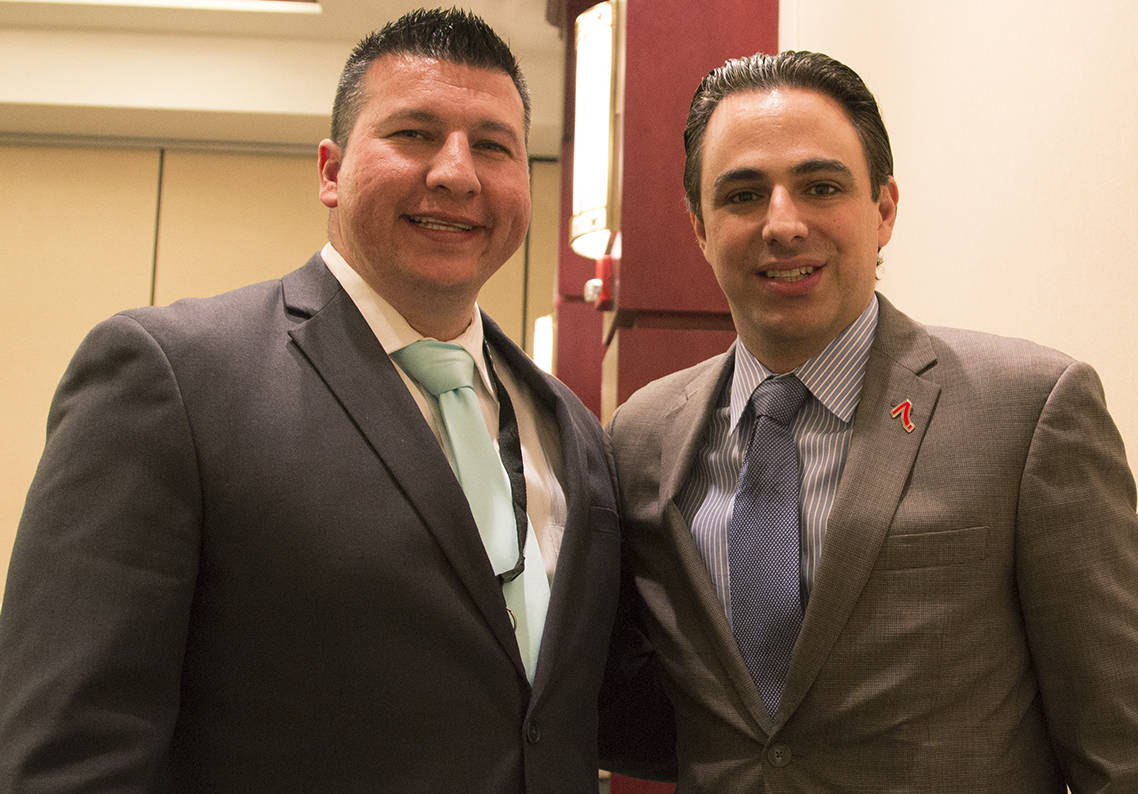
Featured, from left: Edinburg City Councilmember Richard Molina and Rep. Terry Canales, D-Edinburg.
Texas juveniles who are placed by a court on deferred disposition or community supervision for illegal drug use, but who have not been convicted of that crime, could be required to participate in state-approved substance abuse education programs, Rep. Terry Canales, D-Edinburg, featured right, has proposed. The House District 40 lawmaker on Wednesday, February 19, filed House Bill 642, which would give a presiding judge the authority to require a young offender, under age 18, to learn about the terrible consequences of unlawful drug abuse as a requirement for avoiding a harsher penalty or permanent criminal record. “Currently, minors who are convicted of drug offenses can be required to attend an alcohol awareness program. These programs are designed to help increase a minor’s awareness of the potential dangers and detriments of alcohol use,” Canales explained. “Unfortunately, this requirement does not extend to minors who are placed on deferred disposition or community supervision for drug-related offenses.” Deferred Disposition is a form of probation, which allows for dismissal of a charge if certain criteria(s) are met. Community supervision means the placement of a defendant by a court under a continuum of programs and sanctions, with conditions imposed by the court for a specified period. But, many young people who commit these offenses – often minor in nature – are entering pre-trial programs where they are not actually convicted of the crime, the House 40 state lawmaker continued. “A large percentage of juvenile crimes are misdemeanors involving kids with small amounts of drugs. These kids do not need to go to jail. They need an approach tailored to their issues,” Canales said. “Judges need more power to require local programs aimed to help our youth.” His legislation also comes as a major national study, with a conservative Texas point of view, shed more light on the need to provide juvenile offenders with local rehabilitation efforts in or near their home regions. That first-of-its-kind investigation comparing Texas youth with nearly identical characteristics shows that juveniles treated by court-approved programs closer to home “are far less likely to reoffend than those incarcerated in state correctional facilities,” the Council of State Governments (CSG) Justice Center, in partnership with Texas A&M University, announced on Thursday, January 29. Featured with Canales as part of a visit to the Texas Capitol in early February by Edinburg leaders is City Councilmember Richard Molina. Molina is a U.S. Army veteran who served in Operation Joint Forge-Bosnia and was honorably discharged. Molina was an employee of the Hidalgo County Sheriff’s Department and later served as an Edinburg Police Sergeant for 11 years. Molina is now the owner and manager of Molina Rental Properties in Edinburg.
•••••• (more…)
by Legislative Media | Feb 24, 2015 | Politics

Featured, seated, from left: Linda Tovar of Edinburg, Senior Manager of Public Affairs, H-E-B; Jo Ann Gonzáles Gama of Edinburg, Co-Founder, President, and Superintendent, IDEA Public Schools; and Carmen Pagan of McAllen, Co-Owner, Milestone Therapeutic Associates. Standing, from left: Edinburg Mayor Richard H. García, Attorney-at-Law, García, Quintanilla and Palacios; and former Hidalgo Mayor John David Franz, Law Offices of John David Franz.
Photograph Courtesy THE UNIVERSITY OF TEXAS-PAN AMERICAN
Edinburg’s retail economy for the 2014 was 8.62 percent better than 2013, generating $18,935,258 in local sales taxes last year, compared with $17,433,116 the year before, Mayor Richard García has announced. The mayor also is President of the Board of Director for the Edinburg Economic Development Corporation, which is the jobs-creation arm of the Edinburg City Council. The amount of local sales taxes collected helps reflect the strength of an economy, along with construction activities, per capita income, education, historical performances, and related trends. The $18.9 million annual figure was reached after the city’s economy in December 2014 generated $2,087,133.29 in local sales taxes, keeping pace with the December 2013 output of $2,140,298.48. This latest data was released on Wednesday, February 11, by the Texas Comptroller of Public Accounts. The local sales tax figures represent December 2014 sales reported by monthly tax filers as well as October, November and December sales by businesses that report tax quarterly. The December 2014 local sales taxes were sent to the Texas Comptroller of Public Accounts in January, and returned as sales tax rebates to the respective local government entities in February. The local sales tax is used in Edinburg to help pay for many city services, while the EEDC uses its one-half cent local sales tax to help generate economic development in the city. The sales tax, formally known as the State Sales and Use Tax, is imposed on all retail sales, leases and rentals of most goods, as well as taxable services. Texas cities, counties, transit authorities and special purpose districts have the option of imposing an additional local sales tax for a combined total of state and local taxes of 8 1/4% (.0825). Edinburg’s local retail economy has shown positive growth since 2008, increasing in its market share in the Valley from 8.05 percent in 2008 to 9.45 percent in 2014, according to Valley-wide data compiled by http://www.MyHarlingen.US, which is the official website for the City of Harlingen. In this image, Garcia is featured with four other area leaders who will be honored as “Presidential Pillars” on Thursday, February 27, as outstanding alumnus of The University of Texas-Pan American. The gala, which raises money for scholarships, is sold out. It is being held at the Boggus Ford Events Center, formerly the Pharr Events Center, beginning at 6:30 p.m. More details about the achievements of García, Franz, Tovar, Gama, and Pagan are available online at: http://www.utpa.edu/news/2015/01/gone-country-bling-it-up-for-final-alumni-ball-feb-27.htm
•••••• (more…)
by Legislative Media | Feb 23, 2015 | Politics

Rep. Terry Canales, D-Edinburg, featured on Wednesday, November 20, 2013 at The University of Texas Regional Academic Health Center in Harlingen.
Photograph By JOSUE ESPARZA
The public’s right to know about how executions take place in Texas – including current, controversial secret information regarding the lethal drugs used to administer the death sentence – would be dramatically strengthened under legislation filed on Friday, February 20, by Rep. Terry Canales, D-Edinburg. House Bill 1587 by Canales would require the Texas Department of Criminal Justice to provide details about the names of the drugs used in the lethal injections, along with the identity of their manufacturers, the expiration dates of the deadly concoction, the results of laboratory tests performed on those ingredients, and pertinent information relating to the toxic substance. “In Texas, we do not give the bureaucrats the absolute authority to decide what the public can and cannot know about what their government is doing,” said Canales. “When it comes to the death penalty, Texans will not allow state government to keep secrets about this drug, which wields the power of life and death.” His support of disclosing such details in the name of open government has drawn strong support from Kelley Shannon, Executive Director of the Freedom of Information Foundation of Texas. “The people of Texas need information to scrutinize their government and hold it accountable,” said Shannon, who helps lead the non-profit 301(c)(3) organization, which is devoted to promoting open government, freedom of speech, and freedom of press. “With the death penalty, we are talking about the ultimate punishment for a crime. The people have the right to know how their state is carrying out punishment by lethal injection.” On January 23, 2015, the U.S. Supreme Court announced it will review later this year the drug protocol increasingly used across the country to determine whether the use of lethal injections, under certain circumstances, constitute cruel and unusual punishment. “The U.S. Supreme Court’s upcoming case will deal with the very important American protection against cruel and unusual punishment, which is a very complicated issue,” Canales said. “House Bill 1587 deals with the people’s right to know where Texas taxes are being spent to buy lethal drugs to use in executions. I will always fight for the people’s right to know about what their government is doing in their name.”
•••••• (more…)
by Legislative Media | Feb 20, 2015 | Politics

Featured, from left: Hidalgo County District Attorney Ricardo Rodríguez; Congressman Joaquín Castro, D-San Antonio; and Mayor Richard H. García, during the Thursday, January 1, 2015 swearing-in for Rodríguez, held at the Pharr Events Center.
Photograph By MARK MONTEMAYOR
Honoring his family’s legacy is important to Richard H. García, who can trace his roots in South Texas back to the late 1700s. “When they were colonizing all of the cities here on the river, 38 families were brought to Mier, which was the original colony here,” he said, “My family was part of that group.” Today, as a successful attorney and mayor of the City of Edinburg, the UTPA alumnus and 2015 Pillar of Success continues to build on what his ancestors helped establish in the Rio Grande Valley. The Pillars of Success are the university’s official annual “Alumni” awards, which honor UTPA’s most distinguished alumni. The Pillars of Success celebrate a select group of Broncs for their inspirational stories and outstanding achievements. The event, which raises funds for scholarships, will be held on Friday, February 27, at Boggus Ford Events Center (formerly the Pharr Events Center) at 6:30 p.m. Tickets are $100 each and can be purchased online or at the UTPA Alumni Center in Edinburg (2402 S. Closner Blvd.). García talks with pride about a new pedestrian corridor that will connect Edinburg’s City Hall to the UTPA campus and include a Valley Metro station and a new residential complex for students that will feature apartments above retail space, a project that had the enthusiastic blessing of UT-Pan American’s administration. “I was a little nervous with the transition (to The University of Texas-Rio Grande Valley), but Guy Bailey (president of the new university) tells me he buys into the whole plan,” García said. Also on the horizon for the City of Edinburg is a new $60 million, 8,500-seat events arena that will be home to the NBA Development League Champion Rio Grande Valley Vipers, beginning in 2017, and will host other sporting events as well as provide a prime location for concerts, graduations and meetings. The 115,799-square-foot arena will be built on 40-acres of land located on the east side of I-69C (US 281) on Alberta Road. The entire property includes nine additional pad sites for the development of a future hotels and restaurants. When the project was announced in November 2013, García said not only will it enhance the economy by millions of dollars, but it will also improve the quality of life for Edinburg residents and visitors. “People want to visit and live in cities where they can get educated, where they can work and where they can play. We’ve created more than 3,500 jobs in the last three years; we have UTPA, which is about to become an even larger UT System campus complete with a medical school; and now we will also have a place for entertainment,” he noted. The mayor also boasts of another project, La Sienna, a 726-acre master planned community along I-69C (US 281) at Monte Cristo Road that is “going gangbusters.” In addition to several moderate to exclusive residential areas, renowned Dallas developer Henry Miller will develop 45 acres along the freeway into what García describes as “a cross between The Quarry and La Cantera (two high-end shopping areas in San Antonio)” that will include water features, restaurants, shops, a hotel and an IMAX theatre. The Edinburg Economic Development Corporation, which is the jobs-creation arm of the Edinburg City Council, also has 100 additional acres that it will soon put on the market. “With those two things – the arena and La Sienna – along with the medical school, the sky’s the limit for the city,” said García, the president of the EEDC Board of Directors. He said he is excited about the transition of his alma mater, UTPA, into The University of Texas-Rio Grande Valley next year. “When San Antonio got its medical school 25 years ago, the demographics and population were similar to Hidalgo County’s today. Now, San Antonio is the second largest city in Texas and number seven in the nation. That’s because of the medical investment. That’s what I see happening to us down here, and the impacts will be the medical school and UT-RGV. The fact that it’s going to be the second largest in the UT System speaks volumes, and Dr. Bailey said we may end up being even larger than UT Austin in numbers. Wow, what can you say about that?”
•••••• (more…)
by Legislative Media | Feb 19, 2015 | Politics

Featured, from left: Sen. Juan “Chuy” Hinojosa, D-McAllen, and Mario E. Ramírez, M.D., of Rio Grande City, who was appointed in March 1991 by Gov. Bill Clements to serve a six-year term on the University of Texas System Board of Regents, share ideas and memories in Edinburg during the Tuesday, August 26 groundbreaking ceremony of the $54 million UT-Rio Grande Valley School of Medicine Medical Education Building.
Photograph By MARK MONTEMAYOR
Legislation to create a Hidalgo County Healthcare District was filed on Wednesday, February 18, by Sen. Juan “Chuy” Hinojosa, D-McAllen, and Sen. Eddie Lucio, Jr., D-Brownsville, to provide a source of local funding for The University of Texas-Rio Grande Valley School of Medicine, as well as to deliver health care to the region while lowering the tax burden on Hidalgo County residents. Senate Bill 626 legislation to create a Hidalgo County Healthcare District is s a top priority this legislative session, and Hinojosa and Lucio will work together with the Valley House delegation to ensure its passage. “The Hidalgo County Healthcare District is critical for our families in the Rio Grande Valley to provide resources to support a medical school, to cover our community’s healthcare needs for both the insured and uninsured, and to decrease the tax burden on our county taxpayers,” said Hinojosa. The McAllen-based lawmaker, whose District 20 covers most of Hidalgo County stretching northward to Nueces County, includes Edinburg, where major facilities of the UT-RGV School of Medicine are going to be built. Hinojosa said without the healthcare district, hospitals in deep South Texas, which are required by federal law to provide emergency medical care, wind up tapping into public funds in order to provide critical care to patients, regardless of their ability to pay. “Our healthcare providers provide millions of dollars in care to people who can’t afford it ever year, forcing them to pass the bill onto county taxpayers or to people with insurance through higher fees and premiums,” said Hinojosa. “The healthcare district will benefit taxpayers by bringing more federal dollars to the county and putting the uninsured into the system with a focus on prevention and early treatment.” Lucio, who represents a portion of Hidalgo County, echoed Hinojosa’s call for action. “I am pleased to joint author this bill which is critical to healthcare delivery in Hidalgo County. We have some of the highest rates of uninsured individuals and amongst the worst health care outcomes in the nation,” said Lucio, who represents Senate District 27. “Senate Bill 626 will allow Hidalgo County to improve our indigent care program as well as leverage and draw down additional federal funds to address health disparities,” the Brownsville lawmaker said. “The Hidalgo County Healthcare District will provide the ability to improve health outcomes in some of the most vulnerable communities, and the benefit to all cannot be underestimated.”
•••••• (more…)
by Legislative Media | Feb 18, 2015 | Politics

Featured, from left: Rep. Sergio Muñoz, Jr., D-Mission; Speaker of the House Joe Straus, R-San Antonio; Rep. R.D. “Bobby” Guerra, D-McAllen; and McAllen Mayor Jim Darling on Thursday, June 17, 2014 at the Edinburg Conference Center at Renaissance.
Photograph By MARK MONTEMAYOR
With southwest McAllen as part of his House District 36, which includes a major presence of South Texas College along with key international bridges and transportation systems, Rep. Sergio Muñoz, Jr., D-Mission, will be a powerful asset once more for The City of McAllen and its ambitious, progressive agenda during the ongoing 140-day regular session of the Texas Legislature, which runs through May 31. Muñoz’ body of work at the Texas Capitol, in partnership with his fellow Valley lawmakers, is sure to continue registering victories, especially following his reappointment to several of the most influential House of Representatives legislative committees. Texas Speaker of the House Joe Straus, R-San Antonio, one of the three most powerful leaders in Texas government, on Wednesday, February 4, elevated Muñoz to Vice-Chair of the House Committee on Insurance, and also kept him as a member of the budget-setting Appropriations Committee, and the Local and Consent Calendars Committee. “I am sincerely honored and grateful to be reappointed to these very important committees by Speaker Straus,” Muñoz said after receiving his assignments. “I fully intend to represent the interests of my constituents and the greater Rio Grande Valley region as I serve on these committees. I thank Speaker Straus for entrusting me with these assignments and for placing me in a position to better serve Texas.” Muñoz’ rising star in the Texas Legislature is a definite asset to the City of McAllen’s legislative agenda, which was adopted by the McAllen Mayor and McAllen City Commission late last year. McAllen’s top state priorities will focus on the following goals: the creation of a Hidalgo County Hospital District; improving international trade and shipping with Mexico through local international bridges; seeking funding to build the first phase of a northbound commercial vehicle inspection station at Anzaldúas International Bridge; extending Ware Road (FM 2220), a primary north-south arterial in McAllen, north from Trenton Road (FM 676) to State Highway 107; building an overpass over Pecan Boulevard at the South Texas College main campus, which is one of the fastest growing in the country (32,000 students), to coincide with a $55 million locally-funded campus expansion currently underway; enhancing Texas’ relationship with Mexico, including holding high-level annual meetings in McAllen or Rio Grande City featuring the Texas governor’s office and Texas secretary of state’s office with their counterparts from Mexican states that border Texas for the purposes of discussing trade, transportation, energy, security and other bi-national issues; and seeking funding, through legislation or Texas Parks and Wildlife Department prioritization, for the construction of hike-and-bike trails in McAllen and surrounding cities.
•••••• (more…)
by Legislative Media | Feb 17, 2015 | Politics

Featured, from left, Blanca Davila and Stephanie Méndez encourage students to apply for an Archer Fellowship. The application deadline for both the fall 2015 semester and the spring 2016 semester is Monday, February 23. For more information, contact Stephen Cisneros, Interim Director of Student Engagement, at 956-882-7152 or [email protected].
Photograph By LETTY FERNÁNDEZ
Stephanie Méndez and Blanca Davila are enthusiastic promoters of the Bill Archer Fellowship Program, an education program designed to provide students from throughout The University of Texas System with an intense learning and exploration experience in Washington, D.C. Students attending The University of Texas at Brownsville – who will be enrolled at The University of Texas-Rio Grande Valley in the fall – can apply to the Archer Fellows Program for the 2015–2016 academic year. Méndez, who will graduate from UT-Brownsville with her Bachelor of Business Administration in Marketing and Management in May, was an Archer Fellow during the fall 2014 semester. Davila, who will receive her Master of Public Policy and Management from UT Brownsville in May, participated in the Archer Graduate Program in Public Policy in summer 2014.
•••••• (more…)
by Legislative Media | Feb 12, 2015 | Politics

Sen. Juan “Chuy” Hinojosa, D-McAllen, a former U.S. Marines combat squad leader in Vietnam, walks by a Texas honor guard which was standing at attention at the Texas Capitol as the South Texan senator prepared to participate in the Tuesday, January 20 Texas Inauguration, held on the South Steps of the historic building, to witness the Oath of Office Ceremony for Gov. Gregg Abbott.
Photograph By SENATE MEDIA
Sen. Juan “Chuy” Hinojosa, D-McAllen, who as of Wednesday, February 11, had filed 50 bills and resolutions, is promoting his legislative agenda from a position of strength, as he is the only state senator from south of San Antonio who is on the powerful Senate Finance Committee – of which he is Vice-Chair – allowing him to heavily influences the final state budget for Texas. “I am honored to serve as Vice-Chair of Senate Finance and that Lt. Governor (Dan) Patrick (R-Houston) has entrusted me with these important responsibilities. Through these appointments I am able to put South Texas at the forefront of the critical discussions that will be taking place during this session,” said Hinojosa. “There is no question that this session will be challenging as our communities face critical issues, our lawmakers face significant hurdles, and solutions are not always transparent.” Among some of his issues beginning to generate attention are Senate Bill 97, which would prohibit the sale, distribution, possession, and use of electronic cigarettes to minors; a soon-to-be released proposal to bring a Texas Department of Public Safety (DPS) trooper training facility to the Valley; and Senate Bill 552, which would require state agencies to prepare an economic impact statement and regulatory flexibility analysis if a state agency is made aware that a proposed rule may have an adverse economic effect on small businesses.” Hinojosa represents the counties of Nueces, Jim Wells, Brooks, and Hidalgo (part), and serves as the Senate President Pro Tempore of the Texas Senate in the 84th Texas Legislature. The Senate District 20 lawmaker’s constituents include Edinburg and most of McAllen, stretching north and northeast to Corpus Christi.
•••••• (more…)