by Legislative Media | Apr 10, 2015 | Politics

Featured, from left: Congressman Rubén Hinojosa, D-Mercedes; Pedro Reyes, Ph.D., formerly of Alamo, Executive Vice Chancellor for Academic Affairs at The University of Texas System in Austin; and Ernest Aliseda of McAllen, Member, The UT System Board of Regents, in Edinburg on Tuesday, August 14, 2014.
Photograph By MARK MONTEMAYOR
Pedro Reyes, Ph.D., the Executive Vice Chancellor for Academic Affairs for the mammoth University of Texas System, and who has built a legacy as a long-time champion for student success, is stepping down to return to full-time teaching and research at The University of Texas at Austin. Reyes, who is originally from Alamo in the Rio Grande Valley, will stay through December 2015 in a pivotal role for the UT System leadership, providing guidance on UT-RGV, UT System’s engineering and computer science initiative, the establishment of the Americas Institute and other high-profile projects. “Working with the UT System’s academic presidents to make significant improvements in student success on such a wide scale has been one of the richest and most rewarding experiences of my professional career,” Reyes said. “But now it’s time for me to return to my other passion – teaching and research.” As the top academic leader in the UT System for the last several years, Reyes led a far-reaching – and successful – effort to increase student success and retention at every academic institution. He and his team coordinated funding, training and resources to help each campus set and strive to reach its targets. News of Reyes’ decision came on Thursday, April 9, the same day that Congressman Rubén Hinojosa, D-Mercedes, announced that The National Science Foundation awarded two separate grants to UT-RGV totaling $685,976 for a program that creates a pathway to obtaining a Master’s degree in Mathematics and a workshop that will encourage and assist women of color in entering the field of political science. “The National Science Foundation has long been a great source of support for many vital programs in education throughout our nation”, said Hinojosa. “These grants will benefit so many students at our new UT-RGV for many years. I am very pleased to see that our higher education system in deep South Texas continues to grow in ways that will enhance our communities and our residents throughout the Rio Grande Valley.” The goal of the conference is to provide attendees the necessary skills and networks to enter the political science profession, successfully achieve tenure and sustain their careers thereafter. This workshop brings together scholars from different universities, at different stages in their careers, to deepen intellectual engagement and to build coalitions that support excellence in diversifying the political science profession. Research demonstrates that women of color face barriers such as lack of mentorship, financial resources, and significant familial responsibilities in their pursuit of higher education and subsequent careers in political science. The awards are scheduled to begin this month and May of 201
•••••• (more…)
by Legislative Media | Apr 9, 2015 | Politics

Featured, from left: Agustín “Gus” García, Jr., Executive Director, Edinburg Economic Development Corporation; Ramiro Garza, Jr., Edinburg City Manager; and Edinburg City Councilmember Richard Molina, in the Gallery of the Texas House of Representatives on Tuesday, February 10 for Rio Grande Valley Day at the State Capitol.
Photograph By DIEGO REYNA
Edinburg’s retail economy for the month of February 2015 was 14.38 percent better than the same month last year, generating $1,560,490.17 in local sales taxes, compared with $1,364,200.96 in February 2014, the Edinburg Economic Development Corporation has announced. The EEDC is the jobs-creation arm of the Edinburg City Council. That showing was the best among all of the Valley’s major cities for February 2015, according to the Texas Comptroller of Public Accounts, which on Wednesday, April 8, released statewide figures, which represents the most up-to-date figures information for that state agency. Edinburg’s almost 15 percent improvement also was significantly higher than the average of all city economies in the state, which combined showed an improvement of 3.3 percent when comparing February 2015 with the same month last year, the state comptroller’s office also reported. The amount of local sales taxes collected helps reflect the strength of an economy, along with construction activities, per capita income, education, historical performances, and related trends. Year-to-date, the Edinburg economy is 6.40 percent ahead of 2014, having produced $6,677,232.04 in local sales taxes in 2015, compared with $6,275,246.74 during the same period last year. The local sales tax figures represent sales reported by monthly tax filers for February 2015, sent to the Texas Comptroller of Public Accounts in March, and returned as sales tax rebates to the respective local government entities in April. The local sales tax is used in Edinburg to help pay for many city services, while the EEDC uses its one-half cent local sales tax to help generate economic development in the city. Fitch Ratings, Inc., a global credit conglomerate which rates economies on their strengths and weaknesses for national and international businesses and investors, in early March gave independent and positive views on Edinburg’s economy. On March 4, the New York-based credit rating agency provided its public analyses of Edinburg’s economy and financial activities of the city government and the Edinburg Economic Development Corporation. Among its key findings: Because of its position near the Mexican border along a major transportation route, Edinburg serves as a distribution center, benefiting from the trade generated by cross-border manufacturing activity as well as the agricultural production in the region. Retail trade, government, education and health services are all major components of the area economy; and further economic expansion is expected in the near term related to $150 million in projects underway at the newly designated University of Texas-Rio Grande Valley, including the region’s first medical school, and a $200 million expansion of the local hospital. Planned projects include a $650 million power plant and an upscale retail, entertainment, and hotel complex.
•••••• (more…)
by Legislative Media | Apr 8, 2015 | Politics

Featured: Paul Williams of McAllen, a Mission police officer, on Tuesday, April 7, announced his candidacy as a Democrat for U.S. Congress, House District 15 in Texas, for the March 2016 Democratic Party primary.
Photograph Courtesy http://www.PAUL4YOU.org
McAllen resident and Mission police officer Paul Williams, a U.S. Marine veteran of two combat tours in Iraq, on Tuesday, April 7, announced his candidacy as a Democrat for U.S. Congress, House District TX-15, which is currently held by Congressman Rubén Hinojosa, D-Mercedes. The Democratic Party primary in Texas will be held in March 2016. The 15th Congressional District includes all or portions of Brooks, Duval, Guadalupe, Hidalgo, Jim Hogg, Karnes, Live Oak, and Wilson Counties. Key cities in that congressional district include Edinburg, Falfurrias, George West, Hebbronville, Karnes City, McAllen (part), Mission (part), New Braunfels, Pharr, Schertz, Seguín, Stockdale, Three Rivers, and Weslaco. As a third-generation Marine, Williams described himself “as a hard-working middle class American.” In a text simultaneously sent with his news release, Williams offered the following additional comments: “I am proud to let you know that I have decided to deepen my commitment to public service by running for U.S. Congress, House District 15 in Texas. Because I am not a career politician, I need your help to serve my fellow hard-working middle-class Americans. I’ve done so as a Marine Corps Iraqi war veteran and continued to as a police officer. I want to do more. Please contribute $10 today to my campaign and help bring a true public servant Congress. Thank you and God bless.” According to his official campaign paperwork filed in March with the Federal Elections Commission, Amanda Marie Martínez of Weslaco was listed as his campaign treasurer. In his news release, Jacqueline Armendáriz is listed as Williams’ Interim Campaign Manager. “Paul brings diversity and a strong, fresh voice ready to act as an advocate on behalf of District 15. Public service is what drives Paul, as well as the Marine Corps values of honor, courage and commitment,” said Armendáriz. “He wants to earn your vote to become a U.S. House Representative because he believes representing you in Congress is where he can affect the most change.” Williams is sponsoring a Candidate Meet & Greet, which is free and open to the media and the public, on Saturday, April 25, at noon, at Kray Maga Ghost, 4208 North 10th Street, Suite 1100, in McAllen.
•••••• (more…)
by Legislative Media | Apr 7, 2015 | Politics

Featured, Dr. Juliet V. García, Executive Director of The University of Texas Americas Institute, formerly President of the University of Texas at Brownsville, and one of the members of a national blue-ribbon panel on higher education, the National Commission on Financing 21st Century Higher Education.
Photograph By PAUL CHOUY
Increasing pressure on state budgets, along with changing student demographics and new academic models arising from advances in teaching and learning, create both opportunities and challenges for American higher education. However, without creative new funding policies that expand access to meaningful educational opportunities beyond high school, including increased access made possible by wise use of existing public funds and by partnerships that generate greater private investment, the nation could fall short of the educated population it needs. To address the need for innovative new ideas, the University of Virginia’s Miller Center on Tuesday, March 31, announced the creation of a nonpartisan National Commission on Financing 21st Century Higher Education. With support from Lumina Foundation, the commission will initiate blue-sky thinking to develop policy proposals aimed at providing long-term sustainable finance models for U.S. higher education. Dr. Juliet V. García, Executive Director of The University of Texas Americas Institute, formerly President of the University of Texas at Brownsville, is one of the members of this blue-ribbon panel. The commission will foster a new national dialogue as it works toward a consensus on new policies that have the potential to help the nation meet educational attainment goals. During its deliberations, the commission will explore how public and private dollars can clear the way for innovation, ensure fair educational outcomes for all students, and affordably educate enough people to reach attainment goals. “Thomas Jefferson — the first American president to found a university — felt that individuals ‘endowed with genius and virtue’ should receive an education ‘without regard for wealth, birth, or other accidental condition or circumstance.’ Jefferson’s mission has come to a major obstacle. State support for public higher ed and federal support for student aid both face real limits, so many deserving students are finding it harder to pursue their own educational journeys without running out of financial resources. The commission aims to do something about that,” said William Antholis, Director and CEO of the Miller Center. By commissioning outside nonpartisan research and analyses, the Miller Center’s group will identify creative and practical solutions involving public funding and private capital. Each policy option will be examined for its ability to expand the capacity of states to increase the percentages of residents with high-quality postsecondary credentials. In addition to García, the commission will be led by two former governors and will include other state leaders who have experience working with budgets, presidents of several colleges and universities, and CEOs of some of America’s largest companies.
•••••• (more…)
by Legislative Media | Apr 5, 2015 | Politics

Featured, center, Sen. Juan “Chuy” Hinojosa, D-McAllen, along with Roxanne De La Garza, who serves on Hinojosa’s legislative and McAllen district staffs, greet Alex Ríos, District Director for Rep. Terry Canales, D-Edinburg, on Tuesday, August 26, 2014 prior to the groundbreaking of The University of Texas-Rio Grande Valley’s $54 million Medical Academic Building in Edinburg, the first new construction for the UT-RGV School of Medicine.
Photograph By MARK MONTEMAYOR
The House of Representatives is considering a $4.6 billion tax relief package, approved by the Senate on Wednesday, March 25, which its supporters, including Sen. Juan “Chuy” Hinojosa, D-McAllen, say is designed to benefit homeowners and small businesses. Hinojosa is a joint author of Senate Bill 1, Senate Bill 7, and Senate Bill 8, which would give many Texas homeowners a bigger break on their school property taxes, and provide more small business owners with relief from the amount of franchise tax they must pay. “I am proud to joint-author these tax relief bills giving our hard-working families and small business owners much-needed tax cuts,” said Hinojosa. “These bills make good economic sense and will provide critical tax relief on a statewide level for our Texas families so they will be able to keep more of the dollars they earn.” The first measure, SB 1 by Sen. Jane Nelson, R-Flower Mound, would decrease school property taxes for homeowners by increasing the homestead exemption, a move which lowers the value of a home for the purpose of paying those property taxes. The result would be reducing school property taxes on the primary residence by about $220 a year over the next two years, according to Lt. Gov. Dan Patrick, R-Houston. During that period, school districts would be entitled to additional state aid to the extent current formulas do not fully reimburse them for the local tax revenue losses from SB 1. The state would use more than $2.1 billion from the state budget surplus over the next two years to make up for the revenue losses by local school districts. Property tax in Texas is a locally assessed and locally administered tax, according to the Texas Comptroller of Public Accounts. Texas law allows a variety of partial or complete exemptions from local property taxes. A partial exemption removes a percentage or fixed dollar amount of the property’s value from taxation. An absolute or total exemption excludes the entire property from taxation. Currently, all school districts in Texas are required to offer a $15,000 exemption on residence homesteads. But under SB 1, as approved by the Senate, the homestead exemption for school district taxes would significantly improve from its current $15,000 level to 25 percent of Texas home median market value. The exemption amounts are estimated to be $33,625 in 2016 and $35,979 in 2017, according to Hinojosa. “SB 1 will specifically benefit homeowners with immediate and long-term economic relief by raising the homestead exemption and decreasing the property taxes homeowners will have to pay,” Hinojosa said. If SB 1, and a related measure, Senate Joint Resolution 1, also by Nelson, are approved by the Legislature and the governor, a statewide election would be held on Saturday, September 12, 2015, which would give Texas voters the final say on more than doubling the school property tax exemption for homeowners. SJR 1 is the constitutional amendment required to implement SB1, and like all proposed amendments would put the question of the new exemption before the voters in September, according to Texas Senate News, the public information arm of the Texas Senate. SJR 1 also contains language to exempt the state money necessary to cover the cost of the tax cut from the state spending cap. The state constitution forbids the state budget growing faster than the state economy, which Nelson has said in the past hinders the ability of lawmakers to cut taxes. In addition, SJR 1 would constitutionally prohibit the establishment of any tax on real estate sales, thus preventing future Legislatures – without another statewide election – from taxing the sales of homes in order to generate more money for the state government, Hinojosa added. Nelson, who serves as Chair of the Senate Finance Committee – on which Hinojosa serves as Vice-Chairman – also filed legislation to make all tax cuts and debt relief appropriations exempt from the spending cap, but SJR 1 is only a one-time exemption for the estimated $2.1 billion needed to cover the cost of SB 1. The two other tax-relief proposals being championed by Hinojosa are SB 8, which establishes a $4 million total revenue exemption from the state’s business franchise tax for small businesses, and SB 7, which reduces the franchise tax rate by 15 percent for those over the $4 million threshold. “SB7 and SB 8 will similarly give small business owners a tax reduction. Small businesses create jobs and drive our economy; they are the backbone of our Texas economy. For many small businesses struggling to survive, the franchise tax represents an unnecessary and burdensome tax that limits job growth and economic investment,” Hinojosa explained. “SB 8 will exempt more than 61,000 small businesses in Texas that would otherwise pay the franchise tax. These small businesses represent over 52 percent of all businesses in Texas required to remit payment under the current franchise tax structure.” The Texas franchise tax is a privilege tax imposed on each taxable entity formed or organized in Texas or doing business in Texas, with the exception of most sole proprietorships. The owners of businesses which pay the franchise tax receive key benefits, such as liability protections under the state law, where their personal assets can be shielded against potentially-devastating legal judgments against their businesses. A sole proprietorship, on the other hand is an unincorporated business with one owner who pays personal income tax on profits from the business, according to Investopedia.com. With little government regulation, they are the simplest business to set up or take apart, making them popular among individual self contractors or business owners.
•••••• (more…)
by Legislative Media | Mar 30, 2015 | Politics

Featured, right, Edinburg Mayor Richard H. García speaking with reporters on Thursday, January 22, 2015, prior to welcoming Gov. Greg Abbott to the Edinburg Conference Center at Renaissance.
Photograph By MARK MONTEMAYOR
Edinburg’s unemployment rate for February 2015 was 4.8 percent, which was lower than the previous month’s level of 5.1 percent, better than the February 2014 level of 6.2 percent, and the best showing for that month since 2008, the Edinburg Economic Development Corporation has announced. The EEDC is the jobs-creation arm of the Edinburg Mayor and the Edinburg City Council. The unemployment rate is a key indicator of the strength of the local economy. Those most recent figures, released on Friday, March 27 by the Texas Workforce Commission (TWC), came about a week after Teleperformance U.S.A., a global company which specializes in customer service, technical support, call center, debt collection and social media, announced that it will begin hiring 200 more staff members at its Edinburg site, located at 1701 South Closner Blvd. Only McAllen had a better monthly performance among the Valley’s major economies, coming in with a 4.7 percent unemployment rate for February 2015, the TWC reported. The previous month, the unemployment rate in McAllen was five percent. Edinburg’s February 2015 unemployment rate of 4.8 percent remained close to the Texas statewide average, which was 4.3 percent for February 2015, compared with statewide average of 4.6 percent for January 2015, according to TWC figures. With more than 700 employees at the local Teleperformance facility, the company currently utilizes about 50,000 square feet with about 800 work stations. “Our clients see Edinburg as a great place for customer service and support,” said Miranda Collard President of Operational Delivery for Teleperformance U.S.A. “They recognize the area’s diversity, talent, and education in the community. Edinburg offers a unique advantage to employers like Teleperformance because of the strength of the community and the incredible work ethic of the people. We are excited to continue our growth in this area.”Mayor Richard H. García congratulated Teleperformance with its continued success and agreed with the company’s assessment of the work ethics in this region. “For us working hard is just something we do. That’s what our parents taught us and I’m glad we’re being recognized for our hard working habits,” the mayor said. ‘“This is their second expansion since they first opened in 2003. Clearly, we’re a good fit.” Their first expansion was in 2013, when Teleperformance added 400 positions and increased square footage by 24,000 feet, making room for 350 more workstations. Agustín “Gus” García, Jr. (no relation to the mayor), Executive Director of the EEDC, said the additional 200 jobs at Teleperformance U.S.A. will contribute to the city’s declining unemployment rate. “This also means that people looking for a job will have high-paying positions to choose from, great jobs that could turn into careers,” the EEDC Executive Director reflected.
•••••• (more…)
by Legislative Media | Mar 27, 2015 | Politics
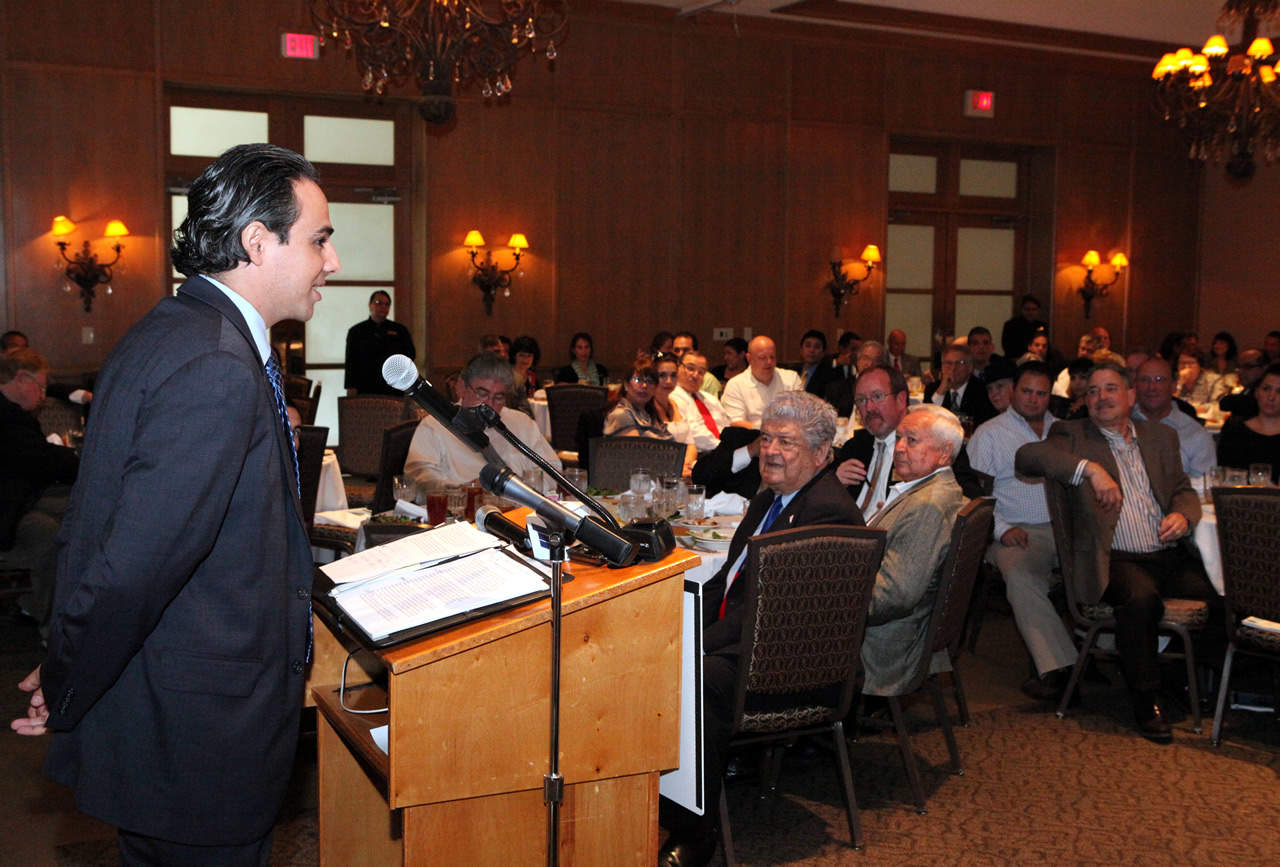
Rep. Terry Canales, D-McAllen, featured on Tuesday, September 17, 2013, addressing the State Legislative Session Wrap-Up Luncheon, sponsored by the City of McAllen, the McAllen Economic Development Corporation, and the McAllen Chamber of Commerce, held at the McAllen Country Club.
Photograph By MARK MONTEMAYOR
With a growing number of state agencies providing detailed information in Spanish on their respective websites, Rep. Terry Canales, D-Edinburg, is working to create a bilingual presence on the Internet for the Texas House of Representatives. Canales has filed House Bill 288, which proposes that key components of the home page for the House of Representatives, as well as for the individual websites for each of the 150 state representatives, also have the capability to be read in Spanish. “It is both practical and beneficial to offer legislative information in both English and Spanish. As we seek to modernize our government and keep pace with the 21st century, I believe we must allow legislative information to be accessible in English and Spanish,” said Canales, who is fluent in English and Spanish. “The success of government depends on effectively communicating with the public and offering nondiscriminatory, accurate information.” On Wednesday, March 18, HB 288 was unanimously approved by the House Committee on Transparency and Operation with the recommendation that it be approved by the House of Representatives, then sent to the Senate for their action. Canales noted that the Texas Senate for the past 14 years has maintained and improved its Spanish-language version of its Internet web site, including the individual official websites of each state senator. That site is available online at http://www.senate.state.tx.us/Senado.htm. The House of Representatives should also break down language barriers, the lawmaker said. “People in the United States should speak English because that is the most spoken language of our country, but we do not want to disenfranchise those (who are more fluent in Spanish),” Canales said. “According to a 2011 Census survey, almost 30 percent of Texans speak Spanish. Of that figure, more than 42 percent of those Texans speak English less than very well.” The Center for Immigration Studies found that the Census Bureau recently released information from the 2013 American Community Survey (ACS), including languages spoken for those five years of age and older. “The new data show that the number of people who speak a language other than English at home reached an all-time high of 61.8 million, up 2.2 million since 2010,” Karen Ziegler and Steven A. Camarota reported in their October 2014 article, One in Five U.S. Residents Speaks Foreign Language at Home, Record 61.8 million. “The largest increases from 2010 to 2013 were for speakers of Spanish, Chinese, and Arabic. One in five U.S. residents now speaks a foreign language at home.” (http://cis.org/record-one-in-five-us-residents-speaks-language-other-than-english-at-home). In 2007, the Centers For Disease Control and Prevention (CDC), a federal agency under the management of the U.S. Department of Health and Human Services, released updated information, based on the 2000 Census, that detailed the languages spoken in U.S. and Texas. According to the CDC, English and Spanish, or predominantly Spanish, are spoken considerably by Texas residents at their homes, including in the major metropolitan regions not located along the Texas-Mexico border: Harris County (Houston): 898,885; Dallas County (Dallas): 539,570; Bexar County (San Antonio): 517,885; Tarrant County (Ft. Worth): 218,615; Travis County (Austin): 168,285; and Nueces County (Corpus Christi): 118,745. These figures do not include residents in those counties who spoke English only. Counties bordering Mexico, as expected, reported large percentages of their residents who spoke English and Spanish, or predominantly Spanish. “Providing more Spanish-language content on the House of Representatives websites also will help generate more commerce with non-English nations which do business with Texas, he added. “Texas bordering Mexico also makes it crucial that our largest trading partner have access to our Legislature and the information we have.” According to http://www.TexasWideOpenForBusiness.com, which is a maintained by the Texas Economic Development Corporation – an arm of the Office of the Governor – Mexico in 2014 was ranked number one with $102.6 billion in Texas exports, followed by Canada ($31.1 billion), Brazil ($11.7 billion), China ($10.9 billion), and the Netherlands ($8.9 billion) as the top five international trade partners. Exports are goods or services sent from Texas to another country for sale. Mexico also held the top spot as country of origin for Texas imports, accounting for more than $90.1 billion, or 29 percent, of Texas imports in 2014. China ranked number two for Texas imports ($45.4 billion), followed by Saudia Arabia ($19 billion), and Canada ($17.4 billion), added TexasWideOpenforBusiness.com. Imports are goods or services sent from another country to Texas for sale.The public hearing, in its entirety, is available on the Internet by logging on to http://www.house.state.tx.us/video-audio/committee-broadcasts/ , then scroll down to “03/11/15 Government Transparency & Operation” and click the committee’s name.
•••••• (more…)
by Legislative Media | Mar 26, 2015 | Politics

Robert. S. Nelsen, Ph.D., former President of The University of Texas-Pan American, addressing a gathering at the Student Union Building on Thursday, October 24, 2013.
Photograph By MARK MONTEMAYOR
The California State University (CSU) Board of Trustees on Wednesday, March 25, appointed former University of Texas-Pan American President Robert. S. Nelsen, Ph.D., as President of California State University, Sacramento (officially known as “Sacramento State”). He will assume leadership of the university in July 2015. “Sacramento State has truly become a destination campus where students receive a transformative educational experience that prepares them for success in the future,” said Nelsen. “The opportunity to work alongside the many dedicated faculty and staff who guide students along that journey and prepare them for achievements beyond the classroom is incredibly exciting.” Nelsen will become the eighth permanent president of Sacramento State and succeeds Alexander González, who will retire at the end of the academic year after 12 years as president. “Dr. Robert Nelsen is an ambitious and visionary leader who will successfully build on the foundation President González has established at Sacramento State,” said CSU Trustee Steve Glazer, chair of the Sacramento State Presidential Search Committee. “He has extensive experience leading a large, diverse university and a long history of always putting students first.” Pedro Reyes, Ph.D., Executive Vice Chancellor for Academic Affairs for the UT System, congratulated Nelsen on the announcement, citing the soon-to-be former UTPA president long-lasting impact in Texas. “Dr. Nelsen served The University of Texas System with great distinction and we will miss his leadership and guidance,” said Reyes. “He embraced the culturally rich environment of the Rio Grande Valley as president of UT Pan American, and his passion and dedication for students and faculty and their success are without comparison.” Nelsen’s importance and influence in Edinburg also was recognized last fall with a proclamation in his honor unanimously approved by the Edinburg City Council. “Jody and I have loved everything about the Rio Grande Valley, and it will be very hard to leave this magical place,” Nelsen said. “But we are excited to embark on a new adventure in California, and we will take all of you with us in our hearts. Somos para siempre familia.”
•••••• (more…)
by Legislative Media | Mar 25, 2015 | Politics

Keith A. Patridge, President and CEO of the McAllen Economic Development Corporation, with Adriana Treviño, Marketing Director for the MEDC.
Photograph Courtesy McALLEN ECONOMIC DEVELOPMENT CORPORATION
Keith A. Patridge, President and Chief Executive Officer of the McAllen Economic Development Corporation, will share his extensive knowledge and experiences about business and how it is impacted by government and politics as one of three high-profile experts serving on a blue-ribbon panel for “Economic Development – A Regional Outlook” on Thursday, March 26 in Edinburg. The event, which is open to the public, will be held from 11:30 a.m. to 1 p.m. at the Edinburg Conference Center at Renaissance, 118 Paseo Del Prado. Joining Patridge will be Agustín “Gus” García, Jr., Executive Director of the Edinburg Economic Development Corporation, and Alejandro “Alex” Meade, Chief Executive Officer of the Mission Economic Development Corporation. The EEDC, which is a sponsor of the event, is the jobs-creation arm of the Edinburg City Council. The gathering on Thursday, which is organized by the Edinburg Chamber of Commerce, is also designed to allow business professionals to meet, network, and create opportunities for the companies they represent, costs $18 per person, or $200 for a table of eight, and includes a hot lunch, beverage and dessert. For more information or to make a reservation, individuals may call the Edinburg Chamber of Commerce at 956/383-4974. The Thursday, March 26 session is consistent with the strategies of the Edinburg Mayor, Edinburg City Council, and the Edinburg Economic Development Corporation Board of Directors, who have made regional cooperation with other South Texas cities a priority as part of their efforts to promote socioeconomic advances in deep South Texas. The McAllen Economic Development Corporation is one of that city’s pro-business, job-creation entities. According to the McAllen Chamber of Commerce, the MEDC is a not-for-profit corporation under contract with the City of McAllen to create jobs for McAllen by attracting new industry and helping existing companies to expand. With 28 years of working at the McAllen Economic Development Corporation and McAllen Foreign Trade Zone, Patridge has a great deal of experience in assisting companies with their start-up operations in either McAllen or Reynosa, according to his official biography. Patridge has worked with global companies planning a strategic move or expansion to service their industry from a cost competitive market. During his almost three decades of service with the McAllen Economic Development Corporation, that organization has assisted more than 600 companies in the relocation and start-up of successful operations in its community, resulting in the creation of tens of thousands of new jobs.
•••••• (more…)
by Legislative Media | Mar 22, 2015 | Politics

Alejandro “Alex” Meade, Chief Executive Officer, Mission Economic Development Corporation.
Photograph Courtesy OFFICE OF THE TEXAS GOVERNOR
Alejandro “Alex” Meade, Chief Executive Officer, Mission Economic Development Corporation, will be joining Keith A. Patridge, President and CEO of the McAllen Economic Development Corporation, and Agustín “Gus” García, Jr., Executive Director of the Edinburg Economic Development Corporation, on Thursday, March 26, in “Economic Development – A Regional Outlook”, hosted by the Edinburg Chamber of Commerce. The EEDC is the jobs-creation arm of the Edinburg Mayor and Edinburg City Council. The event, which is open to the public, will be held from 11:30 a.m. to 1 p.m. at the Edinburg Conference Center at Renaissance, 118 Paseo Del Prado. The gathering, which also will allow business professionals to meet, network, and create opportunities for the companies they represent, costs $18 per person, or $200 for a table of eight, and includes a hot lunch, beverage and desert. For more information or to make a reservation, individuals may call the Edinburg Chamber of Commerce at 956/383-4974. “The Edinburg Chamber of Commerce is looking forward to the gathering of three of the leading economic development professionals in the Rio Grande Valley,” said Elva Jackson Garza, Vice President of Edwards Abstract and Title Company, which is one of the event sponsors, and Vice Chair of the Edinburg Chamber of Commerce’s Public Affairs Committee. Public Affairs Luncheons are an initiative introduced in 2006, and have featured popular topics with speakers who cover important community and legislative issues. The vision is to inform, involve and educate chamber investors and civic leaders. “There are several important factors for scheduling the economic development panel. Primarily, the growth and vitality of the Rio Grande Valley have been impacted by the continued work and efforts of the economic development corporations,” Garza explained. “The Valley is poised to experience changes in the educational, industrial, commercial and residential sectors. Bringing these three EDC entities together will help further the regional mindset in the civic, business and community leaders.” Fred Sandoval, City Manager of Pharr and Director of the Pharr Economic Development Corporation, had also been invited to participate in the event, but a schedule conflict prevented his valued participation, according to Ronnie Larralde, Director of Marketing/ Special Events at Edinburg Chamber of Commerce. The Thursday, March 26 session is consistent with the strategies of the Edinburg Mayor, Edinburg City Council, and the Edinburg Economic Development Corporation Board of Directors, who have made regional cooperation with other South Texas cities a priority as part of their efforts to promote socioeconomic advances in deep South Texas.
•••••• (more…)