by Legislative Media | May 17, 2015 | Politics

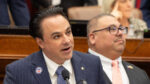
Featured, from left: Rep. Terry Canales, D-Edinburg, Congressman Rubén Hinojosa, D-Mercedes, and Rep. Óscar Longoria, Jr., D-La Joya, on Tuesday, March 25, 2014, after addressing the South Texas College Board of Trustees at the Pecan Campus in McAllen.
Photograph By STEVE TAYLOR
Legislation proposing the creation of a South Texas College extension facility in the Delta Region of Hidalgo County, which was approved by the House of Representatives on Friday, May 8, is set for a Senate committee hearing on Monday, May 18, Rep. Terry Canales, D-Edinburg, has announced. Originally filed to create a branch campus of STC in the Delta Region, Canales changed the language of House Bill 382 to instead call for the creation of an extension facility in order to dramatically reduce the financial cost to the state, which significantly improves its chances of legislative passage. “By requiring an extension facility, STC would be directed by the Texas Legislature to set up a physical presence in the Delta Region, a move that can eventually lead to a branch campus,” Canales said. “What we are wanting to do is move this one step further down the line. We believe that whatever concerns the college may have about the fiscal viability of this program will be shown dramatically to be unfounded because it will quickly flourish.” According to the Texas Higher Education Agency, a branch campus is a major, secondary location of an institution offering multiple programs, usually with its own administrative structure and usually headed by a Dean. A branch campus must be established by the Legislature or approved by the Coordinating Board. He said that STC has an obligation to spread its resources to areas of Hidalgo County which have the population base and geographic location to deserve an extension facility, and eventually, a branch campus. “The Delta Region has historically been a neglected area that can see a positive change from this bill. The area needs better access to higher education to have the same opportunities (as other communities with STC campuses and sites),” Canales said. But times are changing, and for the better, in the Delta Region, further justifying predictions that STC would also grow with those communities. “If we talk about demographics and you look at companies and ask, ‘What are the demographics there?’ Well, they just opened up a Walmart Supercenter, and a new H.E.B., and those businesses conduct incredible demographic studies before they make those multi-million dollar capital investments,” he continued. Canales also spoke about ongoing plans by the state transportation leaders to connect FM 1925, known as the Monte Cristo Road project, between Edinburg and South Padre Island, a thoroughfare which will go through the Delta Region. “The Texas Department of Transportation has opted to expand what is the existing Monte Cristo Road into a highway that will go all the way to Cameron County,” Canales said. “That is why Rep. Lucio and his father, Sen. Eddie Lucio, Jr., and Rep. René Oliveira, support this bill.” The public hearing will take place before the Senate Committee on Intergovernmental Relations, whose chairman is Sen. Eddie Lucio, Jr., D-Brownsville. The meeting, which is open to the public, was at 8:30 a.m. in Room E1.028 of the Texas Capitol complex. The session is available for live viewing on the Internet, or afterwards as a video recording in its entirety, by logging on to http://www.senate.state.tx.us/bin/live.phpby , find the desire program at the bottom of that web page, and click the “play” button. The live programs are listed by their scheduled start time. Lucio is the Senate sponsor of the measure, House Bill 382, of which Canales is the primary author. Canales’ proposal also enjoys vital support from House legislators from the two South Texas counties – Hidalgo County and Starr County – which STC serves. Rep. Óscar Longoria, Jr., D-La Joya, Rep. Armando “Mando” Martínez, D-Weslaco, Rep. Ryan Guillén, D-Rio Grande City, and Rep. Eddie Lucio, III, D-San Benito, are joint authors of Canales’ HB 382. The measure, which was approved by the House of Representatives on Friday, May 8, would require STC, which has campuses in McAllen, Weslaco and Rio Grande City, to establish an extension facility in either Elsa, which is in Canales’ House District 40, or in Edcouch, which is in Longoria’s House District 35. Under the proposal, the STC Board of Trustees are directed to set up the extension facility beginning with the 2016-2017 academic year. The legislation does not authorize STC to increase its property tax rate.
•••••• (more…)
by Legislative Media | May 15, 2015 | Politics

Featured: A section of the $70 million, four-story addition to the Science Building at The University of Texas-Pan American, which received final approval for funding and design development by the UT System Board of Regents in Austin on Thursday, May 14.
Graphics Courtesy MUÑOZ AND COMPANY
A $70 million addition to the Science Building at the University of Texas-Pan American has been approved by the UT System Board of Regents, paving the way for thousands of students a year to receive a cutting-edge education that will lead to professions focused on preventing and treating diseases that cause illnesses and deaths in people, the Edinburg Economic Development Corporation has announced. Meeting in Austin for a regularly-scheduled public meeting, the nine-member UT System governing board, which includes Ernest Aliseda of McAllen, on Thursday, May 14, gave final approval for the release of funding and of design development for the 115,000-square-foot structure. Anticipated construction start is scheduled for December 2015, anticipated substantial completion will take place by December 2017, and the final completion is expected by February 2018, according to the UT System. “This new facility represents the next big wave of higher education opportunities in Edinburg and for deep South Texas,” said Mayor Richard García. “In addition to the positive economic impact in our community from its construction, it will provide the crucial infrastructure, such as classrooms, offices, suites, works stations, laboratories, and equipment, to increase STEM graduates to 873 a year, and provide 16 additional labs that will reduce the time to graduate.” STEM stands for the fields of science, technology, engineering and math. Four teaching labs will allow 4,200 students to take courses and labs during the same semester. The overall project will accommodate 16 additional research labs, two classrooms, 42 faculty offices, 11 staff work stations, and eight suites for research assistants. According to the U.S. Department of Homeland Security, STEM-related programs became a national priority in 2011 because too few college students are pursuing degrees in these fields. The U.S. Department of Labor expects that there will be 1.2 million job openings in STEM related fields by 2018, but there won’t be enough qualified graduates to fill them. The EEDC, which is led by García, is the jobs-creation arm of the mayor and Edinburg City Council. The mayor serves as the President of the five-member EEDC Board of Directors, which works with EEDC Executive Director Agustín “Gus” García, Jr. and his staff on major projects, such as new construction and additional degree programs at UT-Pan American. Mayor Richard García and EEDC Executive Director Gus García are not related. Dr. Havidán Rodríguez, President Ad Interim for UT-Pan American, also serves on the EEDC Board of Directors. Rep. Terry Canales, D-Edinburg, whose House District 40 is home to UT-Pan American, works closely with the city’s elected and appointed leadership, as well as with UT System and UTPA officials, to promote growth and investment at the Edinburg campus, which serves more than 20,000 students. “I wish to commend the University of Texas System Board of Regents for their vision and drive to grow and expand the System’s resources in deep South Texas,” Canales said. “The Science Building (addition) will provide much needed classroom and lab space for the university, while increasing the instructional efficiency for all students of the new University of Texas System institution.” Canales in 2o13 was a joint cosponsor of Senate Bill 24 by Sen. Juan “Chuy” Hinojosa, D-McAllen, and Rep. René Oliveira, D-Brownsville, which is combining the resources of UT-Pan American and UT-Brownsville into that new institution referenced by Canales, to be known as The University of Texas-Rio Grande Valley. UT-Pan American will be the largest component of UT-RGV, complete with a full-fledged medical school, at the end of this August, when UT-Rio Grande Valley becomes a reality. “UT-RGV is more than a new university or a new logo, it is a vision for the future of our community. The investments that the UT System Board of Regents has made in the Rio Grande Valley bring with it a new opportunity for our youth to pursue a quality education and work towards a brighter future for them and their families,” Canales said. Michael O’Donnell, Associate Vice Chancellor for Facilities Planning and Construction for the UT System, noted that the $70 million addition will also provide the space necessary to increase research capacity for approximately 168 researchers, supporting physical and biological sciences with a focus on biomedical research. Hinojosa, whose Senate District 27 includes UT-Pan American, praised the emphasis on producing more students with high-level biomedical research capabilities. “Biomedical research involves the sciences whose goal is to come up with effective treatments and cures for the most serious afflictions, and just like the School of Medicine that is now under construction in Edinburg, this new addition to our Science Building will produce dramatic advances for all of Texas,” said Hinojosa. “When the upcoming 115,000 square-foot addition is connected to the existing Science Building, we will wind up with a 272,000 square-foot intensive STEM research and learning center. It is going to be an extremely large and impressive state-of-the-art complex.” The building will support 21st-century classroom and teaching pedagogies by providing additional group study rooms, collaboration spaces, huddle rooms located throughout the facility, and flexible classrooms and teaching labs supported with AV and IT technologies for long distance and enhanced learning, O’Donnell added. Rooms will also be designed to support multiple furniture configurations. He noted some of the many complexities of linking the Science Building and the $70 million addition. We are constructing a building on a completed, basically built-out campus. Accordingly, the vision and the decision consistent with the Master Plan to put this building in there, this is as big a building as we could fit in there. It met the needs of the campus as it was designed,” O’Donnell said. “But at the same time, this particular addition is very difficult to build, because we have to do lifts from outside, with cranes, into the facility, into the courtyard, to be able to complete the building.” Despite the challenges of connecting the $70 million addition to the exiting Science Building – including having to import contractors from outside the Valley for considerable specialized work – “this building is going to be built for a 21st century learning,” he said.
•••••• (more…)
by Legislative Media | May 13, 2015 | Politics

Rep. Terry Canales, D-Edinburg, on Tuesday, May 5, secured passage by the House of Representatives of his House Bill 1015, which will help Texas district judges rehabilitate petty criminals while they pay their debts to society.
Photograph By HOUSE PHOTOGRAPHY
Texas taxpayers will save money while improving the rehabilitation of tens of thousands of petty criminals every year, many of them serving drug-related sentences, under legislation by Rep. Terry Canales, D-Edinburg, which was approved on Tuesday, May 5 by the House of Representatives. House Bill 1015 would require the Texas Department of Corrections, which supervises 19 state jails in Texas, to notify a district judge, about two weeks ahead of time, when a felon sentenced in their court will have been locked up in a state jail for 75 days. Currently after the first 75 days served in state jails, offenders can be bench warranted back into community supervision, yet experts testified that this rarely occurs because judges do not have an adequate mechanism to monitor this benchmark for each offender, according to a 2014 study by the House Committee on Criminal Jurisprudence, of which Canales is a member. “State jails are notorious for being more expensive than even state prison, and for offenders who are serious about straightening out their lives, a judge can bring them back home for meaningful rehabilitation programs, diversion treatment, and community supervision, which costs taxpayers a fraction of keeping them in state jails,” Canales said. When the Texas state jail system was first created in 1993, it was intended to remove petty-criminals – many of them convicted of drug-related crimes – from contact with violent offenders as found in the prison system, reduce overcrowding in the prison system, and emphasize treatment and rehabilitation with the goal of reducing the chance those felons would wind up in trouble with the law again, the House committee study noted. But, Canales said, the state jail system – which currently houses around 10,000 “detainees” – is failing because it has is now used for warehousing inmates with no programs to provide rehabilitation. “Right now, no one lets the judge know when an offender who was sentenced in their court can begin the journey to becoming a law-abiding citizen, and instead, they wind up being forgotten for up to two years,” he added. “House Bill 1015 would let our judges take the important steps needed to prepare these offenders to return back to society, as they pay their debt to society.” The reliance on keeping offenders in state jails over community supervision has been criticized for costing taxpayers more money per offender, the House committee noted in its legislative findings, which were published on January 12, 2015. State jails average about $43 per day per offender. This cost is less than prison inmates cost per day, but when one takes into account the higher recidivism rate of state jail offenders, the fact they do not receive meaningful rehabilitation programs, and no parole, the cost is a poor return on taxpayers’ investment; especially for repeat offenders. In comparison, diversion treatment and community supervision costs an average of $10 per day. Therefore, state jails are no longer the backup to community supervision, but are the primary response to state jail felonies with minimal rehabilitation opportunities and maximum sentences served, the legislative committee also concluded. Canales credited Nueces County 117th District Judge Sandra Watts for bringing the issue to light when she testified before the House Committee on Criminal Jurisprudence during its public hearing held in Corpus Christi on Tuesday July 29, 2014. Canales credited Nueces County 117th District Judge Sandra Watts for bringing this and other issues to light when she testified before the House Committee on Criminal Jurisprudence during its public hearing held in Corpus Christi on Tuesday, July 29, 2014. Following House passage of HB 1015, Watts reflected, “This bill is another example that Texas is moving towards a ‘Smart on Crime’ approach and away from the ‘War on Drugs’.” During her testimony last summer before the Criminal Jurisprudence Committee, Watts told lawmakers that when the concept of state jails was first introduced, a key goal was to give nonviolent offenders a wake-up call about the consequences of their actions, then bring them back home on probation and rehabilitation. “Problem number one is you are assuming, or the law assumed, that there was a mechanism in place where judges would have a list of everybody they sent away (to state jails). There is no way,” Watts said. “The statute says that after they have served at least 75 days, the district judge has the ability to bench warrant them back and put them on probation. I’m probably as computer literate as they come, and I have spreadsheets about all my inmates, but I can’t keep up with who I’ve sent or this time period.” To further illustrate the need for HB 1015, Watts noted that in 2011, there were 23,000 detainees who went through the state jail system. “Of those 23,000, only 158 in that calendar year were bench warranted (court-ordered) back and put back into community supervision,” she explained. “The intention was perhaps good but has been underutilized. It is not working as perhaps the Legislature in 1993 thought that it would, mainly because of the masses of detainees or the defendants we deal with. We do not have anyway to track them, keep them in our mind.”
•••••• (more…)
by Legislative Media | May 12, 2015 | Politics

Featured, from left: Yolanda González, District Manager at Wells Fargo Upper Rio Grande Valley & Laredo; Sabrina Walker-Hernández, Chief Professional Officer/Executive Director, Boys and Girls Club of Edinburg Rio Grande Valley; and Alma Ortega-Johnson, Area President South Texas Region-Wells Fargo, on Friday, May 8, 2015, during grand opening ceremony of the Wells Fargo newest branch, located at 1628 West University Drive.
Photograph By DIEGO REYNA
Edinburg’s retail economy for the month of March 2015 was 9.84 percent better than the same month last year, generating $1,926,165.61 in local sales taxes, compared with $1,753,587.06 in March 2014, the Edinburg Economic Development Corporation has announced. The EEDC, led by Executive Director Agustín “Gus” García, Jr., is the jobs-creation arm of the Edinburg Mayor and Edinburg City Council. Mayor Richard García (no relation to Gus García, Jr.) is President of the EEDC Board of Directors. That showing was the best among all of the Valley’s major cities for March 2015, according to the Texas Comptroller of Public Accounts, which on Wednesday, May 6, released statewide figures, which represents the most up-to-date figures information for that state agency. Edinburg’s almost 10 percent improvement also was significantly higher than the average of all city economies in the state, which combined showed an improvement of 6.2 percent when comparing March 2015 with the same month last year, the state comptroller’s office also reported.The amount of local sales taxes collected helps reflect the strength of an economy, along with construction activities, per capita income, education, historical performances, and related trends. Year-to-date, the Edinburg economy is 7.15 percent ahead of 2014, having produced $8,603,397.65 from January through March 2015 in local sales taxes, compared with $8,028,833.80 during the same period last year. The local sales tax figures represent sales made in March as well as January, February and March sales by businesses that report tax quarterly, sent to the Texas Comptroller of Public Accounts in April, and returned as sales tax rebates to the respective local government entities in May. The local sales tax is used in Edinburg to help pay for many city services, while the EEDC uses its one-half cent local sales tax to help generate economic development in the city. The sales tax, formally known as the State Sales and Use Tax, is imposed on all retail sales, leases and rentals of most goods, as well as taxable services. Texas cities, counties, transit authorities and special purpose districts have the option of imposing an additional local sales tax for a combined total of state and local taxes of 8 1/4% (.0825).
•••••• (more…)
by Legislative Media | May 10, 2015 | Politics

Featured, from left: Dr. Havidán Rodríguez, President Ad Interim, The University of Texas-Pan American, and Edinburg Mayor Richard H. García, during ceremonies on Friday, February 28, 2015 in Pharr at the Boggus Ford Events Center, where García was honored as one of five alumni named 2015 Pillars of Success, in recognition of their outstanding contributions to the region and to UTPA, which will become The University of Texas-Rio Grande Valley, complete with a full-fledged UT medical school, in late August.
Photograph By JOSUE ESPARZA
Fresh off the grand opening of the $42.7 million Performing Arts Complex at the University of Texas-Pan American – and with the nearby $54 million Medical Education Building taking shape – local and state leaders are awaiting final approval on Wednesday, May 14, for the release of funding and final approval of design development for a $70 million Science Building at the Edinburg campus. The upcoming action item by the UT System Board of Regents, which will be part of that governing body’s regularly-scheduled public session in Austin, was announced by the Edinburg Economic Development Corporation, Sen. Juan “Chuy” Hinojosa, D-McAllen, and Rep. Terry Canales, D-Edinburg. The EEDC is the jobs-creation arm of the Edinburg Mayor and Edinburg City Council. The EEDC, whose president of its five-member Board of Directors is Mayor Richard García, is led by Agustín “Gus” García, (no relation to the mayor), the Executive Director for the EEDC. Dr. Havidán Rodríguez, President Ad Interim for UT-Pan American, also serves on the EEDC Board of Directors. The Science Building is vital since it will provide the academic skills, equipment, and laboratories to prepare university students to attend and succeed in the UT medical school in Edinburg, scheduled to open in Summer/Fall 2016, said Rodríguez. “This facility will provide the research experience that they need, with the expectation that our students will continue through a number of pre-med programs needed to apply to medical school here, and medical schools throughout the country,” Rodríguez explained. “The idea is to get these folks trained, have them get their M.D.s, and return to the Rio Grande Valley, or stay in the Rio Grande Valley to provide the healthcare needs of our population.” The Science Building will help increase the quality and number of courses known as STEM, which stands for the fields of science, technology, engineering and math. According to the U.S. Department of Homeland Security, STEM-related programs became a national priority in 2011 because too few college students are pursuing degrees in these fields. The U.S. Department of Labor expects that there will be 1.2 million job openings in STEM related fields by 2018, but there won’t be enough qualified graduates to fill them. “The four-story Science Building will be built on the Edinburg campus for the benefit of UT-Rio Grande Valley,” the mayor said, citing UT System documents. “The approximately 115,000 gross square foot facility will increase research capacity for approximately 168 researchers and provide four teaching labs allowing students to take courses and labs during the same semester. The project will accommodate 16 additional research labs, two classrooms, 42 faculty offices, 11 staff work stations, and eight suites for research assistants.”
•••••• (more…)
by Legislative Media | May 7, 2015 | Politics

Featured, from left: Hidalgo County 332nd District Court Judge Mario E. Ramírez, Jr. and Robert “Bobby” Villarreal, Economic Development Director for Hidalgo County Judge Ramón García, on Tuesday, March 3, addressing the Hidalgo County Commissioners Court at their meeting at Edinburg City Hall.
Photograph By JACLYN TREVIÑO
Legislation that could raise between $1 million and $2 million a year for the next 30 years to help pay for a new courthouse or renovations of the existing, 64-year-old facility in downtown Edinburg – without increasing property taxes – has been approved by the Senate and is awaiting final action by the House of Representatives. Senate Bill 1964, by Sen. Juan “Chuy” Hinojosa, D-McAllen, was approved by the Senate on Wednesday, April 29, and will be carried (sponsored) by Rep. Armando “Mando” Martínez, D-Weslaco, and Rep. Terry Canales, D-Edinburg, in the House. As of the end of Wednesday, May 6, SB 1964 or the identical measure, House Bill 2868, authored by Martínez/Canales, had not yet been set for a vote by the full House of Representatives. On Wednesday, May 6, Canales signed on as a joint author of Martínez’ HB 2868, publicly throwing his support for the effort which could result in the construction of a $100+ million courthouse in the heart of his House District 40 legislative district. “The Hidalgo County Courthouse complex is one of the major economic engines, along with the University of Texas-Rio Grande Valley and its School of Medicine, that is part of a tremendous revitalization that is going on in deep South Texas,” Canales said. “Just as important, South Texans need a courthouse that provides a safe and secure environment for the administration of justice for individuals and businesses.” Both measures carry the same language, which would allow Hidalgo County to assess a user fee through certain court cases and recording fees to help fund a new courthouse. The new revenue would be generated by adding a $20 fee to the filing of each civil case in Hidalgo County, and be adding a $10 charge to the fee required by the county government for recording the title, mortgages and other liens against property. “SB 1964 allows Hidalgo County to collect a civil courts filing fee similar to the one currently collected in Bexar, Hays, Dallas, Rockwall, and Travis Counties and other courts to assist with the costs of renovating, improving, or constructing new courthouse facilities,” said Hinojosa. On Tuesday, March 3, the Hidalgo County Commissioners Court unanimously approved endorsing the legislation, with Hidalgo County 332nd District Court Judge Mario E. Ramírez, Jr. expressing the support of the Hidalgo County judiciary. During that public session, Hidalgo County Judge Ramón García explained the importance of securing the support for the Hinojosa measure from the judges who lead the county’s system of district, county, and probate courts. “We want to make sure the community is aware that the judiciary is totally in support of our efforts in trying to do what we can to build a new courthouse here in the county, and one of those efforts involves our legislators, specifically Sen. Hinojosa, that will allow the assessing of user fees, or an additional filing fee, to help come up with with somewhere between $1 million to $2 million (a year) that will be set aside and used for a payment of a new courthouse facility,” said García. Ramírez, the senior judge for Hidalgo County, and the longest-serving, currently presiding judge in the 5th Region of Texas, agreed for the need for the legislation. “Speaking for the judiciary, it is really, really obvious that we need a new courthouse. We try cases over there, Judge (García), with multi-parties, and courtrooms are too small. There is no place to put the jurors, the jurors are uncomfortable, and we are unable to try the large, big cases that we have with multi-parties in the space that we have at the present time.” Ramírez added, “It is unsafe at the courthouse, it is not secure, there are many, many problems, and certainly, the judiciary stands united in supporting this resolution.”
•••••• (more…)
by Legislative Media | May 4, 2015 | Politics

Featured, on the floor of the House of Representatives in February 2015: Rep. Terry Canales, D-Edinburg, and Rep. Donna Howard, D-Austin.
Photograph By HOUSE PHOTOGRAPHY
Texas judges would have a new, proven tool for juveniles who are placed on community supervision or deferred disposition (commonly called probation) for illegal drug use under legislation passed out of the Texas House by Rep. Terry Canales D-Edinburg. Judges would be able to require these youth to attend state-approved substance education programs. Under his measure, House Bill 642 – which was approved by the Texas House of Representatives on Thursday, April 30 – a presiding judge would have the authority to require a young offender, under age 18, to attend a class focused on the terrible consequences of unlawful drug abuse as a requirement for avoiding a harsher penalty or permanent criminal record. “Currently, minors who are convicted of drug offenses can be required to attend an alcohol awareness program. These programs are designed to help increase a minor’s awareness of the potential dangers and detriments of alcohol use,” Canales explained. “Unfortunately, this requirement does not extend to minors who are placed on deferred disposition or community supervision for drug-related offenses.” Deferred Disposition is a form of probation, which allows for dismissal of a charge if certain criteria(s) are met. Community supervision means the placement of a defendant by a court under a continuum of programs and sanctions, with conditions imposed by the court for a specified period. But, many young people who commit these offenses – often minor in nature – are entering pre-trial programs where they are not actually convicted of the crime, the House 40 state lawmaker continued. “A large percentage of juvenile crimes are misdemeanors involving kids with small amounts of drugs. These kids do not need to go to jail. They need an approach tailored to their issues,” Canales said. “Judges need more power to require local programs aimed to help our youth.” According to the bill analysis of Canales’ HB 642: The bill would amend the Code of Criminal Procedure and Family Code to permit a judge to require certain defendants, as a condition of community supervision, to attend and complete an alcohol awareness program, approved under Section 106.115, Alcoholic Beverage Code or drug education program, approved by the Department of State Health Services. The bill would require a judge to order the defendant to pay the cost of attending the program, unless the defendant is found to be indigent or unable to pay the cost. Under certain circumstances, the judge would be permitted to require the defendant’s parent or guardian to pay the cost of attending the program. Under the provisions of the bill, the Department of State Health Services would be responsible for the administration of the program, provide training to a person who provides the program, and would be required to adopt rules regarding the drug education program. Canales, an attorney, said one of the many reasons for his legislation is simple: “We can’t just keep pushing kids into prison and hoping that they’re going to get better.” Educational awareness can combat the prevalence of illegal drug usage, and drug-associated criminal activity, he contended. “Our youth need to be made more aware of the mental, behavioral, and physical dependencies caused by drug and alcohol abuse. According to the American Psychological Association and the American Medical Association, drug and alcohol addiction is a disease,” Canales said. “Juvenile offenders in general are more likely to struggle with mental health and substance abuse issues. My bill will help these young Texans get on the right path.” Canales, a member of the crime-fighting House Committee on Criminal Jurisprudence, said he continues shaping legislation that will include battling violent thugs, locking up sexual predators, capturing drug dealers, and putting away robbers, burglars, and swindlers. But he also agrees, especially in the case of a young person who has not yet reached adulthood, that in Texas, everyone who deserves a second chance should get one. “We should not want to destroy the life of a such a young person for a simple mistake or a lack of judgment,” Canales said.
•••••• (more…)
by Legislative Media | Apr 30, 2015 | Politics

Featured, from left: Dr. Dahlia Guerra, D.M.A., Dean of the College of Arts and Humanities, the University of Texas-Pan American; Edinburg Mayor Richard García; Kirk Clark and Jeri Clark, patrons of the UTPA arts, on Thursday, April 23, in the reception room of the $42.7 million Performing Arts Complex at The University of Texas-Pan American.
Photograph By MARK MONTEMAYOR
Edinburg’s unemployment rate for March 2015 was 4.8 percent, representing the second consecutive month that the city posted a monthly rate under five percent, with only McAllen being the other major Valley city to come under five percent, the Edinburg Economic Development Corporation has announced. The EEDC is the jobs-creation arm of the Edinburg Mayor and Edinburg City Council. Edinburg’s unemployment rate, as reported by the Texas Workforce Commission, was the best showing for the city during that month since March 2008, when it was reported at 4.4 percent by the state agency. The city’s latest performance also was better than the U.S. unemployment rate for March 2015, which came in at 5.5 percent, according to the U.S. Department of Labor, Bureau of Labor Statistics. The latest data represents an increase of 457 jobs in Edinburg when comparing the employment figures for March 2015 and March 2014. In March 2015, there were 35,651 persons employed in Edinburg, compared with 35,194 in March 2014. Those most recent figures, released on Friday, April 19 by the Texas Workforce Commission, came about a week before the Grand Premier of the Performing Arts Complex at The University of Texas-Pan American. On Thursday, April 23, the latest ultra-modern complex in Edinburg formally opened to the public, with a free concert, which included faculty and student performers from both campuses, that attracted not only arts patrons, but also students and community members to the 1,000-seat, state-of-the-art performance hall. Dr. Dahlia Guerra, D.M.A., Dean of the College of Arts and Humanities, built on the economic impact theme of the new performing arts conglomerate. “The arts bring so much to a community. It is the heart and soul,” said Guerra, whose brother is Edinburg Mayor Richard García. “The artists bring with them a draw to the community because a city wants to have these opportunities to offer their citizens.” In addition to the cultural aspects of Edinburg that will be enhanced because of the new facility, the financial prosperity of the city also will be increased, she added. “A community that is rich in the arts and rich in culture, it draws business, it draws hotels, it benefits the local economy because people will come to Edinburg to see the events, concerts, art exhibits,” Guerra said. “A rich community will be rich in arts and culture.” The Performing Arts Complex is a $42.7 million investment by the Texas Legislature and the UT System Board of Regents which was the result of successful lobbying several years ago by the Edinburg Mayor, Edinburg City Council, and Edinburg Economic Development Corporation. City officials credit Sen. Juan “Chuy” Hinojosa, D-McAllen, for delivering on the state legislation that resulted in the funding, through the issuance of tuition revenue bonds, for the Performing Arts Complex. Hinojosa shared the praise with his fellow state lawmakers and UTPA leaders, past and present, and reflected on the significance of the Performing Arts Complex. “Today is a momentous day in the history of this campus and of our community. We are opening the most magnificent performing arts center you can imagine,” said Hinojosa, who participated in the public ceremony. “It is wonderful acoustics, incredible lighting and sounds. The most important part to me is that it is an academic performing hall. There are classrooms which are rehearsal halls for our students. Now, they will have the best facilities, and it really does makes a difference when it comes time for performing.” Guerra provided additional details that are designed to make all performances reach world-class levels. “On this stage, there is an incredible amount of clarity. The sound bounces from the stage through the entire auditorium, so the student is required to have very fine-tuning skills to listen carefully and make sure he or she is at the top of their game,” she said. “We will see an improvement in the musical skills of our students.”
•••••• (more…)
by Legislative Media | Apr 29, 2015 | Politics

Featured, from left: Dr. Cynthia Brown, Deputy Provost, The University of Texas Rio Grande Valley; Dr. Guy Bailey, Founding President, UT-RGV; Doug Matney, Regional Vice President, South Texas Health System and President, McAllen Medical Center Foundation; Dr. Matthew Johnson, Associate Professor of Medicine, South Texas Diabetes and Obesity Institute; Dr. Francisco Fernández, Founding Dean, UT-RGV School of Medicine; and Dr. Havidán Rodríguez, President Ad Interim, UT-Pan American, and Founding Provost and Executive Vice President for Academic Affairs, UT-RGV.
Photograph By JOSUE ESPARZA
The University of Texas Rio Grande Valley and the South Texas Diabetes and Obesity Institute have gained another partner in the fight against diabetes. The McAllen Medical Center Foundation, a nonprofit wing of the McAllen Medical Center, on Monday, April 27, announced that it is funding a $100,000 professorship for the institute, a UT-RGV research, clinical and education program that will conduct advanced research on diabetes and obesity and, ultimately, help develop better treatments. During a press conference Monday at McAllen Medical Center, UT-RGV Founding President Guy Bailey thanked the foundation for its support and said partnerships with area hospitals are key to the success of UT-RGV and its School of Medicine. “It’s really kind of a second red-letter day,” Bailey said. “Last week, the Texas Higher Education Coordinating Board gave its stamp of approval for our M.D. (degree). We followed it up this week with an extraordinary gift.” The partnership established with this endowment will allow UT-RGV to tackle an increasingly pervasive health issue for the Valley and the nation. About 30 percent of people in the Valley have diabetes, Bailey said, and it is the seventh-leading cause of death in the United States. “Together, we’ll go forward. We’ll combat diabetes,” Bailey said. “It’s not something we’ll solve tomorrow, but the research that happens will be something that will address and ameliorate it in the future.” Doug Matney, Regional Vice President of South Texas Health System and President of the McAllen Medical Center Foundation, said the foundation traditionally has awarded scholarships to students pursuing degrees in healthcare-related fields, but decided to start the endowment with UT-RGV to support its work in researching diabetes. “We will look to a large degree to UT-RGV to do the research and to come up with some of the solutions that, hopefully, we’ll be able to implement face-to-face with the patients,” Matney said. “Our area of expertise is providing health care. When it comes to education, educational institutions are in a better position on how to select, how to spend those dollars. From our standpoint, we wanted to put those dollars in the hands of who we thought would be the best steward of them and, as a result, we chose to work with UT-RGV,” he added. “Diabetes research is something that certainly adds value to this community.”
•••••• (more…)
by Legislative Media | Apr 28, 2015 | Politics

Featured: University of Texas-Pan American senior Sabrina Herrera in the Science Building Laboratory where she conducts her research that hopefully one day will result in more effective treatments of cancer.
Photograph By JOSUE ESPARZA
Taking a trip to Austin to present her research at the “Texas Undergraduate Research Day at the Capitol” was a once-in-a-lifetime opportunity for Sabrina E. Herrera, a 23-year-old senior at The University of Texas-Pan American. “It was all hustle and bustle and a very different environment for me,” said Herrera, who had never visited the Texas Capitol before. “I was honored to represent UTPA. I was able talk to and learn the different research backgrounds of other students there and to hear the challenges and insights from distinguished faculty who were there. The overall experience gave me confidence.” In addition to Herrera, three students from The University of Texas at Brownsville – Isaiah Díaz, Iram Lerma and Forrest Shriver – displayed their research posters for review by state lawmakers and visitors in the Capitol Ground Floor. The March 4 event showcased the diverse and cutting-edge research by 67 students representing 57 Texas universities. The students’ research poster presentations were on display in the Capitol, where they told legislators and other visitors about their findings and the skills they have attained as researchers. The trip included a tour of the Capitol building and panel presentations by faculty researchers. Former Rep. Verónica Gonzáles, D-McAllen, who now serves as Vice President for Governmental and Community Relations at The University of Texas-Rio Grande Valley, coordinated the Austin event for the for Valley students. Gonzáles arranged for the students and professors to meet with Valley legislators and members of their respective staffs, including Rep. Terry Canales, D-Edinburg; Rep. Bobby Guerra, D-McAllen; Rep. Ryan Guillén, D-Rio Grande City; Rep. Eddie Lucio, III, D-San Benito; Rep. Armando “Mando” Martínez, D-Weslaco; and Rep. René Oliveira, D-Brownsville.
•••••• (more…)