by Legislative Media | Sep 18, 2015 | Politics

From left: Agustín García, Jr., Executive Director, Edinburg Economic Development Corporation; Edinburg City Manager Ramiro Garza, Jr; City Councilmember J.R. Bentancourt; Rep. Terry Canales, D-Edinburg; Councilmember Richard Molina; Víctor G. Guerra, General Counsel, Pathfinder Public Affairs; Rep. R.D. “Bobby” Guerra, D-McAllen; and Jesse Ozuna, Chief Administrator, Precinct 4 County Commissioner Joseph Palacios. These South Texas leaders met in advance of a legislative reception recognizing Tuesday, February 10, 2015 as Rio Grande Valley Day at the Texas Capitol.
Photograph By DIEGO REYNA
The recent announcement by longtime Edinburg city manager Ramiro Garza, Jr. that he will end his public career with the City of Edinburg at the end of December 2015 may have caught area residents by surprise. After all, during what will wind up being an almost 16-year tenure as one of the city’s top appointed leaders, Garza, 41, has been a key and visible figure in the social and economic development of Edinburg. The Port Isabel native, with academic pedigrees that include a Bachelor of Business Administration, Finance and a Master of Business Administration, Business Administration and Management, General, both from the University of Texas at Brownsville, first came to Edinburg in September 2000 to take the reigns as executive director for the Edinburg Economic Development Corporation. The EEDC, of which Agustín García, Jr., is Executive Director, is the jobs-creation arm of the Edinburg City Council. The EEDC Board of Directors is comprised of Mark Iglesias as President, Harvey Rodríguez as Vice President, Ellie M. Torres as Secretary/Treasurer, and Mayor Richard García and Richard Ruppert as Members. Following a successful nine years, three months on the job with the EEDC, Garza, now married with children, was tapped as the city manager for Edinburg in November 2009. With the exception of a six-month leave-of-absence from December 2011 to May 2012 for his first entry into seeking elected office (for Congress, no less), Garza has been the leader of the 700-member city staff, which helps him manage the city’s $100 million annual operational budget. Garza said he was humbled and appreciative for the show of confidence over the years from the mayor and city council. “I am very, very grateful. It has been such an honor and a privilege to serve on the EEDC and then as city manager. When you have that kind of support, it is incomparable. It allows you to go out there and do all you can to help improve the city,” Garza said. “I or any of our staffs would not be able to do what we do without their unwavering support. They set the policies, they have high expectations. Throughout the different administrations, they have been great leaders.” Ever the diplomat, Garza saved high praise for the city and its residents who have helped him succeed. “Edinburg is a very welcoming community. I was made to feel like I was part of the families here, and it allowed me to work with some fine individuals over the course of the past 15 years,” Garza said. “The same open arms that I received, that is how other people are received in Edinburg. You see that with new residents, new businesses, they are made to feel part of the community. Those are some of the reflections I have of Edinburg.” Garza hopes that his successor will enjoy the same blessings that have highlighted Garza’s role as one of the longest-serving city manager’s in Edinburg history. “There is this hunger in Edinburg to bring new opportunities, more shopping, more restaurants, industrial development. It shows in what has happened in the past two years. Over the past 10 years, our assessed values have grown over the last decade. There has been been more than one million square feet of new retail in Edinburg, hundreds of new homes where people can have choices on where to live,” Garzas said. “I was very lucky to have been part of that.” As for offering any advice to his successor, Garza said the best is yet to come. “Edinburg is at the cusp of undergoing another period of important growth, with the new university and the new medical school. There are still challenges of not being able to improve the community in every way we would like to. It’s about building on the strong momentum that we have,” Garza said. “Whoever is going to come in, have an open mind, and roll up their sleeves and work hard with the elected leadership, and anything can be done.”
•••••• (more…)
by Legislative Media | Sep 14, 2015 | Politics

Featured, front row, from left: Francis Whitworth, Edinburg Arts Foundation Board; Tony Casas, Cultural Activities Board; Edna Peña, Edinburg Arts Foundation Board, Cultural Activities Board; Letty Reyes, Edinburg Economic Development Corporation, Edinburg Arts Foundation Board, South Texas International Film Festival Board; Letty Leija, Director of Library & Cultural Arts, South Texas International Film Festival Board; Cynthia Sarmiento, CineSol Film Festival; Kim LeBlanc, Production Consultant, Texas Film Commission, Office of the Governor; and Magdiel Alfonso, Edinburg Arts Foundation Event Coordinator, South Texas International Film Festival Board. Back row, from left: Henry Serrato, CineSol Film Festival; Jonathan Torres, Edinburg Arts Foundation Board, South Texas International Film Festival Board; and Luis Enrique Suñer, El Mañana, South Texas International Film Festival Board. This image was taken on Saturday, August 22, at the awards ceremony, held at the Edinburg Conference Center at Renaissance, for the South Texas International Film Festival.
Photograph By MARK MONTEMAYOR
Edinburg’s retail economy from January through July 2015 is almost six percent ahead of the same period last year, a figure that is better than the statewide average of all Texas cities, which came in with a 4.8 percent improvement year-to-date, the Edinburg Economic Development Corporation has announced. The EEDC, of which Agustín García, Jr. is Executive Director, is the jobs-creation arm of the Edinburg Mayor and Edinburg City Council. The EEDC Board of Directors is comprised of Mark Iglesias as President, Harvey Rodríguez as Vice President, Ellie M. Torres as Secretary/Treasurer, and Mayor Richard García and Richard Ruppert as Members. For the month of July 2015, the city’s retail economy registered a four percent rate of improvement over the same month last year, the EEDC added, according to data released on Thursday, September 10, by the Texas Comptroller of Public Accounts. For the first seven months of 2015, Edinburg’s retail economy has produced $15,140,562.15 in local sales taxes, compared with $14,285,511.68 for January through July 2014, representing an improvement of 5.98 percent. During July 2015, the city’s retail economy generated $1,549,113.91 in local sales taxes, compared with $1,489,519.36 for July 2014, also according to the Texas Comptroller of Public Accounts. The local sales tax is used in Edinburg to help pay for many city services, while the EEDC uses its one-half cent local sales tax to help generate economic development in the city, said Agustin García, Jr., Executive Director for the Edinburg Economic Development Corporation. The amount of local sales taxes collected also helps reflect the strength of an economy, along with construction activities, per capita income, education, historical performances, and related trends, García explained. “Any retail economy is measured by consumer spending patterns for goods and services, such as for consumer durables, which are goods that usually last more than three years, and consumer nondurables, which usually last less than three years,” the EEDC Executive Director noted. “But there are other key factors, such as entertainment venues, which also bring in money into our community, and Edinburg is also leader in those events.” On Friday, August 21, and Saturday, August 22, the inaugural South Texas International Film Festival, which included EEDC as one of the sponsors and organizers, was showcased as an example of high-quality and cutting-edge industries being positioned to help the local economy, said Mayor Richard García, who serves on the Board of Directors of the Edinburg Economic Development Corporation. Mayor García and EEDC Executive Director Agustín García, Jr. are not related. “In hosting the South Texas International Film Festival, we are creating a home to the film arts in our region, and in doing so, proudly displayed the tremendous homegrown talent we have in our region,” noted the mayor. “During this tremendous gathering, we provided the educational courses, know-how, and generated the business connections to foster creativity in our local film industry, which can help our economy continue to flourish and diversify.” Mayor García and Board President Iglesias praised the work of Edinburg area residents who worked diligently to pull of a very successful film festival, notably the EEDC, the Edinburg Chamber of Commerce, the City of Edinburg, Edinburg Arts, and the Consulado de México en McAllen (Mexican Consulate in McAllen). Iglesias noted how the City of Austin has helped its economy prosper through entertainment venues, specifically its now famous South by Southwest Music Festival, which has become the largest music festival of its kind in the world. “According to a 2014 economic impact study by Greyhill Advisors, the economic impact of the South by Southwest Music Festival, which also includes film components, totaled $315.3 million in 2014,” said Iglesias. “First organized in 1987, the South by Southwest Music Festival has had an economic impact on it’s hometown over the past five years of more than $1 billion. These are the high standards by which we in Edinburg set our goals.” The mayor agreed. “For several generations, we in South Texas have worked for a medical school, and by the Fall of 2016, we will be finally opening the doors to a UT School of Medicine, including a major presence here in Edinburg,” said Mayor García. “What that shows everyone is all good things are possible for our region. All it takes is determination and hard work, and the South Texas International Film Festival is the latest example of the vision of our people.” The mayor, along with the Edinburg City Council and EEDC Board of Directors, were influential in the passage of state legislation in 2013 that resulted in the creation of the University of Texas Rio Grande Valley School of Medicine, which includes a $54 million Medical Academic Building now under construction in Edinburg. Occupying more than 88,000 square feet, the new Medical Academic Building will be a teaching facility that promotes faculty and student interaction at the beginning stages of medical school, according to the UT System. The building will include an auditorium, digital library, clinical skills center, pre-clinical laboratories and an anatomy teaching facility. Multiple small classrooms, seminar rooms and other features will offer opportunities for small group problem solving and inter-professional educational experiences.
•••••• (more…)
by Legislative Media | Sep 9, 2015 | Politics

Featured, from left: Agustín García, Jr., Executive Director, Edinburg Economic Development Corporation; Councilmember Richard Molina; Mark Iglesias, President, EEDC Board of Directors; and Mayor Richard García, Member, EEDC Board of Directors, in the Edinburg City Council Chambers at Edinburg City Hall on Wednesday, May 13, 2015.
Photograph By MARK MONTEMAYOR
The combined value of permits issued for construction and related building activities in Edinburg from January through July 2015 totaled more than $78 million, compared with almost $74 million during the same period last year, the Edinburg Economic Development Corporation has announced. A building permit includes the estimated value of the work, but does not include the price of the lot. In general, a building permit is legal permission given by the City of Edinburg to erect, construct, renovate, maintain, or conduct any other specified activity on any building or structure, or on any installations or facilities therein. The term “building permit” includes but is not limited to building permits, electrical permits, mechanical permits, and plumbing permits. The EEDC, of which Agustín García, Jr. is Executive Director, is the jobs-creation arm of the Edinburg Mayor and Edinburg City Council. The EEDC Board of Directors is comprised of Mark Iglesias as President, Harvey Rodríguez as Vice President, Ellie M. Torres as Secretary/Treasurer, and Mayor Richard García and Richard Rupert as Members. The latest figures do not include the more than $107 million for new construction projects, approved by the University of Texas System Board of Regents, which are scheduled to begin this year or which have been authorized this year. UT-RGV, formerly known as UT-Pan American, is a state entity, so the city does not issue building permits or include the value of any construction at the university campus in the data put together by Edinburg’s Code Enforcement Department. “On Thursday, May 14, the UT System Board of Regents gave final permission for the release of funding and of design development for a $70 million, 115,000-square-foot addition to the Science Building at UT-RGV in Edinburg, and that facility, which will be the largest on campus, is set to begin construction this December,” said Mayor García. “A few weeks ago, on Wednesday, August 19, the UT System Board of Regents agreed to begin the process that will lead to the construction of a $37.6 million, 77,000-square-foot Interdisciplinary Engineering and Academic Studies Building for the Edinburg campus.” In addition, the UT System Board of Regents on August 19 gave the go-ahead for UT System officials to negotiate the purchase of 53 acres, located at the southeast quadrant of North Sugar Road and West Chapin Street in Edinburg, from Norquest Family Holdings, Ltd., for “future campus expansion”, the mayor noted. EEDC Board President Iglesias said the Edinburg City Council and the EEDC Board of Directors continue to significantly influence the growth of the local economy with their legislative and public policy strategies, such as lobbying the UT System Board of Regents and the Texas Legislature for more state resources for UT-RGV and the UT-RGV School of Medicine in Edinburg. “The EEDC Board of Directors, the Mayor and City Council work as partners, not only with each other, but with our legislative delegations in Austin and Washington, D.C., with our business and community leaders in our city, and especially with our citizens to set high goals and surpass them,” said Iglesias. “With more economic prosperity and investments, such as these incredible advances in higher education, we will continue to see key growth in construction of homes and businesses in Edinburg.” EEDC Executive Director Agustín García, Jr. (no relation to the mayor), said part of Edinburg’s successes is the determination of the elected and appointed leadership in the community to shape state and national policies, on their own or with other regional and statewide groups, for the benefit of the local economy. “Border security, health care, immigration, job creation, they are all important for the city’s prosperity and quality-of-life, and wherever the decisions on such issues are being made that affect us, from the county courthouse to the state and U.S. capitols, we make sure that we are part of the solution,” said the EEDC Executive Director. “That vision and direction come from the EEDC Board of Directors, the Mayor and the Edinburg City Council, who consult with our citizens, and we see the fruits of their labor throughout Edinburg.” From January through July 2015, building permits valued at $78,554,684 were issued by the city, compared with $73,830,585 for the same period in 2014. The top categories in Edinburg from January to July 2015 were: $25,396,282 – Single-Family Residences New Construction; $22,062,622 – Non-Taxable New Alterations (government, religious, but not including UT-RGV) $12,258,728 – Commercial New Construction; $10,011,285 – Commercial Alterations; $4,909,356 – Multi-Family Residences New Construction; and $3,916,411 – Residential Alterations.
•••••• (more…)
by Legislative Media | Sep 4, 2015 | Politics
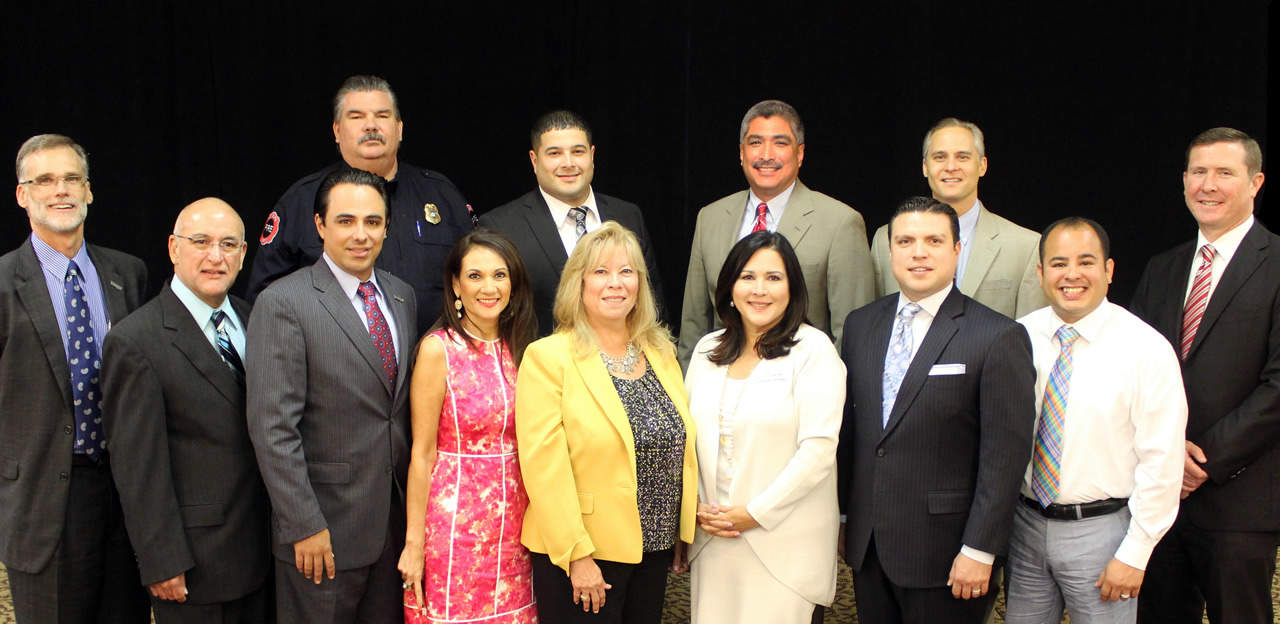
Featured: First row, from left: Martin V. “Marty” Baylor, Executive Vice President for Finance and Administration, The University of Texas Rio Grande Valley; Rep. R.D. “Bobby” Guerra, D-McAllen; Rep. Terry Canales, D-Edinburg; former Rep. Verónica Gonzáles, D-McAllen, Vice President for Government and Community Relations, The University of Texas Rio Grande Valley; Elva Jackson Garza, Vice President and Marketing & Business Development Manager, Edwards Abstract & Title Company; Lucy G. Canales, Partner, Linebarger Goggan Blair & Sampson LLP; Rep. Sergio Muñoz, Jr., D-Mission; Alex Ríos, District Director, Rep. Terry Canales; and Robert McGurk, Senior Vice President, Elsa State Bank & Trust Company. Back row, from left: Edinburg Fire Chief Shawn Snider; Jacob De León, Funeral Director, Memorial Funeral Home; Edinburg City Councilmember David Torres; and Michael Williamson, Market President, PlainsCapital Bank. This portrait was taken at the Edinburg Chamber of Commerce’s Public Affairs Legislative Luncheon held on Thursday, August 27, 2015 at the ECHO Hotel and Conference Center.
Photograph By RONNIE LARRALDE
Chalk up Hidalgo County as the first region in Texas that allows attorneys in all criminal cases to file pleadings and documents electronically – known as e-filing – as a result of a state law passed two years ago by Rep. Terry Canales, D-Edinburg, which will continue to bring the state’s court system into the paperless generation. Effective Tuesday, September 1, the eyes of the state judicial system began looking at the use of e-filing in criminal cases in Hidalgo County, as the rest of the Texas prepares to follow Hidalgo County’s lead beginning on November 1 in implementing a new system designed to improve justice for all. Canales is confident that his measure – House Bill 349, which was sponsored by Sen. Juan “Chuy” Hinojosa, D-McAllen, two years ago – will be a resounding success. HB 349 is designed to improve the delivery of justice in Hidalgo County, reduce costs to county taxpayers, attorneys and litigants, and take advantage of the latest technological advances in the state’s legal system, the House District 40 lawmaker contends. “Courts have long been burdened with processing paper, a problem that continues to grow exponentially and largely unabated,” said Canales. “After more than 167 years of processing traditional filing, Texas Court Clerks are awash in the state’s judicial paper trail. Electronic filing offers a means to stem the paper tide.” Hinojosa, citing data provided by the Office of the Hidalgo County District Clerk, reported that in 2014, there were 5,170 criminal cases filed, in addition to 19,341 civil and family cases. “One of the key advantages of the e-filing system, both in civil and criminal cases, is it allows attorneys more time during the day to submit their motions, rather than face a 5 p.m. deadline,” the state senator explained. “The statewide e-filing portal (efiletexas.gov) allows filers to file documents until midnight during regular business days in both civil and criminal cases. As a result, attorneys have more flexibility and are no longer rushed to file documents at the courthouse before closing hour at 5 p.m.” There would be no cost to the county government to use the e-filing system for civil or criminal cases, and there would be no cost to litigants who are too poor to pay for the service, Canales added. Later this fall, Hidalgo County District Clerk Laura Hinojosa (no relation to Sen. Hinojosa) will organize a question-and-answer session for the area’s attorneys to help them better understand the e-filing system for criminal cases. The details of that event will soon be announced by District Clerk Hinojosa. Also under the new state law, Hidalgo County can still allow traditional paper filing as well. Canales predicts that the future is at hand. ‘The era of big paper is over,” Canales said. According to dictionary.law.com, a motion is a formal request made to a judge for an order or judgment. Motions are made in court all the time for many purposes: to continue (postpone) a trial to a later date, to get a modification of an order, for temporary child support, for a judgment, for dismissal of the opposing party’s case, for a rehearing, for sanctions (payment of the moving party’s costs or attorney’s fees), or for dozens of other purposes. Most motions require a written petition, a written brief of legal reasons for granting the motion (often called “points and authorities”), written notice to the attorney for the opposing party and a hearing before a judge. However, during a trial or a hearing, an oral motion may be permitted
•••••• (more…)
by Legislative Media | Aug 31, 2015 | Politics

Featured, from left: Carlos Sánchez, editor, The Monitor, and Guy Bailey, the founding president of The University of Texas Rio Grande Valley, on Thursday, August 27, during the kick-off of the second season of The Monitor’s Newsmaker Breakfast Series, held at the McAllen Chamber of Commerce.
Photograph By DAVID PIKE
Guy Bailey, founding president of The University of Texas Rio Grande Valley, has put more than 37,000 miles on his pickup truck since July 1, 2014, driving from one end of the Valley to the other to ensure a stellar launch for this distributed university on Monday, August 31. For Bailey, the trips across the Valley are worth it, as it all will lead to success for everyone involved in the creation of this new, one-of-a-kind university that will include a School of Medicine – from students to the community in general, he said. “It is also rewarding because we understand that our mission is Valley-wide,” Bailey said. Bailey will be joined at the Edinburg and Brownsville events by numerous state legislators, county and city elected officials, economic development leaders, with William McRaven, the chancellor of the University of Texas System, to be a featured speaker. McRaven, Bailey and other area leaders will be featured leaders during a Flag-Raising Ceremony from 10 a.m. to 10:45 a.m. at the flagpole on the north side of the Student Services Building at the UT-RGV Edinburg campus on August 31. Those same leaders will then travel to the UT-RGV campus in Brownsville for a Proclamation Ceremony at the Main Building in the Plumeria Courtyard from 2 p.m. to 2:45 p.m. “We are ready and we are excited about it, too,” Bailey told an audience of South Texas dignitaries and residents on Thursday, August 27, during the kickoff of the second season of The Monitor’s Newsmaker Breakfast Series. The interview format series is a partnership between the McAllen Chamber of Commerce and The Monitor and is sponsored by IBC Bank. Bailey was interviewed by Monitor Editor Carlos Sánchez. The Edinburg Mayor, the Edinburg City Council, and the Edinburg Economic Development Corporation were key players in lobbying for the state legislation in 2013 that resulted in the creation of The University of Texas Rio Grande Valley. The EEDC, of which Agustín García, Jr. is Executive Director, is the jobs-creation arm of the Edinburg Mayor and Edinburg City Council. The EEDC Board of Directors is comprised of Mark Iglesias as President, Harvey Rodríguez as Vice President, Ellie M. Torres as Secretary/Treasurer, and Mayor Richard García and Richard Ruppert as Members. Sen. Juan “Chuy” Hinojosa, D-McAllen, and Rep. René Oliveira, D-Brownsville, were the author and sponsor, respectively, of Senate Bill 24, approved by the Texas Legislature in May 2013, which combines the resources of UT-Pan American, UT-Brownsville, and the Regional Academic Health Centers in Edinburg, Harlingen, and Brownsville into the University of Texas Rio Grande Valley. Sen. Eddie Lucio, Jr., D-Brownsville, Sen. Judith Zaffirini, D-Laredo, and Sen. Kel Seliger, R-Amarillo, were joint authors of Hinojosa’s SB 24. Rep. Terry Canales, D-Edinburg, Rep. Sergio Muñoz, Jr., D-Mission, Rep. Armando “Mando” Martínez, D-Weslaco, Rep. Sergio Muñoz, Jr., D-Mission, Rep. Eddie Lucio, III, D-San Benito, Rep. Óscar Longoria, Jr., D-La Joya, Rep. R.D. “Bobby” Guerra, D-McAllen, Rep. J.M. Lozano, R-Kingsville, and Rep. Dan Branch, R-Dallas, were joint sponsors of SB 24. Another major aspect of SB 24 is that the new law gives the UT System the authority to draw much-needed revenue from the Permanent University Fund, which uses money from more than $14 billion in assets to help pay for crucial construction programs throughout the UT System.
•••••• (more…)
by Legislative Media | Aug 21, 2015 | Politics

Featured, from left: Dalia Molina and husband, City Councilmember Richard Molina, and Councilmember David Torres and wife Ellie M. Torres, the newest member of the Board of Directors for the Edinburg Economic Development Corporation, at Edinburg City Hall on Wednesday, May 13, 2o15. The EEDC is the jobs-creation arm of the Mayor and Edinburg City Council.
Photograph By MARK MONTEMAYOR
Edinburg’s retail economy from January through June 2015 continues to prosper, with a 6.21 percent rate of improvement over the first half of 2014, the Edinburg Economic Development Corporation has announced. The EEDC, of which Agustín García, Jr. is Executive Director, is the jobs-creation arm of the Edinburg Mayor and Edinburg City Council. The EEDC Board of Directors is comprised of Mark Iglesias as President, Harvey Rodríguez as Vice President, Ellie M. Torres as Secretary/Treasurer, and Mayor Richard García and Richard Rupert as Members. For the month of June 2015, the city’s retail economy registered a 6.32 percent rate of improvement over the same month last year, the EEDC added, according to data released on Wednesday, August 12, by the Texas Comptroller of Public Accounts. For the first six months of 2015, Edinburg’s retail economy has produced $13,591,448.24 in local sales taxes, compared with $12,795,992.32 for January through June 2014. During June 2015, the city’s retail economy generated $1,843,334.30 in local sales taxes, compared with $1,733,714.45 for June 2014, also according to the Texas Comptroller of Public Accounts. EEDC Board President Iglesias noted that Edinburg’s retail economy continues to perform favorably when compared with statewide figures. “Year-to-date, the city economy’s 6.21 percent rate of improvement is ahead of the average for all cities in Texas, which is 5.1 percent for the period of January through June 2015, according to the Texas Comptroller of Public Accounts,” said Iglesias. The amount of local sales taxes collected helps reflect the strength of an economy, along with construction activities, per capita income, education, historical performances, and related trends, said Mayor García. “The city’s retail economy also will benefit in the coming months from the impact of four planned different housing developments, representing a combined value of $110.4 million, which will bring 448 apartment units and a 150-home subdivision to Edinburg,” the mayor reported. On Wednesday, August 5, the Mayor and City Council approved the $110.4 million in new residential complexes for Edinburg. That action follows previous city approvals for other developers to build 594 apartment units – three of those residential complexes located along the city’s medical corridor, and the fourth residential complex coming up on Sugar Road near the University of Texas Rio Grande Valley. “The housing demand has increased in Edinburg since the announcement in May 2013 that UT-Pan American will be transformed into The University of Texas-Rio Grande Valley, beginning with the Fall 2015 semester,” Mayor García explained. “Very important, for this first time, as a result of the creation of UT-RGV, higher education in the Valley now has access to the multi-billion dollar Permanent University Fund.” On June 30, 2015 the market value and book value of the PUF was $17.8 billion and $14.9 billion, respectively, exclusive of land acreage. “Along with the creation of The University of Texas-Rio Grande Valley, the School of Medicine is set to open by the Fall of 2016, with a major component in Edinburg,” added Mayor García. “People are looking to move closer to the campus, and for the financial and job opportunities within the medical industry expected to materialize once the UT medical school is complete.” The Permanent University Fund (PUF) is a public endowment contributing to the support of institutions of The University of Texas System (UT System) and the Texas A&M University System (A&M System). The Constitution of 1876 established the PUF through the appropriation of land grants previously given to The University of Texas plus one million acres. Additional land grants to the PUF were completed in 1883 with the contribution of another one million acres. Today the PUF contains 2.1 million acres located in 24 counties primarily in West Texas. “We find ourselves in the same situation San Antonio experienced when they got their medical school (UT Health Science Center at San Antonio), and look at their size now. Mark my words, the population in Edinburg will very soon be more than 100,000,” Mayor García predicted. “Our location as the gateway to Hidalgo County, which the U.S. Census Bureau estimates had more than 830,000 people as of 2014, and the fact that there is room to grow in all directions in Edinburg also is attracting entrepreneurs looking for a location proven to be successful.”
•••••• (more…)
by Legislative Media | Aug 18, 2015 | Politics

Featured: The following proposed seal for the University of Texas-Rio Grande Valley will be up for approval by the UT System Board of Regents when it meets in Austin on Wednesday, August 19, and Thursday, August 20, 2015 for its regular board meeting. The motto, Disciplina Praesidium Civitatis, is an approximate Latin translation of a famous quote by Republic of Texas President Mirabeau B. Lamar, who proclaimed, “A cultivated mind is the guardian genius of democracy.”
Graphics: THE UNIVERSITY OF TEXAS SYSTEM
The University of Texas Rio Grande Valley in Edinburg could expand by 53 acres, and a $37.6 million Interdisciplinary Engineering and Academic Studies Building could grace the existing campus under key items set for action by the UT System Board of Regents when it meets in Austin on Wednesday, August 19, and Thursday, August 20, the Edinburg Economic Development Corporation has announced. The EEDC, of which Agustín García, Jr. is Executive Director, is the jobs-creation arm of the Edinburg Mayor and Edinburg City Council. The EEDC Board of Directors is comprised of Mark Iglesias as President, Harvey Rodríguez as Vice President, Ellie M. Torres as Secretary/Treasurer, and Mayor Richard García and Richard Rupert as Members. Those two items, along with the appropriation of $10 million for the UT-RGV School of Medicine and the new proposed official seal for UT-RGV and, are among local interests being monitored by the EEDC and the Edinburg City Council, which championed those measures last spring through the Texas Legislature. The measures relating to UT-RGV are part of the regular board meeting of the UT System Board of Regents, which will be held on the ninth floor of Ashbel Smith Hall, 201 W. 7th Street in downtown Austin. The agenda book and links to the live webcast for the meeting are posted online by logging onto: https://www.utsystem.edu/board-of-regents/meetings/board-meeting-2015-08-19. At the Austin meeting, the regents will be asked to authorize the recommended purchase of unimproved real property, totaling approximately 53 acres, located at the southeast quadrant of North Sugar Road and West Chapin Street, in Edinburg, from Norquest Family Holdings, Ltd., for “future campus expansion”. According to the regents’ agenda packet, the purchasing price will be determined by fair market value as established by independent appraisals, plus all due diligence expenses, closing costs, and expenses to complete the acquisition as deemed necessary by the Executive Director of Real Estate. The appraisals are confidential pursuant to Texas Education Code Section 51.951. More is known about the $37.6 million Interdisciplinary Engineering and Academic Studies Building. According to the synopsis provided by the UT System: This project will construct an approximately 77,000 GSF (gross square feet) building on the Edinburg campus for interdisciplinary space necessary to support enrollment growth in the rapidly growing region; the facility will include a large, 250-seat lecture auditorium, 150-seat lecture hall, 60-seat classrooms, and offices. Although particular emphasis will be placed on preparation of engineering students, this facility will also address flexible space requirements for other disciplines as needed. Additionally, the project will include an outdoor pavilion to be used as a gathering area and study space to relieve pressure on more expensive indoor space and also to support academic events. Design development plans and authorization of expenditure of funding will be presented to the Board of Regents for approval at a later date. EEDC’s Iglesias, who on Saturday, August 15, was unanimously elected President of the EEDC Board of Directors, welcomed the latest planned advances at the Edinburg UTRGV campus. “During our joint workshop with the Edinburg City Council over this past weekend, we reviewed what the EEDC, the Mayor, and the City Council, along with our state lawmakers, have done over the years to help get us to this point, and how very important UTRGV and its School of Medicine are for the economic growth and quality-of-life for our city and region,” said Iglesias. “We are dedicated to helping create one of the best public university systems in the nation.” Mayor Richard García, during his three terms as the city’s top elected leader, has played vital roles before the UT System Board of Regents and the Texas Legislature in rallying political and financial support for UT-RGV in Edinburg. “The UT System leadership recognizes that the future of Texas is right here in South Texas, which has one of the largest and youngest populations in the nation,” the mayor noted. “Just as important, the expansion plans by the UT System for UT-RGV are further proof that we do, indeed, have the brainpower, willpower, and strength of character to overcome all challenges and succeed. This is the message being sent to the world.”
•••••• (more…)
by Legislative Media | Aug 12, 2015 | Politics

Featured: Sandra Bland (Undated photograph posted on her Facebook)
The tragic death of Sandra Bland on Monday, July 13, 2o15, while confined in the Waller County Jail, requires decisive and landmark action by the Texas Legislature to guarantee that every jail cell in Texas is being monitored by a video surveillance system. Bland, 28, a graduate of Prairie View A&M who had come back after accepting a new job at her alma mater, was reportedly alone in a Waller County Jail cell, out-of-sight of a nearby county jail video camera, when she allegedly committed suicide by hanging. Darryl Johnson, a legislative consultant with more than 35 years experience in the Texas Legislature, who resides in Prairie View, is proposing legislation, to be known as “The Sandra Bland Justice for All Act”, be filed when the Texas Legislature begins its regular session in January 2017. Lt. Gov. Dan Patrick of Houston and Speaker of the House Joe Straus of San Antonio should immediately appoint a joint Senate-House legislative committee to come up with ways to require all jails in Texas to maintain an effective video monitoring system so that no one who is being held in a cell is hidden from the protective and unbiased view of a video camera, he recommended. “In light of the terrible controversy and negative worldwide image of Texas that is resulting from this sorrow, now is the time to show the world that we in Waller County will help lead the way on what would be a major improvement of our state’s criminal justice system,” said Johnson. “More important, it is right and just that Sandra Bland, whose life calling courageously revolved around battling injustice, should have her honorable name, through ‘The Sandra Bland Justice for All Act’, be forever linked to protecting the innocent.”
•••••• (more…)
by Legislative Media | Aug 11, 2015 | Politics

Featured: Rep. Terry Canales, D-Edinburg, on Thursday, July 9, 2015, at the DoubleTree Suites by Hilton Hotel in McAllen, addressing the McAllen Chamber of Commerce’s 84th Legislative Session Wrap-Up Luncheon.
Photograph By MARK MONTEMAYOR
The Delta Area School Supplies Drive, which will donate key learning materials, ranging from pens and pencils to paper and erasers to notebooks, is underway and will wrap up on Wednesday, August 19, when the donations will be distributed, while supplies last, to students enrolled in the Edcouch-Elsa Independent School District, Rep. Terry Canales has announced. Canales, who said he has contributed in the past to other school drives, said this is the first time he is helping organize one, serving as host for the event. He also expressed deep appreciation to the Edcouch-Elsa Rotary Club, which is playing a vital role in this event, and to his House 40 constituents in the area. “We have been asking as many people as possible. It is amazing how some companies will pull out their checkbook with a moment’s notice to help with school supplies,” Canales reported. “It is very expensive for all families to prepare their children for the school year. I am just glad to work with the Edcouch-Elsa Rotary Club and other generous leaders to provide help for those who need it.” Any school student is eligible, but each child must be present to receive a backpack. Each child will get a Edcouch-Elsa Independent School District approved backpack, which means it is clear or mesh. In the backpack will be supplies to get a child started out for the year: pencils, folders, notebooks, tissues, glue sticks, erasers, pencil case, rulers, colored pencils and crayons. The backpacks with school supplies will be given away from 4 p.m. to 7 p.m. at the John F. Kennedy Elementary Cafeteria, 500 West 9th Street, in Elsa. Students must show up in person to receive the donations. Individuals who wish to contribute or have questions about the Delta Area School Supplies Drive may call 956/383-0860. Canales said students who show up are the ones who are doing society the real favor. “There is nothing shameful about needing help,” Canales encouraged the public school students. “By receiving these school supplies, they will do better in school, and it shows the world that Valley students want a great education. We’re here to give our Edcouch-Elsa ISD students some of the tools to help the achieve their goals and dreams.” Equally important, Canales said, the generosity demonstrated by groups such as the Edcouch-Elsa Rotary Club, local businesses, and caring individuals involved in the school supply drive are worth of fortune in many other ways that count. “Throughout the state and nation, many families simply don’t have enough resources to properly provide the school supplies needed by their children,” the state lawmaker reflected. “But through the love and caring that our residents have for our communities and for our youth, these small acts of kindness are investments in all of our future and well-being.”
•••••• (more…)
by Legislative Media | Aug 5, 2015 | Politics

Featured, from left: Letty Reyes, Director of Business Development and Public Affairs, Edinburg Economic Development Corporation; Jonathan Torres, Production Specialist and Event Coordinator, City of Edinburg; and Leticia S. Leija, Director of Library and Cultural Arts, City of Edinburg, who are among the Board of Directors of the South Texas International Film Festival, which will be held on Friday, August 21, and Saturday, August 22, at several prime locations in Edinburg. The other members of the Board of Directors of the South Texas International Film Festival are: Magdiel Alfonso, Arts Coordinator, City of Edinburg; Agustín “Gus” García, Jr., Executive Director, Edinburg Economic Development Corporation; Letty González, President, Edinburg Chamber of Commerce; Dr. Dahlia Guerra, Dean, Department of Arts and Humanities, The University of Texas-Rio Grande Valley in Edinburg; José Alberto Navarro, Consul for Political & Cultural Affairs, Consulate of Mexico in McAllen; Imelda Rodríguez, Director of Tourism for the Edinburg Convention and Visitors Bureau; Valente Rodríguez, Actor, Producer, Director, former star of The George López Show; Larry Safir, Member, Board of Directors, Doctors Hospital at Renaissance, and former Executive Vice President, Entravision Communications Corporation; and Luis Enrique Suner, Filmmaker and Journalist, El Mañana;
Photograph By DIEGO REYNA
Known as the “Movie Capital of the Valley” in the late 1960s, Edinburg’s cultural life has been seen as a symbol of the city’s vitality and ingenuity. From the movie theaters in the 1930s and 1940s to the TV revolution in the 1950s, then advancing with cable TV, personal computers, the Internet, the cellphone and electronic tablet innovations, Edinburg’s creativity transforms and re-forms with the changing times. The informal title as “The Movie Capital of the Valley” was built on a rich history of film venues in Edinburg going back decades, and the visual arts continue even stronger today, with the impressive, 84,000-square-foot Carmike 20 Cinema, the groundbreaking Cinemark Movie Bistro, and the upcoming inaugural South Texas International Film Festival (www.stxff.us), which is set for Friday, August 21, and Saturday, August 22, at several prime location in the city. The South Texas International Film Festival will bring into clear view the potential value, in terms of economic development, of increasing local productions of movies and home videos in Edinburg and the Rio Grande Valley. The South Texas International Film Festival– of which the Edinburg Economic Development Corporation is a sponsor – will showcase the abundant regional talent of filmmakers, producers, actors, and related professional staffs, and promote the city and the region as a premium site for national and international movies to be filmed. The Edinburg Economic Development Corporation, of which Mayor Richard Garcia is President of its five-member Board of Directors, is the jobs-creation arm of the Edinburg Mayor and Edinburg City Council. In addition to the EEDC, the other major sponsors and organizers of this landmark two-day event include The City of Edinburg, the Edinburg Chamber of Commerce, Edinburg Arts, and the Consulado de México en McAllen (Mexican Consulate in McAllen). Why consider feature films, documentaries, and other visual works of art as economic development tools? Agustín “Gus” García, the Executive Director for the Edinburg Economic Development Corporation, explains the potential links between Hollywood, the home of the U.S. motion picture industry, and American hometowns, such as Edinburg. The many positive benefits of clustering creative businesses was explained by Jamie Bennett, Director of Public Affairs for the National Endowment for the Arts, said Gus García (no relation to the mayor), who cited the following perspectives: “A theater has 1,000 people show up at eight o’clock and leave at eleven o’clock. A museum might have 1,000 visitors spread out over the course of an eight-hour day. A rehearsal studio might have 30 people coming and going every hour over 12 hours,” said Bennett. “You put the three different organizations in proximity to one another and, all of a sudden, you have a full day of positive foot traffic on a street — feet that belong to people who need to eat meals, buy newspapers, go shopping and take public transportation. You have every mayor’s dream.” Investing in human capital “is immeasurable,” Gus García continued, and that is why the Edinburg EDC is a champion for developing human capital and in supporting projects that help a community prepare its future leaders. Mayor García contends that the role of arts and culture in shaping community-wide prosperity is a priority for the city. This includes the direct and indirect employment effects of the arts and culture. “Today’s workforce seeks certain characteristics in the places they choose to live. Places with entertainment options, public interaction, lively streets, and recreational and educational amenities are preferred, along with arts and culture activities and amenities,” the mayor said. “Leaders in the field of planning and economic development are developing noteworthy, creative approaches to making places of any scale more satisfying to this workforce, while increasing economic viability and competitiveness. This new collaboration between business owners is resulting in increased economic vitality and sense of community between merchants as well as residents, and Edinburg EDC, the Edinburg City Council, and our many partners in the public and private sectors want to capture them all.”
•••••• (more…)