by Legislative Media | Mar 18, 2015 | Politics

Featured, from left; Anne Drescher, Chief-of-Staff; Rep. R.D. “Bobby” Guerra, D-McAllen; and Aisa Showery, Legislative Director, on Tuesday, June 17, 2014 in Edinburg. Guerra is carrying House Bill 1596, set for a public hearing in Austin on Thursday, March 19, to create the Hidalgo County Healthcare District.
Photograph By MARK MONTEMAYOR
An effort to create the Hidalgo County Healthcare District, which would help support the University of Texas-Rio Grande Valley School of Medicine, provide health care for many residents who do not have health insurance, set a limit on the property tax rate that would come with its creation, and generate hundreds of millions of dollars in new jobs and businesses, will receive its first legislative hearing in Austin on Thursday, March 19. House Bill 1596, whose primary author is Rep. R.D. “Bobby” Guerra, D-McAllen, is one of five measures set to go before the House Committee on County Affairs. The public hearing, which will be held in Room E2.016 of the Capitol Extension, will begin at 10:30 a.m. or upon adjournment by the full House of Representatives. The event, which will be broadcast live and also be available for viewing afterwards, is accessible on the Internet. Information on how to access the live and recorded broadcasts are available by logging to http://www.house.state.tx.us/video-audio/. The companion bill in the Senate, which seeks the same goals as HB 1596, is Senate Bill 626 by Sen. Juan “Chuy” Hinojosa, D-McAllen, and Sen. Eddie Lucio, Jr., D-Brownsville. Although no action has been set on SB 626, that measure is currently before the Senate Committee on Intergovernmental Affairs, of which Lucio serves as Chair. In response to feedback received from voters, who in November 2014 narrowly voted against a different version of this legislation, Valley lawmakers have put safeguards into the current legislation in order to ensure the most protections for taxpayers. The name was changed to “Hidalgo County Healthcare District” to allow for a more comprehensive approach to the system which the Valley’s Hidalgo County state legislative delegation hopes to implement. Some of the key differences in this measure from the one last year are: the tax rate would be capped at 25 cents per $100 valuation; the budget must be approved by the Hidalgo County Commissioners Court to ensure proper oversight; all residence homestead exemptions will be provided, including an exemption for elderly and disabled residents as well as a total exemption for 100% disabled veterans and their surviving spouse; and all rollback tax provisions apply. Joining Guerra in support by signing on as Joint Authors are Rep. Terry Canales, D-Edinburg, Rep. Óscar Longoria, Jr., D-La Joya, Rep. Armando “Mando” Martínez, D-Weslaco, and Rep. Sergio Muñoz, Jr., D-Mission.
•••••• (more…)
by Legislative Media | Mar 15, 2015 | Politics

Featured at the 50+ Reunion Brunch on Sunday, March 1 at The University of Texas-Pan American are, seated, from left: Cleo Hinojosa, Minerva Elizalde, and former State Rep. Roberto Gutiérrez, D-McAllen, Class of 1965 inductees, and Elma Arriola Ayala, Class of 1964 inductee. Standing, from left, are Dr. Havidán Rodríguez, UTPA President Ad Interim and the founding Provost and Executive Vice President for Academic Affairs at The University of Texas-Rio Grande Valley, Lydia Alemán, Interim Vice President for University Advancement, María T. Rodríguez, Class of 1963 inductee, and Rebecca López, Gracie Cobo, John Thobe, and Eva Chapa, Class of 1965 inductees.
Photograph By JOSUE ESPARZA
Pan American College graduates and their guests were welcomed “home” during a 50+Reunion Brunch on Sunday, March 1, by Clara Dina Hinojosa, Interim Director of the The University of Texas-Pan American Alumni Relations Office, and Dr. Havidán Rodríguez, UTPA President Ad Interim and the founding Provost and Executive Vice President for Academic Affairs at The University of Texas-Rio Grande Valley. The reunion was part of the university’s 2015 Homecoming Week activities, the last the university will celebrate as UT-Pan American before becoming UT-RGV in September 2015. Rodríguez, who also serves on the Board of Directors of the Edinburg Economic Development Corporation, described the state of the university as “strong”, citing its growth in the number of students, improved retention and graduate rates, the recruitment of top notch faculty and the statewide and national recognition of the many quality programs it offers. He also told them about several new buildings being built on the UTPA and UTB campuses as they transition into UT-RGV as well as the progress being made in the creation of the new medical school and the opportunities it will offer to students and in improved access to healthcare to Valley citizens. “We are here because you are here,” Rodríguez said. “I know that we will be able to count on your continuous active engagement, your support, your commitment to The University of Texas-Rio Grande Valley. This will always be your house. Welcome home.” The EEDC is the jobs-creation arm of the Edinburg Mayor and the Edinburg City Council.
•••••• (more…)
by Legislative Media | Mar 14, 2015 | Politics

Featured, from left, prior to a legislative briefing with Speaker of the House Joe Straus, R-San Antonio, on Tuesday, June 17 at the Edinburg Conference Center at Renaissance, are: McAllen Mayor Jim Darling; Rep. Sergio Muñoz, Jr., D-Mission; and McAllen City Commissioner Trey Pebley.
Photograph By MARK MONTEMAYOR
The House Committee on Appropriations, which includes Rep. Sergio Muñoz, Jr., D-Mission, and Rep. Óscar Longoria, Jr., D-La Joya, on Thursday, March 12, approved the continued funding of Medicaid-to-Medicare parity payments, starting September 1, 2016, in the amount of $460 million. The funding decision is also part of the state legislative agenda of the Edinburg Mayor, Edinburg City Council and the Edinburg Economic Development Corporation. The EEDC is the jobs-creation arm of the Edinburg Mayor and Edinburg City Council. “There is a clear need to address the inadequacy in Medicaid payments,” said Muñoz. “The House Appropriations Committee has budgeted sufficient funds to counteract the growing trend of doctors opting out of Medicaid due to low reimbursement rates. These appropriations will help ensure the longevity of the Medicaid and CHIP services that safeguard the health of millions of Texans and allow us to continue planning for advancements in medical services and technology.” The March 12 action follows requests from primary care physicians statewide and through advocacy organizations such as the Texas Medical Association (TMA) so the state government can retain doctors who participate in Texas’ Medicaid program and CHIP, the Children’s Health Insurance Program, and to ensure that eligible Texans can continue to have access to medical care, according to the TMA. Medicaid and CHIP provide medical coverage for more than 4.6 million low-income Texans as of December 2014. The programs cover half of all children in the state and help provide care for two-thirds of people in nursing homes. In Texas, all CHIP services and most Medicaid services are delivered through managed care health plans under contract with the state, according to the Texas Health and Human Services Commission. The $460 million appropriation, which will be included in the final state budget to be presented for action by the full 150-member House of Representatives, was approved upon the recommendation of the Sub-Committee on Article II – Health and Human Services (HHSC), on which Longoria serves. “Having met with and discussed this issue with many doctors from my district, as well as physicians from across Texas, I, along with my colleagues on the sub-committee, have come to understand the inadequacy of Medicaid payments and the need to pay better to expand access to care,” said Longoria. “We need to invest the necessary resources to improve appropriate and timely access to medical services for Medicaid patients, not only by maintaining higher payments for primary care physicians, but also by ensuring competitive physician payment rates for sub-specialists and CHIP.”
•••••• (more…)
by Legislative Media | Mar 12, 2015 | Politics

Mariachi performers from the Edcouch-Elsa Independent School District serenade Rep. Terry Canales, D-Edinburg, whose House District 40 includes the Delta Region, at Canales’ District Office in Edinburg on Thursday, February 6, 2014.
Photograph By MARK MONTEMAYOR
South Texas state lawmakers – including Rep. Terry Canales – are seeking $20 million in state funding to help pay for the Delta Region Water Management Project, a key component of Hidalgo County’s plans to reduce the damage caused by flooding while capturing such excess rainfall to create a new source of water that can be purified by cities for drinking. The Delta Region Water Management Plan will feature the development of the Delta Watershed, to be located in northeast Hidalgo County near Highway 107 in La Villa. The watershed is one of 25 projects overwhelmingly approved in a county-wide election on November 6, 2012 to improve the region’s drainage system. In that referendum, Hidalgo County voters authorized the county judge and the county commissioners, through their roles as the Board of Directors for Hidalgo County Drainage District No. 1, to issue $84 million in bonds, and leverage a $100 million federal grant, to pay for those 25 projects, including the Delta Watershed in La Villa. The planned Delta Watershed, by bringing the ability to capture stormwater, thus promoting water conservation, could qualify for state funds through the Texas Water Development Board, a state agency whose powers include providing financial help to entities statewide in the form of both grants and loans. As a result, Canales, Rep. Óscar Longoria, Jr., D-La Joya, and Rep. René Oliveira, D-Brownsville, are joint authors of a legislative rider by Rep. Armando “Mando” Martínez, D-Weslaco, that could result in $20 million over the next two years coming from that state agency for the Delta Watershed in La Villa. A rider is a legislative directive, inserted in the General Appropriations Act following appropriation line items for an agency, which provides either direction, expansion, restriction, legislative intent, or an appropriation. The term also applies to special provisions at the end of each article and general provisions in the General Appropriations Act. “What our measure would do, if approved by the Texas Legislature, is authorize the Texas Water Development Board, which is a state agency, to use up to $10 million a year for the next two years, beginning on September 1, from its existing state funds and unexpended balance, for the Delta Watershed, because that project is designed to reclaim flood water runoff,” said Canales. That rider is awaiting action by the House Appropriations Committee, which includes Longoria and Rep. Sergio Muñoz, Jr., D-Mission. Martínez, who is taking the top legislative role with the rider, called the Delta Region Water Management Project “an innovative, forward-thinking plan that will benefit the Valley for decades to come. Whether it is for our agricultural economy, environment, farmers, municipalities, or water supply, this project will positively impact the entire Rio Grande Valley,” Martínez said, adding, “I’m honored to lead the way on this rider and am joined by a strong, united delegation in fighting to provide for a better future for residents of the Rio Grande Valley.” Longoria said the rider would represent an outstanding investment by the Legislature and the Texas Water Development Board because of the uniqueness of the planned Delta Watershed. “Texas, not just the Valley, is dealing with a significant drought, so much so that on March 9, Gov. Abbott said our current drought conditions have reached historic levels and continue to post an imminent threat to public health, property, and the economy,” Longoria said. “But here in Hidalgo County, we have an excellent plan which is deserving of state financial support, and that is the message we are taking to the Legislature and the Texas Water Development Board.”
•••••• (more…)
by Legislative Media | Mar 10, 2015 | Politics

Featured, from left: Wanda F. Garza, Vice President of Student Affairs and Enrollment Services, South Texas College; Rose Benavídez, Member, Board of Trustees, District 1, South Texas College; Dr. Shirley A. Reed, President, South Texas College; and Rep. Sergio Muñoz, Jr., D-Mission, at the House District 36 lawmaker’s Capitol office on Tuesday, February 3.
Photograph By PETER SALINAS
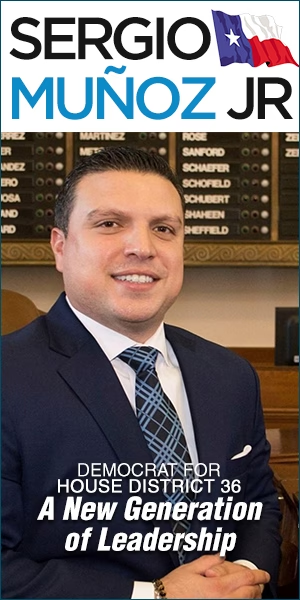
With the goal of increasing educational opportunities while improving public safety and border security, Rep. Sergio Muñoz, Jr., D-Mission, is carrying several measures designed to help fight crime, including landmark legislation that could eventually lead to the establishment of a full-fledged South Texas College campus in Pharr. House Bill 1887, filed by Muñoz on Tuesday, February 25, would allow South Texas College to create the Regional Center for Public Safety, which would be built on a yet-undisclosed 50- to 60-acre site to be donated by the City of Pharr. With Muñoz serving as the primary author – which means the legislation is the idea of the Mission Democrat – Rep. Terry Canales, D-Edinburg, on Monday, March 9, signed on as a joint author in support of HB 1887. “Having such an educational facility for our current and future law enforcement officials will be a tremendous benefit for the delivery of justice and the protection of all of us in deep South Texas,” said Canales, whose House District 40 includes 19 percent of the City of Pharr. “I appreciate Rep. Muñoz allowing me to sign on as joint author of HB 1887, and I look forward to working with him and the leadership of Pharr and South Texas College on this most important legislative effort.” Muñoz’ House District 36 includes 76 percent of the City of Pharr. Included in HB 1887 is language that would authorize South Texas College to also allow “aspiring law enforcement officers to earn a bachelor’s degree that will provide more career opportunities for our community,” Muñoz said. “STC is positioned to offer a bachelor’s degree in Homeland Security, Public Safety and Law Enforcement, or whatever degree specifically responds to the needs of our metropolitan region.” STC officials would be responsible for developing the appropriate bachelor’s degree program, which would have to receive final approval from the Texas Higher Education Coordinating Board, the lawmaker added. Currently, 1,751 law enforcement officers are employed in Hidalgo and Starr counties, with the intent to hire 134 additional certified officers during the current fiscal year. The Texas Workforce Commission predicts that there will be a 22 percent increase during the next 10 years for more certified police officers in these two counties, but access to training opportunities is limited. “HB 1887 would serve the greater need of the Valley’s law enforcement personnel, as facilities become available, by increasing the number of instructional programs offered in deep South Texas with new certificate and associate of applied science degree in programs such as police administration, forensics, emergency management, leadership, aircraft rescue, homeland security, special weapons and tactics,” said Muñoz. HB 1887 states that STC would administer the regional center in partnership with political subdivisions and participating school districts in the Valley, and would require the headquarters of the regional center to be located “at South Texas College in Pharr.” His bill would allow the regional center to use property and facilities at other locations in Hidalgo and Starr counties. Muñoz is working with Sen. Juan “Chuy” Hinojosa, D-McAllen, and Sen. Eddie Lucio, Jr., D-Brownsville, to secure support in the Senate.
•••••• (more…)
by Legislative Media | Mar 8, 2015 | Politics

Congressman Rubén Hinojosa, D-Mercedes, outlines his vision for continued economic growth and job creation for his 15th Congressional District, which includes Hidalgo County, at the Pharr Convention Center (now Boggus Ford Events Center) on Tuesday, November 4, as his wife, Martha López Hinojosa, looks on. “When I first took office in January 1997, the unemployment rate for Hidalgo County was at 22 percent. I made it my goal to help bring this number down to single digits and we succeeded,” Hinojosa said. The latest jobs figures bear him out, according to the Texas Workforce Commission, a state agency which provides information and analysis on shifts in occupations and industries within the state, including unemployment rates and employment figures, broken down by cities, counties, and regions in Texas, on a monthly basis. All cities combined in Hidalgo County averaged an 8.3 percent unemployment rate in January 2015. Also for January 2015, there were 307,706 individuals were employed in Hidalgo County. Hinojosa’s perspectives are shared by the leadership of the Texas Workforce Commission, who were appointed by then-Gov. Rick Perry, a Republican. “The diversity of skills found in the Texas workforce has contributed greatly to the strength of the Texas economy,” said TWC Commissioner Representing Labor Ronny Congleton. “As jobs are added, Texas has skilled workers to fill them and resources available for workers to obtain new skills when needed. I encourage all job seekers to look for available positions through TWC’s online job-matching resource, WorkInTexas.com and to take advantage of the many services and training resources available through their local Workforce Solutions office.”
Photograph by MARK MONTEMAYOR
Edinburg’s unemployment rate for January 2015 was 5.1 percent, a significant improvement from the monthly rate in January 2014, when it came in at 6.3 percent, and better than the January 2015 U.S. unemployment rate of 5.7 percent, the Edinburg Economic Development Corporation has announced. The EEDC is the jobs-creation arm of the Edinburg City Council. The unemployment rate is a key indicator of the strength of the local economy. Only McAllen had a better performance among the Valley’s major economies, coming in with a 5.0 percent unemployment rate for January 2015, according to the Texas Workforce Commission. Edinburg’s latest monthly showing also remained within striking distance of the Texas statewide average, which was 4.6 percent for January 2015, while better than the U.S. unemployment rate of 5.7 percent for the same month, the TWC reported. According to the Texas Workforce Commission, the four-county Valley’s other major communities shared in Edinburg and McAllen’s good news, continuing to boast unemployment rates in the single-digits, in the following order: Harlingen (6.3 percent); Mission (6.3 percent); Weslaco (7.2 percent); Pharr (7.5 percent); and Brownsville (7.8 percent). The January 2015 data, released by the Texas Workforce Commission on Friday, March 5, also showed an increase of 636 jobs in Edinburg when comparing the employment figures for January 2015 and January 2014. In January 2015, there were 35,536 persons employed in Edinburg, compared with 34,900 in January 2014. The January 2015 unemployment rate of 5.1 percent for Edinburg is also better than the annual unemployment rate in Edinburg for 2014, which was 5.8 percent, the best 12-month average from January through December in seven years, according to the Texas Workforce Commission.
•••••• (more…)