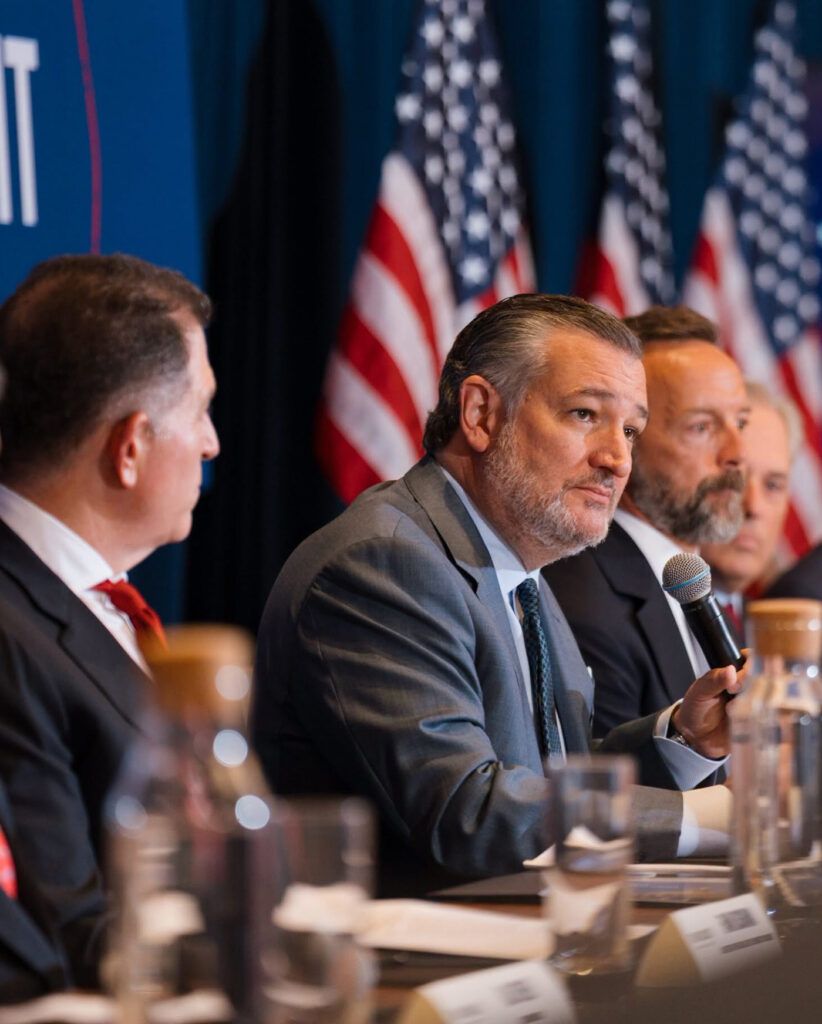
FEATURED, CENTER: Sen. Ted Cruz, R-Texas, appears at a press conference regarding Trump Accounts on Monday, August 31, 2026 at the AT&T Hotel in Austin. On Wednesday, September 16, 2026, Cruz celebrated the passage of the AM Radio for Every Vehicle Act by the U.S. House of Representatives. The measure would require auto makers to include AM broadcast radio in their new vehicles at no additional charge, reports Edinburg Mayor Omar Ochoa.
Photograph Courtesy SEN. TED CRUZ FACEBOOK
••••••
With CD players all but eliminated from new cars, Congress set to save A&M radio in vehicles from same fate, reports Edinburg Mayor Oma Ochoa
By DAVID A. DÍAZ
[email protected]
With CD players all but eliminated from new cars, vehicle A&M radio may soon be saved from the same fate by the U.S. Congress, reports Edinburg Mayor Oma Ochoa, as a result of a key role played by U.S. Sen. Ted Cruz, R-Texas.
https://www.facebook.com/omar.ochoa.330
Built-in CD players in new vehicles have virtually disappeared due to the shift toward smartphone integration, streaming services, and digital media.
AM radio is a broadcast method that uses amplitude modulation to send audio signals over long distances.
https://www.google.com/search?client=safari&rls=en&q=AM+Radio+definition&ie=UTF-8&oe=UTF-8
The U.S. Congress is the bicameral legislative branch of the United States federal government, responsible for making federal laws. It is made up of the U.S. Senate and the U.S. House of Representatives.
On Wednesday, September 16, 2026, Cruz and Sen. Ed Markey, D-Massachusetts, celebrated the passage of the AM Radio for Every Vehicle Act by the U.S. House of Representatives. The measure would require automakers to include AM broadcast radio in their new vehicles at no additional charge.
Cruz partnered with Markey to lead the introduction and reintroduction of the AM Radio for Every Vehicle Act, which directs federal regulators to require AM broadcast receivers in new cars. As chairman of the Senate Commerce Committee, Cruz helped shepherd and advance the legislation through Senate committee approval. [1, 2]
Following the vote by the full U.S. House of Representatives, Cruz and Markey issued the following joint statement:
“This vote sends a clear message to car manufacturers that AM Radio is a lifeline that must be protected in new vehicles. From emergency response to sports, entertainment, and news, AM radio is an essential communication tool for tens of millions of Americans. It is now time for the Senate to pass the AM Radio for Every Vehicle Act and for this legislation to become law so AM radio remains a trusted and essential resource for commuters and communities across the country.”
The next required action for the AM Radio for Every Vehicle Act is consideration, debate and action in the full U.S. Senate.
A summary by congress.gov of the AM Radio for Every Vehicle Act provides the following insight:
• In addition to excluding AM broadcast radio, some original equipment manufacturers (OEMs) have opted to exclude equipment designed to receive satellite transmission from the 20-year-old radio service SiriusXM, which, similar to broadcast radio stations, has relied on access to drivers and passengers to generate revenue.
• Also, the emergence of the infotainment interfaces from Apple Inc. (CarPlay) and Alphabet Inc. (Android Auto), which enable drivers to access audio news and entertainment via applications (apps), has led some OEMs to claim that listeners do not need broadcast receivers to listen to programming from AM stations that simulcast via mobile apps.
https://www.congress.gov/crs-product/R48315
“According to the National Association of Broadcasters, whose leaders have been lobbying for the AM Radio for Every Vehicle Act: ‘AM radio serves a vital role in our nation’s emergency infrastructure as the backbone of the Emergency Alert System (EAS), which is a national public warning system designed to enable the President to address the public within 10 minutes during a national emergency,’ Ochoa said. “‘It is also used by federal, state, local, tribal, and territorial authorities to broadcast urgent information scubas severe weather warnings and Amber alerts.’”
Ochoa noted that losing AM radio in vehicles would affect AM radio stations in the Valley and throughout the nation.
“At least nine AM radio stations are licensed to operate within the U.S. side of the Lower Rio Grande Valley (the McAllen–Brownsville–Harlingen radio market area), and their undisputed contributions to the culture, economy, entertainment, and public safety of our region span a lifetime,” the mayor reported. “According to a U.S. Congress summary of the AM Radio for Every Vehicle Act ‘because motor vehicles are the most popular location for people to listen to radio, losing access in vehicles poses an economic threat to broadcast radio stations. Broadcast radio stations generate most of their revenue from advertisers seeking to reach the stations’ listeners.’” [1, 2]
Those AM radio stations in deep South Texas feature:
• KRIO (910 AM) licensed to McAllen, Texas (Spanish Christian/Radio Esperanza)
https://www.google.com/search?client=safari&rls=en&q=KRIO+RADIO&ie=UTF-8&oe=UTF-8
• KURV (710 AM) licensed to Edinburg, Texas (Talk radio)
https://en.wikipedia.org/wiki/KURV
• KVJY (840 AM) licensed to Pharr, Texas (Spanish Christian)
https://en.wikipedia.org/wiki/KVJY
• KUBR (1210 AM) licensed to San Juan, Texas (Spanish)
https://en.wikipedia.org/wiki/KUBR
• KSOX (1240 AM) licensed to Raymondville, Texas (Spanish)
https://en.wikipedia.org/wiki/KSOX
• KRGE (1290 AM) licensed to Weslaco, Texas (Spanish/Radio Vida)
https://en.wikipedia.org/wiki/KRGE
• KIRT (1580 AM) licensed to Mission, Texas (Spanish)
https://en.wikipedia.org/wiki/KIRT
• KVNS (1700 AM) licensed to Brownsville, Texas (Fox Sports Radio)
https://en.wikipedia.org/wiki/KVNS
• KYWW (1530AM) licensed to Harlingen, Texas (Spanish language, Tejano);
https://en.wikipedia.org/wiki/KYWW
Born and raised in Edinburg, Ochoa’s roots run deep in the community.
A graduate of Edinburg North High School, he went on to earn a business degree, a master’s in accounting, and a law degree from the University of Texas at Austin.
A champion for government transparency, Ochoa provides regular reports to the public on the Texas Public Information Act, the Texas Open Meetings Act, and existing and proposed state laws that affect the mainstream and social media and the people’s rights to know about the actions of their governments in the Lone Star State.
Mainstream media refers to traditional news outlets, typically controlled by large organizations, that aim to inform the public. This includes newspapers, magazines, television and radio broadcasting, and increasingly, major online news sites. In essence, it's the news and information you typically find in the mainstream, often seen as more established and widely circulated.
https://www.google.com/search?client=safari&rls=en&q=what+is+mainstream+media&ie=UTF-8&oe=UTF-8
Social media are online platforms where users connect, share information, and interact with each other through various forms of content. These platforms facilitate the creation and sharing of content, allowing individuals to form online communities and networks. Examples of social media include websites and apps like Facebook, Instagram, X, and YouTube.
Approximately 82 million Americans (about one in three radio listeners) tune in to AM radio on a monthly basis, with three-quarters of that listening occurring inside vehicles.
Total Monthly Reach: Over 82 million people listen to AM radio monthly, representing roughly one-third of all American radio listeners. [1, 3]
In-Vehicle Concentration: 75% of all AM radio listening takes place in motor vehicles.
Other key aspects of AM radio include:
• When the power goes out and cell networks are down, the car radio is often the only way for people to get information, sometimes for days at a time. With tens of millions of weekly listeners, AM radio is also an extremely popular way for Americans to stay connected to both national and local news, sports and entertainment.
• AM radio is highly important to agricultural communities, providing weather updates, crop reports and other information to farmers and ranchers.
• AM stations also serve communities of color and underrepresented groups with in-language, religious and other community-oriented niche programming.
• Despite this, certain automakers have removed AM radio as a feature on electric vehicles and signaled that they may remove AM radio from new models of internal combustion engine vehicles in the future.
• There has been a public outcry from members of Congress, Federal Communications Commission officials and former Federal Emergency Management Agency (FEMA) administrators about removing AM radio from vehicles.
Broadcasters have been working with automakers to address concerns they may have, including utilizing a simple software upgrade that reduces noise and interference.
Key organizations and entities opposing the mandate include:
The Alliance for Automotive Innovation and major tech and EV coalitions lead the primary opposition to the AM Radio for Every Vehicle Act. [1, 2]
• Alliance for Automotive Innovation: Represents major automakers who argue that a federal mandate forces legacy technology, adds consumer costs, and complicates engineering design. AM radio listenership is on the decline. That's in part because automakers have invested heavily in infotainment systems featuring advanced technologies including Bluetooth, voice recognition, satellite radio and smartphone integration. These systems provide consumers with a superior audio experience compared with traditional analog AM radio and also help deliver hands-free operability to drivers. [1, 2]
• Consumer Technology Association (CTA): Led aggressive advertising campaigns against the bill, characterizing the mandate as an unnecessary interference in automotive innovation. CTA last year released research showing that only 1 percent of American adults received the nationwide Oct. 4 test of the Emergency Alert System (EAS) via AM radio, while 95 percent received it on their mobile phones. The survey results discredited a main talking point of broadcasters: that AM radio is the backbone of the EAS. [1]
• Zero Emission Transportation Association (ZETA): Opposes the bill due to electromagnetic interference challenges, noting that analog AM signals conflict with unshielded electric vehicle (EV) components. “Requiring the installation of analog AM radios in automobiles is an unnecessary action that would impact EV range, efficiency and affordability at a critical moment of accelerating adoption,” said ZETA Executive Director Albert Gore in a statement released at the same time. “Mandating AM radio would do little to expand drivers’ ability to receive emergency alerts. At a time when we are more connected than ever, we encourage Congress to allow manufacturers to innovate and produce designs that meet consumer preference, rather than pushing a specific communications technology.” [1, 2]
• TechNet: A tech sector trade association that joined joint petitions warning that mandating specific hardware slows modern digital innovation. Alliance for Automotive Innovation joined Consumer Technology Association (CTA), Zero Emission Transportation Association (ZETA) and TechNet in a new letter to Congress opposing a proposal to mandate analog AM radio in new vehicles. The letter noted that requiring manufacturers to use a particular technology will slow innovation. The organizations also highlighted several alternative forms of emergency communication – such as Wireless Emergency Alerts, the Integrated Public Alert and Warning System, and digital audio broadcasting. [1, 2]
“It is amazing that in this age of futurist communication technology, such as artificial intelligence, fully-immersive holographic systems, brain-computer interface, satellite phones and satellite internet, super-fast broadband, and smartphones, having AM radio in your vehicle – an innovation which dates back almost 100 years – is still just as vital a communication system for the security, protection, and education of our nation,” said Ochoa.
Artificial intelligence (AI) is the capability of computer systems and algorithms to perform tasks that typically require human intelligence, such as learning, reasoning, problem-solving, perception, and decision-making.
• A fully-immersive holographic system is an advanced, theoretical or emerging technology that projects high-resolution, three-dimensional light fields intro physical space, allowing users to interact with lifelike digital environments and objects from any angle without wearing headsets, smart glasses, or special footwear.
• Brain-computer interface (BCI) is a direct communication link between the brains electrical activity and an external device like a computer or robotic limb.
• A satellite phone is a mobile device that connects directly to orbiting satellites instead of ground-based cell towers.
https://www.google.com/search?client=safari&rls=en&q=satellite+phone+defiintion&ie=UTF-8&oe=UTF-8
• Satellite internet involves transmitting data between satellites in space and the satellite dish installed on your home roof.
https://www.google.com/search?client=safari&rls=en&q=Satellite+internet+defintion&ie=UTF-8&oe=UTF-8
• Superfast broadband general refers to an internet connection delivering download speeds range from 30Mbps to 300 Mbps, though specific official definitions vary.
••••••
For more on this and other Texas legislative news stories that affect the Rio Grande Valley metropolitan region, please log on to Titans of the Texas Legislature (TitansoftheTexasLegislature.