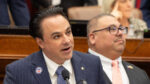
FEATURED: Sen. Phil King, R-Weatherford, addresses his colleagues on Tuesday, January 28, 2025, from the floor of the Texas Senate at the State Capitol in Austin. King led the way to create a new state law designed to help ensure the safety and security of top leaders of public and private universities and colleges in Texas, according to South Texas attorney and Edinburg Mayor Omar Ochoa.
Photograph Courtesy SENATE MEDIA
••••••
For the sake of their safety, top leadership of higher education in Texas now shielded from having their personal information made public, reports Edinburg Mayor Omar Ochoa
By DAVID A. DÍAZ
[email protected]
Personal information of top leaders of public and private higher education systems, universities and colleges – such as the University of Texas Rio Grande Valley, South Texas College, Texas Southmost College, and Texas State Technical Institute – is now shielded from being disclosed as a result of a recent state law, reports South Texas attorney and Edinburg Mayor Omar Ochoa.
The home address, telephone number, emergency contact information, social security number, and family makeup of those public officials and public employees would not be revealed on government websites or when a public information request was submitted for any such material.
The state law, which was created by Senate Bill 1569, protects higher education leaders from harassment and threats by extending them the same protections that are already offered to law enforcement officers, judges, and other public officials, according to its bill analysis, Ochoa added.
In essence, Texas prioritizes protecting those in dangerous roles and gives many others the power to control access to their private lives, balancing transparency with safety and privacy.
“According to the bill analysis of Senate Bill 1569, which went into effect on Monday, September 1, 2025, that measure changed the Government Code and Tax Code to provide for the confidentiality of certain personal identifying information of the following persons: a member of the governing board or the president or other chief executive of a public, private, or independent institution of higher education; and the chancellor or other chief executive officer of a university system,” said Ochoa.
A bill analysis is a document prepared for all bills and joint resolutions reported out of committee. A bill analysis may include background information on the measure, a statement of purpose or intent, and an analysis of the content of the measure.
A bill is a type of legislative measure that requires passage by the Senate and House of Representatives, and action by the governor in order to become effective. A bill is the primary means used to create and change the laws of the state.
Senate Bill 1569, which was supported by all of the Rio Grande Valley state legislative delegation, added these higher education leaders to a Tax Code provision to restrict public access to information identifying their home address in appraisal records.
Sen. Phil King, R-Weatherford, was the primary author of Senate Bill 1569, which means he wrote and filed the bill and guided it through the legislative process.
“Filed” is used to refer to a measure that has been introduced into the legislative process and given a number.
Rep. Drew Darby, R-San Angelo, was the primary sponsor of Senate Bill 1569, which means he carried the bill through the House of Representatives.
“After recent controversies on university campuses, members of the governing boards of higher education institutions have had their private information shared on social media websites. Consequently, dozens of protestors showed up outside the residence of at least one university president on numerous occasions in the spring of 2024 chanting with megaphones, hitting pots and pans on the sidewalk and street, and even trespassing onto private property,” said King. “Legislation was needed to prevent the public sharing of Texas university officials’ home addresses and to ensure the safety and security of these officials and their families.”
As an example, in late April 2024, a group of protesters gathered outside the home of then-UT-Austin President Jay Hartzell in opposition of his handling of a Pro-Palestinian rally on the UT campus, organized by the Palestinian Solidarity Commission in response to the ongoing Gaza war at the time.
https://en.wikipedia.org/wiki/2024_University_of_Texas_at_Austin_pro-Palestinian_campus_protests
In a video posted to social media platform X, a group of protesters – considerably small that the group that had gathered on campus earlier (in April 2024) – can be seen yelling “shame” and chanting “Hartzell, Hartzell, you’re a clown, we demand that you step down,” according to a story by the Texas Tribune’s Zack Despart and Pooja Salhotra.
https://www.texastribune.org/2024/05/02/jay-hartzell-university-texas-republicans-protest/
In Texas, several groups of public officials and employees, including judges, law enforcement (peace officers, corrections, Office of the Attorney General law enforcers), firefighters, certain attorneys (DFPS), state legislators and legislative staff, can shield their home addresses and other personal info under state law (like Gov. Code § 552.117) by claiming Privacy of Public Employee Information or through specific programs like the Address Confidentiality Program (ACP) for judges/victims, protecting them from public records requests, though the Texas Public Information Act generally favors disclosure.
On a national level, students frequently protest outside university presidents’ homes or offices in the U.S., especially during major campus movements like the recent pro-Palestinian demonstrations, where encampments, sit-ins, and rallies occurred at locations likeUniversity of Utah, Michigan State, and Towson University to demand divestment or policy changes from leadership. These actions target university officials directly, aiming to pressure them into addressing demands, as seen historically with protests against apartheid at UC-Berkeley and at Missouri, where student activists forced a president's resignation.
Concerns had been raised about increased targeting and harassment of higher education official, including the sharing of such officials’ personal information on social media, according to supporters of Senate Bill 1569. Supporters of the measure had recommended that the Texas Public Information Act be changed to make the personal information of such officials confidential in order to protect their safety and privacy.
A champion for government transparency, Ochoa provides regular reports to the public on the Texas Public Information Act, the Texas Open Meetings Act, and existing and proposed state laws that affect the mainstream and social media and the people’s rights to know about the actions of their governments in the Lone Star State.
Government transparency is the principle that government operations, decisions, and date should be open, accessible, and understandable to the public, allowing citizens to see how their government works, how their taxes are spent, and to hold officials accountable. It involves proactive sharing of information like budgets, policies, meeting records, and performance reports, often through online portals, ensuring public oversight and preventing misuse of power.
The Texas Public Information Act provides a mechanism for citizens to inspect or copy government records. It also provides that governmental bodies may withhold government records from the public in specific instances.
The Texas Open Meetings Act ensures transparency and accountability by requiring meetings of governmental bodies to be open to the public, except for specific, authorized closed sessions, and requiring public notice of the time, place, and subject matter of the meeting.
Mainstream media refers to widely accessible, large-scale news organizations like major TV networks (CNN, Fox News, ABC), national newspapers (New York Times, Wall Street Journal), and radio that historically dominated public discourse by shaping perceptions and reflecting widely accepted beliefs, often contrasting with social media. Mainstream media is characterized by its broad reach, influence on public opinion, and role as a gatekeeper of information, though its authority is debated with the rise of digital platforms and social media.
Social media refers to internet-based platforms and apps (like Facebook, Instagrams, TikTok, X) that lets users create, share content (text, photos, videos), and interact with online communities, serving as powerful tools for personal connection, brand building, entertainment, and news dissemination. It’s a digital space for communication, collaboration, and building audiences, evolving from simple friend connections to complex ecosystems for commerce and information sharing.
Several individuals serve as the chief executive officers (chancellors) of the various public university systems across Texas.
The major systems and their current leaders are:
• University of Texas System: The current chancellor is John M. Zerwas, MD. He oversees a system with 13 academic and health institutions.
• Texas A&M University System: The chancellor is Glenn Hegar. He assumed office in July 2025 and leads a system of 12 universities and eight state agencies.
• Texas Tech University System: The chancellor and CEO is Brandon Creighton. He began his tenure on November 19, 2025.
• University of Houston System: The dual role of chancellor and president of the flagship university is held by Renu Khator. She is the first female chancellor of a Texas higher education system.
• University of North Texas System: The chancellor is Michael R. Williams.
• Texas State University System: The chancellor is Brian McCall, Ph.D..
More detailed information about Senate Bill 1569, including the history of its movement through the legislative process, the different versions of the measure, similar legislation, the names of the authors and sponsors of the legislation, and witnesses who testified for, against, and on the bill, are available online at:
The final version of Senate Bill 1569, which became state law, follows:
S.B. No. 1569
AN ACT
relating to the availability of certain personal information of a member of the governing board of an institution of higher education, the chief executive officer of the institution, or the chief executive officer of a university system.
BE IT ENACTED BY THE LEGISLATURE OF THE STATE OF TEXAS:
SECTION 1. Section 552.117(a), Government Code, is amended to read as follows:
(a) Information is excepted from the requirements of Section 552.021 if it is information that relates to the home address, home telephone number, emergency contact information, or social security number of the following person or that reveals whether the person has family members:
(1) a current or former official or employee of a governmental body, except as otherwise provided by Section 552.024;
(2) a current or honorably retired peace officer as defined by Article 2A.001, Code of Criminal Procedure, or a current or honorably retired security officer commissioned under Section 51.212, Education Code, regardless of whether the officer complies with Section 552.024 or 552.1175, as applicable;
(3) a current or former employee of the Texas Department of Criminal Justice or of the predecessor in function of the department or any division of the department, regardless of whether the current or former employee complies with Section 552.1175;
(4) a peace officer as defined by Article 2A.001, Code of Criminal Procedure, or other law, a reserve law enforcement officer, a commissioned deputy game warden, or a corrections officer in a municipal, county, or state penal institution in this state who was killed in the line of duty, regardless of whether the deceased complied with Section 552.024 or 552.1175;
(5) a commissioned security officer as defined by Section 1702.002, Occupations Code, regardless of whether the officer complies with Section 552.024 or 552.1175, as applicable;
(6) an officer or employee of a community supervision and corrections department established under Chapter 76 who performs a duty described by Section 76.004(b), regardless of whether the officer or employee complies with Section 552.024 or 552.1175;
(7) a current or former employee of the office of the attorney general who is or was assigned to a division of that office the duties of which involve law enforcement or are performed under Chapter 231, Family Code, regardless of whether the current or former employee complies with Section 552.024 or 552.1175;
(8) a current or former employee of the Texas Juvenile Justice Department or of the predecessors in function of the department, regardless of whether the current or former employee complies with Section 552.024 or 552.1175;
(9) a current or former juvenile probation or supervision officer certified by the Texas Juvenile Justice Department, or the predecessors in function of the department, under Title 12, Human Resources Code, regardless of whether the current or former officer complies with Section 552.024 or 552.1175;
(10) a current or former employee of a juvenile justice program or facility, as those terms are defined by Section 261.405, Family Code, regardless of whether the current or former employee complies with Section 552.024 or 552.1175;
(11) a current or former member of the United States Army, Navy, Air Force, Coast Guard, or Marine Corps, an auxiliary service of one of those branches of the armed forces, or the Texas military forces, as that term is defined by Section 437.001;
(12) a current or former district attorney, criminal district attorney, or county or municipal attorney whose jurisdiction includes any criminal law or child protective services matters, regardless of whether the current or former attorney complies with Section 552.024 or 552.1175;
(13) a current or former employee of a district attorney, criminal district attorney, or county or municipal attorney whose jurisdiction includes any criminal law or child protective services matters, regardless of whether the current or former employee complies with Section 552.024 or 552.1175;
(14) a current or former employee of the Texas Civil Commitment Office or of the predecessor in function of the office or a division of the office, regardless of whether the current or former employee complies with Section 552.024 or 552.1175;
(15) a current or former federal judge or state judge, as those terms are defined by Section 1.005, Election Code, a federal bankruptcy judge, a marshal of the United States Marshals Service, a United States attorney, or a family member of a current or former federal judge, including a federal bankruptcy judge, a marshal of the United States Marshals Service, a United States attorney, or a state judge;
(16) a current or former child protective services caseworker, adult protective services caseworker, or investigator for the Department of Family and Protective Services, regardless of whether the caseworker or investigator complies with Section 552.024 or 552.1175, or a current or former employee of a department contractor performing child protective services caseworker, adult protective services caseworker, or investigator functions for the contractor on behalf of the department;
(17) an elected public officer, regardless of whether the officer complies with Section 552.024 or 552.1175;
(18) a current or former United States attorney, assistant United States attorney, federal public defender, deputy federal public defender, or assistant federal public defender and the spouse or child of the current or former attorney or public defender, regardless of whether the person complies with Section 552.024 or 552.1175; [or]
(19) a firefighter or volunteer firefighter or emergency medical services personnel as defined by Section 773.003, Health and Safety Code, regardless of whether the firefighter or volunteer firefighter or emergency medical services personnel comply with Section 552.024 or 552.1175, as applicable;
(20) a member of the governing board of an institution of higher education or a private or independent institution of higher education, as those terms are defined by Section 61.003, Education Code;
(21) the chancellor or other chief executive officer of a university system, as defined by Section 61.003, Education Code; or
(22) the president or other chief executive officer of an institution of higher education or a private or independent institution of higher education, as those terms are defined by Section 61.003, Education Code.
SECTION 2. Section 552.1175(a), Government Code, is amended to read as follows:
(a) This section applies only to:
(1) current or honorably retired peace officers as defined by Article 2A.001, Code of Criminal Procedure, or special investigators as described by Article 2A.002, Code of Criminal Procedure;
(2) current or honorably retired county jailers as defined by Section 1701.001, Occupations Code;
(3) current or former employees of the Texas Department of Criminal Justice or of the predecessor in function of the department or any division of the department;
(4) commissioned security officers as defined by Section 1702.002, Occupations Code;
(5) a current or former district attorney, criminal district attorney, or county or municipal attorney whose jurisdiction includes any criminal law or child protective services matters;
(5-a) a current or former employee of a district attorney, criminal district attorney, or county or municipal attorney whose jurisdiction includes any criminal law or child protective services matters;
(6) officers and employees of a community supervision and corrections department established under Chapter 76 who perform a duty described by Section 76.004(b);
(7) criminal investigators of the United States as described by Article 2A.002(a), Code of Criminal Procedure;
(8) current or honorably retired police officers and inspectors of the United States Federal Protective Service;
(9) current and former employees of the office of the attorney general who are or were assigned to a division of that office the duties of which involve law enforcement or are performed under Chapter 231, Family Code;
(10) current or former juvenile probation and detention officers certified by the Texas Juvenile Justice Department, or the predecessors in function of the department, under Title 12, Human Resources Code;
(11) current or former employees of a juvenile justice program or facility, as those terms are defined by Section 261.405, Family Code;
(12) current or former employees of the Texas Juvenile Justice Department or the predecessors in function of the department;
(13) federal judges and state judges as defined by Section 1.005, Election Code;
(14) current or former employees of the Texas Civil Commitment Office or of the predecessor in function of the office or a division of the office;
(15) a current or former member of the United States Army, Navy, Air Force, Coast Guard, or Marine Corps, an auxiliary service of one of those branches of the armed forces, or the Texas military forces, as that term is defined by Section 437.001;
(16) a current or former child protective services caseworker, adult protective services caseworker, or investigator for the Department of Family and Protective Services or a current or former employee of a department contractor performing child protective services caseworker, adult protective services caseworker, or investigator functions for the contractor on behalf of the department;
(17) an elected public officer;
(18) a firefighter or volunteer firefighter or emergency medical services personnel as defined by Section 773.003, Health and Safety Code;
(19) a current or former United States attorney, assistant United States attorney, federal public defender, deputy federal public defender, or assistant federal public defender;
(20) a member of the governing board of an institution of higher education or a private or independent institution of higher education, as those terms are defined by Section 61.003, Education Code;
(21) the chancellor or other chief executive officer of a university system, as defined by Section 61.003, Education Code; and
(22) the president or other chief executive officer of an institution of higher education or a private or independent institution of higher education, as those terms are defined by Section 61.003, Education Code.
SECTION 3. Section 25.025(a), Tax Code, as amended by Chapters 76 (S.B. 617), 152 (S.B. 870), 430 (H.B. 1911), 765 (H.B. 4504), and 937 (S.B. 1525), Acts of the 88th Legislature, Regular Session, 2023, is reenacted and amended to read as follows:
(a) This section applies only to:
(1) a current or former peace officer as defined by Article 2A.001, Code of Criminal Procedure, and the spouse or surviving spouse of the peace officer;
(2) the adult child of a current peace officer as defined by Article 2A.001, Code of Criminal Procedure;
(3) a current or honorably retired county jailer as defined by Section 1701.001, Occupations Code;
(4) an employee of the Texas Department of Criminal Justice;
(5) a commissioned security officer as defined by Section 1702.002, Occupations Code;
(6) an individual who shows that the individual, the individual's child, or another person in the individual’s household is a victim of family violence as defined by Section 71.004, Family Code, by providing:
(A) a copy of a protective order issued under Chapter 85, Family Code, or a magistrate's order for emergency protection issued under Article 17.292, Code of Criminal Procedure; or
(B) other independent documentary evidence necessary to show that the individual, the individual's child, or another person in the individual's household is a victim of family violence;
(7) an individual who shows that the individual, the individual's child, or another person in the individual's household is a victim of sexual assault or abuse, stalking, or trafficking of persons by providing:
(A) a copy of a protective order issued under Subchapter A or B, Chapter 7B, Code of Criminal Procedure, or a magistrate's order for emergency protection issued under Article 17.292, Code of Criminal Procedure; or
(B) other independent documentary evidence necessary to show that the individual, the individual's child, or another person in the individual's household is a victim of sexual assault or abuse, stalking, or trafficking of persons;
(8) a participant in the address confidentiality program administered by the attorney general under Subchapter B, Chapter 58, Code of Criminal Procedure, who provides proof of certification under Article 58.059, Code of Criminal Procedure;
(9) a federal judge, a federal bankruptcy judge, a marshal of the United States Marshals Service, a state judge, or a family member of a federal judge, a federal bankruptcy judge, a marshal of the United States Marshals Service, or a state judge;
(10) a current or former district attorney, criminal district attorney, or county or municipal attorney whose jurisdiction includes any criminal law or child protective services matters;
(11) a current or former employee of a district attorney, criminal district attorney, or county or municipal attorney whose jurisdiction includes any criminal law or child protective services matters;
(12) an officer or employee of a community supervision and corrections department established under Chapter 76, Government Code, who performs a duty described by Section 76.004(b) of that code;
(13) a criminal investigator of the United States as described by Article 2A.002(a), Code of Criminal Procedure;
(14) a current or honorably retired police officer or inspector of the United States Federal Protective Service;
(15) a current or former United States attorney, assistant United States attorney, federal public defender, deputy federal public defender, or assistant federal public defender and the spouse and child of the attorney or public defender;
(16) a current or former employee of the office of the attorney general who is or was assigned to a division of that office the duties of which involve law enforcement or are performed under Chapter 231, Family Code;
(17) a medical examiner or person who performs forensic analysis or testing who is employed by this state or one or more political subdivisions of this state;
(18) a current or former member of the United States armed forces who has served in an area that the president of the United States by executive order designates for purposes of 26 U.S.C. Section 112 as an area in which armed forces of the United States are or have engaged in combat;
(19) a current or former employee of the Texas Juvenile Justice Department or of the predecessors in function of the department;
(20) a current or former juvenile probation or supervision officer certified by the Texas Juvenile Justice Department, or the predecessors in function of the department, under Title 12, Human Resources Code;
(21) a current or former employee of a juvenile justice program or facility, as those terms are defined by Section 261.405, Family Code;
(22) a current or former employee of the Texas Civil Commitment Office or the predecessor in function of the office or a division of the office;
(23) a current or former employee of a federal judge or state judge;
(24) a current or former child protective services caseworker, adult protective services caseworker, or investigator for the Department of Family and Protective Services or a current or former employee of a department contractor performing child protective services caseworker, adult protective services caseworker, or investigator functions for the contractor on behalf of the department;
(25) an elected public officer;
(26) a firefighter or volunteer firefighter or emergency medical services personnel as defined by Section 773.003, Health and Safety Code;
(27) a customs and border protection officer or border patrol agent of United States Customs and Border Protection or the spouse, surviving spouse, or adult child of a customs and border protection officer or border patrol agent;
(28) a current or former employee or contract staff member of a university health care provider at a corrections facility operated by the Texas Department of Criminal Justice or the Texas Juvenile Justice Department; [and]
(29) a current or former attorney for the Department of Family and Protective Services;
(30) a member of the governing board of an institution of higher education or a private or independent institution of higher education, as those terms are defined by Section 61.003, Education Code;
(31) the chancellor or other chief executive officer of a university system, as defined by Section 61.003, Education Code; and
(32) the president or other chief executive officer of an institution of higher education or a private or independent institution of higher education, as those terms are defined by Section 61.003, Education Code.
SECTION 4. To the extent of any conflict, this Act prevails over another Act of the 89th Legislature, Regular Session, 2025, relating to nonsubstantive additions to and corrections in enacted codes.
SECTION 5. The changes in law made by this Act apply only to a request for information that is received by a governmental body or an officer on or after the effective date of this Act.
SECTION 6. This Act takes effect September 1, 2025.
••••••
For more on this and other Texas legislative news stories that affect the Rio Grande Valley metropolitan region, please log on to Titans of the Texas Legislature (TitansoftheTexasLegislature.com).