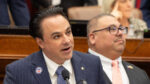
FEATURED: Rep. Terry Canales, D-Edinburg, addresses the audience at the McAllen Convention Center during the 49th Annual Combined Law Enforcement Association of Texas (CLEAT) Convention and Leadership Academy held from Thursday, September 4, 2025 through Saturday, September 6, 2025. Canales served in a leadership role last spring in the passage of House Bill 2306, a recent new state law that helps ensure that offenders who target children and vulnerable Texans stay behind bars.
Photograph Courtesy REP. TERRY CANALES FACEBOOK
••••••
Tough new law coauthored by Rep. Terry Canales ensures that human traffickers of children and people with disabilities no longer qualify for parole
By DAVID A. DÍAZ
[email protected]
A recent state law, of which Rep. Terry Canales, D-Edinburg, help lead through the legislative process, guarantees that convicted human traffickers of children and people with disabilities no longer can get out of prison on parole.
Human trafficking involves the use of force, fraud, or coercion to obtain some type of labor or commercial sex act.
In Texas, parole is the supervised, early release of an eligible inmate from prison to serve the rest of their sentence in the community, granted by the Texas Board of Pardons and Paroles (TxBPP) as a privilege, not a right, under strict conditions like regular check-ins with a parole officer and specific requirements for living/employment, with violations leading to re-incarceration.
It is distinct from probation (which happens before prison) and involves a review process using guidelines to assess risk, aiming to reintegrate offenders while maintaining public safety.
“My colleague, Rep. Denise Villalobos, who was the author of House Bill 2306, noted that before the passage of this measure, people convicted of trafficking offenses had to serve at least half of their sentence, or 30 years, whichever is minimum,” Canales explained. “The sentencing is 25 years to life, so a convicted human trafficker could have – before House Bill 2306 became state law last September – serve as little as 12 years and get released on parole.”
As author, Villalobos, R-Robstown, filed House Bill 2306 and guided it through the legislative process (also called the primary author).
“Filed” is used to refer to a measure that has been introduced into the legislative process and given a number.
A bill is a type of legislative measure that requires passage by the Texas Senate and Texas House of Representatives and action by the governor in order to become effective. A bill is the primary means used create and change the laws of the state.
Every year, millions of men, women, and children are trafficked worldwide – including in the United States. It can happen in any community and victims can be any age, race, gender, or nationality.
As coauthor of House Bill 2306, Canales was authorized by Villalobos to join in the authorship of the bill.
A coauthor serves as an important ally, increasing a bill’s visibility and potential for passage.
Sen. Tan Parker, R-Flower Mound, was the sponsor of House Bill 2306.
As Senate sponsor, Parker guided the bill through the Senate, acting as its champion, explaining its intent, working with committees, and securing votes.
“The passage of House Bill 2036, which became law on Monday, September 1, 2025, now means that human trafficking of children or disabled persons join the list of very serious crimes that result in ineligibility for parole” including Capital Murder, Aggravated Kidnapping, Aggravated Sexual Assault, Indecency with a Child, and offenses with findings of deadly weapons or resulting in injury to a child/elderly/disabled individual, especially when sentenced as first-degree felonies,” Canales said.
“This bill is simple. It adds to the current list of offenses in the Government Code that are ineligible for release for parole,” Villalobos testified on Wednesday, April 9, 2025, before the House Committee on Corrections. “Any criminal convicted of trafficking kids in Texas should never be paroled.
“Since 2021, there have been 10 (ten) inmates released on parole due to trafficking children, and this bill simply seeks to ensure those taking advantage of our children in the most cruel and heinous ways are fully held accountable,” Villalobos added.
Villalobos’ main witness in support of House Bill 2036 was Crystal Sepulveda Morazán, representing herself and on behalf of the Human Trafficking Leadership Council of Texas.
Highlights of Morazán’s testimony follows:
“I am here not only as a professional in the mental health field working with vulnerable children, I am also here as a survivor as well as a member of the Human Trafficking Survivor Leadership Council of Texas.
“I stand before you in strong and unwavering support of this bill. It is not only necessary but it is critical. It is a matter of public safety, of justice, and of protecting the most vulnerable members of our community.
“My (attacker) was one of the first in the state of Texas to be convicted of trafficking minors. He also targeted undocumented women of color, individuals often overlooked and underserved, exploiting their fear, their lack of resources, and their trust. Among his victims is myself.
“And now, he is out on parole. Since his release, the trauma he has inflicted has not ended. It has resurfaced, intensified, and multiplied. Survivors like myself now live with the daily fear. He remains in contact with individuals in vulnerable situations, including some of the very same women he once exploited. His release (on parole) has not rehabilitated him, it has emboldened him.
“I speak not only from personal experience, but also from years of professional work in trauma response care. I’ve spoken at universities, including Texas A&M, UT Austin School of Nursing, I’ve worked alongside nonprofits to include CASA and SAFE Alliance, as well as numerous law enforcement agencies.
“Despite all of these, and despite all of the things I have been privy to see and learn, nothing has prepared for the agony of knowing that my trafficker walks free with the same access, and the same manipulative tactics.
“There is research and data that supports the need for this bill. According to the U.S. Department of Justice, individuals convicted of sexual exploitation and trafficking of minors show higher rates of recidivism. While some studies report re-offense rates of 70 percent within a few years, these individuals do not simply reform. They are strategic and persistent in their abuse, often targeting those they believe cannot or will not speak out, especially children, people with disabilities, and undocumented individuals.
“We know that traffickers are not just opportunists, that they are predators. Parole does not rehabilitate predators, it gives them proximity and it gives them opportunity.
"This bill acknowledges the simple and sobering truth: there are crimes so heinous, so devastating in their impact that release is not an option. Some individuals have demonstrated through their actions and repeated behaviors that they all continue to exploit and harm.
“My (attacker) has already violated the conditions of his parole several times, and has been placed back into prison as well as released back out on parole, and yet continues to be released, placing countless others at risk. How many second chances will he be given before other people are continued to be hurt?
“I urge you do not give the most dangerous traffickers another opportunity to destroy lives. Survivors should not have to look over their shoulder for the rest of their lives while their abusers walk among us. We need this bill to ensure that justice is not just about punishment, but that it is also about prevention.
"Protecting our children, protecting our disabled community, and protecting the women of color whose voices are so often silenced. Please stand with survivors, stand for justice, and please pass this bill. Let Texas lead the way and let us be the state that puts an end to this cycle of exploitation.”
Texas Penal Code § 20A identifies four major types of trafficking:
• ADULT SEX TRAFFICKING: Trafficking of adults for commercial sex by force, fraud, or coercion
• ADULT LABOR TRAFFICKING: Trafficking of adults for labor by force, fraud, or coercion
• CHILD SEX TRAFFICKING: Trafficking children, under the age of 18, for commercial sex by any means
• CHILD LABOR TRAFFICKING: Trafficking children, under the age of 18, for labor by force, fraud, or coercion
All fall under one statute, which can be used to prosecute anyone who recruits, harbors, transports, entices, or provides another person for forced labor or sexual exploitation, as well as anyone who benefits from that labor or exploitation. Although a common misconception is that transportation or movement of the victim is required, it is not.
According to the bill analysis of House Bill 2306, that measure resulted in thenumerous changes.
A bill analysis is document prepared for all bills and joint resolutions reported out of committee. A bill analysis may include background information on the measure, a statement of purpose or intent, and an analysis of the content of the measure.
Those changes included:
• House Bill 2306 amends (changes) the Code of Criminal Procedure and Government Code to make an inmate serving a sentence for any of the following offenses ineligible for release on parole:
• Trafficking a child or disabled individual with the intent that the trafficked child or disabled individual engage in forced labor or services;
• Receiving a benefit from participating in a venture that involves such trafficking activity;
• Trafficking a child or disabled individual and by any means causing the trafficked child or disabled individual to engage in or become the victim of certain sexual offenses; or
• Receiving a benefit from participating in a venture that involves such trafficking activity causing the child or individual to engage in or become the victim of certain sexual offenses or engaging in sexual conduct with such a trafficked child or disabled individual.
House Bill 2306 was one of two bills approved by the Texas Legislature and signed into law by Gov. Greg Abbott in 2025 that took aim at human traffickers.
On Thursday, August 21, 2025, Abbott ceremonially signed House Bill 2306 and Senate Bill 1212 into law at the Governor’s Mansion, imposing the toughest penalties on human traffickers.
“I thank all the survivors of human trafficking for stepping up and telling their stories, sharing their insight, and talking about what needs to be done to help their lives," said Abbott. "We want to ensure that we do all we can so that human traffickers never walk the streets of Texas again. These two bills help achieve that goal.
“Senate Bill 1212 increases the penalty for all human trafficking offenses to a first degree felony. The worst of the worst are human traffickers of children and people with disabilities. House Bill 2306 ensures that those traffickers will serve every single day of their prison sentence behind bars, no parole for the worst of the worst.”
In Texas, a first-degree penalty (for a First Degree Felony) means 5 years to life in prison (up to 99 years) and a fine of up to $10,000, representing the most severe felonies below capital crimes, with examples including aggravated robbery, aggravated sexual assault, and murder. Conviction also carries consequences like loss of voting/firearm rights, affecting employment and housing.
Canales voted for Senate Bill 1212.
Senate Bill 1212 (Paxton/Kerwin) increasedthe ability to prosecute and more effectively punish defendants for human trafficking. This bill also increasedthe penalty for any conduct constituting the offense of trafficking of a persons to a first-degree felony.
Sen. Angela Paxton, R-McKinney, was the Senate author of Senate Bill 12, while Rep. Helen Kerwin, R-Cleburne, was the House sponsor of that measure.
A House sponsor in the Texas Legislature is a member of the House of Representatives who agrees to guide a bill, usually originally passed by the Senate, through the House committee and floor process. White the bill author initiates a bill in its chamber of origin, the sponsor champions it in the opposite chamber.
“In spite of the volume of human trafficking that occurs in Texas, our state has more lenient penalties than some other states. The horrific crime of trafficking should have a penalty that reflects its gravity,” said Paxton.
Texas has historically led the rest of the states on anti-trafficking legislation. For example, Texas made headlines in 2021 as being the first state to make the purchase of commercial sex a felony, combatting the demand side of this crime, not just penalizing the traffickers (87R House Bill 1540). However, when it comes to across-the-board human trafficking offenses, Texas is over a decade behind other states.
“In Florida, coercion for labor or commercial sexual activity is a first degree felony, with some additional punishment specifications for certain conditions,” Paxton added. “While trafficking was originally a second degree felony in Florida, Florida increased the penalty to a first degree felony in 2012.”
Before Senate Bill 1212 became state law, human trafficking was a second degree felony in Texas, with the offense increased to a first degree felony only under certain conditions.
Senate Bill increased the penalty for human trafficking offenses across the board to a first degree felony wherever it is not already.
Senate Bill 1212 amended (changed) current law relating to the prosecution and punishment for the offense of trafficking of persons and increases a criminal penalty.
••••••
For more on this and other Texas legislative news stories that affect the Rio Grande Valley metropolitan region, please log on to Titans of the Texas Legislature (TitansoftheTexasLegislature.com).