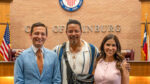
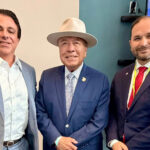
FEATURED, FROM LEFT: Sen. Juan Hinojosa, D-McAllen, The Vaquero (skilled horseman), who is the mascot of the University of Texas Rio Grande Valley sports teams, and Rep. Terry Canales, D-Edinburg. The two state lawmakers were on hand on Wednesday, October 8, 2025, for the grand opening of the $145.7 million UT Health RGV Cancer and Surgery Center, located at 1400 N. Commerce Center Street in McAllen.
Photograph Courtesy UTRGV FACEBOOK
••••••
Sen. Hinojosa, Rep. Canales, Rep. Guerra praise grand opening of $145.7 million UT Health RGV Cancer and Surgery Center in McAllen, hint at much bigger expansion in upcoming few years
By DAVID A. DÍAZ
[email protected]
Sen. Juan Hinojosa, D-McAllen, Rep. Terry Canales, D-Edinburg, and Rep. Bobby Guerra, D-McAllen, on Wednesday, October 8, 2025, praised the grand opening of the $145.7 million UT Health RGV Cancer and Surgery Center, located at 1400 N. Commerce Center Street in McAllen, and hinted at much bigger expansions in the upcoming few years.
“This is just a start. You will see this facility grow and expand, and we will work to bring more resources, bring more funding, to increase our footprint in the Rio Grande Valley to become a leading research institution in the state of Texas,” Hinojosa pledged.
UT Health RGV is the clinical practice of the UTRGV School of Medicine, providing primary and specialty care services throughout the Rio Grande Valley. It offers a wide range of services, including primary care, pediatrics, cancer care, and various surgical specialties, and also conducts cutting-edge research. UT Health RGV has multiple locations across the Valley, including clinics specifically for UTRGV students.
In 2013, Hinojosa was the author of Senate Bill 24, which combined the assets of its legacy institutions University of Texas-Pan American and the University of Texas at Brownsville to establish one strengthened and unified university across the Valley, now known as the University of Texas Rio Grande Valley (UTRGV).
Senate Bill 24 also created the UTRGV School of Medicine and provided UTRGV access to the Permanent University Fund, which has almost $40 billion in state money which is used to fund major construction projects within the University of Texas System and Texas A&M System.
A bill is a type of legislative measure that requires passage by the Texas Senate and Texas House of Representatives, and action by the governor in order to become effective. A bill is the primary means used to create and change the laws of the state.
As the author of Senate Bill 24, Hinojosa was the legislator who wrote and introduced the measure and guided it through the legislative process (also called the primary author).
“My father died of cancer, my mother died of cancer, so I know the fear that we all have of cancer,” Hinojosa said. “But by working together, we are able to manage, prevent by treatment, by research, and at a much earlier stage, even cure cancer.”
Canales, who as cosponsor of Senate Bill 24 helped secure approval by the House of Representatives, shared Hinojosa’s vision for the McAllen-based UTRGV medical campus.
“I believe this is the seed for a much larger tree of knowledge, of hope, of cancer prevention and cancer treatment. I believe this probably will be the focus of cancer treatment for the Rio Grande Valley,” Canales predicted. “This is obviously a milestone. Coming together as a community we have made an enormous leap for health care in the Rio Grande Valley.”
A cosponsor is a legislator who joins with the primary sponsor to guide a bill or resolution through the legislative process in the opposite chamber. A cosponsor must be a member of the opposite chamber from the one in which the measure was filed.
The sponsor is the legislator who guides a bill through the legislative process after the bill has passed the originating chamber.
Filed is used to refer to a measure that has been introduced into the legislative process and given a number.
“When I helped create UTRGV and the School of Medicine, it was merely a dream. Today we have made one more dream become a reality, and it is just the beginning,” Canales continued.
Verónica Gonzales, Senior Vice President of Governmental and Community Relations for the University of Texas Rio Grande Valley, who served as the Master of Ceremonies for the ribbon-cutting, welcomed the lawmakers’ determination to work in the Texas Legislature and with the UT System leadership to make expansion plans a high priority.
“You heard it, more funding, this is just the beginning,” Gonzales told the standing-room audience at the event held inside the center, and then directed her comments to the lawmakers. “I took notes.”
Also according to Canales, the Valley state legislative delegation succeeded in securing almost $351 million in combined state funds through the General Appropriations Act for UTRGV and its School of Medicine for a two-year period that began on Monday, September 1, 2025 – an increase of nine percent from the previous two years.
In Texas, the General Appropriations Act (GAA) is a crucial bill passed by the Legislature every two years that details how state funds are allocated to state agencies and institutions for their operations during the upcoming two-year period. It serves as the primary method for funding state agency (including universities and medical schools) and state programs.
“This is not just a building, it is a symbol of hope, healing and a source of inspiration for young students who aspire to study medicine and join the medical field,” Canales said.
Guerra, who recently announced he will not be seeking reelection in 2026 but who will continue to serve out his current two-year term until Tuesday, January 12, 2027, said the UT Health RGV Cancer and Surgery Center and future expansions on the remainder of the 38-acre site will experience dramatic growth sooner rather than later.
“One of my top priorities as state representative was improving the health care system in the RGV. The UT Health RGV Cancer and Surgery Center is another important step towards much needed equitable health care options for our community,” Guerra said. “Not only will our neighbors gain access to more care, the center will bring jobs, economic development, and new knowledge for our people.”
Already in operation next to the UT Health RGV Cancer and Surgery Center is the 65,000-square-foot, $23.4 million UTRGV McAllen ISD Collegiate Academy. This state-of-the-art facility, which opened in 2024, is a partnership between UTRGV and McAllen Independent School District to give students a head start on a bachelor’s degree, with many students focusing on health professions.
The UT Health RGV Cancer and Surgery Center in McAllen is approximately 144,000 to 145,000 square feet and is a three-story facility.
It opened some specialty clinics on Monday, August 4, 2025, and offers services in orthopedics, surgical oncology, and hematology-oncology, and provides coordinated, expert care under one roof. Additional services will continue to roll out in the coming months, expanding access to comprehensive outpatient care for patients across the Valley.
“The journey for this center started years ago. The concept was first proposed by DHR Health leadership to create a partnership with MD Anderson Center,” Hinojosa recalled. “In 2019, I traveled to Houston with my Chief of Staff Luis Moreno to meet with MD Anderson Center President Dr. Peter Pisters to discuss the request. Since then, we have worked to secure the partnerships and investments necessary so that our cancer patients in South Texas will have access to top-notch facilities and world-class doctors right here at home.”
For many Rio Grande Valley residents, seeking specialized cancer treatment often meant traveling to San Antonio, Houston or beyond, resulting in time away from loved ones and countless missed workdays, according to university officials. For those without transportation or the ability to take time off, these distances created insurmountable barriers to the vital care they needed.
“When it comes to cancer research, cancer treatment here in the Rio Grande Valley, this is cutting edge. The reality is we’re providing a center here in the RGV and people will not have to travel hundreds of miles, like they currently do now,” Canales said. “In fact, we will be partnered with MD Anderson, one of the world’s most renowned cancer centers and cancer treatment centers.”
Hinojosa thanked the Rio Grande Valley state legislative delegation “because they have never lost sight of what we need in the Rio Grande Valley. We know many of our neighbors were having to travel to Houston, to San Antonio, to get treatment.
“Here we are now, offering the same services, to deal with research for preventing and treatment of cancer right here in the Rio Grande Valley,” Hinojosa continued. “It could not have been done without teamwork by the Legislature, the UT System Board of Regents, (UTRGV) President (Guy) Bailey, our many leaders, and by la gente (the people), who came and talked to us. We saw the problems they faced when they had cancer.”
In August 2021, Hinojosa joined Bailey in announcing the UT Health RGV Cancer and Surgery Center would include oncology advisory services provided by The University of Texas MD Anderson Cancer Center.
In August of that year, the UT System Board of Regents authorized the expenditure of $145,723,401, which included $49,493,963 from Permanent University Fund (PUF) Bond Proceeds, $44,922,833 from Tuition Revenue Bond (TRB) Proceeds, supported by the Rio Grande Valley Legislative Delegation and approved by the Texas Legislature in 2021, $40,000,000 from Revenue Financing System (RFS) Bond Proceeds, $10,306,605 from Designated Funds, and $1,000,000 from Gifts.
During the 89th Regular Session of the Texas Legislature, which took place during the first half of 2025, “working with my colleagues, we secured $5 million for the biennium to support clinical operations and $1.9 million for research at the UT Health RGV Cancer and Surgery Center,” Canales said.
UTRGV leaders also hailed the grand opening as a new era as community leaders, healthcare providers and Valley residents gathered for the ribbon-cutting of the UT Health RGV Cancer and Surgery Center.
“Today has been a dream in the making for all of us,” Bailey said. “I can’t stress enough how important today is for the university and for the Rio Grande Valley.”
This celebration is nothing short of historic,” said Dr. Everardo Cobos, Interim Dean of the UTRGV School of Medicine, and Chair of the Department of Medicine and Oncology, who is a hematologist-oncologist at UT Health RGV. “We are opening the door to a new era of hope, an era of healing and increased possibilities for our community.
"We are the only academic cancer center in the Valley," Cobos emphasized. "We're going to discover new treatments and new pathways that will benefit patients, not just here, but across our nation."
An academic health center is an institution that combines a medical school with one or more affiliated teaching hospitals.
The new state-of-the-art UT Health RGV Cancer and Surgery Center is designed to be a one-stop destination for coordinated outpatient care.
Services include:
• Cancer care – Medical and surgical oncology, hematology, diagnostics and infusion therapy.
• Orthopedic and sports medicine – Specialized surgeons and physicians, on-site imaging and outpatient rehabilitation services.
• Outpatient surgery – Sports medicine, foot and ankle, hand, joint, gastroenterology and oncology procedures (launching soon).
• Diagnostic imaging – MRI 3T, CT, X-ray, mammography, bone density, general ultrasound, and the only Automated Breast Ultrasound (ABUS) in Hidalgo County. PET/CT and fluoroscopy services coming soon.
• Clinical laboratory services – On-site lab supporting timely diagnosis, treatment planning and ongoing patient care, with direct-to-consumer testing available soon.
• Outpatient rehabilitation – Occupational, hand and oncology therapy, with physical therapy services launching soon.
• Clinical Research and Training – Expanding opportunities for trials and medical education in the Valley.
The center's layout and imaging capabilities were intentionally built with comfort, speed and diagnostic excellence in mind.
“People heal better at home, and that’s the whole purpose of this center,” said Dr. Michael Sander, Chief Executive Physician for UT Health RGV. “We have built it here to enable us to do so many more things, so our patients don't have to leave.”
This commitment to excellence extends to oncology pharmacy services, ensuring timely, personalized cancer medications. Unlike other options, UT Health RGV's specialty pharmacy provides face-to-face support from professionals who collaborate closely with oncologists.
The infusion and chemotherapy pharmacy facilities, expected to open soon, will meet the highest national safety standards, including negative-pressure rooms and sterile pass-through chambers, features rarely found in outpatient centers across the Valley.
“We are filling a vital need in the RGV,” Sander said. “With this center, we have it all under one roof.”
The same level of innovation and patient-centered design is also shaping the center’s outpatient surgery program, scheduled to launch later this year. Services will include sports medicine, foot and ankle, hand, joint, gastroenterology and oncology procedures.
The center will also become the new home for UT Health RGV's Orthopedic Surgery and Sports Medicine services, providing patients with access to advanced surgical care, imaging and rehabilitation all in one location.
The facility was designed to bridge critical care gaps while unlocking new opportunities in research and education. Leaders emphasized that the space was created to enable patients to access comprehensive cancer treatment and cutting-edge clinical trials without leaving their community.
The center will also serve as a training hub for future doctors, medical students, nurses, physician residents and fellows.
Students will gain hands-on learning experiences that not only strengthen the medical workforce but also help address the growing physician shortage in Texas.
Looking ahead, Cobos said the center reflects what the Valley has always deserved and what the future holds.
“We’re going to train in here, in this environment where science, compassion and healing come together," Cobos said. "We are going to grow our own doctors and our own scientists – homegrown experts to understand the culture, the people and are committed to serving the Valley.”
••••••
Heriberto Pérez-Zúñiga contributed to this article. For more on this and other Texas legislative news stories that affect the Rio Grande Valley metropolitan region, please log on to Titans of the Texas Legislature (TitansoftheTexasLegislature.com).