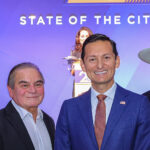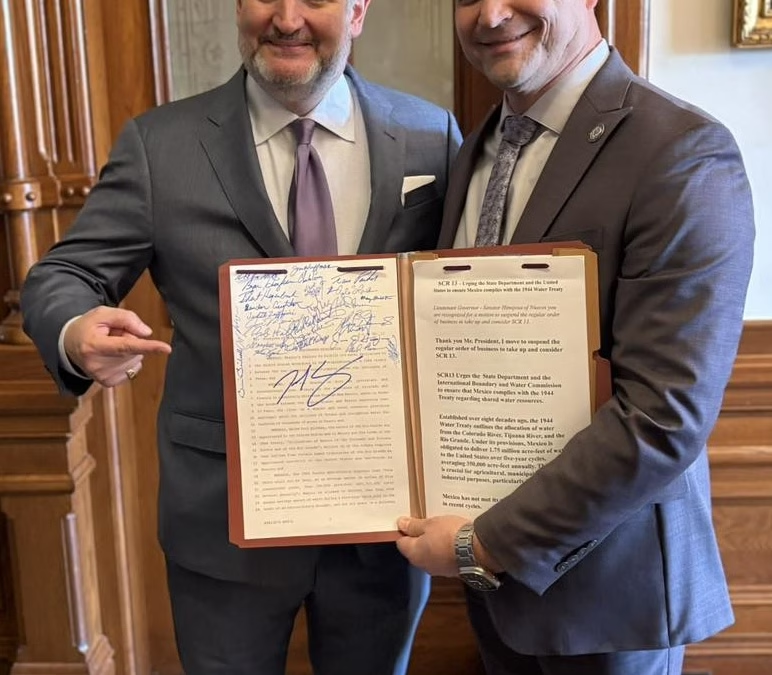
FEATURED, FROM LEFT: U.S. Sen. Ted Cruz, R-Texas, and Texas Sen. Adán “Adam” Hinojosa, R-Brownsville, celebrate the passage of Hinojosa’s Senate Concurrent Resolution 13 on Wednesday, April 30, 2025 by the Texas Senate, which urged the U.S. Department of State and International Boundary and Water Commission (IBWC) to take immediate diplomatic action to ensure Mexico fulfills its obligations under the critical 1944 US-Mexico Water Treaty. SCR 13 was then approved the House of Representatives and signed into law by Gov. Greg Abbott.
https://senate.texas.gov/members/d27/press/en/p20250319a.pdf
Photograph Courtesy SENATE MEDIA SERVICES
•••••••
With key governments in South Texas using taxpayer-funded lobbyists, Sen. Adán “Adam” Hinojosa, R-Corpus Christi, taking leadership role to stop use of such a practice by local politicians
By DAVID A. DÍAZ
[email protected]
With key governments in South Texas for years using taxpayer-funded lobbyists, Sen. Adán “Adam” Hinojosa, R-Corpus Christi, is taking a leadership role to stop use of such a practice by local politicians in Corpus Christi and the Rio Grande Valley.
In Texas, “taxpayer-funded lobbyists” refers to the practice of local governments (cities, counties, school districts, and other political subdivisions) using public funds to hire or contract with lobbyists or to pay dues to associations that employ lobbyists.
These lobbyists then advocate on behalf of those local entities to influence state lawmakers on various issues, sometimes including matters like increased spending, regulatory expansion, or opposition to tax relief initiatives.
Sen. Adán “Adam” Hinojosa is an author of Senate Bill 12, which would forbid cities, counties, and school districts from using public dollars to hire lobbyists.
A bill is a type of legislative measure that requires passage by both chambers of the legislature and action by the governor in order to become effective. A bill is the primary means used to create and change the laws of the state.
Local elected leaders have long argued the practice is needed for localities to advocate for their constituents at the state level. In the Texas Legislature, a constituent is a citizen residing in the district of an elected state representative, state senator, lt. governor, and governor.
Among the many individuals who testified for, again, or on Senate Bill 12 on Tuesday, July 22, 2025, when it was heard by the Senate Committee on State Affairs were Brownsville Mayor John Cowan, Jr., Corpus Christi City Manager Peter Zanoni, and Keely Hovatter, a lobbyist for the City of McAllen.
Cowan, Zanoni, and Hovatter were against the passage of Senate Bill 12.
https://capitol.texas.gov/tlodocs/891/witlistbill/html/SB00012S.htm
Rio Grande Valley and Coastal Bend governmental bodies which currently employ lobbyists to work before the Texas Legislature and major state offices include:
- Brownsville Navigation District
- Brownsville Public Utilities Board
- Cameron County
- Cameron County Drainage District No. 6
- Cameron County Regional Mobility Authority
- City of Brownsville
- City of Corpus Christi
- City of Edinburg
- City of Harlingen
- City of McAllen
- City of Mission
- City of Pharr
- City of Roma
- City of South Padre Island
- City of Weslaco
- Hidalgo County Drainage District No. 1
- Hidalgo County Regional Mobility Authority
- Hidalgo County Water Improvement District No. 3
- Nueces County
- Nueces County Drainage District #2i
- Nueces County Hospital District
- Port of Corpus Christi
- Port of Corpus Christi Authority
Sen. Adán “Adam” Hinojosa and other supporters of Senate Bill 12 are concerned that the use of public funds by political subdivisions for lobbying activities is an improper use of taxpayer funds and that there is a general lack of transparency regarding public spending on lobbying activities.
According the bill analysis of the measure, Senate Bill 12 seeks to address these concerns by prohibiting the use of public funds by political subdivisions for hiring or contracting with a person required to register as a lobbyist under Chapter 305, Government Code.
A bill analysis is a document prepared for all bills and joint resolutions reported out of committee. A bill analysis may include background information on the measure, a statement of purpose or intent, and an analysis of the content of the measure.
Additionally, Senate Bill 12 prohibits the use of public funds to pay dues or fees to a non-profit statewide association that primarily represents political subdivisions and hires or contracts with a person required to register as a lobbyist under Chapter 305, Government Code.
Senate Bill 12, whose primary author is Sen. Mayes Middleton, R-Galveston, cleared the Senate on Friday, August 1, 2025 by a 17-11 vote.
Sen. Juan “Chuy” Hinojosa, D-McAllen (no relation to Sen. Adán “Adam” Hinojosa), and Sen. Judith Zaffirini, D-Laredo, whose legislative district includes all of Starr County, voted against Senate Bill 12.
The bill is awaiting action by the House of Representatives.
https://www.texastribune.org/2025/07/30/texas-taxpayer-funded-lobbying-2025
As one of the authors of Senate Bill 12, Sen. Adán “Adam” Hinojosa is part of the leadership team helping Middletown guide the measure through the legislative process.
The main provisions of Senate Bill 12, as passed by the Senate on Friday, August 1, 2025, are:
SECTION 1. Chapter 556, Government Code, is amended by adding Section 556.0056 to read as follows:
Sec. 556.0056. RESTRICTION ON USE OF PUBLIC FUNDS BY POLITICAL SUBDIVISIONS FOR LOBBYING ACTIVITIES.
(a) A political subdivision may not spend public funds:
(1) to hire or contract with an individual required to register as a lobbyist under Chapter 305 for the purpose of lobbying a member of the legislature; or
(2) to pay a nonprofit association or organization that:
(A) primarily represents political subdivisions; and
(B) hires or contracts with an individual required to register as a lobbyist under Chapter 305.
(b) Subsection (a) does not apply to an association or organization that solely represents elected sheriffs or individual law enforcement officers.
(c) Subsection (a) does not prohibit:
(1) an officer or employee of a political subdivision from providing information for a member of the legislature or appearing before a legislative committee;
(2) an elected officer of a political subdivision from advocating for or against or otherwise influencing or attempting to influence the outcome of legislation pending before the legislature while acting as an officer of the political subdivision;
(3) an employee of a political subdivision from advocating for or against or otherwise influencing or attempting to influence the outcome of legislation pending before the legislature if those actions would not require a person to register as a lobbyist under Chapter 305;
(4) a political subdivision from reimbursing an officer or full-time employee of the political subdivision for direct travel expenses incurred by the officer or employee for engaging in an activity described by Subdivision (1), (2), or (3); or
(5) a full-time employee of a nonprofit association or organization that primarily represents political subdivisions of this state from:
(A) providing legislative services related to bill tracking, bill analysis, and legislative alerts;
(B) communicating directly with a member of the legislature to provide information if the communication would not require a person to register as a lobbyist under Chapter 305; or
(C) testifying for or against legislation before the legislature.
(d) If a political subdivision engages in an activity prohibited by Subsection (a), a taxpayer or resident of the political subdivision is entitled to appropriate injunctive relief to prevent further activity prohibited by that subsection and further payment of public funds related to that activity.
(e) A taxpayer or resident who prevails in an action under Subsection (d) is entitled to recover from the political subdivision the taxpayer's or resident's reasonable attorney's fees and costs incurred in bringing the action.
SECTION 2. Section 89.002, Local Government Code, is amended to read as follows:
Sec. 89.002. STATE ASSOCIATION OF COUNTIES. (a) Except as provided by Section 556.0056, Government Code, the commissioners court may spend, in the name of the county, money from the county's general fund for membership fees and dues of a nonprofit state association of counties if:
(1) a majority of the court votes to approve membership in the association;
(2) the association exists for the betterment of county government and the benefit of all county officials;
(3) the association is not affiliated with a labor organization; and
(4) neither the association nor an employee of the association directly or indirectly contributes any money, services, or other valuable thing to a political campaign or endorses a candidate or group of candidates for public office.
(b) If any association or organization supported wholly or partly by payments of tax receipts from political subdivisions engages in an activity described by Subsection (a)(4), a taxpayer of a political subdivision that pays fees or dues to the association or organization is entitled to appropriate injunctive relief to prevent any further activity described by Subsection (a)(4) or any further payments of fees or dues.
SECTION 3. Section 556.0056, Government Code, as added by this Act, applies only to an expenditure or payment of public funds by a political subdivision that is made on or after the effective date of this Act, including an expenditure or payment of public funds by a political subdivision that is made under a contract entered into before, on, or after the effective date of this Act. A contract term providing for an expenditure or payment prohibited by Section 556.0056, Government Code, as added by this Act, is void on the effective date of this Act.
SECTION 4. Section 89.002, Local Government Code, as amended by this Act, applies only to the spending of money by a county from the county's general fund that occurs on or after the effective date of this Act. The spending of money by a county from the county's general fund that occurs before the effective date of this Act is governed by the law as it existed immediately before the effective date of this Act, and that law is continued in effect for that purpose.
SECTION 5. This Act takes effect on the 91st day after the last day of the legislative session.
••••••
For more on this and other Texas legislative news stories that affect the Rio Grande Valley metropolitan region, please log on to Titans of the Texas Legislature (TitansoftheTexasLegislature.com).